
Copper Cable Market Trends, Size & Growth by 2034
Coverage: By Type (CAT3 cables, CAT5 cables, CAT5E cables, CAT6 cables, CAT6A cables, CAT7 cables, CAT8 cables); Application (Building Wire, Power Distribution, Automotive Conductors, Communications Wire, Appliance Conductor, Others) , and Geography (North America, Europe, Asia Pacific, and South and Central America)
- Status : Data Released
- Report Code : TIPRE00003704
- Category : Electronics and Semiconductor
- No. of Pages : 150
- Available Report Formats :


- Last update date : August 10, 2026


2025 Market Size
US$ 248.71 Bn
Base year value
2034 Forecast
US$ 317.75 Bn
Projected by 2034
CAGR 2026-2034
2.76 %
Growth rate
Addressable Market
US$ 2,571.16 Bn
(2026-2034)
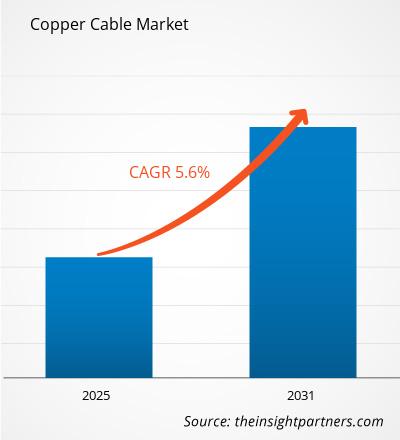
The global Copper Cable market was valued at US$ 248.71 billion in 2025 and is expected to reach US$ 317.75 billion by 2034; it is estimated to record a CAGR of 2.76% during 2026-2034.
Copper Cable Market Assessment and Insights
- North America accounted for 17–19% share in 2025 and is projected to grow at a CAGR range of 2.8–3.2% during 2026–2034, led by grid resilience, data centers, and building electrification.
- US represented 78–82% of North America in 2025 and is expected to grow at a CAGR range of 2.9–3.3% during 2026–2034.
- Europe held 19–22% share in 2025 and is forecast to grow at a CAGR range of 2.6–3.0%, with Germany, the UK, France, Italy, and Spain leading demand.
- Asia Pacific captured 43–46% share in 2025 and is projected to grow at a CAGR range of 3.4–3.9%, supported by China, India, Japan, South Korea, and Australia.
- Largest Segment Power Distribution held 31–34% market share in 2025, with a CAGR range of 3.2–3.6% during 2026–2034, driven by transmission and distribution upgrades.
- High Growth Segment Communications Wire held 14–17% market share in 2025, with a CAGR range of 3.8–4.3% during 2026–2034, reflecting broadband, enterprise network, and data infrastructure demand.
- Key companies analyzed in detail: Aberdare Cables Pty Ltd, CommScope Holding Company, Inc., Proterial, Ltd., Nexans S.A., General Cable Technologies Corporation, Belden Inc., Elcowire Group AB, Schneider Electric SE, Southwire Company, LLC, Siemens AG.
Source: The Insight Partners' analysis based on proprietary research, government publications, company annual reports, investor presentations, industry databases, and expert interviews.
Trends in production have now changed to include increased throughput in extrusion, tight tolerances in insulation, and improved scrap recycling due to the volatile nature of copper price levels. The has likewise moved away from the commodity production of cables to production of application-specific cables such as those used in smart buildings, renewable energy interconnects, industrial automation, and secure communication links. Manufacturers would need to balance obtaining pure copper and rapid delivery times while end-users such as utilities and contractors would favor low-risk installation cables.
Electrification initiatives in countries such as India, Southeast Asia, Gulf states, and certain regions in Africa will drive future demand growth, since these areas require new conductor capacities in order to address losses and increase load capacities in their urban settings. Favorable regulatory tailwinds on building safety regulations, access to renewable energy grids, and local manufacturing are expected to underpin long-cycle purchases.
Copper Cable Market Report Scope
| Report Attribute | Details |
|---|---|
| Market size in 2025 | US$ 248.71 Billion |
| Market Size by 2034 | US$ 317.75 Billion |
| Global CAGR (2026 - 2034) | 2.76% |
| Historical Data | 2021-2024 |
| Forecast period | 2026-2034 |
Copper Cable Market Analysis
Growth drivers of Copper Cable Market are increasing energy consumption, deteriorating network infrastructure, and requirement of dependable conductors in building wires, power distribution, automotive wires, communication wires, and appliance wires. There is replacement of overloaded lines by utilities, along with undergrounding programs. Commercial building contractors need wiring that is compliant with the code for HVAC, lighting, elevators, and security systems.
Participants of the ecosystem are copper mining companies, rod producers, compounders, cable producers, distributors, electrical contractors, original equipment manufacturers (OEMs), and utility companies. The factors that impact the dynamics of the supply chain are availability of copper cathodes, logistics costs, cost of insulation resin, and regional certification. Customers increasingly value predictable lead times, traceability, and support, which makes the role of integrated suppliers stronger and limits the potential of low specification imported products.
In Copper Cable Market report, competitive environment is assessed according to three dimensions: scale, depth of certification, and specialization in downstream end-uses. Nexans S.A., Southwire Company, LLC, Belden Inc., CommScope Holding Company, Inc., Schneider Electric SE, Siemens AG, Elcowire Group AB, Aberdare Cables Pty Ltd, Proterial, Ltd., and General Cable Technologies Corporation are the main players in different but overlapping demand niches.
The investment trend is towards low voltage manufacturing capacity, data cable infrastructure, medium voltage utility products, recycling, and digital quality control. The strategic factors of success are closeness to construction markets, utility agreements, and approval processes. Companies with wide distribution and good practice of copper procurement are more resilient to price volatility and serve contractors, telecoms, appliance OEMs, and automobile manufacturers.
● REPORT CUSTOMIZATION
Tailor This Report To Align With Your Specific Business Requirements
This report can be customized to align precisely with your business objectives, scope, and target markets. Customization options include tailored segmentation, geography, competitive analysis, and strategic insights to support informed decision-making.
Customize This Report →WHAT YOU CAN ADJUST
- ● Segmentations
- ● Geography
- ● Competitive Analysis
- ● Language Preferences
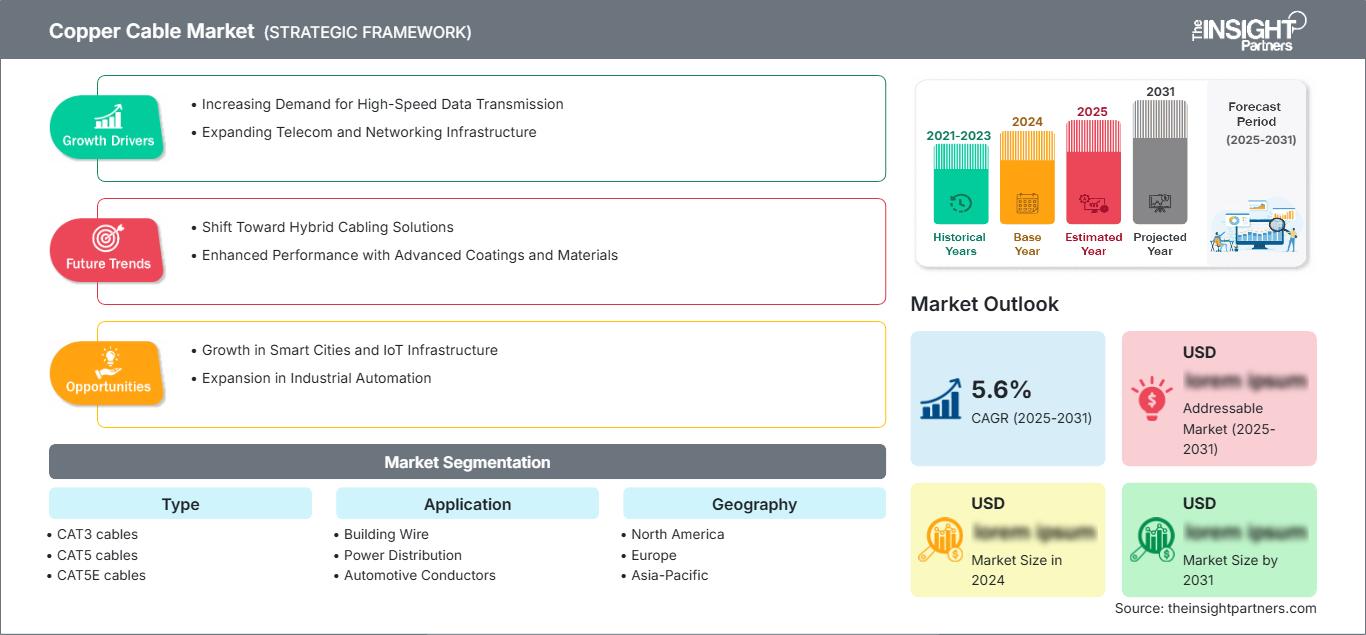
Copper Cable Market: Strategic Insights
Regional Insights
North America Copper Cable Market
North America accounted for 17–19% share in 2025, with a CAGR range of 2.8–3.2% during 2026–2034. Grid modernization, industrial reshoring, data center construction, and building code upgrades remain the main structural drivers. The Copper Cable Market share in this region is supported by high replacement demand rather than only new construction.
Utility spending is concentrated on resilience against storms, undergrounding, and distribution automation, while cable manufacturers are increasingly using more flame-retardant cables that are easy to handle. Communication wire demand gets a boost due to corporate networks and broadband extension. Canada and Mexico get their share due to their industrial applications, automotive wiring, and interconnection of renewables, but the U.S. dictates the rules.
U.S. Copper Cable Market
In 2025, the United States accounted for 78–82% share in the North American region and is estimated to have a CAGR of 2.9–3.3% between 2026 and 2034. Its demand will depend on commercial construction, utility distribution, plant electrification, and data networks. The following companies have established themselves in the market: Southwire Company, LLC, Belden Inc., CommScope Holding Company, Inc., Siemens AG, and Schneider Electric SE.
Demand for building wire, low-voltage power distribution, industrial control cable, and communication wire is increasing. There is an increased demand for copper conductor in data centers and manufacturing plants, where uptime and heat management are important. Copper conductor in automotive is benefiting from electric vehicles, battery charging systems, and electronics in automobiles.
Europe Copper Cable Market
Share of Europe was estimated at 19–22% in 2025 with a projected CAGR of 2.6–3.0%. Germany has a dominant market position because of industrial automation, electricity grid upgrading, and renewable energy penetration. In the UK, steady demand is ensured by projects related to offshore wind farms, property renovations, railways electrification, and development of data centers that require copper wires with certifications.
Additional demand for copper conductors will come from France, Italy, and Spain due to distribution network improvements, manufacturing of appliances, constructions reconstruction, and installation of solar power systems. European consumers value fire safety, recycling opportunities, and compliance with the standards of low smoke and halogen-free cables. Beneficiaries of regional certification process and good consumer relationships are Nexans S.A., Siemens AG, Schneider Electric SE, Elcowire Group AB, and Belden Inc.
APAC Copper Cable Market
The APAC region held 43-46% market share in 2025 and is forecast to register a CAGR of 3.4-3.9%. China is the major country, owing to investments in grid construction, automation of factories, urbanization, and renewable energy. India is positioned second due to distribution upgrades, electric railways, and residential wiring needs.
Japan and South Korea promote specialty copper wires and cables used in electronics, cars, and machinery, while Australia also boosts mining, utilities, and infrastructure projects. Governmental encouragement for local manufacturing and energy interconnectivity supports the growth. The Market operates on economies of scale, however, the trend of quality differentiation emerges among customers.
Middle East & Africa Copper Cable Market
Middle East & Africa is expected to grow at a CAGR range of 3.0–3.5% during 2026–2034, with Saudi Arabia leading demand. Mega projects, grid expansion, desalination, oil and gas electrification, and utility interconnections support copper cable consumption across the Gulf.
The UAE contributes through commercial buildings, data centers, and transport infrastructure, while South Africa requires distribution reliability and industrial replacement. Rest of MEA demand remains project-led, especially in energy corridors and urban infrastructure. Suppliers with local approvals, heat-resistant insulation, and distributor networks are positioned to capture opportunities.
Segmentation Analysis
Type
The Type segment is expected to grow at a CAGR range of 3.0–3.4% during 2026–2034. Copper Cable Market scope across CAT3 cables, CAT5 cables, CAT5E cables, CAT6 cables, CAT6A cables, CAT7 cables, and CAT8 cables reflects a mix of legacy replacement and high-speed network upgrades. Demand is moving toward higher-category cabling as enterprise, industrial, and data-intensive facilities require bandwidth reliability.
- CAT3 cables remain relevant in limited voice, alarm, and legacy control applications where low data requirements and installed-base compatibility matter more than bandwidth expansion.
- CAT5 cables are largely replacement-oriented, serving cost-sensitive networks and older commercial buildings that require basic connectivity without major infrastructure redesign.
- CAT5E cables continue to serve small offices, retail spaces, and moderate-speed networks, balancing affordability, installation familiarity, and acceptable performance for standard Ethernet use.
- CAT6 cables hold strong demand in offices, campuses, and industrial facilities because they support higher data rates, lower crosstalk, and longer service lives.
- CAT6A cables gain strategic importance in data centers, healthcare, education, and smart buildings where 10-gigabit performance and shielding resilience are increasingly required.
- CAT7 cables address specialized installations needing enhanced shielding and stable high-frequency transmission, particularly where electromagnetic interference risks are materially higher.
- CAT8 cables serve short-reach, high-speed data center links where copper remains viable for low-latency connectivity and controlled installation environments.
Application
The Application segment is expected to grow at a CAGR range of 3.1–3.6% during 2026–2034. Building wire and power distribution account for large installed demand, while automotive conductors and communications wire add technology-led momentum. Appliance conductor demand is steadier, linked to housing cycles and manufacturing output. The Market remains application-diverse, reducing dependence on any single end-use vertical.
- Building Wire is supported by residential, commercial, and institutional construction, with safety codes and renovation cycles sustaining demand for reliable insulated copper conductors.
- Power Distribution is the largest application, reflecting utility feeder upgrades, industrial power networks, renewable interconnections, and resilient underground distribution projects.
- Automotive Conductors benefit from higher electrical content in vehicles, electric drivetrains, battery systems, charging equipment, and advanced safety or infotainment systems.
- Communications Wire grows with broadband extensions, enterprise connectivity, industrial Ethernet, data centers, and smart building networks requiring stable signal transmission.
- Appliance Conductor demand follows household appliance production, energy-efficient motors, heating components, and compact wiring needs in connected devices.
Opportunity Snapshot
| Application | Revenue Contribution | Trend Tag | Adoption Stage |
| Building Wire | High | Code Upgrade | Mature |
| Power Distribution | High | Grid Renewal | Scaling |
| Automotive Conductors | Medium | EV Wiring | Scaling |
| Communications Wire | Medium | Data Links | Scaling |
| Appliance Conductor | Medium | Smart Appliances | Mature |
| Others | Low | Specialty Use | Emerging |
Copper Cable Market Growth Drivers and Impact Analysis
Grid Modernization and Distribution Reliability
Utilities are prioritizing distribution reliability because electrification is raising peak loads in buildings, transport, and industrial sites. Copper conductors remain critical in feeders, substations, transformers, and underground circuits where low resistance and thermal performance reduce losses. The real-world impact is longer order visibility for medium-voltage and low-voltage cable suppliers, especially where storm hardening and grid automation are funded through multi-year capital plans. This driver also improves demand stability, because replacement cycles continue even when new construction slows.
Building Electrification and Safety Code Compliance
Commercial and residential buildings are using more electrical capacity for heat pumps, charging points, digital controls, elevators, lighting, and security systems. Building wire demand rises when codes require safer insulation, better flame performance, and clearer traceability. Contractors prefer copper because it supports predictable installation, high conductivity, and compatibility with established electrical systems. The Market benefits as renovation and retrofit projects add demand beyond new floor-space creation, making building wire a resilient application through varied real estate cycles.
Data Connectivity and Industrial Automation
Enterprises, factories, hospitals, logistics hubs, and campuses are upgrading networks to support sensors, access control, industrial Ethernet, edge computing, and high-density data traffic. Copper communications cables remain relevant where short-distance performance, cost control, power-over-Ethernet capability, and installation familiarity are important. The market impact is a shift from basic cabling toward CAT6A, CAT7, and CAT8 products in demanding environments. Suppliers with tested performance, shielding expertise, and channel partnerships are positioned to capture premium demand.
Copper Cable Market Future Trends
Higher-Category Copper Data Cabling
Copper Cable Market trends point toward higher-category data cabling as organizations combine cloud access, on-site analytics, security devices, and building automation. CAT6A will remain a practical standard for many commercial sites, while CAT8 will expand in short-run data center links where copper supports low latency and fast deployment. The future opportunity is not only speed, but verified performance under interference, heat, and dense cable tray conditions. Suppliers that pair product testing with installer training can reduce rework and strengthen specification influence.
Circular Copper and Low-Carbon Supply Chains
Procurement teams are expected to request more evidence on recycled content, energy use, and responsible sourcing as infrastructure owners align with carbon reduction targets. Copper is highly recyclable without losing conductivity, which supports circular procurement models for cable scrap, rod production, and manufacturing waste. Over the forecast period, suppliers may differentiate through closed-loop programs, product passports, and lower-carbon inputs. The trend will not replace performance requirements, but it will increasingly influence tenders in Europe, North America, and large corporate projects.
Copper Cable Market Opportunities
Utility Framework Agreements in Emerging Grids
Emerging economies need conductor capacity for urban feeders, rural electrification, renewable evacuation, and industrial corridors. Copper Cable Market Forecasts indicate that suppliers can capture value by pursuing utility framework agreements rather than only spot project tenders. This approach supports predictable production planning, localized inventories, and technical standardization. Manufacturers should prioritize certified medium-voltage and low-voltage ranges, heat-resistant insulation, and after-sales engineering support. Partnerships with EPC firms and distributors can improve access to publicly funded infrastructure while reducing execution risk in geographically dispersed networks.
Specialized Cables for Data Centers and Smart Buildings
Data centers, hospitals, airports, campuses, and high-rise commercial assets require dense wiring systems that combine power, control, monitoring, and communications. This creates opportunities for premium copper cables with stronger shielding, fire performance, identification features, and installation efficiency. Suppliers can improve margins by offering bundled specifications, pre-engineered cable schedules, and contractor training. The opportunity is strongest where downtime costs are high and owners prefer proven copper solutions for short-reach connectivity, safety-critical systems, and reliable power distribution.
Recent Developments
- May 2025: Dynamic Cables announced plans to strengthen its manufacturing capabilities and expand its product portfolio to address rising demand from the power transmission, distribution, and renewable energy sectors. The company is also focusing on export growth and capacity expansion to support long-term infrastructure development.
- May 2025: Molex launched its ImPress Co-Packaged Copper (CPC) solutions to enable high-speed near-ASIC connectivity for next-generation AI data centres. The new copper interconnects support higher data rates, lower power consumption, and improved signal integrity, helping hyperscalers scale AI infrastructure more efficiently.
- May 2025: Marvell expanded its connectivity portfolio with Active Copper Cable (ACC) Linear Equalizers, designed to extend the reach and performance of high-speed copper interconnects in AI and cloud data centres. The solution delivers improved signal quality, reduced power consumption, and a cost-effective alternative to optical links for short-reach networking.
Frequently Asked Questions

- Comprehensive Market Sizing and Forecast Analysis
- Detailed Segmentation Analysis
- In-Depth Market Dynamics Assessment
- Regional and Country-Level Insights
- Competitive Landscape and Company Benchmarking
- Strategic Business Intelligence
Recent Reports
Testimonials

The Insight Partners' SCADA System Market report is comprehensive, with valuable insights on current trends and future forecasts. The team was highly professional, responsive, and supportive throughout. We are very satisfied and highly recommend their services.
RAN KEDEM Partner, Reali Technologies LTDs
I requested a report on a very specific software market and the team produced the report in a few days. The information was very relevant and well presented. I then requested some changes and additions to the report. The team was again very responsive and I got the final report in less than a week.
JEAN-HERVE JENN Chairman, Future Analytica
We worked with The Insight Partners for an important market study and forecast. They gave us clear insights into opportunities and risks, which helped shape our plans. Their research was easy to use and based on solid data. It helped us make smart, confident decisions. We highly recommend them.
PIYUSH NAGPAL Sr. Vice President, High Beam Global
The Insight Partners delivered insightful, well-structured market research with strong domain expertise. Their team was professional and responsive throughout. The user-friendly website made accessing industry reports seamless. We highly recommend them for reliable, high-quality research services
YUKIHIKO ADACHI CEO, Deep Blue, LLC.
This is the first time I have purchased a market report from The Insight Partners.While I was unsure at first, I visited their web site and felt more comfortable to take the risk and purchase a market report.I am completely satisfied with the quality of the report and customer service. I had several questions and comments with the initial report, but after a couple of dialogs over email with their analyst I believe I have a report that I can use as input to our strategic planning process.Thank you so much for taking the extra time and making this a positive experience.I will definitely recommend your service to others and you will be my first call when we need further market data.
JOHN SUZUKI President and Chief Executive Officer, Board Director, BK Technologies
I wish to appreciate your support and the professionalism you displayed in the course of attending to my request for information regarding to infectious disease IVD market in Nigeria. I appreciate your patience, your guidance, and the fact that you were willing to offer a discount, which eventually made it possible for us to close a deal. I look forward to engaging The Insight Partners in the future, all thanks to the impression you have created in me as a result of this first encounter.
DR CHIJIOKE ONYIA MANAGING DIRECTOR, PineCrest Healthcare Ltd.Reason to Buy
- Informed Decision-Making
- Understanding Market Dynamics
- Competitive Analysis
- Identifying Emerging Markets
- Customer Insights
- Market Forecasts
- Risk Mitigation
- Boosting Operational Efficiency
- Strategic Planning
- Investment Justification
- Tracking Industry Innovations
- Aligning with Regulatory Trends





 Get Free Sample for