
Crystal Oscillator Market Size, Trends & Demand by 2034
Coverage: By Type (Frequency-Controlled Crystal Oscillator, Temperature-Compensated Crystal Oscillator, Simple Packaged Crystal Oscillator, Oven-Controlled Crystal Oscillator, Others); Mounting Scheme (Thru-hole, Surface Mount); Application (Research and Measurement, Medical Equipment, Telecom and Networking, Consumer Electronics, Aerospace, Others); Geography () , and Geography (North America, Europe, Asia Pacific, and South and Central America)
- Status : Data Released
- Report Code : TIPRE00004641
- Category : Electronics and Semiconductor
- No. of Pages : 150
- Available Report Formats :


- Last update date : August 04, 2026


2025 Market Size
US$ 3.03 Bn
Base year value
2034 Forecast
US$ 4.48 Bn
Projected by 2034
CAGR 2026-2034
4.43 %
Growth rate
Addressable Market
US$ 34.08 Bn
(2026-2034)
The Crystal Oscillator Market size stood at US$ 3.03 Billion in 2025 and is forecast to attain US$ 4.48 Billion by 2034, registering a CAGR of 4.43% during 2026-2034. There has been an expansion in the market owing to the increasing necessity of exact frequency regulation in telecom synchronization, consumer electronics, medical instruments, space navigation, and research tools.
The growth in demand across North America is anticipated to record CAGR of 4.1–4.8% owing to growing needs for low-jitter timing devices in 5G network densification, defense electronics, medical devices, and cloud computing. The Crystal Oscillator Market gets strength from the increasing use of surface-mounts, better temperature stability, and dependable supply to aerospace, networking, and measurement devices.
Crystal Oscillator Market Assessment and Insights
- North America held 24–27% share in 2025 and is growing at a CAGR of 4.1–4.8% during 2026–2034, supported by telecom upgrades, aerospace electronics, and medical equipment demand.
- US represented 78–82% of North America in 2025 and is growing at a CAGR of 4.2–4.9%, led by defense, networking, and semiconductor design activity.
- Europe accounted for 18–21% share in 2025 and is advancing at a CAGR of 3.7–4.4%, with Germany, the UK, France, Italy, and Spain leading demand.
- Asia Pacific captured 43–47% share in 2025 and is expanding at a CAGR of 4.8–5.5%, led by China, Japan, South Korea, India, and Taiwan electronics ecosystems.
- Largest Segment Surface Mount held 72–76% market share in 2025 and is growing at a CAGR of 4.6–5.2%, supported by miniaturized electronics and automated assembly.
- High Growth Segment Temperature-Compensated Crystal Oscillator held 24–28% market share in 2025 and is growing at a CAGR of 5.0–5.7%, driven by 5G, GNSS, and mobile devices.
- Key companies analyzed in detail: Daishinku Corp., Hosonic Technology (Group) Co., Ltd., KYOCERA Corporation, Murata Manufacturing Co., Ltd., MERCURY Electronic Ind. Co., Ltd., River Eletec Corporation, Rakon Limited, Seiko Epson Corporation, TXC Corporation, and Microchip Technology Inc.
Source: The Insight Partners' analysis based on proprietary research, government publications, company annual reports, investor presentations, industry databases, and expert interviews.
The technology of frequency control will progress from conventional quartz clocks to small, temperature-insensitive, and low-noise units compatible with high-speed communication systems. In terms of production, the dynamics will involve an integration of Japanese precision, Taiwanese packaging expertise, and Chinese electronics consumption needs. The Crystal Oscillator Market will be impacted by this change, due to tight tolerance, miniature size, and reliability needs of telecommunications, automotive, aircraft, and medical customers.
Prospects of demand growth will be affected by new electronics manufacturing centers, private 5G communications systems, satellite communications, precision medical instrumentation, and AI data processing. Funding will go towards SMT lines, automotive parts qualification, low-power frequency control solutions, and high-frequency crystals. Regulations regarding the radio synchronization, reliability of medical devices, and safety of flights will stimulate suppliers with proven performance and reliable production capacity.
Crystal Oscillator Market Report Scope
| Report Attribute | Details |
|---|---|
| Market size in 2025 | US$ 3.03 Billion |
| Market Size by 2034 | US$ 4.48 Billion |
| Global CAGR (2026 - 2034) | 4.43% |
| Historical Data | 2021-2024 |
| Forecast period | 2026-2034 |
Crystal Oscillator Market Analysis
The market growth is based on the development of wireless infrastructures, connecting consumer products, automation industry requirements, and aerospace timing needs. Base stations for 5G networks, global navigation satellite systems modules, smart meters, wearables, and network switches need stable oscillators to stay synchronized and minimize any drift. Growth drivers include medical imaging and monitoring, and laboratory instruments in which repeatable measurements rely on precision frequencies.
Quartz blanks production, packaging, integration with ICs, testing, logistics, and product qualification on equipment level are included in the value chain. Supply chain is based on pure quartz crystals, ceramic packaging, CMOS-based circuitry, temperature compensation techniques, and surface-mount technology automation. End users increasingly take into consideration jitter performance, aging rate, temperature range, lead time, and lifecycle availability due to critical functions of oscillators.
The Crystal Oscillator market competition is taking place between Japanese suppliers of precision crystal oscillator, Taiwanese suppliers of scale crystal oscillator and high-reliability specific suppliers. Competing in frequency stability, package miniaturization and applications certification are the following suppliers: Seiko Epson Corporation, KYOCERA Corporation, Murata Manufacturing Co., Ltd., Daishinku Corp., TXC Corporation, Rakon Limited, River Eletec Corporation, Hosonic Technology (Group) Co., Ltd., MERCURY Electronic Ind. Co., Ltd., Microchip Technology Inc.
Positioning strategy changes towards higher frequency, lower phase noise and temperature stable products portfolio. The investments into development of TCXO, OCXO, SPXO and application-specific oscillators for telecom, aerospace, medical and consumer electronics applications are being made. The procurement departments are also seeking diversification of supplies due to instability of semiconductor components supply chain.
● REPORT CUSTOMIZATION
Tailor This Report To Align With Your Specific Business Requirements
This report can be customized to align precisely with your business objectives, scope, and target markets. Customization options include tailored segmentation, geography, competitive analysis, and strategic insights to support informed decision-making.
Customize This Report →WHAT YOU CAN ADJUST
- ● Segmentations
- ● Geography
- ● Competitive Analysis
- ● Language Preferences
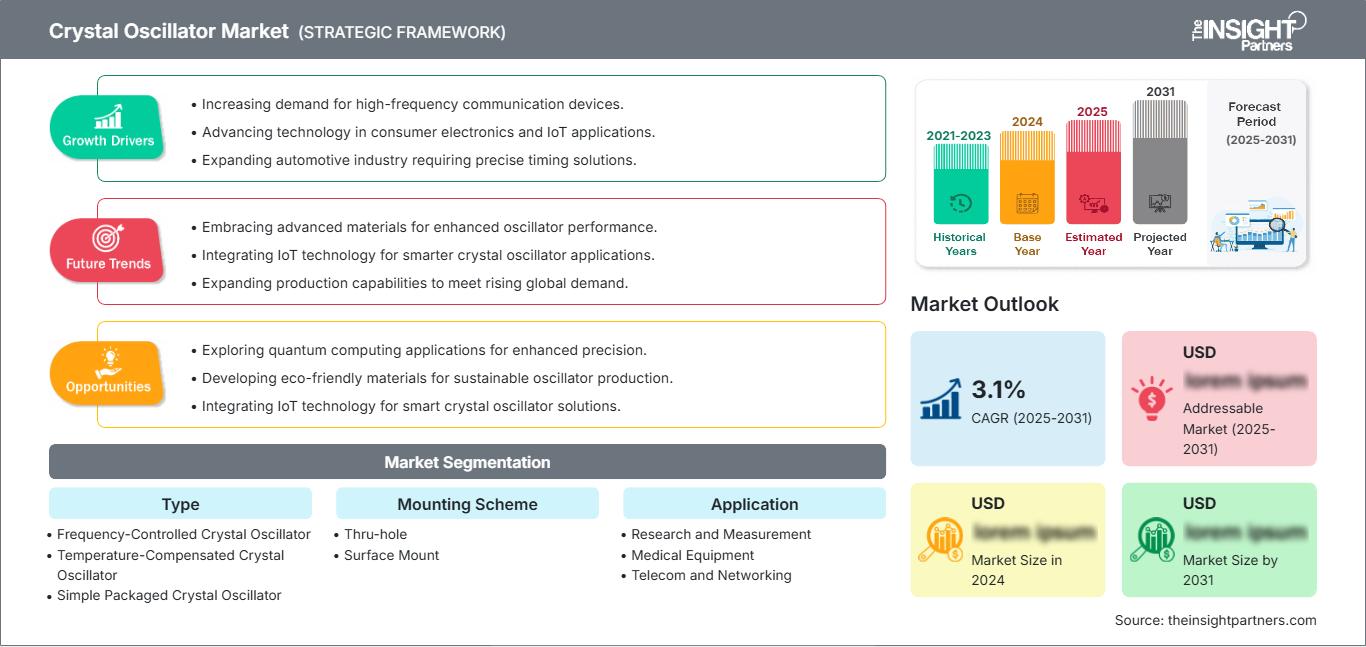
Crystal Oscillator Market: Strategic Insights
Regional Insights
North America Crystal Oscillator Market
The North America segment had a 24-27% market share in 2025 and is expected to have a CAGR of 4.1-4.8% from 2025-2034. Factors driving the Crystal Oscillator Market share include modernization of telecommunications network infrastructure, development of aerospace and defense electronics, manufacturing of medical devices, and test-and-measurement application requirements.
High demand is in the United States since equipment designers prefer low-jitter TCXOs and OCXOs for networking, defense communication, and precision measurement applications. The Canadian market supports the regional growth through telecom, aerospace, and industrial automation segments. Buyers in North America focus on reliability, documentation, and availability due to costly qualification process and risk of component redesign.
U.S. Crystal Oscillator Market Market
North America is estimated to be comprised of 78-82% share in the U.S., which is expected to witness a growth of 4.2-4.9% CAGR during 2025. Applications include telecom and network systems, defense platform applications, aerospace navigation, medical instruments and equipment, and research instrumentation. Microchip Technology Inc. retains its domestic timing knowledge, while other international manufacturers cater to U.S. design wins with distribution and application engineering support.
Key applications include telecom and network systems, which use high-performance oscillators for synchronization and phase-noise management, as well as medical and aerospace applications that stress qualification stability. Surface mount components dominate new designs due to the benefits offered by automation, such as reduced board area and lower costs.
Europe Crystal Oscillator Market Market
Europe was accounting for 18-21% share in 2025, expected to have a CAGR of 3.7-4.4%. Germany dominates with its automotive electronics, industrial automation, and test instruments. UK includes aerospace, defense, and satellite communications. France favors avionics and medical electronics, while Italy and Spain are adding through telecom equipment, industrial controls, and consumer electronics manufacturing.
In Europe, there is strong emphasis on compliance, reliability, and lifecycle management. Frequency stability over wide temperature ranges is required for automotive and industrial applications, and phase noise and packaged qualification is required from aerospace manufacturers. Growth in Europe is more stable than APAC but replacement cycles, private networks, and medical electronics present long-term prospects for premium oscillators.
APAC Crystal Oscillator Market Market
Asia Pacific was estimated to account for 43-47% market share in 2025 and would register a CAGR of 4.8-5.5% from 2021 to 2025. China drives the demand through use in smartphones, networking, IoT modules, and consumer electronic manufacturing applications whereas Japan maintains importance through the use of precision quartz technology. Korea, India, Taiwan, and Australia will further drive the demand through electronics, telecommunications, aerospace, and medical devices.
Government policies encouraging semiconductors localization, 5G rollouts, and electronics export will increase adoption. Larger regional scale will lead to preference for surface mount oscillators whereas the demand for more expensive TCXO and OCXO will increase owing to RF modules, base stations, GNSS devices, and data center applications.
Middle East & Africa Crystal Oscillator Market Market
Middle East & Africa is projected to grow at a CAGR of 3.9–4.6% as Saudi Arabia, the UAE, South Africa, and the rest of MEA invest in telecom networks, defense electronics, aviation, medical equipment, and energy infrastructure. The UAE leads regional electronics import demand, while Saudi Arabia expands digital and industrial programs.
Harsh operating environments increase demand for temperature-stable oscillators in outdoor telecom, aerospace, and energy monitoring systems. Adoption depends on equipment imports, distributor availability, and system-level qualification. Growth is smaller than APAC or North America, but infrastructure modernization creates steady demand for reliable timing components.
Segmentation Analysis
Type
Type is expected to grow at a CAGR of 4.2–4.9% from 2026 to 2034 as the Crystal Oscillator Market scope spans standard timing, temperature correction, oven-controlled precision, and frequency-control designs. Product selection depends on phase noise, stability, current consumption, package size, and qualification needs across telecom, medical, aerospace, and consumer systems.
- Frequency-Controlled Crystal Oscillator supports stable timing in communication modules and instruments where frequency tuning, compact design, and dependable signal output are important for equipment synchronization.
- Temperature-Compensated Crystal Oscillator is strategically important for mobile, GNSS, and networking devices because compensation circuits maintain accuracy under changing thermal conditions.
- Simple Packaged Crystal Oscillator serves high-volume electronics that need low-cost, reliable clock generation for consumer devices, computing peripherals, and industrial control boards.
- Oven-Controlled Crystal Oscillator targets premium timing applications in base stations, aerospace, test equipment, and synchronization systems requiring exceptional stability and low phase noise.
Mounting Scheme
Mounting Scheme is projected to grow at a CAGR of 4.4–5.0% during 2026–2034 as manufacturers shift toward compact board layouts and automated assembly. Surface-mount devices dominate new electronics, while thru-hole components remain relevant in legacy equipment, harsh environments, repairable systems, and applications requiring mechanical robustness.
- Thru-hole remains useful in industrial, aerospace, and legacy equipment where mechanical strength, serviceability, and established qualification records outweigh the need for miniaturized circuit boards.
- Surface Mount leads volume demand because smartphones, IoT modules, networking equipment, and medical devices require compact timing components compatible with high-speed automated placement.
Application
Application is expected to grow at a CAGR of 4.3–5.0% from 2026 to 2034 as timing demand expands across measurement, healthcare, telecom, consumer electronics, and aerospace. Telecom and networking generate high precision requirements, while consumer devices drive scale. Medical and aerospace users add value through qualification, reliability, and extended lifecycle needs.
- Research and Measurement applications require stable oscillators for analyzers, counters, reference instruments, and laboratory systems where measurement repeatability depends on accurate frequency control.
- Medical Equipment uses crystal oscillators in imaging, monitoring, diagnostics, and portable devices that need reliable timing, compact packages, and consistent operation across regulated use environments.
- Telecom and Networking is strategically critical because base stations, routers, switches, optical modules, and synchronization equipment require low-jitter timing to preserve signal integrity.
- Consumer Electronics drives high-volume shipments through smartphones, wearables, laptops, gaming devices, cameras, and wireless modules requiring compact, low-power clock sources.
- Aerospace uses qualified oscillators in navigation, communications, avionics, satellites, and defense electronics where temperature range, vibration tolerance, and long-term stability are essential.
Opportunity Snapshot
Market Opportunity Snapshot
| Application | Revenue Contribution | Trend Tag | Adoption Stage |
| Research and Measurement | Medium | Precision Labs | Mature |
| Medical Equipment | Medium | Portable Care | Scaling |
| Telecom and Networking | High | 5G Timing | Scaling |
| Consumer Electronics | High | Mini Devices | Mature |
| Aerospace | Medium | Mission Timing | Scaling |
Crystal Oscillator Market Growth Drivers and Impact Analysis
5G Synchronization Raises Demand for Low-Jitter Timing
Telecom infrastructure is increasing demand for crystal oscillators with tighter phase-noise and frequency-stability performance. 5G radio units, small cells, transport networks, and optical modules require precise timing to reduce packet errors and maintain low-latency connectivity. This shifts procurement toward TCXO and OCXO devices rather than basic clock sources in performance-critical nodes. The real-world market impact is higher value per unit in networking applications, stronger qualification requirements, and closer collaboration between oscillator suppliers and RF equipment designers. Vendors with stable output options, compact packages, and proven thermal performance can capture design wins as operators densify networks and expand private 5G deployments.
Miniaturized Electronics Expand Surface-Mount Adoption
Consumer electronics, wearables, medical devices, and IoT modules continue to reduce board area while adding wireless connectivity and sensors. That design direction increases use of compact surface-mount oscillators that support automated assembly, low current consumption, and stable clock generation. The market impact is volume growth for miniature SPXO and TCXO products, especially in devices requiring Bluetooth, Wi-Fi, GNSS, cellular, or sensor synchronization. Suppliers must balance footprint reduction with frequency stability because smaller packages can intensify thermal and mechanical design challenges. Companies able to provide broad frequency ranges, documentation, and high-volume consistency gain stronger positions with electronics manufacturers.
Aerospace and Medical Systems Reinforce Premium Reliability
Aerospace, defense, and medical equipment applications support demand for higher-reliability oscillators because timing failure can affect navigation, communication, diagnostics, or patient monitoring. These sectors require extended-temperature operation, tighter aging limits, low phase noise, and documented qualification. The impact is a resilient premium segment that is less exposed to consumer electronics price pressure. Suppliers with application engineering, traceability, and long lifecycle support can protect margins even when high-volume devices face commoditization. As satellite communications, avionics upgrades, portable medical systems, and diagnostic equipment expand, qualified crystal oscillators remain essential timing components in regulated and mission-critical electronics.
Crystal Oscillator Market Future Trends
Temperature-Stable Timing Becomes Mainstream in Connected Devices
Crystal Oscillator Market trends will increasingly reflect the movement of temperature-compensated timing from premium telecom and GNSS devices into broader connected electronics. Wearables, asset trackers, industrial sensors, vehicle modules, and portable medical devices must operate across variable temperature conditions while preserving battery life. This trend will favor compact TCXO designs with lower current draw, better aging behavior, and simplified integration. Suppliers that can provide qualified miniature packages and application support will reduce design risk for device makers. Standard oscillators will remain important for low-cost electronics, but the value pool will increasingly move toward compensated timing in connected products.
High-Frequency, Low-Noise Designs Support Data Infrastructure
Data infrastructure will require oscillators that support faster interfaces, optical networking, synchronization, and lower jitter budgets. As cloud, AI, and edge computing architectures expand, timing components must maintain signal integrity across switches, transceivers, servers, and timing modules. This trend supports investment in high-frequency crystal devices, advanced packaging, and improved test capability. It also encourages closer coordination between oscillator suppliers, semiconductor vendors, and network equipment manufacturers. The market will reward companies that deliver repeatable performance at scale, because data equipment designers need timing devices that meet both electrical specifications and long-term supply commitments.
Crystal Oscillator Market Opportunities
Qualified Timing Platforms for Telecom and Aerospace Programs
Crystal Oscillator Market Forecasts support investment in qualified timing platforms that can serve telecom, aerospace, defense, and satellite communications with shared performance architectures. Suppliers can create opportunity by offering families of TCXO, OCXO, and SPXO products with common footprints, documented aging performance, and extended-temperature options. This approach reduces redesign work for customers and supports multi-year equipment programs. The opportunity is strongest where buyers value lifecycle continuity, traceability, and technical support over unit price alone. Manufacturers that align quality systems with regulated electronics and provide regional support can build durable positions in higher-margin applications.
Localized Supply and Dual-Sourcing Support Electronics Resilience
Electronics manufacturers are reviewing timing-device sourcing after supply disruptions exposed dependence on concentrated quartz processing, packaging, and logistics routes. This creates opportunity for suppliers that can offer regional inventory, second-source compatibility, and transparent capacity planning. Distributors and manufacturers can also collaborate on safety-stock models for medical, aerospace, telecom, and industrial customers. The investment case is not limited to new factories; it includes test automation, quality systems, and application engineering near customer design centers. Companies that reduce qualification risk while improving delivery reliability can win preferred-supplier status even in applications with moderate growth rates.
Recent Developments
- July 2026: Daishinku Corp. the company uploaded its KDS New Wave technical story on thermistor-equipped resonators based on the Arkh structure, highlighting ongoing product engineering around temperature sensing and compact resonator performance for mobile, IoT, automotive, factory automation, and infrastructure applications.
- May 2026: Microchip Technology launched the EX-423 Evacuated Miniature Crystal Oscillator (EMXO), a compact, low-power timing solution designed for applications that demand high stability, accuracy and long-term reliability. Building on the company’s EX-421 portfolio, the EX-423 delivers high RF performance in a low-profile 13 mm x 13 mm package for space- and power-constrained designs.
- January 2026: Kyocera Corporation (President: Hideo Tanimoto) announced that mass production of its "X Series" differential clock crystal oscillators. The new series delivers industry-leading low phase jitter of 30 femtoseconds (fs) and low noise performance.
Frequently Asked Questions

- Comprehensive Market Sizing and Forecast Analysis
- Detailed Segmentation Analysis
- In-Depth Market Dynamics Assessment
- Regional and Country-Level Insights
- Competitive Landscape and Company Benchmarking
- Strategic Business Intelligence
Recent Reports
Testimonials

The Insight Partners' SCADA System Market report is comprehensive, with valuable insights on current trends and future forecasts. The team was highly professional, responsive, and supportive throughout. We are very satisfied and highly recommend their services.
RAN KEDEM Partner, Reali Technologies LTDs
I requested a report on a very specific software market and the team produced the report in a few days. The information was very relevant and well presented. I then requested some changes and additions to the report. The team was again very responsive and I got the final report in less than a week.
JEAN-HERVE JENN Chairman, Future Analytica
We worked with The Insight Partners for an important market study and forecast. They gave us clear insights into opportunities and risks, which helped shape our plans. Their research was easy to use and based on solid data. It helped us make smart, confident decisions. We highly recommend them.
PIYUSH NAGPAL Sr. Vice President, High Beam Global
The Insight Partners delivered insightful, well-structured market research with strong domain expertise. Their team was professional and responsive throughout. The user-friendly website made accessing industry reports seamless. We highly recommend them for reliable, high-quality research services
YUKIHIKO ADACHI CEO, Deep Blue, LLC.
This is the first time I have purchased a market report from The Insight Partners.While I was unsure at first, I visited their web site and felt more comfortable to take the risk and purchase a market report.I am completely satisfied with the quality of the report and customer service. I had several questions and comments with the initial report, but after a couple of dialogs over email with their analyst I believe I have a report that I can use as input to our strategic planning process.Thank you so much for taking the extra time and making this a positive experience.I will definitely recommend your service to others and you will be my first call when we need further market data.
JOHN SUZUKI President and Chief Executive Officer, Board Director, BK Technologies
I wish to appreciate your support and the professionalism you displayed in the course of attending to my request for information regarding to infectious disease IVD market in Nigeria. I appreciate your patience, your guidance, and the fact that you were willing to offer a discount, which eventually made it possible for us to close a deal. I look forward to engaging The Insight Partners in the future, all thanks to the impression you have created in me as a result of this first encounter.
DR CHIJIOKE ONYIA MANAGING DIRECTOR, PineCrest Healthcare Ltd.Reason to Buy
- Informed Decision-Making
- Understanding Market Dynamics
- Competitive Analysis
- Identifying Emerging Markets
- Customer Insights
- Market Forecasts
- Risk Mitigation
- Boosting Operational Efficiency
- Strategic Planning
- Investment Justification
- Tracking Industry Innovations
- Aligning with Regulatory Trends





 Get Free Sample for