
Current Transducer Market Growth, Share & Trends by 2034
Coverage: By Technology (Open loop, Closed Loop); Application (Battery Management, Motor Drive, UPS and SMPS, Converter and Inverter, Others); End User (Industrial, Renewable Energy, Automotive and Transportation, Residential and Commercial, Others) , and Geography (North America, Europe, Asia Pacific, and South and Central America)
- Status : Data Released
- Report Code : TIPRE00008814
- Category : Electronics and Semiconductor
- No. of Pages : 150
- Available Report Formats :


- Last update date : August 04, 2026


2025 Market Size
US$ 771.55 Mn
Base year value
2034 Forecast
US$ 1,002.89 Mn
Projected by 2034
CAGR 2026-2034
2.96 %
Growth rate
Addressable Market
US$ 8,057.13 Mn
(2026-2034)
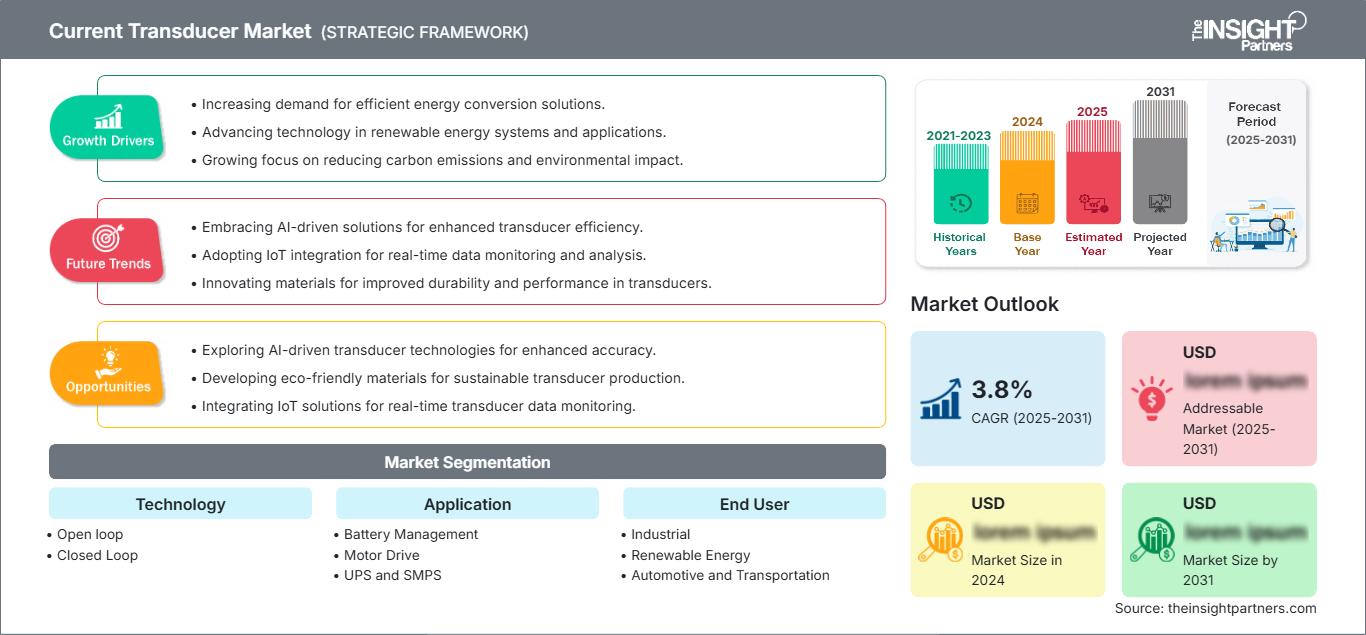
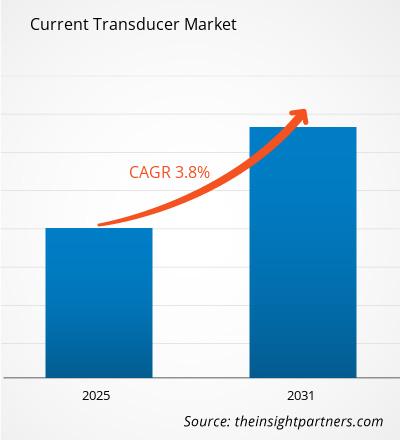
The Current Transducer Market size was US$ 771.55 Million in 2025 and expected to grow to US$ 1,002.89 Million by 2034, growing at a CAGR of 2.96% from 2026 to 2034. Demand for current transducers will be driven by accurate measurement of AC and DC currents within industrial automation applications, battery management, motor drives, UPS and SMPS systems, converters, inverters, renewable energy generation systems, automotive applications, and commercial power-monitoring applications.
North America continues to lead as an advanced technology base for current transducer demand with Current Transducer Market size forecast to be driven by a CAGR of 2.7% to 3.2% in 2026-2034. Growth will be driven by electrified factories, electric vehicle test systems, smart grids, backup power systems in data centers, and power quality monitoring.
Current Transducer Market Assessment and Insights
- North America: The region holds 26–30% share in 2025 and is forecast to grow at a CAGR of 2.7–3.2% during 2026–2034, supported by industrial controls, EV test benches, smart buildings, and grid automation.
- US: The country represents 78–82% of North America in 2025 and is projected to grow at a CAGR of 2.8–3.3% during 2026–2034.
- Europe: Europe accounts for 24–28% share in 2025 and is expected to grow at a CAGR of 2.6–3.1% during 2026–2034, led by Germany, the UK, France, Italy, and Spain.
- Asia Pacific: Asia Pacific represents 36–40% share in 2025 and is forecast to grow at a CAGR of 3.2–3.8% during 2026–2034, with China, Japan, South Korea, India, and Australia driving adoption.
- Largest Segment: Industrial holds 40–44% market share in 2025 and is expected to grow at a CAGR of 2.7–3.3% during 2026–2034.
- High Growth Segment: Battery Management holds 14–18% market share in 2025 and is expected to grow at a CAGR of 3.6–4.2% during 2026–2034.
- Key companies analyzed in detail: ABB Ltd.; American Aerospace Controls, Inc.; Howard Butler Ltd.; Johnson Controls International plc; NK Technologies; Ohio Semitronics, Inc.; Siemens AG; Texas Instruments Incorporated; Topstek Inc.; Veris Industries; LEM International SA.
Source: The Insight Partners' analysis based on proprietary research, government publications, company annual reports, investor presentations, industry databases, and expert interviews.
Measurement of power has evolved from simple panel indicators to embedded sensors within drive systems, inverters, battery racks, chargers, and automation machines. Open-loop Hall sensors are preferred where there is an emphasis on cost and size savings, whereas closed-loop sensors have applications in high-precision industrial processes, rail transport, and power conversion systems. The Current Transducer Market trends include smaller sensor packaging, wider temperature ranges, faster speed, and compatibility with digital monitoring systems.
Future requirements will be driven by renewable energy, EV battery testing, plant automation, and power quality standards. New markets will be integrating inverters, chargers, and energy storage systems that need accurate measurement of current. There is a growing focus on isolation, minimal drift in electronics, standard output signals, and application-based current transducers.
Current Transducer Market Report Scope
| Report Attribute | Details |
|---|---|
| Market size in 2025 | US$ 771.55 Million |
| Market Size by 2034 | US$ 1,002.89 Million |
| Global CAGR (2026 - 2034) | 2.96% |
| Historical Data | 2021-2024 |
| Forecast period | 2026-2034 |
Current Transducer Market Analysis
Demand is based on equipment safety, system integrity, and efficiency in use of energy. The Growth of the Current Transducer Market is greatest where drives, converters, and batteries need to have isolated feedback for control purposes. Industrial customers want reliable measurement in the presence of electrical noise, and renewable and automotive customers need devices capable of withstanding thermal cycling and rapid current changes.
The current transducer ecosystem consists of core suppliers, semiconductor companies, precision electronics providers, enclosure providers, calibration labs, distribution companies, OEM design groups, and panel houses. The market dynamics favor those businesses that can provide accuracy, isolation, consistent lead times, and certifications over various current ranges. Availability is an issue as well, since transducers are typically platform-dependent and take time to qualify.
The competitive environment encompasses automation majors, specialist transducers, and analog semiconductor vendors. According to Current Transducer Market research, competitors such as ABB Ltd., Siemens AG, Texas Instruments Incorporated, LEM International SA, NK Technologies, Ohio Semitronics, Inc., Veris Industries, Topstek Inc., Howard Butler Ltd., American Aerospace Controls, Inc., and Johnson Controls International plc offer solutions through precision, durability, wide range of product lineups, and distribution channels.
Current investment trends cover closed loop capability, surface mount current sensing, small DIN rail transducers, and high-speed inverters. The positioning strategy is becoming more dependent upon design-in capability, local inventory capability, calibration traceability, and documentation capability. Those companies able to minimize the efforts of power electronics manufacturers in engineering will be able to preserve their value despite low cost open-loop transducers.
● REPORT CUSTOMIZATION
Tailor This Report To Align With Your Specific Business Requirements
This report can be customized to align precisely with your business objectives, scope, and target markets. Customization options include tailored segmentation, geography, competitive analysis, and strategic insights to support informed decision-making.
Customize This Report →WHAT YOU CAN ADJUST
- ● Segmentations
- ● Geography
- ● Competitive Analysis
- ● Language Preferences
Current Transducer Market: Strategic Insights
Regional Insights
North America Current Transducer Market
North America holds 26–30% share in 2025 and is projected to grow at a CAGR of 2.7–3.2% during 2026–2034. Current Transducer Market share is supported by industrial automation, building controls, EV test equipment, data-center power monitoring, and grid modernization programs across utility and commercial assets.
Demand favors isolated Hall-effect and closed-loop devices used in motor drives, UPS systems, inverters, and battery validation. Regional buyers emphasize UL-recognized designs, technical documentation, and channel availability. ABB Ltd., Siemens AG, Texas Instruments Incorporated, NK Technologies, Ohio Semitronics, Inc., and Veris Industries strengthen local access to application support.
U.S. Current Transducer Market
In 2025, the US made up 78%-82% of North America and will continue to grow at a CAGR of 2.8-3.3% from 2026 through 2034. Key applications in this region are EV battery recyclers, industrial motor drives, renewable energy inverters, facility energy management, and mission-critical power systems protection.
There is extensive market presence in automation, aerospace, controls, and semiconductor manufacturing processes. American Aerospace Controls, Inc., NK Technologies, Ohio Semitronics, Inc., Texas Instruments Incorporated, and Veris Industries are among the companies meeting the design-in requirements of domestic buyers. Fast sampling, calibration accuracy, digital outputs, and sturdy packaging are key buyer criteria.
Europe Current Transducer Market
Europe holds the share of 24–28% in 2025 and is estimated to witness growth at a CAGR of 2.6–3.1% between 2026–2034. Germany drives the market with industrial applications, rail electrification, machinery export, and renewables adoption. The United Kingdom fuels the demand with building automation, aerospace electronics, and distributed energy systems.
Power conversion, grid technology, and manufacturing modernization are some drivers of France, Italy, and Spain. CE compliance, energy efficiency regulations, and OEM preference for qualified suppliers drive procurement. ABB Ltd., Siemens AG, Howard Butler Ltd., and LEM International SA drive the Current Transducer Market in Europe with their expertise.
APAC Current Transducer Market
APAC accounts for 36–40% share in 2025 and is expected to grow at a CAGR of 3.2–3.8% during 2026–2034. China is the leading country, supported by electronics manufacturing, EV production, solar inverter capacity, and industrial automation spending.
Japan, South Korea, India, and Australia add demand through robotics, motor control, charging infrastructure, and renewable projects. Policy support for electrification and grid reliability improves sensor adoption. Topstek Inc., Texas Instruments Incorporated, ABB Ltd., Siemens AG, and LEM International SA benefit from regional OEM design activity.
Middle East & Africa Current Transducer Market
Middle East & Africa is projected to grow at a CAGR of 2.3–2.9% during 2026–2034. Saudi Arabia leads as utilities, oil and gas facilities, industrial zones, and renewable-energy projects require accurate current monitoring.
The UAE supports demand through smart buildings, data centers, and distributed energy assets, while South Africa and Rest of MEA adopt transducers in mining, backup power, and infrastructure upgrades. Local availability, enclosure durability, and service support remain decisive purchasing factors.
Segmentation Analysis
Technology
The Technology segment is projected to grow at a CAGR of 2.8–3.4% during 2026–2034. Current Transducer Market scope covers open-loop and closed-loop designs serving cost-sensitive monitoring, high-accuracy feedback, and safety-critical current isolation. Selection depends on bandwidth, linearity, temperature drift, power consumption, installation space, and the required output signal.
- Open loop devices are widely used where compact size, lower cost, and moderate accuracy meet control needs in drives, power supplies, building automation, and general energy monitoring.
- Closed Loop devices address higher-precision applications requiring better linearity, faster response, and lower drift, including EV testing, rail systems, industrial drives, converters, and laboratory power equipment.
Application
The Application segment is estimated to grow at a CAGR of 3.0–3.6% during 2026–2034. Demand is led by motor drive control, battery measurement, inverter protection, UPS reliability, and conversion efficiency. OEMs require sensors that simplify circuit design while maintaining isolation and accuracy under rapid load changes.
- Battery Management is gaining strategic importance as EVs, stationary storage, and backup systems need precise charge, discharge, balancing, safety, and health monitoring across battery packs.
- Motor Drive remains a core application because drives require current feedback for torque control, overload protection, energy efficiency, and predictive maintenance in automated machinery.
- UPS and SMPS applications depend on transducers for overload detection, power-quality monitoring, rectifier control, and reliable backup operation in facilities and electronics systems.
- Converter and Inverter applications use current sensing to manage switching behavior, protect semiconductor devices, stabilize output, and optimize renewable, industrial, and automotive power conversion.
End User
The End User segment is projected to grow at a CAGR of 2.9–3.5% during 2026–2034. Industrial users form the largest base, while renewable energy and automotive platforms add higher design intensity. Residential and commercial demand is linked to energy monitoring, smart buildings, backup power, and distributed power assets.
- Industrial users deploy transducers in drives, robotics, process equipment, welding systems, panels, and protection circuits where downtime reduction and energy efficiency are priorities.
- Renewable Energy users require current feedback in solar inverters, wind converters, storage systems, and grid interfaces to improve conversion efficiency and operational safety.
- Automotive and Transportation users integrate transducers into EV test benches, traction systems, onboard chargers, rail power equipment, and battery validation platforms.
- Residential and Commercial users apply transducers in building automation, smart meters, HVAC controls, UPS systems, and facility energy-management equipment.
Opportunity Snapshot
| Application | Revenue Contribution | Trend Tag | Adoption Stage |
| Battery Management | High | Pack Safety | Scaling |
| Motor Drive | High | Torque Control | Mature |
| UPS and SMPS | Medium | Backup Reliability | Mature |
| Converter and Inverter | High | Power Conversion | Scaling |
| Others | Low | Panel Monitoring | Emerging |
Current Transducer Market Growth Drivers and Impact Analysis
Electrification of Industrial and Mobility Platforms
Electrification is increasing the number of controlled power paths inside factories, vehicles, chargers, and energy systems. Each path needs reliable current measurement for protection, feedback, and diagnostics. The effect on the market is seen by an increase in sensors per machine, sensors per inverter, and sensors per battery pack. There is consistent demand for industrial automation, and there are increased needs for isolation and faster performance with regard to EVs and EV charging. Companies that have tested their products in real-life applications are more likely to win early design wins and stay embedded.
Renewable Energy and Storage Integration
Solar power, wind energy, and power storage systems need precise current feedback control for stabilization of the conversion process, fault detection, semiconductor protection, and effective management of power flow. With the proliferation of distributed generation, transducers have become vital in inverters, combiner boxes, battery racks, and interfacing hardware. The Current Transducer Market will gain from the need for efficiency and safety in renewable energy systems due to load variability. The demand will remain steady in places where utilities and commercial customers employ storage systems to overcome intermittency.
Energy-Efficiency and Equipment Protection Requirements
Electrical loads are being measured more precisely by manufacturers, building operators, and utility companies to minimize losses, avoid overheating and facilitate maintenance scheduling. Transducers offer the required information to set up overload protection, monitor motors, check on power quality and initiate automatic shutdown. This results in a larger market for current transducers which extends beyond power electronics to include control panels, HVAC units, pumps, compressors and back-up units. Increasingly, customers evaluate reliability over time, calibration and ease of installation. Suppliers who make the installation and compliance easier can turn efficiency projects into an ongoing market.
Current Transducer Market Future Trends
Digital Output and Smart Monitoring Integration
Current Transducer Market trends are shifting from analog-only measurement toward digital outputs, embedded diagnostics, and connectivity-ready designs. Future products will increasingly combine sensing, signal conditioning, fault detection, and communication interfaces to reduce external circuitry. This will help OEMs design smarter panels, drives, storage units, and charging systems with faster commissioning. The trend is not only about data availability; it also changes maintenance by enabling threshold alerts, drift monitoring, and remote verification. Suppliers that provide software support and standardized data formats can move closer to system-level value.
Higher Accuracy for Wide-Bandgap Power Electronics
Wide-bandgap semiconductor adoption in inverters, chargers, and high-efficiency power supplies will raise expectations for sensor bandwidth, response time, and noise immunity. Silicon carbide and gallium nitride systems switch faster and operate at higher efficiency, but they also require current feedback that remains stable under sharp electrical transients. Future transducer designs will therefore focus on faster signal chains, improved shielding, and lower offset drift. This trend favors suppliers with deep power-electronics application knowledge and the ability to validate devices under realistic switching conditions.
Current Transducer Market Opportunities
Battery Test, Storage, and Charging Infrastructure
Current Transducer Market Forecasts point to battery-related applications as the clearest investment opportunity because battery packs, cyclers, storage cabinets, and chargers need accurate bidirectional current measurement. Vendors can target OEMs with compact isolated devices, high-current models, and calibration services suited to pack validation and field operation. The action path includes partnerships with battery-equipment makers, EV test laboratories, and charging infrastructure providers. Products that combine precision, safety certification, and thermal stability can secure long design lives across battery management, formation, diagnostics, and grid-connected storage platforms.
Localized Supply and Application Engineering Support
Regional OEMs increasingly prefer suppliers that can provide samples, compliance files, calibration guidance, and design troubleshooting without long delays. This creates an opportunity for manufacturers and distributors to build localized inventories and application engineering teams around industrial, renewable, and automotive clusters. The commercial benefit is stronger design-in retention, fewer qualification barriers, and better responsiveness when product platforms change. Companies that standardize documentation while tailoring support to local installation practices can compete effectively against low-cost devices by reducing engineering risk and time to market.
Recent Developments
- June 2026: Danisense launched the MBC4000I compact high-precision fluxgate AC/DC current transducer, designed for accurate current measurement up to 4000 A in demanding power electronics and industrial applications. Based on Danisense’s closed-loop fluxgate technology, the new transducer delivers measurement accuracy below 0.05%, ultra-low sensitivity drift, and stable performance across a wide temperature range. Featuring a large Ø121 mm aperture for busbar installations and a 1:5000 primary-to-secondary ratio, the MBC4000I is targeted at applications including battery testing, renewable energy systems, UPS systems, power converters, motor drives, and advanced test and measurement equipment.
- February 2026: Danisense expanded its DN1000ID high-precision current transducer product family with the launch of the new DN1000ID-CP02 model, designed for high-voltage applications requiring enhanced electrical isolation and measurement accuracy. The new transducer increases creepage and clearance distance to 38 mm and supports up to 3200 V on uninsulated cables, making it suitable for power measurement and analysis in EV chargers, power inverters, and battery energy storage systems. Featuring Danisense’s closed-loop fluxgate technology, the device delivers 1 ppm linearity, low offset, ultra-low drift, and precise current monitoring capabilities for demanding applications including EV testing, medical systems, particle accelerators, and calibration equipment.
- January 2025: Danisense and GMW Associates strengthened their strategic partnership to expand the availability of high-precision current transducers across the North American market. Through the enhanced collaboration, GMW Associates will provide faster access to Danisense’s advanced current sensing solutions in the U.S., leveraging its expertise in sensors, transducers, test and measurement, instrumentation, and magnetics. The partnership, built over more than a decade, aims to support growing demand for accurate current measurement technologies driven by energy transition, electric mobility, power electronics, and advanced industrial applications.
Frequently Asked Questions

- Comprehensive Market Sizing and Forecast Analysis
- Detailed Segmentation Analysis
- In-Depth Market Dynamics Assessment
- Regional and Country-Level Insights
- Competitive Landscape and Company Benchmarking
- Strategic Business Intelligence
Recent Reports
Testimonials

The Insight Partners' SCADA System Market report is comprehensive, with valuable insights on current trends and future forecasts. The team was highly professional, responsive, and supportive throughout. We are very satisfied and highly recommend their services.
RAN KEDEM Partner, Reali Technologies LTDs
I requested a report on a very specific software market and the team produced the report in a few days. The information was very relevant and well presented. I then requested some changes and additions to the report. The team was again very responsive and I got the final report in less than a week.
JEAN-HERVE JENN Chairman, Future Analytica
We worked with The Insight Partners for an important market study and forecast. They gave us clear insights into opportunities and risks, which helped shape our plans. Their research was easy to use and based on solid data. It helped us make smart, confident decisions. We highly recommend them.
PIYUSH NAGPAL Sr. Vice President, High Beam Global
The Insight Partners delivered insightful, well-structured market research with strong domain expertise. Their team was professional and responsive throughout. The user-friendly website made accessing industry reports seamless. We highly recommend them for reliable, high-quality research services
YUKIHIKO ADACHI CEO, Deep Blue, LLC.
This is the first time I have purchased a market report from The Insight Partners.While I was unsure at first, I visited their web site and felt more comfortable to take the risk and purchase a market report.I am completely satisfied with the quality of the report and customer service. I had several questions and comments with the initial report, but after a couple of dialogs over email with their analyst I believe I have a report that I can use as input to our strategic planning process.Thank you so much for taking the extra time and making this a positive experience.I will definitely recommend your service to others and you will be my first call when we need further market data.
JOHN SUZUKI President and Chief Executive Officer, Board Director, BK Technologies
I wish to appreciate your support and the professionalism you displayed in the course of attending to my request for information regarding to infectious disease IVD market in Nigeria. I appreciate your patience, your guidance, and the fact that you were willing to offer a discount, which eventually made it possible for us to close a deal. I look forward to engaging The Insight Partners in the future, all thanks to the impression you have created in me as a result of this first encounter.
DR CHIJIOKE ONYIA MANAGING DIRECTOR, PineCrest Healthcare Ltd.Reason to Buy
- Informed Decision-Making
- Understanding Market Dynamics
- Competitive Analysis
- Identifying Emerging Markets
- Customer Insights
- Market Forecasts
- Risk Mitigation
- Boosting Operational Efficiency
- Strategic Planning
- Investment Justification
- Tracking Industry Innovations
- Aligning with Regulatory Trends





 Get Free Sample for