
Data Acquisition System Market Share, Demand & Growth by 2034
Coverage: By Components (Hardware, Software, Services); Application (Research and Development, Field Studies, Others); Industry Vertical (Automotive and Transportation, Aerospace and Defense, Energy and Power, Food and Beverages, Healthcare, Others) , and Geography (North America, Europe, Asia Pacific, and South and Central America)
- Status : Data Released
- Report Code : TIPRE00005695
- Category : Electronics and Semiconductor
- No. of Pages : 150
- Available Report Formats :


- Last update date : July 28, 2026


2025 Market Size
US$ 2.94 Bn
Base year value
2034 Forecast
US$ 4.75 Bn
Projected by 2034
CAGR 2026-2034
5.48 %
Growth rate
Addressable Market
US$ 34.88 Bn
(2026-2034)
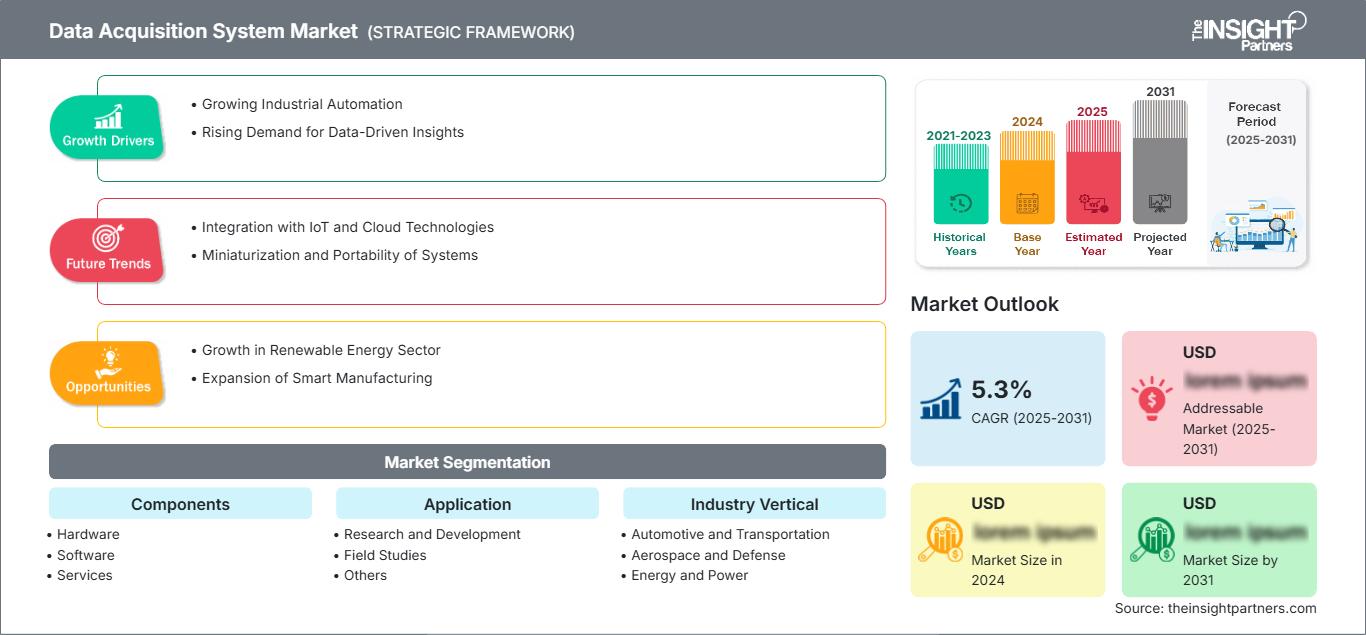
The Data Acquisition System Market size is estimated to be valued at US$ 2.94 Billion in 2025 and is forecasted to reach US$ 4.75 Billion by 2034, growing at a CAGR of 5.48%. The market indicates increasing adoption of tools including hardware, software, and services for capturing sensor signals, conditioning inputs, conversion, and other research and field testing activities in decision-making processes for industrial applications.
The North American market is anticipated to grow at a CAGR of 5.1–5.8% during 2026-2034, driven by test equipment modernization in the aerospace sector, electric vehicle testing, and grid monitoring. The region is characterized by the presence of advanced laboratories, high spend on semiconductors and defense and the need for modular systems to link physical measurement with analytical tools.
Data Acquisition System Market Assessment and Insights
- North America held 31–35% Data Acquisition System Market share in 2025 and is growing at a CAGR of 5.1–5.8% during 2026–2034, led by aerospace testing, EV validation, grid modernization, and laboratory automation.
- US represented 80–84% of North American revenue in 2025 and is growing at a CAGR of 5.2–5.9% during 2026–2034, supported by defense, automotive, semiconductor, and healthcare testing.
- Europe accounted for 25–29% share in 2025 and is growing at a CAGR of 4.9–5.6% during 2026–2034, with Germany, the UK, France, Italy, and Spain leading industrial and aerospace adoption.
- Asia Pacific held 28–32% share in 2025 and is growing at a CAGR of 6.2–6.9% during 2026–2034, led by China, Japan, South Korea, India, and Australia.
- Largest Segment Hardware held 50–54% market share in 2025 and is growing at a CAGR of 5.0–5.7% during 2026–2034 due to sensor interface and chassis demand.
- High Growth Segment Software represented 24–28% market share in 2025 and is growing at a CAGR of 6.3–7.0% during 2026–2034, supported by analytics and automation.
- Key companies analyzed in detail: ABB Ltd.; AMETEK, Inc.; Brüel & Kjær Sound & Vibration Measurement A/S; Hottinger Brüel & Kjær GmbH; Honeywell International Inc.; Keysight Technologies, Inc.; National Instruments Corporation; Rockwell Automation, Inc.; Siemens Aktiengesellschaft; Yokogawa Electric Corporation.
Source: The Insight Partners' analysis based on proprietary research, government publications, company annual reports, investor presentations, industry databases, and expert interviews.
Measurement architecture is moving away from independent instruments to modular and software-defined solutions that ensure synchronization of inputs in vibration, temperature, pressure, voltage, and acoustic channels. Another change in the production process includes integration of analog front ends, processors, Ethernet connectivity, and software for cloud in the creation of scalable solutions. Such developments will ensure repeatability in research laboratories, reduce validation periods in automotive and aerospace projects, and allow users to build their engineering proof based on the Data Acquisition System Market.
Future demand will grow thanks to developments in electrification, industrial automation, renewables, and quality management processes. Geographies that are at early stages of development focus on building up laboratory facilities, smart factories, network infrastructure, and health care facilities. More developed regions are focused on software compatibility and security solutions. Regulatory requirements in aerospace, medical equipment, and energy testing favor calibration systems that guarantee data integrity. Hardware and software suppliers with service capabilities will benefit from stable replacement and greenfield demand.
Data Acquisition System Market Report Scope
| Report Attribute | Details |
|---|---|
| Market size in 2025 | US$ 2.94 Billion |
| Market Size by 2034 | US$ 4.75 Billion |
| Global CAGR (2026 - 2034) | 5.48% |
| Historical Data | 2021-2024 |
| Forecast period | 2026-2034 |
Data Acquisition System Market Analysis
Data Acquisition System market drivers are based on the requirements of accurate time-synced measurement in product validation, asset monitoring, and regulated testing applications. In the automotive industry, there is a requirement for acquiring battery, powertrain, NVH, and ADAS data. In the aerospace industry, there is a requirement for structural, propulsion, and avionics evidence. In the energy industry, there is a requirement to monitor turbines, substations, and storage systems.
Drivers for supply will include availability of precision analog hardware, embedded computing, connectors, durable housing, and software upgrades. Availability of semiconductors and calibration capabilities impact delivery times, while customers now need open APIs, cyber security protocols, and full lifecycle support. Energy transition progress monitoring by IEA, IATA air travel recovery, and WHO cold chain requirements reinforce test and monitoring demands in power, aerospace, and healthcare domains.
Competitive Dynamics in the Data Acquisition Systems Market suggest rivalry between comprehensive automation vendors and niche measurement solution providers. National Instruments Corporation, Keysight Technologies, Inc., Hottinger Brüel & Kjær GmbH, and Brüel & Kjær Sound & Vibration Measurement A/S engage in competing using modular architectures, fast sampling rates, and industry-specific software. On their part, ABB Ltd., Siemens Aktiengesellschaft, Rockwell Automation, Inc., Honeywell International Inc., AMETEK, Inc., and Yokogawa Electric Corporation expand via industrial automation and process controls.
Funding is shifting from the core technology into edge analytics, distributed testing, cloud management, and field robustness of data acquisition systems. Success hinges on channel access, calibration authority, applications development, and the capacity to merge hardware profitability with software subscriptions. Niche demand allows for specialization, yet bigger players favor platforms that minimize integration risks at lab, manufacturing line, and field locations.
● REPORT CUSTOMIZATION
Tailor This Report To Align With Your Specific Business Requirements
This report can be customized to align precisely with your business objectives, scope, and target markets. Customization options include tailored segmentation, geography, competitive analysis, and strategic insights to support informed decision-making.
Customize This Report →WHAT YOU CAN ADJUST
- ● Segmentations
- ● Geography
- ● Competitive Analysis
- ● Language Preferences
Data Acquisition System Market: Strategic Insights
Regional Insights
North America Data Acquisition System Market
The North America region captured a market share of 31-35% for the Data Acquisition System Market in 2025 and is expected to register a CAGR of 5.1-5.8% during 2026-2034. Factors responsible for the growth of the market include aerospace & defense testing budget, electric vehicle testing, modernizing grids, and advanced medical device testing. High-level university laboratories, national research centers, and automation programs drive demand for calibration, modularity, and multiple channel acquisition system.
A growing trend among buyers in the North American region includes adoption of Ethernet-based chassis, module synchronization, and software security as test data needs to be transferred from bench to enterprise database. Data Acquisition System Market also captures the trend of electronics production, battery production, and infrastructure monitoring reshore in North America. Suppliers include National Instruments Corporation, Keysight Technologies, Inc., Honeywell International Inc., and AMETEK, Inc.
U.S. Data Acquisition System Market
The United States accounted for 80–84% of North America's revenue in 2025 and is estimated to experience a 5.2–5.9% CAGR from 2026 to 2034. Demand for the system arises in defense labs, semiconductor fabs, electric vehicles programs, aerospace qualification, energy storage test facilities, and medical devices validation. The large number of the U.S. installed base of automated test equipment will drive the recurring need for software upgrades and equipment replacements.
Some of the companies that have a good level of visibility in the market include National Instruments Corporation, Keysight Technologies, Inc., Honeywell International Inc., AMETEK, Inc., Rockwell Automation, Inc., and ABB Ltd. The application areas with increasing demand include high-speed battery cycler monitoring, vibration analysis, hardware-in-the-loop test systems, and remote field measurements.
Europe Data Acquisition System Market
Europe’s market holds 25-29% share and has been forecast to grow at a CAGR of 4.9-5.6% for 2026-2034. Leading Europe is Germany, driven by automotive testing, industrial automation, wind power generation, and machine testing applications. In addition, the United Kingdom brings in aerospace, military, academia, and medical device development applications with requirements for high integrity, software, and adherence to safety and quality standards.
Demand is further generated by France, Italy, and Spain from rail transportation, aerospace parts manufacturers, food processing, and energy infrastructure markets. Low noise instruments, environmental testing, and systems which interface with factory automation are preferred by European users. Engineering and automation base installations by Siemens Aktiengesellschaft, Hottinger Brüel & Kjær GmbH, Brüel & Kjær Sound & Vibration Measurement A/S, ABB Ltd., and Yokogawa Electric Corporation help drive the market regionally.
APAC Data Acquisition System Market
The Asia Pacific region holds a 28–32% market share in 2025 and will witness a CAGR of 6.2–6.9% during 2026–2034. Leading contributors are China with its dominance in electronics manufacturing, EV battery systems, railroad equipment, and automation of industry.
Supporting India and Australia are renewable energy, mining, defense laboratories, and monitoring of infrastructure projects. The strong push towards indigenous manufacturing and reliable grids boosts adoption of the product, despite sensitivity to pricing. The Data Acquisition System Market players offering durable equipment, good service locally, and flexible software licenses are expected to benefit.
Middle East & Africa Data Acquisition System Market
Market growth for the Middle East & Africa is expected to be between 5.4% and 6.1% CAGR for 2026-2034. Saudi Arabia takes the lead due to initiatives in the energy, petrochemical, industrial automation, and infrastructure sectors that depend on robust field measurements. UAE contributes through airports, utilities, data centers, and research organizations.
South Africa and Rest of MEA are dependent on mining, power, water and transportation projects. Tough conditions raise the need for rugged equipment and secure communications. Budget constraints may hamper adoption, but needs for energy efficiency, safety, and regulations generate solid opportunities.
Segmentation Analysis
Components
Components is projected to grow at a CAGR of 5.3–6.0% during 2026–2034. The Data Acquisition System Market scope covers hardware, software, and services that together determine measurement accuracy, deployment speed, and lifecycle cost. Hardware remains the largest revenue contributor, software is gaining strategic value through analytics and automation, and services support calibration, integration, training, and field reliability.
- Hardware leads demand because chassis, modules, converters, signal conditioning, and rugged enclosures form the measurement backbone for laboratories, plants, vehicles, aircraft, and remote field assets.
- Software is strategically important as buyers need visualization, automation, data logging, analytics, test sequencing, and secure transfer of measurement records into enterprise engineering systems.
- Services support adoption through calibration, integration, validation, maintenance, and user training, especially where regulated testing or distributed field deployment requires traceable operating procedures.
Application
Application is forecast to grow at a CAGR of 5.4–6.1% during 2026–2034. Research and development remains a major demand base because engineering teams require repeatable evidence before product release. Field studies are expanding as utilities, transport operators, and infrastructure owners monitor real-world conditions. Application diversity supports resilient demand across laboratory, plant, mobile, and remote environments.
- Research and Development dominates usage in product design, prototype testing, materials evaluation, NVH studies, battery validation, and aerospace qualification where measurement quality determines engineering confidence.
- Field Studies are gaining importance as organizations collect data from bridges, pipelines, turbines, vehicles, and environmental assets to validate performance under operating conditions.
Industry Vertical
Industry Vertical is expected to grow at a CAGR of 5.5–6.2% during 2026–2034. Automotive and transportation, aerospace and defense, energy and power, food and beverages, and healthcare use acquisition systems for testing, compliance, condition monitoring, and operational improvement. Growth is strongest where electrification, safety assurance, process control, and regulated documentation increase measurement intensity.
- Automotive and Transportation uses systems for EV batteries, power electronics, ADAS validation, chassis testing, vibration measurement, rail monitoring, and fleet diagnostics under increasingly software-defined mobility programs.
- Aerospace and Defense requires synchronized, traceable measurements for structural tests, propulsion systems, avionics, acoustic studies, and qualification programs where reliability and certification evidence are essential.
- Energy and Power applies acquisition platforms to turbines, substations, batteries, solar farms, grid assets, and industrial motors where operators need continuous visibility and fault detection.
- Food and Beverages uses measurement systems for process temperature, pressure, flow, vibration, and quality monitoring, especially in automated plants needing repeatability and audit-ready records.
- Healthcare relies on data capture for medical device development, laboratory instrumentation, environmental monitoring, and clinical equipment validation where accuracy, safety, and documentation are critical.
Opportunity Snapshot
| Industry Vertical | Revenue Contribution | Trend Tag | Adoption Stage |
| Automotive and Transportation | High | EV Testing | Scaling |
| Aerospace and Defense | High | Flight Test | Mature |
| Energy and Power | Medium | Grid Monitoring | Scaling |
| Food and Beverages | Medium | Process Quality | Mature |
| Healthcare | Medium | Device Validation | Scaling |
| Others | Low | Asset Sensing | Emerging |
Data Acquisition System Market Growth Drivers and Impact Analysis
Electrified mobility expands validation workloads
Recurring measurements of electrical variables, including voltage, current, temperature, vibration, acoustic performance, and thermal runaway characteristics, are critical in electric vehicles, hybrid systems, charging technology, and software-based mobility. This use case has driven the need for synchronized data acquisition capabilities capable of functioning in labs, on-road testing, and durability test stands. The market opportunity is most pronounced for companies in the automotive industry, battery providers, railroads, and components manufacturers who seek to validate faster but without sacrificing safety data. Suppliers gain by offering scaleable chassis, isolation, high-speed sampling, and analysis tools that turn data into decisions.
Smart factories require traceable operating data
Machinery manufacturers are switching from periodic testing to real-time measuring of equipment, devices, assembly lines, and even the environment. Data acquisition systems help them do this by providing measurements of physical signals that normal enterprise software cannot measure. This effect is evident in predictive maintenance, increased yields, better quality management, and rapid root cause analysis. Buyers now demand integration with programmable logic controllers, historians, manufacturing execution system applications, and cloud services. Vendors who offer tough hardware with open software interface technology can cater to both old and new automated factories.
Energy transition increases monitoring intensity
Renewable generation, battery storage, hydrogen systems, and grid modernization create complex operating profiles that require measurement across electrical, mechanical, and environmental variables. Utilities and equipment suppliers need acquisition platforms for turbine testing, inverter validation, substation diagnostics, thermal monitoring, and field trials. The real-world impact is higher demand for distributed, rugged, and remotely managed systems that maintain data integrity in harsh locations. This driver also supports service contracts, calibration programs, and software analytics because operators must convert continuous measurements into actionable reliability and safety insights.
Data Acquisition System Market Future Trends
Edge analytics moves closer to sensors
Data Acquisition System Market trends point toward embedded analytics that process signals at the measurement point before data moves to a server or cloud environment. Future platforms will filter noise, detect anomalies, compress records, and trigger automated workflows locally. This will reduce bandwidth requirements in field studies and improve response time in test cells. Suppliers will differentiate through firmware, AI-assisted diagnostics, and secure edge computing rather than hardware specifications alone, especially where uptime and data integrity are decisive.
Open software ecosystems gain priority
Customers will increasingly select acquisition platforms that integrate with Python, MATLAB, LabVIEW, industrial historians, cloud databases, and digital twin environments. Open software ecosystems reduce vendor lock-in and help engineering teams reuse data across design, simulation, certification, and operations. This trend will favor suppliers that publish APIs, maintain plug-in libraries, and support secure data formats. It will also increase the value of software maintenance, training, and integration services because measurement workflows are becoming enterprise-wide assets.
Data Acquisition System Market Opportunities
Standardized EV and battery test platforms
Data Acquisition System Market Forecasts support investment in repeatable EV and battery validation packages that combine isolated inputs, thermal sensing, power analysis, automated sequencing, and reporting templates. Vendors can target automakers, cell manufacturers, charging infrastructure firms, and certification laboratories seeking faster program execution. The opportunity is attractive because customers want fewer custom integrations and stronger correlation between laboratory, road, and environmental test results. Suppliers that bundle calibration, safety workflows, and analytics can create recurring revenue beyond hardware sales.
Field monitoring for resilient infrastructure
Infrastructure owners need continuous evidence on bridges, tunnels, pipelines, rail assets, substations, renewable plants, and water networks. Acquisition suppliers can package rugged hardware, wireless gateways, low-power sensing, cloud dashboards, and maintenance services for long-duration deployments. This opportunity is distinct from laboratory testing because customers value environmental protection, remote diagnostics, and lifecycle support. Partnerships with engineering consultants, utilities, and public agencies can accelerate adoption where asset safety, climate exposure, and capital planning depend on reliable measurement records.
Recent Developments
- February 2025: National Instruments Corporation — Emerson expanded the NI data acquisition portfolio with Ethernet chassis and input modules intended to improve distributed test deployment, while also supporting FlexLogger software plug-ins for configurable measurement workflows. The release strengthened NI’s position in modular DAQ for laboratories, validation teams, and industrial test environments. — https://www.ni.com/en/about-ni/newsroom.html
- April 2026: NetApp (NASDAQ: NTAP), the Intelligent Data Infrastructure company, announced that it has expanded its collaboration with Google Cloud with a 4-year Enterprise Agreement to accelerate the deployment of the NetApp storage solutions within the Google Distributed Cloud air-gapped (GDC), Google's sovereign cloud platform delivered by World Wide Technology (WWT). The NetApp data platform within this full-stack, air-gapped private cloud solution delivers the built-in security organizations need to handle sensitive information and meet data sovereignty requirements.
- February 2026: BPC Instruments launched BPC DAQ, a new data acquisition unit for the BPC Go platform. It adds structured process data logging alongside gas flow and volume measurements, with data kept time aligned in the same workflow in Aurora.
- February 2025: Emerson unveiled the latest additions to its data acquisition (DAQ) lineup, introducing the NI cDAQ-9187and cDAQ-9183 Ethernet chassis and NI 9204 input module. Along with a GitHub repository for NI FlexLogger DAQ software plug-ins, these new solutions provide cost-effective options for deploying high-performance test and measurement systems over Ethernet. The cDAQ-9187 and cDAQ-9813 chassis are the first entry-level Ethernet solutions in Emerson's NI CompactDAQ family of hardware. These budget-friendly chassis are specifically designed for electrical and sensor measurements over Ethernet-supported distances. Both models feature a single Ethernet port and omit external trigger lines, reducing cost without sacrificing performance, and include QR codes for quick access to “getting started” videos and relevant documentation to help streamline the setup process.
Frequently Asked Questions

- Comprehensive Market Sizing and Forecast Analysis
- Detailed Segmentation Analysis
- In-Depth Market Dynamics Assessment
- Regional and Country-Level Insights
- Competitive Landscape and Company Benchmarking
- Strategic Business Intelligence
Recent Reports
Testimonials

The Insight Partners' SCADA System Market report is comprehensive, with valuable insights on current trends and future forecasts. The team was highly professional, responsive, and supportive throughout. We are very satisfied and highly recommend their services.
RAN KEDEM Partner, Reali Technologies LTDs
I requested a report on a very specific software market and the team produced the report in a few days. The information was very relevant and well presented. I then requested some changes and additions to the report. The team was again very responsive and I got the final report in less than a week.
JEAN-HERVE JENN Chairman, Future Analytica
We worked with The Insight Partners for an important market study and forecast. They gave us clear insights into opportunities and risks, which helped shape our plans. Their research was easy to use and based on solid data. It helped us make smart, confident decisions. We highly recommend them.
PIYUSH NAGPAL Sr. Vice President, High Beam Global
The Insight Partners delivered insightful, well-structured market research with strong domain expertise. Their team was professional and responsive throughout. The user-friendly website made accessing industry reports seamless. We highly recommend them for reliable, high-quality research services
YUKIHIKO ADACHI CEO, Deep Blue, LLC.
This is the first time I have purchased a market report from The Insight Partners.While I was unsure at first, I visited their web site and felt more comfortable to take the risk and purchase a market report.I am completely satisfied with the quality of the report and customer service. I had several questions and comments with the initial report, but after a couple of dialogs over email with their analyst I believe I have a report that I can use as input to our strategic planning process.Thank you so much for taking the extra time and making this a positive experience.I will definitely recommend your service to others and you will be my first call when we need further market data.
JOHN SUZUKI President and Chief Executive Officer, Board Director, BK Technologies
I wish to appreciate your support and the professionalism you displayed in the course of attending to my request for information regarding to infectious disease IVD market in Nigeria. I appreciate your patience, your guidance, and the fact that you were willing to offer a discount, which eventually made it possible for us to close a deal. I look forward to engaging The Insight Partners in the future, all thanks to the impression you have created in me as a result of this first encounter.
DR CHIJIOKE ONYIA MANAGING DIRECTOR, PineCrest Healthcare Ltd.Reason to Buy
- Informed Decision-Making
- Understanding Market Dynamics
- Competitive Analysis
- Identifying Emerging Markets
- Customer Insights
- Market Forecasts
- Risk Mitigation
- Boosting Operational Efficiency
- Strategic Planning
- Investment Justification
- Tracking Industry Innovations
- Aligning with Regulatory Trends





 Get Free Sample for