
Data Center Flash Storage Market Demand, Trends & Forecast by 2034
Coverage: by Systems (Direct-Attached Storage (DAS), Storage Area Network (SAN), Network Attached Storage (NAS)); End-Users (IT services, BFSI, Healthcare, Retail, Others) , and Geography (North America, Europe, Asia Pacific, and South and Central America)
- Status : Data Released
- Report Code : TIPRE00012720
- Category : Electronics and Semiconductor
- No. of Pages : 150
- Available Report Formats :


- Last update date : August 10, 2026


2025 Market Size
US$ 12.1 Bn
Base year value
2034 Forecast
US$ 30.96 Bn
Projected by 2034
CAGR 2026-2034
11.0 %
Growth rate
Addressable Market
US$ 190.24 Bn
(2026-2034)
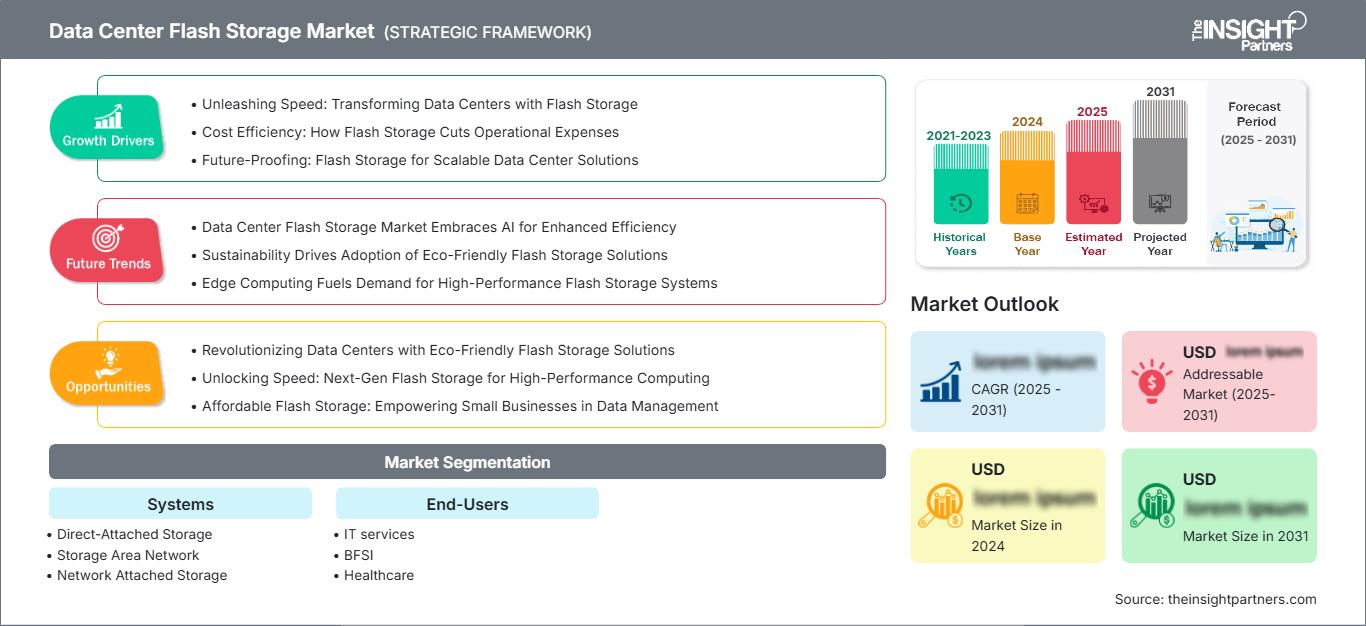
The global Data Center Flash Storage market was valued at US$ 12.1 billion in 2025 and is expected to reach US$ 30.96 billion by 2034; it is estimated to record a CAGR of 11.0% during 2026-2034.
Data Center Flash Storage Market Assessment and Insights
- North America held 34–36% share in 2025 and is growing at a CAGR range of 11.8–12.4% during 2026–2034 as AI clusters, private cloud platforms, and regulated enterprise workloads raise demand for high-throughput flash systems.
- US represented 78–82% of North America in 2025 and is growing at a CAGR range of 11.9–12.5% during 2026–2034, led by hyperscale campuses and financial workloads.
- Europe accounted for 22–24% share in 2025 and is growing at a CAGR range of 10.7–11.4% during 2026–2034, with Germany, the UK, and France leading enterprise flash modernization.
- Asia Pacific captured 28–30% share in 2025 and is growing at a CAGR range of 13.4–14.1% during 2026–2034, supported by China, Japan, South Korea, India, and Australia.
- Largest Segment Storage Area Network held 43–46% market share in 2025, with a CAGR range of 11.9–12.6% during 2026–2034, due to mission-critical block storage demand.
- High Growth Segment Healthcare held 13–16% market share in 2025, with a CAGR range of 14.2–15.0% during 2026–2034, driven by imaging, genomics, and digital records.
- Key companies analyzed in detail: Caringo, Inc., Cloudian, Inc., Cohesity, Inc., Dell Technologies Inc., Fujitsu Limited, Hewlett Packard Enterprise Company, Huawei Technologies Co., Ltd., IBM Corporation, NetApp, Inc., Pure Storage, Inc.
Source: The Insight Partners' analysis based on proprietary research, government publications, company annual reports, investor presentations, industry databases, and expert interviews.
Storage technology has evolved from capacity-based purchase considerations to being tailored for performance based on workload, especially as companies centralize their databases, analytics, virtualizations, and AI pipeline on common infrastructure. The densification of NAND, the use of QLC, NVMe fabrics, and software-defined storage are changing the economics of production through lower rack utilization and power consumption, as well as increased input/output efficiency. Platform vendors are also shifting focus from hardware to cyber resiliency, automation, and hybrid cloud mobility.
The future demand for the product will shift toward enterprises building private clouds ready for AI outside the hyperscale data centers. Digital government, sovereign data laws, healthcare imaging networks, and colocation centers in India, Gulf region, and Eastern Europe will offer new deployment opportunities. Energy-efficiency regulations and the increasing cost of electricity will further favor flash storage systems as they enable more workload processing per rack, per watt, and per admin hour.
Data Center Flash Storage Market Report Scope
| Report Attribute | Details |
|---|---|
| Market size in 2025 | US$ 12.1 Billion |
| Market Size by 2034 | US$ 30.96 Billion |
| Global CAGR (2026 - 2034) | 11.0% |
| Historical Data | 2021-2024 |
| Forecast period | 2026-2034 |
Data Center Flash Storage Market Analysis
The market growth enabler is the shift from batch-based computing to real-time digital operations. Artificial intelligence inference, fraud analysis, electronic medical records, retail websites personalization, and cloud native applications need predictable latencies and fast metadata handling. The flash storage technology enables reduced transactions time, higher density of virtual machines, and eliminates application delays caused by faster compute progress than storage modernization.
The market environment depends on NAND manufacturers, storage system providers, cloud providers, systems integrators, and managed services providers. The supply situation continues to depend on the memory prices and controllers developments, but the customers become more concerned about software value like compression, deduplication, snapshots, replication, ransomware recovery, and workloads orchestration.
The Data Center Flash Storage Market report shows that the focus of competition revolves around platform completeness, readiness for AI workloads, consumption models, and SLAs. The companies such as Dell Technologies Inc., Hewlett Packard Enterprise Company, NetApp, Inc., Pure Storage, Inc., Huawei Technologies Co., Ltd., and IBM Corporation emphasize integrated data services, while Cloudian, Inc., Caringo, Inc., and Cohesity, Inc. offer improved features in terms of object storage, backup, and unstructured data.
Investment trends are in the areas of modular refresh, storage-as-a-service, and AI reference architectures. Customers are looking for offerings that will allow them to extend the lifecycle of the products by means of non-disruptive upgrade and unified management of block, file, and object workloads. Differentiation factors are energy efficiency, cyber-resilience, AI pipelines, and interoperability with virtualization, Kubernetes, and hybrid cloud control planes.
● REPORT CUSTOMIZATION
Tailor This Report To Align With Your Specific Business Requirements
This report can be customized to align precisely with your business objectives, scope, and target markets. Customization options include tailored segmentation, geography, competitive analysis, and strategic insights to support informed decision-making.
Customize This Report →WHAT YOU CAN ADJUST
- ● Segmentations
- ● Geography
- ● Competitive Analysis
- ● Language Preferences
Data Center Flash Storage Market: Strategic Insights
Regional Insights
North America Data Center Flash Storage Market
North America was estimated at 34-36% of global revenue in 2025, being the leader of Data Center Flash Storage Market share due to the presence of developed cloud and enterprise infrastructure hubs. The region is set to grow with the CAGR range between 11.8-12.4% in the period from 2026 to 2034 due to AI infrastructure, hybrid cloud, and cyber-resilient backup trends impacting the storage replacement.
The demand for the solution is mainly observed in the United States and Canada due to the need for greater performance per rack by financial service, healthcare networks, SaaS and colocation companies. The trend is also driven by sustainability initiatives as the flash solutions take less physical space and provide cooling.
U.S. Data Center Flash Storage Market
US held 78-82% share of North America in 2025 and is expected to register a growth of CAGR of 11.9–12.5% between 2026-2034. The hyperscale data center deployment, AI training applications, digital banking, and healthcare informatics sectors are creating intense read/write scenarios that will benefit all-flash and NVMe-based solutions.
The company presence is high in terms of Dell Technologies Inc., Hewlett Packard Enterprise Company, NetApp, Inc., Pure Storage, Inc., IBM Corporation, Cohesity, Inc., and Cloudian, Inc. Other factors driving the growth of the market include private cloud modernization and data transfer from the edge to core. The retail analytics, fraud prevention, electronic medical imaging, and SaaS database applications constitute major application areas of market.
Europe Data Center Flash Storage Market
The Europe market was worth 22-24% in 2025 and forecast to witness a CAGR between 10.7 and 11.4% during 2026-2034. Germany is the frontrunner due to the need for reliable, low latency storage for manufacturing, automotive software and enterprise clouds. The United Kingdom has demand for BFSI, fintech, media platform and public sector IT infrastructure. France, Italy, and Spain are growing due to healthcare, telecom cloud and sovereign data initiatives.
Compliance with regulations regarding data privacy and continuity of service makes adoption of flash storage systems attractive. European customers value efficiencies over the entire product lifecycle, less power consumption and hybrid cloud management, all aiding further Data Center Flash Storage Market penetration.
APAC Data Center Flash Storage Market
The APAC region held a market share between 28-30% in 2025 and is projected to exhibit a CAGR between 13.4-14.1% over 2026-2034. The market in the region is driven by the presence of AI infrastructure, cloud, and enterprise storage infrastructure in China. Further, Japan and South Korea have semiconductor, telecommunications, and manufacturing use cases.
In India and Australia, the market is driven by the development of digital infrastructure, banking modernization, and adoption of the cloud. Policies related to data processing locally and development of co-location services help the market flourish. Enterprises look for flash storage to minimize latency, consolidate workloads, and enable analytics.
Middle East & Africa Data Center Flash Storage Market
The Middle East and Africa segment is expected to see a growth CAGR of 12.2–12.9% between 2026 and 2034, driven by the adoption in the UAE through cloud, smart-city, and finance verticals. Meanwhile, Saudi Arabia shows a growing interest due to its giga-projects, e-government, and artificial intelligence strategy that demands more high-performing storage infrastructure.
For South Africa and other MEA countries, flash storage is becoming more widespread in conjunction with the development of telecommunications infrastructure, banking systems, and regional colocation centers. Energy availability and efficient cooling play a crucial role for such infrastructure. When operators want to achieve higher density of workloads under the same conditions of power limitation, flash becomes an easy way.
Segmentation Analysis
Systems
The Systems segment is projected to grow at a CAGR range of 12.1–12.8% during 2026–2034, supported by enterprise shifts from isolated storage appliances toward integrated architectures. The market scope within systems includes performance-sensitive direct storage, scalable SAN environments, and shared NAS platforms that support virtualized, analytics-heavy, and cloud-native workloads.
- Direct-Attached Storage remains relevant for localized high-performance workloads, edge deployments, and cost-sensitive compute nodes where direct connectivity reduces latency and simplifies management for specific applications.
- Storage Area Network dominates mission-critical enterprise environments because it supports scalable block access, high availability, centralized management, and predictable performance for databases, virtualization, and transaction-heavy workloads.
- Network Attached Storage supports shared file access, content repositories, backups, and collaborative workflows, making it strategically important for unstructured data growth and hybrid-cloud data services.
End-Users
The End-Users segment is projected to grow at a CAGR range of 12.4–13.1% during 2026–2034 as flash adoption expands across latency-sensitive, regulated, and data-intensive sectors. IT services remain the largest demand base, while healthcare shows the fastest adoption due to imaging, genomics, clinical systems, and secure patient-data workflows.
- IT services generate sustained demand through cloud hosting, managed infrastructure, SaaS delivery, and platform modernization requiring scalable, multi-tenant, and automation-ready flash storage environments.
- BFSI prioritizes low-latency storage for payments, trading, fraud detection, digital banking, and compliance workloads where availability, security, and rapid recovery directly affect operational risk.
- Healthcare is gaining strategic importance as hospitals, diagnostics networks, and research institutions handle imaging archives, electronic records, genomics, and AI-assisted clinical analytics.
- Retail uses flash storage for personalization engines, inventory visibility, omnichannel analytics, and transaction platforms that depend on rapid data access during peak demand periods.
Opportunity Snapshot
| End-Users | Revenue Contribution | Trend Tag | Adoption Stage |
| IT services | High | Cloud Hosting | Mature |
| BFSI | High | Fraud Analytics | Scaling |
| Healthcare | Medium | Clinical Imaging | Scaling |
| Retail | Medium | Omnichannel Data | Scaling |
Data Center Flash Storage Market Growth Drivers and Impact Analysis
AI Workloads Raise Latency and Throughput Requirements
AI training, inferencing, recommendation systems, and real-time analytics are forcing enterprises to remove storage bottlenecks that limit GPU and CPU utilization. Flash storage supports faster checkpointing, parallel reads, and metadata handling, which improves infrastructure productivity in data-intensive environments. The market benefits because buyers increasingly view storage as a performance layer rather than a passive capacity tier. This impact is strongest in cloud, BFSI, healthcare imaging, and retail personalization, where delayed data access can reduce service quality, increase compute idle time, and raise operating cost.
Energy Efficiency Becomes a Procurement Priority
Data center operators face rising electricity prices, grid constraints, and customer pressure to reduce infrastructure emissions. Flash platforms improve performance density, allowing more workloads to run in fewer racks with lower cooling demand than disk-heavy configurations. This creates direct market impact by making storage modernization part of both capacity planning and sustainability strategy. Enterprises with constrained facilities can delay expensive building expansion, while colocation providers can offer higher-density services.
Cyber Resilience Drives Flash-Based Backup Modernization
Ransomware recovery requirements are pushing organizations to modernize backup, replication, and immutable snapshot strategies. Flash-based systems reduce recovery time objectives for critical workloads and allow frequent snapshots without severely affecting production performance. The market impact is clear in BFSI, healthcare, and public-sector environments where downtime carries regulatory, financial, and reputational consequences. Vendors are embedding anomaly detection, secure copies, and isolated recovery capabilities into storage platforms, making cyber resilience a core purchase criterion within the market.
Data Center Flash Storage Market Future Trends
Disaggregated Flash Fabrics Move into Enterprise Clouds
Data Center Flash Storage Market trends point toward disaggregated storage fabrics that separate compute and storage scaling while preserving low latency. NVMe-over-fabrics, Ethernet-based architectures, and composable infrastructure will allow enterprises to assign flash capacity dynamically to AI, database, and virtualization workloads. This trend will reduce stranded capacity and improve utilization across private clouds. As Kubernetes, virtualization stacks, and AI pipelines converge, buyers will prefer storage platforms that expose flexible services through software controls rather than fixed appliance boundaries.
QLC Flash Expands Capacity-Optimized Enterprise Use Cases
QLC flash is expected to widen the addressable market by improving cost per terabyte for workloads that need more performance than disk but do not require premium endurance tiers. Vendors will combine QLC media with advanced controllers, compression, wear management, and software intelligence to serve backups, analytics repositories, content platforms, and warm data lakes. As buyers compare total facility cost rather than only media cost, QLC systems can accelerate broader replacement of hybrid and HDD-based arrays.
Data Center Flash Storage Market Opportunities
Healthcare Data Modernization Creates High-Value Deployments
Healthcare offers one of the clearest Data Center Flash Storage Market Forecasts opportunities because imaging, diagnostics, genomics, and digital records are becoming more data-intensive and latency-sensitive. Providers need fast retrieval for clinical workflows, secure replication for compliance, and scalable repositories for AI-assisted decision support. Vendors can target hospitals, diagnostic chains, and research networks with validated architectures combining performance, encryption, immutable backup, and hybrid-cloud extension. The strongest opportunity lies in packaged solutions that reduce deployment complexity while meeting strict availability and privacy requirements.
Regional Colocation Expansion Opens Midmarket Demand
Secondary data center hubs in India, Southeast Asia, the Gulf, Eastern Europe, and Latin America are creating opportunities beyond hyperscale buyers. Colocation providers and managed service firms need compact, resilient, and easily managed flash platforms to serve local enterprises adopting cloud, analytics, and regulatory data residency. Vendors can capture this demand through channel-led bundles, consumption pricing, and reference designs for virtualization, backup, and database acceleration. This opportunity favors suppliers able to combine enterprise functionality with simplified operations and predictable lifecycle costs.
Recent Developments
- July 2026: Kioxia announced its next-generation NX1 Series E1.S PCIe 5.0 NVMe SSDs for AI and hyperscale environments. The new SSDs feature Kioxia's in-house controller architecture, direct liquid cooling support, and deliver up to 38% higher sequential write and 20% higher random write performance than the previous generation.
- July 2026: Huawei unveiled its new-generation OceanStor Dorado all-flash storage platform for AI-ready data centers. The solution enhances storage performance, resilience, and intelligent management with AI-driven capabilities, enabling enterprises to efficiently handle modern, data-intensive workloads.
- July 2026: IBM introduced its next-generation FlashSystem portfolio, featuring AI-powered storage management, enhanced cyber resilience, and new FlashCore Modules with built-in ransomware detection. The updated portfolio helps enterprises automate storage operations while improving performance, security, and recovery capabilities.
Frequently Asked Questions

- Comprehensive Market Sizing and Forecast Analysis
- Detailed Segmentation Analysis
- In-Depth Market Dynamics Assessment
- Regional and Country-Level Insights
- Competitive Landscape and Company Benchmarking
- Strategic Business Intelligence
Recent Reports
Testimonials

The Insight Partners' SCADA System Market report is comprehensive, with valuable insights on current trends and future forecasts. The team was highly professional, responsive, and supportive throughout. We are very satisfied and highly recommend their services.
RAN KEDEM Partner, Reali Technologies LTDs
I requested a report on a very specific software market and the team produced the report in a few days. The information was very relevant and well presented. I then requested some changes and additions to the report. The team was again very responsive and I got the final report in less than a week.
JEAN-HERVE JENN Chairman, Future Analytica
We worked with The Insight Partners for an important market study and forecast. They gave us clear insights into opportunities and risks, which helped shape our plans. Their research was easy to use and based on solid data. It helped us make smart, confident decisions. We highly recommend them.
PIYUSH NAGPAL Sr. Vice President, High Beam Global
The Insight Partners delivered insightful, well-structured market research with strong domain expertise. Their team was professional and responsive throughout. The user-friendly website made accessing industry reports seamless. We highly recommend them for reliable, high-quality research services
YUKIHIKO ADACHI CEO, Deep Blue, LLC.
This is the first time I have purchased a market report from The Insight Partners.While I was unsure at first, I visited their web site and felt more comfortable to take the risk and purchase a market report.I am completely satisfied with the quality of the report and customer service. I had several questions and comments with the initial report, but after a couple of dialogs over email with their analyst I believe I have a report that I can use as input to our strategic planning process.Thank you so much for taking the extra time and making this a positive experience.I will definitely recommend your service to others and you will be my first call when we need further market data.
JOHN SUZUKI President and Chief Executive Officer, Board Director, BK Technologies
I wish to appreciate your support and the professionalism you displayed in the course of attending to my request for information regarding to infectious disease IVD market in Nigeria. I appreciate your patience, your guidance, and the fact that you were willing to offer a discount, which eventually made it possible for us to close a deal. I look forward to engaging The Insight Partners in the future, all thanks to the impression you have created in me as a result of this first encounter.
DR CHIJIOKE ONYIA MANAGING DIRECTOR, PineCrest Healthcare Ltd.Reason to Buy
- Informed Decision-Making
- Understanding Market Dynamics
- Competitive Analysis
- Identifying Emerging Markets
- Customer Insights
- Market Forecasts
- Risk Mitigation
- Boosting Operational Efficiency
- Strategic Planning
- Investment Justification
- Tracking Industry Innovations
- Aligning with Regulatory Trends





 Get Free Sample for