
Data Center Switch Market Size, Share & Trends by 2034
Coverage: By Type (Core Switches, Distribution Switches, Access Switches); Technology (Ethernet, Fibre Channel, InfiniBand); End-User (Enterprises, Telecommunications Industry, Government Organizations, Cloud Service Providers) , and Geography (North America, Europe, Asia Pacific, and South and Central America)
- Status : Data Released
- Report Code : TIPRE00006775
- Category : Electronics and Semiconductor
- No. of Pages : 150
- Available Report Formats :


- Last update date : October 26, 2026


2025 Market Size
US$ 15.72 Bn
Base year value
2034 Forecast
US$ 38.58 Bn
Projected by 2034
CAGR 2026-2034
10.49 %
Growth rate
Addressable Market
US$ 240.78 Bn
(2026-2034)
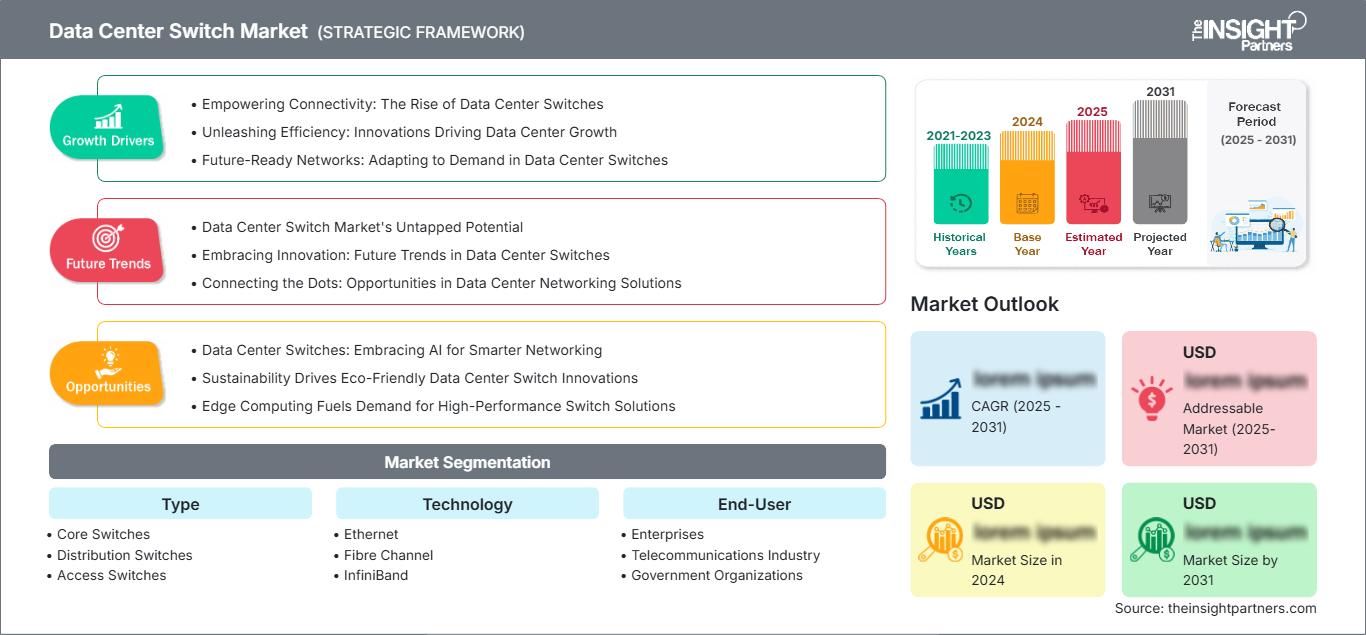
The Data Center Switch Market size was valued at US$ 15.72 Billion in 2025 and is expected to grow up to US$ 38.58 Billion by 2034 with a CAGR of 10.49% during 2026-2034, which can be attributed to increasing demand for switching solutions for connecting servers, storage, accelerators, and cloud fabrics in various industries such as enterprise, telecom, government, and hyperscale data center.
In North America, the market size is driven by 9.8% - 10.7% CAGR on the growth of hyperscale cloud regions, AI clusters, and colocation campuses that upgrade their fabrics to 400G/800G Ethernet due to increasing east-west traffic, power-aware design, and migration from the three-tier infrastructure towards automated leaf-spine switching in enterprises.
Data Center Switch Market Assessment and Insights
- North America: North America held a 36–39% share in 2025 and is growing at a 9.8–10.7% CAGR between 2026–2034, supported by hyperscale cloud, AI infrastructure, and colocation expansion.
- US: The US represented 82–86% of North America in 2025 and is growing at a 9.9–10.8% CAGR between 2026–2034, led by cloud regions and AI training clusters.
- Europe: Europe accounted for a 22–25% share in 2025 and is growing at an 8.8–9.7% CAGR between 2026–2034, with the UK, Germany, France, Netherlands, and Ireland leading deployment.
- Asia Pacific: Asia Pacific held a 29–32% share in 2025 and is growing at an 11.5–12.7% CAGR between 2026–2034, driven by China, Japan, South Korea, India, Singapore, and Australia.
- Largest Segment: Core switches led with a 41–44% market share in 2025 and a 9.6–10.4% CAGR between 2026–2034, reflecting spine-layer and backbone capacity demand.
- High Growth Segment: Cloud service providers held a 34–37% market share in 2025 and are growing at an 11.8–13.1% CAGR between 2026–2034 due to AI-scale infrastructure.
- Key companies analyzed in detail: Arista Networks, Inc., Cisco Systems, Inc., Extreme Networks, Inc., Fortinet, Inc., Hewlett Packard Enterprise Company, Huawei Technologies Co., Ltd., Juniper Networks, Inc., Lenovo Group Limited, NEC Corporation, and ZTE Corporation.
Source: The Insight Partners' analysis based on proprietary research, government publications, company annual reports, investor presentations, industry databases, and expert interviews.
Network architecture is shifting from fragmented campus switching to programmable, high-radix data center fabrics. The Data Center Switch Market is driven by 100G, 200G, 400G, and 800G Ethernet switch platforms, lossless network, telemetry, liquid cooling ready chassis, and silicon that provides low-latency per watt. Production trends now increasingly hinge upon merchant ASICs, optical modules, automation in firmware, and testing in which switches are matched up with GPUs, DPUs, storage systems, and cloud orchestration layers.
Future demand will be determined by sovereign cloud, AI inferencing campuses, edge data centers, carrier cloud, and government digital infrastructure. New geographies are implementing modular and fixed-form switches as more domestic cloud zones emerge. Regulatory tailwinds exist in the form of data residency regulations, cybersecurity standards, and energy efficiency disclosure requirements, all driving operators to update their network architectures with performance, segmentation, and power management capabilities in mission-critical facilities.
Data Center Switch Market Report Scope
| Report Attribute | Details |
|---|---|
| Market size in 2025 | US$ 15.72 Billion |
| Market Size by 2034 | US$ 38.58 Billion |
| Global CAGR (2026 - 2034) | 10.49% |
| Historical Data | 2021-2024 |
| Forecast period | 2026-2034 |
Data Center Switch Market Analysis
Data Center Switch Market Growth is fueled by the requirement for greater amounts of east-west traffic transfer between servers, accelerators, and distributed storage systems. Cloud Service Providers are upgrading 25G/100G layer with 400G/800G fabrics in order to address the issues of oversubscription and training time reduction. On-premises enterprises are refreshing switches in order to support virtualization, container workloads, on-premises AI, and disaster recovery within their hybrid environments.
Ecosystem participants include OEM switch vendors, merchant silicon vendors, optics vendors, network operating system vendors, system integrators, colocation providers, and cloud service providers. Supply factors will benefit companies able to obtain sufficient ASICs, certify coherent and pluggable optics, as well as offer automation capabilities that mitigate manual configuration risks. IDC reported a significant data center Ethernet switch market growth in 2025 due to AI infrastructure development.
Competitive Analysis of the Data Center Switch Market revolves around aspects such as throughput density, latency, software uniformity, security, and channel reach. Arista Networks, Inc. is a formidable competitor in cloud and AI fabrics whereas Cisco Systems, Inc. relies on its portfolio of Nexus, Silicon One, and enterprise accounts. Hewlett Packard Enterprise Company and Juniper Networks, Inc. cater to automated data center networking via software and services.
Extreme Networks, Inc., Fortinet, Inc., Huawei Technologies Co., Ltd., Lenovo Group Limited, NEC Corporation, and ZTE Corporation are competitors based on enterprise, telecom, government, and regional data center portfolios. The investment focus lies in preparing for 800G, 1.6T, intent-based operations, zero-trust segmentation, and energy aware switching. Competitive positioning is defined by platform scope, software licensing, support service provision, supply chain, and cloud native ecosystem alignment.
● REPORT CUSTOMIZATION
Tailor This Report To Align With Your Specific Business Requirements
This report can be customized to align precisely with your business objectives, scope, and target markets. Customization options include tailored segmentation, geography, competitive analysis, and strategic insights to support informed decision-making.
Customize This Report →WHAT YOU CAN ADJUST
- ● Segmentations
- ● Geography
- ● Competitive Analysis
- ● Language Preferences
Data Center Switch Market: Strategic Insights
Regional Insights
North America Data Center Switch Market
The North American region had a market share of 36-39% in 2025 and is projected to register a 9.8-10.7% CAGR between 2026 and 2034. Factors contributing to the Data Center Switch Market share comprise of hyperscale cloud regions, AI training facilities, development in colocation centers, and private-cloud transformation for enterprises. Companies focus on high radix spines, 400G leaf switches, 800G AI fabric, and automation to manage operational complexity.
The key structural factors are huge technology capital expenditures, state-of-the-art semiconductors, dense fiber pathways, and the requirement for secure interconnections that have low latency. Demand from the US is leading in this region, but Canada also makes its contribution via the expansion of clouds, financial services hosting, and government workloads. Major companies having a strong presence in the region are Arista Networks, Inc., Cisco Systems, Inc., Hewlett Packard Enterprise Company, Juniper Networks, Inc., Extreme Networks, Inc., and Fortinet, Inc.
U.S. Data Center Switch Market
The US accounted for 82-86% of North America in 2025 and is expected to grow at a CAGR of 9.9-10.8% during 2026-2034. The market demand includes availability zones of hyperscale clouds, AI model training clusters, business modernization, and telecom edge facilities. Investment will be on high-speed Ethernet fabric, which connects GPUs, storage, and frontend services.
The companies in this region include Arista Networks, Inc., Cisco Systems, Inc., Extreme Networks, Inc., Fortinet, Inc., Hewlett Packard Enterprise Company, and Juniper Networks, Inc. Applications trends include cloud service providers and enterprises adopting segmented fabric architecture and unified observability and automated change management. Digital initiatives of the federal and state governments also include secure refresh of infrastructure in government data centers.
Europe Data Center Switch Market
Europe occupied a 22%–25% share in 2025 and is expected to expand at a 8.8%–9.7% CAGR from 2026 to 2034. The UK holds the leadership position via financial services, cloud regions, and carrier-neutral colocation services. Germany occupies the second position due to industrial clouds, automotive data platforms, and sovereign infrastructure wherein secure network segmentation is key for procurement.
France, the Netherlands, Ireland, Italy, and Spain are responsible for public cloud regions, subsea connectivity, and enterprise hosting. EU privacy rules, energy efficiency policies, and efforts toward digital sovereignty promote modernization. Cisco Systems, Inc., Arista Networks, Inc., Hewlett Packard Enterprise Company, Juniper Networks, Inc., Huawei Technologies Co., Ltd., NEC Corporation, and ZTE Corporation are some of the competitive players.
APAC Data Center Switch Market
The APAC market had a 29-32% market share in 2025 and is anticipated to grow with an 11.5-12.7% CAGR during 2026-2034. China has been leading via cloud, telecom, and AI infrastructure, whereas Japan and South Korea have been using high-speed switching in semiconductors, gaming, and enterprise clouds.
India, Singapore, and Australia are building data center capacities with policy, digital infrastructure, and cloud needs in the region. Industry automation, 5G core network infrastructure, and sovereign hosting are boosting switch densities. Some of the key companies in the industry include Huawei Technologies Co., Ltd., ZTE Corporation, NEC Corporation, Lenovo Group Limited, Cisco Systems, Inc., and Arista Networks, Inc.
Middle East & Africa Data Center Switch Market
MEA (Middle East and Africa) market is projected to grow with a 10.2% to 11.4% CAGR from 2026 to 2034. Saudi Arabia is at the forefront of growth driven by cloud regions, smart city infrastructure, and AI spending, and UAE contributes to growth via financial services, telecom cloud, and colocation facilities in the region.
Rest of MEA and South African demand depends on carrier modernization, digital government and enterprise hosting. Energy availability, cooling considerations, and undersea connectivity impact the economics of the deployments. The vendors differentiate themselves based on secure switching, localized presence, and partnerships with telecom carriers, systems integrators, and government infrastructure projects.
Segmentation Analysis
Type
The Type segment is forecast to grow at a 10.0–10.9% CAGR during 2026–2034. Data Center Switch Market scope by type reflects the layered role of switching in scalable fabrics. Core switches remain the largest value pool because they concentrate backbone and spine capacity, while distribution and access switches support workload segmentation, east-west traffic control, and server-facing connectivity.
- Core Switches: Core switches hold the strongest position because hyperscale, telecom, and large enterprise facilities require high-throughput spine platforms with deep buffers, redundant architecture, and ultra-low latency.
- Distribution Switches: Distribution switches support aggregation between access and core layers, balancing traffic, policy enforcement, and resilience where enterprises still operate hybrid three-tier and leaf-spine designs.
- Access Switches: Access switches connect servers, storage, and appliances directly, making port density, automation, power efficiency, and 25G to 400G migration central to procurement decisions.
Technology
The Technology segment is projected to grow at a 10.3–11.2% CAGR during 2026–2034. Ethernet dominates because cloud and enterprise operators prefer open ecosystems, broad vendor support, and faster migration to 400G and 800G. Fibre Channel remains relevant for storage-area networks, while InfiniBand retains importance in specialized HPC and AI environments requiring tightly coupled acceleration.
- Ethernet: Ethernet leads deployment because standardized switching, merchant silicon, open telemetry, and broad optics availability make it suitable for cloud, enterprise, telecom, and AI front-end networks.
- Fibre Channel: Fibre Channel maintains demand in mission-critical storage environments where deterministic performance, lossless behavior, and established SAN management practices remain important for regulated enterprises.
- InfiniBand: InfiniBand serves high-performance computing and select AI clusters where low latency, remote direct memory access, and accelerator ecosystem alignment justify specialized network design.
End-User
The End-User segment is projected to grow at a 10.8–11.9% CAGR during 2026–2034. Demand is strongest where switch performance directly affects compute utilization and service reliability. Cloud service providers lead capacity additions, telecommunications operators expand carrier cloud, enterprises modernize private data centers, and government organizations procure secure switching for digital services and sovereign workloads.
- Enterprises: Enterprises deploy switches for private cloud, virtualization, analytics, and branch-to-data-center integration, prioritizing automation, segmentation, lifecycle support, and predictable upgrade paths.
- Telecommunications Industry: Telecommunications operators use switching in 5G core, edge cloud, network functions virtualization, and content delivery environments where latency, redundancy, and scale are critical.
- Government Organizations: Government organizations require secure, auditable, and resilient switching for citizen services, defense workloads, research computing, and data sovereignty programs.
- Cloud Service Providers: Cloud service providers represent the highest-growth buyer group because AI, storage, and multi-region cloud services require massive, repeatable, high-speed switching architectures.
Opportunity Snapshot
| End-User | Revenue Contribution | Trend Tag | Adoption Stage |
| Enterprises | Medium | Private AI | Scaling |
| Telecommunications Industry | Medium | Edge Cloud | Scaling |
| Government Organizations | Low | Sovereign Data | Emerging |
| Cloud Service Providers | High | AI Fabrics | Mature |
Data Center Switch Market Growth Drivers and Impact Analysis
AI Workloads Require Higher-Bandwidth Ethernet Fabrics
As AI training and inferencing drive higher east-west traffic density in data centers, network capability is becoming a key factor in determining accelerator utilization. In massive deployments, there is a need for switching fabrics that are not prone to congestion, loss, and job completion delays through thousands of servers. This trend is affecting purchase decisions since buyers assess their 400G/800G capabilities, telemetry, congestion control and optical power usage along with per-port costs. It has resulted in a shorter refresh cycle for core and access switches, increased interest in reference architecture validation and alignment among vendors of switches, GPUs, clouds and colo companies.
Cloud and Colocation Expansion Raises Fabric Standardization Needs
There is increasing growth in cloud regions and carrier-neutral campus environments in both established and emerging markets, thus making a case for repeatable switch fabric that can be rapidly installed. This calls for similar hardware configurations, automation templates, and observability models in several halls and locations. It cuts down on the number of misconfigurations, lowers the amount of time to deploy, and increases the efficiency of managing devices with many ports. The market benefits most when there is a need for rapid interconnection, elasticity in terms of bandwidth, and security segmentation in colocation tenants.
Energy and Space Constraints Push Dense, Efficient Switching
Power budgets are becoming more constrained, densities are increasing, and there is greater focus on power efficiency. Systems which offer increased bandwidth per rack unit and decreased watts per gigabit enable data center managers to free up room for profitable computing while maintaining pressure on cooling systems. This factor leads to increased demand for high-end ASICs, energy efficient optics, liquid-cooled compatible hardware, and monitoring software which tracks port utilization. The effects of this include the consolidation of legacy layers with high radix switches, simplified cabling, and better capacity planning.
Data Center Switch Market Future Trends
1.6T Readiness Reshapes Fabric Roadmaps
Data Center Switch Market trends point toward 1.6T-ready platforms as AI clusters scale beyond current 800G deployments. Future roadmaps will emphasize switch silicon, co-packaged optics, linear-drive pluggables, and automation that can support faster ports without proportionate power increases. Operators will evaluate migration paths that protect current 400G and 800G investments while preparing for larger accelerator pools. Adoption will depend on optics maturity, thermal design, and software stability. Vendors with early interoperability testing, credible supply plans, and ecosystem partnerships can capture strategic accounts before full-scale volume deployments begin.
Intent-Based Operations Become Standard for Large Fabrics
Future switching environments will rely more heavily on intent-based operations that translate policy, topology, and performance targets into automated configuration. As data centers scale, manual change management becomes too slow and error-prone for AI and cloud workloads. Intent systems will combine telemetry, digital twins, and closed-loop remediation to reduce outages and improve capacity utilization. Buyers will prioritize explainability, role-based controls, and integration with security platforms. This trend will shift differentiation from hardware alone toward lifecycle operations, enabling vendors with strong software stacks to defend margins and strengthen customer retention.
Data Center Switch Market Opportunities
AI Fabric Modernization for Cloud Service Providers
Data Center Switch Market Forecasts indicate a major opportunity in AI fabric modernization for cloud service providers building larger accelerator clusters. Suppliers can package 800G-ready switching, validated optics, congestion-management software, and deployment services into repeatable architectures. This opportunity is action-oriented because cloud buyers need rapid capacity without compromising latency or reliability. Vendors should prioritize reference designs, interoperability with GPU and DPU ecosystems, and lifecycle services that include telemetry tuning and failure-domain planning. Strong execution can convert one-time cluster wins into multi-year refresh programs as AI inference and training workloads diversify across regions.
Secure Sovereign Cloud Switching for Public Infrastructure
Public agencies and regulated industries are increasing investment in sovereign cloud, national data platforms, and secure digital services. This creates an opportunity for vendors to offer switches with verified security features, supply-chain transparency, encryption support, and auditable management. Buyers need architectures that separate sensitive workloads while maintaining efficient shared infrastructure. Vendors can partner with systems integrators, telecom operators, and local cloud providers to meet residency and compliance requirements. Differentiation will depend on certification support, long lifecycle commitments, and the ability to integrate switching with identity, monitoring, and incident response workflows.
Recent Developments
- June 2026: Marvell Technology announced the availability of the Teralynx T100, the industry's first 102.4 Tbps Ethernet switch silicon purpose-built for AI and cloud data center infrastructure. Built on a 3nm process, the switch delivers up to 25% lower power consumption, reduced latency, and support for large-scale AI clusters with up to 512,000 XPUs, enabling hyperscale cloud providers to build more efficient, high-bandwidth, and scalable AI networking infrastructure.
- February 2025: Cisco introduced the Cisco N9300 Series Smart Switches, embedding AMD Pensando DPUs and Cisco Silicon One E100 into data center switches to integrate networking and security services directly into the network fabric. The new architecture enables enterprises to deploy services such as Cisco Hypershield without additional hardware, simplifying AI data center infrastructure, reducing power consumption and operational complexity, and improving scalability, security, and performance for AI workloads.
- November 2025: Schneider Electric and Switch expanded their longstanding partnership through a US$1.9 billion Supply Capacity Agreement (SCA) to support the growing demand for AI factories and hyperscale data centers. The agreement includes Schneider Electric’s prefabricated power modules, advanced Uniflair™ cooling systems, and lifecycle services, enabling Switch to build scalable, energy-efficient AI infrastructure while improving power reliability, cooling performance, and deployment speed for next-generation AI workloads.
Frequently Asked Questions

- Comprehensive Market Sizing and Forecast Analysis
- Detailed Segmentation Analysis
- In-Depth Market Dynamics Assessment
- Regional and Country-Level Insights
- Competitive Landscape and Company Benchmarking
- Strategic Business Intelligence
Recent Reports
Testimonials

The Insight Partners provided valuable market intelligence that supported our global go-to-market strategy. Their team was professional, responsive, and attentive to our feedback, providing thoughtful analysis and helpful methodological clarifications throughout the project.
Junmo Kim Chief Financial Officer (CFO), Enertech Co., Ltd.
The Insight Partners' SCADA System Market report is comprehensive, with valuable insights on current trends and future forecasts. The team was highly professional, responsive, and supportive throughout. We are very satisfied and highly recommend their services.
RAN KEDEM Partner, Reali Technologies LTDs
I requested a report on a very specific software market and the team produced the report in a few days. The information was very relevant and well presented. I then requested some changes and additions to the report. The team was again very responsive and I got the final report in less than a week.
JEAN-HERVE JENN Chairman, Future Analytica
We worked with The Insight Partners for an important market study and forecast. They gave us clear insights into opportunities and risks, which helped shape our plans. Their research was easy to use and based on solid data. It helped us make smart, confident decisions. We highly recommend them.
PIYUSH NAGPAL Sr. Vice President, High Beam Global
The Insight Partners delivered insightful, well-structured market research with strong domain expertise. Their team was professional and responsive throughout. The user-friendly website made accessing industry reports seamless. We highly recommend them for reliable, high-quality research services
YUKIHIKO ADACHI CEO, Deep Blue, LLC.
This is the first time I have purchased a market report from The Insight Partners.While I was unsure at first, I visited their web site and felt more comfortable to take the risk and purchase a market report.I am completely satisfied with the quality of the report and customer service. I had several questions and comments with the initial report, but after a couple of dialogs over email with their analyst I believe I have a report that I can use as input to our strategic planning process.Thank you so much for taking the extra time and making this a positive experience.I will definitely recommend your service to others and you will be my first call when we need further market data.
JOHN SUZUKI President and Chief Executive Officer, Board Director, BK Technologies
I wish to appreciate your support and the professionalism you displayed in the course of attending to my request for information regarding to infectious disease IVD market in Nigeria. I appreciate your patience, your guidance, and the fact that you were willing to offer a discount, which eventually made it possible for us to close a deal. I look forward to engaging The Insight Partners in the future, all thanks to the impression you have created in me as a result of this first encounter.
DR CHIJIOKE ONYIA MANAGING DIRECTOR, PineCrest Healthcare Ltd.Reason to Buy
- Informed Decision-Making
- Understanding Market Dynamics
- Competitive Analysis
- Identifying Emerging Markets
- Customer Insights
- Market Forecasts
- Risk Mitigation
- Boosting Operational Efficiency
- Strategic Planning
- Investment Justification
- Tracking Industry Innovations
- Aligning with Regulatory Trends





 Get Free Sample for