
DC Torque Tool Market Growth, Demand & Size by 2034
DC Torque Tool Market Size and Forecasts (2021–2034), Global and Regional Share, Trends, and Growth Opportunity Analysis Report Coverage : By Technology (Radio Frequency Identification (RFID), Biometrics); Application (Leisure Travel, Business Travel)
- Status : Data Released
- Report Code : TIPRE00039809
- Category : Electronics and Semiconductor
- No. of Pages : 150
- Available Report Formats :


- Last update date : July 31, 2026


2025 Market Size
US$ 1.04 Bn
Base year value
2034 Forecast
US$ 2.13 Bn
Projected by 2034
CAGR 2026-2034
9.39 %
Growth rate
Addressable Market
US$ 15.06 Bn
(2026-2034)
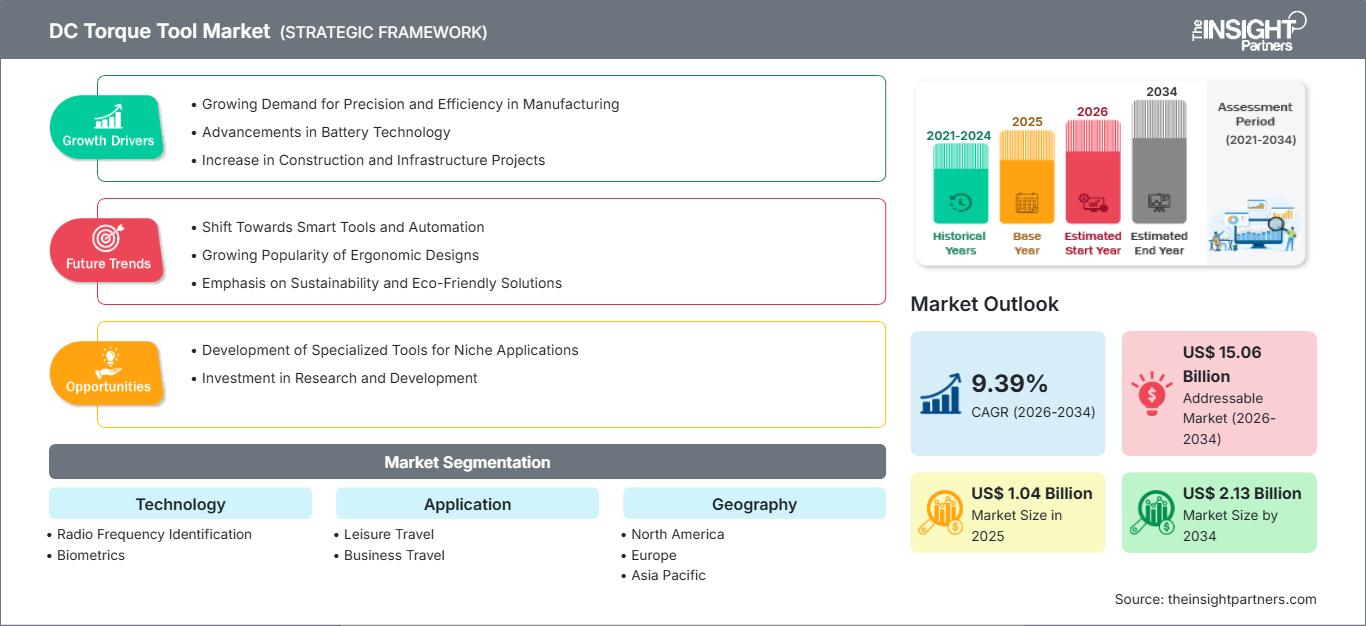
The DC Torque Tool Market stood at US$ 1.04 billion in 2025 and forecasted to touch US$ 2.13 billion by 2034; the market is predicted to have a CAGR of 9.39% during the forecast period, from 2026 to 2034. The demand for DC torque tools will be driven by fastening needs in a controlled environment due to traceability, repeatability, and assistance needed to assure quality programs.
North America continues to be the high value adopting region, with a CAGR estimated at 8.6-9.1% till 2034 due to the adoption of connected fastening systems by automotive, aerospace, and electronics industries. North America will contribute to the DC Torque Tool Market size with its modernizing factories due to reshoring trends, investments in batteries, and increased documentation requirements for safety critical joints.
DC Torque Tool Market Assessment and Insights
- North America held 31–34% share in 2025 and is growing at 8.6–9.1% CAGR between 2026–2034, supported by advanced assembly automation and strong aerospace certification discipline.
- US represented 76–79% of North America in 2025 and is growing at 8.7–9.2% CAGR between 2026–2034, led by EV and aerospace assembly lines.
- Europe accounted for 27–30% share in 2025 and is expanding at 8.2–8.8% CAGR between 2026–2034, with Germany, France, Italy, Spain, and the UK leading adoption.
- Asia Pacific captured 25–28% share in 2025 and is growing at 10.1–10.8% CAGR between 2026–2034, driven by China, Japan, South Korea, India, and Australia.
- Largest Segment Business Travel held 57–60% market share in 2025 and is growing at 8.8–9.3% CAGR between 2026–2034 due to enterprise-grade fastening control needs.
- High Growth Segment Biometrics held 44–47% market share in 2025 and is growing at 10.4–11.1% CAGR between 2026–2034 as identity-linked tool authorization expands.
- Key companies analyzed in detail: Atlas Copco AB, Apex Tool Group, LLC, Ingersoll Rand Inc., Stanley Black & Decker, Inc., Robert Bosch GmbH, Techtronic Industries Co. Ltd., Hilti Corporation, Makita Corporation, GEDORE Werkzeugfabrik GmbH & Co. KG, HAIMER GmbH.
Source: The Insight Partners' analysis based on proprietary research, government publications, company annual reports, investor presentations, industry databases, and expert interviews.
Buyers of manufacturing equipment have shifted from stand-alone electric fastening tools to interconnected fastening cells capable of capturing data such as torque, angle, operator identity, and job sequencing. The shift from individual electric fastening tools to fastening cells has led to changes in buying considerations within the market because purchasing departments are comparing the total cost of quality over tool price.
Over the forecast period, there will be increasing demand for DC torque tools in Mexico, India, Southeast Asia, and Central Europe because of localization of production as well as adoption of digital quality control systems. Replacement demand for DC torque tools will be driven by regulatory focus on safety, battery performance, and aircraft documentation. Manufacturers will also be making capital investments in modular workstation solutions, which will enable small manufacturers to use programmable tools without investing in whole production line overhauls.
DC Torque Tool Market Report Scope
| Report Attribute | Details |
|---|---|
| Market size in 2025 | US$ 1.04 Billion |
| Market Size by 2034 | US$ 2.13 Billion |
| Global CAGR (2026 - 2034) | 9.39% |
| Historical Data | 2021-2024 |
| Forecast period | 2026-2034 |
DC Torque Tool Market Analysis
Demand is growing due to the adoption by manufacturers of DC technology as a substitute for manual and pneumatic fastening to increase joint quality and minimize waste. DC Torque Tool Market growth is highest in applications, where a single mistake in fastening causes risk of warranty, recall costs, and downtime such as EV batteries, aircraft seats, housing of electronics products, and manufacturing assemblies of industrial machines.
Value chain consists of motor suppliers, transducer suppliers, control software suppliers, tool suppliers, calibration, and plant integration. Supply is favorable for firms that can offer a wide range of torque, repair service within their locality, and open protocol since customers need to connect their DC Torque Tools to MES, Quality Management, and Line Balancing software for fastener verification.
Competition in the market is moderately concentrated between Atlas Copco AB, Apex Tool Group, LLC, Ingersoll Rand Inc., and Stanley Black & Decker, Inc. which compete on accuracy, software, ergonomic design, and service support. Robert Bosch GmbH and Techtronic Industries Co. Ltd. complement their existing adjacent cordless solutions whereas Hilti Corporation, Makita Corporation, GEDORE Werkzeugfabrik GmbH & Co. KG, and HAIMER GmbH complement specialty demand.
The investments are shifting towards data platforms, battery efficiency, tool authentication, and controller compatibility. DC Torque Tool Market report reveals that companies with calibration services and installed base analysis can protect their margins more effectively than those which only offer hardware, especially because companies are now standardizing less number of tool brands in their plants worldwide.
● REPORT CUSTOMIZATION
Tailor This Report To Align With Your Specific Business Requirements
This report can be customized to align precisely with your business objectives, scope, and target markets. Customization options include tailored segmentation, geography, competitive analysis, and strategic insights to support informed decision-making.
Customize This Report →WHAT YOU CAN ADJUST
- ● Segmentations
- ● Geography
- ● Competitive Analysis
- ● Language Preferences
DC Torque Tool Market: Strategic Insights
Regional Insights
North America DC Torque Tool Market
North America held 31–34% share in 2025 and is expected to grow at 8.6–9.1% CAGR during 2026–2034. The region benefits from high automation density, aerospace qualification requirements, and automotive electrification programs that need documented fastening. The DC Torque Tool Market share in this region is supported by rapid adoption of connected controllers in Tier 1 and OEM assembly environments.
U.S. reshoring incentives, Mexican vehicle production, and Canadian aerospace clusters create a stable replacement cycle for programmable tools. Suppliers with local calibration, repair, and training capabilities gain preference because manufacturers cannot tolerate long downtime on validated lines. Wireless tools are also expanding where flexible stations must handle model variants without extensive cable routing.
U.S. DC Torque Tool Market
The USA holds 76–79% share of North America in 2025 and is anticipated to witness a CAGR of 8.7–9.2% till 2034. The applications are dominated by electric vehicle platforms, aerospace manufacture, heavy machinery and electronics assembly, where the need for precise fastening helps in compliance, reduction of warranties and consistency of process.
Applications are battery tray assembly, interior seats and airframes, semiconductors equipment, and medical device housings. There is an increased requirement for manufacturers to authorize tools, record torque angle, and connect plant networks. There is need for controllers that are compatible with manufacturing execution systems (MES), but help in changing of operations easily.
Europe DC Torque Tool Market
In Europe, the share for 2025 was 27-30%, and the growth from 2026 to 2034 is expected at 8.2-8.8% CAGR, and the key country in the region is Germany. The strength of the region is due to premium automotive assembly, aerospace industry chains, and machinery exports. Germany has high robot density and industry 4.0 implementation, while the UK has fasteners used for aerospace and defense industry.
The aircraft, railway and power generation equipment programs are sustained by France. The vehicle assembly, machinery export, and household appliance manufacture are provided by Italy and Spain. The buyers in the region pay great attention to the ergonomic features, traceability, and lifecycle service, which favors suppliers with calibrated documentation in different languages.
APAC DC Torque Tool Market
APAC had 25–28% of the market in 2025 and is estimated to witness growth of 10.1–10.8% CAGR from 2026 to 2034, thus being the fastest growing region. China dominates owing to the volume of its electric vehicles, batteries, and electronics, and Japan and South Korea have high precision assembly requirements.
India is becoming increasingly relevant as a manufacturing location thanks to localization strategies in automotive and electronics. Australia participates with mining and industrial maintenance equipment. The government support of advanced manufacturing facilities and export-oriented production with quality certifications encourages the implementation of connected tools that document all tightening processes.
Middle East & Africa DC Torque Tool Market
Middle East & Africa is projected to grow at 7.4–8.0% CAGR from 2026 to 2034. Saudi Arabia is the leading country as industrial diversification, energy infrastructure, and localized manufacturing create demand for calibrated fastening tools in maintenance and assembly environments.
The UAE supports demand through aerospace services, logistics equipment, and industrial zones, while South Africa remains important for automotive assembly and mining equipment. Rest of MEA adoption is project-driven, often linked to oil, gas, utilities, and infrastructure contractors that require repeatable bolting and documented service procedures.
Segmentation Analysis
Technology
Technology is expected to grow at 9.5–10.1% CAGR between 2026 and 2034 as factories link tool access, operator identity, and production traceability. The DC Torque Tool Market scope includes authentication and verification layers that reduce misuse, prevent unauthorized program changes, and improve accountability for safety-critical tightening jobs.
- Radio Frequency Identification supports controlled workstation access, tool-program selection, and component tracking. Demand is strongest where mixed-model production requires automatic recipe selection and reduced operator dependency.
- Biometrics is gaining strategic importance as manufacturers link operator identity to fastening records. It improves accountability in regulated assembly and supports controlled access for sensitive production tasks.
Application
Application is forecast to grow at 8.9–9.6% CAGR during 2026–2034 as end users adopt torque control across travel-related industrial workflows. Business travel-related manufacturing and service networks account for higher tool intensity, while leisure travel-linked applications expand through maintenance, equipment refurbishment, and transport infrastructure upgrades.
- Leisure Travel demand is linked to rail, recreational vehicles, marine equipment, and airport service assets, where maintenance teams need repeatable tightening and portable tools for distributed operations.
- Business Travel remains the largest application as aircraft, fleet vehicles, premium rail, and commercial transport assets require controlled fastening, uptime assurance, and documented maintenance across service networks.
Opportunity Snapshot
| Application | Revenue Contribution | Trend Tag | Adoption Stage |
| Leisure Travel | Medium | Fleet Service | Scaling |
| Business Travel | High | Audit Trails | Mature |
DC Torque Tool Market Growth Drivers and Impact Analysis
Traceability Requirements in Safety-Critical Assembly
Proving that every fastener is torqued to the right specification by a legitimate user with the right program has become essential in safety-sensitive manufacturing operations. This is clear in EV battery packs, aircraft interiors, brakes, and medical equipment. Connected DC power tools minimize the chances of a missing torqueing process, incorrect torque values, and rework without documentation. There is more of a market impact in areas where there is more risk with warranty implications because digital documentation speeds up root cause analysis.
Electrification of Automotive and Industrial Platforms
More fastening is required for electric cars, battery energy storage units, and electrification of industrial machines in relation to modules, bus bars, housings, and thermal components. Torque control is essential in such applications to prevent disconnection, vibrational loosening, or damage to the component. The advantage for tool manufacturers occurs when the customer increases assembly capacity as opposed to merely upgrading their existing tooling. With an increase in production lines for batteries, those who provide programmable controls, insulated tools, and data connectivity at the plant level will get repeat business.
Factory Digitalization and Workforce Standardization
Manufacturers are relying on digital work instructions, operator instructions, and automated inspections to minimize the variance in shift-to-shift and site-to-site manufacturing. Torque control systems meet this requirement through the ability of the controller to lock down the program, document results, and notify managers that a sequence has not been completed. The commercial significance of this driver goes beyond efficiency, as uniform fastener data allows comparisons between plants for multinational manufacturing companies.
DC Torque Tool Market Future Trends
AI-Assisted Tightening Quality Analytics
DC Torque Tool Market trends will increasingly center on predictive quality analytics that analyze torque curves, angle signatures, cycle time, and operator behavior. Instead of flagging only pass or fail outcomes, future platforms will identify abnormal patterns before failures reach final inspection. This shift can reduce destructive testing, improve first-pass yield, and help maintenance teams detect tool wear earlier. Vendors that combine domain expertise with secure analytics will become preferred partners for high-volume manufacturers.
Cordless Connected Tools for Flexible Cells
Future assembly lines will rely more on modular cells that change product variants without extensive retooling. Cordless connected DC tools are suited to these layouts because they reduce cable constraints while maintaining program control and traceability. Battery improvements, wireless communication reliability, and onboard storage will make cordless tools more acceptable for quality-critical jobs. This trend will also support field service and distributed maintenance teams that need production-grade documentation away from fixed workstations.
DC Torque Tool Market Opportunities
Localized Calibration and Lifecycle Service Networks
Suppliers can unlock stronger margins by expanding certified calibration, repair, rental, and training services near manufacturing clusters. DC Torque Tool Market Forecasts point to rising installed-base complexity as plants use more tool models, controllers, and authentication modules. Customers need fast turnaround, traceable calibration certificates, and application support to keep validated lines running. Service-led models can improve customer retention, create recurring revenue, and differentiate vendors in regions where hardware competitors compete mainly on price.
Mid-Market Automation Packages
Small and mid-sized manufacturers often need traceability but lack the budget for full automation projects. Vendors can address this gap with packaged workstations that combine a controller, tool, software dashboard, RFID access, and basic integration services. These packages reduce implementation risk and shorten payback periods for component makers, electronics assemblers, and maintenance workshops. The opportunity is especially relevant in emerging industrial regions where quality requirements are rising faster than automation budgets.
Recent Developments
- August 2025: Kyocera Unimerco introduced the DTD500 electric insert driver, combining screwdriver and torque wrench functions in a single tool to improve machining efficiency. The solution enables faster insert replacement, precise torque adjustment up to 5 N·m, and reduced variation in tightening operations, helping manufacturers improve productivity and accuracy during tool maintenance processes.
- September 2025: Panasonic launched the AccuPulse 4+ cordless torque tool, introducing advanced snug torque detection and intelligent buffering technology for precision assembly operations. The tool improves fastening accuracy by identifying the snug point before final torque application, while enhanced software controls, wireless data management, and batch tracking capabilities help manufacturers reduce rework, improve quality assurance, and increase productivity in high-mix production environments.
- March 2026: Atlas Copco introduced the XB range of cordless assembly tools, including mechanical clutch and torque transducer models designed for smart manufacturing applications. The tools provide improved tightening precision, real-time OK/NOK feedback, torque control, and angle monitoring while offering cordless mobility for flexible production environments. The solution helps manufacturers enhance assembly quality, reduce errors, and support the transition toward connected and efficient manufacturing operations.
Frequently Asked Questions

- Comprehensive Market Sizing and Forecast Analysis
- Detailed Segmentation Analysis
- In-Depth Market Dynamics Assessment
- Regional and Country-Level Insights
- Competitive Landscape and Company Benchmarking
- Strategic Business Intelligence
Recent Reports
Testimonials

The Insight Partners' SCADA System Market report is comprehensive, with valuable insights on current trends and future forecasts. The team was highly professional, responsive, and supportive throughout. We are very satisfied and highly recommend their services.
RAN KEDEM Partner, Reali Technologies LTDs
I requested a report on a very specific software market and the team produced the report in a few days. The information was very relevant and well presented. I then requested some changes and additions to the report. The team was again very responsive and I got the final report in less than a week.
JEAN-HERVE JENN Chairman, Future Analytica
We worked with The Insight Partners for an important market study and forecast. They gave us clear insights into opportunities and risks, which helped shape our plans. Their research was easy to use and based on solid data. It helped us make smart, confident decisions. We highly recommend them.
PIYUSH NAGPAL Sr. Vice President, High Beam Global
The Insight Partners delivered insightful, well-structured market research with strong domain expertise. Their team was professional and responsive throughout. The user-friendly website made accessing industry reports seamless. We highly recommend them for reliable, high-quality research services
YUKIHIKO ADACHI CEO, Deep Blue, LLC.
This is the first time I have purchased a market report from The Insight Partners.While I was unsure at first, I visited their web site and felt more comfortable to take the risk and purchase a market report.I am completely satisfied with the quality of the report and customer service. I had several questions and comments with the initial report, but after a couple of dialogs over email with their analyst I believe I have a report that I can use as input to our strategic planning process.Thank you so much for taking the extra time and making this a positive experience.I will definitely recommend your service to others and you will be my first call when we need further market data.
JOHN SUZUKI President and Chief Executive Officer, Board Director, BK Technologies
I wish to appreciate your support and the professionalism you displayed in the course of attending to my request for information regarding to infectious disease IVD market in Nigeria. I appreciate your patience, your guidance, and the fact that you were willing to offer a discount, which eventually made it possible for us to close a deal. I look forward to engaging The Insight Partners in the future, all thanks to the impression you have created in me as a result of this first encounter.
DR CHIJIOKE ONYIA MANAGING DIRECTOR, PineCrest Healthcare Ltd.Reason to Buy
- Informed Decision-Making
- Understanding Market Dynamics
- Competitive Analysis
- Identifying Emerging Markets
- Customer Insights
- Market Forecasts
- Risk Mitigation
- Boosting Operational Efficiency
- Strategic Planning
- Investment Justification
- Tracking Industry Innovations
- Aligning with Regulatory Trends





 Get Free Sample for