
Decentralized Identity Market Size, Growth & Demand by 2034
Decentralized Identity Market Size and Forecasts (2021–2034), Global and Regional Share, Trends, and Growth Opportunity Analysis Report Coverage : By Identity Type (Biometrics, Non-biometrics), End User(Individual, Enterprises), Organization Size(Large Enterprise and SMEs), Vertical (BFSI, Government, Healthcare and Life Sciences, Retail and eCommerce, Telecom and IT, Transport and Logistics, Real Estate)
- Status : Data Released
- Report Code : TIPRE00039810
- Category : Electronics and Semiconductor
- No. of Pages : 150
- Available Report Formats :


- Last update date : August 10, 2026


2025 Market Size
US$ 1.46 Bn
Base year value
2034 Forecast
US$ 6.36 Bn
Projected by 2034
CAGR 2026-2034
17.76 %
Growth rate
Addressable Market
US$ 32.48 Bn
(2026-2034)
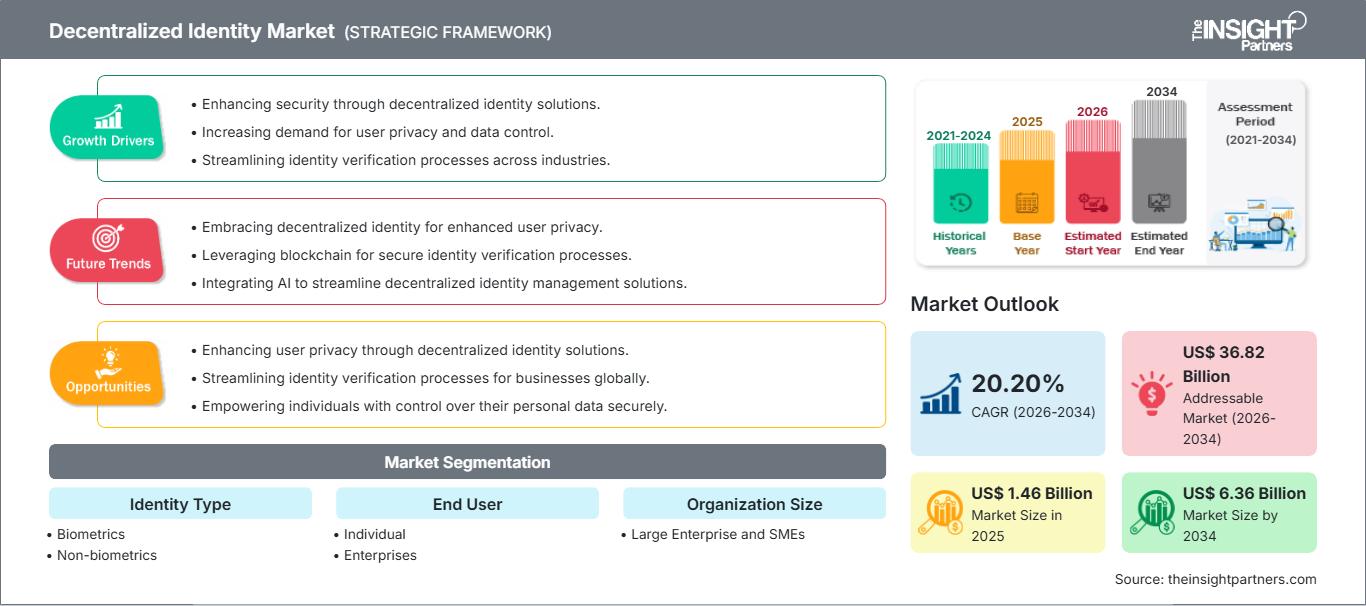
The Decentralized Identity market was valued at US$ 1.46 billion in 2025 and is expected to reach US$ 6.36 billion by 2034; it is estimated to record a CAGR of 17.76% during 2026-2034.
Decentralized Identity Market Assessment and Insights
- North America held 34–36% share in 2025 and is growing at a CAGR of 19–22% between 2026–2034, driven by banking identity modernization, healthcare credential portability, and public-sector digital identity frameworks.
- US accounted for 76–79% of North America in 2025 and is growing at a CAGR of 18–21% between 2026–2034, supported by enterprise identity security budgets.
- Europe captured 27–29% share in 2025 and is growing at a CAGR of 20–23% between 2026–2034, led by Germany, the UK, France, Spain, and Italy as digital wallet regulation accelerates.
- Asia Pacific represented 21–24% share in 2025 and is growing at a CAGR of 22–25% between 2026–2034, with China, India, Japan, South Korea, and Australia expanding digital public infrastructure.
- Largest Segment Enterprises held 61–64% market share in 2025 and is growing at a CAGR of 19–22% between 2026–2034 as organizations prioritize reusable credentials.
- High Growth Segment Biometrics held 43–46% market share in 2025 and is growing at a CAGR of 22–25% between 2026–2034 amid demand for stronger assurance.
- Key companies analyzed in detail: Microsoft Corporation, Accenture plc, Wipro Limited, SecureKey Technologies Inc., Persistent Systems Limited, Avast Software s.r.o., Civic Technologies, Inc., R3 LLC, Validated ID, S.L., Dragonchain, Inc.
Source: The Insight Partners' analysis based on proprietary research, government publications, company annual reports, investor presentations, industry databases, and expert interviews.
The process of technology evolution is changing the identity production process from centralized identity directories to issuer-holder-verifier models. Open standards for decentralized identifiers and verifiable credentials cut down reliance on proprietary identity repositories, and the use of wallets for proof submission minimizes data collection. In addition, the process of identity production is evolving as integrators provide services that bundle credential issuance, wallet management, governance, and verification APIs.
Future growth drivers will come from Asia Pacific public identity programs, European digital wallet mandates, and North American workforce security spending. The spending will probably be focused on interoperability, fraud detection, biometric binding, and reusable KYC infrastructure. Privacy regulation winds and the use of cross-border credential frameworks will probably result in decentralized identity becoming an essential infrastructure layer for digital finance, healthcare access, educational records, travel, and enterprise onboarding.
Decentralized Identity Market Report Scope
| Report Attribute | Details |
|---|---|
| Market size in 2025 | US$ 1.46 Billion |
| Market Size by 2034 | US$ 6.36 Billion |
| Global CAGR (2026 - 2034) | 17.76% |
| Historical Data | 2021-2024 |
| Forecast period | 2026-2034 |
Decentralized Identity Market Analysis
Demand for growth of the Decentralized Identity Marketplace is supported by the increasing expense of account takeover attacks, synthetic identity fraud, and repetitive verification. Reusable credentials are becoming more popular as enterprises do not need to store any unnecessary personal data in order to validate employment, age, education, or customer eligibility.
The market consists of issuers (governments and employers), holders who use digital wallets, verifiers (banks and healthcare organizations), and platform providers providing credential lifecycle management services. Growth in supply is provided by cloud identity solutions, blockchain platforms, systems integration companies, trust registries, and standards organizations that allow interoperability of sector-specific credential exchanges.
Decentralized Identity Market analysis reveals that the competitive environment is bifurcated into enterprise identity platforms, consultancy-driven transformation solution providers, and specialized wallet or credentials providers. Managed verifiable credentials service is being developed by Microsoft Corporation, whereas Accenture plc and Wipro Limited offer enterprise architecture and implementation for large projects.
On the other hand, SecureKey Technologies Inc., Civic Technologies, Inc., Validated ID, S.L., and Dragonchain, Inc. target specialized applications through solutions such as consent, digital signature, identity proofing, and blockchain-based credentials exchange. Enterprise-level infrastructure is being targeted by R3 LLC and Persistent Systems Limited, whereas consumer trust and privacy provided by Avast Software s.r.o. can help wallet adoption.
● REPORT CUSTOMIZATION
Tailor This Report To Align With Your Specific Business Requirements
This report can be customized to align precisely with your business objectives, scope, and target markets. Customization options include tailored segmentation, geography, competitive analysis, and strategic insights to support informed decision-making.
Customize This Report →WHAT YOU CAN ADJUST
- ● Segmentations
- ● Geography
- ● Competitive Analysis
- ● Language Preferences
Decentralized Identity Market: Strategic Insights
Regional Insights
North America Decentralized Identity Market
North America captured 34–36% of the global revenue share in 2025 and had the largest Decentralized Identity Market share across all regions. North America will continue growing at a CAGR of 19–22% from 2026 to 2034 owing to adoption of verifiable credentials in the banking sector, healthcare networks, and educational institutes to make onboarding smoother and enable reuse of eligibility checks in privacy-friendly ways.
The drivers in the region include the development of cloud identity infrastructure, robust venture capital investments for cyber-security solutions, and government interests in mobile driver licenses and workforce credentials. The high enterprise cybersecurity spending in North America further facilitates commercial deployment of credential issuance, identity proofing, and identity verification services.
U.S. Decentralized Identity Market
The United States held a market share of 76–79% in North America in 2025 and is projected to witness growth of 18–21% CAGR until 2034. There is high penetration among financial institutions, enterprise employee identity, healthcare credentialing, educational credentialing, and age validation, wherein reusable credentials streamline the onboarding process without compromising sensitive attributes.
Companies such as Microsoft Corporation, Civic Technologies, Inc., R3 LLC, Dragonchain, Inc., and Persistent Systems Limited have significant commercial and delivery presence in the United States and support application trends including passwordless authentication, KYC re-use, supply chain identity, and regulated data exchange. Enterprise customers prefer solutions which can integrate within existing IAM, fraud management, compliance, and zero trust security frameworks.
Europe Decentralized Identity Market
Europe had a market share of 27–29% in 2025 and is expected to witness growth at 20–23% CAGR from 2026 to 2034. Germany has been leading the market driven by regulations for digital identity wallet, need for bank compliance, and industrial trust framework. In the UK, reuse of credentials is being driven in financial onboarding, employment, and education verification.
France, Italy, and Spain are working on digitizing their public services, digital signatures, healthcare access, and cross-border trust services. Validated ID, S.L. augments the specialized player ecosystem in Europe, whereas Accenture plc, Wipro Limited, and Microsoft Corporation enable large-scale transformation projects. The requirement for interoperability drives demand for conformance testing, wallet management, and credential revocation capabilities.
APAC Decentralized Identity Market
The APAC region held a market share of 21-24% in 2025 and is forecasted to record a 22-25% CAGR up to 2034, thus becoming the fastest growing regional cluster. China dominates the market in terms of size, whereas India, Japan, South Korea, and Australia develop digital public infrastructure, payment identities, and work force verification.
The factors driving policies include the development of national digital identities, digitization of cross-border trade, and data protection requirements. The industry requirements are evident in the field of telecom enrollment, logistics documentation, real estate transactions, and healthcare services. The regional trends are associated with the preference for mobile wallets, API-based authentication and managed services.
Middle East & Africa Decentralized Identity Market
Middle East and Africa is expected to grow at an 18–21% CAGR from 2026 to 2034. Saudi Arabia and the UAE lead regional adoption through smart government, digital finance, travel, and infrastructure modernization. South Africa is developing enterprise and public-service opportunities, while the rest of MEA remains early stage.
Energy, construction, aviation, and logistics projects require reliable verification of contractors, suppliers, and workforce credentials. Identity wallets can reduce manual documentation in mega-projects and cross-border mobility. Adoption depends on cloud readiness, trust-framework governance, local data residency, and integration with national identity systems already used for citizen services.
Segmentation Analysis
Identity Type
Identity Type is projected to grow at a 20–23% CAGR from 2026 to 2034 as organizations combine biometric assurance with non-biometric credential proofs. The Decentralized Identity Market scope in this segment is shaped by risk-based verification, wallet usability, and privacy rules that determine how much personal data is disclosed during authentication.
- Biometrics supports high-assurance onboarding, liveness checks, and account recovery where organizations need stronger proof of presence, making it strategically important for banking, travel, healthcare, and regulated workforce access.
- Non-biometrics remains essential for document credentials, employment records, education certificates, and entitlement proofs where privacy, portability, and interoperability are prioritized over continuous biometric verification.
End User
End User is expected to grow at a 19–22% CAGR from 2026 to 2034, led by enterprises that need reusable verification and lower data liability. Individuals gain value from consent-based credential sharing, but enterprise procurement drives larger deployments because identity controls directly affect fraud loss, compliance cost, and customer onboarding efficiency.
- Individual adoption is linked to wallet convenience, trust in issuers, and recognizable use cases such as age checks, education certificates, employment credentials, and healthcare access permissions.
- Enterprises dominate procurement because they need verified workforce, customer, supplier, and partner identities across digital channels while reducing repeated KYC, manual checks, and stored personal information.
Organization Size
Organization Size is projected to grow at a 20–22% CAGR from 2026 to 2034. Large enterprises lead because they operate complex identity estates and high-volume verification processes. SMEs are gradually adopting through cloud-based identity services, embedded verification APIs, and wallet-ready customer journeys that reduce implementation burden.
- Large Enterprise demand is concentrated in banking, telecom, healthcare, logistics, and government contracting where identity assurance, auditability, and integration with existing IAM platforms are essential.
- SMEs favor packaged verification tools, lower-cost onboarding automation, and partner-led deployments that allow them to accept trusted credentials without building full identity infrastructure internally.
Vertical
Vertical is expected to grow at a 20–23% CAGR from 2026 to 2034 as regulated industries move identity verification closer to the user. BFSI leads current spending, while government, healthcare, telecom, transport, and real estate create specialized credential workflows tied to authorization, licensing, eligibility, and transaction integrity.
- BFSI uses reusable credentials for KYC, account opening, fraud reduction, and high-value transaction assurance, making it the most commercially mature vertical for decentralized verification.
- Government adoption centers on citizen wallets, permits, benefits, licenses, and cross-agency credential exchange where trust frameworks and legal recognition determine implementation speed.
- Healthcare and Life Sciences demand is shaped by patient identity, provider credentials, consent management, trial participation, and secure access to sensitive health records.
- Retail and eCommerce applies credential verification to age-restricted goods, loyalty programs, fraud screening, returns management, and privacy-focused customer account recovery.
- Telecom and IT uses decentralized credentials for SIM registration, workforce access, developer identity, device trust, and customer onboarding across digital service platforms.
- Transport and Logistics benefits from verified driver credentials, shipment documentation, customs workflows, supplier identity, and secure access across multimodal trade networks.
- Real Estate applies credential proofs to tenant screening, broker licensing, property transactions, title workflows, and digital notarization where trust and audit evidence are critical.
Opportunity Snapshot
| Vertical | Revenue Contribution | Trend Tag | Adoption Stage |
| BFSI | High | Reusable KYC | Scaling |
| Government | High | Citizen Wallets | Scaling |
| Healthcare and Life Sciences | Medium | Patient Proofs | Scaling |
| Retail and eCommerce | Medium | Age Checks | Emerging |
| Telecom and IT | Medium | Device Trust | Scaling |
| Transport and Logistics | Medium | Trade Credentials | Emerging |
| Real Estate | Low | Title Proofs | Emerging |
Decentralized Identity Market Growth Drivers and Impact Analysis
Regulated Digital Onboarding Requires Reusable Trust
Financial institutions, healthcare providers, telecom carriers, and governments are shifting from one-time verifications of documents to reusable verification processes of credentials. This driver affects the market directly as each onboarding process results in cost, auditability, and potential risk of fraud. Decentralized credentials make it possible for users to validate their claims without forcing each of the verifiers to keep the same sensitive information. With the shift of customer acquisition online, businesses can lower the number of abandonments that result from re-verification of identities. This use case fits the Decentralized Identity Market well as frequent verifications are common there.
Privacy Regulation Pushes Data Minimization by Design
Identity architecture is undergoing evolution through privacy legislation, with unnecessary storage of data becoming an economic and regulatory burden. Decentralized identities enable selective sharing whereby a user may verify their age, employment, qualifications, or eligibility without having to share the whole document. This creates a new economic dynamic for enterprises whereby verification becomes more about a matter of trust and not data gathering. Consent management, revocation checks, wallet management, and policy-based disclosure services stand to benefit from the demand created through regulation. The effect will be most felt in Europe and North America due to their privacy legislations.
Standards Maturity Improves Enterprise Procurement Confidence
The adoption of verifiable credentials and decentralized identifiers standards creates more chances for avoiding the problem of vendor lock-in, which had become one of the main obstacles to enterprise procurement. In the case of interoperability between issuers, wallets, and verifiers, companies can implement their own identity workflows without obligating all partners to use the same technology. It increases addressable demand, shifting the focus from siloed pilots to multi-party networks with participation of banks, employers, universities, departments of governments, and supply chain entities. The Decentralized Identity Market benefits from such developments due to procurement justification through interoperability and future-proofing.
Decentralized Identity Market Future Trends
Wallets Become Embedded in Everyday Digital Journeys
Decentralized Identity Market trends point to identity wallets becoming embedded inside banking apps, employee portals, telecom onboarding, healthcare access, and government service channels rather than operating as separate niche tools. This shift will make credential presentation feel like a normal authentication step. Future competition will focus on wallet recovery, biometric binding, issuer trust marks, and low-friction user consent. As more organizations accept reusable claims, wallet value rises through network effects, encouraging consumers and employees to maintain verified credentials for multiple high-frequency transactions across sectors.
Machine and Agent Identity Expands the Addressable Base
The next phase will extend decentralized identity beyond people to software agents, devices, robots, and connected assets. Enterprises deploying AI agents will need verifiable authority, delegated permissions, and auditable actions tied to non-human identities. Industrial IoT, logistics, and energy infrastructure will also require trusted credentials for machines exchanging data or initiating transactions. This expansion creates new demand for credential lifecycle management, policy engines, revocation registries, and event logging that can prove which digital entity acted, under whose authorization, and within which operational limits.
Decentralized Identity Market Opportunities
Reusable KYC Networks for Financial Institutions
Reusable KYC networks represent a high-value opportunity because banks, fintechs, insurers, and payment providers repeatedly verify the same customers across similar risk controls. Decentralized Identity Market Forecasts indicate that investment will concentrate on issuer accreditation, liability models, fraud analytics, and compliance-grade audit trails. Institutions that collaborate on trusted credential exchange can reduce duplicate verification costs while improving customer conversion. The strongest action point is to build sector-specific trust frameworks that define who may issue credentials, how claims are refreshed, and how revoked or expired credentials are handled.
Credential Infrastructure for Cross-Border Workforce Mobility
Cross-border workforce mobility creates an actionable opportunity for employers, governments, education bodies, and certification authorities. Verified credentials can shorten checks for qualifications, right-to-work status, professional licenses, safety training, and employment history. This matters in healthcare, construction, aviation, logistics, and technology services, where labor shortages make rapid verification commercially important. Vendors can capture value by connecting credential issuers with employer verification systems, applicant tracking tools, and immigration workflows. The most attractive models combine wallet issuance, consent management, fraud screening, and standards-based credential exchange.
Recent Developments
- June 2026: LF Decentralized Trust announced Panurus as a new incubating project to advance enterprise tokenization. Evolving from the Hyperledger Fabric Token SDK, Panurus provides reusable, vendor-neutral infrastructure for managing tokenized assets on permissioned blockchain networks, helping accelerate enterprise blockchain adoption.
- March 2023: Ping Identity launched PingOne Neo, a decentralized identity management solution that gives users greater control over their digital identities. Built on decentralized identity principles, the platform enhances privacy and security while enabling organizations to verify credentials without centrally storing sensitive personal data.
- August 2024: Dai Nippon Printing (DNP) introduced the DNP Decentralized ID Management Platform for issuing and verifying decentralized digital credentials. The platform supports Decentralized IDs (DIDs) and Verifiable Credentials (VCs), enabling secure digital identity management for enterprises and public-sector organizations.
Frequently Asked Questions

- Comprehensive Market Sizing and Forecast Analysis
- Detailed Segmentation Analysis
- In-Depth Market Dynamics Assessment
- Regional and Country-Level Insights
- Competitive Landscape and Company Benchmarking
- Strategic Business Intelligence
Recent Reports
Testimonials

The Insight Partners provided valuable market intelligence that supported our global go-to-market strategy. Their team was professional, responsive, and attentive to our feedback, providing thoughtful analysis and helpful methodological clarifications throughout the project.
Junmo Kim Chief Financial Officer (CFO), Enertech Co., Ltd.
The Insight Partners' SCADA System Market report is comprehensive, with valuable insights on current trends and future forecasts. The team was highly professional, responsive, and supportive throughout. We are very satisfied and highly recommend their services.
RAN KEDEM Partner, Reali Technologies LTDs
I requested a report on a very specific software market and the team produced the report in a few days. The information was very relevant and well presented. I then requested some changes and additions to the report. The team was again very responsive and I got the final report in less than a week.
JEAN-HERVE JENN Chairman, Future Analytica
We worked with The Insight Partners for an important market study and forecast. They gave us clear insights into opportunities and risks, which helped shape our plans. Their research was easy to use and based on solid data. It helped us make smart, confident decisions. We highly recommend them.
PIYUSH NAGPAL Sr. Vice President, High Beam Global
The Insight Partners delivered insightful, well-structured market research with strong domain expertise. Their team was professional and responsive throughout. The user-friendly website made accessing industry reports seamless. We highly recommend them for reliable, high-quality research services
YUKIHIKO ADACHI CEO, Deep Blue, LLC.
This is the first time I have purchased a market report from The Insight Partners.While I was unsure at first, I visited their web site and felt more comfortable to take the risk and purchase a market report.I am completely satisfied with the quality of the report and customer service. I had several questions and comments with the initial report, but after a couple of dialogs over email with their analyst I believe I have a report that I can use as input to our strategic planning process.Thank you so much for taking the extra time and making this a positive experience.I will definitely recommend your service to others and you will be my first call when we need further market data.
JOHN SUZUKI President and Chief Executive Officer, Board Director, BK Technologies
I wish to appreciate your support and the professionalism you displayed in the course of attending to my request for information regarding to infectious disease IVD market in Nigeria. I appreciate your patience, your guidance, and the fact that you were willing to offer a discount, which eventually made it possible for us to close a deal. I look forward to engaging The Insight Partners in the future, all thanks to the impression you have created in me as a result of this first encounter.
DR CHIJIOKE ONYIA MANAGING DIRECTOR, PineCrest Healthcare Ltd.Reason to Buy
- Informed Decision-Making
- Understanding Market Dynamics
- Competitive Analysis
- Identifying Emerging Markets
- Customer Insights
- Market Forecasts
- Risk Mitigation
- Boosting Operational Efficiency
- Strategic Planning
- Investment Justification
- Tracking Industry Innovations
- Aligning with Regulatory Trends





 Get Free Sample for