
Delta-Sigma Modulator Market Size, Growth & Trends by 2034
Coverage: By Type (External, Built-in); Application (Automotive, Consumer Electronics, IT and Telecommunications, Healthcare Industrial, Others) , and Geography (North America, Europe, Asia Pacific, and South and Central America)
- Status : Data Released
- Report Code : TIPRE00020261
- Category : Electronics and Semiconductor
- No. of Pages : 150
- Available Report Formats :


- Last update date : August 10, 2026


2025 Market Size
US$ 1.32 Bn
Base year value
2034 Forecast
US$ 2.8 Bn
Projected by 2034
CAGR 2026-2034
8.65 %
Growth rate
Addressable Market
US$ 18.40 Bn
(2026-2034)
The Delta-Sigma Modulator market size is forecast to rise from US$ 1.32 billion in 2025 to US$ 2.8 billion by 2034, with a compound annual growth rate of 8.65% for the period 2026–2034. This will be driven by the demand for high resolution signal processing and sensing in automotive applications, consumer electronics, IT and telecommunications, healthcare, and industrial sectors.
According to the Delta-Sigma Modulator Market forecast, North America continues to play an important structural role as a demand center, with a forecast compound annual growth rate (CAGR) between 7.8% and 8.4% during 2026–2034, driven by applications such as automotive electrification, industrial automation, and semiconductor fabrication programs.
Delta-Sigma Modulator Market Assessment and Insights
- North America held 31–34% share in 2025 and is growing at a CAGR range of 7.8–8.4% during 2026–2034, supported by EV platforms, factory automation, and medical electronics procurement.
- US accounted for 78–82% of North America in 2025 and is growing at a CAGR range of 7.9–8.5% during 2026–2034.
- Europe held 22–25% share in 2025 and is growing at a CAGR range of 7.1–7.8% during 2026–2034, led by Germany, the UK, France, Italy, and Spain.
- Asia Pacific held 35–38% share in 2025 and is growing at a CAGR range of 9.2–10.0% during 2026–2034, with China, Japan, South Korea, India, and Taiwan supporting manufacturing scale.
- Largest Segment Built-in modulators held 62–66% market share in 2025 and are growing at a CAGR range of 8.3–8.9% during 2026–2034.
- High Growth Segment Automotive held 24–28% market share in 2025 and is growing at a CAGR range of 9.4–10.2% during 2026–2034.
- Key companies analyzed in detail: Texas Instruments Incorporated, Analog Devices, Inc., Qualcomm Incorporated, NXP Semiconductors N.V., NI, Infineon Technologies AG, Richtek Technology Corporation, Taiwan Semiconductor Co., Ltd., Ozic Co., Ltd., and Taiwan Semiconductor Manufacturing Company Limited.
Source: The Insight Partners' analysis based on proprietary research, government publications, company annual reports, investor presentations, industry databases, and expert interviews.
The migration of technology is driving the demand for integrated mixed-signal components that incorporate isolators, filters, and digital interfaces instead of separate signal-conditioning boards. Applications such as automotive traction inverters, battery-management systems, precision motor drives, and medical monitoring systems need stable conversion through noisy environments. The production landscape is influenced by foundry constraints, analog expertise, and packaging strategies that save board real estate while providing thermal stability.
During the forecast period, new geographies will see opportunities arise owing to electronics localization, electric vehicle manufacturing, grid investments, and widespread use of industrial sensors. Energy efficiency and vehicle safety requirements will promote reliable components offering predictable accuracy. Component suppliers that offer automotive-qualified products, regional availability, and design-in references will be rewarded with design wins.
Delta-Sigma Modulator Market Report Scope
| Report Attribute | Details |
|---|---|
| Market size in 2025 | US$ 1.32 Billion |
| Market Size by 2034 | US$ 2.8 Billion |
| Global CAGR (2026 - 2034) | 8.65% |
| Historical Data | 2021-2024 |
| Forecast period | 2026-2034 |
Delta-Sigma Modulator Market Analysis
Demand in the market growth cycle is driven by higher sensor density, EV current measurement, industrial automation, and medical signal acquisition. Oversampling and noise shaping allow designers to extract accurate low-frequency signals in electrically noisy environments, which is essential for motor control, audio processing, and battery diagnostics.
The value chain includes analog IP design, wafer fabrication, packaging, calibration, module integration, and OEM qualification. Supply dynamics favor companies with proven mixed-signal libraries, automotive-grade reliability, and long product lifecycles. Foundry partnerships are increasingly relevant because built-in conversion blocks must align with power, thermal, and digital interface requirements.
Competitive intensity is led by Texas Instruments Incorporated, Analog Devices, Inc., Infineon Technologies AG, NXP Semiconductors N.V., and Qualcomm Incorporated, while NI and Richtek Technology Corporation strengthen test, measurement, and power-management adjacency. This Delta-Sigma Modulator Market analysis indicates that portfolio breadth, isolation performance, and design support shape customer retention.
Investment is moving toward low-power architectures, embedded diagnostic features, and application-specific reference platforms. Analog Devices, Inc. now includes Maxim Integrated assets, expanding precision signal-chain depth. Taiwan Semiconductor Manufacturing Company Limited supports the broader ecosystem through advanced manufacturing services, while Taiwan Semiconductor Co., Ltd. participates in adjacent discrete and power semiconductor demand.
● REPORT CUSTOMIZATION
Tailor This Report To Align With Your Specific Business Requirements
This report can be customized to align precisely with your business objectives, scope, and target markets. Customization options include tailored segmentation, geography, competitive analysis, and strategic insights to support informed decision-making.
Customize This Report →WHAT YOU CAN ADJUST
- ● Segmentations
- ● Geography
- ● Competitive Analysis
- ● Language Preferences
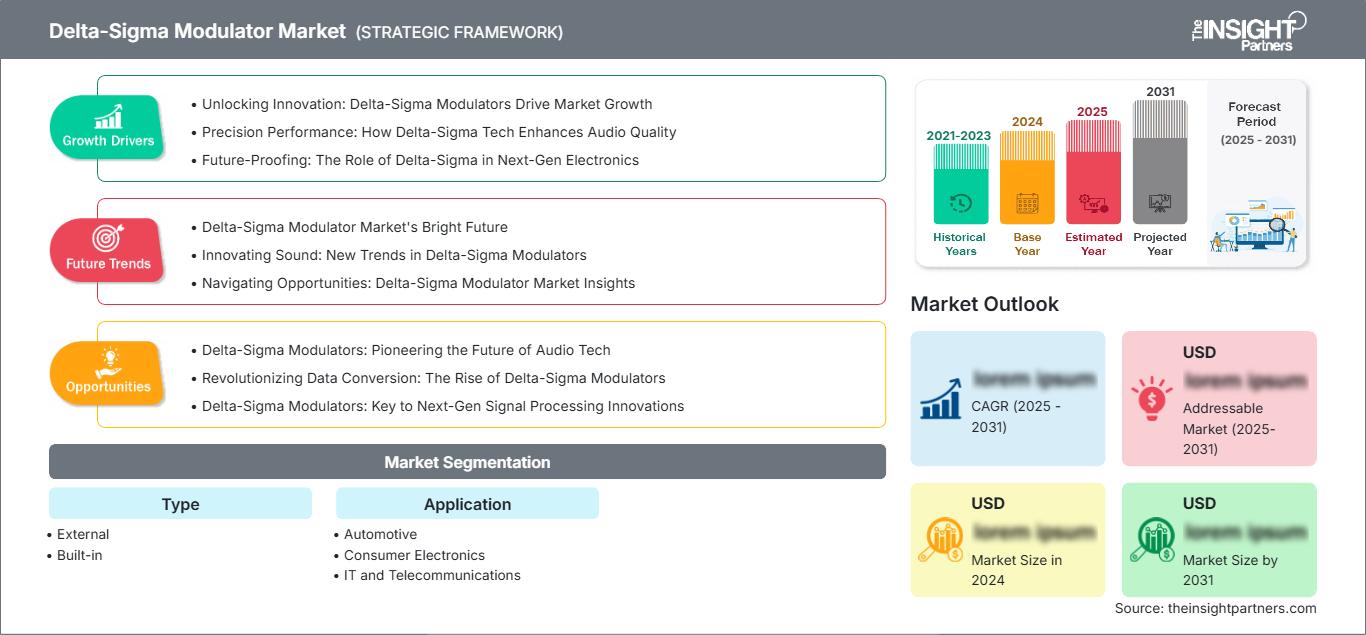
Delta-Sigma Modulator Market: Strategic Insights
Regional Insights
North America Delta-Sigma Modulator Market
North America represented 31–34% share in 2025 and is forecast to grow at a 7.8–8.4% CAGR range through 2034. The Delta-Sigma Modulator Market share is supported by EV platforms, aerospace instrumentation, factory automation, and semiconductor reshoring incentives that increase demand for resilient analog signal chains.
Automotive and industrial customers prioritize isolated current measurement, vibration sensing, and precision temperature monitoring. Regional demand also benefits from medical devices, data centers, and test equipment, where low drift and reliable conversion remain procurement priorities. Supplier proximity improves engineering support during qualification cycles.
U.S. Delta-Sigma Modulator Market
The US held 78%-82% share in North America in 2025 and is projected to register CAGR in the range of 7.9%-8.5% in 2026-2034. The application requirements include EV Power Electronics, Industrial Drives, Precision Healthcare, and High-Frequency Audio Electronics requiring Digitization accuracy.
Texas Instruments Incorporated, Analog Devices, Inc., Qualcomm Incorporated, NI, and NXP Semiconductors N.V. have robust US engineering and customer support network. The company offerings include Isolated ADCs, Embedded Modulator IP, Signal Processing near RF, and test flows of OEMs that are validating their electronics with high accuracy.
Europe Delta-Sigma Modulator Market
The Europe region has an estimated market share of 22–25%, which is forecasted to have a 7.1–7.8% CAGR. Germany takes the lead due to the precision signal conversion required in automotive electronics, industrial automation, and powertrain testing applications. The UK helps in the procurement of instruments, aerospace electronics, and medical electronics.
France, Italy, and Spain add value through industrial controls, renewable energy generation systems, and rail electrification projects. Infineon Technologies AG and NXP Semiconductors N.V. increase the design influence within the region, while European OEMs prioritize long-term availability and system safety documentation.
APAC Delta-Sigma Modulator Market
In 2025, APAC accounted for a 35%–38% share and was expected to grow at a CAGR of 9.2% to 10.0%, driven by China. Japan and South Korea make contributions in terms of demand from automobiles, robotics, and consumer electronics; meanwhile, India and Australia make contributions in terms of industrial automation and energy infrastructure.
The support from policies for local semiconductor industry and electric vehicles supply chain encourages design activities. Taiwan Semiconductor Manufacturing Company Limited enhances its capability for fabricating mixed-signal ICs, and the regional electronics manufacturers use in-built modulators to cut down space on boards.
Middle East & Africa Delta-Sigma Modulator Market
Middle East and Africa is smaller but is growing at a 6.2–6.9% CAGR range through 2034, led by Saudi Arabia and the UAE. Energy automation, grid monitoring, and infrastructure modernization support selective use of precision signal-conversion components.
South Africa adds industrial controls and mining automation demand, while Rest of MEA adopts electronics for utilities, transport, and healthcare equipment. Growth is linked to imported modules, distributor-led technical support, and long replacement cycles in industrial assets.
Segmentation Analysis
Type
The Type segment is expected to grow at a 8.1–8.8% CAGR range during 2026–2034. The market scope across type categories reflects the balance between standalone precision devices and built-in conversion blocks used inside compact mixed-signal systems.
- External devices remain relevant in high-isolation industrial drives, laboratory instruments, and retrofit systems where designers need independent component selection, easier validation, and predictable analog performance.
- Built-in modulators dominate compact electronics because embedded conversion reduces board area, simplifies digital interfaces, lowers system power, and supports scalable production across automotive and consumer platforms.
Application
The Application segment is forecast to grow at a 8.5–9.2% CAGR range during 2026–2034. Adoption is strongest where analog signals must be digitized accurately despite heat, vibration, electromagnetic noise, or space limitations, making application-specific qualification a central purchasing factor.
- Automotive demand is tied to EV inverters, battery management, onboard charging, and advanced safety electronics that require isolated current sensing and robust performance over wide temperatures.
- Consumer Electronics uses modulators in audio codecs, wearables, smart devices, and compact peripherals where low power, small area, and consistent signal quality influence product differentiation.
- IT and Telecommunications demand arises from infrastructure monitoring, RF-adjacent signal chains, and network equipment that need precise conversion for diagnostics, synchronization, and power-management feedback.
- Healthcare Industrial combines medical monitoring, imaging support, process control, robotics, and instrumentation, where measurement integrity and reliability justify higher-specification mixed-signal components.
Opportunity Snapshot
| Application | Revenue Contribution | Trend Tag | Adoption Stage |
| Automotive | High | EV Sensing | Scaling |
| Consumer Electronics | High | Premium Audio | Mature |
| IT and Telecommunications | Medium | Network Sync | Scaling |
| Healthcare Industrial | Medium | Precision Monitoring | Scaling |
Delta-Sigma Modulator Market Growth Drivers and Impact Analysis
Electrified Powertrains Need Accurate Isolated Measurement
EV traction inverters, onboard chargers, and battery systems require accurate current and voltage feedback to protect components and optimize energy conversion. Market suppliers benefit because isolated measurement architectures reduce noise exposure and improve safety separation between high-voltage and control domains. As vehicle platforms move from single model programs to multi-region production, component qualification becomes more valuable than spot pricing. The practical market impact is longer design-in cycles, higher attach rates per vehicle, and stronger demand for automotive-grade packages with diagnostic support.
Industrial Automation Expands Precision Sensor Density
Factories are adding vibration sensors, motor feedback loops, temperature monitoring, and process-control instrumentation to reduce downtime and improve throughput. Delta-sigma architectures are suited to low-frequency, high-resolution measurements where signal accuracy matters more than raw conversion speed. Industrial customers also value long lifecycles, stable calibration, and immunity to electromagnetic interference from drives and switching equipment. This driver increases demand for both external and built-in devices, especially when OEMs redesign equipment around predictive maintenance, remote diagnostics, and energy-efficient motor control.
Compact Medical and Wearable Devices Require Low-Noise Conversion
Healthcare electronics increasingly collect weak bio-signals, pressure signals, and temperature data from compact devices operating on limited power budgets. Low-noise conversion improves measurement repeatability, while integration helps device makers reduce board area and thermal load. The market benefits when medical OEMs prioritize accuracy, compliance documentation, and supply continuity over short-term cost reduction. Market impact is strongest in patient monitoring, portable diagnostics, laboratory instruments, and industrial-grade healthcare equipment that must maintain performance across long service intervals.
Delta-Sigma Modulator Market Future Trends
Embedded Diagnostics Become a Design Differentiator
Delta-Sigma Modulator Market trends point toward devices that provide conversion plus self-test, fault detection, and digital health indicators. Automotive and industrial customers increasingly want components that help identify drift, open inputs, abnormal noise, or isolation stress before system failure. Suppliers that combine low-noise performance with diagnostic metadata can reduce OEM software burden and improve field-service visibility. Over time, embedded diagnostics will shift purchasing decisions from component specifications toward system-level reliability contribution, especially in safety-related power electronics and unattended industrial equipment.
Built-in Conversion Blocks Move Closer to Edge Intelligence
Future product roadmaps are expected to place modulation, filtering, calibration, and lightweight signal interpretation closer to sensors. This approach reduces data movement, improves latency, and supports compact equipment that cannot host large analog front ends. The market will benefit as edge devices require cleaner input data for local decisions in robotics, medical wearables, grid assets, and building automation. Integration will also encourage partnerships between analog specialists, microcontroller vendors, and foundries that can support mixed-signal process optimization.
Delta-Sigma Modulator Market Opportunities
Automotive Reference Platforms for Faster OEM Qualification
Suppliers can capture incremental design wins by packaging modulators with evaluation boards, isolation guidance, safety notes, and software examples for traction inverter and battery management use cases. Automotive customers often face long validation cycles and prefer components supported by proven documentation. The opportunity is not only selling silicon but reducing engineering friction for OEMs and tier suppliers. Companies that align field application engineering with regional EV programs can improve socket retention and increase per-platform content across multiple vehicle generations.
Industrial Sensor Modules for Predictive Maintenance
Module makers and semiconductor suppliers can jointly address predictive maintenance by combining sensing, modulation, filtering, and connectivity in ruggedized assemblies. Industrial customers need faster deployment than custom board design allows, especially in brownfield factories. The market can gain from standardized modules that convert vibration, current, and temperature data accurately before transmission to control systems. Commercial success will depend on certification support, distributor availability, and compatibility with common automation protocols used by machine builders.
Recent Developments
- April 2025: Renesas unveiled the RV1S9353A, an optically isolated delta-sigma modulator delivering industry-leading accuracy for industrial automation applications. The device offers higher input resistance, supports both current sensing and voltage monitoring, and simplifies precision motor control and inverter designs while meeting stringent safety standards.
- June 2024: Asahi Kasei Microdevices (AKM) began sample distribution of its CQ36 Series Delta-Sigma digital output coreless current sensor ICs for robotics and industrial automation. The new sensors integrate a current sensor and Delta-Sigma modulator into a single package, replacing conventional shunt resistor and isolated ADC solutions to reduce system size, improve efficiency, and enable high-precision torque control in robots and AC servo amplifiers.
Frequently Asked Questions

- Comprehensive Market Sizing and Forecast Analysis
- Detailed Segmentation Analysis
- In-Depth Market Dynamics Assessment
- Regional and Country-Level Insights
- Competitive Landscape and Company Benchmarking
- Strategic Business Intelligence
Recent Reports
Testimonials

The Insight Partners' SCADA System Market report is comprehensive, with valuable insights on current trends and future forecasts. The team was highly professional, responsive, and supportive throughout. We are very satisfied and highly recommend their services.
RAN KEDEM Partner, Reali Technologies LTDs
I requested a report on a very specific software market and the team produced the report in a few days. The information was very relevant and well presented. I then requested some changes and additions to the report. The team was again very responsive and I got the final report in less than a week.
JEAN-HERVE JENN Chairman, Future Analytica
We worked with The Insight Partners for an important market study and forecast. They gave us clear insights into opportunities and risks, which helped shape our plans. Their research was easy to use and based on solid data. It helped us make smart, confident decisions. We highly recommend them.
PIYUSH NAGPAL Sr. Vice President, High Beam Global
The Insight Partners delivered insightful, well-structured market research with strong domain expertise. Their team was professional and responsive throughout. The user-friendly website made accessing industry reports seamless. We highly recommend them for reliable, high-quality research services
YUKIHIKO ADACHI CEO, Deep Blue, LLC.
This is the first time I have purchased a market report from The Insight Partners.While I was unsure at first, I visited their web site and felt more comfortable to take the risk and purchase a market report.I am completely satisfied with the quality of the report and customer service. I had several questions and comments with the initial report, but after a couple of dialogs over email with their analyst I believe I have a report that I can use as input to our strategic planning process.Thank you so much for taking the extra time and making this a positive experience.I will definitely recommend your service to others and you will be my first call when we need further market data.
JOHN SUZUKI President and Chief Executive Officer, Board Director, BK Technologies
I wish to appreciate your support and the professionalism you displayed in the course of attending to my request for information regarding to infectious disease IVD market in Nigeria. I appreciate your patience, your guidance, and the fact that you were willing to offer a discount, which eventually made it possible for us to close a deal. I look forward to engaging The Insight Partners in the future, all thanks to the impression you have created in me as a result of this first encounter.
DR CHIJIOKE ONYIA MANAGING DIRECTOR, PineCrest Healthcare Ltd.Reason to Buy
- Informed Decision-Making
- Understanding Market Dynamics
- Competitive Analysis
- Identifying Emerging Markets
- Customer Insights
- Market Forecasts
- Risk Mitigation
- Boosting Operational Efficiency
- Strategic Planning
- Investment Justification
- Tracking Industry Innovations
- Aligning with Regulatory Trends





 Get Free Sample for