
Density Meter Market Growth, Share & Trends by 2034
Coverage: by Type (Benchtop, Modules, Portables); Application (Process Characterization Device, Coriolis, Nuclear, Others); End User (Food and Beverages, Oil and Gas, Chemicals, Electronics, Others), and Geography (North America, Europe, Asia Pacific, and South and Central America)
- Status : Data Released
- Report Code : TIPRE00013532
- Category : Electronics and Semiconductor
- No. of Pages : 150
- Available Report Formats :


- Last update date : July 31, 2026


2025 Market Size
US$ 1.28 Bn
Base year value
2034 Forecast
US$ 2.29 Bn
Projected by 2034
CAGR 2026-2034
6.64 %
Growth rate
Addressable Market
US$ 16.11 Bn
(2026-2034)
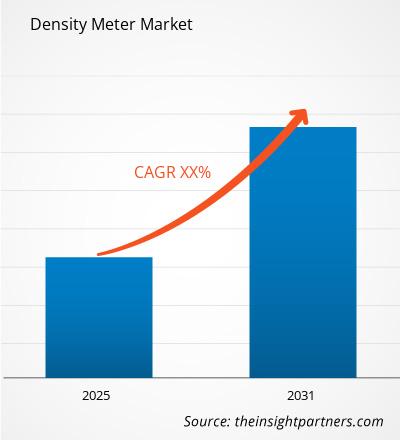
The Density Meter Market was valued at US$ 1.28 Billion in 2025 and is projected to reach US$ 2.29 Billion by 2034, registering a CAGR of 6.64% during 2026–2034. The market is seeing growth, as industries are demanding high accuracy of fluid characterization, quality validation, and measurements for regulatory requirements in their processes.
Within North America, the growth of the market will occur at a CAGR of 5.8% to 6.3%, driven by the need for modernization of refineries, production of specialty chemicals, and analysis of food products. The growth of the Density Meter Market size is driven by automation technology, laboratory accreditations, and inline density meters.
Density Meter Market Assessment and Insights
- North America held 34%–36% share in 2025 and is growing at a CAGR of 5.8%–6.3% during 2026–2034, supported by process automation, refinery upgrades, laboratory accreditation, and food safety testing.
- US represented 72%–76% of North America in 2025 and is growing at a CAGR of 5.9%–6.4%, led by chemicals, energy, and analytical laboratories.
- Europe accounted for 28%–30% share in 2025 and is advancing at a CAGR of 5.5%–6.0%, with Germany, the UK, France, Italy, and Spain leading adoption.
- Asia Pacific captured 24%–26% share in 2025 and is expanding at a CAGR of 7.8%–8.4%, led by China, Japan, South Korea, India, and Australia.
- Largest Segment Application – Coriolis held 41%–45% market share in 2025 and is growing at a CAGR of 6.5%–7.0%, supported by simultaneous mass flow and density measurement.
- High Growth Segment Type – Portables held 20%–24% market share in 2025 and is growing at a CAGR of 8.1%–8.8%, driven by field testing and rapid maintenance checks.
- Key companies analyzed in detail: Anton Paar GmbH, Mettler-Toledo International Inc., Emerson Electric Co., Endress+Hauser Group, Yokogawa Electric Corporation, Thermo Fisher Scientific Inc., AMETEK, Inc., Rudolph Research Analytical, Rhosonics Analytical B.V., and Berthold Technologies GmbH & Co. KG.
Source: The Insight Partners' analysis based on proprietary research, government publications, company annual reports, investor presentations, industry databases, and expert interviews.
Instrument development is shifting from the individual density measurement instrument towards more integrated applications. The benchtop instrument continues to play an important role in laboratory processes, while the modules and portable instruments are incorporated into automated manufacturing lines, field inspection, and maintenance tasks. Process trends involve tighter sensor specifications, better construction of the oscillating tube, digital diagnostics, and customers favoring those instruments which save material, lower calibration, and minimize off-specified product risks.
Future demand will depend on the development of industrial capacity, more demanding quality needs, and process visibility. Fast growth is expected in the Asia Pacific region while North America and Europe will remain as technology-focused regions. Energy efficiency regulations according to the IEA and ISO calibration standards mean that accurate measurement is necessary for the cost control and emissions, as well as for the product consistency.
Density Meter Market Report Scope
| Report Attribute | Details |
|---|---|
| Market size in 2025 | US$ 1.28 Billion |
| Market Size by 2034 | US$ 2.29 Billion |
| Global CAGR (2026 - 2034) | 6.64% |
| Historical Data | 2021-2024 |
| Forecast period | 2026-2034 |
Density Meter Market Analysis
The Density Meter Market share is propelled by higher levels of automation, stricter product specifications, and growing need for online measurement in the chemical, oil and gas, food and beverages, and electronics industries. Density meters help in ensuring that operators monitor concentration changes and reduce manual sampling time in continuous operations. There is greater demand in situations where slight variations in density can impact yields, safety, billing, or documentation purposes.
The value chain comprises sensor manufacturers, glass component manufacturers, electronics suppliers, calibration labs, system integrators, automation companies, distributors, and service engineers. Supply considerations are affected by precision machining availability, certified reference material availability, approvals for hazardous areas, and compatibility with industrial communication networks. Purchasing considerations are shifting towards comparing accuracy, repeatability, sampling, calibration traceability, lifecycle services, and system integration.
Density Meter Market Report reveals the competition among laboratory experts, automation vendors, and industrial instrumentation companies. Anton Paar GmbH and Mettler-Toledo International Inc. stand out in highly accurate laboratory devices, whereas Emerson Electric Co., Endress+Hauser Group, and Yokogawa Electric Corporation focus on enhancing inline process measurement with help of flow, pressure, and automation solutions.
Key investment focus is on developing intelligent diagnostic tools, compact modules, digital service platforms, and robust sensors for challenging applications such as those involving abrasion or harmful conditions. The key competitors in terms of applications and measuring precision include Thermo Fisher Scientific Inc., AMETEK, Inc., Rudolph Research Analytical, Rhosonics Analytical B.V., and Berthold Technologies GmbH & Co. KG.
● REPORT CUSTOMIZATION
Tailor This Report To Align With Your Specific Business Requirements
This report can be customized to align precisely with your business objectives, scope, and target markets. Customization options include tailored segmentation, geography, competitive analysis, and strategic insights to support informed decision-making.
Customize This Report →WHAT YOU CAN ADJUST
- ● Segmentations
- ● Geography
- ● Competitive Analysis
- ● Language Preferences
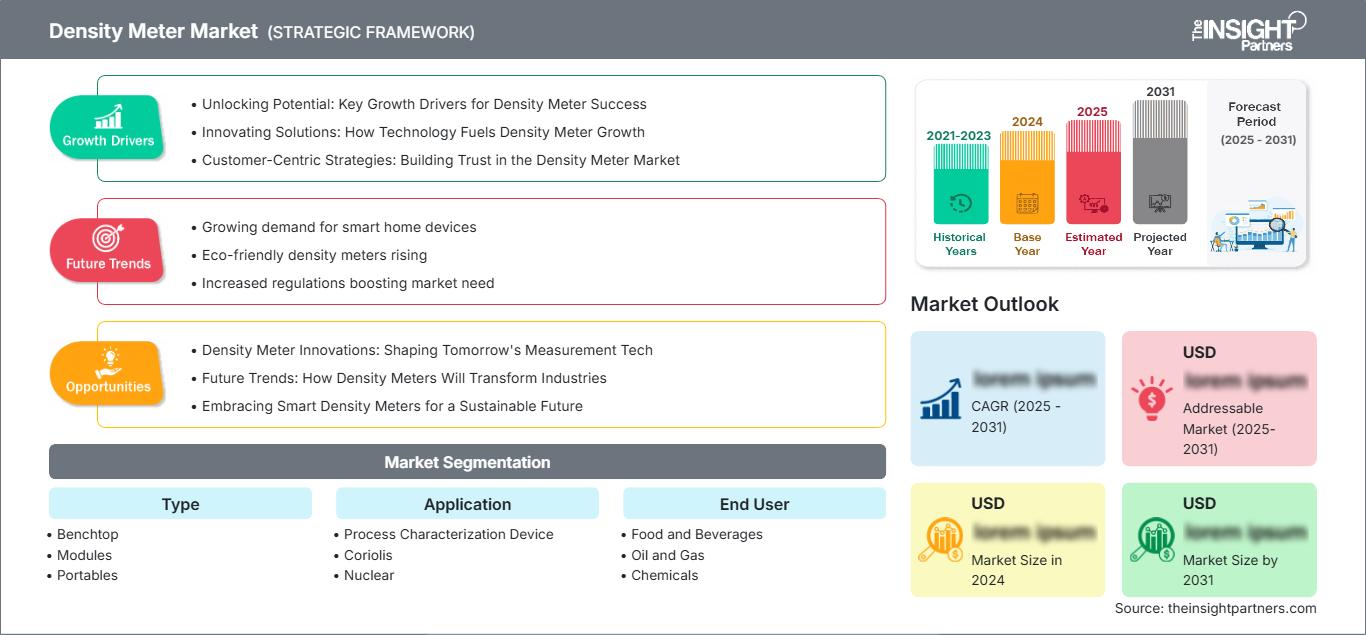
Density Meter Market: Strategic Insights
Regional Insights
North America Density Meter Market
North America will account for 34% to 36% share of the Density Meter Market in 2025 and expected to witness growth at 5.8% to 6.3% CAGR during 2026-2034. Drivers include refinery optimization, specialty chemicals manufacturing, pharmaceutical testing, beverages quality control, and process automation. The US and Canada enjoy well-established metrology services and laboratory certification framework.
Growing preference of the commercial and industrial sector for inline & modular density meters is seen in lowering the frequency of sampling while increasing process visibility. Coriolis-based systems are common among hydrocarbon and chemical processing industries whereas bench top density meters continue to find applications in quality laboratories.
U.S. Density Meter Market
The US accounts for 72%–76% of North America in 2025 and will have a growth rate of 5.9%–6.4%. The demand will be seen in petrochemical applications, refining, food and beverage testing, pharmaceutical labs, battery material, and semiconductors specialty chemicals. Users prefer calibrated products with low maintenance costs and easy integration into existing automation systems.
The companies of Anton Paar GmbH, Mettler-Toledo International Inc., Emerson Electric Co., Thermo Fisher Scientific Inc., AMETEK, Inc., and Rudolph Research Analytical are all highly relevant to the USA through the channels of sales in laboratories, processes, and distributions. Application trends that can be identified are those of Coriolis Mass Measurement and portable inspection instruments.
Europe Density Meter Market
Europe had the 28% to 30% share in 2025 and is forecasted to grow by 5.5% to 6.0%, driven by Germany in terms of chemicals, process engineering, and precision instruments. The UK drives the need for instruments through pharmaceuticals, beverage testing, and energy applications, whereas France profits from food processing, specialty chemicals, and lab automation.
Germany’s base of automation providers and chemical production facilities drives the requirement for inline measuring, certification, and diagnostics of measurement. Italy and Spain contribute to the adoption from food, beverage, petrochemicals, and materials applications. The quality, safety, and environmental demands in the EU lead to the adoption of instruments generating traceable data and conserving resources.
APAC Density Meter Market
In 2025, APAC’s market share was 24%–26%, and it is projected to grow at 7.8%–8.4%, driven by China’s regional implementations. The countries of Japan, South Korea, India, and Australia implement such policies as a result of their electronics manufacturing industry, chemical manufacturing plants, food processing, mining, and refining industries.
Advanced manufacturing policy, domestic chemical manufacturing, and semiconductors policy will add to the demand for the measurement technology. Local manufacturing scale keeps costs low, and multinational companies will increase service provision.
Middle East & Africa Density Meter Market
The Middle East & Africa region is expected to grow at 6.8%–7.3% during 2026–2034, with Saudi Arabia leading adoption. The UAE, South Africa, and the Rest of MEA are investing in refining, petrochemicals, mining, water treatment, and infrastructure-linked industrial systems.
Energy diversification, downstream petrochemical capacity, and process efficiency programs support demand for inline density instruments. Mining and slurry monitoring also create opportunities for rugged ultrasonic, nuclear, and non-contact measurement solutions.
Segmentation Analysis
Type
Type is expected to grow at 6.7%–7.2% during 2026–2034 as buyers select formats based on precision needs, installation environment, sample mobility, and automation level. The Density Meter Market scope under this segment covers benchtop systems for laboratories, modules for integrated platforms, and portable units for field or maintenance measurements.
- Benchtop instruments remain essential for quality laboratories because they provide high accuracy, controlled sample handling, traceable calibration, and repeatable testing across food, chemicals, pharmaceuticals, and research environments.
- Modules are strategically important where density measurement must be embedded into analyzers, process skids, automated sampling systems, or OEM equipment requiring compact integration.
- Portables are gaining adoption for field verification, maintenance inspections, incoming material checks, and decentralized testing where rapid results reduce downtime and laboratory dependency.
Application
Application is projected to grow at 6.8%–7.3% during 2026–2034 as density measurement becomes more connected to process control, custody verification, and product release decisions. Coriolis remains the largest application because mass flow and density data can be captured simultaneously in demanding industrial operations.
- Process Characterization Device supports material identification, concentration control, formulation verification, and process diagnostics where density is used with temperature, viscosity, or flow data.
- Coriolis leads adoption because it delivers density and mass flow measurement together, supporting custody transfer, chemical batching, food processing, and oil and gas operations.
- Nuclear measurement remains important in harsh, opaque, or high-temperature processes where non-contact density monitoring can reduce exposure, maintenance, and process interruption.
End User
End User is forecast to grow at 6.3%–6.8% during 2026–2034 as process industries invest in quality control, resource efficiency, and measurement traceability. Food and beverages, oil and gas, chemicals, and electronics require different instrument formats, but all depend on accurate density data to protect yield, safety, and product consistency.
- Food and Beverages use density measurement for sugar concentration, alcohol control, recipe consistency, incoming material checks, and final product release in beverage and ingredient workflows.
- Oil and Gas requires density data for refining, custody transfer support, blending, hydrocarbon characterization, drilling fluids, and process optimization in upstream and downstream operations.
- Chemicals rely on density meters for concentration monitoring, batch control, reaction tracking, raw material verification, and continuous quality assurance across specialty and commodity production.
- Electronics adoption is increasing in ultrapure chemicals, specialty fluids, battery materials, and semiconductor processes where small composition deviations can affect performance and yield.
Opportunity Snapshot
| End User | Revenue Contribution | Trend Tag | Adoption Stage |
| Food and Beverages | High | Recipe Control | Mature |
| Oil and Gas | High | Custody Support | Mature |
| Chemicals | High | Batch Analytics | Scaling |
| Electronics | Medium | Precision Fluids | Emerging |
Density Meter Market Growth Drivers and Impact Analysis
Automation Raises Need for Real-Time Density Data
Process plants are shifting from periodic manual monitoring to continuous measurement owing to the fact that changes in density indicate process variations such as drift in concentrations, contamination, phase segregation, or blending problems. Such real-time data enables operators to rectify the process variables even before the material goes out-of-spec, hence lowering wastage and rework. This driver has significant effect in the chemicals, refining, food & beverages, and specialty materials industries, where continuous operations and expensive raw material inputs elevate the significance of measurements. In addition, interfacing with distributed control systems, laboratory information systems, and manufacturing execution systems enhances traceability.
Quality Standards Increase Laboratory and Calibration Demand
In this regard, companies that manufacture products subject to regulation have been increasing their investment in density meters because traceability in the measurements facilitates the release of the product and the preparation for audits and compliance documentation. Calibration needs in accordance to ISO 17025, food safety plans, pharmaceutical quality management system requirements, and client specific requests necessitate instruments capable of providing repeatability and documented data. Benchtop instruments which are equipped with automatic fill verification, temperature stabilization, and certified standards are preferred by laboratories. The effect on the market is the regular replacement cycle of highly accurate instruments and increased need for maintenance services.
Energy and Chemical Capacity Expansion Supports Inline Systems
Increased capacity in terms of refineries, petrochemicals, battery materials, and specialty chemicals raises the requirement for instrumentation to continuously track process streams. Density measurements help in blending, concentration tracking, slurry monitoring, and custody verification; thus, it becomes important when plants are being designed and optimized. The significance of the region of Asia Pacific and Middle East lies in the fact that any industrial capacity increase goes hand in hand with automation efforts. This makes inline density meters useful since they are able to decrease sampling requirements, enable closed loop control, and better use of resources.
Density Meter Market Future Trends
AI-Enabled Diagnostics and Connected Calibration
Density Meter Market trends will increasingly center on intelligent diagnostics, automated validation, and connected calibration workflows. Future instruments are expected to detect bubbles, coating, drift, and filling errors before results affect production decisions. Cloud-enabled service portals may track calibration histories, instrument health, and method performance across multiple sites. For customers, this shift reduces unplanned downtime and improves confidence in measurement integrity. Vendors will compete on software usability, cybersecurity, and the ability to convert raw measurement signals into actionable maintenance guidance without adding complexity for laboratory technicians or process operators.
Portable Instruments Move Closer to Laboratory Accuracy
Portable density meters are expected to improve through better temperature compensation, rugged sensor design, longer battery life, and wireless data capture. This trend will expand field use in oil and gas terminals, beverage plants, maintenance teams, and incoming material inspection. Instead of waiting for laboratory confirmation, operators can screen materials faster and escalate only exceptions. As accuracy gaps narrow, portable devices will become a practical extension of quality systems rather than informal troubleshooting tools, especially where remote locations or time-sensitive operations make central laboratory testing inefficient.
Density Meter Market Opportunities
Service-Led Expansion in Emerging Industrial Hubs
Vendors can capture opportunity by building calibration, application support, and field service networks in emerging industrial hubs. Density Meter Market Forecasts indicate that faster growth will come from regions adding chemicals, refineries, food processing, mining, and electronics capacity. Customers in these markets need more than instruments, they require installation guidance, method development, training, and preventive maintenance. Local service capability reduces downtime concerns and improves procurement confidence. Partnerships with automation integrators and laboratory distributors can shorten sales cycles and position suppliers as measurement partners rather than hardware providers.
Application Packages for High-Value Process Niches
Investment opportunities are strongest where density measurement solves a defined operational problem, such as slurry concentration, sugar content, alcohol strength, battery electrolyte consistency, or hydrocarbon blending. Suppliers can improve adoption by offering application packages that combine sensors, sample handling, software templates, calibration materials, and validation documentation. This approach reduces engineering effort for customers and differentiates vendors from commodity instrument suppliers. High-value niches also support recurring revenue through service, replacement parts, and method updates. Companies that translate measurement accuracy into measurable savings will be best positioned for premium projects.
Recent Developments
- July 2025: Anton Paar GmbH launched a new generation of digital density meters, ranging from DMA 502 benchtop units to DMA 6002 with six-digit repeatability. The series uses 100% in-house oscillating U-tube production, improved calibration processes, U-Dry cleaning, U-Pulse measurement, and U-View filling diagnostics for higher precision and reliability.
- January 2025: Endress+Hauser Group launched its strategic partnership with SICK, integrating SICK gas analysis and flow measurement technology into its process instrumentation portfolio. The collaboration transferred around 800 sales and service employees across 42 countries and created Endress+Hauser SICK GmbH+Co. KG for production and development.
- February 2024: Yokogawa Electric Corporation acquired Adept Fluidyne Pvt. Ltd., an Indian manufacturer of electromagnetic flowmeters, strengthening Yokogawa’s liquid measurement capabilities and regional process automation portfolio. The transaction supports broader precision measurement offerings for industrial customers requiring flow, liquid characterization, and automation integration across Asian process industries.
Frequently Asked Questions

- Comprehensive Market Sizing and Forecast Analysis
- Detailed Segmentation Analysis
- In-Depth Market Dynamics Assessment
- Regional and Country-Level Insights
- Competitive Landscape and Company Benchmarking
- Strategic Business Intelligence
Recent Reports
Testimonials

The Insight Partners provided valuable market intelligence that supported our global go-to-market strategy. Their team was professional, responsive, and attentive to our feedback, providing thoughtful analysis and helpful methodological clarifications throughout the project.
Junmo Kim Chief Financial Officer (CFO), Enertech Co., Ltd.
The Insight Partners' SCADA System Market report is comprehensive, with valuable insights on current trends and future forecasts. The team was highly professional, responsive, and supportive throughout. We are very satisfied and highly recommend their services.
RAN KEDEM Partner, Reali Technologies LTDs
I requested a report on a very specific software market and the team produced the report in a few days. The information was very relevant and well presented. I then requested some changes and additions to the report. The team was again very responsive and I got the final report in less than a week.
JEAN-HERVE JENN Chairman, Future Analytica
We worked with The Insight Partners for an important market study and forecast. They gave us clear insights into opportunities and risks, which helped shape our plans. Their research was easy to use and based on solid data. It helped us make smart, confident decisions. We highly recommend them.
PIYUSH NAGPAL Sr. Vice President, High Beam Global
The Insight Partners delivered insightful, well-structured market research with strong domain expertise. Their team was professional and responsive throughout. The user-friendly website made accessing industry reports seamless. We highly recommend them for reliable, high-quality research services
YUKIHIKO ADACHI CEO, Deep Blue, LLC.
This is the first time I have purchased a market report from The Insight Partners.While I was unsure at first, I visited their web site and felt more comfortable to take the risk and purchase a market report.I am completely satisfied with the quality of the report and customer service. I had several questions and comments with the initial report, but after a couple of dialogs over email with their analyst I believe I have a report that I can use as input to our strategic planning process.Thank you so much for taking the extra time and making this a positive experience.I will definitely recommend your service to others and you will be my first call when we need further market data.
JOHN SUZUKI President and Chief Executive Officer, Board Director, BK Technologies
I wish to appreciate your support and the professionalism you displayed in the course of attending to my request for information regarding to infectious disease IVD market in Nigeria. I appreciate your patience, your guidance, and the fact that you were willing to offer a discount, which eventually made it possible for us to close a deal. I look forward to engaging The Insight Partners in the future, all thanks to the impression you have created in me as a result of this first encounter.
DR CHIJIOKE ONYIA MANAGING DIRECTOR, PineCrest Healthcare Ltd.Reason to Buy
- Informed Decision-Making
- Understanding Market Dynamics
- Competitive Analysis
- Identifying Emerging Markets
- Customer Insights
- Market Forecasts
- Risk Mitigation
- Boosting Operational Efficiency
- Strategic Planning
- Investment Justification
- Tracking Industry Innovations
- Aligning with Regulatory Trends





 Get Free Sample for