
Destructive Testing Market Size, Demand & Growth by 2034
Coverage: By Device Type (Texture Analyzer, Moisture Analyzer, Corrosion Detector, Pressure Tester, Karl Fischer Titrator); Application (Packaged Food, Dairy, Confectionery, Bakery, Pet Foods, Frozen Food, Others) , and Geography (North America, Europe, Asia Pacific, and South and Central America)
- Status : Data Released
- Report Code : TIPRE00027279
- Category : Electronics and Semiconductor
- No. of Pages : 150
- Available Report Formats :


- Last update date : August 06, 2026


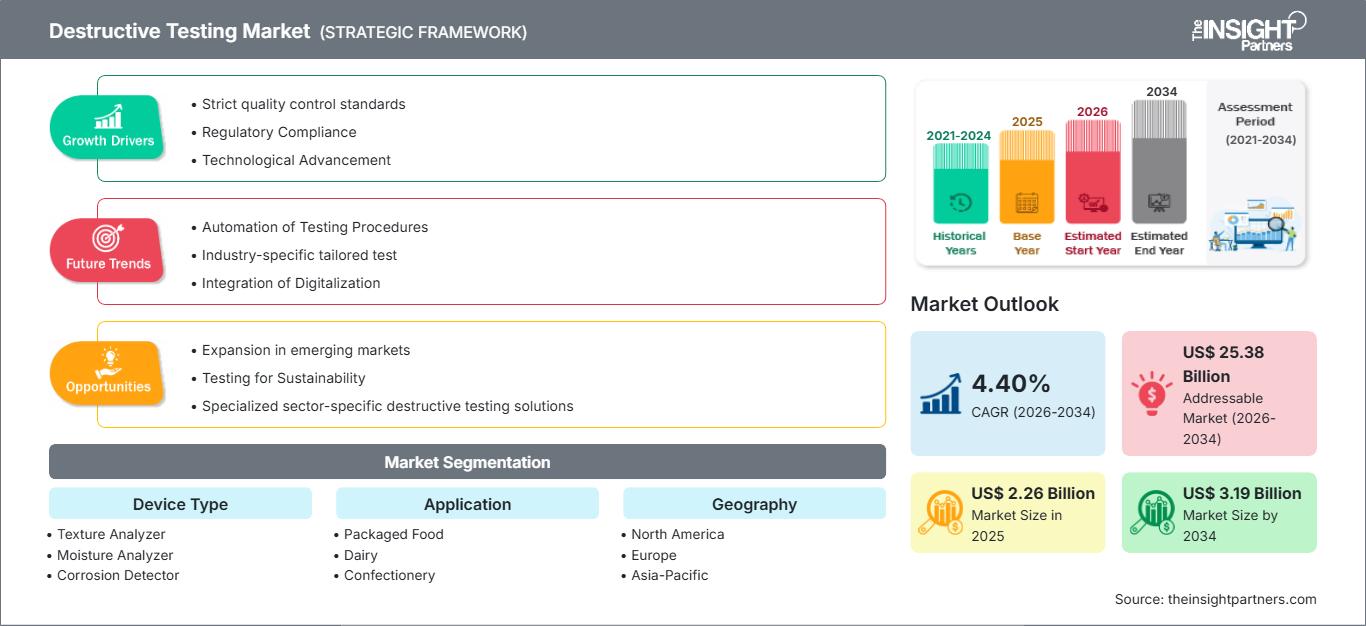
2025 Market Size
US$ 2.26 Bn
Base year value
2034 Forecast
US$ 3.19 Bn
Projected by 2034
CAGR 2026-2034
4.40 %
Growth rate
Addressable Market
US$ 25.38 Bn
(2026-2034)
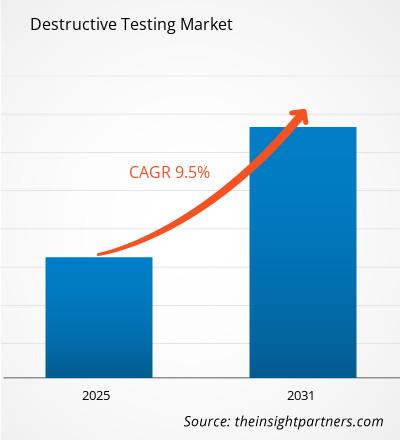
The Destructive Testing Market was estimated to be worth US$ 2.26 billion in 2025 and is expected to reach US$ 3.19 billion by 2034, growing at a CAGR of 4.40% over the 2026–2034 period. The demand will rise as packaged food, dairy, confectionery, bakery, pet food, and frozen food companies conduct more destructive tests in laboratories for factors such as moisture, texture, corrosion, pressure resistance, and chemical stability.
In North America, the Destructive Testing Market Size is backed up by FDA-compliant food safety systems, innovations in packaged food products, and greater adoption of validated laboratory equipment. The North America market is forecast to exhibit a CAGR growth rate of 3.9–4.7% over the 2026–2034 period.
Destructive Testing Market Assessment and Insights
- North America: The region holds 32–35% share in 2025 and grows at a CAGR range of 3.9–4.7% during 2026–2034, supported by packaged food quality programs, laboratory automation, and stronger shelf-life validation.
- US: The country represents 78–82% of North America in 2025 and grows at a CAGR range of 4.0–4.8% during 2026–2034, led by processed food testing.
- Europe: Europe accounts for 25–28% share in 2025 and grows at a CAGR range of 3.6–4.3% during 2026–2034, with Germany, the UK, France, Italy, and Spain leading adoption.
- Asia Pacific: Asia Pacific holds 27–31% share in 2025 and grows at a CAGR range of 4.8–5.8% during 2026–2034, led by China, India, Japan, South Korea, and Australia.
- Largest Segment: Texture Analyzer holds 27–30% market share in 2025 and grows at a CAGR range of 4.1–4.9% during 2026–2034 through texture-led quality control.
- High Growth Segment: Moisture Analyzer holds 19–22% market share in 2025 and grows at a CAGR range of 4.9–5.8% during 2026–2034 as shelf-life testing intensifies.
- Key companies analyzed in detail: AMETEK MOCON, Hanna Instruments, Inc., IMADA Co., Ltd., KERN & SOHN GmbH, Mettler-Toledo International Inc., METER Group, Inc. USA, S.I. Instruments, Texture Technologies Corp., Thermo Fisher Scientific Inc., Xylem Inc.
Source: The Insight Partners' analysis based on proprietary research, government publications, company annual reports, investor presentations, industry databases, and expert interviews.
There has been a shift from manual pass-fail procedures towards the use of instruments for destructive tests that measure force, moisture, pressure, corrosion, and titration end points. Food manufacturers have embraced the use of analyzers not only to meet the requirements of release but also formulation and packaging purposes and qualifying suppliers. The choice of device is driven by factors such as accuracy, traceability software, calibration capability, speed, and training.
The future demands will be more towards packaged food items that are large-sized and meet high standards of safety and texture, and cold chain logistics. The emerging markets will have their accredited laboratories whereas existing markets will move out of old technologies and opt for new technologies. Favorable tailwinds for investments include changes in regulatory issues of food safety modernization, allergens, moisture, and packaging.
Destructive Testing Market Report Scope
| Report Attribute | Details |
|---|---|
| Market size in 2025 | US$ 2.26 Billion |
| Market Size by 2034 | US$ 3.19 Billion |
| Global CAGR (2026 - 2034) | 4.40% |
| Historical Data | 2021-2024 |
| Forecast period | 2026-2034 |
Destructive Testing Market Analysis
Market growth for Destructive Testing is fueled by increasing food specifications, greater diversity of packaged goods, and verification of characteristics that cannot be observed visually. Texture analyzers evaluate the hardness, fracture characteristics, bite, and spreadability, while moisture analyzers and Karl Fisher titrators facilitate decisions concerning shelf life and stability. The pressure and corrosion testers are used for validating the integrity of packaging and manufacturing equipment.
In terms of the ecosystem, the stakeholders are comprised of the instrument makers, calibration labs, food manufacturers, packagers, food ingredients manufacturers, testing labs, and regulators. The supply chain dynamics are stable because most of the instruments feature the proven sensors, scales, titration units, load cells, and software platforms. On the other hand, the buying side looks for suppliers providing service networks and validated applications.
Positioning in Destructive Testing Market report can be considered through application range, accuracy, reputation, and after-sales services. Mettler-Toledo International Inc. and Thermo Fisher Scientific Inc. have an advantage through their extensive portfolio in laboratory applications, whereas AMETEK MOCON excels at packaging gas and permeation knowledge. Texture Technologies Corp., IMADA Co., Ltd., and S.I. Instruments are key players in force and texture measuring solutions.
In terms of investments, there is an increasing emphasis on benchtop automation, digital data acquisition, easy cleaning, and instruments designed to be used repeatedly in food processing plants. Hanna Instruments, Inc., KERN & SOHN GmbH, METER Group, Inc. USA, and Xylem Inc. bring competitive value through moisture, balances, environment, and analytical measurements. Increasing differentiation is achieved through validated methods and training content.
● REPORT CUSTOMIZATION
Tailor This Report To Align With Your Specific Business Requirements
This report can be customized to align precisely with your business objectives, scope, and target markets. Customization options include tailored segmentation, geography, competitive analysis, and strategic insights to support informed decision-making.
Customize This Report →WHAT YOU CAN ADJUST
- ● Segmentations
- ● Geography
- ● Competitive Analysis
- ● Language Preferences
Destructive Testing Market: Strategic Insights
Regional Insights
North America Destructive Testing Market
Share in North America is accounted for 32-35% in 2025 with a CAGR rate of 3.9-4.7% between 2026 and 2034. Destructive Testing Market Share includes food safety standards, high processed food intake, and extensive utilization of third-party laboratories. High demand is observed in packaged foods, dairy products, baked products, snacks, and pet foods due to moisture, texture, and packaging requirements.
Those which have reliable testing techniques, document their readings digitally and provide prompt services are more favored by regional customers. Some of the prominent companies with substantial market presence are AMETEK MOCON, Mettler-Toledo International Inc., Thermo Fisher Scientific Inc., Texture Technologies Corp. and Hanna Instruments, Inc. The adoption is encouraged by growing production of branded products and the need for destructive testing by retail companies.
U.S. Destructive Testing Market
The United States is 78-82% of North America in 2025 and has a CAGR growth range of 4.0-4.8% from 2026 to 2034. The demand is driven by FDA-related preventive controls, large packaged food manufacturers, contract manufacturing, and rapid innovation cycles. Texture, moisture, titration, and pressure testing help ensure release of products, handle complaints, and qualify suppliers for both national brand and private label products.
Trends in applications include firmness tests in bakery products, moisture and water activity measurements in snack foods, Karl Fischer titrations for measuring low moisture content ingredients, and verification of headspace in packaging for shelf-stable foods. Companies are widespread in the market, including such names as AMETEK MOCON, Thermo Fisher Scientific Inc., Mettler-Toledo International Inc., Texture Technologies Corp., IMADA Co., Ltd., and Xylem Inc.
Europe Destructive Testing Market
Europe holds a share of 25–28% in 2025 and experiences growth in the CAGR of 3.6–4.3% during 2026–2034. Europe's dominance is contributed by Germany via equipment manufacturing, dairy processing, and bakery applications. In addition, the United Kingdom contributes via chilled foods and food retailer test requirements. France contributes via dairy, confectionery, and high-end packaged foods' quality requirements.
Italy and Spain contribute to bakery, confectionery, frozen food, and export-oriented packaged food. Europe is focused on traceability, food contact materials testing, and calibration testing. The companies Mettler-Toledo International Inc., KERN & SOHN GmbH, Thermo Fisher Scientific Inc., and AMETEK MOCON have advantages via well-established networks for distribution and service.
APAC Destructive Testing Market
APAC possesses 27–31% market share in 2025 and achieves a CAGR of 4.8–5.8% from 2026 to 2034. The major country in the region is China due to its scale in packaging foods, dairy products, frozen meals, and pet foods. Japan and South Korea provide quality confectionery, bakery, and convenient foods.
India and Australia increase their adoption due to modernization of food safety, export testing, and growth of organized retailing. The factors driving policy in these countries are stringent labeling, quality control, and cold chain investments. Buyers tend to emphasize robust instruments, local servicing, and economical calibration as multi-location food production demands regular destructive tests.
Middle East & Africa Destructive Testing Market
The CAGR growth rate of Middle East & Africa region is forecasted in the range of 3.8–4.9% between 2026 and 2034. The leading countries include Saudi Arabia on account of food security investments, dairy, and packaged food products. UAE contributes through re-export, high-end retail, and aircraft catering needs. South Africa provides its support through regional processing and laboratory services.
Other MEA demand is project-oriented but improves through local production, Halal certification, and import substitution. Energy and infrastructure perspective is important for this region since temperature, logistics, and pack resistance influence shelf life of products. Hence, food manufacturers invest in selective tests for moisture, pressure, and texture of products.
Segmentation Analysis
Device Type
Device Type is projected to grow at a CAGR range of 4.2–5.1% during 2026–2034. Destructive Testing Market scope is defined by how food manufacturers measure product attributes that require sample alteration or consumption. Demand varies by test method, with texture analyzers leading sensory validation, moisture systems supporting shelf-life control, and titrators addressing precise water determination.
- Texture Analyzer: Texture analyzers lead demand because hardness, adhesiveness, chewiness, crispness, and spreadability define consumer acceptance in bakery, confectionery, dairy, pet foods, and frozen meals.
- Moisture Analyzer: Moisture analyzers are strategically important for shelf-life, microbial risk, and batch release decisions, especially in low-moisture snacks, powders, pet food, and bakery ingredients.
- Corrosion Detector: Corrosion detectors support packaging and processing equipment validation where acidic foods, cleaning chemicals, and humid environments can compromise metal surfaces and contamination controls.
- Pressure Tester: Pressure testers help verify package seal strength, container performance, and process resistance for retort foods, dairy packs, frozen meals, and pressurized packaging formats.
- Karl Fischer Titrator: Karl Fischer titrators provide high-precision water determination in ingredients, oils, dairy powders, flavors, and confectionery inputs where small moisture deviations affect stability.
Application
Application is expected to grow at a CAGR range of 4.0–4.8% during 2026–2034. Adoption is strongest where product failure directly affects safety, shelf life, eating quality, and brand consistency. Food companies use destructive laboratory methods to translate sensory expectations into measurable specifications, reduce formulation drift, and validate packaging under storage and distribution stress.
- Packaged Food: Packaged food applications require broad testing across moisture, pressure, texture, and packaging integrity because ready meals, snacks, and shelf-stable products face complex distribution conditions.
- Dairy: Dairy processors use destructive testing for moisture, viscosity, gel strength, powder stability, and package performance, supporting consistency in cheese, yogurt, milk powders, and desserts.
- Confectionery: Confectionery demand centers on water control, snap, hardness, bloom prevention, and filling stability, where small formulation variations can quickly affect premium quality perception.
- Bakery: Bakery producers rely on texture and moisture testing to manage softness, crust behavior, staling, crumb strength, and shelf-life performance across industrial production runs.
- Pet Foods: Pet food manufacturers test kibble hardness, moisture, oil stability, and packaging resilience to support palatability, shelf life, and safety across dry and wet formats.
- Frozen Food: Frozen food applications use destructive testing to assess texture after thawing, moisture migration, package seal strength, and product stability through cold-chain handling.
Opportunity Snapshot
| Application | Revenue Contribution | Trend Tag | Adoption Stage |
| Packaged Food | High | Shelf Life | Mature |
| Dairy | High | Powder Control | Mature |
| Confectionery | Medium | Texture Claims | Scaling |
| Bakery | Medium | Staling Tests | Scaling |
| Pet Foods | Medium | Kibble Quality | Scaling |
| Frozen Food | Medium | Thaw Texture | Scaling |
| Others | Low | Lab Services | Emerging |
Destructive Testing Market Growth Drivers and Impact Analysis
Food Safety and Shelf-Life Validation Becoming More Quantified
Food manufacturers are converting sensory, safety, and shelf-life requirements into measurable destructive tests because recalls, retailer penalties, and waste costs remain material risks. Moisture, water content, seal pressure, and texture data help teams decide whether a batch can withstand storage, transport, and consumer handling. The market impact is greater instrument use in routine quality control rather than only R&D. Laboratories are also documenting test methods more rigorously, creating demand for analyzers with audit trails, calibration certificates, and reproducible sample fixtures across multiple manufacturing sites.
Packaged Food Innovation Increasing Test Method Complexity
New product development in snacks, chilled meals, dairy desserts, confectionery, bakery, and pet foods is increasing the number of attributes that must be destroyed, compressed, punctured, dried, titrated, or pressure tested before launch. Reformulation for protein enrichment, sugar reduction, alternative fats, clean-label ingredients, and recyclable packaging can change texture and water behavior. The market impact is higher demand for versatile analyzers and application support. Suppliers that provide fixtures, method templates, and food-specific validation guidance can shorten development cycles for manufacturers.
Automation and Data Integrity Improving Laboratory Productivity
Quality laboratories face pressure to release batches faster while maintaining traceability. Automated endpoint detection, digital balance integration, barcode-enabled sample tracking, and connected software reduce manual transcription errors and improve repeatability. The market impact is a gradual replacement cycle from standalone instruments to systems that integrate with laboratory information management and manufacturing quality platforms. This driver favors vendors that combine rugged hardware with service, software updates, and compliance support, especially for multi-plant food companies seeking consistent test execution across regions.
Destructive Testing Market Future Trends
Connected Benchtop Instruments Becoming Standard
Destructive Testing Market trends will increasingly center on connected benchtop devices that combine precise measurement with secure data capture. Food manufacturers will expect instruments to export structured results, manage methods, flag calibration status, and support remote troubleshooting. This shift will not remove the need for operator skill, but it will reduce variability between plants and contract manufacturers. Vendors that offer intuitive software, cybersecurity controls, and service diagnostics will be better positioned as laboratories integrate destructive testing data into enterprise quality systems.
Food Texture Testing Moving Closer to Consumer Claims
Texture testing will move beyond internal quality release toward claim substantiation for crunch, creaminess, softness, chewiness, and freshness. As brands compete in premium bakery, confectionery, dairy, frozen meals, and pet treats, objective texture metrics will support sensory panels and packaging decisions. Future systems may combine mechanical curves with image analysis and recipe databases to predict consumer acceptance earlier. This trend increases the strategic value of fixtures, methods, and application expertise rather than only instrument specifications.
Destructive Testing Market Opportunities
Application-Specific Bundles for Food Manufacturers
Destructive Testing Market Forecasts point to an opportunity for suppliers to package instruments, fixtures, reagents, calibration services, and method libraries around specific applications such as dairy powders, bakery softness, confectionery hardness, pet food kibble, and frozen meal texture. Bundled solutions reduce method development time and make procurement easier for quality teams. Vendors can improve retention by offering training, preventive maintenance, and validation documentation. The most attractive targets are multi-site food producers seeking standardized testing across plants and regions.
Emerging Market Laboratory Upgrades and Accreditation
Emerging food manufacturing hubs need accredited laboratories to serve export markets, modern retail, and domestic quality programs. This creates an investment opportunity for distributors, instrument suppliers, and service providers that can deliver affordable analyzers with local calibration and training. Demand will be strongest in dairy, packaged snacks, frozen foods, and pet food as producers formalize specifications. Companies that establish regional demonstration labs, reagent availability, and rapid repair support can win share against low-cost equipment vendors with weaker lifecycle service.
Recent Developments
- March 2026: Waygate Technologies (a Baker Hughes business) and Liminal Insights announced a strategic partnership to deliver the industry's first integrated multi-modal battery inspection solution. The collaboration combines Waygate’s industrial radiography, computed tomography (CT), and ultrasound expertise with Liminal’s AI-powered ultrasound analytics to provide full-lifecycle battery inspection—from cell production to module assembly and field service. The partnership also includes co-development of next-generation in-line ultrasound inspection systems, enabling battery manufacturers to improve defect detection, increase production yields, reduce costs, and enhance quality assurance for EV battery manufacturing.
- August 2025: PROtect LLC announced a strategic partnership with Sentin GmbH to deliver AI-powered industrial inspection services for non-destructive testing (NDT) across North America. By integrating Sentin’s AI platform, the collaboration automates defect detection, measurements, and quality validation, improving inspection accuracy, consistency, and turnaround times while reducing human error. The partnership is expected to expand to additional NDT methods and inspection workflows, helping industries enhance asset reliability, compliance, and operational efficiency.
- June 2025: Vertech Group announced a strategic partnership with MISTRAS Group to introduce Automated Radiographic Testing (ART) Crawler technology for advanced Corrosion Under Insulation (CUI) inspections in Australia. The solution uses digital radiography to detect corrosion in insulated and uninsulated pipelines without removing insulation or interrupting operations, enabling safer, faster, and more cost-effective asset inspections while improving infrastructure integrity and reducing operational downtime.
Frequently Asked Questions

- Comprehensive Market Sizing and Forecast Analysis
- Detailed Segmentation Analysis
- In-Depth Market Dynamics Assessment
- Regional and Country-Level Insights
- Competitive Landscape and Company Benchmarking
- Strategic Business Intelligence
Recent Reports
Testimonials

The Insight Partners' SCADA System Market report is comprehensive, with valuable insights on current trends and future forecasts. The team was highly professional, responsive, and supportive throughout. We are very satisfied and highly recommend their services.
RAN KEDEM Partner, Reali Technologies LTDs
I requested a report on a very specific software market and the team produced the report in a few days. The information was very relevant and well presented. I then requested some changes and additions to the report. The team was again very responsive and I got the final report in less than a week.
JEAN-HERVE JENN Chairman, Future Analytica
We worked with The Insight Partners for an important market study and forecast. They gave us clear insights into opportunities and risks, which helped shape our plans. Their research was easy to use and based on solid data. It helped us make smart, confident decisions. We highly recommend them.
PIYUSH NAGPAL Sr. Vice President, High Beam Global
The Insight Partners delivered insightful, well-structured market research with strong domain expertise. Their team was professional and responsive throughout. The user-friendly website made accessing industry reports seamless. We highly recommend them for reliable, high-quality research services
YUKIHIKO ADACHI CEO, Deep Blue, LLC.
This is the first time I have purchased a market report from The Insight Partners.While I was unsure at first, I visited their web site and felt more comfortable to take the risk and purchase a market report.I am completely satisfied with the quality of the report and customer service. I had several questions and comments with the initial report, but after a couple of dialogs over email with their analyst I believe I have a report that I can use as input to our strategic planning process.Thank you so much for taking the extra time and making this a positive experience.I will definitely recommend your service to others and you will be my first call when we need further market data.
JOHN SUZUKI President and Chief Executive Officer, Board Director, BK Technologies
I wish to appreciate your support and the professionalism you displayed in the course of attending to my request for information regarding to infectious disease IVD market in Nigeria. I appreciate your patience, your guidance, and the fact that you were willing to offer a discount, which eventually made it possible for us to close a deal. I look forward to engaging The Insight Partners in the future, all thanks to the impression you have created in me as a result of this first encounter.
DR CHIJIOKE ONYIA MANAGING DIRECTOR, PineCrest Healthcare Ltd.Reason to Buy
- Informed Decision-Making
- Understanding Market Dynamics
- Competitive Analysis
- Identifying Emerging Markets
- Customer Insights
- Market Forecasts
- Risk Mitigation
- Boosting Operational Efficiency
- Strategic Planning
- Investment Justification
- Tracking Industry Innovations
- Aligning with Regulatory Trends





 Get Free Sample for