
Digital Audio IC Market Trends, Size & Forecast by 2034
Coverage: by Device type (Digital Audio Amplifier, Digital Sound Processor IC, Others); End Use (Automotive, Computer and Tablets, Home Entertainments, Portables, Others) , and Geography (North America, Europe, Asia Pacific, and South and Central America)
- Status : Data Released
- Report Code : TIPRE00009378
- Category : Electronics and Semiconductor
- No. of Pages : 150
- Available Report Formats :


- Last update date : August 11, 2026


2025 Market Size
US$ 13.77 Bn
Base year value
2034 Forecast
US$ 25.3 Bn
Projected by 2034
CAGR 2026-2034
6.99 %
Growth rate
Addressable Market
US$ 176.39 Bn
(2026-2034)
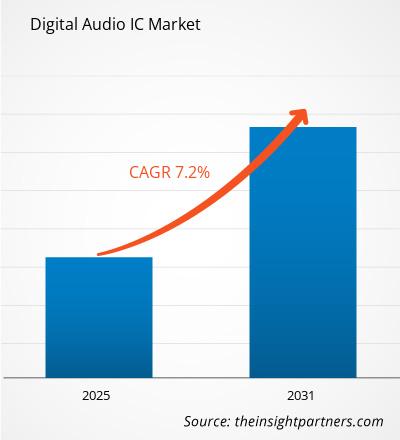
The Digital Audio IC Market was valued at US$ 13.77 Billion in 2025 and is projected to reach US$ 25.3 Billion by 2034, expanding at a CAGR of 6.99% during 2026–2034. There has been an increase in the use of digital amplifiers, signal processors, codecs, and sound-control ICs in connected automobiles, portable electronics, computers, and home entertainment equipment.
North America has been identified as a high-value demand source, where growth in the Digital Audio IC Market size is driven by high-end audio in vehicles, creator-based computers, and home entertainment solutions. It is expected to grow at a 6.3-6.8% CAGR from 2026 to 2034 owing to the growth in automotive software-defined cockpits and replacement needs for laptops, tablets, sound bars, headsets, and connected speakers.
Digital Audio IC Market Assessment and Insights
- North America accounted for 26–29% share in 2025 and is expected to grow at a CAGR range of 6.3–6.8% during 2026–2034, supported by automotive infotainment upgrades and premium computing audio.
- US represented 78–82% of North America in 2025 and is projected to grow at 6.4–6.9% CAGR during 2026–2034, led by automotive and laptop OEM demand.
- Europe held 20–23% share in 2025 and is projected to expand at 5.8–6.3% CAGR during 2026–2034, with Germany, the UK, and France leading vehicle and pro-audio integration.
- Asia Pacific captured 39–42% share in 2025 and is expected to record 7.4–8.0% CAGR during 2026–2034, driven by China, Japan, South Korea, and India electronics manufacturing.
- Largest Segment Digital audio amplifier held 43–47% market share in 2025 and is projected to grow at 6.5–7.0% CAGR during 2026–2034, reflecting broad device-level adoption.
- High Growth Segment Automotive held 22–26% market share in 2025 and is forecast to grow at 8.0–8.7% CAGR during 2026–2034 as software-defined cabins expand.
- Key companies analyzed in detail: Asahi Kasei Microdevices Corporation, Microchip Technology Inc., Cirrus Logic Inc., CML Microcircuits plc, Renesas Electronics Corporation, Digital Voice Systems Inc., DSP Group Inc., Eletech Enterprise Co. Ltd., Holtek Semiconductor Inc., and Micronas GmbH.
Source: The Insight Partners' analysis based on proprietary research, government publications, company annual reports, investor presentations, industry databases, and expert interviews.
The evolution of technology is leading to a shift in production models, as OEMs are switching from analog components to a fully digital system that consists of digital amplification, programmable DSP and audio platforms that incorporate both digital and analog signals. The Market will be fueled by the growing number of speakers per vehicle, thin design of computers and efficient class D amplification used in battery operated devices.
Future investments will be directed towards software defined cabins, voice interfaces assisted by AI, low power hearables and hi-end sound bars. Newly formed manufacturing centers in India, Vietnam and Southeast Asia provide more flexibility in terms of sourcing consumer electronics. The focus on vehicle safety warnings, energy efficient electronics and accessibility features plays an important role in the demand for audio processing.
Digital Audio IC Market Report Scope
| Report Attribute | Details |
|---|---|
| Market size in 2025 | US$ 13.77 Billion |
| Market Size by 2034 | US$ 25.3 Billion |
| Global CAGR (2026 - 2034) | 6.99% |
| Historical Data | 2021-2024 |
| Forecast period | 2026-2034 |
Digital Audio IC Market Analysis
Demand expansion is based on audio quality being a design differentiator and not an ancillary component. Market growth can be supplemented with the trend towards car cockpit integration, remote work tools, games, and entertainment equipment which need higher outputs, less distortion, and better thermal performance.
The value chain involves wafer manufacturing, mixed-signal design, acoustic software, firmware tuning, module assembly, and OEM validation. The supply situation benefits the vendors that can successfully integrate programmable hardware and reference design as the customer base prefers faster tuning, reduced power usage, and customizable speakers' architecture.
Definition of competitive positioning includes domain depth in codecs, Class-D amplifiers, automotive DSP and embedded acoustic algorithms. According to the Digital Audio IC Market report, Asahi Kasei Microdevices Corporation, Cirrus Logic Inc., Renesas Electronics Corporation, and Microchip Technology Inc. compete on the basis of their mixed-signal integration capabilities, power efficiency and platform support services.
Increasing investment is being made in the audio platform which can minimize OEM's engineering efforts. CML Microcircuits plc, Digital Voice Systems Inc., DSP Group Inc., Eletech Enterprise Co. Ltd., Holtek Semiconductor Inc., and Micronas GmbH are considered as the significant companies in areas where voice coding and application specific audio play major role.
● REPORT CUSTOMIZATION
Tailor This Report To Align With Your Specific Business Requirements
This report can be customized to align precisely with your business objectives, scope, and target markets. Customization options include tailored segmentation, geography, competitive analysis, and strategic insights to support informed decision-making.
Customize This Report →WHAT YOU CAN ADJUST
- ● Segmentations
- ● Geography
- ● Competitive Analysis
- ● Language Preferences
Digital Audio IC Market: Strategic Insights

Regional Insights
North America Digital Audio IC Market
North America accounted for 26–29% of 2025 demand and is projected to grow at 6.3–6.8% CAGR during 2026–2034. The Digital Audio IC Market share in the region is supported by high attach rates in premium vehicles, notebooks, tablets, smart speakers, and creator-focused audio equipment.
The US is the largest region when it comes to consumption, and Canada participates in the growth of automotive electronics and professional audio. The presence of semiconductor design, OEM reference designs, and the rise of cabin personalization help to promote digital amplifier and programmable sound processor usage.
U.S. Digital Audio IC Market
In 2025, the U.S. accounted for 78–82% of North America and will register a CAGR of 6.4–6.9% for the period 2026–2034. The growth driver for demand is automotive infotainment, laptop reference designs, gaming peripherals, and high-performance audio converters that are widely used by professional equipment manufacturers.
The presence of companies in the market has been largely because of design activity, system validation, and OEM collaboration rather than manufacturing. The company, Cirrus Logic Inc., has emphasized audio reference design for PCs, while connectivity and embedded players have enabled voice-based systems and smart speaker applications.
Europe Digital Audio IC Market
Market share in Europe is around 20-23%, and it is expected to expand at a CAGR of 5.8-6.3% from 2026 to 2034. Leading nations in the region include Germany with car manufacturing, cabin electronics, and audio systems. The UK contributes to the development of professional audio solutions, software calibration, and electronics specialization.
France, Italy, and Spain add value with automotive supply chain management, consumer electronics networks, and home entertainment upgrades. The requirement in Europe is for energy efficient ICs, automotive reliability, and flexible DSPs which minimize acoustic tuning time.
APAC Digital Audio IC Market
APAC accounted for 39–42% share in 2025 and is forecast to grow at 7.4–8.0% CAGR during 2026–2034. China remains the leading country because of electronics assembly, smartphone scale, and automotive cockpit localization.
Japan and South Korea provide support for premium audio equipment, automotive chipsets, and semiconductors. India and Australia contribute to the growth by means of connectivity products, automobile electronic parts, smart home technology, and the electronics manufacturing localization driven by local policy.
Middle East & Africa Digital Audio IC Market
The Middle East & Africa is projected to grow at 5.2% to 5.8% CAGR from 2026 to 2034, led by premium electronics retailing and deployment of connected homes in the UAE. The infrastructure development of Saudi Arabia drives the growth in terms of demand through modernization, entertainment centers, and importation of automobiles.
In South Africa, the replacement of consumer electronics, as well as vehicle audio after market products, drive the growth. In the rest of MEA, the demand is driven by urban retailing. Expansion of energy infrastructure and construction of smart buildings increase the applications for announcement, infotainment, and connected audio products.
Segmentation Analysis
Device type
The device type segment is projected to grow at 6.4–7.1% CAGR during 2026–2034. Digital Audio IC Market scope is expanding as OEMs combine amplifier efficiency, DSP programmability, and compact mixed-signal integration to meet thinner form factors, richer speaker arrays, and battery-sensitive product requirements.
- Digital Audio Amplifier leads demand because Class-D efficiency reduces heat and battery drain while supporting louder output in vehicles, soundbars, laptops, portable speakers, and compact entertainment systems.
- Digital Sound Processor IC is strategically important where equalization, noise control, spatial audio, voice pickup, and cabin or room tuning require flexible firmware-driven sound optimization.
End Use
The end use segment is projected to grow at 6.8–7.5% CAGR during 2026–2034. Adoption is strongest where audio quality, voice interaction, and power efficiency affect user experience. Automotive shows the fastest acceleration, while computing and home entertainment provide stable volume across replacement cycles.
- Automotive demand is rising as digital cockpits integrate branded audio, active noise management, voice assistance, and safety alerts across electric, premium, and connected vehicle platforms.
- Computer and Tablets require compact codecs, smart amplifiers, and low-power processing to improve speakers, microphones, conferencing quality, and creator-oriented media performance in thin devices.
- Home Entertainments uses digital amplifiers and processors in soundbars, smart televisions, receivers, and connected speakers where multi-channel clarity and energy efficiency influence product differentiation.
- Portables depend on small-footprint, low-power audio ICs for wireless speakers, headsets, wearables, and handheld devices where battery life and loudness remain purchase drivers.
Opportunity Snapshot
| End Use | Revenue Contribution | Trend Tag | Adoption Stage |
| Automotive | High | Cabin Audio | Scaling |
| Computer and Tablets | High | AI Audio | Mature |
| Home Entertainments | Medium | Spatial Sound | Scaling |
| Portables | Medium | Battery Audio | Scaling |
| Others | Low | Embedded Voice | Emerging |
Digital Audio IC Market Growth Drivers and Impact Analysis
Software-Defined Vehicle Cabins Raise Audio IC Content
Vehicle interiors are moving towards immersive infotainment, voice control, road noise cancellation, and personalized listening zones. This leads to an increase in the number of amplifier channels, microphones, and DSP functionality per vehicle platform. The quietness of electric cars makes it even more essential to improve acoustic management. With OEMs introducing digital cockpits in mid-range and premium vehicles, suppliers of DSPs that have been qualified for the automotive industry will benefit.
Portable Devices Prioritize Power-Efficient Sound
The new generation of smartphones, tablets, headsets, wearables, and small speakers needs more volume, better voice quality, and extended operation with no growth of the printed circuit board footprint. Digital amplifiers and smart codecs solve the problem due to increased conversion efficiency, built-in protection features, and software configuration. The actual result will be faster turnover of low-power audio semiconductors, especially those for devices with limited space for a speaker or heat dissipation.
Premium Home Entertainment Expands Multi-Channel Demand
Soundbars, smart TVs, AV receivers, and wireless speakers are leveraging multichannel amplifiers and DSP in order to generate spatial audio in an all-in-one design. Users require crystal-clear dialogue, powerful bass, and adaptive audio without complicated setup. This leads to a need for an integrated chip solution that provides both efficient amplifiers and programmable processing. This is most evident in mid to high-end devices where OEM manufacturers compete in terms of acoustic performance, low standby consumption, and streaming capability.
Digital Audio IC Market Future Trends
AI-Assisted Acoustic Calibration Moves Into Mainstream Devices
Digital Audio IC Market trends point toward automated tuning that adjusts speakers, microphones, and noise-control functions with less manual engineering. AI-assisted calibration will help OEMs adapt one hardware platform across vehicle trims, laptop models, and smart speakers. The benefit is faster launch timing and more consistent sound in varied acoustic environments. As processing shifts closer to the audio path, DSP suppliers that support embedded algorithms and cloud-assisted development workflows will gain strategic relevance.
Chiplet and Advanced Process Choices Improve Efficiency
Future audio architectures will increasingly balance advanced process nodes for digital control with mature nodes for analog power delivery. This hybrid approach can improve cost, reliability, and energy efficiency without forcing every function onto the same silicon. Automotive and computing customers are likely to favor platforms that preserve analog performance while enabling firmware-rich features. Over time, modular design methods may also improve supply resilience by separating compute, amplification, and interface functions across optimized component families.
Digital Audio IC Market Opportunities
Automotive DSP Reference Platforms for Emerging OEMs
Digital Audio IC Market Forecasts indicate a strong opportunity for suppliers that package DSP hardware, amplifier stages, software tuning, and validation documentation into modular automotive reference platforms. Emerging EV brands and regional OEMs often lack large acoustic engineering teams, making pre-integrated solutions commercially attractive. Vendors can capture share by reducing calibration workload, supporting scalable speaker layouts, and meeting automotive reliability requirements. Partnerships with acoustic software providers and tier-one integrators will improve market access.
Creator and Collaboration Devices Need Better Audio Front Ends
Laptops, tablets, USB interfaces, webcams, and conferencing systems need cleaner capture and playback as hybrid work and creator production remain embedded behaviors. Semiconductor vendors can pursue this opportunity through low-power codecs, smart amplifiers, microphone processing, and distortion-control algorithms. The investment case is strongest where OEMs need differentiated audio without major mechanical redesign. Close collaboration with processor vendors and ODMs will help audio IC suppliers secure platform-level adoption before device makers finalize chassis and speaker layouts.
Recent Developments
- July 2026: NXP Semiconductors introduced the SAF9800, an automotive processor that integrates analog AM/FM radio and AI/ML-enabled audio processing into a single chip. The solution simplifies infotainment system design, reduces hardware complexity and cost, and enables automakers to scale AI-enhanced audio features across global software-defined vehicle platforms.
- July 2026: NXP unveiled its latest single-chip radio solution featuring integrated AM/FM reception and AI-powered audio processing. The processor enhances in-car listening experiences, reduces component count and power consumption, and provides automakers with a cost-effective platform for advanced infotainment systems.
- July 2025: LX Semicon introduced a new automotive display driver IC (DDI) designed for software-defined vehicles, offering higher display resolution, lower power consumption, and enhanced functional safety. The solution targets next-generation digital cockpits and in-vehicle infotainment systems, supporting automakers' growing demand for advanced automotive displays.
Frequently Asked Questions

- Comprehensive Market Sizing and Forecast Analysis
- Detailed Segmentation Analysis
- In-Depth Market Dynamics Assessment
- Regional and Country-Level Insights
- Competitive Landscape and Company Benchmarking
- Strategic Business Intelligence
Recent Reports
Testimonials

The Insight Partners' SCADA System Market report is comprehensive, with valuable insights on current trends and future forecasts. The team was highly professional, responsive, and supportive throughout. We are very satisfied and highly recommend their services.
RAN KEDEM Partner, Reali Technologies LTDs
I requested a report on a very specific software market and the team produced the report in a few days. The information was very relevant and well presented. I then requested some changes and additions to the report. The team was again very responsive and I got the final report in less than a week.
JEAN-HERVE JENN Chairman, Future Analytica
We worked with The Insight Partners for an important market study and forecast. They gave us clear insights into opportunities and risks, which helped shape our plans. Their research was easy to use and based on solid data. It helped us make smart, confident decisions. We highly recommend them.
PIYUSH NAGPAL Sr. Vice President, High Beam Global
The Insight Partners delivered insightful, well-structured market research with strong domain expertise. Their team was professional and responsive throughout. The user-friendly website made accessing industry reports seamless. We highly recommend them for reliable, high-quality research services
YUKIHIKO ADACHI CEO, Deep Blue, LLC.
This is the first time I have purchased a market report from The Insight Partners.While I was unsure at first, I visited their web site and felt more comfortable to take the risk and purchase a market report.I am completely satisfied with the quality of the report and customer service. I had several questions and comments with the initial report, but after a couple of dialogs over email with their analyst I believe I have a report that I can use as input to our strategic planning process.Thank you so much for taking the extra time and making this a positive experience.I will definitely recommend your service to others and you will be my first call when we need further market data.
JOHN SUZUKI President and Chief Executive Officer, Board Director, BK Technologies
I wish to appreciate your support and the professionalism you displayed in the course of attending to my request for information regarding to infectious disease IVD market in Nigeria. I appreciate your patience, your guidance, and the fact that you were willing to offer a discount, which eventually made it possible for us to close a deal. I look forward to engaging The Insight Partners in the future, all thanks to the impression you have created in me as a result of this first encounter.
DR CHIJIOKE ONYIA MANAGING DIRECTOR, PineCrest Healthcare Ltd.Reason to Buy
- Informed Decision-Making
- Understanding Market Dynamics
- Competitive Analysis
- Identifying Emerging Markets
- Customer Insights
- Market Forecasts
- Risk Mitigation
- Boosting Operational Efficiency
- Strategic Planning
- Investment Justification
- Tracking Industry Innovations
- Aligning with Regulatory Trends





 Get Free Sample for