
Digital Data Loggers Market Trends, Size & Growth by 2034
Coverage: By Type (Mechanical Data Loggers, Electronic Data Loggers, Wireless Data Loggers); Application (Oil and Gas, Power, Transportation, Environment, Other), and Geography (North America, Europe, Asia Pacific, and South and Central America)
- Status : Data Released
- Report Code : TIPRE00016004
- Category : Electronics and Semiconductor
- No. of Pages : 150
- Available Report Formats :


- Last update date : August 06, 2026


2025 Market Size
US$ 2.82 Bn
Base year value
2034 Forecast
US$ 7.75 Bn
Projected by 2034
CAGR 2026-2034
11.91 %
Growth rate
Addressable Market
US$ 46.45 Bn
(2026-2034)
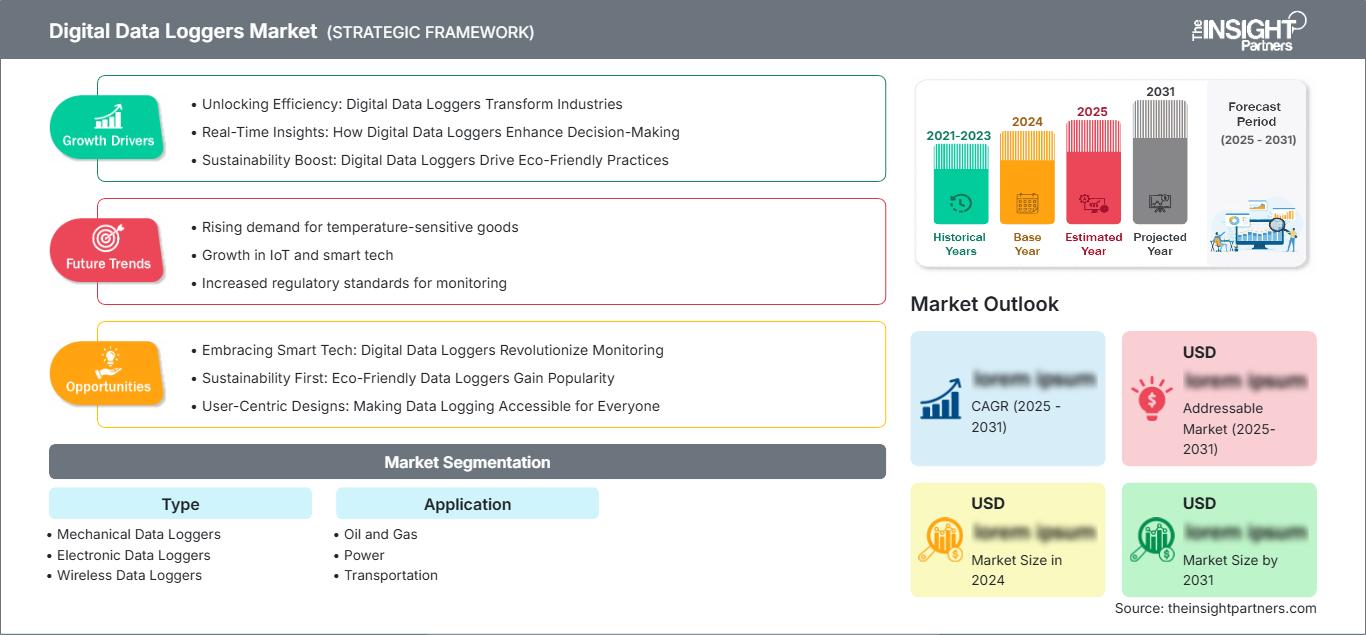
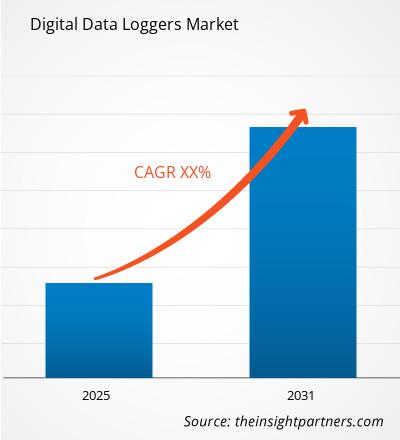
The Digital Data Loggers Market was recorded as US$ 2.82 Billion in 2025 and is expected to reach US$ 7.75 Billion by 2034 with an estimated growth rate of 11.91% in 2026-2034. This market includes the use of mechanical, electronic, and wireless data loggers in oil and gas industry, power industry, transportation, and environmental monitoring.
In North America region, the value of the Digital Data Loggers Market is projected to increase at a CAGR between 10.8% to 12.2%. Continuous monitoring through utilities, fleets, laboratories, and environmental organizations is driving the growth of the market in North America.
Digital Data Loggers Market Assessment and Insights
- North America: The region accounts for 30–34% share in 2025 and grows at a CAGR range of 10.8–12.2% during 2026–2034, supported by power reliability, oilfield automation, cold-chain logistics, and environmental compliance.
- US: The country represents 78–82% of North America in 2025 and grows at a CAGR range of 11.0–12.4% during 2026–2034, led by utilities, transportation, and laboratories.
- Europe: Europe holds 24–28% share in 2025 and grows at a CAGR range of 10.0–11.4% during 2026–2034, with Germany, the UK, France, Italy, and Spain leading adoption.
- Asia Pacific: Asia Pacific holds 28–32% share in 2025 and grows at a CAGR range of 12.4–13.8% during 2026–2034, led by China, Japan, South Korea, India, and Australia.
- Largest Segment: Electronic Data Loggers hold 48–52% market share in 2025 and grow at a CAGR range of 11.0–12.2% during 2026–2034 as industrial monitoring expands.
- High Growth Segment: Wireless Data Loggers hold 24–28% market share in 2025 and grow at a CAGR range of 13.2–14.6% during 2026–2034 due to cloud connectivity.
- Key companies analyzed in detail: Ammonit Measurement GmbH; Dickson; Dolphin Technology, Inc.; National Instruments Corporation; Omega Engineering Inc.; OMRON Corporation; Onset Computer Corporation; Rotronic AG; Testo SE & Co. KGaA; Vaisala Oyj.
Source: The Insight Partners' analysis based on proprietary research, government publications, company annual reports, investor presentations, industry databases, and expert interviews.
The approach to data collection has transitioned from stand-alone devices to networked systems, consisting of calibrated sensors, computing, secure memory storage, and cloud-based dashboards. Such an approach is going to transform the production process since vendors need to ensure the compatibility of sensor precision, battery life span, housing robustness, security, and integration. The industry is becoming more dependent on compliant recordkeeping, multi-parameter measurements, and rugged devices used in remote areas.
The future demand is going to expand as new geographical regions build grids, monitor the health of oil and gas infrastructure, deploy smart transportation systems, and build environmental monitoring systems. Regulations related to temperature management, emissions control, safety verification, and environmental reports are likely to create favorable conditions for vendors who offer traceable calibration, long-lasting devices, and analytical platforms.
Digital Data Loggers Market Report Scope
| Report Attribute | Details |
|---|---|
| Market size in 2025 | US$ 2.82 Billion |
| Market Size by 2034 | US$ 7.75 Billion |
| Global CAGR (2026 - 2034) | 11.91% |
| Historical Data | 2021-2024 |
| Forecast period | 2026-2034 |
Digital Data Loggers Market Analysis
With increasing demand due to automation of data logging from manual logging by industrial users, growth of market is fueled by constant temperature, pressure, humidity, voltage, vibration, and flow measurement in utilities, pipeline, laboratories, refrigerated logistics, and environmental stations. Value is highest where there is downtime risk, noncompliance risk, or product loss with financial consequence.
Market participants include sensors, enclosures, firmware, calibration, distribution, cloud software providers, and user engineering groups. Supply factors are semiconductors, calibration capacity, wireless module certification, and battery chemistry. Applications in oilfield and environmental networks demand sealing, while cold chain and laboratory applications demand accuracy certificates and tamperproof recording.
The Digital Data Loggers Market report suggests that the market has a fragmented structure where instrumentation vendors and application-oriented monitoring vendors fight based on accuracy, connectivity, validation, and distribution channel. The first category of companies including National Instruments Corporation, Omega Engineering Inc., Testo SE & Co. KGaA, Vaisala Oyj, and OMRON Corporation focus on the wide spectrum of measuring parameters while Dickson, Onset Computer Corporation, Rotronic AG, Ammonit Measurement GmbH, and Dolphin Technology, Inc. focus on specialized monitoring services.
Investments in strategy include Bluetooth, Wi-Fi, cellular, LoRaWAN, edge computing, improved battery life, and secure data export. As far as the strategic positioning is concerned, software ecosystem has become more important because of preference of configuration, role-based access, calibration reminders, and exception alerts by procurement managers.
● REPORT CUSTOMIZATION
Tailor This Report To Align With Your Specific Business Requirements
This report can be customized to align precisely with your business objectives, scope, and target markets. Customization options include tailored segmentation, geography, competitive analysis, and strategic insights to support informed decision-making.
Customize This Report →WHAT YOU CAN ADJUST
- ● Segmentations
- ● Geography
- ● Competitive Analysis
- ● Language Preferences
Digital Data Loggers Market: Strategic Insights
Regional Insights
North America Digital Data Loggers Market
North America holds 30–34% share in 2025 and is projected to grow at a CAGR range of 10.8–12.2% during 2026–2034. Digital Data Loggers Market share is supported by high adoption of connected instrumentation in utilities, laboratories, energy assets, food distribution, and transportation fleets.
Structural demand is strengthened by cold-chain documentation rules, grid reliability investments, pipeline monitoring, and environmental reporting. The region also benefits from mature calibration services and strong channel networks. Buyers increasingly prefer wireless devices that reduce manual site visits, support audit trails, and integrate with enterprise quality systems.
U.S. Digital Data Loggers Market
The U.S. accounts for 78-82% of North America in 2025 and expands at the rate of 11.0-12.4% CAGR from 2026 to 2034. Utilities, pharmaceuticals, refrigerated logistics, test labs, and oil & gas players are some of the segments creating demand for accurate measurement in highly regulated and remote settings.
The players in the market are National Instruments Corporation, Omega Engineering Inc., Dickson, Onset Computer Corporation, and OMRON Corporation, among others through domestic sale and integration. From the point of application, there is higher use of sensors in areas such as vaccine dispensation, grid substations, vehicle telematics, oil field pressure monitoring, and compliance centers for environmental laws.
Europe Digital Data Loggers Market
The region represents 24 to 28% market share in 2025 and witnesses a CAGR of 10.0 to 11.4% during 2026-2034. Germany emerges as the dominant country since process industry, automotive testing, renewable energy, and environmental monitoring sectors depend on calibrated instruments. The United Kingdom focuses on cold chain, railways, and laboratories compliance.
Power grid, food logistics, environment, and industrial automation drive the demand for calibrated devices in France, Italy, and Spain. The region attaches great significance to data accuracy, calibration traceability, and privacy-oriented cloud solutions. Some of the prominent companies operating in the region include Vaisala Oyj, Testo SE & Co. KGaA, Rotronic AG, and Ammonit Measurement GmbH.
APAC Digital Data Loggers Market
Asia Pacific region comprises 28-32% of share in 2025 and experiences growth at CAGR of 12.4-13.8% over 2026-2034. China dominates through manufacturing, growth in use of renewables, smart logistics and environmental monitoring schemes, whereas Japan and South Korea focus on precision-based factory and transportation applications.
India and Australia contribute towards growth with grid upgrades, cold-chain logistics, mining, weather monitoring systems and water utilities. Policies supporting digitization of industries, local manufacturing and emissions monitoring drive the uptake of IoT in the region. Asia Pacific consumers prioritize price competitiveness with durability, favoring wireless and electronic solutions.
Middle East & Africa Digital Data Loggers Market
Middle East & Africa is estimated to see a CAGR growth between 9.2% and 10.6% from 2026 to 2034. Adoption in Saudi Arabia and UAE will be driven through applications like oilfield monitoring, smart infrastructure, data center, and logistics, while South Africa contributes to mining, power, and environmental applications.
Rest of MEA demand will depend on water utilities, renewables projects, ports, and temperature control logistics. Diverse climates contribute to the need for rugged enclosures, long battery life, and wireless communications. Adoption will be enhanced through the inclusion of IoT devices with SCADA, solar monitoring, and asset management systems.
Segmentation Analysis
Type
Type is projected to grow at a CAGR range of 11.2–12.5% during 2026–2034. The Digital Data Loggers Market scope by type reflects migration from mechanical recording to electronic and wireless platforms. Buyers still use mechanical units where simplicity matters, but connected models are gaining because they automate alerts, storage, and reporting.
- Mechanical Data Loggers: Mechanical devices remain useful in basic field recording, legacy processes, and low-power applications where operators value simplicity, physical traceability, and limited dependence on software infrastructure.
- Electronic Data Loggers: Electronic data loggers form the largest segment because they offer calibrated sensing, higher memory, multi-parameter measurement, and reliable transfer for laboratories, utilities, and industrial plants.
- Wireless Data Loggers: Wireless platforms are expanding quickly as Bluetooth, Wi-Fi, cellular, and long-range networks support remote assets, cold-chain shipments, smart buildings, and automated environmental stations.
Application
Application is expected to grow at a CAGR range of 11.5–12.9% during 2026–2034. Adoption is strongest where monitored variables affect safety, compliance, asset productivity, or environmental reporting. Oil and gas and power applications need rugged, high-reliability devices, while transportation and environment applications increasingly require connected, portable, and audit-ready systems.
- Oil and Gas: Oil and gas operators use loggers for pressure, temperature, vibration, corrosion, and process monitoring across wells, pipelines, refineries, and storage assets where downtime carries high cost.
- Power: Power utilities deploy loggers in substations, transformers, renewable plants, battery systems, and load studies to improve reliability, maintenance planning, and performance visibility.
- Transportation: Transportation applications include refrigerated logistics, rail systems, vehicle testing, cargo monitoring, and infrastructure inspection where continuous records support safety, compliance, and service quality.
- Environment: Environmental monitoring uses data loggers for weather, air quality, water level, soil moisture, and habitat studies, supporting climate research and regulatory reporting.
Opportunity Snapshot
| Application | Revenue Contribution | Trend Tag | Adoption Stage |
| Oil and Gas | High | Asset Integrity | Mature |
| Power | High | Grid Reliability | Scaling |
| Transportation | Medium | Cold Chain | Scaling |
| Environment | Medium | Climate Sensors | Emerging |
Digital Data Loggers Market Growth Drivers and Impact Analysis
Regulated Cold Chains Demand Auditable Monitoring
Continuous monitoring is critical for pharmaceutical products, vaccines, biological products, and temperature-sensitive food stuffs during storage until they reach their destinations. Continuous monitoring becomes essential under the International Air Transport Association's (IATA) temperature control regulations, WHO's recommendations for vaccine handling and storage, and good distribution practices. Digital loggers make monitoring more efficient, record temperature excursions, and help implement corrective measures. This technology is most effective in transportation and storage since lack of documentation may result in shipment rejection and loss of goods or regulatory risk. Suppliers of certified sensors and accessible records are favored by the market.
Power Reliability Programs Increase Sensor Deployment
Utilities are equipping their substations, transformers, renewable energy facilities, and battery units with data loggers for measuring load, temperature, humidity, power quality, and equipment behavior. With increasing penetration of intermittent sources on the grid, there will be a need for local documentation for the purpose of fault diagnosis and maintenance. From a commercial perspective, there will be a recurring need for durable data loggers that can withstand electrical interference and exposure outdoors over an extended period.
Industrial IoT Converts Logging into Real-Time Insight
Manufacturers and users are shifting from measurement on an ad hoc basis to a model of continuous operation. Wireless and electronic loggers are now connected to maintenance programs, quality systems, and control room screens, converting raw data into alarms and trends. The effect is seen in purchasing considerations that increasingly require API capabilities, power, encryption, and integration. Companies that match hardware with the process of analytics will be able to justify their pricing and enjoy better customer relations.
Digital Data Loggers Market Future Trends
Edge Intelligence Moves into Field Loggers
Digital Data Loggers Market trends will increasingly favor devices that process data locally before transmitting only exceptions, summaries, or compressed records. Edge intelligence can extend battery life, reduce network costs, and support faster action in remote oilfields, environmental stations, and transportation assets. Future products are expected to include onboard anomaly detection, configurable thresholds, and automated metadata capture. This shift will make loggers more valuable as decision-support tools rather than passive recorders, especially where operators manage thousands of distributed measurement points.
Validated Cloud Platforms Become Buying Criteria
Cloud platforms will become central to purchasing decisions as enterprises seek standardized records across locations, suppliers, and assets. Future systems will need role-based access, audit logs, calibration histories, automated reports, and cybersecurity controls that satisfy quality and IT teams. This trend will reshape competition because device accuracy alone will be insufficient. Suppliers with validated software, open integration, and regional data hosting options can win multi-site accounts and convert hardware sales into recurring monitoring subscriptions.
Digital Data Loggers Market Opportunities
Wireless Retrofit Programs for Legacy Assets
Digital Data Loggers Market Forecasts support investment in retrofit kits that add wireless monitoring to legacy substations, pipelines, cold rooms, rail assets, and environmental stations. Many operators cannot replace full systems quickly, but they can add validated sensing nodes and gateways. Vendors should focus on easy installation, battery replacement simplicity, and compatibility with common industrial networks. Channel partners can create service revenue through site surveys, device placement, calibration, and dashboard configuration, making retrofit programs attractive for both suppliers and system integrators.
Environmental Monitoring Networks in Emerging Economies
Emerging economies are expanding air quality, water resource, weather, and agricultural monitoring networks to support climate resilience and infrastructure planning. This creates opportunity for rugged, solar-compatible, low-maintenance loggers that can operate in remote sites with limited connectivity. Suppliers can differentiate through modular sensors, multilingual software, and local calibration support. Public agencies and research institutions may favor vendors that provide transparent data ownership, exportable formats, and long-term service plans, especially where monitoring programs depend on grant funding or multiyear procurement cycles.
Recent Developments
- July 2026: EV acquired Scientific Data Systems (SDS), the developer of the Warrior Data Acquisition System, to expand its data acquisition and wellbore intelligence platform for the global energy industry. The acquisition combines SDS’s industry-established well logging hardware and software capabilities with EV’s advanced visualization, data delivery, and analytics technologies, creating an integrated workflow from wellsite data capture through interpretation, decision-making, and secure data management. The combined platform aims to improve operational efficiency, enhance wellbore insights, and enable energy companies to make faster, data-driven decisions across the well lifecycle.
- March 2025: TTTech Auto introduced the PM-350 Automotive Data Logger, a next-generation solution designed for Software-Defined Vehicle (SDV) verification and validation. The high-performance logger enables synchronized capture of high-speed Automotive Ethernet (up to 10GBase-T) along with traditional vehicle interfaces such as CAN FD, LIN, and FlexRay. Featuring hot-swappable NVMe storage, open API programmability, remote data analysis, fleet management capabilities, and sub-100 ns timestamp precision, the PM-350 helps automotive manufacturers accelerate testing, improve vehicle safety validation, and reduce development complexity for next-generation connected and autonomous vehicles.
- June 2024: ACR Systems Inc. launched the SmartReader SRX series of self-powered, multi-channel data loggers designed for electrical and industrial monitoring applications. The new SRX3 and SRX7 models integrate with ACR’s TrendReader TRX real-time graphing and analysis software, enabling users to capture, visualize, and analyze operational data with improved accuracy and efficiency. The product line supports applications including electrical current and voltage monitoring, compressor analysis, SCADA troubleshooting, and process signal recording, with features such as storage capacity of up to 1 million readings, two-stage alarm notifications, NIST calibration capability, and portable standalone operation for industrial environments.
Frequently Asked Questions

- Comprehensive Market Sizing and Forecast Analysis
- Detailed Segmentation Analysis
- In-Depth Market Dynamics Assessment
- Regional and Country-Level Insights
- Competitive Landscape and Company Benchmarking
- Strategic Business Intelligence
Recent Reports
Testimonials

The Insight Partners' SCADA System Market report is comprehensive, with valuable insights on current trends and future forecasts. The team was highly professional, responsive, and supportive throughout. We are very satisfied and highly recommend their services.
RAN KEDEM Partner, Reali Technologies LTDs
I requested a report on a very specific software market and the team produced the report in a few days. The information was very relevant and well presented. I then requested some changes and additions to the report. The team was again very responsive and I got the final report in less than a week.
JEAN-HERVE JENN Chairman, Future Analytica
We worked with The Insight Partners for an important market study and forecast. They gave us clear insights into opportunities and risks, which helped shape our plans. Their research was easy to use and based on solid data. It helped us make smart, confident decisions. We highly recommend them.
PIYUSH NAGPAL Sr. Vice President, High Beam Global
The Insight Partners delivered insightful, well-structured market research with strong domain expertise. Their team was professional and responsive throughout. The user-friendly website made accessing industry reports seamless. We highly recommend them for reliable, high-quality research services
YUKIHIKO ADACHI CEO, Deep Blue, LLC.
This is the first time I have purchased a market report from The Insight Partners.While I was unsure at first, I visited their web site and felt more comfortable to take the risk and purchase a market report.I am completely satisfied with the quality of the report and customer service. I had several questions and comments with the initial report, but after a couple of dialogs over email with their analyst I believe I have a report that I can use as input to our strategic planning process.Thank you so much for taking the extra time and making this a positive experience.I will definitely recommend your service to others and you will be my first call when we need further market data.
JOHN SUZUKI President and Chief Executive Officer, Board Director, BK Technologies
I wish to appreciate your support and the professionalism you displayed in the course of attending to my request for information regarding to infectious disease IVD market in Nigeria. I appreciate your patience, your guidance, and the fact that you were willing to offer a discount, which eventually made it possible for us to close a deal. I look forward to engaging The Insight Partners in the future, all thanks to the impression you have created in me as a result of this first encounter.
DR CHIJIOKE ONYIA MANAGING DIRECTOR, PineCrest Healthcare Ltd.Reason to Buy
- Informed Decision-Making
- Understanding Market Dynamics
- Competitive Analysis
- Identifying Emerging Markets
- Customer Insights
- Market Forecasts
- Risk Mitigation
- Boosting Operational Efficiency
- Strategic Planning
- Investment Justification
- Tracking Industry Innovations
- Aligning with Regulatory Trends





 Get Free Sample for