
Digital Electronic Thermometers Market Growth, Size & Forecast by 2034
Coverage: By Type (Forehead Type Thermometer, Ear Type Thermometer); Application (Individual, Hospital, Clinic) , and Geography (North America, Europe, Asia Pacific, and South and Central America)
- Status : Data Released
- Report Code : TIPRE00025502
- Category : Life Sciences
- No. of Pages : 150
- Available Report Formats :


- Last update date : July 08, 2026


2025 Market Size
US$ 1.31 Bn
Base year value
2034 Forecast
US$ 3.72 Bn
Projected by 2034
CAGR 2026-2034
13.94 %
Growth rate
Addressable Market
US$ 23.95 Bn
(2026-2034)
The Digital Electronic Thermometers Market is witnessing sustained expansion as healthcare providers, households, and outpatient facilities increasingly prioritize rapid, accurate, and non-invasive temperature monitoring solutions. The market is estimated at approximately US$ 1.31 billion in 2025 and is projected to reach nearly US$ 3.72 billion by 2034, advancing at a CAGR of 13.94% during 2026–2034. Growing awareness of infection control, preventive healthcare practices, and demand for contactless measurement technologies continues to support adoption across both professional and personal healthcare environments.
North America remains a significant revenue-generating region for the Digital Electronic Thermometers Market, supported by high healthcare expenditure, widespread home-monitoring adoption, and strong retail healthcare networks. The regional digital electronic thermometers market is anticipated to expand at an estimated CAGR of around 12.8% through 2034. Increasing utilization of remote patient monitoring programs, combined with rising demand for accurate fever screening in hospitals and long-term care facilities, continues to strengthen market momentum across the region.
Digital Electronic Thermometers Market Assessment and Insights
- North America: North America accounted for 34–37% of the digital electronic thermometers market share in 2025 and is anticipated to expand at a CAGR of 13.1–14.0% during 2026–2034. Strong adoption of home healthcare solutions, increasing use of infection-control technologies, and growing demand for non-contact temperature monitoring continue to support regional market growth.
- U.S.: The U.S. represented 74–78% of the North American digital electronic thermometers market size in 2025 and is projected to register a CAGR of 13.3–14.2% during 2026–2034, driven by expanding home healthcare adoption, advanced healthcare infrastructure, and increasing demand for rapid temperature screening devices.
- Europe: Europe held 26–29% of the digital electronic thermometers market share in 2025 and is expected to grow at a CAGR of 12.7–13.6% during 2026–2034. Germany, the United Kingdom, and France remain leading markets, supported by healthcare digitization initiatives, preventive care programs, and increasing adoption of advanced diagnostic technologies.
- Asia Pacific: Asia Pacific accounted for 25–28% of the digital electronic thermometers market share in 2025 and is forecast to expand at a CAGR of 15.0–16.2% during 2026–2034. China, Japan, and India continue to lead regional demand, driven by expanding healthcare access, rising middle-class healthcare spending, and strong medical device manufacturing capabilities.
- Largest Segment: Forehead Type Thermometer represented the largest digital electronic thermometers market segment and is expected to record a CAGR of 13.5–14.3% during 2026–2034, reflecting widespread preference for non-contact, rapid temperature screening solutions across healthcare and home settings.
- High Growth Segment: Hospital Application is projected to grow at a CAGR of 14.8–15.8% during 2026–2034, driven by increasing patient monitoring requirements, infection prevention protocols, and growing adoption of advanced temperature monitoring devices.
- Key companies analyzed in detail: Tecnimed S.r.l.; Koninklijke Philips N.V.; OMRON Healthcare Co., Ltd.; Braun GmbH; Jiangsu Yuyue Medical Equipment & Supply Co., Ltd. (Yuwell); Microlife Corporation; PAUL HARTMANN AG; Berrcom Medical Technology Co., Ltd.; Citizen Systems Japan Co., Ltd.; Baxter International Inc. (Welch Allyn brand).
Source: The Insight Partners' analysis based on proprietary research, government publications, company annual reports, investor presentations, industry databases, and expert interviews.
The Digital Electronic Thermometers Market report has transitioned from a largely hospital-centric diagnostic category into a broader health monitoring ecosystem. Demand accelerated as healthcare systems emphasized rapid screening capabilities, while consumers increasingly adopted home-based diagnostic devices. Advances in infrared sensing, measurement precision, and ergonomic designs have improved usability and expanded deployment across clinics, pharmacies, schools, and residential settings.
Market prospects remain favorable as healthcare providers seek efficient patient triage tools and governments continue strengthening disease surveillance capabilities. Manufacturers are focusing on enhanced accuracy algorithms, faster response times, and digital connectivity features that support remote healthcare applications. The combination of technological improvements and expanding preventive healthcare awareness is expected to sustain long-term market expansion.
Digital Electronic Thermometers Market Report Scope
| Report Attribute | Details |
|---|---|
| Market size in 2025 | US$ 1.31 Billion |
| Market Size by 2034 | US$ 3.72 Billion |
| Global CAGR (2026 - 2034) | 13.94% |
| Historical Data | 2021-2024 |
| Forecast period | 2026-2034 |
Digital Electronic Thermometers Market Analysis
Demand patterns within the Digital Electronic Thermometers Market are influenced by rising healthcare digitization, increasing infectious disease surveillance, and growing consumer preference for convenient monitoring devices. Temperature measurement remains one of the most frequently performed diagnostic assessments across healthcare settings, making digital electronic thermometers an essential component of routine care delivery.
The value chain spans sensor manufacturers, electronic component suppliers, device assemblers, distributors, healthcare institutions, pharmacies, and e-commerce platforms. Product differentiation increasingly depends on measurement speed, accuracy, hygiene benefits, and integration capabilities. Growing online distribution channels have also expanded accessibility in both developed and emerging markets.
Competition remains characterized by established healthcare device manufacturers and regional specialists. Companies such as Tecnimed Srl, Philips, Omron, Braun, Yuwell, Microlife, Hartmann, Berrcom, Citizen Group, and Welch Allyn continue emphasizing innovation, quality assurance, and regulatory compliance to strengthen market positioning.
Investment activity is increasingly directed toward sensor miniaturization, infrared measurement technologies, connected health platforms, and manufacturing expansion in high-growth regions. Strategic partnerships with healthcare providers, retail chains, and telehealth ecosystems are enabling companies to capture broader customer segments while improving product visibility and adoption.
● REPORT CUSTOMIZATION
Tailor This Report To Align With Your Specific Business Requirements
This report can be customized to align precisely with your business objectives, scope, and target markets. Customization options include tailored segmentation, geography, competitive analysis, and strategic insights to support informed decision-making.
Customize This Report →WHAT YOU CAN ADJUST
- ● Segmentations
- ● Geography
- ● Competitive Analysis
- ● Language Preferences
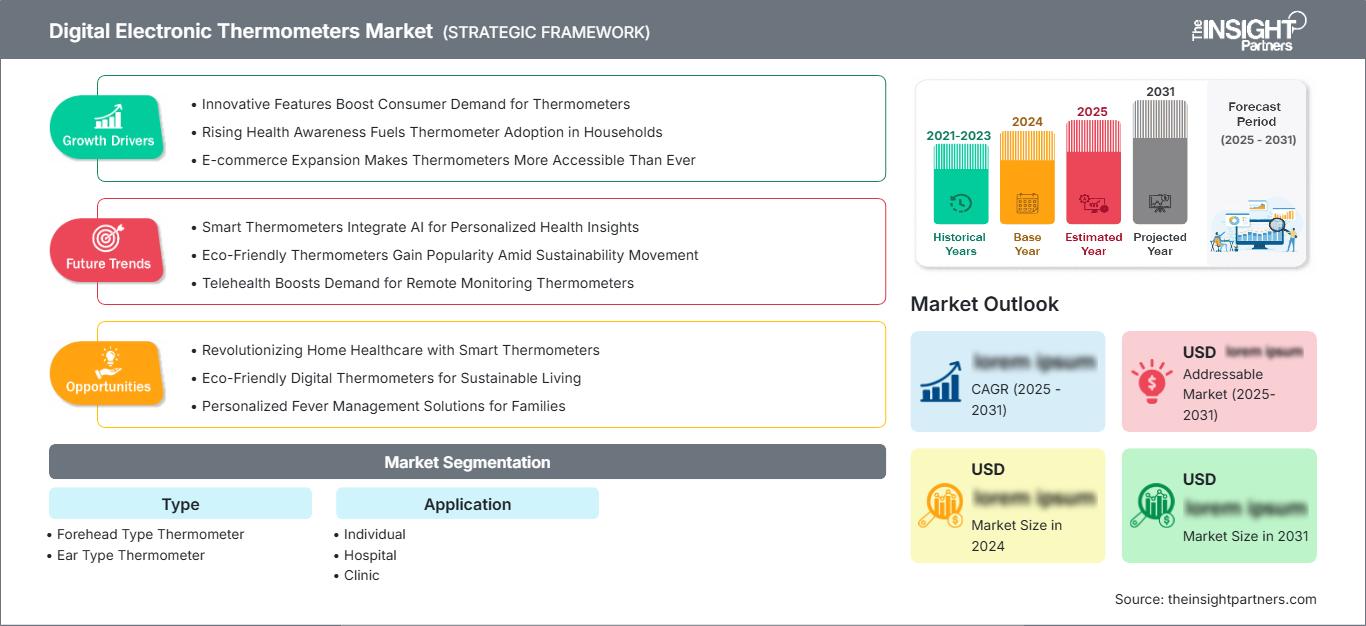
Digital Electronic Thermometers Market: Strategic Insights
Regional Insights
North America Digital Electronic Thermometers Market
North America accounts for a substantial share of global revenues, supported by advanced healthcare infrastructure and widespread awareness of preventive health monitoring. The regional market is projected to record a CAGR of approximately 12.8% through the forecast period. Strong adoption across hospitals, clinics, and households continues to generate stable demand.
Non-contact temperature measurement products are increasingly adopted by healthcare professionals for their ability to improve work efficiency and enhance infection control. The trend will be further promoted by an aging population, growing needs for home care services, and the encouragement of telemonitoring techniques. Further investments in healthcare digitalization are anticipated to fuel regional demand.
U.S. Digital Electronic Thermometers Market
The United States represents the largest national market, accounting for an estimated 68–72% share of North American revenue. The market is expected to expand at a CAGR of roughly 12.6% through 2034. Strong purchasing power, extensive healthcare networks, and widespread adoption of consumer healthcare devices contribute to sustained demand.
Leading companies have established strong distribution through hospitals, pharmacies, and online stores. The use of application software has grown tremendously in home-based healthcare facilities, outpatients, and emergency care facilities. Telemedicine services and home monitoring also increase demand for digital thermometer solutions across diverse patient populations.
Europe Digital Electronic Thermometers Market
Europe maintains a significant position within the Digital Electronic Thermometers Market, accounting for approximately 26–30% of global revenue. The regional market is anticipated to grow at a CAGR of around 13.1% through the forecast period. Demand is supported by strong healthcare systems, stringent quality standards, and increasing emphasis on preventive healthcare initiatives.
The United Kingdom continues to see growing usage of digital monitoring devices in both public and private sectors of the healthcare industry. Increasing consumer knowledge about self-monitoring and infection control drives market growth.
Germany continues to be the leading nation in Europe owing to its developed medical device industry, well-developed hospitals, and high healthcare spending. Consistent investments in diagnostic solutions further drive the market growth.
France, Italy, and Spain together make up an important demand side as well, due to increased investment in outpatient facilities and higher per-family health expenditure. Non-touch technology used for measuring body temperature facilitates market penetration in these countries.
APAC Digital Electronic Thermometers Market
Asia Pacific is projected to be the fastest-growing regional digital electronic thermometers market, expanding at an estimated CAGR of 15.8% through 2034 while representing approximately 24–28% of global revenue. Rapid urbanization, healthcare infrastructure development, and increasing healthcare awareness continue to support robust market expansion.
China occupies a leading position due to its large manufacturing capacity, investment in the healthcare sector, and high levels of consumer demand. Manufacturing capacity and the process of healthcare modernization contribute to market growth.
Japan and South Korea have advantages in their technologically advanced healthcare sectors and aging populations that require regular healthcare monitoring. In turn, India emerges as one of the growth engines, driven by increasing access to healthcare and the widespread use of diagnostic devices in households. Australia continues to demonstrate steady demand driven by preventive healthcare initiatives and strong retail healthcare networks.
Middle East & Africa Digital Electronic Thermometers Market
The Middle East & Africa market is experiencing gradual expansion as governments invest in healthcare modernization and disease surveillance infrastructure. The region is expected to register a CAGR of approximately 12.9% through the forecast period.
Saudi Arabia's dominance continues owing to the implementation of transformation programs in the healthcare sector, investment in hospitals, and the adoption of modern medical technologies. Growing healthcare facilities have played an essential role in procuring digital diagnostic equipment.
The UAE currently enjoys many advantages of digitalization in the healthcare sector, along with the rising demand for patient monitoring devices. There have been positive developments in healthcare availability and preventive diagnostics in South Africa. The growth of healthcare infrastructure and public healthcare campaigns across the MEA region has created opportunities for digital thermometers.
Segmentation Analysis
Type
- Forehead Type Thermometer: Represents the dominant segment owing to its contactless operation, rapid measurement capability, and suitability for hospitals, clinics, schools, workplaces, and household healthcare applications where hygiene and efficiency remain critical priorities.
- Ear Type Thermometer: Maintains strong demand due to reliable readings, ease of use, and suitability for pediatric and adult temperature measurement. Adoption remains particularly notable in clinical environments requiring consistent and repeatable assessments.
Application
- Individual: Growing health awareness, increasing self-monitoring practices, and wider availability of affordable digital healthcare devices continue to drive substantial demand from household users seeking convenient temperature monitoring solutions.
- Hospital: Hospitals utilize digital electronic thermometers extensively for patient screening, infection control, emergency care, and inpatient monitoring, making this application segment a major contributor to overall market revenue.
- Clinic: Clinics increasingly deploy digital thermometers to improve workflow efficiency, reduce patient wait times, and support accurate temperature assessment during routine examinations and outpatient consultations.
Opportunity Snapshot
| Application | Revenue Contribution | Trend Tag | Adoption Stage |
| Individual | High | Home Monitoring | Scaling |
| Hospital | High | Infection Control | Mature |
| Clinic | Medium | Rapid Screening | Scaling |
Digital Electronic Thermometers Market Growth Drivers and Impact Analysis
Expansion of Home Healthcare Monitoring
The increasing trend towards home-based healthcare is having a significant impact on market demand. Consumers now require reliable and effective medical devices that assist them in monitoring their health from the comfort of their homes, without needing to visit healthcare facilities regularly. Digital electronic thermometers have proven to be essential healthcare devices because of their ease of use, low cost, and rapid diagnosis. Awareness of the importance of early illness detection has further promoted their use.
This phenomenon is affecting not only consumers but also the healthcare sector. Healthcare systems now encourage monitoring patients at home to reduce unnecessary visits and improve the efficiency of healthcare resource use. With the increasing popularity of telemedicine worldwide, digital thermometers remain important diagnostic devices.
Growing Focus on Infection Prevention and Screening
The healthcare industry continues to focus on infection control measures, thereby ensuring sustained demand for hygienic temperature-taking devices. The deployment of digital electronic thermometers, particularly non-contact models, will substantially reduce the risk of cross-contamination and facilitate rapid patient examination.
It is this driver that has been affecting procurement approaches adopted by hospitals, medical centers, schools, transportation centers, and even employers. Improved screening techniques have increased the significance of temperature measurement as the primary diagnostic procedure, making it important for organizations to implement advanced temperature-measuring systems.
Technological Advancements in Sensor Accuracy
The consistent improvement in technologies such as infrared sensing, microelectronic components, and measurement algorithms is enhancing performance. Companies have been rolling out products that are faster, more accurate, have memory capabilities, and are even more connected.
This technological advancement is expanding the scope of these devices' applications and improving customer trust in digital body temperature measuring devices. The products' capabilities are making it easy for people to accept these devices.
Digital Electronic Thermometers Market Future Trends
Integration with Connected Healthcare Platforms
The use of digital thermometers is increasingly becoming part of integrated healthcare ecosystems, reflecting key digital electronic thermometers market trends. Manufacturers are planning to integrate with mobile apps, remote monitoring systems, and EHRs to increase access to healthcare data and patient engagement.
For future development, data sharing, automated monitoring, and compatibility with other monitoring devices are features anticipated to be integrated into the product development process. The integration of these features would enable digital thermometers to play an even bigger role in preventive care and chronic disease management.
Rise of Advanced Non-Contact Measurement Technologies
The industry is experiencing increasing demand for temperature-measuring devices that use non-contact methods and help improve sanitary conditions, increase convenience, and boost effectiveness. Infrared forehead thermometers have seen progress in sensor accuracy and environmental compensation techniques.
In the future, companies will likely focus their efforts on multi-sensor technology, artificial intelligence-based measurement corrections, and improved human-machine interaction systems. Such approaches might contribute not only to higher reliability but also to more widespread use of infrared forehead thermometers in various industries.
Digital Electronic Thermometers Market Opportunities
Expansion Across Emerging Healthcare Markets
Emerging economies present substantial growth opportunities due to expanding healthcare infrastructure, increasing healthcare spending, and rising awareness of preventive diagnostics. Government initiatives and healthcare provider investments in primary care are creating stronger demand for affordable, dependable diagnostic devices, reinforcing the digital electronic thermometers market forecast.
Firms that create local distribution networks, regional manufacturing facilities, and a product range tailored to each market segment can increase their competitiveness. Investment in healthcare services in underdeveloped areas can be highly profitable due to the increasing availability of these services.
Development of Premium Smart Thermometry Solutions
The trend towards prioritizing connectivity in healthcare devices offers potential for developing premium digital thermometers. Devices that provide connectivity, health analytics, cloud capability, and personalization can cater to changing consumer needs.
Organizations that merge accurate performance measurement with digital health capabilities will capture high-value customer segments. The potential to generate revenue through investment in a software ecosystem, companion apps, and remote monitoring can provide customers with an edge.
Recent Developments
- October, 2025: OMRON Healthcare reported that its skin infrared thermometer, MC-F300, received the 2025 Good Design Award alongside several healthcare products, highlighting continued investment in user-centric medical device design and diagnostic innovation.
- July, 2025: OMRON Healthcare announced plans for a new manufacturing facility in Chennai, India, aimed at expanding local production capacity and strengthening access to home healthcare monitoring devices across high-growth markets. The investment supports the company's long-term preventive healthcare strategy.
- June, 2025: The FDA has now exempted certain clinical electronic thermometers without telethermographic or continuous temperature measurement functions from premarket notification requirements.
Frequently Asked Questions

- Comprehensive Market Sizing and Forecast Analysis
- Detailed Segmentation Analysis
- In-Depth Market Dynamics Assessment
- Regional and Country-Level Insights
- Competitive Landscape and Company Benchmarking
- Strategic Business Intelligence
Recent Reports
Testimonials

The Insight Partners' SCADA System Market report is comprehensive, with valuable insights on current trends and future forecasts. The team was highly professional, responsive, and supportive throughout. We are very satisfied and highly recommend their services.
RAN KEDEM Partner, Reali Technologies LTDs
I requested a report on a very specific software market and the team produced the report in a few days. The information was very relevant and well presented. I then requested some changes and additions to the report. The team was again very responsive and I got the final report in less than a week.
JEAN-HERVE JENN Chairman, Future Analytica
We worked with The Insight Partners for an important market study and forecast. They gave us clear insights into opportunities and risks, which helped shape our plans. Their research was easy to use and based on solid data. It helped us make smart, confident decisions. We highly recommend them.
PIYUSH NAGPAL Sr. Vice President, High Beam Global
The Insight Partners delivered insightful, well-structured market research with strong domain expertise. Their team was professional and responsive throughout. The user-friendly website made accessing industry reports seamless. We highly recommend them for reliable, high-quality research services
YUKIHIKO ADACHI CEO, Deep Blue, LLC.
This is the first time I have purchased a market report from The Insight Partners.While I was unsure at first, I visited their web site and felt more comfortable to take the risk and purchase a market report.I am completely satisfied with the quality of the report and customer service. I had several questions and comments with the initial report, but after a couple of dialogs over email with their analyst I believe I have a report that I can use as input to our strategic planning process.Thank you so much for taking the extra time and making this a positive experience.I will definitely recommend your service to others and you will be my first call when we need further market data.
JOHN SUZUKI President and Chief Executive Officer, Board Director, BK Technologies
I wish to appreciate your support and the professionalism you displayed in the course of attending to my request for information regarding to infectious disease IVD market in Nigeria. I appreciate your patience, your guidance, and the fact that you were willing to offer a discount, which eventually made it possible for us to close a deal. I look forward to engaging The Insight Partners in the future, all thanks to the impression you have created in me as a result of this first encounter.
DR CHIJIOKE ONYIA MANAGING DIRECTOR, PineCrest Healthcare Ltd.Reason to Buy
- Informed Decision-Making
- Understanding Market Dynamics
- Competitive Analysis
- Identifying Emerging Markets
- Customer Insights
- Market Forecasts
- Risk Mitigation
- Boosting Operational Efficiency
- Strategic Planning
- Investment Justification
- Tracking Industry Innovations
- Aligning with Regulatory Trends





 Get Free Sample for