
Digital Inclinometer Market Size, Share & Forecast by 2034
Coverage: By Type (Low Accuracy, High Accuracy); Application (Construction, Geological Survey, Oil and Gas) , and Geography (North America, Europe, Asia Pacific, and South and Central America)
- Status : Data Released
- Report Code : TIPRE00017130
- Category : Electronics and Semiconductor
- No. of Pages : 150
- Available Report Formats :


- Last update date : August 25, 2026


2025 Market Size
US$ 206.55 Mn
Base year value
2034 Forecast
US$ 402.19 Mn
Projected by 2034
CAGR 2026-2034
7.69 %
Growth rate
Addressable Market
US$ 2,741.96 Mn
(2026-2034)
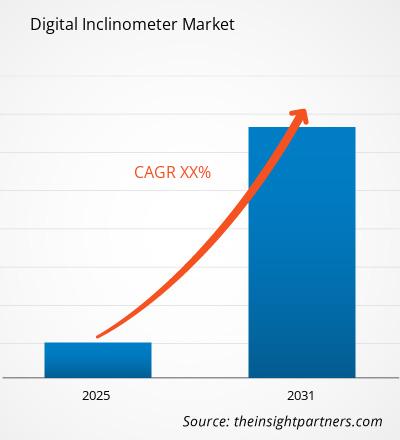
The Digital Inclinometer Market size was valued at US$ 206.55 Million in 2025 and will register US$ 402.19 Million by 2034, growing at a CAGR of 7.69% between 2026-2034. The growth can be attributed to increasing application of electronic tilting measurement in construction alignment, geological measurement, and oil & gas applications, owing to enhanced accuracy, safety, data logging, and connectivity provided by electronic sensors.
In the North American region, the market is anticipated to grow at an estimated CAGR of 7.1-7.7% by 2034. Infrastructure rehabilitation, geotechnical instrumentation, pipeline integrity, and automatic machinery alignment drive the buying of these tools. Sensor design, specialized distribution, and strict safety documentation norms are favorable factors for adoption in the region.
Digital Inclinometer Market Assessment and Insights
- North America held 30–33% share in 2025 and is projected to grow at a 7.1–7.7% CAGR during 2026–2034, supported by infrastructure renewal, geotechnical monitoring, pipeline inspection, and industrial alignment.
- US represented 79–83% of North American revenue in 2025 and should expand at a 7.2–7.8% CAGR through 2034.
- Europe accounted for 25–28% share in 2025 and is expected to record a 6.8–7.4% CAGR, led by Germany, the UK, France, Italy, and Spain.
- Asia Pacific captured 32–36% share in 2025 and should advance at an 8.4–9.0% CAGR, led by China, Japan, South Korea, India, and Australia.
- Largest Segment Low Accuracy held 58–62% market share in 2025 and is projected to post a 7.0–7.6% CAGR during 2026–2034.
- High Growth Segment High Accuracy represented 38–42% market share in 2025 and is expected to grow at an 8.4–9.0% CAGR during 2026–2034.
- Key companies analyzed in detail: Apex Instruments, Inc.; Bosch Limited; Ericco International Limited; The Fredericks Company; GEOKON, Inc.; JSB Tech Pte. Ltd.; Level Developments Ltd.; Rieker Inc.; Singer Instruments and Control Ltd.; and Taylor Hobson Ltd., an AMETEK, Inc. business.
Source: The Insight Partners' analysis based on proprietary research, government publications, company annual reports, investor presentations, industry databases, and expert interviews.
Digital inclinometers have come from single axis bubble level replacements to MEMS based, temperature compensated multi axis digital inclinometers with wireless communication and digital filtering and continuous logging capability. The manufacturing process includes accelerometers, high accuracy analog front end circuitry, built-in calibration systems, robust housing, and applications software. Affordable sensors have widened the scope of construction application whereas the more expensive high accuracy devices are used for settlement, borehole, machine tool, and offshore applications. It marks the trend of Digital Inclinometer Market towards connected assets instead of individual angle measurement.
From 2021 to 2034, funding shall be invested in infrastructure projects in Asia, rehabilitation projects in North America, and industrial automation zones in Europe. Increased public funding for resilient transport system, strict regulations for slopes, excavation safety measures, and pipeline integrity will increase the need for traceable, calibrated inclinometers. Providers that can deliver durable, low drift, cloud capable data, and regional service networks are expected to meet the needs of construction and engineering teams.
Digital Inclinometer Market Report Scope
| Report Attribute | Details |
|---|---|
| Market size in 2025 | US$ 206.55 Million |
| Market Size by 2034 | US$ 402.19 Million |
| Global CAGR (2026 - 2034) | 7.69% |
| Historical Data | 2021-2024 |
| Forecast period | 2026-2034 |
Digital Inclinometer Market Analysis
The Digital Inclinometer Market’s success is tied to an increasing need for rapid, repeatable angle measurements in civil engineering, geology, and energy operations. This industry consists of the relationships between MEMS manufacturers, calibration facilities, instrument makers, software developers, distributors, survey companies, and asset owners. Measurement accuracy is determined by noise, temperature effects, mounting, cross-axis response, and traceable calibration since field vibration and temperature cycles can affect results significantly.
Market supply favors modular systems that have electronics shared among handheld levels, borehole probes, and fixed monitoring stations. Construction drives volume purchases, whereas geological surveys and oil and gas exploration activities drive high-end products. Precision sensors, enclosure testing and calibration can increase lead times. Buyers are increasingly demanding Bluetooth, RS-485, CAN, or cloud connectivity for tilt data integration into project controls and condition monitoring systems.
The Digital Inclinometer Market forecast reveals a fragmented industry consisting of two groups of players, namely general measurement equipment producers and geotechnical instruments suppliers. Bosch Limited caters to general construction customers, whereas GEOKON, Inc. and Rieker Inc. target at engineered sensing applications. Competing in their high accuracy, calibration stability and applicability in the areas where these characteristics are valued, Level Developments Ltd., The Fredericks Company and Taylor Hobson Ltd., a division of AMETEK, Inc., operate.
Investment priorities include reducing drifts, automated calibration, wireless telemetry, compact sizes. Companies like Apex Instruments, Inc., Ericco International Limited, JSB Tech Pte. Ltd., and Singer Instruments and Control Ltd. cater to special industrial demands by providing customized solutions and regional support. Competitive edge is gained by demonstrated accuracy across temperature range, robust design, interoperability of signals and life cycle service instead of solely resolution, especially for safety-critical civil and energy infrastructure.
● REPORT CUSTOMIZATION
Tailor This Report To Align With Your Specific Business Requirements
This report can be customized to align precisely with your business objectives, scope, and target markets. Customization options include tailored segmentation, geography, competitive analysis, and strategic insights to support informed decision-making.
Customize This Report →WHAT YOU CAN ADJUST
- ● Segmentations
- ● Geography
- ● Competitive Analysis
- ● Language Preferences
Digital Inclinometer Market: Strategic Insights
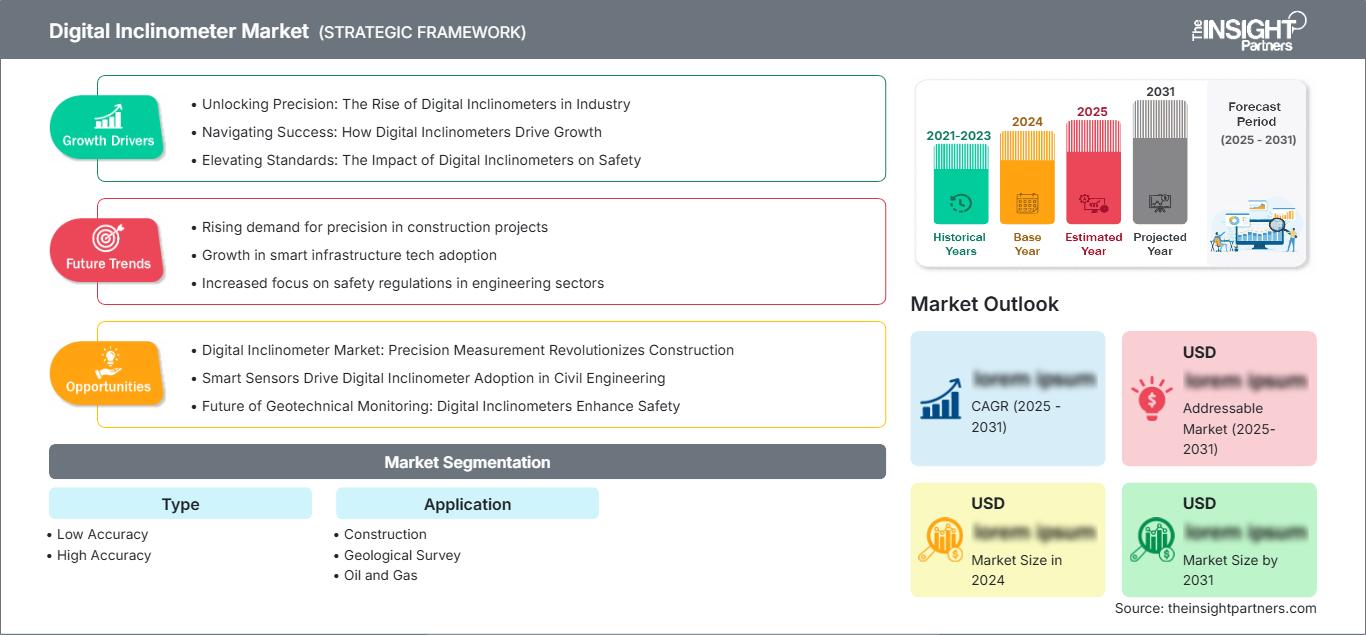
Regional Insights
North America Digital Inclinometer Market
The North America region held 30-33% Digital Inclinometer Market share in 2025 and is expected to achieve a 7.1-7.7% CAGR till 2034. The market growth is attributed to applications like bridges, tunnels, dams, excavation work, pipelines, and leveling during construction. The need for upgrades in infrastructure by federal and state governments expands the existing base, along with documentation required by miners and energy companies.
The presence of reliable geotechnical consultants, calibrators, and industrial distributors contributes to regional strength. Canadian applications include mining activities, hydropower operations, transportation networks, and applications in cold climates; Mexican contribution includes manufacturing, construction, and energy sectors. Connected systems are becoming more popular due to situations wherein engineers have to incorporate tilt measurements with displacements, strains, and vibrations. Suppliers providing robust housing, calibration, and telemetry are set to benefit from replacements and projects.
U.S. Digital Inclinometer Market
United States held the share of 79-83% of revenue in North America in 2025 and would register a growth rate of 7.2-7.8% CAGR during 2026-2034. Some of the local manufacturers of geotechnical instruments include GEOKON, Inc., Rieker Inc., The Fredericks Company, and Apex Instruments, Inc. Applications include excavation support, structural health monitoring, railway alignment, pipeline installation, drilling support, machinery setup, and laboratory calibrations.
The trend in procurement is evolving from periodic manual measurements to measurement networking in critical sites. While contractors prefer rapid set-up and good display, geotechnical engineers need accuracy and repeat ability, probe availability, and traceable calibration. Shock resistant, environmental proof, and communication-enabled devices are the needs of energy industry operators. Thus, buyers in the United States would prefer product lines consisting of portable instruments, fixed sensors, data loggers, and software for consistent measurement processes from first surveys to monitoring.
Europe Digital Inclinometer Market
The region accounted for 25% to 28% of worldwide revenues in 2025 and is forecast to grow at a CAGR of 6.8% to 7.4% through 2034. Germany holds its position by machinery manufacturing, automotive manufacturing, railway infrastructure, and precision measurement. The United Kingdom makes its contribution in sensor design, offshore engineering, tunneling, and railway monitoring, having well-developed distribution channels for both portable and embedded products.
France is represented by civil infrastructure, nuclear energy, aerospace, and energy inspection; Italy and Spain make additional contributions with construction, transport infrastructure modernization, and industry alignment requirement. The buyers from Europe focus on CE approval, uncertainty documentation, repairable design, and environmental impact. Projects related to smart infrastructure and the presence of legacy systems lead to monitoring requirements, but fragmented procurement may lengthen the sales cycle.
APAC Digital Inclinometer Market
The Asia Pacific region accounted for 32-36% market share in 2025 and is expected to post an 8.4-9.0% CAGR, which will be the fastest-growing regional market. China dominates with construction, railroads, mining, and indigenous production of sensors, whereas Japan and South Korea add precision machinery, electronics, ship building, and factory automation.
India’s investments in metro rails, highways, tunnels, and energy projects increase demand for field products, while Australia helps with mining, geotechnical consultancy, and offshore operations. Localizations, increased engineering capability, and higher infrastructure budgets drive localization. Sensitivity to prices favors manufacturers with good accuracy, solid build, easy-to-use software, and regional calibration services.
Middle East & Africa Digital Inclinometer Market
Middle East and Africa should register a 6.2–6.8% CAGR through 2034. Saudi Arabia leads through transport megaprojects, mining, and oil infrastructure, while the UAE supports high-rise construction, ports, and industrial maintenance. South Africa contributes mining, dams, and geotechnical engineering demand.
Across the rest of MEA, adoption remains project-driven and dependent on imported instrumentation. Harsh temperatures, dust, and remote locations increase the value of sealed housings, temperature compensation, and long battery life. Vendors can improve penetration through local distributors, field training, calibration partnerships, and bundled monitoring systems for energy, infrastructure, and slope-stability projects.
Segmentation Analysis
Type
The Type segment is projected to grow at a 7.6–8.2% CAGR during 2026–2034. Digital Inclinometer Market scope spans economical tools for routine leveling and precision instruments for geotechnical, metrology, and energy applications. Adoption depends on allowable error, operating temperature, shock exposure, calibration interval, and interface requirements. Platform reuse across accuracy tiers helps manufacturers balance volume economics with specialized margins.
- Low Accuracy holds the leading position because construction crews and maintenance teams prioritize affordability, portability, fast readings, and sufficient precision for leveling, installation, drainage, and general alignment.
- High Accuracy carries strategic importance in borehole surveys, structural monitoring, machine calibration, and offshore work, where low drift, temperature compensation, repeatability, and traceable calibration justify premium pricing.
Application
The Application segment should expand at a 7.7–8.3% CAGR through 2034. Construction provides broad demand for layout, grading, and structural checks; geological survey requires repeatable subsurface and slope measurements; oil and gas emphasizes ruggedness and remote operation. Digital records improve auditability and enable integration with broader monitoring datasets, strengthening instrument value across project lifecycles.
- Construction remains the largest application as contractors use digital tilt measurement for formwork, façades, foundations, cranes, tunnels, roads, and equipment installation across recurring project stages.
- Geological Survey supports high-value demand in landslide assessment, borehole deviation, dam monitoring, and excavation control, where repeatable datasets guide engineering decisions and risk mitigation.
- Oil and Gas requires sealed, shock-resistant instruments for drilling support, platform leveling, pipeline alignment, and equipment monitoring, making lifecycle reliability and remote data access commercially important.
Opportunity Snapshot
| Application | Revenue Contribution | Trend Tag | Adoption Stage |
| Construction | High | Smart Layout | Mature |
| Geological Survey | Medium | Slope Monitoring | Scaling |
| Oil and Gas | Medium | Remote Integrity | Scaling |
Digital Inclinometer Market Growth Drivers and Impact Analysis
Infrastructure Renewal Expands Precision Measurement
For transport projects, water, energy, and infrastructure schemes, it is crucial to have an accurate angle measurement system for building and later on to detect any deformation. Inclinometers are used in formwork positioning, railroad track layout, rotation of bridges, performance of retaining walls, convergence in tunnels, and dams’ security. As opposed to analog solutions, these devices offer digital readings that can be time-stamped, exchanged, and compared during subsequent inspections. It is useful not only for ensuring good quality of work by contractors but also for identifying deformation at an early stage for the asset owner. The market potential of such devices is bigger than portable inclinometers since it includes fixed inclinometers, loggers, gateways, calibration, and engineering services.
Connected Monitoring Replaces Periodic Manual Checks
There is now an increased demand for continuous tilt data when manual intervention would be either too dangerous, too costly, or insufficiently frequent to determine that acceleration is taking place. With wireless or hardwired digital inclinometers working alongside other sensing technologies like strain, displacement, groundwater, and vibration monitoring, the full picture of structural health can emerge. Processing at the edge will minimize data transmission requirements through triggering only those events that have reached certain thresholds, while remote configuration will minimize on-site visits. The effect of this development will be a move toward revenue streams from software, connectivity, and maintenance along with instrument sales. Success will hinge on factors including battery life, cybersecurity, network coverage, and quality of data.
Safety-Critical Operations Require Traceable Accuracy
Geotechnical surveys, drilling support, offshore platforms, and precision machinery demand more than a high-resolution display. Users need known uncertainty, low temperature drift, repeatability after shock, and calibration traceability so measurements can support engineering decisions. Digital instruments automate compensation and reduce transcription errors, but performance must remain stable under vibration, humidity, dust, and changing orientations. This increases demand for high-accuracy products, protective enclosures, calibration certificates, and service contracts. The commercial effect is stronger differentiation between general-purpose and professional instruments. Manufacturers that publish realistic specifications, maintain accredited calibration pathways, and design for field verification can build trust with consultants, energy operators, and regulated asset owners facing substantial consequences from incorrect alignment.
Digital Inclinometer Market Future Trends
Self-Diagnosing Sensor Nodes
Digital Inclinometer Market trends will increasingly emphasize instruments that evaluate their own health rather than merely report tilt. Future nodes will monitor temperature exposure, supply voltage, noise, drift indicators, communication quality, and mounting disturbance, then flag readings requiring inspection. Embedded diagnostics can reduce false alarms and make large distributed networks easier to maintain. Reference checks and automated plausibility tests will support longer calibration intervals where regulations permit. Suppliers will differentiate through transparent confidence metrics and service analytics, not only nominal accuracy. Adoption should begin in remote geotechnical and energy assets, where unnecessary site visits are costly and sensor failure can compromise critical decisions.
Multi-Sensor Digital Twins for Ground and Structures
Future monitoring platforms will combine inclination with displacement, strain, vibration, pore pressure, weather, and construction activity inside digital twins. Tilt data will gain value when models relate small angular changes to specific structural components, soil layers, or operating events. Engineers can then test scenarios, prioritize inspections, and distinguish temporary movement from persistent deterioration. Standardized timestamps, metadata, and coordinate references will become essential for combining devices from different suppliers. This trend favors vendors offering well-documented APIs and integration support. It also creates opportunities for specialist analytics firms to convert raw measurements into asset-level risk indicators and maintenance recommendations.
Digital Inclinometer Market Opportunities
Retrofit Monitoring Kits for Aging Infrastructure
Digital Inclinometer Market Forecasts support investment in modular retrofit kits for bridges, retaining walls, tunnels, dams, towers, and industrial structures lacking permanent instrumentation. A commercially effective package should combine compact sensors, magnetic or anchored mounts, battery or solar power, gateway connectivity, and a configurable dashboard. Installation partners can create recurring value through site surveys, commissioning, alarm setup, calibration, and annual maintenance. Investors should prioritize open communications and simple export because asset owners often operate mixed monitoring fleets. Demonstrating reduced inspection travel, earlier anomaly detection, and clearer maintenance prioritization will strengthen procurement cases and enable phased deployments that begin with the highest-risk assets.
Localized Calibration and Service Networks
Manufacturers can expand in rapidly building markets by investing in regional calibration, repair, rental, and application-support capacity. Customers often delay purchases when instruments must be returned overseas for certification or troubleshooting, especially on schedule-sensitive construction and energy projects. Authorized laboratories and trained distributors shorten downtime, improve confidence, and support compliance with project quality plans. Rental fleets also introduce high-accuracy equipment to smaller contractors without immediate capital expenditure. The strongest models will combine local service with centralized engineering oversight, standardized procedures, and digital certificate management. Partnerships with survey firms, universities, and geotechnical consultants can generate demonstration projects and create credible routes into public infrastructure procurement.
Recent Developments
- August 2025: HBK has introduced the MV7-AR, a ruggedised inertial measurement unit (IMU) designed to deliver reliable and accurate motion measurements in some of the most demanding environments. Built for challenging applications, the MV7-AR is engineered to withstand harsh conditions where conventional measurement equipment may struggle. Its robust construction makes it suitable for industries and projects involving significant vibration, shock, temperature variations, and other environmental stresses.
- February 2025: Daniamant has announced that its DanEI-300 electronic inclinometer has received IMO Wheelmark approval, making it the first electronic inclinometer certified to meet the new IMO carriage requirements for container ships and bulk carriers. The approval confirms that the DanEI-300 meets the requirements of the EU Marine Equipment Directive (MED) 2014/90/EU. The product successfully completed conformity assessments under Modules B and D, with certification carried out by DNV (Notified Body 0098).
- May 2026: ifm has launched its new JBC series of dynamic inclination sensors, designed to provide accurate angle measurement in industrial applications exposed to shock, vibration and continuous movement. Unlike conventional inclination sensors, the JBC series combines 3D acceleration and 3D gyroscope data to maintain reliable measurement performance even when machinery is accelerating, braking, turning or operating over uneven surfaces. The sensors monitor movement across six degrees of freedom (6DoF) and use an advanced Kalman filter to compensate for disturbances that could otherwise affect inclination measurements.
Frequently Asked Questions

- Comprehensive Market Sizing and Forecast Analysis
- Detailed Segmentation Analysis
- In-Depth Market Dynamics Assessment
- Regional and Country-Level Insights
- Competitive Landscape and Company Benchmarking
- Strategic Business Intelligence
Recent Reports
Testimonials

The Insight Partners provided valuable market intelligence that supported our global go-to-market strategy. Their team was professional, responsive, and attentive to our feedback, providing thoughtful analysis and helpful methodological clarifications throughout the project.
Junmo Kim Chief Financial Officer (CFO), Enertech Co., Ltd.
The Insight Partners' SCADA System Market report is comprehensive, with valuable insights on current trends and future forecasts. The team was highly professional, responsive, and supportive throughout. We are very satisfied and highly recommend their services.
RAN KEDEM Partner, Reali Technologies LTDs
I requested a report on a very specific software market and the team produced the report in a few days. The information was very relevant and well presented. I then requested some changes and additions to the report. The team was again very responsive and I got the final report in less than a week.
JEAN-HERVE JENN Chairman, Future Analytica
We worked with The Insight Partners for an important market study and forecast. They gave us clear insights into opportunities and risks, which helped shape our plans. Their research was easy to use and based on solid data. It helped us make smart, confident decisions. We highly recommend them.
PIYUSH NAGPAL Sr. Vice President, High Beam Global
The Insight Partners delivered insightful, well-structured market research with strong domain expertise. Their team was professional and responsive throughout. The user-friendly website made accessing industry reports seamless. We highly recommend them for reliable, high-quality research services
YUKIHIKO ADACHI CEO, Deep Blue, LLC.
This is the first time I have purchased a market report from The Insight Partners.While I was unsure at first, I visited their web site and felt more comfortable to take the risk and purchase a market report.I am completely satisfied with the quality of the report and customer service. I had several questions and comments with the initial report, but after a couple of dialogs over email with their analyst I believe I have a report that I can use as input to our strategic planning process.Thank you so much for taking the extra time and making this a positive experience.I will definitely recommend your service to others and you will be my first call when we need further market data.
JOHN SUZUKI President and Chief Executive Officer, Board Director, BK Technologies
I wish to appreciate your support and the professionalism you displayed in the course of attending to my request for information regarding to infectious disease IVD market in Nigeria. I appreciate your patience, your guidance, and the fact that you were willing to offer a discount, which eventually made it possible for us to close a deal. I look forward to engaging The Insight Partners in the future, all thanks to the impression you have created in me as a result of this first encounter.
DR CHIJIOKE ONYIA MANAGING DIRECTOR, PineCrest Healthcare Ltd.Reason to Buy
- Informed Decision-Making
- Understanding Market Dynamics
- Competitive Analysis
- Identifying Emerging Markets
- Customer Insights
- Market Forecasts
- Risk Mitigation
- Boosting Operational Efficiency
- Strategic Planning
- Investment Justification
- Tracking Industry Innovations
- Aligning with Regulatory Trends





 Get Free Sample for