
Digital IC Market Trends, Share & Demand by 2034
Coverage: by Component (Memory, Microprocessor, Microcontroller, and Digital Signal Processing System); Raw Material (Silicon, Gallium Arsenide, and Others); End-User (Automotive, Industrial, Consumer Electronics, and Communication), and Geography (North America, Europe, Asia Pacific, and South and Central America)
- Status : Data Released
- Report Code : TIPEL00002157
- Category : Electronics and Semiconductor
- No. of Pages : 150
- Available Report Formats :


- Last update date : July 31, 2026


2025 Market Size
US$ 179.02 Bn
Base year value
2034 Forecast
US$ 374.01 Bn
Projected by 2034
CAGR 2026-2034
8.53 %
Growth rate
Addressable Market
US$ 2,480.56 Bn
(2026-2034)
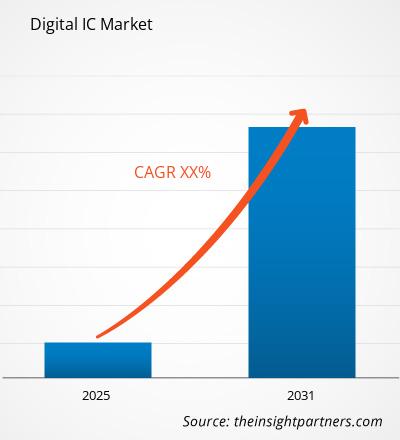
The Digital IC market is pegged at US$ 179.02 billion in 2025, which is expected to grow to US$ 374.01 billion by 2034 at a CAGR of 8.53% from 2026 to 2034. The market is growing owing to the increasing role played by memory, microprocessors, microcontrollers, and digital signal processors in connected cars, industrial automation, consumer electronics, communication systems, and AI computing systems.
In North America, factors such as investments in cloud infrastructure, automotive electronics, defense electronics, and the resurgence of semiconductor production are driving the growth of the Digital IC Market size. The market is expected to register growth of 7.8–8.4% from 2026 to 2034 due to growing demand for performance logic, memory, and embedded control devices.
Digital IC Market Assessment and Insights
- North America held 28%–31% share in 2025 and is growing at a CAGR of 7.8%–8.4% during 2026–2034, supported by AI servers, domestic fab incentives, automotive electronics, and communications infrastructure.
- US represented 80%–84% of North America in 2025 and is growing at a CAGR of 8.0%–8.6%, led by cloud, defense, and chip design ecosystems.
- Europe accounted for 16%–19% share in 2025 and is advancing at a CAGR of 6.9%–7.5%, with Germany, the UK, France, Italy, and Spain leading adoption.
- Asia Pacific captured 44%–48% share in 2025 and is expanding at a CAGR of 8.8%–9.5%, led by China, Taiwan, South Korea, Japan, and India.
- Largest Segment Memory held 38%–42% market share in 2025 and is growing at a CAGR of 8.9%–9.6%, supported by AI infrastructure and advanced consumer electronics.
- High Growth Segment Digital Signal Processing System held 14%–17% market share in 2025 and is growing at a CAGR of 9.4%–10.2%, driven by communications, ADAS, and edge AI workloads.
- Key companies analyzed in detail: Samsung Electronics Co., Ltd., Intel Corporation, Qualcomm Incorporated, Toshiba Corporation, Taiwan Semiconductor Manufacturing Company Limited, Texas Instruments Incorporated, Renesas Electronics Corporation, Analog Devices, Inc., Infineon Technologies AG, and Skyworks Solutions, Inc.
Source: The Insight Partners' analysis based on proprietary research, government publications, company annual reports, investor presentations, industry databases, and expert interviews.
Technological advances are moving digital ICs from modular to heterogenous platforms consisting of logic, memory, on-chip control, and signal processing capabilities. The Digital IC Market share is gained from greater requirements for AI accelerators, high-bandwidth memory, microcontrollers, and domain-specific processors. Manufacturing is still driven by the constraints of wafer capacity, node transition, packaging limitations, EDA software, and geopolitics that favor local production.
Going forward, demand will be driven by cloud computing, connected cars, industrial edge computing systems, satellite communications, 5G roll-outs, and consumer electronics needing increased compute efficiency. New geographic locations are developing their electronics manufacturing capacities, while geopolitical support for semiconductor independence favors new fabrication facilities, investments in materials, and workforces. Suppliers able to ensure foundry capacity, IP library certification, and custom design will have strategic advantage.
Digital IC Market Report Scope
| Report Attribute | Details |
|---|---|
| Market size in 2025 | US$ 179.02 Billion |
| Market Size by 2034 | US$ 374.01 Billion |
| Global CAGR (2026 - 2034) | 8.53% |
| Historical Data | 2021-2024 |
| Forecast period | 2026-2034 |
Digital IC Market Analysis
Digital IC Market growth is driven by an increase in data generation, AI model implementation, software-defined vehicles, plant automation, and fast connectivity. The WSTS indicated integrated circuits to be at US$ 611.58 billion in 2025 and forecasted a 9.1% growth in 2026, with memory and logic driving the growth in the industry. Such structural signs indicate growing demand for digital ICs capable of processing, storing, controlling, and communicating information in the electronics ecosystem.
The value chain comprises electronic design automation companies, fabless semiconductor design firms, integrated device manufacturers, foundry players, outsourced assembly and test providers, substrate manufacturers, equipment companies, and OEMs of final products. Supply is influenced by the advanced wafer starts, maturity nodes for microcontrollers, packaging of high bandwidth memories, and qualification cycles in automotive and industrial sectors due to reliability criteria.
According to the Digital IC Market report, there is competition between vertically-integrated firms, fabless semiconductor firms, and foundry partners. Samsung Electronics Co., Ltd. and Toshiba Corporation still remain crucial in the memory field, while Intel Corporation is dedicated to its processors and foundries. Qualcomm Incorporated is a leader in the mobile and edge computing markets, and Taiwan Semiconductor Manufacturing Company Limited offers its high-quality logic fabrication services to various customers around the world.
The trends in investments now point towards advanced process technology, 300-mm fab capacity, chiplets, and local supply chain security. Texas Instruments Incorporated and Infineon Technologies AG expand their presence in embedded control and automotive electronics, and Renesas Electronics Corporation, Analog Devices, Inc., and Skyworks Solutions, Inc. focus on the mixed-signal, connectivity, and system-level integration approach.
● REPORT CUSTOMIZATION
Tailor This Report To Align With Your Specific Business Requirements
This report can be customized to align precisely with your business objectives, scope, and target markets. Customization options include tailored segmentation, geography, competitive analysis, and strategic insights to support informed decision-making.
Customize This Report →WHAT YOU CAN ADJUST
- ● Segmentations
- ● Geography
- ● Competitive Analysis
- ● Language Preferences
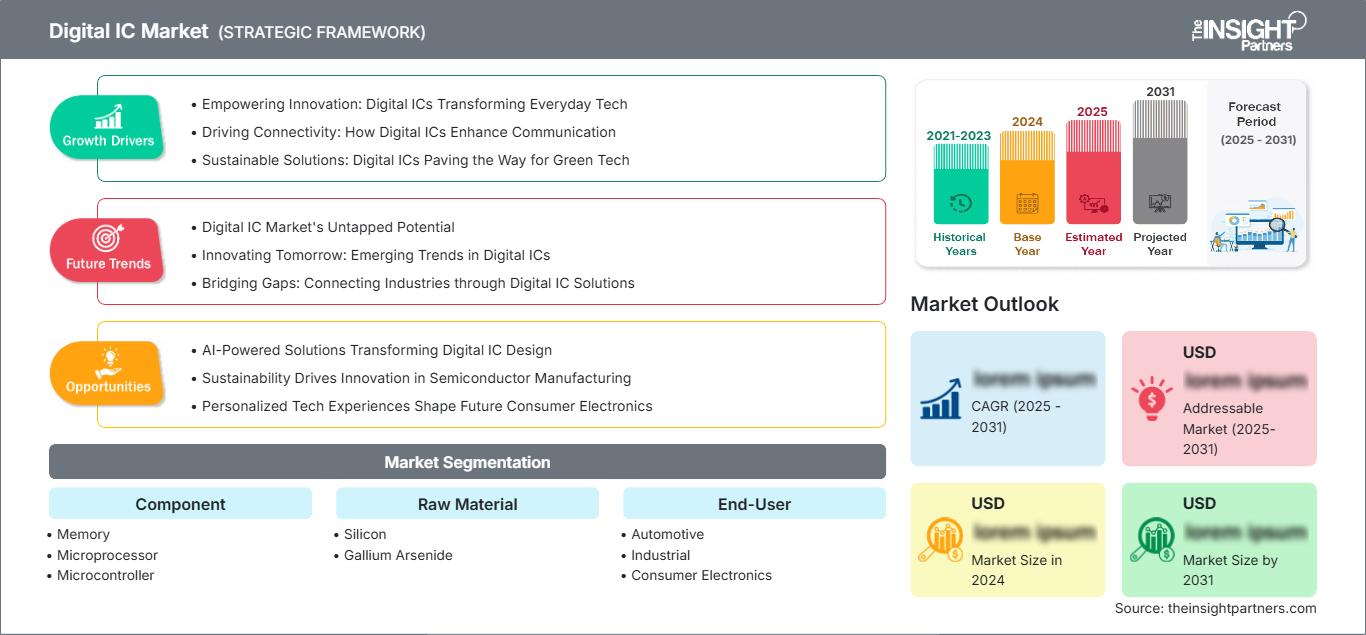
Digital IC Market: Strategic Insights
Regional Insights
North America Digital IC Market
North America’s market share of Digital IC was estimated to be 28%-31% in 2025 and the growth rate expected to be 7.8%-8.4% between 2026-2034. The drivers include hyperscale data center, defense electronics, cloud AI accelerators, automotive electronics, and communications infrastructure upgrade. According to SIA analysis based on WSTS data, industry growth is happening in Logic and Memory, which reflects design strength and demand for advanced computing.
The factors that aid North America in developing an ecosystem for the region include policy incentives in the U.S., fabs commitment in the private sector, and packaging initiatives. However, the issue here is the timing of production ramp. Canada helps in the field of AI technology, communications technology, and design strength, whereas Mexico helps with electronics manufacturing integration.
U.S. Digital IC Market
The U.S. comprised 80%-84% of North America in 2025, and the forecasted growth is at 8.0%-8.6%. The major demand drivers include cloud computing, defense systems, autonomous mobility, industrial automation, and high-end consumer electronics. Companies with U.S. headquarters have influence over processor, modem, controller, and AI accelerators even when the manufacturing process involves foundries globally.
Some of the critical portfolios related to domestic importance include processor platforms, embedded control, signal processing, RF front-end, and connectivity, from companies like Intel Corporation, Qualcomm Incorporated, Texas Instruments Incorporated, Analog Devices, Inc., and Skyworks Solutions, Inc. Some of the applications trends include advanced processors for data centers, microcontrollers for automotive and industrial uses, and digital signal processing for communications, radar, audio, and edge inference.
Europe Digital IC Market
Europe had 16% to 19% market share in 2025 and is expected to expand by 6.9% to 7.5% growth, being led by Germany in automotive electronics, industrial automation and semiconductor manufacturing ecosystem. United Kingdom provides design, communication and artificial intelligence innovation and research, whereas France enjoys aerospace, defense and embedded electronic projects. The regional strategy focuses on strategic independence and reliable chip supply.
German automotive and industrial automation drive requirements for microcontrollers, memories and processors in electrified and Industry 4.0 systems. Italy and Spain provide additional market potential for industrial control systems, consumer electronics assembly, and energy infrastructure improvement. Infineon Technologies AG and other European companies enhance the reputation of the region in automotive and industrial grade semiconductor qualifications.
APAC Digital IC Market
APAC held 44%-48% market share in 2025 and is expected to experience a growth rate of 8.8%-9.5%, with Taiwan and South Korea dominating advanced manufacturing and memory capacity. China, Japan, India, and Australia increase the demand for semiconductors through electronics manufacturing, automotive electrification, telecommunications, cloud computing infrastructures, and industrial digitization.
Emphasis on semiconductor self-sufficiency, exportability, and electronics manufacturing in the region makes APAC the center of production for advanced digital integrated circuits and consumer electronics supply chains. Some companies that dominate this include Taiwan Semiconductor Manufacturing Company Limited, Samsung Electronics Co., Ltd., Toshiba Corporation.
Middle East & Africa Digital IC Market
The Middle East & Africa region is expected to grow at 7.1%–7.8% during 2026–2034, with the UAE leading adoption. Saudi Arabia, South Africa, and the Rest of MEA invest in data centers, smart infrastructure, telecom networks, energy automation, and digital government platforms.
Energy infrastructure modernization encourages embedded control, processor, and communications IC adoption across grid, oilfield, and industrial monitoring systems. Local manufacturing remains limited, but cloud investment, sovereign AI initiatives, and 5G expansion create demand for imported digital IC platforms and secure electronics supply partnerships.
Segmentation Analysis
Component
Component is expected to grow at 8.6%–9.2% during 2026–2034 as buyers prioritize compute density, memory bandwidth, real-time control, and signal-processing efficiency. The Digital IC Market scope under this segment covers memory for data-intensive workloads, microprocessors for computing platforms, microcontrollers for embedded control, and digital signal processing systems for communications, audio, radar, and edge intelligence.
- Memory remains the largest component group because AI servers, smartphones, PCs, networking equipment, and vehicles require higher density, faster bandwidth, and improved energy efficiency.
- Microprocessor demand is shaped by cloud servers, PCs, smartphones, industrial computers, and embedded edge devices that need efficient instruction execution and software compatibility.
- Microcontroller devices are strategically important for automotive, industrial, and consumer systems because they combine processing, memory, and peripherals for reliable embedded control.
- Digital Signal Processing System adoption is rising in 5G, radar, audio, imaging, and edge AI applications where fast mathematical processing enables real-time data interpretation.
Raw Material
Raw Material is projected to grow at 7.9%–8.5% during 2026–2034 as wafer quality, substrate availability, and compound semiconductor performance influence digital IC manufacturing economics. Silicon remains dominant due to mature manufacturing scale, while gallium arsenide serves specialized high-frequency and RF-adjacent functions that complement digital communications and advanced connectivity modules.
- Silicon dominates demand because it supports mature and advanced CMOS processes, large wafer ecosystems, established supply chains, and broad compatibility with logic, memory, and microcontroller production.
- Gallium Arsenide serves specialized high-frequency electronics where speed, noise performance, and RF characteristics are valuable for communications modules and integrated signal chains.
End-User
End-User is expected to grow at 8.3%–8.9% during 2026–2034 as electronics content expands across vehicles, factories, devices, and networks. Automotive adoption is accelerated by electrification and driver assistance, industrial demand by automation, consumer electronics by AI-enabled devices, and communication by 5G, satellite, and broadband infrastructure.
- Automotive demand reflects electrification, ADAS, digital cockpit, battery management, powertrain control, and vehicle connectivity requirements that increase digital processing content per platform.
- Industrial users deploy microcontrollers, processors, and memory in robotics, motor control, factory sensors, programmable logic systems, and predictive maintenance equipment.
- Consumer Electronics remains a high-volume outlet as smartphones, PCs, wearables, gaming devices, and smart appliances require efficient processors and memory-rich architectures.
- Communication applications depend on digital ICs for base stations, routers, optical transport, satellites, modems, and signal-processing systems supporting high-throughput networks.
Opportunity Snapshot
| End-User | Revenue Contribution | Trend Tag | Adoption Stage |
| Automotive | High | Software Defined | Scaling |
| Industrial | Medium | Factory Edge | Scaling |
| Consumer Electronics | High | On-Device AI | Mature |
| Communication | High | 5G Backhaul | Scaling |
Digital IC Market Growth Drivers and Impact Analysis
AI Infrastructure Raises Compute and Memory Intensity
Infrastructure for AI will increase the demand for logic and memory on a per-server, accelerator, network, and storage basis. The training and inference tasks will require high bandwidth memory, powerful processors, data mobility, and power management systems around high-density compute clusters. Market implications of this include a reallocation of wafers into memory and logic solutions that have high performance needs. The suppliers also need to be able to match up packaging and substrate capabilities, test, and thermal management. Companies that will benefit from this trend include those able to connect their design plans with foundries and advanced packaging capabilities.
Vehicle Electronics Expand Embedded Control Demand
Vehicle platforms are becoming software-defined systems with more electronic control units, zonal architectures, ADAS functions, battery management, infotainment, and connectivity modules. Each function increases demand for microcontrollers, processors, memory, and digital signal processing. The market impact is durable, qualification-led growth because automotive components require long operating life, functional safety compliance, and reliable supply commitments. Even when vehicle production grows slowly, semiconductor content per vehicle rises as electrification and automation increase complexity. Suppliers with automotive-grade portfolios, design support, and regional manufacturing options are better positioned to secure long-cycle programs with OEMs and Tier 1 suppliers.
Industrial Automation Moves Intelligence to the Edge
Industrial automation is moving data processing closer to machines, sensors, controllers, and robotics platforms. Edge systems need microcontrollers for deterministic control, microprocessors for local computing, memory for data buffering, and signal processors for vibration, vision, and motor-control analysis. The market impact is broader demand across mature and advanced nodes, because industrial customers need reliability more than only the smallest geometry. Digital IC vendors can capture value through reference designs, software tools, security features, and long-life product commitments. As factories adopt predictive maintenance and flexible production, embedded digital content becomes a core productivity enabler.
Digital IC Market Future Trends
Chiplet Architectures Become Mainstream
Digital IC Market trends will increasingly center on chiplet architectures that combine compute, memory, I/O, and accelerators in modular packages. This approach helps designers improve yield, reuse proven IP, and match functions to suitable process nodes instead of forcing every block onto the most advanced technology. Future products in data centers, communications, and automotive computing will use chiplets to balance cost, performance, and supply flexibility. The trend will elevate packaging, interconnect standards, thermal design, and test capability as strategic differentiators.
Edge AI Drives Domain-Specific Processing
Future products will increasingly include domain-specific processors that run AI workloads near cameras, sensors, vehicles, machines, and communication nodes. The goal is to reduce latency, improve privacy, lower bandwidth use, and support autonomous decisions without sending every data stream to the cloud. This trend will influence microcontrollers, DSPs, and microprocessors as vendors add neural processing blocks, security engines, and optimized software stacks. Adoption will be strongest where real-time response and power efficiency matter.
Digital IC Market Opportunities
Automotive Compute Platforms and Zonal Architectures
Automotive compute platforms create an opportunity for suppliers that can support zonal architectures, central processing, secure networking, and long-term software compatibility. Digital IC Market Forecasts indicate that automakers will prioritize scalable platforms rather than fragmented electronic control units as vehicles add ADAS, infotainment, battery intelligence, and connectivity. Vendors can invest in safety-certified processors, microcontrollers, memory interfaces, cybersecurity features, and reference designs for Tier 1 suppliers. Winning strategies will combine technical validation, stable supply, and application engineering that reduces integration time for vehicle programs.
Localized Semiconductor Supply and Design Partnerships
Regional semiconductor policies create an opportunity for closer partnerships among chip designers, foundries, packaging companies, and end-market OEMs. Governments are encouraging resilient supply for defense, communications, automotive, and critical infrastructure, which increases interest in qualified local or allied production routes. Vendors can differentiate through multi-source manufacturing strategies, design-for-test support, and packaging collaboration. The opportunity is strongest for companies that can translate policy incentives into commercially reliable capacity, especially for digital ICs serving regulated or strategically sensitive applications.
Recent Developments
- July 2026: Taiwan Semiconductor Manufacturing Company Limited reported second-quarter earnings and continued highlighting advanced-node and packaging demand from AI and high-performance computing customers, reinforcing its role as a key manufacturing partner for digital processors, accelerators, and memory-interface devices across global semiconductor supply chains.
- March 2026: Siemens announced the Fuse EDA AI Agent system, a purpose-built domain-scoped autonomous AI agent that plans and orchestrates multi-tool and multi-agent complex semiconductor, 3D IC and printed circuit board (PCB) system workflows that span across design, verification and manufacturing sign-off. Supporting NVIDIA Agent Toolkit, advanced Nemotron models and NVIDIA AI infrastructure, the Fuse EDA AI Agent manages workflows across Siemens' comprehensive EDA portfolio, delivering automation that significantly accelerates engineering productivity and achieves higher-quality designs.
- June 2025: Texas Instruments Incorporated announced a large U.S. manufacturing investment program focused on 300-mm semiconductor capacity, strengthening domestic supply for embedded processing, analog, and related integrated circuit portfolios used across automotive, industrial, communications, and consumer electronics applications.
Frequently Asked Questions

- Comprehensive Market Sizing and Forecast Analysis
- Detailed Segmentation Analysis
- In-Depth Market Dynamics Assessment
- Regional and Country-Level Insights
- Competitive Landscape and Company Benchmarking
- Strategic Business Intelligence
Recent Reports
Testimonials

The Insight Partners' SCADA System Market report is comprehensive, with valuable insights on current trends and future forecasts. The team was highly professional, responsive, and supportive throughout. We are very satisfied and highly recommend their services.
RAN KEDEM Partner, Reali Technologies LTDs
I requested a report on a very specific software market and the team produced the report in a few days. The information was very relevant and well presented. I then requested some changes and additions to the report. The team was again very responsive and I got the final report in less than a week.
JEAN-HERVE JENN Chairman, Future Analytica
We worked with The Insight Partners for an important market study and forecast. They gave us clear insights into opportunities and risks, which helped shape our plans. Their research was easy to use and based on solid data. It helped us make smart, confident decisions. We highly recommend them.
PIYUSH NAGPAL Sr. Vice President, High Beam Global
The Insight Partners delivered insightful, well-structured market research with strong domain expertise. Their team was professional and responsive throughout. The user-friendly website made accessing industry reports seamless. We highly recommend them for reliable, high-quality research services
YUKIHIKO ADACHI CEO, Deep Blue, LLC.
This is the first time I have purchased a market report from The Insight Partners.While I was unsure at first, I visited their web site and felt more comfortable to take the risk and purchase a market report.I am completely satisfied with the quality of the report and customer service. I had several questions and comments with the initial report, but after a couple of dialogs over email with their analyst I believe I have a report that I can use as input to our strategic planning process.Thank you so much for taking the extra time and making this a positive experience.I will definitely recommend your service to others and you will be my first call when we need further market data.
JOHN SUZUKI President and Chief Executive Officer, Board Director, BK Technologies
I wish to appreciate your support and the professionalism you displayed in the course of attending to my request for information regarding to infectious disease IVD market in Nigeria. I appreciate your patience, your guidance, and the fact that you were willing to offer a discount, which eventually made it possible for us to close a deal. I look forward to engaging The Insight Partners in the future, all thanks to the impression you have created in me as a result of this first encounter.
DR CHIJIOKE ONYIA MANAGING DIRECTOR, PineCrest Healthcare Ltd.Reason to Buy
- Informed Decision-Making
- Understanding Market Dynamics
- Competitive Analysis
- Identifying Emerging Markets
- Customer Insights
- Market Forecasts
- Risk Mitigation
- Boosting Operational Efficiency
- Strategic Planning
- Investment Justification
- Tracking Industry Innovations
- Aligning with Regulatory Trends





 Get Free Sample for