
Digital Oscilloscope Market Size, Trends & Demand by 2034
Coverage: By Type (Digital storage oscilloscope, Digital phosphorous oscilloscope, Digital sampling oscilloscope); Application (Cars, Defense), and Geography (North America, Europe, Asia Pacific, and South and Central America)
- Status : Data Released
- Report Code : TIPRE00014522
- Category : Electronics and Semiconductor
- No. of Pages : 150
- Available Report Formats :


- Last update date : August 11, 2026


2025 Market Size
US$ 15.1 Bn
Base year value
2034 Forecast
US$ 31.98 Bn
Projected by 2034
CAGR 2026-2034
8.70 %
Growth rate
Addressable Market
US$ 211.05 Bn
(2026-2034)
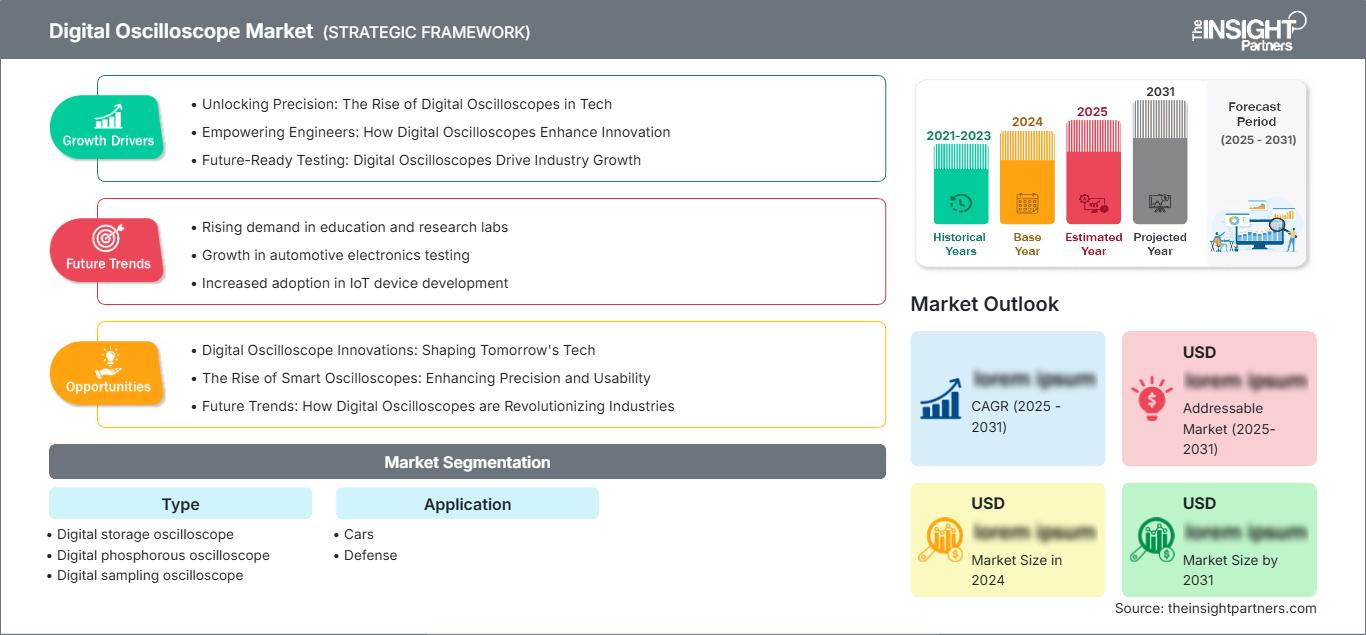
The Digital Oscilloscope Market stood at US$ 15.1 Billion in 2025 and is estimated to touch US$ 31.98 Billion by 2034, recording a CAGR of 8.70% over the forecast period 2026 – 2034. This projection is a result of the rising application of these instruments in a variety of end-use sectors such as automotive electronics, telecommunication network infrastructure, aerospace & defense, and consumer electronics manufacturing among others.
One of the important regional markets of digital oscilloscopes is North America where it records a CAGR of 7.5-8.5% over the forecast period. The region enjoys a well-established aerospace & defense segment along with a robust semiconductor design segment and investments in network infrastructure upgrades. North America also has many test and measurement equipment makers along with Research & Development centers in the USA and Canada.
Digital Oscilloscope Market Assessment and Insights
- North America: The regional Digital Oscilloscope Market is estimated to account for 28–32% share in 2025, driven by aerospace and defense spending, automotive OEM engineering, and telecommunications modernization. Growing at a CAGR of 7.5–8.5% from 2026 to 2034.
- US: The U.S. dominates the North American market with an estimated 85–90% share in 2025, supported by strong semiconductor and defense R&D investments. Growing at a CAGR of 7.5–8.5% from 2026 to 2034.
- Europe: Europe accounts for an estimated 22–26% of the global market in 2025, with Germany, the UK, and France as leading countries. Growing at a CAGR of 7.0–8.0% from 2026 to 2034, driven by automotive manufacturing and industrial automation.
- Asia Pacific: APAC is the largest regional market with an estimated 38–42% share in 2025, led by China, Japan, South Korea, and India. Growing at a CAGR of 9.0–10.0% from 2026 to 2034, fueled by electronics manufacturing and 5G deployment.
- Largest Segment: Digital storage oscilloscopes represent the largest product type with an estimated 45–50% market share in 2025. Growing at a CAGR of 8.0–9.0% from 2026 to 2034.
- High Growth Segment: Digital sampling oscilloscopes are the fastest-growing segment with an estimated 15–18% market share in 2025. Growing at a CAGR of 9.0–10.0% from 2026 to 2034, driven by high-speed digital applications.
- Key companies analyzed in detail: Agilent Technologies, Inc., Fluke Corporation, GWInstek America Corp., Keithley Instruments, LeCroy Corporation, Rohde and Schwarz GmbH & Co KG, Tektronix Inc., Yokogawa Electric Corporation, ZTEC Instruments, Inc.
Source: The Insight Partners' analysis based on proprietary research, government publications, company annual reports, investor presentations, industry databases, and expert interviews.
The Digital Oscilloscope Market has seen significant development from the analog cathode ray tube technology to modern digital oscilloscopes with memory depth, high sampling rate, and advanced triggering. These developments have made it possible for oscilloscopes to solve measurement problems in advanced high-speed digital designs, RF communications, and power electronics. Modular and software-based production has been achieved by manufacturers, making oscilloscopes highly adaptable to various applications while maintaining low costs.
In the future, the Digital Oscilloscope Market will grow due to the growth in the number of emerging geographies, including Southeast Asia and Latin America. Investments in advanced communication standards like 6G and satellite communications will create further market opportunities. Favorable regulations including EMC standards and automotive electronics safety standards will help drive the usage of digital oscilloscopes.
Digital Oscilloscope Market Report Scope
| Report Attribute | Details |
|---|---|
| Market size in 2025 | US$ 15.1 Billion |
| Market Size by 2034 | US$ 31.98 Billion |
| Global CAGR (2026 - 2034) | 8.70% |
| Historical Data | 2021-2024 |
| Forecast period | 2026-2034 |
Digital Oscilloscope Market Analysis
The requirement for digital oscilloscopes is driven by multiple underlying factors that determine the growth trajectory of the market. With the rising adoption of Internet of Things (IoT) technology and various smart technologies, there is a growing need for precise waveform analysis and signal integrity assessment throughout the electronics value chain. The growing complexity and higher frequency operation of the electronic devices have led to an increased dependence on digital oscilloscopes among the designers of such products. The shift in the automotive industry towards EVs and ADAS is expected to broaden the market opportunity, as these applications require precise measurement capabilities.
Market Competition within the Digital Oscilloscope Market is defined by the existence of established companies with high technological prowess and wide-ranging product lines. The companies Tektronix Inc., Rohde and Schwarz GmbH & Co KG, and Keysight Technologies (earlier called electronic measurement division of Agilent Technologies) have maintained their dominance through innovations and strategic acquisitions. The investment trend points towards development of software-based oscilloscopes which provide upgradeable functionalities and cloud analytics, thereby allowing users to make changes to their testing needs by making adjustments through software only and not changing hardware. Companies like Yokogawa Electric Corporation and LeCroy Corporation have been concentrated on developing high-end oscilloscopes with better bandwidth and higher sampling rate.
● REPORT CUSTOMIZATION
Tailor This Report To Align With Your Specific Business Requirements
This report can be customized to align precisely with your business objectives, scope, and target markets. Customization options include tailored segmentation, geography, competitive analysis, and strategic insights to support informed decision-making.
Customize This Report →WHAT YOU CAN ADJUST
- ● Segmentations
- ● Geography
- ● Competitive Analysis
- ● Language Preferences
Digital Oscilloscope Market: Strategic Insights
Regional Insights
North America Digital Oscilloscope Market
The North American Digital Oscilloscope Market will capture around 28-32% of the overall revenue by 2025, at a CAGR of 7.5%-8.5%. The dominance of the region can be attributed to heavy aerospace and defense capital expenditure. The United States is the major market player in the region because it has a large number of semiconductor design companies, auto OEMs engineering companies, and telecom infrastructure companies. Also, the presence of top oscilloscope manufacturers, such as Tektronix and Keysight Technologies makes the region technologically advanced.
Some structural factors in the North American region include the investments being made in 5G network development, increased expenditure on R&D in the healthcare and medical devices industry, and complexities of the automotive electronics. Research activities carried out in universities in the leading technology clusters, like Silicon Valley, Boston, and Austin are responsible for the constant demand for digital oscilloscopes. The region has an established distribution and after sales support base for the product.
U.S. Digital Oscilloscope Market
The U.S. Digital Oscilloscope Market constitutes about 85-90% of the total North American regional market in 2025, registering a CAGR of 7.5-8.5% during 2026-2034. The U.S. market is driven by its mature defense electronics landscape where large procurement plans for radar systems, electronic warfare systems, and communication systems call for sophisticated test instrumentation. The semiconductor industry in regions like Texas, California, and Oregon also depends greatly on the use of digital oscilloscopes for testing chips designs, debugging the silicon, and testing of the chip in production.
Global market leaders dominate the U.S. market presence, and these companies include Tektronix, Keysight Technologies, and Fluke Corporation. In terms of applications, there is an increasing adoption of high-bandwidth oscilloscopes for testing emerging technologies like AI accelerator, high-speed memory interface technology, and optical communication systems. The U.S. market is also aided by its startup environment in electronics and semiconductor sectors which creates steady demand for testing equipment.
Europe Digital Oscilloscope Market
The European Digital Oscilloscope Market is expected to capture between 22%-26% of total global revenue in 2025 with a CAGR between 7.0%-8.0%. The largest national market in Europe will be Germany due to its large automotive manufacturing, industrial automation sector and research organizations. UK is benefited from the presence of aerospace and defense companies and semiconductor designing center in Cambridge and Thames Valley regions. The French market is benefiting from the presence of their aerospace, defense and telecom industries whereas Italy and Spain have been growing in their industrial electronics and auto-components manufacturing.
European markets are governed by strong regulatory environment that includes the directives on EMC and automotive safety requirements for extensive testing and compliance. German leadership in industrial 4.0 programs has resulted in growing requirement of digital oscilloscopes in factory automation and predictive maintenance. The presence of European oscilloscope manufacturer such as Rohde and Schwarz GmbH & Co KG in the region is beneficial.
APAC Digital Oscilloscope Market
The largest among all the regional markets is the Asia Pacific Digital Oscilloscope Market, which is expected to account for about 38–42% of worldwide revenue in 2025 with a CAGR of 9.0–10.0%. In the APAC region, China dominates, owing to its large-scale capability of electronics manufacturing, heavy investments in semiconductor fabrication plants, and widespread adoption of 5G technology. Japan and South Korea are the contributors due to their advanced electronics and automotive industry, and India's emerging electronics and IT manufacturing sector is adding to the demand for test & measurement equipment. The market in Australia is fueled by research institutes and defense-related procurements.
In the APAC region, drivers are represented by the government's efforts to support their domestic semiconductor manufacturing, including initiatives like 'Made in China 2025' and 'PLI Scheme for Electronics Manufacturing' in India. The APAC region, being one of the leading regions in the production of consumer electronics products globally, will keep demanding digital oscilloscopes in all stages of their supply chains.
Middle East & Africa Digital Oscilloscope Market
According to estimates, the Middle East and Africa Digital Oscilloscope Market will record a CAGR of 6.5-7.5% between 2026-2034. Saudi Arabia emerges as the major country in the region with the growth in investments in defense modernization programs, implementation of smart city projects, and diversification of industries under Vision 2030 program. The contribution of UAE comes from aerospace, telecoms, and technology hub operations in Dubai and Abu Dhabi.
The energy and infrastructure projects, oil & gas automation, power grid upgrades and renewable energy installations, create a requirement for digital oscilloscopes for condition monitoring, power quality management, and system commissioning activities. Digital transformation and technological adaptation initiatives in the region would contribute to the expansion of the market in the coming years.
Segmentation Analysis
Type
The Digital Oscilloscope Market is segmented by type into digital storage oscilloscopes, digital phosphorous oscilloscopes, and digital sampling oscilloscopes. Digital storage oscilloscopes represent the largest segment, capturing an estimated 45–50% market share in 2025, with a projected CAGR of 8.0–9.0% during the forecast period. Their dominance is attributed to versatile functionality, broad application coverage, and continuous technological improvements in sampling rates and memory depth. Digital phosphorous oscilloscopes offer advanced visualization capabilities for complex signal analysis. Digital sampling oscilloscopes represent the fastest-growing segment, driven by increasing demand for high-speed digital interface testing in telecommunications and data center applications.
- Digital storage oscilloscope: The most widely adopted type, digital storage oscilloscopes offer deep memory, advanced triggering, and extensive analysis capabilities. They are the preferred choice for general-purpose debugging, design verification, and production testing across automotive, consumer electronics, and telecommunications applications.
- Digital phosphorous oscilloscope: Digital phosphorous oscilloscopes provide intensity-graded displays that reveal signal detail and anomalies. They are particularly valuable for analyzing complex, dynamic signals in radar, communications, and power electronics applications where traditional oscilloscopes may miss transient events.
- Digital sampling oscilloscope: Digital sampling oscilloscopes are specialized instruments designed for ultra-high-frequency signal analysis. They are essential for characterizing high-speed serial data links, optical communication systems, and RF components, where bandwidth requirements exceed conventional real-time oscilloscope capabilities.
Application
The Digital Oscilloscope Market is segmented by application into cars (automotive) and defense. The automotive segment benefits from the electrification of vehicles, increasing electronic content per vehicle, and the growing complexity of ADAS and infotainment systems. The defense segment is driven by modernization programs, radar and electronic warfare system development, and the need for secure, high-performance test equipment for mission-critical applications.
- Cars: The automotive application segment encompasses electric vehicle (EV) powertrain testing, battery management system validation, ADAS sensor calibration, and in-vehicle network analysis. The transition to software-defined vehicles and zonal architectures is expected to sustain demand for advanced oscilloscope capabilities.
- Defense: The defense application segment includes radar system testing, electronic warfare equipment validation, communication system characterization, and aerospace avionics verification. Stringent reliability requirements and the need for secure, trusted test equipment drive demand for high-performance oscilloscopes in this segment.
Opportunity Snapshot
| Application Segment | Revenue Contribution | Trend Tag | Adoption Stage |
|---|---|---|---|
| Cars | High | EV Testing | Scaling |
| Defense | Medium | Radar Systems | Mature |
Digital Oscilloscope Market Growth Drivers and Impact Analysis
Rising Complexity of Electronic Systems and Signal Integrity Requirements
The increasing complexity of electronic systems, driven by higher data rates, denser circuit boards, and tighter timing margins, has elevated the importance of signal integrity analysis in the product development lifecycle. Digital oscilloscopes with high bandwidth, deep memory, and advanced triggering capabilities enable design engineers to identify and resolve signal integrity issues such as jitter, crosstalk, and electromagnetic interference. The proliferation of high-speed serial interfaces, including PCI Express, USB, and Ethernet, has created demand for oscilloscopes capable of capturing and analyzing multi-gigabit signals. As electronic devices continue to push the boundaries of performance, the need for sophisticated measurement tools to validate design integrity and ensure compliance with industry standards will sustain growth in the Digital Oscilloscope Market.
Electrification and Increasing Electronic Content in Automotive Applications
The global automotive industry's transition toward electric vehicles and advanced driver-assistance systems has significantly expanded the addressable market for digital oscilloscopes. EVs require extensive testing of power electronics, including inverters, onboard chargers, and DC-DC converters, where oscilloscopes are essential for analyzing voltage and current waveforms under various operating conditions. ADAS systems incorporate multiple sensors, including radar, LiDAR, and cameras, all of which require rigorous testing and calibration using digital oscilloscopes. The increasing electronic content per vehicle, with modern cars containing hundreds of microcontrollers and sophisticated networking architectures, has made oscilloscopes indispensable tools for automotive engineers across the development and manufacturing lifecycle.
5G Deployment and Telecommunications Infrastructure Investment
The global rollout of 5G networks has created substantial demand for digital oscilloscopes in telecommunications equipment manufacturing, network deployment, and field testing. 5G infrastructure requires testing of high-frequency components, including millimeter-wave transceivers, power amplifiers, and filters, where oscilloscopes with high bandwidth and low noise are essential. The deployment of massive MIMO antennas and beamforming technologies has introduced new testing challenges that require advanced oscilloscope capabilities. Telecommunications equipment manufacturers and network operators rely on digital oscilloscopes for design validation, production testing, and network optimization. As 5G deployment continues globally and research into 6G technologies accelerates, the telecommunications sector will remain a key growth driver for the Digital Oscilloscope Market.
Digital Oscilloscope Market Future Trends
Software-Defined Oscilloscopes and Cloud-Enabled Analytics
The Digital Oscilloscope Market is witnessing a fundamental shift toward software-defined architectures that enable users to upgrade instrument capabilities through software licenses rather than hardware replacements. This trend allows organizations to extend the useful life of oscilloscope investments while accessing the latest analysis features and measurement algorithms. Cloud-enabled analytics platforms are emerging, allowing engineers to offload data processing, collaborate remotely, and leverage machine learning algorithms for automated signal analysis and anomaly detection. Manufacturers are increasingly offering application-specific software packages for power analysis, serial data decoding, and EMI debugging, creating new revenue streams and enhancing the value proposition of oscilloscope platforms. The integration of oscilloscopes into broader test and measurement ecosystems is expected to accelerate as organizations seek greater efficiency and data-driven insights from their testing operations.
Increasing Bandwidth Requirements for High-Speed Digital Applications
The relentless demand for higher data rates in computing, networking, and consumer electronics is driving the development of oscilloscopes with ever-increasing bandwidth and sampling rates. Emerging applications, including artificial intelligence accelerators, high-performance computing, and optical communication systems, require oscilloscopes capable of capturing signals with sub-picosecond timing resolution. Manufacturers are investing in advanced semiconductor technologies, including silicon-germanium (SiGe) and indium phosphide (InP) processes, to achieve bandwidths exceeding 100 GHz. The trend toward higher bandwidth is accompanied by advances in probe technology, triggering systems, and analysis software that enable engineers to extract meaningful insights from increasingly complex signals. As data rates continue to climb, the demand for high-performance oscilloscopes will remain strong across research, development, and production environments.
Digital Oscilloscope Market Opportunities
Emerging Applications in Power Electronics and Renewable Energy Systems
The rapid growth of renewable energy systems, including solar photovoltaic installations, wind turbines, and energy storage systems, presents significant opportunities for the Digital Oscilloscope Market. Power electronics are fundamental to renewable energy conversion, requiring extensive testing of inverters, converters, and power management systems. Digital oscilloscopes with high-voltage differential probes and advanced power analysis software enable engineers to characterize switching losses, measure efficiency, and validate control algorithms under real-world operating conditions. The electrification of transportation, including electric vehicles, trains, and marine vessels, further expands the addressable market for power electronics testing. As governments worldwide implement policies to accelerate the transition to clean energy, investment in power electronics R&D and manufacturing capacity will drive demand for digital oscilloscopes. Manufacturers that develop specialized solutions for power electronics testing, including isolated channels, high common-mode rejection, and automated compliance testing, will capture significant market share in this growing segment.
Expansion of Semiconductor Manufacturing and Testing Capabilities
The global semiconductor industry's expansion, driven by government initiatives to strengthen domestic chip production and growing demand for specialized chips for AI, automotive, and IoT applications, presents substantial opportunities for digital oscilloscope vendors. Semiconductor manufacturing requires rigorous testing at multiple stages, including wafer-level characterization, package-level validation, and system-level integration. Digital oscilloscopes are essential tools for semiconductor test engineers, enabling characterization of high-speed I/O interfaces, power integrity analysis, and timing validation. The increasing complexity of semiconductor devices, with billions of transistors and advanced packaging technologies, has created demand for oscilloscopes with higher bandwidth, deeper memory, and advanced analysis capabilities. Manufacturers that establish strong relationships with semiconductor companies and develop application-specific solutions for semiconductor testing will benefit from sustained demand as the industry continues to invest in new fabrication facilities and advanced packaging technologies.
Recent Developments
- February 2026: Keysight introduced the Infiniium XR8 real-time oscilloscopes to accelerate high-speed digital validation and compliance testing. Powered by the new Infiniium 2026 software platform, the XR8 delivers faster analysis, enhanced signal integrity, advanced jitter and PAM analysis, and improved workflows for next-generation interfaces such as USB, DDR, and DisplayPort.
- November 2025: GW Instek expanded its GDS-3000A series with the GDS-3102A and GDS-3104A digital storage oscilloscopes, featuring 1 GHz bandwidth, 5 GSa/s sampling, and 200 Mpts memory depth per channel. The instruments target high-speed digital design, power electronics, and education, offering deep memory, high waveform capture rates, and integrated spectrum analysis for advanced measurements.
Frequently Asked Questions

- Comprehensive Market Sizing and Forecast Analysis
- Detailed Segmentation Analysis
- In-Depth Market Dynamics Assessment
- Regional and Country-Level Insights
- Competitive Landscape and Company Benchmarking
- Strategic Business Intelligence
Recent Reports
Testimonials

The Insight Partners' SCADA System Market report is comprehensive, with valuable insights on current trends and future forecasts. The team was highly professional, responsive, and supportive throughout. We are very satisfied and highly recommend their services.
RAN KEDEM Partner, Reali Technologies LTDs
I requested a report on a very specific software market and the team produced the report in a few days. The information was very relevant and well presented. I then requested some changes and additions to the report. The team was again very responsive and I got the final report in less than a week.
JEAN-HERVE JENN Chairman, Future Analytica
We worked with The Insight Partners for an important market study and forecast. They gave us clear insights into opportunities and risks, which helped shape our plans. Their research was easy to use and based on solid data. It helped us make smart, confident decisions. We highly recommend them.
PIYUSH NAGPAL Sr. Vice President, High Beam Global
The Insight Partners delivered insightful, well-structured market research with strong domain expertise. Their team was professional and responsive throughout. The user-friendly website made accessing industry reports seamless. We highly recommend them for reliable, high-quality research services
YUKIHIKO ADACHI CEO, Deep Blue, LLC.
This is the first time I have purchased a market report from The Insight Partners.While I was unsure at first, I visited their web site and felt more comfortable to take the risk and purchase a market report.I am completely satisfied with the quality of the report and customer service. I had several questions and comments with the initial report, but after a couple of dialogs over email with their analyst I believe I have a report that I can use as input to our strategic planning process.Thank you so much for taking the extra time and making this a positive experience.I will definitely recommend your service to others and you will be my first call when we need further market data.
JOHN SUZUKI President and Chief Executive Officer, Board Director, BK Technologies
I wish to appreciate your support and the professionalism you displayed in the course of attending to my request for information regarding to infectious disease IVD market in Nigeria. I appreciate your patience, your guidance, and the fact that you were willing to offer a discount, which eventually made it possible for us to close a deal. I look forward to engaging The Insight Partners in the future, all thanks to the impression you have created in me as a result of this first encounter.
DR CHIJIOKE ONYIA MANAGING DIRECTOR, PineCrest Healthcare Ltd.Reason to Buy
- Informed Decision-Making
- Understanding Market Dynamics
- Competitive Analysis
- Identifying Emerging Markets
- Customer Insights
- Market Forecasts
- Risk Mitigation
- Boosting Operational Efficiency
- Strategic Planning
- Investment Justification
- Tracking Industry Innovations
- Aligning with Regulatory Trends





 Get Free Sample for