
Digital Soldering Station Market Strategies, Top Players, Growth Opportunities, Analysis and Forecast by 2034
Coverage: by Component (Soldering Tips and Nozzles, Soldering Iron, Display Units, Others); Voltage Range (Up to 150 Volts, 151 200 Volts, 201 Volts and Above); Sales Channel (Direct Sales Channel, Indirect Sales Channel); End user (Commercial, Industrial, Residential) , and Geography (North America, Europe, Asia Pacific, and South and Central America)
- Status : Data Released
- Report Code : TIPRE00005259
- Category : Electronics and Semiconductor
- No. of Pages : 150
- Available Report Formats :


- Last update date : August 05, 2026


2025 Market Size
US$ 247.79 Mn
Base year value
2034 Forecast
US$ 392.33 Mn
Projected by 2034
CAGR 2026-2034
5.24 %
Growth rate
Addressable Market
US$ 2,904.02 Mn
(2026-2034)
The global Digital Soldering Station market was valued at US$ 247.79 million in 2025 and is expected to reach US$ 392.33 million by 2034; it is estimated to record a CAGR of 5.24% during 2026-2034.
Digital Soldering Station Market Assessment and Insights
- North America accounted for 28–31% share in 2025 and is projected to grow at a CAGR of 5.4–5.9% between 2026–2034, supported by PCB assembly reshoring, aerospace electronics repair, and higher quality compliance.
- US represented 78–82% of North America in 2025 and is expected to grow at a CAGR of 5.5–6.0% between 2026–2034, led by defense, EV, and industrial electronics demand.
- Europe held 24–27% share in 2025 and is forecast to expand at a CAGR of 5.0–5.5% between 2026–2034, with Germany, the UK, France, Italy, and Spain leading adoption.
- Asia Pacific captured 34–38% share in 2025 and is projected to advance at a CAGR of 6.0–6.6% between 2026–2034, driven by China, Japan, South Korea, India, and Australia.
- Largest Segment Industrial end users held 48–52% market share in 2025 and are expected to grow at a CAGR of 5.6–6.1% during 2026–2034, reflecting production and repair intensity.
- High Growth Segment Direct sales channel held 38–42% market share in 2025 and is forecast to grow at a CAGR of 6.1–6.7% during 2026–2034 as manufacturers pursue configured solutions.
- Key companies analyzed in detail: Antex Electronics Limited, AOYUE International Limited, HAKKO Corporation, Ideal Resources Products Pvt. Ltd., OK International Metcal, PACE Worldwide, Taiyo Electric Ind. Co., Ltd., UY CHAN, Weller Tools GmbH, XYtronic Soldering Tools.
Source: The Insight Partners' analysis based on proprietary research, government publications, company annual reports, investor presentations, industry databases, and expert interviews.
Today’s digital soldering products have progressed from simple temperature-controlled irons to stations that allow fast heat recovery, sleep modes, calibration locks, and display feedback systems. Process dynamics today favor reproducibility since lead-free soldering, compact PCB designs, and fine pitch components make less thermal variability tolerant. Thus, the Digital Soldering Station Market is positioned well due to this trend as electronics companies standardize their tools in maintenance benches, research facilities, CM production lines, and field repairs.
Going forward, electronics capacity development projects, EV charging network development, telecommunications equipment, and medical devices repair would expand the installed base. Increasing demand in India, Southeast Asia, and the Middle East regions would be driven by electronics localization initiatives and industrial training centers. Also, environmental regulations regarding soldering safety and compliance with RoHS regulations would prompt buyers to upgrade to more advanced digital products.
Digital Soldering Station Market Report Scope
| Report Attribute | Details |
|---|---|
| Market size in 2025 | US$ 247.79 Million |
| Market Size by 2034 | US$ 392.33 Million |
| Global CAGR (2026 - 2034) | 5.24% |
| Historical Data | 2021-2024 |
| Forecast period | 2026-2034 |
Digital Soldering Station Market Analysis
Growth of the Digital Soldering Station Market is associated with higher frequency of circuit board repairs, more rapid electronics product lifecycles, and the necessity to create stable solder joints in compact gadgets. According to IPC, there are certain 2025 figures where the demand exceeds shipments of North American EMS and PCBs, thus creating replacement opportunities for the benchtop soldering stations. Nowadays buyers pay attention to the heat recovery, availability of the tip ecosystem, calibration capabilities, and operator's safety rather than just the price of the device.
The value chain consists of the producers of heating elements, producers of tips and nozzles, assembly of stations, distributors, repair service centers, and electronics training organizations. The supply chain remains somewhat fragmented, as the stations are standardized sufficiently to be distributed widely but still differ by the software, cartridges, thermal sensors, and ergonomically designed hand pieces.
Digital Soldering Station Market analysis shows competition among the premium process control players and value-based suppliers who cater to educational, repair and workshop purposes. HAKKO Corporation, Weller Tools GmbH, OK International Metcal and PACE Worldwide are some of the key competitors who are competing based on reliability, cartridge technology and industrial support, whereas AOYUE International Limited, UY CHAN and XYtronic Soldering Tools target cost sensitive service market.
Investment trends point towards stations that are compatible with fume extraction, firmware upgrades, digital displays, and multi-channel facilities. Antex Electronics Limited, Taiyo Electric Ind. Co., Ltd., and Ideal Resources Products Pvt. Ltd. add more muscle to the competitive dynamics with their regional distribution and niche product offering. Positioning is becoming more important with respect to application support, training and availability of consumables.
● REPORT CUSTOMIZATION
Tailor This Report To Align With Your Specific Business Requirements
This report can be customized to align precisely with your business objectives, scope, and target markets. Customization options include tailored segmentation, geography, competitive analysis, and strategic insights to support informed decision-making.
Customize This Report →WHAT YOU CAN ADJUST
- ● Segmentations
- ● Geography
- ● Competitive Analysis
- ● Language Preferences
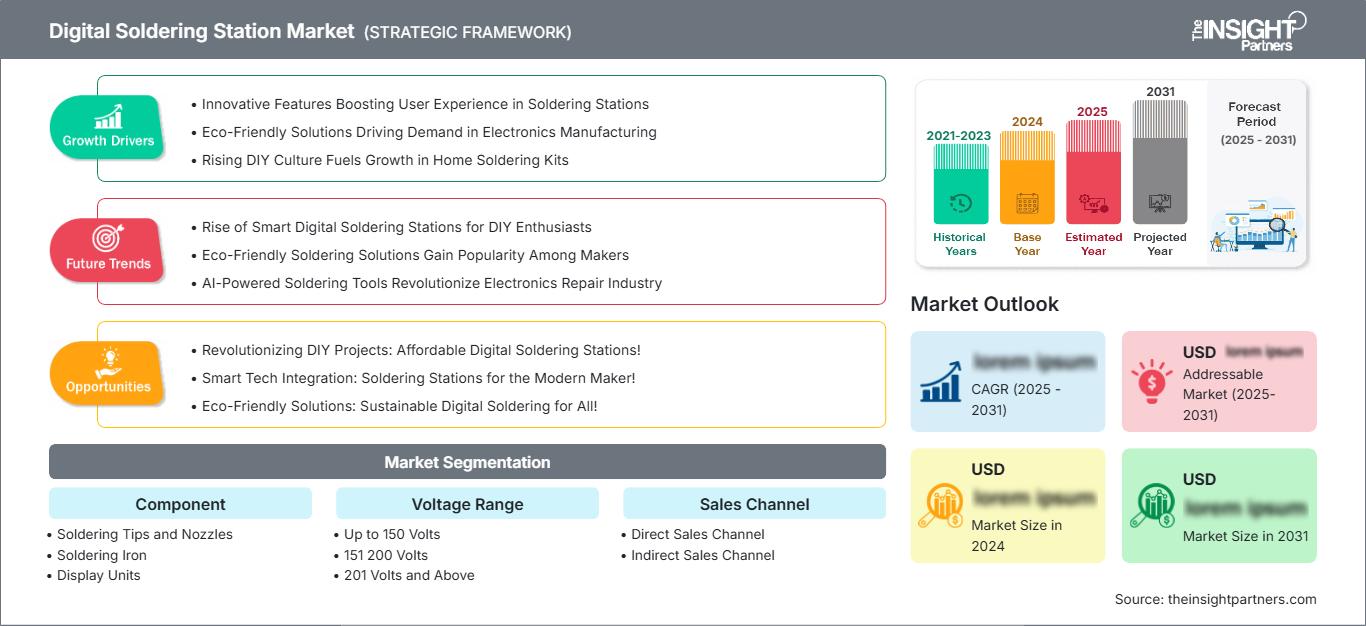
Digital Soldering Station Market: Strategic Insights
Regional Insights
North America Digital Soldering Station Market
North America represented 28–31% Digital Soldering Station Market share in 2025 and is expected to grow at a CAGR of 5.4–5.9% during 2026–2034. Demand is anchored in PCB rework, aerospace maintenance, industrial automation service, and electronics education. Reshoring commitments in manufacturing and foreign direct investment have also increased the need for reliable benchtop soldering capacity.
Regional buyers emphasize traceability, ESD-safe workstations, and support for lead-free soldering. The US remains the core market, while Canada and Mexico benefit from automotive electronics, contract assembly, and nearshoring-linked repair networks. Replacement demand is strengthened by stricter quality documentation and the need to standardize tools across multi-site production and service operations.
U.S. Digital Soldering Station Market
United States is responsible for 78-82% share of North America market in 2025 and will have a CAGR of 5.5-6.0% until 2034. Defense electronics, EV power modules, semiconductor equipment repair, and medical device servicing fuel the demand for professional grade stations. Assembly programs are creating demand for technician training and process-controlled soldering benches in the US market.
Corporate representation includes companies such as Weller Tools GmbH, OK International Metcal, PACE Worldwide, and HAKKO Corporation among others. Market applications cover rework of high density printed circuit boards, communications equipment field service, and automation controls repair. Consumers are opting for digital soldering stations with lockable parameters to eliminate the variability in the operator.
Europe Digital Soldering Station Market
Europe accounted for 24-27% market share in 2025 and is projected to record a CAGR of 5.0-5.5% between 2026-2034. Germany dominates due to application in automotive electronics, industrial controls, and precise manufacturing. The UK gets benefit of applications in aerospace repair and electronic prototype production. France, Italy, and Spain create demand due to military, railway, power generation and appliance electronics repair.
The compliance of regulations in line with RoHS standards and workplace safety standards promotes the use of calibrated and fume resistant equipment. Germany and the UK are the top countries by value, whereas France, Italy and Spain offer consistent demand for replacements through repair facilities for industries. European customers prefer durable products along with parts availability and compliance.
APAC Digital Soldering Station Market
APAC held the share of 34-38% in 2025 and is expected to generate a CAGR of 6.0-6.6% during 2024-2034. Leading country-wise demand in the region is from China due to high demand in electronics assembly operations, and precision, reliability, and rework are key demands in Japan and South Korea. Demand in India will grow with electronics localization, repair, and technical education.
Demand contribution in Australia will come from mining automation maintenance, defense electronics, and repair. Policies that favor semiconductor manufacturing, telecommunication, and consumer electronics will create opportunities for professional soldering demand. Digital soldering station market growth will be supported by well-established distributors providing tips, nozzles, and replacement handpieces.
Middle East & Africa Digital Soldering Station Market
The Middle East & Africa market is expected to grow with a CAGR of 4.7–5.2% in the period 2026–2034, with Saudi Arabia being the major player in the market. Energy infrastructure, telecommunication infrastructure, industrial maintenance and electronics servicing is driving the demand for such products. The UAE supports this through the means of trade distribution, aircraft maintenance and professional servicing facilities.
South Africa is still considered an important market for industrial and mining equipment servicing, whereas the Rest of MEA is experiencing a gradual adoption of these devices in the education sector and maintenance workshops. Users usually prefer devices that are durable, have a wide variety of consumables and multi-voltage capabilities.
Segmentation Analysis
Component
Component is expected to grow at a CAGR of 5.3–5.8% during 2026–2034. The Digital Soldering Station Market scope across components is shaped by recurring replacement of tips and nozzles, demand for ergonomic irons, and adoption of display units that improve temperature visibility. Component-level differentiation supports aftermarket revenue and customer retention.
- Soldering Tips and Nozzles remain strategically important because they are consumed regularly and determine heat transfer quality, making compatibility, coating durability, and application-specific geometry central to buyer preference.
- Soldering Iron demand is linked to operator comfort, thermal recovery, and station compatibility, with industrial buyers preferring lightweight handpieces that reduce fatigue during repetitive assembly and rework.
- Display Units support accuracy, training, and process control by allowing visible temperature settings, lock functions, and diagnostic feedback, especially in regulated electronics repair and production environments.
Voltage Range
Voltage Range is projected to grow at a CAGR of 5.2–5.7% from 2026 to 2034. Voltage selection reflects workplace standards, region-specific power supply norms, and application intensity. Lower-voltage systems serve education and light repair, while higher-voltage stations are selected for industrial loads, faster recovery, and stable thermal output during extended soldering cycles.
- Up to 150 Volts serves classrooms, hobbyist benches, and light commercial repair where portability, basic temperature control, and affordability matter more than high thermal capacity.
- 151 200 Volts addresses mainstream professional use, balancing power, safety, and compatibility with common station architectures for repair shops, laboratories, and small production cells.
- 201 Volts and Above is preferred in industrial settings requiring faster recovery, stable output, and extended-duty operation for dense boards, connectors, and higher thermal mass assemblies.
Sales Channel
Sales Channel is anticipated to expand at a CAGR of 5.6–6.2% during 2026–2034. Direct engagement is increasing for configured workstations, technical support, and institutional procurement, while indirect channels remain essential for fast availability of stations, tips, and accessories. Channel strategy is becoming a differentiator as buyers seek dependable aftersales support.
- Direct Sales Channel is strategically relevant for industrial accounts requiring application support, calibration guidance, bundled accessories, and long-term supply assurance for standardized production and repair benches.
- Indirect Sales Channel remains vital for broad market coverage, enabling small repair businesses, educational buyers, and regional distributors to access stations, spares, and consumables quickly.
End user
End user is expected to grow at a CAGR of 5.5–6.1% during 2026–2034. Industrial demand dominates because production maintenance, PCB assembly, and component rework require repeatable temperature control. Commercial repair networks are growing with consumer electronics service demand, while residential adoption is supported by maker communities, DIY repair, and electronics learning.
- Commercial users include repair shops, service centers, and training providers that need dependable stations with accessible consumables, visible controls, and moderate purchase costs.
- Industrial users prioritize calibration, uptime, operator consistency, and thermal performance because solder quality affects electronics reliability in automotive, aerospace, telecom, and factory automation systems.
- Residential demand is smaller but resilient, supported by DIY electronics, home repair, maker education, and online access to compact digital stations and replacement tips.
Opportunity Snapshot
| End user | Revenue Contribution | Trend Tag | Adoption Stage |
| Commercial | Medium | Repair Hubs | Scaling |
| Industrial | High | Process Control | Mature |
| Residential | Low | DIY Repair | Emerging |
Digital Soldering Station Market Growth Drivers and Impact Analysis
Precision Needs in Miniaturized Electronics
The use of fine pitch components, smaller PCBs, and lead-free soldering increases the significance of reliable thermal energy transmission. Older analog devices can produce non-reliable connections when dealing with small pads, multiple-layered PCBs, or higher solder melting points. Digital machines overcome this problem through features like set point visibility, quick recovery, sleep capability, and calibration adjustment. This effect has the most significant influence on automotive electronics, medical equipment, telecom units, and aviation reworking, where rework failures cause reliability risks that are expensive for the manufacturer.
Electronics Reshoring and Local Repair Capacity
The trend towards localized manufacturing and nearshoring is driving greater demand for small-batch assembly, maintenance, and engineering closer to end consumers. US Reshoring and foreign direct investment announcements over the last few years have emphasized investment in manufacturing plant capacity, and IPC data shows that electronics demand remains strong despite any variations in shipments. All of this creates opportunities for the purchase of workstations for prototyping, maintenance, training, and manufacturing. Digital Soldering Station Market growth is driven by these factors.
Lifecycle Maintenance of Connected Equipment
The devices that are linked together in manufacturing plants, transport means, houses, and power facilities are connected through electronic control boards, which must be installed immediately to prevent delays. Service providers currently service various devices, such as sensors, controllers, inverters, battery systems, and communication modules, rather than replacing the entire assembly. Digital soldering irons facilitate this process by enabling effective rework and precise tip temperature control, and they are compatible with a variety of control boards.
Digital Soldering Station Market Future Trends
Connected Workstations for Traceable Repair
Digital Soldering Station Market trends point toward connected benches that record temperature settings, tool usage, and maintenance alerts. Industrial buyers are likely to link soldering stations with quality systems, especially in regulated electronics, aerospace repair, and high-reliability assembly. Firmware updates, lockable profiles, and data capture will help supervisors reduce variation between operators and shifts. Suppliers that combine hardware reliability with simple software interfaces can strengthen account retention because tool data becomes part of broader production traceability and technician accountability.
Safer and More Energy-Efficient Benchtop Systems
Future station designs will place greater emphasis on operator safety, fume extraction compatibility, low standby power, and rapid heat recovery. As electronics workshops formalize safety procedures, buyers will compare equipment based on automatic sleep functions, tip life extension, and integration with extraction units. Energy-efficient stations also support procurement teams seeking lower operating costs across large service floors. Brands that deliver measurable reductions in heat-up time, idle energy use, and consumable wear can convert sustainability goals into purchase decisions.
Digital Soldering Station Market Opportunities
Industrial Training and Certification Ecosystems
Technical institutes, repair academies, and electronics manufacturing training centers represent a practical expansion route for suppliers. Digital Soldering Station Market Forecasts indicate that skills development will become more important as localized electronics repair and assembly expand. Vendors can offer bundled stations, consumables, safety accessories, and curriculum support to build early brand familiarity among technicians. This opportunity is strongest in India, Southeast Asia, the US, and the Middle East, where governments and companies are investing in manufacturing skills and maintenance capability.
Configured Solutions for High-Reliability Repair
High-reliability repair in aerospace, defense, medical electronics, and power systems creates opportunity for configured workstation packages. Customers in these fields often need soldering stations, cartridges, tip cleaners, fume extraction, calibration tools, and documentation support from a single vendor or distributor. Suppliers can improve margins by selling complete benches instead of individual units. The investment case is strengthened when packages reduce rework defects, simplify audit readiness, and ensure that operators use approved tools and consumables across multiple locations.
Recent Developments
- February 2026: INDE Enterprises launched the 1300W HRS61D High-Power Precision Hot Air Rework Station, designed for advanced electronics rework applications with high thermal capacity, rapid heat recovery, closed-loop temperature control, and support for large SMD components including QFP and PLCC packages.
- July 2025: HAKKO introduced the evolved FX-971 series soldering station, featuring updated performance, enhanced usability, and improved soldering control capabilities for professional electronics manufacturing and repair applications.
- February 2025: ProTek RC announced the launch of the PTK-6700 80W Digital Professional Soldering Station along with two additional products, expanding its tool lineup for RC hobbyists with precision soldering capabilities, digital temperature control, adjustable heating from 302°F to 1022°F, replaceable tips, auto standby, sleep mode, and temperature locking features.
Frequently Asked Questions

- Comprehensive Market Sizing and Forecast Analysis
- Detailed Segmentation Analysis
- In-Depth Market Dynamics Assessment
- Regional and Country-Level Insights
- Competitive Landscape and Company Benchmarking
- Strategic Business Intelligence
Recent Reports
Testimonials

The Insight Partners' SCADA System Market report is comprehensive, with valuable insights on current trends and future forecasts. The team was highly professional, responsive, and supportive throughout. We are very satisfied and highly recommend their services.
RAN KEDEM Partner, Reali Technologies LTDs
I requested a report on a very specific software market and the team produced the report in a few days. The information was very relevant and well presented. I then requested some changes and additions to the report. The team was again very responsive and I got the final report in less than a week.
JEAN-HERVE JENN Chairman, Future Analytica
We worked with The Insight Partners for an important market study and forecast. They gave us clear insights into opportunities and risks, which helped shape our plans. Their research was easy to use and based on solid data. It helped us make smart, confident decisions. We highly recommend them.
PIYUSH NAGPAL Sr. Vice President, High Beam Global
The Insight Partners delivered insightful, well-structured market research with strong domain expertise. Their team was professional and responsive throughout. The user-friendly website made accessing industry reports seamless. We highly recommend them for reliable, high-quality research services
YUKIHIKO ADACHI CEO, Deep Blue, LLC.
This is the first time I have purchased a market report from The Insight Partners.While I was unsure at first, I visited their web site and felt more comfortable to take the risk and purchase a market report.I am completely satisfied with the quality of the report and customer service. I had several questions and comments with the initial report, but after a couple of dialogs over email with their analyst I believe I have a report that I can use as input to our strategic planning process.Thank you so much for taking the extra time and making this a positive experience.I will definitely recommend your service to others and you will be my first call when we need further market data.
JOHN SUZUKI President and Chief Executive Officer, Board Director, BK Technologies
I wish to appreciate your support and the professionalism you displayed in the course of attending to my request for information regarding to infectious disease IVD market in Nigeria. I appreciate your patience, your guidance, and the fact that you were willing to offer a discount, which eventually made it possible for us to close a deal. I look forward to engaging The Insight Partners in the future, all thanks to the impression you have created in me as a result of this first encounter.
DR CHIJIOKE ONYIA MANAGING DIRECTOR, PineCrest Healthcare Ltd.Reason to Buy
- Informed Decision-Making
- Understanding Market Dynamics
- Competitive Analysis
- Identifying Emerging Markets
- Customer Insights
- Market Forecasts
- Risk Mitigation
- Boosting Operational Efficiency
- Strategic Planning
- Investment Justification
- Tracking Industry Innovations
- Aligning with Regulatory Trends





 Get Free Sample for