
Digital Sound Processors Market Growth, Size & Forecast by 2034
Coverage: By Type (8-Channel, 16-Channel, 32-Channel, Others); End-User (Automotive, Commercial, Residential, Others), and Geography (North America, Europe, Asia Pacific, and South and Central America)
- Status : Data Released
- Report Code : TIPRE00017719
- Category : Electronics and Semiconductor
- No. of Pages : 150
- Available Report Formats :


- Last update date : August 13, 2026


2025 Market Size
US$ 9.52 Bn
Base year value
2034 Forecast
US$ 21.96 Bn
Projected by 2034
CAGR 2026-2034
9.74 %
Growth rate
Addressable Market
US$ 140.33 Bn
(2026-2034)
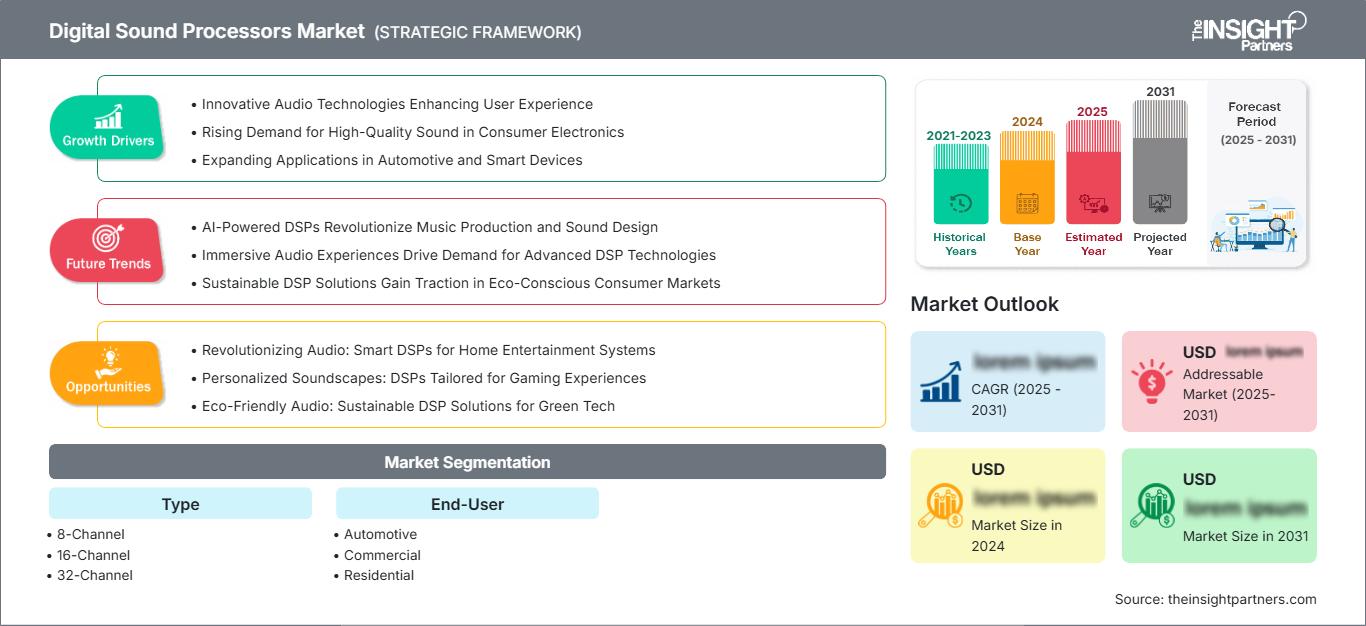
The digital sound processors market is anticipated to be US$ 9.52 Billion in 2025 and further estimated to witness US$ 21.96 Billion by 2034, with a growth rate of 9.74% from 2026 to 2034. This market encompasses 8-channel, 16-channel, and 32-channel processors used in automotive, commercial, and residential audio applications where real-time tuning, routing, equalization, and immersive sound control play an important role in the system.
In North America, the Digital sound processor market size is expected to grow at a CAGR of 8.7%-10.1%, driven by vehicle electrification, high-end home theater upgradation, and modernizing commercial venues. High installer networks, high presence of infotainment systems, and increasing trend towards application-based calibration drives the demand for processors without changing the speaker systems.
Digital Sound Processors Market Assessment and Insights
- North America: The region accounts for 31–35% share in 2025 and grows at a CAGR range of 8.7–10.1% during 2026–2034, supported by premium automotive audio, installed AV upgrades, and residential theater demand.
- US: The country represents 79–83% of North America in 2025 and grows at a CAGR range of 8.9–10.3% during 2026–2034, led by vehicle customization and home cinema.
- Europe: Europe holds 23–27% share in 2025 and grows at a CAGR range of 8.2–9.6% during 2026–2034, with Germany, the UK, France, Italy, and Spain leading adoption.
- Asia Pacific: Asia Pacific holds 30–34% share in 2025 and grows at a CAGR range of 10.6–12.0% during 2026–2034, led by China, Japan, South Korea, India, and Australia.
- Largest Segment: Automotive holds 42–46% market share in 2025 and grows at a CAGR range of 9.6–11.0% during 2026–2034 as cabin audio becomes a key vehicle differentiator.
- High Growth Segment: 32-Channel holds 18–22% market share in 2025 and grows at a CAGR range of 11.2–12.8% during 2026–2034 due to immersive multi-zone installations.
- Key companies analyzed in detail: Alps Alpine Co., Ltd.; Anthem Audio Group; AudioControl Inc.; Emotiva Audio Corporation; Focal-JMlab; Masimo Corporation; Onkyo Corporation; Rotel Co., Ltd.; Sony Group Corporation; Xtreme Audio.
Source: The Insight Partners' analysis based on proprietary research, government publications, company annual reports, investor presentations, industry databases, and expert interviews.
Audio processing technology has evolved from fixed analog equalizers to software-based solutions that take care of time alignment, crossover control, room correction, noise cancellation, and source routing. Production is changing as manufacturers integrate DSP silicon, amplifier integration, mobile, microphone and installation software solutions. The market is increasingly being influenced by the complexities of car audio, portable home systems, and entertainment venues that require accurate sound tuning of multi-zone systems.
Future demand will increase as developing cities begin to build entertainment facilities, luxury cars, hospitality facilities, and smart homes. Increasing regulations in vehicles, consumer desire for quiet electric car cabins, and audio streaming will lead to an increase in processors per unit systems. Purchasers will make comparisons of channel capability, latency, tuning process, flexibility and upgradeable firmware before standardizing a platform.
Digital Sound Processors Market Report Scope
| Report Attribute | Details |
|---|---|
| Market size in 2025 | US$ 9.52 Billion |
| Market Size by 2034 | US$ 21.96 Billion |
| Global CAGR (2026 - 2034) | 9.74% |
| Historical Data | 2021-2024 |
| Forecast period | 2026-2034 |
Digital Sound Processors Market Analysis
Growing demand due to software tuning in contrast to fixed hardware is driving the market. Premium automobiles, home theater, restaurants, places of worship, retail audio and conference rooms which need flexibility in routing and acoustical correction also add value for this market. Maximum value would be created in installations where the installer could improve sound quality by adding processing, delay, and equalization without changing speakers, amplifiers, or audio sources.
Some participants in the ecosystem include DSP chip providers, amplifier providers, speaker providers, software providers, specialized distributors, car original equipment manufacturers, and audio-visual (AV) integrators. The supply chain issues that need to be considered include semiconductors, Bluetooth/Wi-Fi connectivity, power amplifier integration, and housing. Commercial and automotive applications will require rugged connectors and low latency systems. Residential applications will require user-friendly applications and automatic setup capabilities.
Digital sound processor market report demonstrates the competitive environment divided into three segments: those who specialize in automotive sector, home theaters and custom install solutions. The former are Alps Alpine Co., Ltd. and AudioControl Inc., while Anthem Audio Group, Masimo Corporation, Onkyo Corporation, Rotel Co., Ltd. and Sony Group Corporation offer products through receivers, processors and room correction systems. Also, there are firms focusing more on specialization, such as Focal-JMlab, Emotiva Audio Corporation, and Xtreme Audio.
The investment tendencies include greater number of channels, tuning with apps, Dirac-type room correction, automotive sound zoning and firmware update via cloud computing. As for strategic positioning, it becomes increasingly focused on overall system performance due to customers' demand of the processors, which can work with amplifiers, microphones, mobile interface and installation equipment.
● REPORT CUSTOMIZATION
Tailor This Report To Align With Your Specific Business Requirements
This report can be customized to align precisely with your business objectives, scope, and target markets. Customization options include tailored segmentation, geography, competitive analysis, and strategic insights to support informed decision-making.
Customize This Report →WHAT YOU CAN ADJUST
- ● Segmentations
- ● Geography
- ● Competitive Analysis
- ● Language Preferences
Digital Sound Processors Market: Strategic Insights
Regional Insights
North America Digital sound processor market
North America has 31-35% market share for 2025 and is expected to grow with a CAGR of 8.7-10.1% from 2026 to 2034. Digital sound processor market share is driven by upgrades in the audio systems of premium vehicles, replacement of home theater systems, professional AV installations, and venues requiring even audio distribution.
The structural factors influencing market growth are the higher disposable income spend on entertainment, established installer certification systems, and increasing use of connected infotainment. Electric vehicle cabin silence is drawing attention towards audio tuning among consumers, while hospitality and educational institutions are replacing their sound systems for hybrid events. Requirement exists for 16-channel and 32-channel processors with easy-to-calibrate and firmware-supported systems.
U.S. Digital sound processor market
America makes up 79–83% of North America in 2025 with CAGR between 8.9–10.3% for 2026–2034. Applications are limited to high-end aftermarket automobile audio, home theater receiver, houses of worship, restaurants, conference room, and live venues demanding precise equalization and zoning control.
Organizations having presence through distribution, retail and professional installation include AudioControl Inc., Alps Alpine Co., Ltd., Sony Group Corporation, Anthem Audio Group, and Masimo Corporation. In terms of application trends, the rising use of application controlled processors is witnessed for SUVs, EVs, home entertainment systems, pubs, and educational organizations considering intelligibility, subwoofer control, and flexible source availability.
Europe Digital sound processor market
Europe has a 23–27% market share in 2025 and will register a CAGR rate of 8.2–9.6% between 2026 and 2034. Germany leads the market due to automotive engineering expertise, high-end speakers production, and custom installation services that favor processor integration. In the UK, there is growing demand for home cinemas and replacement of audiovisual systems in commercial establishments.
France, Italy, and Spain are developing thanks to hotel refurbishing, luxury shops, home entertainment, and sophisticated automotive interior design features. The Europeans place much importance on precise acoustics, minimal distortion, efficient energy usage, and compliance with installation standards. Focal-JMlab, Rotel Co., Ltd., Masimo Corporation, Onkyo Corporation, and Sony Group Corporation are all known for their brands and experienced dealerships.
APAC Digital sound processor market
Asia Pacific accounts for a market share of 30–34% in 2025 and registers a growth rate of CAGR between 10.6–12.0% in 2026–2034. The major driver of the region is China due to automotive manufacturing, consumer electronics scale, and building venues for commercial purposes. Meanwhile, Japan and South Korea are focused on designing premium AV, small processors, and high-resolution audio systems.
In India and Australia, the growth in demand comes from multiplexes, hospitality sector, residential renovation, and vehicles customization. Smart city policies, electronics manufacturing in the country, and EV adoption lead to more complex installation of audio systems. Consumers in the region value performance together with cost, which makes scalable 8-channel and 16-channel devices favorable.
Middle East & Africa Digital sound processor market
MEA & Africa is expected to experience a CAGR of 7.9–9.3% during the period 2026-2034. This region is driven by Saudi Arabia and the UAE, who are adopting the technology via hotels, retail stores, luxury residential projects, entertainment facilities, and automobiles. South Africa on the other hand is driving the demand through commercial AV and home theater upgrades.
Demand in Rest of MEA is influenced by tourism infrastructure, shopping centers, mosques, conference centers, and smart homes. The demanding conditions of this environment result in a need for a durable thermal design and power supply. Adoption of the technology is improved where processors come in packages of speakers and amplifiers.
Segmentation Analysis
Type
Type is projected to grow at a CAGR range of 9.3–10.7% during 2026–2034. The Digital sound processor market scope by type reflects a shift from basic routing toward higher channel density, embedded amplification, and automated calibration. 8-channel products remain important for compact systems, while 16-channel and 32-channel processors enable immersive, multi-zone, and premium cabin deployments.
- 8-Channel: 8-channel processors serve compact automotive upgrades, small media rooms, and light commercial installations where installers need affordable routing, equalization, crossover management, and time alignment.
- 16-Channel: 16-channel systems address premium vehicles, larger home theaters, and mid-sized commercial venues requiring multi-zone control, subwoofer management, surround formats, and flexible input-output configuration.
- 32-Channel: 32-channel processors support immersive theaters, flagship vehicles, studios, and complex venues where object-based audio, sound zoning, and extensive speaker arrays create strategic differentiation.
End-User
End-User is expected to grow at a CAGR range of 9.5–10.9% during 2026–2034. Adoption is strongest where audio quality influences vehicle experience, customer dwell time, or home entertainment value. Automotive leads revenue contribution, commercial installations require reliable multi-zone operation, and residential buyers increasingly adopt processors as streaming, gaming, and cinema systems become more sophisticated.
- Automotive: Automotive users require processors for factory integration, premium aftermarket upgrades, EV cabin tuning, bass management, and personalized sound zones that improve perceived vehicle value.
- Commercial: Commercial venues use processors in restaurants, retail, worship spaces, hotels, education facilities, and conference rooms where intelligibility, reliability, and multi-zone routing are critical.
- Residential: Residential demand is driven by home theaters, gaming rooms, connected speakers, and streaming systems where room correction and surround management improve everyday listening.
Opportunity Snapshot
| End-User | Revenue Contribution | Trend Tag | Adoption Stage |
| Automotive | High | Cabin Tuning | Scaling |
| Commercial | Medium | Venue Zoning | Scaling |
| Residential | Medium | Room Correction | Mature |
Digital Sound Processors Market Growth Drivers and Impact Analysis
Premium Vehicle Cabins Require More Acoustic Control
Automotive demand is expanding because electric and connected vehicles expose cabin noise patterns that were previously masked by engines. Processors help tune speaker timing, compensate for glass and trim reflections, manage subwoofer output, and create personalized zones for passengers. The impact is visible in both OEM premium packages and aftermarket upgrades, where installers use DSP platforms to integrate factory head units without rewiring entire systems. OICA production trends and rising EV model launches support a larger addressable base for cabin audio enhancement.
Commercial Venues Shift Toward Programmable Sound Zones
Restaurants, hotels, gyms, worship spaces, offices, and education facilities increasingly need different audio levels, sources, and equalization profiles across zones. Digital processors reduce operational complexity by allowing presets for events, background music, announcements, and hybrid meetings. The market impact is recurring demand from retrofit projects because existing speakers can often be retained while processors, amplifiers, and control interfaces are upgraded. Integrators gain service revenue through commissioning, acoustic measurement, remote monitoring, and maintenance support.
Home Entertainment Moves Beyond Receiver-Only Processing
Residential users are adding larger screens, gaming consoles, soundbars, subwoofers, and dedicated theater rooms, creating demand for better bass management and room correction. Processors help correct room modes, align speakers, and manage immersive formats where standard receiver settings may be insufficient. The commercial impact is strongest for custom installers serving affluent households and media-room renovations. Vendors that simplify calibration through microphones, mobile apps, and guided workflows can broaden adoption among customers who want professional results without complex manual tuning.
Digital Sound Processors Market Future Trends
AI-Assisted Calibration Becomes Standard
Digital sound processor market trends will increasingly favor systems that use microphones, machine learning, and installer data to recommend crossover points, delay settings, target curves, and room correction filters. AI-assisted calibration can shorten commissioning time, reduce dependence on expert tuners, and make premium audio upgrades more repeatable across vehicles and rooms. Future products are expected to store profiles, compare before-and-after measurements, and support remote expert validation. This shift will make software quality as important as channel count or rated power.
Processors Integrate Deeper with Amplifiers and Apps
Future processor platforms will combine DSP, amplification, wireless connectivity, and control applications in tighter packages. Integration reduces wiring, improves reliability, and supports faster installation in vehicles, homes, and commercial venues. Buyers will expect firmware updates, cloud-stored presets, multi-user permissions, and compatibility with streaming ecosystems. Competition will shift from standalone hardware specifications toward platform usability, documentation, and lifecycle support. Suppliers that align mobile control, installer software, and service diagnostics can defend margins while reducing customer churn.
Digital Sound Processors Market Opportunities
Aftermarket EV and Premium SUV Audio Retrofits
Digital sound processor market Forecasts support investment in retrofit products for EVs, premium SUVs, and connected vehicles where owners want better staging without compromising factory screens or safety systems. Suppliers should focus on plug-compatible harnesses, compact amplifiers, vehicle-specific presets, and installer training. Retailers can create packages that combine processors, speakers, subwoofers, and calibration services. The opportunity is attractive because customers often accept higher ticket values when upgrades preserve warranty-sensitive vehicle functions and deliver audible improvement during demonstrations.
Hospitality and Retail Multi-Zone Modernization
Hotels, restaurants, malls, fitness centers, and luxury retail stores are upgrading audio to support brand experience, announcements, events, and occupancy-based operation. Processors that provide simple presets, remote diagnostics, and reliable zone management can reduce staff workload and improve customer experience. Integrators should target renovation cycles and bundle commissioning, maintenance, and seasonal reprogramming. Vendors that offer scalable 8-channel and 16-channel systems can serve both single-location businesses and regional chains with repeatable designs.
Recent Developments
- July 2026: NXP Semiconductors launched the SAF9100, a next-generation automotive audio processor designed for software-defined vehicles (SDVs). The processor integrates AI and machine learning (AI/ML) acceleration, advanced digital signal processing, and multi-core audio capabilities to enable intelligent in-cabin experiences such as AI-powered voice enhancement, active noise cancellation (ANC), personalized sound zones, and predictive audio optimization. Built to support centralized vehicle architectures, the SAF9100 helps automakers reduce system complexity, enable over-the-air (OTA) software upgrades, and deliver scalable, software-driven infotainment and premium audio experiences.
- July 2026: NXP Semiconductors launched the SAF9800, a single-chip automotive radio and audio processor for software-defined vehicles (SDVs), integrating global analog radio (AM/FM), digital signal processing, and AI/ML-enabled audio processing into a single device. The processor supports intelligent in-cabin features such as AI-powered voice enhancement, active noise cancellation (ANC), immersive spatial audio, and personalized sound zones, while reducing hardware complexity, system cost, and power consumption. Designed for centralized vehicle architectures, the SAF9800 enables scalable infotainment platforms, simplifies global vehicle deployments, and supports over-the-air (OTA) software updates for next-generation connected vehicles.
- June 2025: Dynacord introduced its V Series Zone Audio Platform, expanding its commercial audio portfolio with the VZX-8 8-Zone Audio Processor, VCS-8 8-Zone Call Station, and VWP Wall Panel Controller. The platform delivers a self-contained, web-managed multi-zone audio solution for background music, paging, and messaging, featuring 20 processed input sources, advanced DSP functions (including automixing, automatic gain control, ambient noise compensation, FIR-based speaker optimization, and virtual mixing), browser-based configuration through the VZX Web App, and scalable support for up to 16 connected accessories. Designed for hospitality, retail, education, corporate, and other commercial environments, the platform simplifies deployment while improving audio control, flexibility, and system scalability.
Frequently Asked Questions

- Comprehensive Market Sizing and Forecast Analysis
- Detailed Segmentation Analysis
- In-Depth Market Dynamics Assessment
- Regional and Country-Level Insights
- Competitive Landscape and Company Benchmarking
- Strategic Business Intelligence
Recent Reports
Testimonials

The Insight Partners' SCADA System Market report is comprehensive, with valuable insights on current trends and future forecasts. The team was highly professional, responsive, and supportive throughout. We are very satisfied and highly recommend their services.
RAN KEDEM Partner, Reali Technologies LTDs
I requested a report on a very specific software market and the team produced the report in a few days. The information was very relevant and well presented. I then requested some changes and additions to the report. The team was again very responsive and I got the final report in less than a week.
JEAN-HERVE JENN Chairman, Future Analytica
We worked with The Insight Partners for an important market study and forecast. They gave us clear insights into opportunities and risks, which helped shape our plans. Their research was easy to use and based on solid data. It helped us make smart, confident decisions. We highly recommend them.
PIYUSH NAGPAL Sr. Vice President, High Beam Global
The Insight Partners delivered insightful, well-structured market research with strong domain expertise. Their team was professional and responsive throughout. The user-friendly website made accessing industry reports seamless. We highly recommend them for reliable, high-quality research services
YUKIHIKO ADACHI CEO, Deep Blue, LLC.
This is the first time I have purchased a market report from The Insight Partners.While I was unsure at first, I visited their web site and felt more comfortable to take the risk and purchase a market report.I am completely satisfied with the quality of the report and customer service. I had several questions and comments with the initial report, but after a couple of dialogs over email with their analyst I believe I have a report that I can use as input to our strategic planning process.Thank you so much for taking the extra time and making this a positive experience.I will definitely recommend your service to others and you will be my first call when we need further market data.
JOHN SUZUKI President and Chief Executive Officer, Board Director, BK Technologies
I wish to appreciate your support and the professionalism you displayed in the course of attending to my request for information regarding to infectious disease IVD market in Nigeria. I appreciate your patience, your guidance, and the fact that you were willing to offer a discount, which eventually made it possible for us to close a deal. I look forward to engaging The Insight Partners in the future, all thanks to the impression you have created in me as a result of this first encounter.
DR CHIJIOKE ONYIA MANAGING DIRECTOR, PineCrest Healthcare Ltd.Reason to Buy
- Informed Decision-Making
- Understanding Market Dynamics
- Competitive Analysis
- Identifying Emerging Markets
- Customer Insights
- Market Forecasts
- Risk Mitigation
- Boosting Operational Efficiency
- Strategic Planning
- Investment Justification
- Tracking Industry Innovations
- Aligning with Regulatory Trends





 Get Free Sample for