Digital Step Attenuators Market Demand, Trends & Forecast by 2034
Coverage: By Type (RF Digital Step Attenuators, IF Digital Step Attenuators, Others); Application (Test Equipment and Sensors, CATV/Satellite Set-top Boxes, Fiber Optics and Broadband Telecom, Cellular/3G Infrastructure, Others), and Geography (North America, Europe, Asia Pacific, and South and Central America)
- Status : Data Released
- Report Code : TIPRE00014687
- Category : Electronics and Semiconductor
- No. of Pages : 150
- Available Report Formats :

- Last update date : August 12, 2026
2025 Market Size
US$ 1.34 Bn
Base year value
2034 Forecast
US$ 2.76 Bn
Projected by 2034
CAGR 2026-2034
8.34 %
Growth rate
Addressable Market
US$ 18.39 Bn
(2026-2034)
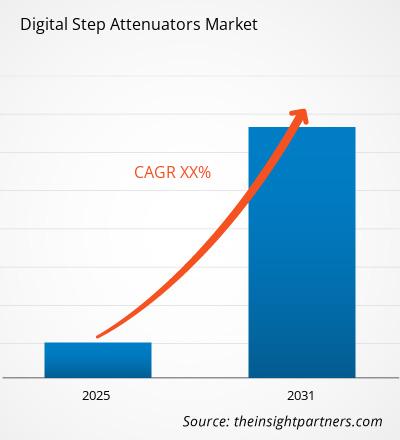
The Digital Step Attenuators Market is forecasted to be valued at $1.34 billion in 2025 and is expected to reach $2.76 billion by 2034, growing at a CAGR of 8.34% between 2026-2034. Growing need for accurate RF signal control in wireless infrastructures, test instruments, broadband telecommunications, satellite set-top box systems, and cellular systems is driving demand, as digitally controlled steps provide better accuracy and repeatability.
The North American market will remain a high-value consumer market, with growth in the region estimated to be in the 7.6% – 8.2% CAGR range until 2034 on account of growing activity in RF design, increased defense electronics spending, and growing wireless testing automation. North America's semiconductor engineering capabilities, investment in carrier networks, and increasing programmable RF control application will positively impact the Digital Step Attenuators Market size.
Digital Step Attenuators Market Assessment and Insights
- North America accounted for 28–32% Digital Step Attenuators Market share in 2025 and is expected to grow at a CAGR of 7.6–8.2% during 2026–2034, led by RF testing, defense electronics, and broadband network validation.
- US represented 78–82% of North America in 2025 and is projected to grow at a CAGR of 7.7–8.3% during 2026–2034, supported by advanced semiconductor design and telecom test demand.
- Europe held 19–23% Digital Step Attenuators Market share in 2025 and is expected to grow at a CAGR of 7.1–7.7% during 2026–2034, with Germany, the UK, and France leading infrastructure and aerospace adoption.
- Asia Pacific represented 34–38% share in 2025 and is forecast to grow at a CAGR of 8.8–9.4% during 2026–2034, led by China, Japan, South Korea, and India.
- Largest Segment RF Digital Step Attenuators held 68–72% market share in 2025 and is expected to grow at a CAGR of 8.1–8.7% during 2026–2034.
- High Growth Segment Fiber Optics and Broadband Telecom held 22–26% market share in 2025 and is expected to grow at a CAGR of 9.0–9.6% during 2026–2034.
- Key companies analyzed in detail: Analog Devices, Inc.; Honeywell International Inc.; MACOM Technology Solutions Holdings, Inc.; Mini-Circuits; NXP Semiconductors N.V.; pSemi Corporation; Qorvo, Inc.; Renesas Electronics Corporation; Skyworks Solutions, Inc.; Vaunix Technology Corporation.
Source: The Insight Partners' analysis based on proprietary research, government publications, company annual reports, investor presentations, industry databases, and expert interviews.
Technology advancements have caused the market to move from standalone devices that control the gain of the signal to RF front-end modules that provide low loss, high linearity, and flexibility in digital interfaces. The manufacturing trends are inclined towards more miniaturized modules using CMOS, SOI, and GaAs since manufacturers need repeatability over a larger range of frequencies. The vendors are also tailoring their product portfolios with respect to automated testing, phased array technology, and miniaturized broadband platforms that require smaller board space and faster switching.
According to the Digital Step Attenuators Market report, In the future, the will witness steady growth owing to the increasing investments in 5G and fiber-optic networks in developing countries. The regulatory support in terms of allocation of spectrum for next generation wireless services and defense modernization programs are set to create conducive environment for growth of the market. Moreover, the growing use of digital step attenuators in automotive radars, satellite communication, and IIoT is likely to drive the industry forward till 2034.
Digital Step Attenuators Market Report Scope
| Report Attribute | Details |
|---|---|
| Market size in 2025 | US$ 1.34 Billion |
| Market Size by 2034 | US$ 2.76 Billion |
| Global CAGR (2026 - 2034) | 8.34% |
| Historical Data | 2021-2024 |
| Forecast period | 2026-2034 |
Digital Step Attenuators Market Analysis
The demand for digital step attenuators stems from the worldwide growth in wireless communication networks, especially those that use the 5G technology. As operators implement large MIMO arrays, small cells, and beamforming technologies, the need to have precisely digitally controlled attenuation of signals has increased significantly. Digital step attenuators ensure fine control of power levels within RF front-end modules and thus maintain signal quality and optimal operation of the network under dynamically changing load. The value chain consists of semiconductor foundries, MMIC developers, suppliers of components, and OEMs from the telecommunication, aerospace, and defense industries. Supply factors include wafer manufacturing capabilities, availability of raw materials, and geopolitical conditions impacting the semiconductor industry.
According to the Digital Step Attenuators Market forecast, competitive dynamics include innovations in products, alliances and expansion geographically. Analog Devices, Inc., Qorvo, Inc., and Skyworks Solutions, Inc. continue to hold significant positions because of the diversity of their product range across different frequency ranges and attenuation levels. MACOM and Mini-Circuits stand out by supplying highly reliable solutions for use in the defense and aerospace industry. Renesas Electronics Corporation and NXP Semiconductors take advantage of their larger semiconductor offerings to provide integrated RF solutions. Digital Step Attenuators Market trends reflect more research and development money going towards higher frequencies, reduced insertion loss, and increased linearity. Strategic positioning is becoming more focused on integration into systems, and digital step attenuators are being developed as parts of an RF front-end module.
● REPORT CUSTOMIZATION
Tailor This Report To Align With Your Specific Business Requirements
This report can be customized to align precisely with your business objectives, scope, and target markets. Customization options include tailored segmentation, geography, competitive analysis, and strategic insights to support informed decision-making.
Customize This Report →WHAT YOU CAN ADJUST
- ● Segmentations
- ● Geography
- ● Competitive Analysis
- ● Language Preferences
Digital Step Attenuators Market: Strategic Insights
Regional Insights
North America Digital Step Attenuators Market
North America accounted for around 38%-42% of the Global Digital Step Attenuators Market in 2025, while the regional market grew at a CAGR of 7.5%-8.0% during the period from 2026 to 2034. North America has witnessed a dominant market demand in the form of the U.S., owing to high investment in defense electronics and 5G infrastructures. North America has a high concentration of semiconductor companies, system integrators, and research institutes contributing towards innovation in RF and microwave technologies. Various modernization initiatives for the armed forces include development of next generation radars, electronic warfare systems, and satellites, thus acting as a major demand generator. The civilian industry, which includes telecom infrastructure and test equipment, also drives the regional market.
U.S. Digital Step Attenuators Market
The U.S. represented approximately 85–90% of the North American market in 2025, with a CAGR of 7.5–8.0% over the forecast period. The country hosts the headquarters and major R&D facilities of leading digital step attenuator manufacturers including Analog Devices, Qorvo, Skyworks, and MACOM. Defense applications remain a cornerstone of U.S. demand, with the Department of Defense investing in advanced radar, electronic warfare, and secure communication systems that require high-reliability attenuation solutions. The commercial telecommunications sector continues to drive growth through 5G network densification and the transition toward 6G technologies. Test and measurement equipment manufacturers, concentrated in the U.S., represent another significant demand channel, as digital step attenuators are essential components in spectrum analyzers, signal generators, and network analyzers.
Europe Digital Step Attenuators Market
Europe captured approximately 22–26% of the global market in 2025, growing at a CAGR of 7.0–7.5%. Germany leads regional demand, driven by its strong automotive electronics sector, particularly advanced driver-assistance systems (ADAS) that rely on radar front-ends incorporating digital step attenuators. The UK follows closely, supported by defense electronics programs and aerospace applications. France contributes through its robust aerospace and defense industries, while Italy and Spain add demand through telecommunications infrastructure and industrial automation. The European market benefits from the region's emphasis on industrial digitalization, automotive innovation, and defense modernization. Regulatory frameworks promoting 5G deployment and spectrum harmonization further support market growth across the region.
APAC Digital Step Attenuators Market
Asia Pacific accounted for approximately 28–32% of the global market in 2025, with a CAGR of 9.0–9.5% – the fastest-growing region. China leads regional demand, driven by massive 5G infrastructure investments and a thriving electronics manufacturing ecosystem. Japan and South Korea contribute through advanced semiconductor capabilities and early 6G research initiatives. India represents an emerging growth market, supported by government-led digital infrastructure programs and expanding telecommunications networks. Australia adds demand through defense and aerospace applications. The region benefits from favorable industrial policies, including government subsidies for semiconductor manufacturing and 5G deployment. The concentration of electronics OEMs in the region creates a robust domestic demand base for digital step attenuators.
Middle East & Africa Digital Step Attenuators Market
The Middle East and Africa region is growing at a CAGR of approximately 6.5–7.0% from 2026 to 2034. Saudi Arabia leads regional demand, driven by smart city initiatives and defense modernization programs. The UAE contributes through telecommunications infrastructure investments and aerospace applications. South Africa represents the primary market in sub-Saharan Africa, supported by telecommunications network upgrades. The Rest of MEA segment includes emerging markets with gradually expanding telecommunications and industrial automation sectors. Energy sector investments, particularly in the Gulf region, create ancillary demand for digital step attenuators in oil and gas monitoring systems. Infrastructure development and digital transformation initiatives across the region support steady market growth.

Segmentation Analysis
Type
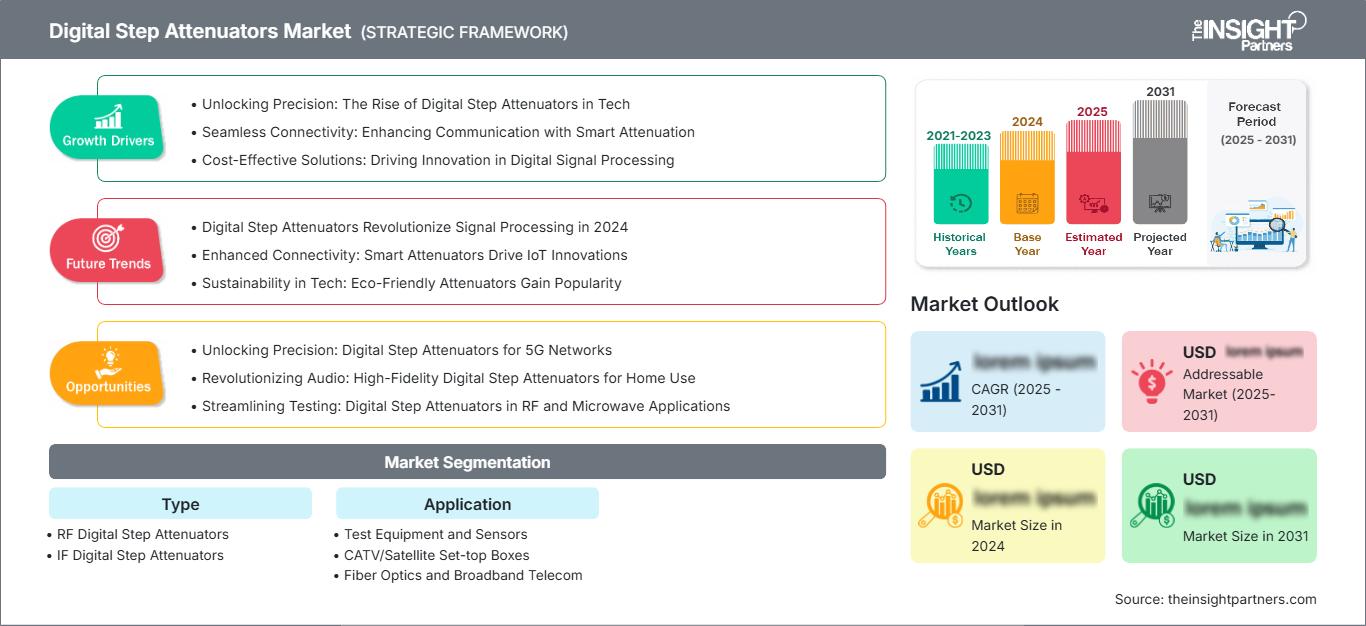
The Type segment of the Digital Step Attenuators Market is bifurcated into RF Digital Step Attenuators and IF Digital Step Attenuators. The RF Digital Step Attenuators segment dominated the market with approximately 62–66% share in 2025 and is projected to grow at a CAGR of 8.0–8.5% from 2026 to 2034. RF attenuators are critical components in 5G base stations, radar systems, and test equipment, where precise signal control at high frequencies is essential. The IF Digital Step Attenuators segment, holding 34–38% share in 2025, is expected to grow at a CAGR of 8.5–9.0%, driven by increasing adoption in fiber optics, broadband telecom, and CATV/satellite applications.
- RF Digital Step Attenuators – These devices operate at radio frequencies and are essential for signal power control in wireless infrastructure, radar systems, and aerospace applications. Their adoption is accelerating with 5G network deployments and defense modernization programs.
- IF Digital Step Attenuators – Intermediate frequency attenuators find extensive use in fiber optic communication systems, broadband telecom networks, and CATV/satellite set-top boxes. Growing demand for high-speed data transmission drives their market expansion.
Application
The Application segment encompasses Test Equipment and Sensors, CATV/Satellite Set-top Boxes, Fiber Optics and Broadband Telecom, and Cellular/3G Infrastructure. This segment is growing at a CAGR of approximately 8.0–8.5% from 2026 to 2034, driven by the proliferation of wireless communication networks and the increasing complexity of electronic systems that require precise signal management.
- Test Equipment and Sensors – Digital step attenuators are integral to spectrum analyzers, signal generators, and network analyzers, enabling accurate calibration and measurement. Growing demand for automated RF testing drives adoption in this segment.
- CATV/Satellite Set-top Boxes – These attenuators ensure optimal signal levels in cable and satellite television systems. The transition to digital broadcasting and high-definition content supports sustained demand.
- Fiber Optics and Broadband Telecom – Digital step attenuators are used in optical transceivers and broadband network equipment to manage signal power. The global expansion of fiber-to-the-home (FTTH) networks drives growth.
- Cellular/3G Infrastructure – Despite the transition to 4G and 5G, 3G infrastructure remains operational in many regions. Digital step attenuators support power control in base stations and repeaters, with replacement and maintenance activities sustaining demand.
Opportunity Snapshot
| Application | Revenue Contribution | Trend Tag | Adoption Stage |
|---|---|---|---|
| Test Equipment and Sensors | High | Precision Calibration | Mature |
| CATV/Satellite Set-top Boxes | Medium | Digital Transition | Mature |
| Fiber Optics and Broadband Telecom | High | FTTH Expansion | Scaling |
| Cellular/3G Infrastructure | Medium | Network Evolution | Mature |
Digital Step Attenuators Market Growth Drivers and Impact Analysis
5G Infrastructure Expansion Driving Digital Step Attenuator Adoption
The global rollout of 5G wireless networks represents a primary growth driver for the Digital Step Attenuators Market. As network operators deploy 5G base stations, small cells, and massive MIMO arrays, the demand for precise signal attenuation and power control in RF front-end modules has intensified significantly. Digital step attenuators offer fine-grain attenuation resolution, compact form factors, and high integration capability, making them indispensable components in modern 5G transceivers and beamforming systems. The transition from 4G LTE to 5G New Radio architectures has fundamentally expanded the addressable market for digital step attenuators across both sub-6 GHz and millimeter-wave frequency bands. With 5G connections projected to reach 3.5 billion by 2026, the need for attenuation solutions offering high resolution and wide dynamic range continues to grow.
Defense Modernization and Aerospace Electronics Procurement
Defense sector modernization initiatives represent a significant growth driver for the Digital Step Attenuators Market. Electronic warfare systems, phased-array radar platforms, and software-defined radios increasingly rely on high-performance digital step attenuators to achieve precise signal control and dynamic range in contested electromagnetic environments. Military-grade attenuators designed to operate across wide temperature ranges and withstand mechanical shock are witnessing growing procurement from defense agencies in North America, Europe, and the Asia-Pacific region. Investment in next-generation radar systems, electronic countermeasure platforms, and satellite communication networks continues to create sustained demand for radiation-hardened and high-reliability digital step attenuator components. The convergence of defense modernization with commercial 5G technology further amplifies market opportunities.
Proliferation of Automotive Radar and ADAS Systems
The increasing adoption of advanced driver-assistance systems (ADAS) and autonomous driving technologies is creating substantial demand for digital step attenuators in automotive radar applications. Radar front-ends require precise signal control to ensure accurate object detection and ranging, with digital step attenuators playing a critical role in power management and signal conditioning. As automotive manufacturers integrate more radar sensors per vehicle and transition toward higher-frequency radar systems operating at 77 GHz and above, the requirement for high-performance attenuation solutions intensifies. The automotive radar segment is expected to grow at a remarkable rate between 2026 and 2034, driven by regulatory mandates for safety features and consumer demand for enhanced vehicle automation.
Digital Step Attenuators Market Future Trends
Integration of AI-Driven Signal Optimization in Attenuation Systems
The integration of artificial intelligence (AI) into RF and microwave systems is emerging as a transformative trend in the Digital Step Attenuators Market. AI-driven signal optimization algorithms are enabling smarter attenuation solutions that can dynamically adjust signal levels based on real-time network conditions, interference patterns, and traffic loads. This trend is particularly relevant in 5G and future 6G networks, where massive MIMO arrays and beamforming architectures require sophisticated power management to optimize spectral efficiency and energy consumption. AI-enabled digital step attenuators can learn from historical data patterns to predict optimal attenuation settings, reducing latency in power control loops and improving overall system performance. The convergence of AI with RF semiconductor design is expected to drive innovation in attenuation accuracy, switching speed, and dynamic range.
Migration Toward Higher-Frequency Millimeter-Wave and Terahertz Operation
The industry is witnessing a clear migration toward digital step attenuators capable of operating at higher frequencies, driven by the expansion of millimeter-wave 5G bands, satellite communications, and emerging 6G research. Manufacturers are investing in advanced semiconductor processes, including gallium nitride (GaN) and silicon-germanium (SiGe), to develop attenuators that maintain performance at frequencies up to 48 GHz and beyond. This trend is accompanied by increasing demand for finer attenuation resolution, lower insertion loss, and improved linearity across wider bandwidths. The development of ultra-wideband digital step attenuators operating from DC to 50 GHz or higher is enabling new applications in automotive radar, aerospace, and advanced test equipment, expanding the addressable market for these components.
Digital Step Attenuators Market Opportunities
Expansion into Emerging Telecommunications Markets
Significant opportunities exist for digital step attenuator manufacturers in emerging telecommunications markets across Asia-Pacific, Latin America, and Africa. As these regions accelerate their 5G infrastructure deployments and expand fiber-optic broadband networks, the demand for RF and IF attenuation solutions is expected to rise substantially. Countries such as India, Brazil, and Indonesia are investing heavily in digital infrastructure, creating new channels for component suppliers. Manufacturers that establish local partnerships, distribution networks, and technical support capabilities in these regions can capture early-mover advantages. The lower penetration of existing attenuation infrastructure in emerging markets compared to developed regions presents a greenfield opportunity for digital step attenuator suppliers, particularly in the cellular infrastructure and broadband telecom segments.
Development of Integrated RF Front-End Modules
The trend toward system-level integration in RF and microwave applications presents a significant opportunity for digital step attenuator manufacturers. As telecommunications equipment makers and aerospace OEMs seek to reduce board space, lower power consumption, and simplify design complexity, the demand for integrated RF front-end modules incorporating digital step attenuators, switches, amplifiers, and other components is growing. Companies that can offer comprehensive module-level solutions, rather than discrete components, are well-positioned to capture value in this evolving landscape. This opportunity extends across multiple end markets, including 5G infrastructure, satellite communications, and automotive radar, where integration reduces bill-of-materials costs and accelerates time-to-market for system designers.
Recent Developments
- October 2025: Mini-Circuits launched the ZX76-24G-30-S+, a wideband digital step attenuator operating from 0.1 to 24 GHz with programmable attenuation from 0 to 31.5 dB in 0.5 dB steps. The device is designed for precision RF applications in aerospace, defense, test, and wireless communication systems, offering flexible signal level control across a broad frequency range.
- June 2026: Qorvo introduced its new Silicon-on-Insulator (SOI) RF control portfolio, eliminating the need for negative bias voltage rails through TTL-compatible control. The portfolio simplifies RF board design, reduces bill of materials (BOM) complexity, and maintains high isolation, fast switching, and high linearity for defense and aerospace applications..
Frequently Asked Questions
Naveen is an experienced market research and consulting professional with over 9 years of expertise across custom, syndicated, and consulting projects. Currently serving as Associate Vice President, he has successfully managed stakeholders across the project value chain and has authored over 100 research reports and 30+ consulting assignments. His work spans across industrial and government projects, contributing significantly to client success and data-driven decision-making.
Naveen holds an Engineering degree in Electronics & Communication from VTU, Karnataka, and an MBA in Marketing & Operations from Manipal University. He has been an active IEEE member for 9 years, participating in conferences, technical symposiums, and volunteering at both section and regional levels. Prior to his current role, he worked as an Associate Strategic Consultant at IndustryARC and as an Industrial Server Consultant at Hewlett Packard (HP Global).
- Comprehensive Market Sizing and Forecast Analysis
- Detailed Segmentation Analysis
- In-Depth Market Dynamics Assessment
- Regional and Country-Level Insights
- Competitive Landscape and Company Benchmarking
- Strategic Business Intelligence
Recent Reports
Testimonials
The Insight Partners' SCADA System Market report is comprehensive, with valuable insights on current trends and future forecasts. The team was highly professional, responsive, and supportive throughout. We are very satisfied and highly recommend their services.
RAN KEDEM Partner, Reali Technologies LTDsI requested a report on a very specific software market and the team produced the report in a few days. The information was very relevant and well presented. I then requested some changes and additions to the report. The team was again very responsive and I got the final report in less than a week.
JEAN-HERVE JENN Chairman, Future AnalyticaWe worked with The Insight Partners for an important market study and forecast. They gave us clear insights into opportunities and risks, which helped shape our plans. Their research was easy to use and based on solid data. It helped us make smart, confident decisions. We highly recommend them.
PIYUSH NAGPAL Sr. Vice President, High Beam GlobalThe Insight Partners delivered insightful, well-structured market research with strong domain expertise. Their team was professional and responsive throughout. The user-friendly website made accessing industry reports seamless. We highly recommend them for reliable, high-quality research services
YUKIHIKO ADACHI CEO, Deep Blue, LLC.This is the first time I have purchased a market report from The Insight Partners.While I was unsure at first, I visited their web site and felt more comfortable to take the risk and purchase a market report.I am completely satisfied with the quality of the report and customer service. I had several questions and comments with the initial report, but after a couple of dialogs over email with their analyst I believe I have a report that I can use as input to our strategic planning process.Thank you so much for taking the extra time and making this a positive experience.I will definitely recommend your service to others and you will be my first call when we need further market data.
JOHN SUZUKI President and Chief Executive Officer, Board Director, BK TechnologiesI wish to appreciate your support and the professionalism you displayed in the course of attending to my request for information regarding to infectious disease IVD market in Nigeria. I appreciate your patience, your guidance, and the fact that you were willing to offer a discount, which eventually made it possible for us to close a deal. I look forward to engaging The Insight Partners in the future, all thanks to the impression you have created in me as a result of this first encounter.
DR CHIJIOKE ONYIA MANAGING DIRECTOR, PineCrest Healthcare Ltd.Reason to Buy
- Informed Decision-Making
- Understanding Market Dynamics
- Competitive Analysis
- Identifying Emerging Markets
- Customer Insights
- Market Forecasts
- Risk Mitigation
- Boosting Operational Efficiency
- Strategic Planning
- Investment Justification
- Tracking Industry Innovations
- Aligning with Regulatory Trends