
Diode Power Modules Market Size, Growth & Trends by 2034
Coverage: By Type (Rectifier Diode, Fast Recovery Diode, Switching Diode, Others); Application (Single- And Three-Phase Input Rectification, Industrial Welding, Switch Mode Power Supplies, Motor Drives, Others); Phase (Single Phase, Three Phase); Industry Verticals (Consumer Electronics, Automotive and Transportation, Aerospace and Defense, Industrial, Others) , and Geography (North America, Europe, Asia Pacific, and South and Central America)
- Status : Data Released
- Report Code : TIPRE00018728
- Category : Electronics and Semiconductor
- No. of Pages : 150
- Available Report Formats :


- Last update date : August 10, 2026


2025 Market Size
US$ 130.09 Mn
Base year value
2034 Forecast
US$ 172.41 Mn
Projected by 2034
CAGR 2026-2034
3.18 %
Growth rate
Addressable Market
US$ 1,373.67 Mn
(2026-2034)
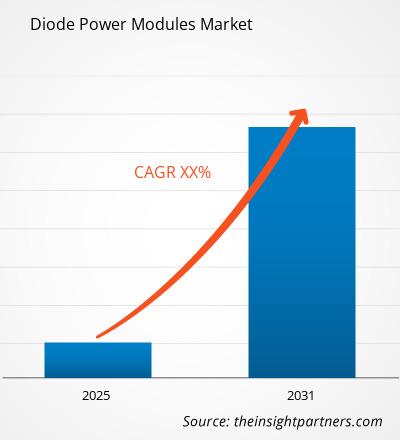
The global Diode Power Modules market was valued at US$ 130.09 million in 2025 and is expected to reach US$ 172.41 million by 2034; it is estimated to record a CAGR of 3.18% during 2026-2034.
Diode Power Modules Market Assessment and Insights
- North America: The region holds 27–30% share in 2025 and grows at a CAGR range of 3.3–3.9% during 2026–2034, supported by industrial automation, defense electronics, and power supply replacement cycles.
- US: The country represents 79–83% of North America in 2025 and grows at a CAGR range of 3.4–4.0% during 2026–2034, led by industrial and aerospace demand.
- Europe: Europe accounts for 24–27% share in 2025 and grows at a CAGR range of 3.0–3.6% during 2026–2034, with Germany, France, Italy, Spain, and the UK leading adoption.
- Asia Pacific: Asia Pacific holds 36–40% share in 2025 and grows at a CAGR range of 4.0–4.8% during 2026–2034, led by China, Japan, South Korea, India, and Taiwan.
- Largest Segment: Rectifier Diode holds 49–53% market share in 2025 and grows at a CAGR range of 3.1–3.7% during 2026–2034 due to broad rectification use.
- High Growth Segment: Fast Recovery Diode holds 29–33% market share in 2025 and grows at a CAGR range of 4.1–4.9% during 2026–2034 as switching efficiency requirements rise.
- Key companies analyzed in detail: Mitsubishi Electric Corporation, Texas Instruments Incorporated, ABB Ltd, Littelfuse, Inc., STMicroelectronics N.V., Toshiba Corporation, Infineon Technologies AG, ROHM Co., Ltd., Phoenix Contact GmbH & Co. KG, Vishay Intertechnology, Inc.
Source: The Insight Partners' analysis based on proprietary research, government publications, company annual reports, investor presentations, industry databases, and expert interviews.
Diode Power Modules Market growth has developed from simple discrete rectifier devices to miniature modules with thermal management properties that allow for high current densities, efficient heat dissipation, and easy equipment installation. Market production trends include standardized packages, press-fit and soldered terminals, and application-oriented designs. Manufacturers need to strike a balance between established silicon diode demand and recovery-related performance requirements for industrial customers as they upgrade their power sections.
The growth opportunities will largely depend on Asia-Pacific manufacturing centers, North American re-shoring projects, and European electrification plans where the reliability of power conversion becomes a factor determining the availability of equipment. The factors contributing to growth will consist of investments into industrial welding machines, motor drives, uninterruptible power supplies, renewable interface, and aerospace power electronics. Regulatory pressure in the area of energy efficiency, grid reliability, and equipment safety will result in replacements due to budget constraints.
Diode Power Modules Market Report Scope
| Report Attribute | Details |
|---|---|
| Market size in 2025 | US$ 130.09 Million |
| Market Size by 2034 | US$ 172.41 Million |
| Global CAGR (2026 - 2034) | 3.18% |
| Historical Data | 2021-2024 |
| Forecast period | 2026-2034 |
Diode Power Modules Market Analysis
Diode Power Modules Market is propelled by reliable rectification in industrial power supplies, welding equipment, motor drives, and transport electronics. Customers prefer modules which simplify the wiring process, provide better heat dissipation capabilities, and protect against high peak currents. The replacement of aged diode stacks in factories and utility companies is another driver of demand for their ability to cause higher costs of unplanned downtime than component upgrades.
Wafer manufacturers, diode chip makers, module assemblers, thermal material suppliers, distributors, OEM design groups, and system integrators are involved in the value chain of Market. The supply side is stable owing to the fact that the silicon rectifiers are well-established technologies. However, the supply may experience some shortages due to the coincidence of transport, renewable energy, and factory automation projects.
Current rating, voltage range, thermal resistance, reliability of package, qualification for certifications, and distribution channels determine the competitive position in Diode Power Modules Market report. Mitsubishi Electric Corporation, Infineon Technologies AG, STMicroelectronics N.V., Toshiba Corporation, and Vishay Intertechnology, Inc. compete through wide portfolios of power semiconductors, whereas Littelfuse, Inc. and ROHM Co., Ltd. expand their positions in protection and power applications.
The major trends in investments include improvements in packaging, thermal cycling endurance, ease of installation, and engineering applications. ABB Ltd, Phoenix Contact GmbH & Co. KG, and Texas Instruments Incorporated exert influence on the adjacent power architecture through industry applications, connections, and power management systems. The differentiation will be increasingly based on longevity of the products, documents, and availability of the industrial systems.
● REPORT CUSTOMIZATION
Tailor This Report To Align With Your Specific Business Requirements
This report can be customized to align precisely with your business objectives, scope, and target markets. Customization options include tailored segmentation, geography, competitive analysis, and strategic insights to support informed decision-making.
Customize This Report →WHAT YOU CAN ADJUST
- ● Segmentations
- ● Geography
- ● Competitive Analysis
- ● Language Preferences
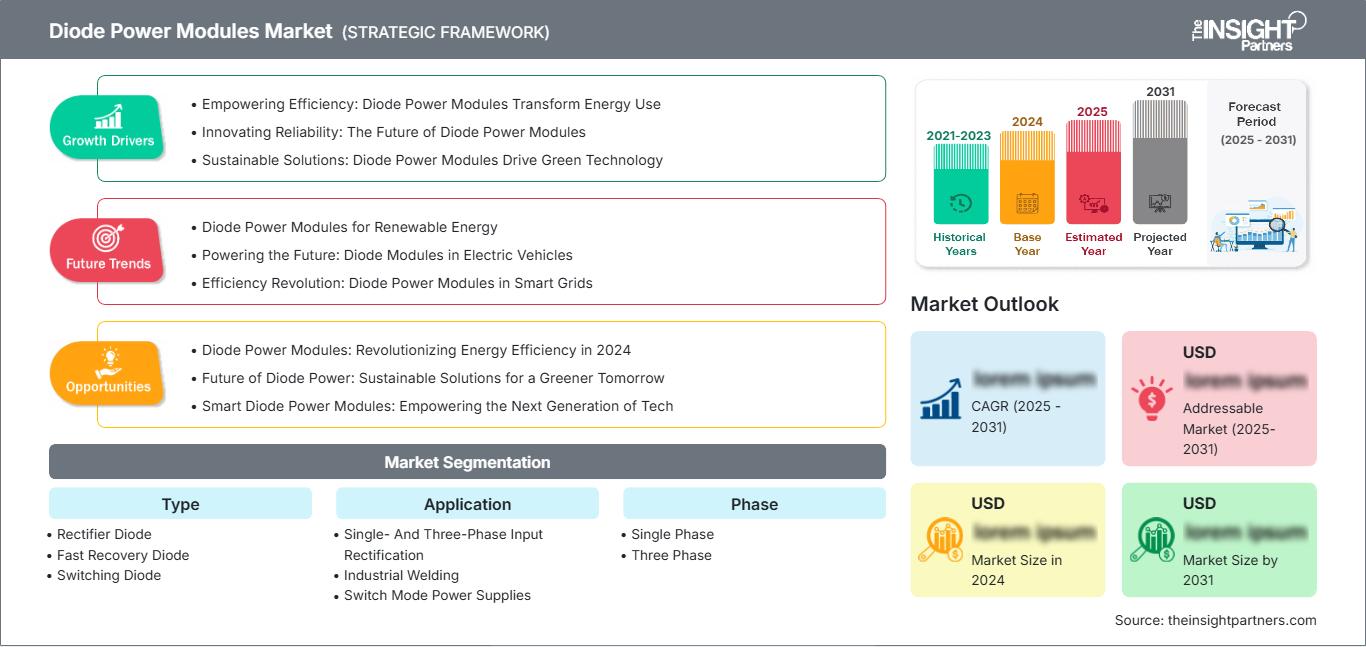
Diode Power Modules Market: Strategic Insights
Regional Insights
North America Diode Power Modules Market
The North American market accounts for 27 to 30% in 2025 and has a CAGR between 3.3% and 3.9% from 2026 to 2034. The Diode Power Modules Market share gains are driven by industrial automation, aerospace electronics, welding equipment, UPS systems, and quality of power purchases. End-users require modules in medium-power rectifiers, single and three-phase input stages, and replacement programs for maintenance purposes within factories, utilities, and defense companies.
Buyer considerations center on reliability data, heat resistance, and technical support in the area. The USA remains the number one country, with Canada and Mexico supporting growth through manufacture, electricity distribution, and assembly of transportation equipment. Manufacturers benefit from incorporating modules in a platform that has a long lifespan because of qualification costs.
U.S. Diode Power Modules Market
The USA constitutes 79–83% of North America in 2025 and has a CAGR of 3.4–4.0% in 2026-2034. The demand is driven by the requirements in aerospace & defense electronics, industrial welding, motor control retrofits, data center backup power, and domestic power equipment manufacturing. The use of rectifiers is most prominent where the installation of small rectifier modules simplifies maintenance and lowers enclosure complications.
The coverage of the companies is wide through direct marketing and distributor network providing the products for OEM and maintenance end-users. Infineon Technologies AG, Littelfuse, Inc., Vishay Intertechnology, Inc., Texas Instruments Incorporated, and STMicroelectronics N.V. cover applications from switch mode power supplies to motor drives. Application trends tend towards faster recovery rectifier modules for higher frequencies and reduced thermal stresses.
Europe Diode Power Modules Market
Europe holds a share of 24-27% in 2025 and has a CAGR of 3.0-3.6% during 2026-2034. Europe is led by Germany via machine tools, industrial drives, welding machines, and power electronic solutions for renewables. The UK is supported by demand in aerospace, defense, and power supply sectors. The French have rail sector, industrial automation, and electrical infrastructure.
The Italian and Spanish contribution includes manufacturing equipment, energy infrastructure, and transportation electrification programs. Europeans often give preference to the documents proving compliance, data on thermal cycling, and wide availability periods. Infineon Technologies AG, ABB Ltd, STMicroelectronics N.V., Phoenix Contact GmbH & Co. KG, and Vishay Intertechnology, Inc. can take advantage of the engineering proximity to Europe and its industries.
APAC Diode Power Modules Market
The APAC region accounts for a market share of 36-40% in 2025 and witnesses a CAGR of 4.0-4.8% between 2026-2034. China dominates via electronics production, welding equipment, industrial drives, and transport infrastructure. Japan and South Korea contribute to advanced module designs, automation, and demand for automotive electronics.
India, Taiwan, and Australia contribute additional volumes via power supplies manufacture, energy integration, mining equipment, and upgrading of factories. Emphasis on domestic electronics, energy efficiency, and grid reliability in policies encourages locally sourced material and multi-vendor qualification.
Middle East & Africa Diode Power Modules Market
Middle East & Africa is projected to grow at a CAGR range of 3.2–4.1% during 2026–2034. Saudi Arabia leads through power infrastructure, industrial diversification, and oilfield electrification. The UAE adds logistics, data centers, and building power systems, while South Africa supports mining and industrial maintenance demand.
Rest of MEA demand is project-led and linked to energy, water, transport, and construction infrastructure. Buyers focus on robust modules that tolerate heat, voltage fluctuation, and service constraints. Rectifier diode modules remain preferred in maintenance-heavy environments where ruggedness and availability outweigh advanced switching features.
Segmentation Analysis
Type
Type is projected to grow at a CAGR range of 3.4–4.1% during 2026–2034. Diode Power Modules Market scope is defined by rectification duty, switching speed, thermal endurance, and voltage class. Rectifier diode modules dominate mature conversion tasks, while fast recovery and switching diode modules gain relevance as equipment designers pursue reduced losses and compact power stages.
- Rectifier Diode: Rectifier diode modules lead demand because they convert AC to DC in industrial supplies, welding units, chargers, and control panels with proven reliability and broad current ratings.
- Fast Recovery Diode: Fast recovery diode modules are strategically important in higher-frequency circuits where reverse recovery losses affect heat, efficiency, and component stress in power conversion equipment.
- Switching Diode: Switching diode modules serve compact electronic assemblies and control circuits where rapid response, low leakage, and predictable behavior support protection and signal-related power functions.
Application
Application is expected to grow at a CAGR range of 3.5–4.2% during 2026–2034. Demand differs by electrical duty cycle, heat profile, and service criticality. Single- and three-phase rectification provides the largest installed base, while motor drives and switch mode power supplies require modules that support compact layouts, stable thermal paths, and predictable recovery behavior.
- Single- And Three-Phase Input Rectification: This application holds the broadest base because industrial equipment, chargers, UPS systems, and control panels require durable AC-to-DC conversion across varied current classes.
- Industrial Welding: Welding systems use diode modules for rugged rectification, surge tolerance, and thermal stability, especially where high duty cycles and harsh shop-floor conditions affect reliability.
- Switch Mode Power Supplies: Switch mode power supplies need compact modules with efficient recovery behavior, enabling stable conversion in data, telecom, industrial control, and embedded power platforms.
- Motor Drives: Motor drives use diode modules in input rectification and freewheeling functions, supporting industrial automation, pumps, fans, compressors, and transport systems with controlled power conversion.
Phase
Phase is projected to grow at a CAGR range of 3.3–4.0% during 2026–2034. Single phase modules remain important in smaller supplies and equipment, while three phase modules dominate industrial rectification where higher power, balanced loads, and efficient thermal management are required. OEM preference depends on grid interface, enclosure size, and service accessibility.
- Single Phase: Single phase modules serve compact equipment, small industrial systems, and distributed power supplies where simple input architecture and lower current requirements define the design choice.
- Three Phase: Three phase modules are critical in industrial drives, welding, UPS, and heavy equipment because they handle higher power levels and improve conversion stability.
Industry Verticals
Industry Verticals is expected to grow at a CAGR range of 3.6–4.3% during 2026–2034. Industrial users account for the most consistent demand, while automotive and transportation applications add higher qualification requirements. Consumer electronics favor compact power supplies, and aerospace and defense buyers emphasize traceability, derating margins, and long lifecycle availability.
- Consumer Electronics: Consumer electronics demand centers on compact power adapters, appliances, and embedded supplies where reliable rectification supports efficiency, thermal control, and long operating life.
- Automotive and Transportation: Automotive and transportation applications use diode modules in charging, auxiliary conversion, rail equipment, and commercial vehicle electronics where qualification and vibration tolerance matter.
- Aerospace and Defense: Aerospace and defense buyers prioritize traceability, conservative derating, thermal endurance, and supplier continuity for mission-critical power conversion and actuation systems.
- Industrial: Industrial applications dominate because motor drives, welding, UPS, automation, and process equipment require rugged modules with predictable performance under continuous duty.
Opportunity Snapshot
| Application | Revenue Contribution | Trend Tag | Adoption Stage |
| Single- And Three-Phase Input Rectification | High | Input Bridges | Mature |
| Industrial Welding | Medium | Arc Stability | Mature |
| Switch Mode Power Supplies | Medium | Compact Conversion | Scaling |
| Motor Drives | High | Drive Efficiency | Scaling |
Diode Power Modules Market Growth Drivers and Impact Analysis
Industrial Power Conversion Replacement Cycles
Factories, utility companies, and processing facilities still keep upgrading their old rectifier units because failure of power sections could disrupt manufacturing, welding, pumping, material handling, and control processes. Diode modules are popular due to ease of installation, avoidance of wiring mistakes, and provision of standard thermal interfaces. Market effects include stable sales of both after-market and original equipment modules, namely diode rectifiers and three phase variants. Manufacturers who can offer legacy compatible packaging and proven electrical equivalence would be able to earn on replacements without having to redesign twenty-year-old equipment.
Higher Efficiency Requirements in Power Supplies
Power Supply Module manufacturers are decreasing heat dissipation by increasing output density in industrial controls, telecommunications systems, data centers, and embedded applications. Fast Recovery Diode Modules play a part in limiting reverse recovery loss and heating problems at higher frequencies in conversion circuits. The effect on the market will be slow but steady evolution from basic rectifier units to those with recovery characteristics, low thermal impedance, and small physical sizes. Manufacturers that offer design information, simulations, and reference designs can become embedded from early on in the design process through qualification cycles.
Expansion of Motor Drives and Welding Automation
The automation industry is employing motor drives, robotic welding, conveyer systems, pumps, compressors, and machine tools. Such systems will require rectifiers which should withstand surges and be capable of enduring heat since there will be varying loads in these systems hence resulting in electrical stresses. In terms of market effects, there is an increased demand for diode modules that are durable and able to help in designing small inverters and rectifiers. There will be growth in cases where producers opt to change their older electromechanical system into electronically-controlled equipment.
Diode Power Modules Market Future Trends
Thermally Enhanced Compact Packages
Diode Power Modules Market trends will increasingly center on smaller packages that maintain surge capability and reduce junction temperature rise. OEMs are compressing enclosure sizes in motor drives, power supplies, and welding equipment, so thermal path engineering is becoming as important as electrical rating. Future module designs will emphasize improved baseplates, lower contact resistance, and easier mounting. Suppliers that validate thermal cycling under realistic duty profiles will gain credibility with customers seeking longer service intervals and lower field failure risk.
Application-Certified Power Building Blocks
Future demand will shift toward modules sold with application-specific evidence rather than catalog specifications alone. Welding OEMs, industrial drive makers, and aerospace suppliers will expect surge test data, thermal curves, insulation information, and failure mode guidance aligned to their use cases. This trend will favor companies that combine manufacturing scale with engineering support. Over time, qualification packages may become a differentiator, helping suppliers reduce customer validation time and protect long-term design positions.
Diode Power Modules Market Opportunities
Retrofit Kits for Industrial Rectifier Platforms
Diode Power Modules Market Forecasts indicate a practical opportunity in retrofit kits that pair modules with mounting hardware, thermal interface materials, protection guidance, and cross-reference documentation. Many industrial plants prefer maintaining existing rectifier, welding, and drive cabinets rather than replacing complete systems. Suppliers can convert this installed base by simplifying substitution decisions for maintenance engineers. The opportunity is strongest for distributors and manufacturers that provide verified equivalents, fast delivery, and technical support for obsolete or long-lead legacy diode assemblies.
Localized Supply for Asia Pacific Equipment Makers
Asia Pacific equipment makers need reliable module supply for welding machines, power supplies, charging equipment, factory automation, and export-oriented industrial systems. Localized inventory, design-in support, and secondary sourcing can reduce procurement risk in high-volume programs. Manufacturers that expand regional application engineering and distributor training can win share beyond price competition. This opportunity is especially relevant where customers require stable quality, compliance documentation, and rapid sample availability before committing diode modules to standardized product platforms.
Recent Developments
- August 2025: Infineon Technologies and Delta Electronics announced a collaboration to accelerate high-density power delivery solutions for next-generation data centers, particularly those supporting AI workloads. The partnership leverages Infineon’s OptiMOS™ TDM22544D integrated power-stage solution, combining silicon MOSFETs, drivers, and power management capabilities to enable efficient vertical power delivery (VPD) modules. The solution is designed to improve power density, energy efficiency, and thermal performance in advanced server architectures, helping data center operators meet increasing power demands from AI computing infrastructure while reducing system complexity.
- June 2025: RIR Power Electronics Ltd. expanded the manufacturing and shipment of its 1200V Silicon Carbide (SiC) Schottky Barrier Diodes (SBDs) through a strategic collaboration with Pro Asia Semiconductor Corporation (PASC), Taiwan. The partnership leverages SiC technology IP acquired from Sicamore Semi, USA, enabling production of 2A to 60A rated 1200V SiC diodes for applications across electric vehicles, renewable energy, industrial power systems, and defense electronics. The successful scale-up to 6-inch wafer production supports RIR Power’s planned SiC semiconductor facility in Odisha, India, helping accelerate high-efficiency power device manufacturing, strengthen domestic semiconductor capabilities, and improve access to global SiC markets
- May 2026: Microchip Technology launched its 3.3 kV HV-D3 mSiC® Power Modules, designed to accelerate the adoption of solid-state transformers (SSTs) for AI hyperscale data centers and other high-voltage power applications. The new modules integrate 3.3 kV silicon carbide (SiC) MOSFETs and Schottky diodes in an industry-standard 62 mm package, enabling efficient power conversion from medium-voltage grids directly to server racks. The modules provide enhanced thermal performance, high isolation capability, and improved power density, helping data centers reduce conversion stages, increase energy efficiency, and support growing AI computing power demands. The HV-D3 mSiC modules are also targeted for applications including megawatt EV charging infrastructure, rail power systems, medium-voltage motor drives, industrial equipment, and defense power systems.
Frequently Asked Questions

- Comprehensive Market Sizing and Forecast Analysis
- Detailed Segmentation Analysis
- In-Depth Market Dynamics Assessment
- Regional and Country-Level Insights
- Competitive Landscape and Company Benchmarking
- Strategic Business Intelligence
Recent Reports
Testimonials

The Insight Partners provided valuable market intelligence that supported our global go-to-market strategy. Their team was professional, responsive, and attentive to our feedback, providing thoughtful analysis and helpful methodological clarifications throughout the project.
Junmo Kim Chief Financial Officer (CFO), Enertech Co., Ltd.
The Insight Partners' SCADA System Market report is comprehensive, with valuable insights on current trends and future forecasts. The team was highly professional, responsive, and supportive throughout. We are very satisfied and highly recommend their services.
RAN KEDEM Partner, Reali Technologies LTDs
I requested a report on a very specific software market and the team produced the report in a few days. The information was very relevant and well presented. I then requested some changes and additions to the report. The team was again very responsive and I got the final report in less than a week.
JEAN-HERVE JENN Chairman, Future Analytica
We worked with The Insight Partners for an important market study and forecast. They gave us clear insights into opportunities and risks, which helped shape our plans. Their research was easy to use and based on solid data. It helped us make smart, confident decisions. We highly recommend them.
PIYUSH NAGPAL Sr. Vice President, High Beam Global
The Insight Partners delivered insightful, well-structured market research with strong domain expertise. Their team was professional and responsive throughout. The user-friendly website made accessing industry reports seamless. We highly recommend them for reliable, high-quality research services
YUKIHIKO ADACHI CEO, Deep Blue, LLC.
This is the first time I have purchased a market report from The Insight Partners.While I was unsure at first, I visited their web site and felt more comfortable to take the risk and purchase a market report.I am completely satisfied with the quality of the report and customer service. I had several questions and comments with the initial report, but after a couple of dialogs over email with their analyst I believe I have a report that I can use as input to our strategic planning process.Thank you so much for taking the extra time and making this a positive experience.I will definitely recommend your service to others and you will be my first call when we need further market data.
JOHN SUZUKI President and Chief Executive Officer, Board Director, BK Technologies
I wish to appreciate your support and the professionalism you displayed in the course of attending to my request for information regarding to infectious disease IVD market in Nigeria. I appreciate your patience, your guidance, and the fact that you were willing to offer a discount, which eventually made it possible for us to close a deal. I look forward to engaging The Insight Partners in the future, all thanks to the impression you have created in me as a result of this first encounter.
DR CHIJIOKE ONYIA MANAGING DIRECTOR, PineCrest Healthcare Ltd.Reason to Buy
- Informed Decision-Making
- Understanding Market Dynamics
- Competitive Analysis
- Identifying Emerging Markets
- Customer Insights
- Market Forecasts
- Risk Mitigation
- Boosting Operational Efficiency
- Strategic Planning
- Investment Justification
- Tracking Industry Innovations
- Aligning with Regulatory Trends





 Get Free Sample for