
Dioxin Analyzer Market Demand, Size & Forecast by 2034
Coverage: By Technology (GC - MS/MS, GC - HRMS, LC - MS/MS); End User (Food Testing Laboratories, Government Institutions, Food Product Companies) , and Geography (North America, Europe, Asia Pacific, and South and Central America)
- Status : Data Released
- Report Code : TIPRE00020262
- Category : Electronics and Semiconductor
- No. of Pages : 150
- Available Report Formats :


- Last update date : August 13, 2026


2025 Market Size
US$ 310.15 Mn
Base year value
2034 Forecast
US$ 439.87 Mn
Projected by 2034
CAGR 2026-2034
3.96 %
Growth rate
Addressable Market
US$ 3,406.64 Mn
(2026-2034)
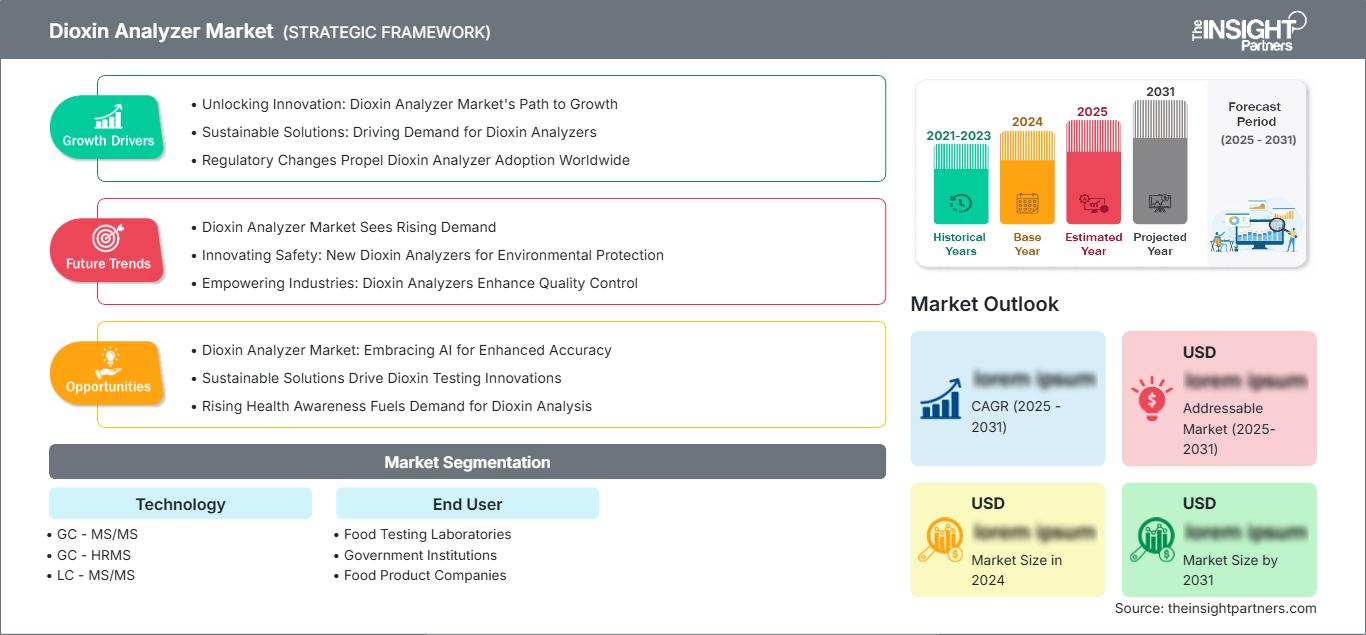
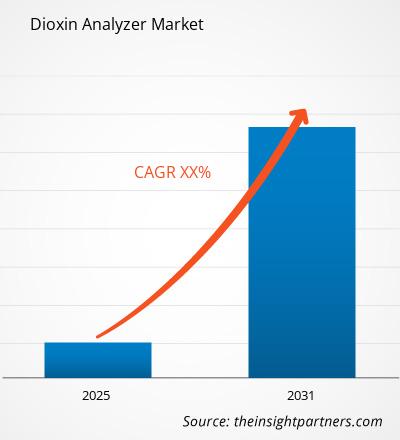
The Dioxin Analyzer Market size was recorded at US$ 310.15 million in 2025 and is anticipated to reach US$ 439.87 million by 2034. The market will see CAGR growth at 3.96% in the period between 2026 and 2034 due to stringent environmental regulations and increasing food safety concerns. Dioxin analyzers are important tools that help detect and measure dioxins, furans, and dioxin-like polychlorinated biphenyls. They use sophisticated technology such as gas chromatography-tandem mass spectrometry, high resolution mass spectrometry, and liquid chromatography-tandem mass spectrometry.
North America has already become a highly developed and strategically important market of dioxin analyzers with a CAGR of 3.2-3.6% within the forecast period. The development of the regional market is determined by the presence of regulatory frameworks such as US EPA Method 1613B, intensive food safety programs, and investments into environmental testing equipment. The cycle of replacing the existing analytical equipment and upgrading to more sensitive devices helps maintain stable demand. Moreover, the construction of waste to energy plants and requirements for industrial combustion control are the additional factors stimulating market development in the USA and Canada.
Dioxin Analyzer Market Assessment and Insights
- North America accounted for approximately 31-34% of the global Dioxin Analyzer Market share in 2025, growing at a CAGR of 3.2-3.6% from 2026 to 2034. The region benefits from mature regulatory enforcement, extensive food testing infrastructure, and consistent replacement demand for high-resolution analytical systems.
- US held roughly 82-86% of the North America in 2025, advancing at a CAGR of 3.0-3.4% during 2026-2034. Strong EPA mandates, a large food production sector, and significant government-funded environmental monitoring programs underpin sustained analyzer procurement.
- Europe represented approximately 25-28% of the global market in 2025, expanding at a CAGR of 3.4-3.8% from 2026 to 2034. Germany, the United Kingdom, and France are leading country markets, driven by EU Industrial Emissions Directive compliance and EFSA food safety standards.
- Asia Pacific captured roughly 26-29% of the global Dioxin Analyzer Market in 2025, registering the fastest regional CAGR of 4.0-4.5% during 2026-2034. China, Japan, India, and South Korea are key growth engines, supported by rapid industrialization and strengthening environmental enforcement.
- Largest Segment – By technology, GC-MS/MS held the largest market share of approximately 38-42% in 2025, with a projected CAGR of 3.6-4.0% from 2026 to 2034. Its dominance reflects widespread adoption for routine dioxin screening due to cost-effectiveness and regulatory acceptance.
- High Growth Segment – By technology, LC-MS/MS is the high-growth segment with approximately 18-22% market share in 2025 and a projected CAGR of 4.2-4.6% during 2026-2034. Increasing application in food and feed testing drives its faster adoption trajectory.
- Key companies analyzed in detail: Thermo Fisher Scientific Inc., Agilent Technologies, Inc., Shimadzu Corporation, Bruker Corporation, Hitachi High-Tech Corporation, AB Sciex Pte. Ltd., JEOL Ltd., Gasmet Technologies Oy, ABB, Schneider Electric.
Source: The Insight Partners' analysis based on proprietary research, government publications, company annual reports, investor presentations, industry databases, and expert interviews.
The market has shifted from being primarily based on high-resolution mass spectrometry systems for laboratory use to being more flexible and automatic analyzers. Technological changes include the increasing preference for GC-MS/MS over GC-HRMS due to cost considerations in meeting regulatory requirements, as well as the development of LC-MS/MS for particular food matrices. Production considerations demonstrate a movement towards modular and easy-to-use systems that are also equipped with data analysis software. Instrument companies are now concentrating on cutting down analysis time and detection limits due to tightening global dioxin limits.
According to the Dioxin Analyzer Market forecasts, the growth potential in the form of new geographies such as Southeast Asia, Latin America, and the Middle East is expected to open up in the coming years. Environmental monitoring infrastructure investments are increasing in developing countries, which are complying with the provisions of Stockholm Convention. The regulatory wind behind the market in the form of stricter dioxin norms by the EU in food and feed, along with changing emission norms by China, is continuing to increase the market potential.
Dioxin Analyzer Market Report Scope
| Report Attribute | Details |
|---|---|
| Market size in 2025 | US$ 310.15 Million |
| Market Size by 2034 | US$ 439.87 Million |
| Global CAGR (2026 - 2034) | 3.96% |
| Historical Data | 2021-2024 |
| Forecast period | 2026-2034 |
Dioxin Analyzer Market Analysis
The dioxin analyzer market trends are mainly governed by the regulation-driven mandate to measure the persistent organic pollutants in the environmental and food samples globally. The Stockholm Convention has enforced a set of regulations on the reduction and elimination of dioxin emissions which have led to the compliance need and the resultant need for the investment in analytical tools. In the value chain, the suppliers of instruments provide high-quality mass spectrometry systems to the food testing labs, regulatory authorities and industrial compliance units. The ecosystem involves consumable providers, calibration service providers, and software providers whose joint efforts contribute to the accurate measurement of dioxins. The factors impacting the supply of dioxin analyzers include the availability of high-grade reagents, specialized columns, and reference material. The market has experienced mergers and acquisitions of the providers of analytical instruments as larger players acquire smaller technology players in order to increase their dioxin analysis portfolio. At the same time, distributors are playing an important role in the market by targeting end-users in different geographical markets.
The competitive environment comprises both well-known international firms and companies providing technologies. The combined share of Thermo Fisher Scientific Inc., Agilent Technologies, Inc., and Shimadzu Corporation is considerable as these companies benefit from their wide range of instruments and global service networks. Bruker Corporation and JEOL Ltd. demonstrate high levels of competition in the market of high resolution mass spectrometry, whereas AB Sciex Pte. Ltd. is known for its liquid chromatography-tandem mass spectrometry technologies. The portable and continuous monitoring systems are offered by such companies as Hitachi High-Tech Corporation and Gasmet Technologies Oy. The firms like ABB and Schneider Electric provide process analysis and automation solutions for industrial emission monitoring. Financial investments in the industry go towards research and development aiming at improving sensitivity, decreasing analysis time and developing user-friendly software. Strategic position of the players includes vertical integration when instrument vendors start producing consumables and offering other services in order to build customer loyalty.
● REPORT CUSTOMIZATION
Tailor This Report To Align With Your Specific Business Requirements
This report can be customized to align precisely with your business objectives, scope, and target markets. Customization options include tailored segmentation, geography, competitive analysis, and strategic insights to support informed decision-making.
Customize This Report →WHAT YOU CAN ADJUST
- ● Segmentations
- ● Geography
- ● Competitive Analysis
- ● Language Preferences
Dioxin Analyzer Market: Strategic Insights
Regional Insights
North America Dioxin Analyzer Market
The market in North America was around 31-34% of the global market in 2025 and will see growth with a CAGR of 3.2-3.6% over the forecast period of 2026 to 2034. North America features characteristics such as high instrument density, periodic technology upgradation, and strict regulatory enforcement. As per US EPA Method 1613B and other federal regulations, there is a need for the presence of dioxins in various environmental matrices including air, water, soil, and food samples; thus, driving the market for high-resolution mass spectrometry systems. With an elaborate food safety testing setup that includes USDA and FDA programs for monitoring of meats, dairy, and seafood, there would be continuous purchase of Dioxin Analyzers for performing safety testing. Environmental consultancy services and contract testing labs are major end-users; most of them use more than one Dioxin Analyzer to process large volumes of samples. The instrument lifecycle of about five to seven years is common in North America and ensures a steady stream of demand. Also, the increasing importance of analysis of PFAS contaminants creates synergy for many Dioxin analyzers capable of emerging contaminant analysis.
U.S. Dioxin Analyzer Market
According to the Dioxin Analyzer Market report, the United States captured the lead in the North American Market by accounting for about 82-86% of the regional market share in 2025 with a CAGR of 3.0-3.4% between 2026 and 2034. The U.S. is supported by prominent instrument makers, namely, Thermo Fisher Scientific and Agilent Technologies, efficient federal and state-based environmental monitoring systems, and the strong commercial food testing sector. The purchase of analyzers is common practice among the EPA's National Dioxin Air Monitoring Network and state-level environmental organizations. The food sector is adopting the use of dioxins in tests after several contamination incidents and food products firms have invested in analyzing dioxins on-site. The U.S. is also considered a significant center of innovations as instrument makers are introducing new generations of GC-MS/MS and GC-HRMS analyzers from their domestic R&D centers. Federal funds for the development of environmental infrastructure are contributing to the market expansion, especially those allocated to the upgrading of state labs.
Europe Dioxin Analyzer Market
The share of Europe in the worldwide Dioxin Analyzers Market was about 25-28% in 2025 with an annual CAGR of 3.4-3.8% from 2026 to 2034. In Europe, Germany became the country leader with its approximately 20-24% of regional sales, followed by the UK with 16-20%, France with 12-16%, Italy with 8-12%, and Spain with 6-10%. The strict regulatory system that consists of the EU Industrial Emissions Directive and the EFSA's revision of maximum levels of dioxins in food and feed ensures the steady demand for efficient analytical equipment. The large industry of Germany includes chemical production and waste-to-energy sector, which requires constant emission monitoring. The food safety agency in the UK conducts testing of foreign and local food products. France and Italy, being leaders in agricultural and food industries, spent considerable efforts on laboratory facilities for dioxin tests. The environmental monitoring system of Spain increased with EU cohesion funds' assistance, promoting dioxin analyzers. There are research projects between reference laboratories of some countries and instrument providers.
APAC Dioxin Analyzer Market
The Asia Pacific region held about 26-29% of the total share of the Global market in 2025 and demonstrated the highest regional CAGR of 4.0-4.5% between 2026 and 2034. In the region, China holds about 30-35% of the APAC region, followed by Japan with around 20-24%, India with around 12-16%, South Korea with around 10-14%, and Australia with about 6-8%. The fast growth of industrialization and strict environmental regulations as per China's Action Plan for Dioxin Emission Reduction is promoting the adoption of dioxin analyzers in China. Japan holds an established network of environmental monitoring and regulations regarding food safety, which ensures consistent replacement demand. An emerging network of food testing laboratories in India, owing to regulations from the Food Safety and Standards Authority of India (FSSAI), provides a major growth potential in the country. South Korea has environmental regulations for the monitoring of emissions from industries, especially for waste incineration facilities, which drives market growth.
Middle East & Africa Dioxin Analyzer Market
The Middle East and Africa is projected to grow at a CAGR of 3.8-4.2% from 2026 to 2034. Saudi Arabia, the UAE, South Africa, and the Rest of MEA represent the key country markets. Saudi Arabia's industrial expansion, particularly in petrochemicals and waste management, has driven demand for emission monitoring systems. The UAE's focus on environmental sustainability and food safety, supported by Dubai Municipality's testing programs, has increased analyzer adoption. South Africa's established environmental regulatory framework and mining sector monitoring requirements contribute to market activity. The Rest of MEA, including countries such as Turkey, Egypt, and Nigeria, is witnessing gradual infrastructure development for environmental monitoring. Energy sector investments, including oil and gas exploration and production activities, require dioxin analysis for compliance with international environmental standards. The region's food import testing programs, particularly for dairy and meat products, are expanding as governments strengthen food safety oversight. International development funding and technical assistance programs are supporting laboratory capacity building across several MEA countries.
Segmentation Analysis
Technology
The technology segment of the Dioxin Analyzer Market encompasses GC-MS/MS, GC-HRMS, and LC-MS/MS, each serving distinct analytical requirements. GC-MS/MS held the largest market share in 2025, driven by its balance of sensitivity, selectivity, and operational cost relative to high-resolution alternatives. The segment is projected to grow at a CAGR of 3.6-4.0% from 2026 to 2034. GC-HRMS remains the gold standard for confirmatory analysis, particularly for regulatory compliance requiring parts-per-quadrillion detection limits. LC-MS/MS is gaining traction for specific food matrices where thermal instability of certain compounds favors liquid chromatography approaches. The market is witnessing a gradual shift toward GC-MS/MS as method validation expands and regulatory agencies recognize its equivalency for many applications. Manufacturers are investing in system automation, software integration, and consumables optimization to enhance productivity and reduce per-sample analysis costs.
- GC - MS/MS: Gas chromatography-tandem mass spectrometry dominates routine dioxin analysis due to its superior sensitivity, selectivity, and cost-effectiveness compared to high-resolution alternatives. It is widely adopted for food safety testing and environmental monitoring applications.
- GC - HRMS: Gas chromatography-high resolution mass spectrometry remains the reference method for confirmatory dioxin analysis, offering unmatched resolving power for complex matrices. It is primarily used by reference laboratories and regulatory agencies.
- LC - MS/MS: Liquid chromatography-tandem mass spectrometry is increasingly adopted for analyzing thermally labile dioxin-like compounds and specific food matrices where GC-based methods face limitations.
End User
The end-user segment of the Dioxin Analyzer Market comprises food testing laboratories, government institutions, and food product companies. Food testing laboratories represent the largest end-user category, driven by the expansion of contract testing services and regulatory requirements for food safety certification. The segment is projected to grow at a CAGR of 3.8-4.2% from 2026 to 2034. Government institutions, including environmental protection agencies and public health laboratories, constitute a significant market segment, with steady demand from federally funded monitoring programs. Food product companies are increasingly investing in in-house dioxin testing capabilities to ensure supply chain integrity and respond to consumer expectations for food safety. The trend toward vertical integration among food manufacturers has accelerated in-house analyzer adoption, particularly among large multinational corporations with extensive quality assurance programs.
- Food Testing Laboratories: Commercial and contract laboratories represent the largest end-user segment, handling high sample volumes for food safety certification. These facilities require high-throughput, automated analyzer systems with robust data management capabilities.
- Government Institutions: Regulatory agencies and public health laboratories perform compliance monitoring and enforcement testing. Their procurement is often budget-driven but sustained by statutory mandates for environmental and food safety oversight.
- Food Product Companies: Food manufacturers increasingly maintain in-house dioxin testing capabilities for quality assurance and supply chain risk management. This segment is growing as companies seek to reduce reliance on external laboratories.
Opportunity Snapshot
| End User Segment | Revenue Contribution | Trend Tag | Adoption Stage |
|---|---|---|---|
| Food Testing Laboratories | High | Lab Automation | Scaling |
| Government Institutions | Medium | Regulatory Compliance | Mature |
| Food Product Companies | Medium | Supply Chain Safety | Emerging |
Dioxin Analyzer Market Growth Drivers and Impact Analysis
Stringent Environmental Regulations and Emission Standards
The enforcement of stringent environmental regulations and emission standards represents the primary driver of the Dioxin Analyzer Market. Global frameworks such as the Stockholm Convention on Persistent Organic Pollutants mandate the reduction and elimination of dioxin releases, compelling signatory nations to establish monitoring programs. Regional regulations including the EU Industrial Emissions Directive, US EPA Method 1613B, and China's evolving emission standards require regular dioxin monitoring in air, water, soil, and industrial waste streams. These requirements compel laboratories and regulatory agencies to adopt advanced analytical instruments capable of detecting ultra-trace levels of contaminants. The economic impact of non-compliance, including fines, operational shutdowns, and reputational damage, further incentivizes investment in reliable dioxin analysis equipment. As developing nations strengthen their environmental enforcement frameworks to align with international standards, the addressable market for dioxin analyzers continues to expand.
Food Safety Concerns and Global Trade Requirements
Growing food safety concerns and international trade requirements significantly drive demand for dioxin analyzers. High-profile dioxin contamination incidents in food supply chains have heightened consumer awareness and regulatory scrutiny. Exporting countries must demonstrate compliance with importing nations' maximum residue limits for dioxins in food products, creating mandatory testing requirements. The expansion of global food trade, particularly in meat, dairy, seafood, and animal feed products, has increased the volume of samples requiring dioxin analysis. Food safety authorities worldwide have implemented monitoring programs that screen for dioxins as part of routine food safety surveillance. Food product companies are investing in in-house testing capabilities to ensure supply chain integrity and respond to consumer expectations for product safety. The economic cost of food recalls and trade disruptions provides strong financial justification for dioxin analyzer investment.
Industrial Expansion and Waste Management Infrastructure
Industrial expansion and the growth of waste management infrastructure drive sustained demand for dioxin analyzers. Waste-to-energy facilities, cement kilns, metallurgical plants, and chemical manufacturing operations generate dioxin emissions that require continuous or periodic monitoring. The global transition toward circular economy models has increased waste incineration capacity, particularly in urban areas with limited landfill space. Industrial combustion facilities must demonstrate compliance with emission limits through regular dioxin analysis, creating recurring demand for analytical services and instrument consumables. Environmental site assessment and remediation programs for contaminated land require dioxin analysis capabilities. As emerging economies industrialize and expand their waste management infrastructure, new facilities require dioxin monitoring equipment, expanding the market beyond traditional developed regions.
Dioxin Analyzer Market Future Trends
Integration of Artificial Intelligence and Automation in Dioxin Analysis
The integration of artificial intelligence and automation is emerging as a transformative trend in the Dioxin Analyzer Market. AI-powered software platforms are being developed to interpret complex chromatographic data, identify dioxin peaks, and generate compliance reports with minimal human intervention. Automated sample preparation systems, including robotic liquid handlers and extraction modules, are reducing manual labor and improving reproducibility. The combination of AI and automation enables laboratories to process higher sample volumes with greater accuracy, addressing the growing demand for dioxin testing capacity. Machine learning algorithms are being trained to recognize patterns in mass spectral data, potentially enabling the identification of unknown dioxin-like compounds. These technological advancements are making dioxin analysis more accessible to laboratories with limited specialized expertise, potentially expanding the market to new end-user segments. Instrument manufacturers are investing significantly in software development to differentiate their offerings and create stickier customer relationships.
Development of Portable and Field-Deployable Dioxin Analyzers
The development of portable and field-deployable dioxin analyzers represents a significant trend shaping the future of the market. Traditional dioxin analysis requires sophisticated laboratory infrastructure, limiting testing to centralized facilities. Advances in miniaturization, detector technology, and battery systems are enabling the creation of compact analyzers suitable for on-site screening applications. Portable systems allow for rapid initial screening of environmental samples, enabling quicker response to contamination incidents and more efficient allocation of laboratory resources for confirmatory analysis. Field-deployable analyzers are particularly valuable for remote locations, emergency response scenarios, and industrial facilities requiring real-time process monitoring. While portable systems currently offer lower sensitivity than laboratory-based instruments, ongoing technological improvements are narrowing the performance gap. The trend toward on-site testing is expected to create new market opportunities across environmental monitoring, industrial hygiene, and disaster response applications.
Dioxin Analyzer Market Opportunities
Expanding Food Testing Infrastructure in Emerging Economies
The expansion of food testing infrastructure in emerging economies presents a significant opportunity for the Dioxin Analyzer Market. Countries across Asia, Latin America, and Africa are strengthening their food safety regulatory frameworks and investing in laboratory capacity to support domestic consumption and export certification. Government initiatives to establish national reference laboratories for dioxin testing create procurement opportunities for instrument manufacturers. The growth of contract testing services in emerging markets offers a channel for reaching smaller food producers that cannot justify in-house analyzer investment. International development funding and technical assistance programs are supporting laboratory modernization efforts across multiple regions. Instrument manufacturers can capitalize on this opportunity by offering cost-effective analyzer configurations, comprehensive training programs, and after-sales support tailored to emerging market requirements. Partnerships with local distributors and service providers are essential for successful market penetration.
Development of Multi-Analyte and Emerging Contaminant Testing Capabilities
The development of multi-analyte and emerging contaminant testing capabilities offers a strategic growth opportunity for the Dioxin Analyzer Market. Dioxin analyzers, particularly high-resolution mass spectrometry systems, can be adapted to detect a broader range of persistent organic pollutants and emerging contaminants including PFAS, brominated flame retardants, and chlorinated paraffins. Laboratories are increasingly seeking versatile analytical platforms that can address multiple testing requirements, maximizing return on capital investment. Instrument manufacturers that develop integrated workflows for simultaneous dioxin and emerging contaminant analysis can differentiate their offerings and expand their addressable market. The growing regulatory focus on PFAS in drinking water and environmental samples creates synergies with dioxin analysis capabilities. Manufacturers can also develop specialized consumables, methods, and software packages tailored to specific contaminant classes, creating new revenue streams and strengthening customer loyalty.
Recent Developments
- April 2024: Thermo Fisher Scientific highlighted advanced solutions for modernizing dioxin and persistent organic pollutant (POP) analysis, showcasing its DFS Magnetic Sector GC-HRMS platform for ultra-trace quantification. The portfolio supports high sensitivity, regulatory compliance, and improved laboratory efficiency for environmental and food safety testing.
- June 2026: Thermo Fisher Scientific expanded its Orbitrap innovation portfolio at ASMS 2026 by introducing three new Orbitrap mass spectrometry platforms and AI-enabled software. The solutions strengthen research, biopharmaceutical, and applied testing workflows with enhanced high-resolution analysis and integrated end-to-end capabilities.
Frequently Asked Questions

- Comprehensive Market Sizing and Forecast Analysis
- Detailed Segmentation Analysis
- In-Depth Market Dynamics Assessment
- Regional and Country-Level Insights
- Competitive Landscape and Company Benchmarking
- Strategic Business Intelligence
Recent Reports
Testimonials

The Insight Partners provided valuable market intelligence that supported our global go-to-market strategy. Their team was professional, responsive, and attentive to our feedback, providing thoughtful analysis and helpful methodological clarifications throughout the project.
Junmo Kim Chief Financial Officer (CFO), Enertech Co., Ltd.
The Insight Partners' SCADA System Market report is comprehensive, with valuable insights on current trends and future forecasts. The team was highly professional, responsive, and supportive throughout. We are very satisfied and highly recommend their services.
RAN KEDEM Partner, Reali Technologies LTDs
I requested a report on a very specific software market and the team produced the report in a few days. The information was very relevant and well presented. I then requested some changes and additions to the report. The team was again very responsive and I got the final report in less than a week.
JEAN-HERVE JENN Chairman, Future Analytica
We worked with The Insight Partners for an important market study and forecast. They gave us clear insights into opportunities and risks, which helped shape our plans. Their research was easy to use and based on solid data. It helped us make smart, confident decisions. We highly recommend them.
PIYUSH NAGPAL Sr. Vice President, High Beam Global
The Insight Partners delivered insightful, well-structured market research with strong domain expertise. Their team was professional and responsive throughout. The user-friendly website made accessing industry reports seamless. We highly recommend them for reliable, high-quality research services
YUKIHIKO ADACHI CEO, Deep Blue, LLC.
This is the first time I have purchased a market report from The Insight Partners.While I was unsure at first, I visited their web site and felt more comfortable to take the risk and purchase a market report.I am completely satisfied with the quality of the report and customer service. I had several questions and comments with the initial report, but after a couple of dialogs over email with their analyst I believe I have a report that I can use as input to our strategic planning process.Thank you so much for taking the extra time and making this a positive experience.I will definitely recommend your service to others and you will be my first call when we need further market data.
JOHN SUZUKI President and Chief Executive Officer, Board Director, BK Technologies
I wish to appreciate your support and the professionalism you displayed in the course of attending to my request for information regarding to infectious disease IVD market in Nigeria. I appreciate your patience, your guidance, and the fact that you were willing to offer a discount, which eventually made it possible for us to close a deal. I look forward to engaging The Insight Partners in the future, all thanks to the impression you have created in me as a result of this first encounter.
DR CHIJIOKE ONYIA MANAGING DIRECTOR, PineCrest Healthcare Ltd.Reason to Buy
- Informed Decision-Making
- Understanding Market Dynamics
- Competitive Analysis
- Identifying Emerging Markets
- Customer Insights
- Market Forecasts
- Risk Mitigation
- Boosting Operational Efficiency
- Strategic Planning
- Investment Justification
- Tracking Industry Innovations
- Aligning with Regulatory Trends





 Get Free Sample for