
Dissolved Air Flotation System Market Trends, Size & Forecast by 2034
Coverage: By Type (Open Tank, Plate Pack); Application (Oil and Gas, Mining Industry, Printing Industry, Paper and Pulp Industry, Metal Plating And Finishing, Food Industry, Others) , and Geography (North America, Europe, Asia Pacific, and South and Central America)
- Status : Data Released
- Report Code : TIPRE00020414
- Category : Electronics and Semiconductor
- No. of Pages : 150
- Available Report Formats :


- Last update date : August 06, 2026


2025 Market Size
US$ 1.62 Bn
Base year value
2034 Forecast
US$ 2.73 Bn
Projected by 2034
CAGR 2026-2034
5.99 %
Growth rate
Addressable Market
US$ 19.72 Bn
(2026-2034)
The Dissolved Air Flotation System market size is forecast to reach US$ 1.62 Billion in 2025 and is projected to reach US$ 2.73 Billion by 2034, with a CAGR of 5.99% for the period of 2026-2034. This market growth is fueled by an increased demand for small-scale clarification, separation of oils and water, removal of suspended solids, and re-use of wastewater under strict discharge controls.
In North America, the market size of the Dissolved Air Flotation System will expand at a CAGR of 5.4%-6.2% due to the growing demand for replacements driven by food processing, water management of the oilfields, recycling of the pulp and paper industry, and municipality pretreatment upgrades.
Dissolved Air Flotation System Market Assessment and Insights
- North America held 27–31% share in 2025 and is growing at a CAGR range of 5.4–6.2% during 2026–2034, supported by industrial pretreatment, food processing capacity, and oil-water separation demand.
- US represented 78–82% of North America in 2025 and is growing at a CAGR range of 5.5–6.3%, led by industrial discharge compliance and packaged treatment retrofits.
- Europe accounted for 23–27% share in 2025 and is advancing at a CAGR range of 5.0–5.8%, with Germany, the UK, France, Italy, and Spain leading demand.
- Asia Pacific captured 28–32% share in 2025 and is expanding at a CAGR range of 6.8–7.7%, led by China, India, Japan, South Korea, and Australia.
- Largest Segment Open Tank held 55–59% market share in 2025 and is growing at a CAGR range of 5.3–6.1%, supported by high-flow industrial and municipal installations.
- High Growth Segment Food Industry held 20–24% market share in 2025 and is growing at a CAGR range of 6.9–7.8%, driven by fats, oils, grease, and organic-load removal.
- Key companies analyzed in detail: Benenv Co., Ltd., Ecologix Environmental Systems, LLC, Evoqua Water Technologies LLC, HUBER SE, Ovivo Inc., Sulzer Ltd, Toro Equipment, S.L., WesTech Engineering, LLC, WPL Limited, Xylem Inc., Nijhuis Saur Industries, and Veolia Environnement S.A.
Source: The Insight Partners' analysis based on proprietary research, government publications, company annual reports, investor presentations, industry databases, and expert interviews.
The technology trend for the Dissolved Air Flotation Systems market is transitioning from the use of traditional clarifiers to smaller high-rate, automated, and chemically optimized systems. Current technologies are designed to focus on microbubble generation, recycle pressurization, lamella support, sludge conditioning, and remote monitoring. The manufacturing process is driven by the use of stainless steel construction, pumps and saturators combination, skimmers' efficiency, and treatability test of the wastewater for oily, fibrous, mineral, and proteinaceous waters.
Future demand will be more diverse due to the establishment of new industrial regions that relate the wastewater treatment process to resource efficiency, water recycling, and risk mitigation of discharges. Investments will go to the modular packaged DAF, plate-pack construction, energy efficient saturation loops, and hybrid systems integrated with membranes or biological processes. The regulatory tailwind will come from the implementation of industrial pretreatment programs and corporate water stewardship goals.
Dissolved Air Flotation System Market Report Scope
| Report Attribute | Details |
|---|---|
| Market size in 2025 | US$ 1.62 Billion |
| Market Size by 2034 | US$ 2.73 Billion |
| Global CAGR (2026 - 2034) | 5.99% |
| Historical Data | 2021-2024 |
| Forecast period | 2026-2034 |
Dissolved Air Flotation System Market Analysis
The market growth will be due to increasing volumes of industrial wastewater, increased exposure to surcharges associated with fats, oils, grease, and suspended solids, as well as requirements for small-scale pre-treatment prior to biological treatment, filtration or discharge. In a Dissolved Air Flotation System, air is injected at a pressure which is released in the form of microbubbles to separate suspended solids.
The value chain consists of engineering consultants, equipment manufacturers, pumps, saturators, skimmers, chemical suppliers, automation systems, EPC contractors and plant operators. The supply chain is affected by the availability of stainless steel, local fabrication capabilities, polymer and coagulant programs and site commissioning. Thus, the Dissolved Air Flotation System Market assessment links the design of equipment with the science of the process, since the separation depends on the properties of the wastewater, floc formation, bubble adhesion and hydraulic loading.
Competitive positioning will be based on reference installations, application depth, service reach, and package engineering. Evoqua Water Technologies LLC, Xylem Inc., Veolia Environnement S.A., Nijhuis Saur Industries, Ovivo Inc., and HUBER SE have multi-national water treatment capabilities, whereas Benenv Co., Ltd., Ecologix Environmental Systems, LLC, Toro Equipment, S.L., WesTech Engineering, LLC, WPL Limited, and Sulzer Ltd will help to provide specialized equipment and regional project delivery.
Current investment trends are in favor of skid-packaged treatment systems, energy-efficient whitewater production, effective sludge thickening, and online sensors for turbidity, flow, pressure, and chemical dosing control. Competitive advantage can be gained by demonstrating reliable contaminant elimination through diverse influents, not by providing tanks. Suppliers who are able to combine treatability studies, prompt delivery, and life-cycle service will be able to win replacement projects and greenfield industrial wastewater contracts.
● REPORT CUSTOMIZATION
Tailor This Report To Align With Your Specific Business Requirements
This report can be customized to align precisely with your business objectives, scope, and target markets. Customization options include tailored segmentation, geography, competitive analysis, and strategic insights to support informed decision-making.
Customize This Report →WHAT YOU CAN ADJUST
- ● Segmentations
- ● Geography
- ● Competitive Analysis
- ● Language Preferences
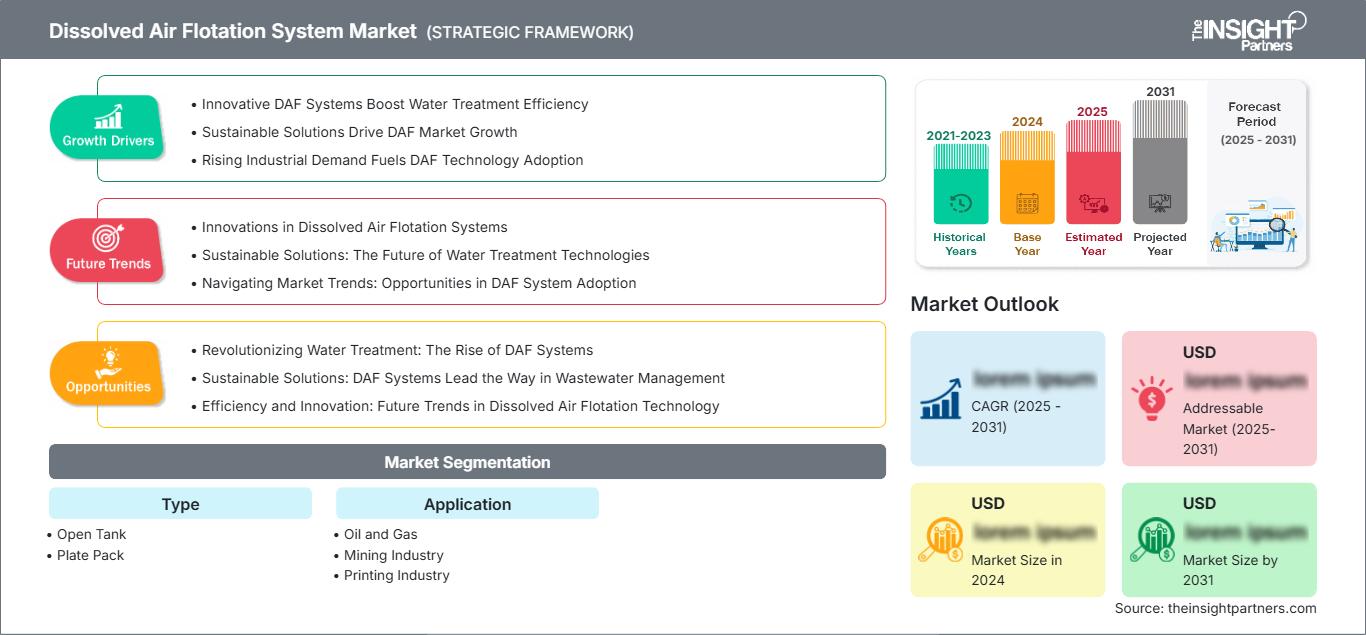
Dissolved Air Flotation System Market: Strategic Insights
Regional Insights
North America Dissolved Air Flotation System Market
North America held 27–31% share in 2025 and is projected to grow at a CAGR range of 5.4–6.2% through 2034. Dissolved Air Flotation System Market share is supported by industrial pretreatment rules, wastewater reuse planning, and the concentration of food processing, oil and gas, pulp and paper, and metal-finishing facilities. Demand is strongest where plants must control fats, oils, grease, total suspended solids, and biochemical oxygen demand before municipal discharge.
System purchases are linked to brownfield retrofits, packaged treatment rooms, and upgrades that reduce sludge hauling and sewer surcharges. The US drives regional volume, while Canada contributes through mining, food processing, and municipal-industrial interfaces. Mexico adds manufacturing and beverage opportunities, especially where export-oriented plants require predictable compliance. Growth remains steady because DAF is often chosen before membranes or biological polishing.
U.S. Dissolved Air Flotation System Market Market
In 2025, US constituted 78-82% of North American market, and is estimated to have growth rate CAGR 5.5-6.3%. Some companies are Evoqua Water Technologies LLC, Xylem Inc., WesTech Engineering, LLC, Ecologix Environmental Systems, LLC, and Ovivo Inc. It is helped by service personnel, distribution channels, and applications in industry such as water treatment. Applications are mainly focused on meat processing, dairy, oilfield produced water, refineries, paper mills, and metal finishing.
Drivers of adoption are wastewater discharge permits, pretreatment ordinances, and penalties for exceeding municipal acceptance limits. FOG removal and organic load reduction is important to food processors in their application, whereas oil-water separation is used by oil and gas operations prior to polishing. Market also enjoys the existence of packaged systems that can be installed with little civil construction in operating facilities.
Europe Dissolved Air Flotation System Market Market
Europe is a major market that will command 23–27% shares in 2025 and is forecast to grow at a CAGR range of 5.0–5.8%. Germany is a leader through its strength in machinery, food processing, chemicals, and metal finishing industries. There are major demands from the UK in areas of food and beverage, utilities, and package wastewater improvements.
European buyers are interested in energy saving systems, small footprint, odor elimination, and compliance with stringent regulations for water quality. HUBER SE, Nijhuis Saur Industries, Toro Equipment, S.L., WPL Limited, Sulzer Ltd, and Veolia Environnement S.A. are significant through supply of equipment and services, and also projects related to wastewater treatment. The growth rate is modest and steady due to wastewater reuse and circular water systems.
APAC Dissolved Air Flotation System Market Market
Asia Pacific held 28–32% share in 2025 and is expected to grow at a CAGR range of 6.8–7.7%. China leads through industrial wastewater volume, manufacturing clusters, and local equipment capacity. India adds high growth from food processing, textile-linked treatment, mining, and industrial parks, while Japan, South Korea, and Australia support premium systems for advanced manufacturing, mining, and municipal-industrial reuse.
Policy pressure on discharge quality, factory modernization, and water-scarcity planning support the Dissolved Air Flotation System Market in APAC. Price competition is intense, yet demand for reliable plate-pack and modular systems is rising where plants need fast installation and consistent contaminant removal.
Middle East & Africa Dissolved Air Flotation System Market Market
Middle East & Africa is projected to grow at a CAGR range of 5.8–6.8% as Saudi Arabia, the UAE, South Africa, and the rest of MEA expand industrial wastewater, oil-water separation, and food-processing infrastructure. Saudi Arabia leads through energy, refining, and industrial-zone investment, while the UAE contributes through packaged water-treatment demand in food, hospitality, and utilities.
South Africa supports mining and municipal-industrial applications, but project execution depends on financing and maintenance capability. Water scarcity and reuse targets make DAF attractive as pretreatment before filtration, membranes, or biological polishing, especially in high-oil and high-solids effluent streams.
Segmentation Analysis
Type
Type is expected to grow at a CAGR range of 5.6–6.4% during 2026–2034 as Dissolved Air Flotation System Market scope covers Open Tank and Plate Pack configurations. Buyers select designs based on influent solids, hydraulic loading, footprint, chemical conditioning, sludge handling, and maintenance access. Open tanks remain preferred for high-flow flexibility, while plate-pack systems gain attention where space and faster clarification matter.
- Open Tank remains the volume anchor because operators value visible flotation zones, easier sludge removal, flexible hydraulics, and suitability for food, pulp, mining, and municipal-industrial pretreatment projects.
- Plate Pack is strategically important where compact layout, improved separation area, and higher loading rates help plants treat constrained sites without expanding civil infrastructure.
Application
Application is projected to grow at a CAGR range of 6.0–6.8% during 2026–2034 as industrial users deploy DAF for pretreatment, product recovery, and effluent polishing. Demand is strongest where oils, fibers, proteins, suspended solids, and metals are difficult to settle. The segment benefits from regulatory compliance, reuse economics, and integration with chemical, biological, filtration, or membrane systems.
- Oil and Gas uses DAF for produced water, refinery wastewater, and oily effluents where separation efficiency protects downstream filtration, reduces hydrocarbon discharge risk, and supports reuse or reinjection strategies.
- Mining Industry applies DAF to remove fine particulates, process residues, and flotation-related contaminants, especially where water recycling and tailings-water clarification are operational priorities.
- Printing Industry requires compact pretreatment for inks, pigments, binders, and wash waters, making DAF useful where variable color, solids, and chemical loads challenge conventional clarification.
- Paper and Pulp Industry values DAF for fiber recovery, whitewater clarification, and suspended-solids reduction, helping mills improve water loops and reduce organic loading before biological treatment.
- Metal Plating And Finishing uses DAF after chemical precipitation to separate hydroxide flocs and fine solids, supporting discharge compliance for metals, suspended solids, and process-water management.
- Food Industry is the highest-growth application because meat, dairy, beverage, and prepared-food plants need reliable FOG, protein, starch, and organic-load removal before discharge or reuse.
Opportunity Snapshot
| Application | Revenue Contribution | Trend Tag | Adoption Stage |
| Oil and Gas | High | Oil Separation | Mature |
| Mining Industry | Medium | Water Reuse | Scaling |
| Printing Industry | Low | Ink Removal | Emerging |
| Paper and Pulp Industry | High | Fiber Recovery | Mature |
| Metal Plating And Finishing | Medium | Metals Control | Scaling |
| Food Industry | High | FOG Removal | Scaling |
Dissolved Air Flotation System Market Growth Drivers and Impact Analysis
Industrial Discharge Compliance Drives Pretreatment Upgrades
Industrial plants are upgrading pretreatment because fines, sewer surcharges, and production interruptions can exceed the cost of planned wastewater investment. DAF is attractive where suspended solids, fats, oils, grease, and emulsified contaminants overload conventional clarifiers. The market impact is strongest in food processing, metal finishing, pulp and paper, printing, and refining, where variable influent can quickly breach discharge limits. Modern systems allow operators to combine chemical coagulation, microbubble separation, and sludge removal in a compact footprint. This improves compliance predictability and protects downstream biological or membrane assets. As permitting scrutiny increases, procurement decisions increasingly evaluate removal reliability, service support, and lifecycle cost rather than only tank price.
Water Reuse and Scarcity Increase DAF Integration
Water-stressed industrial regions are integrating DAF before filtration, membranes, or biological polishing to protect reuse loops and reduce freshwater intake. The system removes floating and suspended contaminants that can foul downstream equipment, making it a practical first barrier for factories pursuing internal recycling. Impact is visible in mining sites, food plants, industrial parks, and oil and gas operations where process water must be treated consistently before reuse or discharge. DAF also helps lower sludge volume compared with poorly optimized settling systems, improving waste-handling economics. As corporate water stewardship moves from reporting to engineering action, demand will shift toward modular, monitored systems that document performance and support auditable reuse targets.
Food Industry Effluent Complexity Strengthens Demand
The food industry is a core growth driver because wastewater from meat, dairy, beverage, starch, and prepared-food operations contains FOG, proteins, sugars, fibers, and high biochemical oxygen demand. These streams often fluctuate by shift, cleaning cycle, and product line, making passive settling unreliable. DAF systems provide fast separation when paired with correct coagulants, flocculants, and pH control. The market impact includes fewer municipal surcharges, lower organic loading on biological treatment, and improved ability to expand production without building entirely new treatment plants. Suppliers with application labs, pilot testing, and hygienic design options can gain advantage because processors need predictable performance under variable loads and tight operating schedules.
Dissolved Air Flotation System Market Future Trends
Smarter Whitewater Control and Automation
Dissolved Air Flotation System Market trends will increasingly center on automated whitewater generation, pressure control, turbidity feedback, and chemical-dose optimization. Operators want systems that respond to influent changes without constant manual adjustment, especially in food and industrial plants with batch production. Smart controls can stabilize air-to-solids ratios, reduce chemical overuse, and alert teams before float quality declines. Future DAF packages will likely integrate sensors, remote service dashboards, and predictive maintenance for pumps, saturators, skimmers, and sludge systems. This evolution will shift purchasing criteria from basic capacity to verified performance, uptime, and lower operating cost across variable wastewater conditions.
Compact Plate-Pack and Modular Systems Gain Share
Future installations will favor compact plate-pack and modular DAF systems where urban plants, industrial estates, and brownfield facilities lack space for large clarification basins. Plate packs increase effective separation area, while skid-mounted packages reduce civil construction and installation time. This trend is particularly relevant for food processors, metal finishers, printing facilities, and distributed industrial sites that need compliance upgrades without major shutdowns. Modular designs also help suppliers standardize fabrication, shorten delivery cycles, and support phased capacity expansion. Over time, compact systems will become more common as buyers compare footprint, installation risk, and maintenance access alongside removal efficiency.
Dissolved Air Flotation System Market Opportunities
Packaged DAF Platforms for Food Processing Clusters
Dissolved Air Flotation System Market Forecasts point to an opportunity in standardized packaged DAF platforms for food processing clusters. Suppliers can offer pre-engineered systems for meat, dairy, beverage, and prepared-food plants with configurable chemical dosing, sludge handling, and monitoring. This approach shortens engineering cycles and helps processors meet discharge requirements while expanding production. Investment should focus on pilot data, sanitation-friendly layouts, rapid installation, and service agreements that keep systems tuned after commissioning. The opportunity is strongest in North America, Europe, China, India, and Southeast Asia, where processing growth and municipal pretreatment pressure are increasing together.
Hybrid Treatment Trains for Industrial Water Reuse
Hybrid DAF treatment trains create an opportunity for equipment suppliers and integrators to move beyond standalone clarification. Pairing DAF with filtration, membranes, biological polishing, or advanced oxidation can help industrial users meet reuse targets and reduce discharge dependency. Investment should prioritize application packages for oil and gas, mining, metal finishing, pulp and paper, and printing effluents where contaminant profiles are complex. Vendors that provide guarantees for pretreatment quality, fouling reduction, and lifecycle service can capture higher-value projects. This opportunity also supports recurring revenue through chemicals, monitoring, spare parts, and performance audits.
Recent Developments
- June 2026: Xylem Launches DAF Solutions for Smarter Wastewater Treatment in South Africa. This recently launched technology introduces a compact, modular, and highly efficient pre-treatment system designed to remove suspended solids from wastewater streams across a wide range of industries. DAF is designed to “slot into” existing treatment processes. It can operate as a standalone solids-separation step or complement downstream biological, filtration, or reuse systems to help achieve site-specific compliance and reuse objectives.
- February 2026: Xylem Inc. (NYSE: XYL), a leading global water solutions company dedicated to solving the world’s most challenging water issues, today reported fourth-quarter and full-year 2025 results. The Company’s fourth-quarter revenue of $2.4 billion was driven by strong execution. Fourth-quarter adjusted earnings per share were up 20% driven by productivity and price.
- March 2025: Veolia presents its 2024 extra-financial performance and confirms the objectives associated with its multifaceted performance as part of the GreenUp 2024-2027 strategic program.
Frequently Asked Questions

- Comprehensive Market Sizing and Forecast Analysis
- Detailed Segmentation Analysis
- In-Depth Market Dynamics Assessment
- Regional and Country-Level Insights
- Competitive Landscape and Company Benchmarking
- Strategic Business Intelligence
Recent Reports
Testimonials

The Insight Partners' SCADA System Market report is comprehensive, with valuable insights on current trends and future forecasts. The team was highly professional, responsive, and supportive throughout. We are very satisfied and highly recommend their services.
RAN KEDEM Partner, Reali Technologies LTDs
I requested a report on a very specific software market and the team produced the report in a few days. The information was very relevant and well presented. I then requested some changes and additions to the report. The team was again very responsive and I got the final report in less than a week.
JEAN-HERVE JENN Chairman, Future Analytica
We worked with The Insight Partners for an important market study and forecast. They gave us clear insights into opportunities and risks, which helped shape our plans. Their research was easy to use and based on solid data. It helped us make smart, confident decisions. We highly recommend them.
PIYUSH NAGPAL Sr. Vice President, High Beam Global
The Insight Partners delivered insightful, well-structured market research with strong domain expertise. Their team was professional and responsive throughout. The user-friendly website made accessing industry reports seamless. We highly recommend them for reliable, high-quality research services
YUKIHIKO ADACHI CEO, Deep Blue, LLC.
This is the first time I have purchased a market report from The Insight Partners.While I was unsure at first, I visited their web site and felt more comfortable to take the risk and purchase a market report.I am completely satisfied with the quality of the report and customer service. I had several questions and comments with the initial report, but after a couple of dialogs over email with their analyst I believe I have a report that I can use as input to our strategic planning process.Thank you so much for taking the extra time and making this a positive experience.I will definitely recommend your service to others and you will be my first call when we need further market data.
JOHN SUZUKI President and Chief Executive Officer, Board Director, BK Technologies
I wish to appreciate your support and the professionalism you displayed in the course of attending to my request for information regarding to infectious disease IVD market in Nigeria. I appreciate your patience, your guidance, and the fact that you were willing to offer a discount, which eventually made it possible for us to close a deal. I look forward to engaging The Insight Partners in the future, all thanks to the impression you have created in me as a result of this first encounter.
DR CHIJIOKE ONYIA MANAGING DIRECTOR, PineCrest Healthcare Ltd.Reason to Buy
- Informed Decision-Making
- Understanding Market Dynamics
- Competitive Analysis
- Identifying Emerging Markets
- Customer Insights
- Market Forecasts
- Risk Mitigation
- Boosting Operational Efficiency
- Strategic Planning
- Investment Justification
- Tracking Industry Innovations
- Aligning with Regulatory Trends





 Get Free Sample for