
Distribution Automation Market Trends, Demand & Growth by 2034
Coverage: by Component (Field Devices, Software, Services); Communication Technology (Wired Communication Technology, Wireless Communication Technology); Utility (Public Utility, Private Utility) , and Geography (North America, Europe, Asia Pacific, and South and Central America)
- Status : Data Released
- Report Code : TIPRE00011979
- Category : Electronics and Semiconductor
- No. of Pages : 150
- Available Report Formats :


- Last update date : August 07, 2026


2025 Market Size
US$ 21.12 Bn
Base year value
2034 Forecast
US$ 72.89 Bn
Projected by 2034
CAGR 2026-2034
14.76 %
Growth rate
Addressable Market
US$ 402.70 Bn
(2026-2034)
The Distribution Automation Market size was valued at US$ 21.12 Billion in 2025 and is projected to reach US$ 72.89 Billion by 2034, registering a CAGR of 14.76% during 2026–2034. The market includes field devices, software, services, wired communication technology, wireless communication technology, public utilities, and private utilities used to automate electricity distribution networks.
North America is expected to expand at a CAGR of 12.8–13.6% during 2026–2034, supported by grid hardening programs, utility digitalization, and reliability mandates. Utilities are prioritizing feeder automation, outage restoration, and distributed energy visibility as aging infrastructure, storm exposure, and electrified loads increase pressure on distribution networks.
Distribution Automation Market Assessment and Insights
- North America held 27–31% Distribution Automation Market share in 2025 and is growing at a CAGR of 12.8–13.6% during 2026–2034, led by smart grid investment, resilience spending, and outage management modernization.
- US represented 78–82% of North American revenue in 2025 and is growing at a CAGR of 13.0–13.8% during 2026–2034, supported by utility automation and DER integration.
- Europe accounted for 21–25% share in 2025 and is growing at a CAGR of 11.9–12.7% during 2026–2034, with Germany, the UK, France, Italy, and Spain leading upgrades.
- Asia Pacific held 35–39% share in 2025 and is growing at a CAGR of 15.6–16.4% during 2026–2034, led by China, India, Japan, South Korea, and Australia.
- Largest Segment Field Devices held 46–50% market share in 2025 and is growing at a CAGR of 13.8–14.6% during 2026–2034 due to feeder, recloser, and sensor deployments.
- High Growth Segment Wireless Communication Technology represented 31–35% market share in 2025 and is growing at a CAGR of 16.2–17.0% during 2026–2034, supported by flexible grid connectivity.
- Key companies analyzed in detail: ABB Ltd.; Schneider Electric SE; Eaton Corporation plc; Xylem Inc.; Siemens AG; Itron, Inc.; Hubbell Incorporated; Toshiba Corporation; Mitsubishi Electric Corporation; GE Vernova Inc.
Source: The Insight Partners' analysis based on proprietary research, government publications, company annual reports, investor presentations, industry databases, and expert interviews.
Distribution utility automation has moved away from stand-alone feeder control systems to integrated distribution management, sensor-heavy field systems, and analytical switchgear. Dynamics of production are shifting towards intelligent electronic devices, cybersecure controllers, modular software applications, and robust communication hardware. Hardware providers are working on integrating their products into cloud-compatible solutions based on standardized protocols and service packages, which will allow utilities to modernize their assets incrementally rather than completely replacing old equipment.
Going forward, demand will be greatest where electrification, renewable connections, and reliability regulations overlap. New grids in Asia Pacific, Middle East, and some selected African markets will be transitioning from simple monitoring capabilities to automated sectionalization and voltage optimization. Decarbonization policies, resilience spending, and investments into utility modernization will ensure ongoing relevance of the market to long-term grid investments.
Distribution Automation Market Report Scope
| Report Attribute | Details |
|---|---|
| Market size in 2025 | US$ 21.12 Billion |
| Market Size by 2034 | US$ 72.89 Billion |
| Global CAGR (2026 - 2034) | 14.76% |
| Historical Data | 2021-2024 |
| Forecast period | 2026-2034 |
Distribution Automation Market Analysis
The Distribution Automation Market growth is being driven by increasing outage costs, distributed solar, EV charging, and the requirement of feeder visibility in real time. The ecosystem comprises of switchgear vendors, sensors, telecommunication firms, grid software firms, utilities, engineering firms, and cybersecurity experts. There is demand for faster fault isolation, reduced technical losses, and improved power quality in medium-voltage networks.
The supply dynamics depend upon the availability of semiconductors, communication module certifications, utility purchase cycle, and interoperability. Field devices are important because automation is dependent on reclosers, fault indicators, voltage regulators, and remote terminal units. Software and services are becoming strategically important as the utilities integrate the field device information in outage management, distributed energy resource management, and advanced distribution management systems.
Market analysis reveals competition among major global electrification firms and firms specializing in domain software and field automation. ABB Ltd., Siemens AG, Schneider Electric SE, Eaton Corporation plc, and GE Vernova Inc. are competing using their integrated grid portfolios. On the other hand, Itron, Inc. and Xylem Inc. offer value propositions through metering, communications, and utility data platforms.
The competitive landscape is further strengthened by Hubbell Incorporated, Toshiba Corporation, and Mitsubishi Electric Corporation through their portfolio of grid hardware, automation controls, and utility equipment. Trends in investments include digital substations, wireless backhaul, AI-powered outage prediction, and lifecycle services. Strategic positioning increasingly relies on access to the installed base, cybersecurity certifications, interoperable protocols, and utility commissioning capabilities.
● REPORT CUSTOMIZATION
Tailor This Report To Align With Your Specific Business Requirements
This report can be customized to align precisely with your business objectives, scope, and target markets. Customization options include tailored segmentation, geography, competitive analysis, and strategic insights to support informed decision-making.
Customize This Report →WHAT YOU CAN ADJUST
- ● Segmentations
- ● Geography
- ● Competitive Analysis
- ● Language Preferences
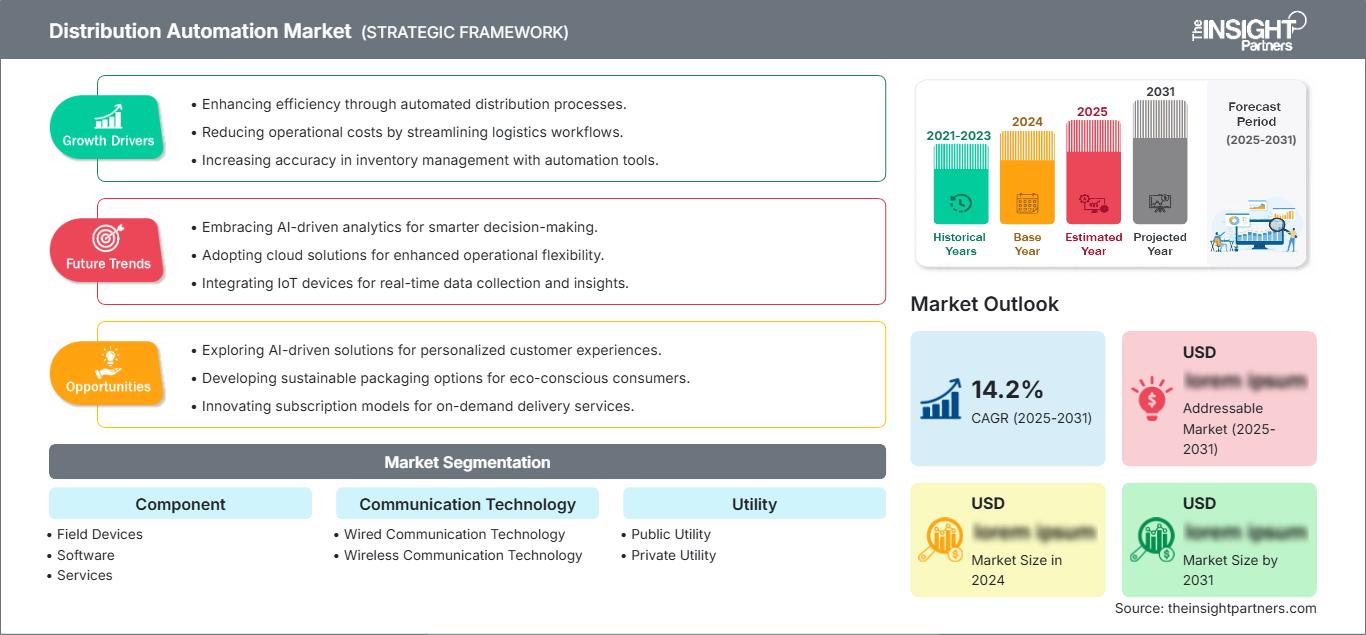
Distribution Automation Market: Strategic Insights
Regional Insights
North America Distribution Automation Market
North America held a market share of 27–31% in 2025 and is expected to expand with a CAGR of 12.8–13.6% through 2026–2034. Market drivers include resilience funding, outdated feeder systems, wildfire prevention, storm restoration requirements, and federal efforts for grid transformation. Utilities are utilizing automated switches, reclosers, feeder monitoring devices, and grid software solutions to minimize outages.
Highly active investments in networks with growing solar distributed generation, new data center loads, and charging stations for electric vehicles are expected. The region is characterized by experienced utility sourcing, advanced telecom infrastructure, and established vendor ecosystem. Increasingly, distribution automation adoption depends on the availability of reliability performance metrics, compliance with cyber security, and truck roll avoidance economics.
U.S. Distribution Automation Market
The U.S. accounts for 78-82% of North American revenues in 2025 and will have a CAGR of 13.0-13.8% in 2026-2034. The application is most prevalent in investor-owned utilities, municipally owned utilities, rural cooperatives, and industrial power grids that require faster fault detection.
ABB Ltd., Eaton Corporation plc, Schneider Electric SE, Hubbell Incorporated, Itron, Inc., and GE Vernova Inc. retain dominance via their grid equipment, software, metering equipment, and services. The market's growth drivers include automation of feeders, voltage management, sectionalization for preventing wildfires, monitoring of distributed energy, and communication systems integration.
Europe Distribution Automation Market
The region captured 21-25% share in 2025 and is estimated to exhibit a CAGR of 11.9-12.7% during 2026-2034. Germany leads via grid strengthening, minimizing curtailments of renewables, and industrial electrification. The UK focuses on digitization of distribution network operators, flexibility markets, and automation that provides visibility under primary substations.
France, Italy, and Spain boost demand via renewables integration, deployment of smart meters, and modernization of medium-voltage grids. European utilities focus on interoperability, cybersecurity, and minimizing losses due to the fact that distribution grids need to accommodate more solar power, heat pumps, and charging infrastructure. Schneider Electric SE, Siemens AG, ABB Ltd., and GE Vernova Inc. play a leading role in automation projects.
APAC Distribution Automation Market
Asia Pacific holds a 35-39% share in 2025 and will exhibit a CAGR of 15.6-16.4% during 2026-2034. Leading countries include China, which has huge investments in the grid and its automation, renewable energy integration, and urban grid expansion, and India, which is expanding automation to decrease losses and improve the quality of services.
Japan and South Korea help in the development of grid control systems, while Australia has huge investments in the visualization of the distributed energy resources and the flexibility of feeders. Electrification, industrial reliability, and renewable energy integration programs further propel the region's growth. The impact of price sensitivity can not be overlooked.
Middle East & Africa Distribution Automation Market
The Middle East & Africa market is projected to grow at a CAGR of 10.8–11.6% during 2026–2034. Saudi Arabia leads as grid expansion, industrial cities, renewable projects, and smart infrastructure increase requirements for automated switching and voltage control.
The UAE supports demand through urban reliability, data centers, and utility digitalization, while South Africa and Rest of MEA focus on loss reduction, outage management, and network reinforcement. Harsh climates increase the need for rugged field devices and resilient communication architectures.
Segmentation Analysis
Component
Component is projected to grow at a CAGR of 14.1–14.9% during 2026–2034. The Distribution Automation Market scope covers physical automation hardware, grid control software, and lifecycle services that support planning, installation, integration, and maintenance. Utilities select component mixes according to feeder criticality, outage performance, communication readiness, and regulatory pressure for reliable, efficient electricity delivery.
- Field Devices hold the strongest market position because automated switches, reclosers, sensors, voltage regulators, and fault indicators create the operational visibility required for faster restoration and safer feeder control.
- Software demand is rising as utilities connect device data to outage management, advanced distribution management, analytics, and DER coordination platforms that improve planning and operational decisions.
- Services remain strategically important because utilities need engineering, cybersecurity assessment, integration, testing, commissioning, training, and lifecycle support to reduce deployment risk across complex networks.
Communication Technology
Communication Technology is forecast to grow at a CAGR of 14.7–15.5% during 2026–2034. Reliable communication determines whether automated devices can deliver real-time control, remote diagnostics, and fast restoration. Utilities balance fiber, Ethernet, powerline carrier, radio, cellular, and hybrid architectures according to terrain, latency needs, cybersecurity standards, asset density, and total cost of ownership.
- Wired Communication Technology remains preferred for substations, high-criticality feeders, and dense urban networks where low latency, high reliability, and controlled cybersecurity boundaries are central purchasing criteria.
- Wireless Communication Technology is expanding quickly because private radio, cellular, and hybrid networks reduce installation complexity and connect remote feeders, sensors, and distributed energy assets cost-effectively.
Utility
Utility is expected to grow at a CAGR of 14.3–15.1% during 2026–2034. Public utilities dominate installed deployments because they manage broad distribution networks, regulated reliability targets, and long-term grid modernization budgets. Private utilities are scaling automation to improve industrial uptime, campus energy management, renewable integration, and resilience for critical facilities.
- Public Utility adoption is anchored in regulated reliability, outage reduction, technical loss management, and service quality requirements across city, regional, and national distribution networks.
- Private Utility demand is increasing as industrial parks, data centers, mining sites, ports, and campuses require automated power management, microgrid control, and faster fault response.
Opportunity Snapshot
| Utility | Revenue Contribution | Trend Tag | Adoption Stage |
| Public Utility | High | Feeder Automation | Scaling |
| Private Utility | Medium | Microgrid Control | Emerging |
Distribution Automation Market Growth Drivers and Impact Analysis
Grid reliability mandates accelerate automation spending
Utilities are finding themselves increasingly pressed to decrease outage frequency, decrease restoration time and keep up service quality with weather-related events, increasing electrification, and aging infrastructure making things difficult. Distribution automation directly contributes to increased reliability through fault detection, isolation and service restoration without waiting for manual switching. This translates to a higher demand on the market side for reclosers, remote terminal units, feeder sensors and control software. Spending is shifting from pilot deployments to full feeder deployments due to rising expectations from regulators and consumers regarding reliability metrics.
Renewable and DER integration raises feeder complexity
Solar rooftops, community storage, electric vehicle charging, and flexible industrial loads are changing power flows on distribution networks. Traditional one-way feeder planning is insufficient when voltage, congestion, and reverse power events vary throughout the day. Automation gives utilities real-time visibility and control across feeders, transformers, and switching points. The market impact is stronger demand for voltage optimization, DER-aware software, advanced sensors, and communication networks that support faster operational decisions. Vendors able to connect field automation with planning and DER management tools gain strategic advantage.
Cybersecure digital infrastructure becomes a purchasing priority
As more grid assets connect to operational networks, cybersecurity becomes inseparable from automation investment. Utilities require secure firmware, authenticated communications, role-based access, monitoring, and lifecycle patching because distribution systems are critical infrastructure. This driver changes procurement by elevating software assurance, supplier governance, and compliance documentation alongside technical performance. The market impact is higher value for vendors offering secure-by-design devices, managed services, and tested interoperability. It also increases replacement demand for older automation equipment that cannot support modern encryption, segmentation, or remote update requirements.
Distribution Automation Market Future Trends
AI-assisted grid orchestration expands
Distribution Automation Market trends point toward AI-assisted orchestration that recommends switching actions, predicts equipment risk, and prioritizes restoration crews based on feeder topology and live sensor data. Future systems will move beyond simple alarms toward decision support that helps operators manage DER variability, storm response, and load growth. This trend will be strongest in utilities with mature telemetry and advanced distribution management systems. Vendors that combine explainable analytics, cybersecurity controls, and operator-friendly workflows will be better positioned than suppliers offering isolated device intelligence.
Hybrid communication architectures become standard
Future deployments will increasingly combine fiber, Ethernet, private radio, cellular, and satellite links to match feeder criticality and geography. Hybrid communication architectures reduce dependence on a single network, improve resilience during storms, and allow utilities to connect remote automation assets faster. The trend supports staged modernization because utilities can prioritize wired links for substations while using wireless networks for rural feeders and temporary capacity needs. Suppliers that pre-certify devices across multiple protocols will reduce integration effort and accelerate program rollout.
Distribution Automation Market Opportunities
Turnkey feeder modernization programs
Distribution Automation Market Forecasts support investment in turnkey feeder modernization packages that combine field devices, communications, software configuration, cybersecurity documentation, and commissioning services. Utilities often face internal capacity limits when moving from pilots to system-wide automation, creating demand for partners that can standardize designs and shorten deployment cycles. The opportunity is strongest in service territories with poor reliability metrics, storm exposure, and high DER growth. Suppliers that bundle hardware, engineering, analytics, and lifecycle maintenance can capture larger contracts and create recurring revenue beyond initial equipment sales.
Automation for private power networks
Private utilities, industrial campuses, ports, mines, and data centers are becoming attractive targets because they need resilient power without waiting for public grid upgrades. Automation can support microgrid control, islanding, load prioritization, and faster fault response across privately managed distribution assets. The opportunity is action-oriented: vendors can package controllers, sensors, software, and services for sectors where downtime has direct financial consequences. Suppliers with strong electrical engineering support and utility-grade cybersecurity can differentiate from basic building automation providers.
Recent Developments
- June 2026: CNC Electric has released its July new product lineup, further enriching its low-voltage electrical product portfolio across power transfer, smart control, power protection, distribution installation, and industrial control applications. The new products are developed to meet practical market needs, with a focus on safer power operation, smarter control, easier installation, and more stable system performance. They are suitable for residential distribution, commercial buildings, industrial equipment, distribution cabinets, and automation control systems.
- Schneider Electric, a global energy technology leader, has launched its latest product in power distribution, MCSeT, in the UK. This new piece of equipment is a next-generation medium-voltage switchgear solution, designed for safe, energy-efficient, and future-ready power distribution in industrial, commercial, and utility applications.
- June 2025: Hitachi Energy introduced its latest innovation for distribution grids, the Compact Line Voltage Regulator (C-LVR), during a launch ceremony at CIRED 2025, the leading international conference on electricity distribution. The compact line voltage regulator is an integrated solution that combines voltage regulation and power transformation within a single, compact product designed for modern distribution grids. Embedded directly into the same footprint as a standard distribution transformer, it enables active voltage control at the feeder level without requiring additional space or infrastructure changes.
Frequently Asked Questions

- Comprehensive Market Sizing and Forecast Analysis
- Detailed Segmentation Analysis
- In-Depth Market Dynamics Assessment
- Regional and Country-Level Insights
- Competitive Landscape and Company Benchmarking
- Strategic Business Intelligence
Recent Reports
Testimonials

The Insight Partners provided valuable market intelligence that supported our global go-to-market strategy. Their team was professional, responsive, and attentive to our feedback, providing thoughtful analysis and helpful methodological clarifications throughout the project.
Junmo Kim Chief Financial Officer (CFO), Enertech Co., Ltd.
The Insight Partners' SCADA System Market report is comprehensive, with valuable insights on current trends and future forecasts. The team was highly professional, responsive, and supportive throughout. We are very satisfied and highly recommend their services.
RAN KEDEM Partner, Reali Technologies LTDs
I requested a report on a very specific software market and the team produced the report in a few days. The information was very relevant and well presented. I then requested some changes and additions to the report. The team was again very responsive and I got the final report in less than a week.
JEAN-HERVE JENN Chairman, Future Analytica
We worked with The Insight Partners for an important market study and forecast. They gave us clear insights into opportunities and risks, which helped shape our plans. Their research was easy to use and based on solid data. It helped us make smart, confident decisions. We highly recommend them.
PIYUSH NAGPAL Sr. Vice President, High Beam Global
The Insight Partners delivered insightful, well-structured market research with strong domain expertise. Their team was professional and responsive throughout. The user-friendly website made accessing industry reports seamless. We highly recommend them for reliable, high-quality research services
YUKIHIKO ADACHI CEO, Deep Blue, LLC.
This is the first time I have purchased a market report from The Insight Partners.While I was unsure at first, I visited their web site and felt more comfortable to take the risk and purchase a market report.I am completely satisfied with the quality of the report and customer service. I had several questions and comments with the initial report, but after a couple of dialogs over email with their analyst I believe I have a report that I can use as input to our strategic planning process.Thank you so much for taking the extra time and making this a positive experience.I will definitely recommend your service to others and you will be my first call when we need further market data.
JOHN SUZUKI President and Chief Executive Officer, Board Director, BK Technologies
I wish to appreciate your support and the professionalism you displayed in the course of attending to my request for information regarding to infectious disease IVD market in Nigeria. I appreciate your patience, your guidance, and the fact that you were willing to offer a discount, which eventually made it possible for us to close a deal. I look forward to engaging The Insight Partners in the future, all thanks to the impression you have created in me as a result of this first encounter.
DR CHIJIOKE ONYIA MANAGING DIRECTOR, PineCrest Healthcare Ltd.Reason to Buy
- Informed Decision-Making
- Understanding Market Dynamics
- Competitive Analysis
- Identifying Emerging Markets
- Customer Insights
- Market Forecasts
- Risk Mitigation
- Boosting Operational Efficiency
- Strategic Planning
- Investment Justification
- Tracking Industry Innovations
- Aligning with Regulatory Trends





 Get Free Sample for