
Document Scanner Market Trends, Size & Forecast by 2034
Coverage: by Product Type (Sheetfed Scanners, Handheld, Flatbed); Enterprise Size (SMEs, Large Enterprises); Industry Vertical (BFSI, IT and Telecom, Healthcare, Education, Transportation and Logistics, Others) , and Geography (North America, Europe, Asia Pacific, and South and Central America)
- Status : Data Released
- Report Code : TIPRE00009546
- Category : Electronics and Semiconductor
- No. of Pages : 150
- Available Report Formats :


- Last update date : August 06, 2026


2025 Market Size
US$ 7.13 Bn
Base year value
2034 Forecast
US$ 9.92 Bn
Projected by 2034
CAGR 2026-2034
3.74 %
Growth rate
Addressable Market
US$ 77.45 Bn
(2026-2034)
The Document Scanner Market reached US$ 7.13 Billion in 2025 and is forecast to grow to US$ 9.92 Billion by 2034, recording a CAGR of 3.74% during the period from 2026 to 2034. The growth of the Market is driven by the process of transforming physical documents into digital formats by enterprises.
The Document Scanner Market size in North America is anticipated to witness a CAGR between 3.3% to 4.0%, driven by the shift towards digitization of records by regulated industries and the decentralized nature of workplaces in the context of hybrid work environment. The key drivers include BFSI regulation, healthcare records storage, educational administration, and enhanced enterprise content management systems.
Document Scanner Market Assessment and Insights
- North America held 34–36% share in 2025 and is growing at a CAGR range of 3.3–4.0% during 2026–2034, supported by mature digitization budgets and compliance-led capture projects.
- US represented 80–83% of North America in 2025 and is growing at a CAGR range of 3.4–4.1%, led by healthcare, BFSI, and federal digitization.
- Europe accounted for 24–27% share in 2025 and is advancing at a CAGR range of 3.0–3.6%, with Germany, the UK, France, Italy, and Spain leading adoption.
- Asia Pacific captured 28–31% share in 2025 and is expanding at a CAGR range of 4.1–4.8%, led by China, Japan, South Korea, India, and Australia.
- Largest Segment Sheetfed Scanners held 45–49% market share in 2025 and is growing at a CAGR range of 3.6–4.2%, supported by batch capture and office automation.
- High Growth Segment Healthcare held 13–16% market share in 2025 and is growing at a CAGR range of 4.4–5.1%, driven by patient records and claims digitization.
- Key companies analyzed in detail: Avision Inc., Brother Industries, Ltd., Canon Inc., Fujitsu Limited, HP Development Company, L.P., Image Access GmbH, Microtek International Inc., Mustek Systems Inc., Panasonic Holdings Corporation, and Seiko Epson Corporation.
Source: The Insight Partners' analysis based on proprietary research, government publications, company annual reports, investor presentations, industry databases, and expert interviews.
The technology evolution in the market has shifted from simple picture scanning to smarter image processing, inbuilt OCR capacity, double-sided capability, networking, and cloud storage capabilities. The production process is based on optical technology, CIS sensors, reliable ADF systems, image processing software, and reliable transportation systems. Nowadays, manufacturers focus on creating products suitable for distributed office spaces, reception desks, and large-scale archives, not only central reproduction rooms.
Future demand for scanners is expected to increase with growing efforts made by governmental institutions, hospitals, educational institutions, logistical firms, and financial institutions to replace paper-based archives with digitized records. In terms of investments, focus will be put on secure scanning, metadata capture, remote management of fleets, and small-sized units suitable for branch operations. Scanners will remain in demand due to data regulation needs even with the emergence of mobile capturing solutions.
Document Scanner Market Report Scope
| Report Attribute | Details |
|---|---|
| Market size in 2025 | US$ 7.13 Billion |
| Market Size by 2034 | US$ 9.92 Billion |
| Global CAGR (2026 - 2034) | 3.74% |
| Historical Data | 2021-2024 |
| Forecast period | 2026-2034 |
Document Scanner Market Analysis
Market Growth for Document Scanners is spurred on by the presence of document intensive industries requiring fast search, cheaper storage and greater compliance readiness. The supply chain involves the manufacturing firms, optical component suppliers, software vendors, distributors, managed print services and enterprise content management systems integrators. The demand for scanners is highest in instances where legal or operational requirements necessitate retention of paper documents such as claims, invoices, admission papers, contracts, logistics papers and identification papers.
The dynamics of supply involve medium level hardware maturity with high differentiation in terms of software, connectivity and service bundling. The sheet-fed scanners are critical for workflow automation since they can scan through multipage documents at great speed while the hand held scanners facilitate field work and flat bed scanners preserve the fragile and bound documents.
Positioning within the Document Scanner Market report will be based on the following characteristics: installed base, distribution channels, scan speed, image quality, software support, and total cost of ownership. Competitors such as Canon Inc., Brother Industries, Ltd., Seiko Epson Corporation, Fujitsu Limited, and HP Development Company, L.P. have a competitive edge in office and enterprise document capture, whereas Avision Inc., Image Access GmbH, Microtek International Inc., Mustek Systems Inc., and Panasonic Holdings Corporation have an edge in specialized, production, and geographic markets.
The investment trend is to acquire scanners with reduced indexing and integration capabilities within workflow management systems. Buyers are looking at security features, remote configuration, warranty coverage, and cloud-based routing, along with scan speed. The strategic advantage of these technologies lies in combining hardware stability and software platforms, which makes the scanner a device for converting documents to business information.
● REPORT CUSTOMIZATION
Tailor This Report To Align With Your Specific Business Requirements
This report can be customized to align precisely with your business objectives, scope, and target markets. Customization options include tailored segmentation, geography, competitive analysis, and strategic insights to support informed decision-making.
Customize This Report →WHAT YOU CAN ADJUST
- ● Segmentations
- ● Geography
- ● Competitive Analysis
- ● Language Preferences
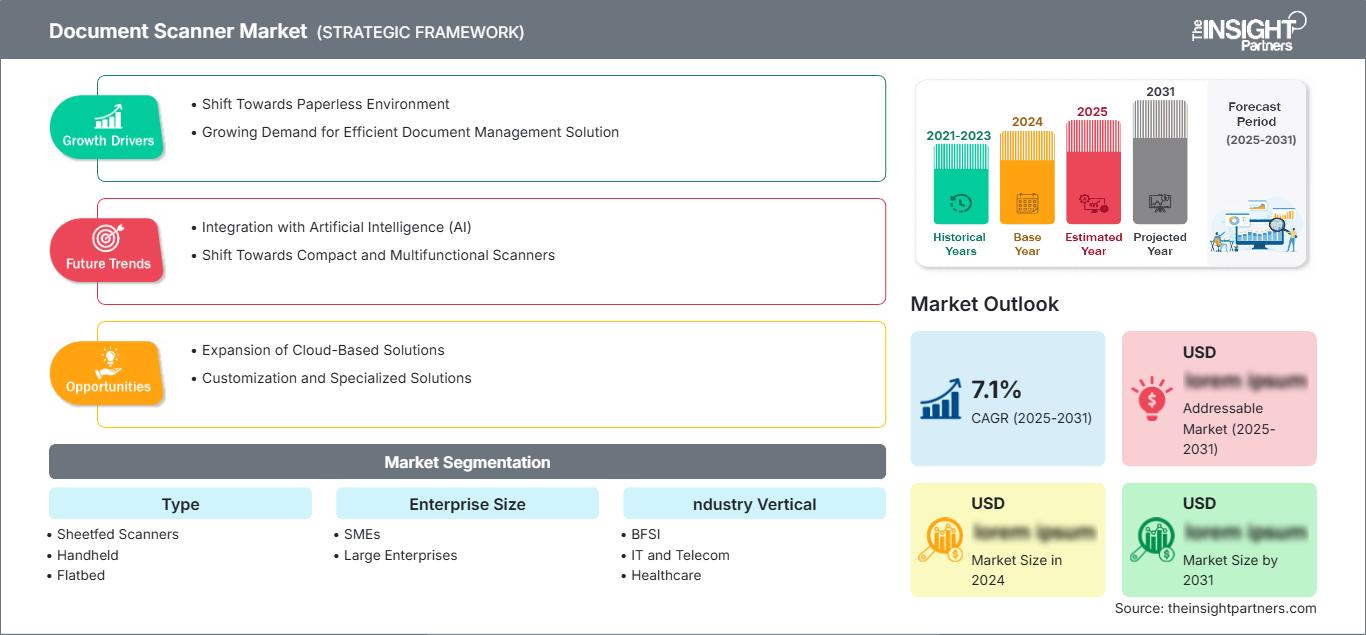
Document Scanner Market: Strategic Insights
Regional Insights
North America Document Scanner Market
Share in North America was 34-36% in 2025, and is forecasted to be CAGR range of 3.3-4.0% during 2025-2034. Document Scanner Market share is driven by regulated record keeping, hybrid work environment, insurance documents, and healthcare administration. Electronic records move by U.S. National Archives has increased the need for proper digital workflow, while private organizations are upgrading their fleet.
Region-specific adoption is high in the US, with BFSI, healthcare, legal, logistics, and education verticals needing batch scanning and cloud routes. Canada plays its part through modernization efforts in public sector and healthcare records, while Mexico provides demand from manufacturing administration and trade documents.
U.S. Document Scanner Market
The US represented 80–83% of North America in 2025 and is forecast to grow at a CAGR range of 3.4–4.1%. Company presence includes Canon Inc., Brother Industries, Ltd., Fujitsu Limited, HP Development Company, L.P., Seiko Epson Corporation, Panasonic Holdings Corporation, and Avision Inc. through enterprise devices, desktop scanners, service channels, and workflow software integrations.
Applications include claims processing, conversions of patient records, branch banking, school administration, logistics paperwork, and document discovery. Customers demand systems that can scan both sides of the document simultaneously, have barcode readers, be able to connect with the cloud, and offer centralized device management capabilities. The market shows solid growth as the volume of paper-based documents decreases steadily, but digitization needs remain high.
Europe Document Scanner Market
Europe held a 24-27% market share in 2025 and will witness a CAGR growth rate of 3.0-3.6%. Germany dominates the market for manufacturing administration, insurance and archiving, and public sector needs. In the UK, the demand comes from finance and legal services and healthcare workflow processes. France, Italy, and Spain offer their contributions through government transformation, education, logistics documentation, and healthcare digitization processes.
The customers in Europe are concerned about privacy, security of storage, and process traceability with the help of strict data protection laws. Companies such as Canon Inc., Brother Industries, Ltd., Seiko Epson Corporation, Fujitsu Limited, Image Access GmbH, and Panasonic Holdings Corporation meet the demand with office capture solutions, production scanning, and book scanning.
APAC Document Scanner Market
APAC region has a market share of 28-31% in 2025, and will experience growth in a range of CAGR from 4.1-4.8%. APAC region has market leadership by means of digitization of enterprises, governmental administration and educational institutions. Japan and South Korea drive the growth through premium office automation. India and Australia increase demand from banks, healthcare sector, universities, logistics and government services.
Public policies in digitalization of governmental services, e-government, financial inclusion and healthcare documentation contribute to Document Scanner Market in APAC. Price sensitivity of the local consumer drives the demand towards compact sheet-fed and flatbed scanners. Larger organizations implement high-speed scanning with OCR technology integration into workflow. Regional market grows faster due to transition from legacy paper document management systems.
Middle East & Africa Document Scanner Market
Middle East & Africa is projected to grow at a CAGR range of 3.5–4.3% as Saudi Arabia, the UAE, South Africa, and the rest of MEA expand digital government, banking modernization, and healthcare administration. The UAE leads through smart-government programs, while Saudi Arabia contributes through large public-sector and enterprise transformation projects.
Scanners have been used to meet the demands of banking, education, legal services, and documentation in the government due to unevenness in procurement. The preference for durable scanners with easy maintenance, and the ability to scan Arabic and English languages into documents management systems has been considered important.
Segmentation Analysis
Type
Type is expected to grow at a CAGR range of 3.5–4.1% during 2026–2034 as Document Scanner Market scope covers Sheetfed Scanners, Handheld, and Flatbed. Buyers select devices based on document volume, portability, media condition, speed, and integration needs. Sheetfed scanners dominate recurring office workflows, handheld scanners serve mobile capture, and flatbed models remain necessary for delicate or bound documents.
- Sheetfed Scanners remain the volume anchor because they support batch processing, duplex capture, automatic feeding, and rapid conversion of invoices, claims, forms, contracts, and administrative records.
- Handheld scanners address field teams, small offices, and mobile workers needing lightweight capture for receipts, identity documents, delivery records, and ad hoc paperwork outside centralized offices.
- Flatbed scanners retain strategic value for books, photographs, fragile records, certificates, and irregular media where feeder-based systems may damage originals or compromise image quality.
Enterprise Size
Enterprise Size is projected to grow at a CAGR range of 3.4–4.0% during 2026–2034 as SMEs and Large Enterprises digitize records at different scales. SMEs favor affordable, cloud-ready desktop units with simple setup, while large enterprises need fleet management, security policies, high duty cycles, and integration with enterprise content platforms.
- SMEs adopt scanners to reduce filing costs, digitize invoices and customer records, and support hybrid work without building complex centralized document management infrastructure.
- Large Enterprises prioritize secure, standardized capture across branches and departments, often linking scanners with workflow automation, records retention rules, and audit-ready document repositories.
Industry Vertical
Industry Vertical is expected to grow at a CAGR range of 3.6–4.3% during 2026–2034 as adoption varies by document intensity, compliance burden, and workflow maturity. BFSI and healthcare remain structurally important because they manage sensitive forms, claims, and records, while IT and telecom, education, and logistics use scanners to streamline distributed administration.
- BFSI relies on scanners for account opening, claims, KYC files, loan documents, and audit records where secure capture improves compliance, retrieval, and customer service response.
- IT and Telecom uses scanners for contracts, service records, procurement files, customer documentation, and back-office workflows that need fast digitization across distributed offices.
- Healthcare is strategically important because patient records, insurance documents, consent forms, referrals, and lab paperwork require accurate capture into electronic health and billing systems.
- Education adopts scanners for admissions, transcripts, examination records, certificates, finance documents, and administrative workflows that require searchable archives and faster student services.
- Transportation and Logistics uses scanners for bills of lading, delivery proofs, customs paperwork, fleet records, and warehouse documents where digitization reduces reconciliation delays.
Opportunity Snapshot
Market Opportunity Snapshot
| Industry Vertical | Revenue Contribution | Trend Tag | Adoption Stage |
| BFSI | High | KYC Capture | Mature |
| IT and Telecom | Medium | Contract Routing | Scaling |
| Healthcare | High | Patient Records | Scaling |
| Education | Medium | Transcript Digitization | Scaling |
| Transportation and Logistics | Medium | Proof Delivery | Scaling |
| Others | Low | Archive Capture | Emerging |
Document Scanner Market Growth Drivers and Impact Analysis
Regulated Workflows Require Reliable Digital Capture
BFSI, healthcare, education, and logistics organizations still receive large volumes of physical documents, yet they must store, retrieve, and audit records digitally. Scanners bridge this operational gap by converting signed forms, identity documents, invoices, claims, and certificates into structured repositories. The market impact is strongest where penalties, service delays, or lost records create measurable cost. Devices with duplex capture, OCR, encryption, and automated routing reduce manual indexing and improve record quality. This driver supports replacement demand because older scanners often lack network security, remote administration, or compatibility with modern content management systems.
Hybrid Work Pushes Capture Closer to Users
Hybrid operations have distributed document intake across homes, branch offices, clinics, classrooms, and service counters. Instead of relying only on centralized scan rooms, organizations need compact devices that non-specialist users can operate with minimal setup. The market impact is visible in demand for Wi-Fi scanners, cloud destination presets, automatic image cleanup, and small-footprint sheetfed models. SMEs benefit from lower administrative friction, while large enterprises use standardized fleets to maintain governance across locations. Vendors that simplify provisioning, driver management, and secure routing can capture refresh cycles as document capture becomes embedded in everyday work.
Intelligent Processing Raises Scanner Value
The scanner is increasingly evaluated as an entry point into workflow automation rather than a standalone peripheral. OCR, barcode recognition, blank-page removal, auto-cropping, and metadata capture reduce the labor needed after scanning. The market impact is higher willingness to pay for devices bundled with software that improves downstream accuracy. Healthcare providers can attach patient documents to records faster, banks can accelerate onboarding files, and logistics teams can reconcile delivery paperwork sooner. This driver shifts competition toward ecosystem strength, where hardware makers work with document management, robotic process automation, and cloud storage providers.
Document Scanner Market Future Trends
AI-Enhanced Capture Quality and Classification
Document Scanner Market trends will increasingly center on AI-enhanced capture that detects skew, blur, missing pages, duplicate forms, and document type at the device or software layer. Future systems will classify invoices, identity records, medical forms, and education documents before they enter repositories, reducing rework and manual tagging. This trend will matter most in shared-service centers and branch networks where inconsistent user behavior affects output quality. Vendors that provide transparent accuracy metrics, secure processing, and easy model updates will strengthen adoption among regulated buyers that need automation without sacrificing audit control.
Cloud-Managed Scanner Fleets Become Normal
Future deployments will increasingly use cloud-managed scanner fleets that allow IT teams to configure profiles, monitor device status, update software, and enforce security policies remotely. This model fits organizations with many small branches, clinics, schools, or offices where local technical support is limited. Fleet analytics can reveal underused devices, recurring jams, and workflow bottlenecks, improving total cost of ownership. As scanning becomes part of distributed digital operations, buyers will prefer platforms that combine hardware visibility, user authentication, destination control, and service alerts instead of isolated desktop installations.
Document Scanner Market Opportunities
Healthcare Records Capture Bundles
Document Scanner Market Forecasts point to an opportunity in healthcare records capture bundles for clinics, hospitals, diagnostic networks, and insurance administrators. Suppliers can package sheetfed scanners, secure routing, OCR templates, maintenance support, and integration services for patient intake, referrals, claims, and consent forms. Investment should focus on reducing staff workload while maintaining privacy controls and accurate indexing. The opportunity is strongest in mid-sized providers that have electronic health systems but still handle paper at reception, billing, laboratories, and legacy archive conversion.
SME Cloud Scanning Subscriptions
SME-focused cloud scanning subscriptions create an opportunity to convert hardware purchases into recurring service relationships. Small firms often need document capture for invoices, tax files, customer records, contracts, and HR paperwork, but they lack IT resources for complex deployment. Vendors can bundle compact scanners, cloud storage connectors, searchable PDF creation, device replacement, and support under predictable monthly pricing. This approach lowers upfront cost, improves retention, and differentiates branded devices from low-cost alternatives. The opportunity is attractive because SMEs value simplicity, security, and quick deployment more than advanced production throughput.
Recent Developments
- April 2026: Canon today announced the launch of the imageFORMULA DR-C340 and DR-C350, a new generation of high-speed desktop document scanners designed to empower businesses in their digital transformation journey. With an ultra-narrow width of only 283 mm and single-pass duplex scanning of up to 80/100ipm1, the new scanners can handle diverse media types for document-intensive industries and departments providing the performance required to streamline modern, space-constrained workspaces.
- May 2026: Canon India Expands Business Portfolio with New High Speed A3 Colour MFD and Document Scanners. Offering high-speed colour output of up to 50 pages per minute, the imageFORCE C3150 delivers consistent quality, reliability and media flexibility to support demanding, high-volume print environments. Through this launch, Canon aims to expand its footprint across key verticals and new markets, drive incremental market share, and build on its No.1 position in the laser copier market for 10 consecutive years.
- April 2026: IBML has introduced the FUSiON HD High Volume Document Scanner, designed to meet the Federal Agencies Digital Guidelines Initiative (FADGI) 3-star imaging quality standards. The scanner can digitize high-quality documents quickly and is ideal for organizations needing to process large volumes of paperwork efficiently.
Frequently Asked Questions

- Comprehensive Market Sizing and Forecast Analysis
- Detailed Segmentation Analysis
- In-Depth Market Dynamics Assessment
- Regional and Country-Level Insights
- Competitive Landscape and Company Benchmarking
- Strategic Business Intelligence
Recent Reports
Testimonials

The Insight Partners' SCADA System Market report is comprehensive, with valuable insights on current trends and future forecasts. The team was highly professional, responsive, and supportive throughout. We are very satisfied and highly recommend their services.
RAN KEDEM Partner, Reali Technologies LTDs
I requested a report on a very specific software market and the team produced the report in a few days. The information was very relevant and well presented. I then requested some changes and additions to the report. The team was again very responsive and I got the final report in less than a week.
JEAN-HERVE JENN Chairman, Future Analytica
We worked with The Insight Partners for an important market study and forecast. They gave us clear insights into opportunities and risks, which helped shape our plans. Their research was easy to use and based on solid data. It helped us make smart, confident decisions. We highly recommend them.
PIYUSH NAGPAL Sr. Vice President, High Beam Global
The Insight Partners delivered insightful, well-structured market research with strong domain expertise. Their team was professional and responsive throughout. The user-friendly website made accessing industry reports seamless. We highly recommend them for reliable, high-quality research services
YUKIHIKO ADACHI CEO, Deep Blue, LLC.
This is the first time I have purchased a market report from The Insight Partners.While I was unsure at first, I visited their web site and felt more comfortable to take the risk and purchase a market report.I am completely satisfied with the quality of the report and customer service. I had several questions and comments with the initial report, but after a couple of dialogs over email with their analyst I believe I have a report that I can use as input to our strategic planning process.Thank you so much for taking the extra time and making this a positive experience.I will definitely recommend your service to others and you will be my first call when we need further market data.
JOHN SUZUKI President and Chief Executive Officer, Board Director, BK Technologies
I wish to appreciate your support and the professionalism you displayed in the course of attending to my request for information regarding to infectious disease IVD market in Nigeria. I appreciate your patience, your guidance, and the fact that you were willing to offer a discount, which eventually made it possible for us to close a deal. I look forward to engaging The Insight Partners in the future, all thanks to the impression you have created in me as a result of this first encounter.
DR CHIJIOKE ONYIA MANAGING DIRECTOR, PineCrest Healthcare Ltd.Reason to Buy
- Informed Decision-Making
- Understanding Market Dynamics
- Competitive Analysis
- Identifying Emerging Markets
- Customer Insights
- Market Forecasts
- Risk Mitigation
- Boosting Operational Efficiency
- Strategic Planning
- Investment Justification
- Tracking Industry Innovations
- Aligning with Regulatory Trends





 Get Free Sample for