
Drone Motors Market Share, Growth & Demand by 2034
Coverage: By Type (Brushless DC Motor, Brushed DC Motor); Power (Below 100 W, 100 W-200 W, Above 200 W); Drone Type (Fixed Wing, Multi-Rotor, Single-Rotor, Fixed-Wing Hybrid); Application (Commercial Drones, Consumer Drones), and Geography (North America, Europe, Asia Pacific, and South and Central America)
- Status : Data Released
- Report Code : TIPRE00014524
- Category : Electronics and Semiconductor
- No. of Pages : 150
- Available Report Formats :


- Last update date : August 06, 2026


2025 Market Size
US$ 3.27 Bn
Base year value
2034 Forecast
US$ 16.09 Bn
Projected by 2034
CAGR 2026-2034
19.37 %
Growth rate
Addressable Market
US$ 79.02 Bn
(2026-2034)
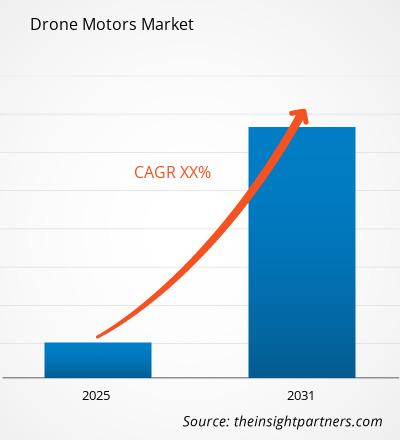
The Drone Motors Market size was US$ 3.27 Billion in 2025 and is estimated to achieve US$ 16.09 Billion by 2034, indicating a CAGR of 19.37%. This market includes brushless DC motor and brushed DC motor types delivered in power ranges of less than 100 W, 100 W–200 W, and greater than 200 W for fixed wing, multi-rotor, single-rotor, and fixed-wing hybrid drones.
North America Drone Motors Market is estimated to grow at a CAGR of 18.4–19.2% between 2026 and 2034, aided by the presence of inspection fleets, defense contracts, and automation projects. The operators are now looking for enhanced thrust-to-weight ratio, higher-duty cycles, and maintenance-free propulsion as their applications move beyond simple imaging and hobby purposes towards utility, logistics, agricultural, and public safety operations.
Drone Motors Market Assessment and Insights
- North America held 30–34% share in 2025 and is growing at a CAGR of 18.4–19.2% during 2026–2034, driven by defense UAVs, inspection drones, and premium propulsion adoption.
- US represented 76–80% of North American revenue in 2025 and is growing at a CAGR of 18.7–19.5% during 2026–2034, supported by commercial and defense programs.
- Europe accounted for 20–24% share in 2025 and is growing at a CAGR of 17.6–18.4% during 2026–2034, with Germany, the UK, France, Italy, and Spain leading demand.
- Asia Pacific held 34–38% share in 2025 and is growing at a CAGR of 20.2–21.0% during 2026–2034, led by China, Japan, South Korea, India, and Australia.
- Largest Segment Brushless DC Motor held 84–88% market share in 2025 and is growing at a CAGR of 19.8–20.6% during 2026–2034 due to efficiency and durability.
- High Growth Segment Above 200 W represented 24–28% market share in 2025 and is growing at a CAGR of 21.4–22.2% during 2026–2034, supported by payload-heavy missions.
- Key companies analyzed in detail: ALIGN Corporation Limited; FAULHABER MICROMO LLC; Hacker Motor USA LLC; KDE Direct LLC; MAD Components; NeuMotors; Nidec Corporation; SunnySky Motors; T-MOTOR; X-TeamRC.
Source: The Insight Partners' analysis based on proprietary research, government publications, company annual reports, investor presentations, industry databases, and expert interviews.
From simple, hobby-grade brushed motors, drones have evolved to incorporate highly engineered brushless systems comprising carefully designed windings, rare-earth magnets, electronic speed controllers, and heat-management features. Production trends now focus on high power densities, low vibrations, sensorless operation, motor-ESC-propeller modules, and application-specific optimizations. Quality control standards for drone motors have tightened up too because commercial drone operations need repeatable thrusts, predictable efficiency, and more robust performance across inspections, farming, mapping, delivery, and public safety tasks.
Demand will rise most in nations developing local UAV production, expanding aviation corridors for testing, and increasing their industrial drone operations. Investments are being made in big motors, complete propulsion modules, and quiet engines for urban operations and military use. Favorable regulatory trends for remote identification, beyond-visual-line-of-sight flying, and public safety drone operations help fuel the Drone Motors Market.
Drone Motors Market Report Scope
| Report Attribute | Details |
|---|---|
| Market size in 2025 | US$ 3.27 Billion |
| Market Size by 2034 | US$ 16.09 Billion |
| Global CAGR (2026 - 2034) | 19.37% |
| Historical Data | 2021-2024 |
| Forecast period | 2026-2034 |
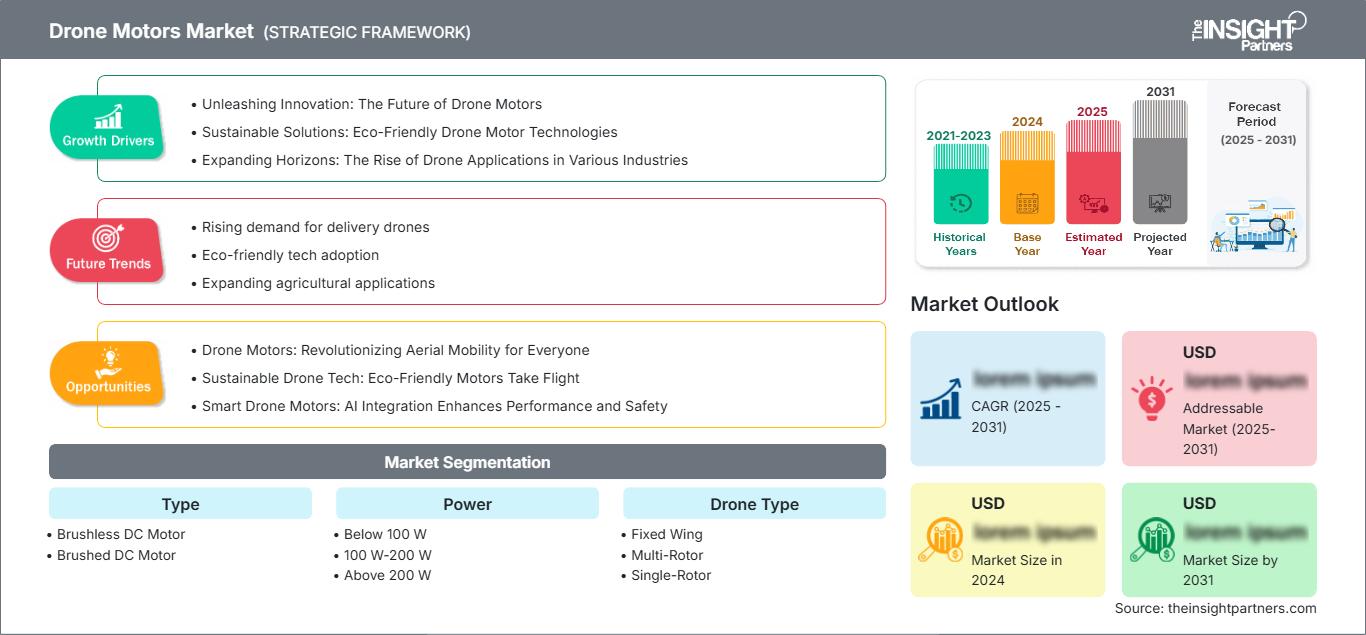
Drone Motors Market Analysis
The factors that contribute to Drone Motors Market development include growing applications for inspection services, precision agriculture, logistics testing, security monitoring, and public safety. The industry demands a propulsion system capable of increasing flight time, stabilizing loads, and minimizing maintenance costs per mission. The supply chain comprises magnet suppliers, copper windings producers, motor producers, electronic speed controller producers, propeller producers, drone manufacturers, distributors, and fleet managers.
The supply drivers include availability of rare earth magnets, precision bearing technology, cost of copper, power semiconductors production capacity, and adherence to standards required for aviation quality products. Brushless DC systems prevail due to low friction losses and higher speed control capability. Motors exceeding 200 watts become significant when drones use LiDAR equipment, multispectral cameras, spraying mechanisms, cargo, and communication payload.
The Drone Motors Market exhibits a rivalry among global motion control equipment suppliers and UAV propulsion providers. Nidec Corporation and FAULHABER MICROMO LLC offer expertise in miniaturized motors, and T-MOTOR, KDE Direct LLC, Hacker Motor USA LLC, and SunnySky Motors offer product variety, thrust information, and integration solutions for drones.
ALIGN Corporation Limited, MAD Components, NeuMotors, and X-TeamRC add to the specialized competition through radio control, racing, industrial, and customized propulsion systems. Investment focuses on propulsion kit modularity, electromagnetic compatibility, thermal efficiency, and ESC-compatible motors. The market positioning now relies on verified performance information, local presence, military qualification, and design cycle support for OEMs.
● REPORT CUSTOMIZATION
Tailor This Report To Align With Your Specific Business Requirements
This report can be customized to align precisely with your business objectives, scope, and target markets. Customization options include tailored segmentation, geography, competitive analysis, and strategic insights to support informed decision-making.
Customize This Report →WHAT YOU CAN ADJUST
- ● Segmentations
- ● Geography
- ● Competitive Analysis
- ● Language Preferences
Drone Motors Market: Strategic Insights
Regional Insights
North America Drone Motors Market
In 2025, North America had a 30-34% Drone Motors Market share which is expected to register a CAGR of 18.4%-19.2% between 2026 and 2034. Drivers include defense upgrades, infrastructure inspection, emergency applications, construction surveying, and agricultural scouting. Orders tend towards motors with verified thrust tables, environmental capabilities, low vibration, and high-value sensor integration.
North America has many well-established drone service companies, FAA rulemaking, and a robust OEM engineering network. Utility inspections, public safety missions, film-making, and military training programs all demand motors capable of enduring many cycles in varied weather conditions. Suppliers have an edge in providing local customer support, replacement parts, and application advice for both multi-rotor, fixed-wing, and hybrid drones.
U.S. Drone Motors Market
North America accounted for 76-80% of the U.S. share in 2025 and is projected to increase at a CAGR of 18.7-19.5% during 2026-2034. Momentum will be driven by inspections, public safety, defense prototyping, filmmaking, farming, and delivery tests that require reliable propulsion systems with constant thermal properties and minimal downtime.
Specialized suppliers in the U.S., including Hacker Motor USA LLC, KDE Direct LLC, NeuMotors, T-MOTOR distributors, and X-TeamRC are responsible for addressing customer requirements. Users tend to focus on over 200 W motor systems for heavy lift platforms, while smaller motors of under 100 W will continue to play an essential role in training, racing, and light imaging drones.
Europe Drone Motors Market
The Europe region accounted for 20–24% market share in 2025 and is estimated to grow at a CAGR of 17.6–18.4% between 2026 and 2034. Europe has Germany leading through its adoption of industry automation technology, inspection robots, and engineering-based drone development. The UK contributes to the increase in adoption rate through defense, public safety tests, and offshore energy inspection drones.
France, Italy, and Spain have contributed to increased adoption through agriculture monitoring and mapping, borders surveillance and maintenance of infrastructures. Safety documentation, electromagnetic compatibility, and traceability of quality assurance are highly valued by European customers. Companies like FAULHABER MICROMO LLC, Nidec Corporation, T-MOTOR, and specialized distributors thrive due to their high power density and reliability.
APAC Drone Motors Market
Asia-Pacific held 34%-38% share in 2025 and will have CAGR of 20.2%-21.0% between 2026-2034. China dominates the market owing to its manufacturing capability, components, and production of consumer and industrial drones, while Japan and South Korea contribute precision motor engineering.
Growth will be driven by India and Australia through agricultural services, mining inspections, security, and UAV policies. The industrial capacity of the region makes it possible to manufacture motors economically, however, premium segments demand efficiency, improved bearings and thermal stability. SunnySky Motors, ALIGN Corporation Limited, T-MOTOR and Nidec Corporation are key suppliers in the region.
Middle East & Africa Drone Motors Market
Middle East & Africa market is expected to grow with a CAGR of 15.8 – 16.6% from 2026 to 2034. Saudi Arabia emerges as the leader among all MEA countries due to high requirements for motors in the fields of energy infrastructure, defense surveillance, smart cities, and desert logistics.
UAE provides application for drones in the fields of security, construction, event coverage, and inspections; South Africa and Rest of MEA will be driven by mining, agriculture, conservation, and infrastructure monitoring. Extremity of working conditions favors motor assemblies with bearing seals, temperature margins, and replacement parts.
Segmentation Analysis
Type
Type is projected to grow at a CAGR of 19.2–20.0% during 2026–2034. The Drone Motors Market scope covers propulsion architectures selected by endurance, payload, cost, maintainability, and control precision. Brushless platforms dominate professional drones because they reduce mechanical wear, while brushed motors remain relevant in low-cost, lightweight, and entry-level designs where simplicity outweighs lifecycle performance.
- Brushless DC Motor holds the strongest market position because higher efficiency, longer service life, and precise speed control support commercial missions, professional imaging, heavy-lift platforms, and repeatable fleet operations.
- Brushed DC Motor demand remains concentrated in toy drones, education kits, small consumer models, and price-sensitive applications where low cost, easy control, and simple replacement are purchasing priorities.
Power
Power is forecast to grow at a CAGR of 19.6–20.4% during 2026–2034. Motor wattage determines payload capacity, endurance, heat generation, and airframe compatibility. Buyers choose lower power bands for compact drones and training, mid-range motors for professional imaging and inspection, and above 200 W systems for agricultural spraying, logistics trials, and industrial payloads.
- Below 100 W motors serve compact consumer drones, training platforms, and lightweight imaging systems where low mass, affordable replacement, and battery efficiency are more important than heavy payload capability.
- 100 W-200 W motors address professional multi-rotor and fixed-wing applications requiring balanced endurance, moderate payload lift, stable control, and compatibility with widely used battery and ESC configurations.
- Above 200 W motors gain strategic importance in industrial, agricultural, logistics, and defense drones that require sustained thrust, better cooling, stronger bearings, and higher torque margins.
Drone Type
Drone Type is expected to grow at a CAGR of 19.4–20.2% during 2026–2034. Propulsion requirements vary by airframe because fixed-wing platforms need efficient cruise power, multi-rotors require responsive thrust, single-rotor systems need torque stability, and fixed-wing hybrids combine vertical lift with cruise endurance. Motor suppliers increasingly tune designs for mission-specific duty cycles.
- Fixed Wing drones use motors optimized for cruise efficiency, lower heat buildup, and longer endurance, making them important for mapping, surveillance, corridor inspection, and environmental monitoring.
- Multi-Rotor drones represent broad demand because vertical takeoff, hovering, and maneuverability require several synchronized motors with fast response, stable torque, and dependable thermal performance.
- Single-Rotor drones need propulsion systems that support higher lift efficiency and longer missions, serving niche inspection, payload, and endurance applications where operational complexity is acceptable.
- Fixed-Wing Hybrid platforms are strategically important because they combine vertical takeoff with cruise range, increasing demand for coordinated lift and propulsion motors in logistics and defense missions.
Application
Application is projected to grow at a CAGR of 19.7–20.5% during 2026–2034. Commercial drones generate the strongest propulsion requirements because fleet users measure uptime, payload stability, and maintenance cost. Consumer drones remain important for volume, brand visibility, and technology diffusion, but professional applications increasingly shape motor specifications, testing standards, and supplier qualification.
- Commercial Drones create high-value demand for motors that support inspection, agriculture, mapping, logistics, security, and public safety missions with dependable endurance and low service interruption.
- Consumer Drones sustain volume demand through photography, racing, education, and recreation, where compact size, price accessibility, quiet operation, and easy replacement remain important purchase factors.
Opportunity Snapshot
| Application | Revenue Contribution | Trend Tag | Adoption Stage |
| Commercial Drones | High | Fleet Endurance | Scaling |
| Consumer Drones | Medium | Quiet Flight | Mature |
Drone Motors Market Growth Drivers and Impact Analysis
Commercial drone fleets raise propulsion performance requirements
Propulsion in commercial drone applications is now more focused on uptime, payload stability, sound characteristics, and maintenance costs rather than simply the cost of acquisition. Drone inspection, agricultural, surveying, and emergency response activities demand engines which are capable of providing reliable thrust during multiple launches, various environmental conditions, and with added sensors aboard. The effect on the marketplace would be a greater need for brushless DC motors, wider power ranges, improved bearings, and compatible ESC firmware. Manufacturers who provide validated data, heat testing, and replacement capabilities will see repeat orders from fleets.
Payload-heavy applications accelerate higher wattage adoption
The growing use of aerial spray applications, LiDAR mapping, parcel delivery testing, defense surveillance, and industrial inspection is putting increasing demands on payloads for drones. Increased motor wattage allows for greater lift capacity, improved climb ratios, and safe operation even when the drone airframe carries sensors, fuel cells, batteries, or communication devices. The implications of this trend in terms of the industry market involve moving toward 200 W motors and above, improved cooling solutions, improved magnet quality, and motors capable of continuous operation.
Localized UAV supply chains reshape sourcing decisions
Governments and corporate purchasers have begun giving greater consideration to traceability, exposure to imports, and service continuity as drones move into operational roles. Motors are not fungible commodities in this scenario, as military eligibility, maintenance access, and recorded test information will influence whether or not a system gets approved. This will have an effect on the market in terms of increased interest in local distributors, alternative sources, and flexible propulsion systems capable of being installed into local aircraft.
Drone Motors Market Future Trends
Integrated smart propulsion modules expand
Drone Motors Market trends point toward integrated propulsion modules that combine motor, ESC, propeller, protection logic, and digital diagnostics into pre-tested units. Future buyers will prefer modules that shorten assembly, reduce wiring errors, and provide operating data for predictive maintenance. This direction is especially relevant for commercial fleets, fixed-wing hybrids, and heavy-lift platforms where downtime has direct economic cost. Suppliers that embed temperature monitoring, fault logging, and firmware compatibility will move closer to OEM design decisions and capture more value than vendors selling standalone motors.
Low-noise and high-efficiency designs gain priority
Future drone deployments in cities, campuses, industrial sites, and public safety corridors will increase attention on acoustic footprint and energy use. Motor design will move toward optimized electromagnetic geometry, smoother bearings, improved balancing, and propeller matching that reduces vibration and noise without sacrificing thrust. The trend supports longer battery endurance and broader acceptance of drones operating near people or sensitive infrastructure. Manufacturers that can document acoustic performance, efficiency maps, and durability under repeated duty cycles will have stronger positioning in premium commercial programs.
Drone Motors Market Opportunities
Propulsion kits for commercial fleet standardization
Drone Motors Market Forecasts support investment in standardized propulsion kits for inspection, agriculture, mapping, and public safety fleets. Fleet operators need predictable maintenance, simplified spare parts, and consistent thrust behavior across multiple airframes. Vendors can package motors, ESCs, propellers, installation guidance, and performance documentation for specific mission profiles. This opportunity is strongest where customers operate recurring routes or large asset networks. Suppliers that reduce configuration complexity and offer lifecycle replacement programs can increase account retention and move beyond transactional component sales.
Heavy-lift propulsion for agriculture and logistics
Agriculture spraying, seed spreading, medical logistics, warehouse yard movement, and remote infrastructure support create demand for motors that can sustain heavier payloads safely. The opportunity is action-oriented because OEMs need propulsion partners that help balance thrust, battery draw, heat, and airframe weight. Above 200 W motors and modular lift systems can command higher value when paired with testing data and rapid replacement support. Vendors that collaborate early with drone builders can shape designs before certification, procurement, or field deployment decisions are locked.
Recent Developments
- July 2026: Valeo, a global leader in automotive technologies, and Harmattan AI, a defense technology company specializing in the development of integrated autonomous systems, are partnering to produce in France a sovereign electric motor for drones. Valeo brings its expertise in electrification to offer a sovereign electric drone motor for civil and defense applications. The technology developed by Valeo allows the motor to operate without heavy rare earths, thereby securing the supply chain. It will equip Harmattan AI drones. Production will begin in early 2027 at a Valeo site in France.
- July 2026: ePropelled, a leader in advanced electric propulsion and intelligent power management technologies, announced the global launch of its eP Unified Architecture (ePUA) alongside the introduction of ePLink, a new hardware enabled connectivity platform designed to enable software-defined propulsion systems across the range. Unveiled at the Farnborough International Airshow 2026, the combined solution represents a significant shift from component-based propulsion design toward integrated, intelligent and continuously evolving propulsion ecosystems. The eP Unified Architecture brings together motors, controllers, starter-generators, intelligent power systems and connected software into a single platform, enabling system-level propulsion management across uncrewed air, land and sea applications. At the centre of the launch is ePLink, a space efficient physical onboard device that allows direct interaction with propulsion systems across development, manufacturing and operational environments. The platform enables firmware updates, system configuration, diagnostics and secure data exchange between embedded systems and cloud-based tools.
- December 2025: HOBBYWING officially announces the release of the X9 G2L integrated drone propulsion system, featuring significant upgrades across multiple aspects, including functionality, efficiency, and intelligence. With a single-axis rated thrust of 7-12 kg and a maximum thrust of 24 kg, the X9 G2L is versatile, suitable for 16L agricultural drones and IV-class drones. This new propulsion system provides a more efficient and reliable power solution for agricultural and industrial UAV operations.
Frequently Asked Questions

- Comprehensive Market Sizing and Forecast Analysis
- Detailed Segmentation Analysis
- In-Depth Market Dynamics Assessment
- Regional and Country-Level Insights
- Competitive Landscape and Company Benchmarking
- Strategic Business Intelligence
Recent Reports
Testimonials

The Insight Partners' SCADA System Market report is comprehensive, with valuable insights on current trends and future forecasts. The team was highly professional, responsive, and supportive throughout. We are very satisfied and highly recommend their services.
RAN KEDEM Partner, Reali Technologies LTDs
I requested a report on a very specific software market and the team produced the report in a few days. The information was very relevant and well presented. I then requested some changes and additions to the report. The team was again very responsive and I got the final report in less than a week.
JEAN-HERVE JENN Chairman, Future Analytica
We worked with The Insight Partners for an important market study and forecast. They gave us clear insights into opportunities and risks, which helped shape our plans. Their research was easy to use and based on solid data. It helped us make smart, confident decisions. We highly recommend them.
PIYUSH NAGPAL Sr. Vice President, High Beam Global
The Insight Partners delivered insightful, well-structured market research with strong domain expertise. Their team was professional and responsive throughout. The user-friendly website made accessing industry reports seamless. We highly recommend them for reliable, high-quality research services
YUKIHIKO ADACHI CEO, Deep Blue, LLC.
This is the first time I have purchased a market report from The Insight Partners.While I was unsure at first, I visited their web site and felt more comfortable to take the risk and purchase a market report.I am completely satisfied with the quality of the report and customer service. I had several questions and comments with the initial report, but after a couple of dialogs over email with their analyst I believe I have a report that I can use as input to our strategic planning process.Thank you so much for taking the extra time and making this a positive experience.I will definitely recommend your service to others and you will be my first call when we need further market data.
JOHN SUZUKI President and Chief Executive Officer, Board Director, BK Technologies
I wish to appreciate your support and the professionalism you displayed in the course of attending to my request for information regarding to infectious disease IVD market in Nigeria. I appreciate your patience, your guidance, and the fact that you were willing to offer a discount, which eventually made it possible for us to close a deal. I look forward to engaging The Insight Partners in the future, all thanks to the impression you have created in me as a result of this first encounter.
DR CHIJIOKE ONYIA MANAGING DIRECTOR, PineCrest Healthcare Ltd.Reason to Buy
- Informed Decision-Making
- Understanding Market Dynamics
- Competitive Analysis
- Identifying Emerging Markets
- Customer Insights
- Market Forecasts
- Risk Mitigation
- Boosting Operational Efficiency
- Strategic Planning
- Investment Justification
- Tracking Industry Innovations
- Aligning with Regulatory Trends





 Get Free Sample for