
Ducting Silencers Market Size, Trends & Growth by 2034
Coverage: By Type (Rectangular Silencer, Elbow Silencers, Circular Silencers, Others); End User (Commercial, Industrial) , and Geography (North America, Europe, Asia Pacific, and South and Central America)
- Status : Data Released
- Report Code : TIPRE00016965
- Category : Electronics and Semiconductor
- No. of Pages : 150
- Available Report Formats :


- Last update date : August 10, 2026


2025 Market Size
US$ 479.14 Mn
Base year value
2034 Forecast
US$ 670.51 Mn
Projected by 2034
CAGR 2026-2034
3.80 %
Growth rate
Addressable Market
US$ 5,220.40 Mn
(2026-2034)
The Ducting Silencers Market was assessed at US$ 479.14 Million and estimated to touch US$ 670.51 Million by 2034, rising at a CAGR of 3.80% during the period from 2026–2034. The Market includes engineered acoustic products used within the ventilation and air-handling duct system, which reduces noise due to fan operation, airflow, and machinery through commercial and industrial applications.
The Ducting Silencers Market size in North America is anticipated to grow at an estimated CAGR of 3.4–3.8% on account of increased capacity for data centers, health-care construction, and commercial refurbishment. Sound management in buildings and occupational noise regulation aid in driving replacement applications, whereas engineering firms are optimizing insertion loss against pressure drop.
Ducting Silencers Market Assessment and Insights
- North America: Accounted for 22–24% share in 2025 and is projected to grow at a 3.4–3.8% CAGR between 2026–2034, supported by data centers, hospitals, laboratories, and retrofit-led acoustic compliance.
- US: Represented 79–81% of North American revenue in 2025, with a 3.5–3.9% CAGR between 2026–2034, led by mission-critical ventilation and commercial refurbishment.
- Europe: Held 26–28% share in 2025 and should expand at 3.1–3.5% CAGR between 2026–2034; Germany leads, while the UK, France, Italy, and Spain sustain specification demand.
- Asia Pacific: Captured 40–42% share in 2025 and is forecast to grow at 4.4–4.8% CAGR between 2026–2034, with China leading and India, Japan, South Korea, and Australia contributing.
- Largest Segment: Rectangular Silencer held 50–54% market share in 2025 and is projected to record a 3.4–3.8% CAGR during 2026–2034.
- High Growth Segment: Industrial held 44–48% market share in 2025 and is expected to register a 4.1–4.5% CAGR during 2026–2034.
- Key companies analyzed in detail: Airmatic Inc., Elta Group Limited, Kinetics Noise Control, Inc., Lindab International AB, Ruskin Company, TROX GmbH, Systemair AB, Taikisha Ltd., Vent-Axia, and Vibro-Acoustics.
Source: The Insight Partners' analysis based on proprietary research, government publications, company annual reports, investor presentations, industry databases, and expert interviews.
In terms of the development of the product design phase, it has gone through from the stage of generic absorbers to application engineered parts where the designer has to consider parameters like insertion loss, pressure drop, hygiene and area. Calculations concerning air flow, geometry adjustment of the splitter part and software selection tools are making the process more efficient, fitting better in crowded plant rooms. Metal is the material used in manufacturing the product; thus, the availability of galvanized steel and its production becomes more important factors.
During the forecast period, the market growth will diversify to include manufacturing regions in Asia, infrastructure developments in the Gulf region, and city renovation projects. The investments will go into modular products, low-pressure-drop products, and the selection software integrated into building information models. Increased enforcement of occupational noise regulations, as well as stringent control over community noise levels, will boost industrial demand, and decarbonization efforts will support projects involving upgrading of ventilation systems and preservation of fan efficiency.
Ducting Silencers Market Report Scope
| Report Attribute | Details |
|---|---|
| Market size in 2025 | US$ 479.14 Million |
| Market Size by 2034 | US$ 670.51 Million |
| Global CAGR (2026 - 2034) | 3.80% |
| Historical Data | 2021-2024 |
| Forecast period | 2026-2034 |
Ducting Silencers Market Analysis
Ducting Silencer growth relies on mechanical ventilation expansion, increased fan concentration and enhanced noise standards within data centers, health care buildings, offices, laboratories and factories. The demand process starts with consultancy translating room requirements and boundary limits to an insertion loss requirement, followed by manufacturer selection, production, distribution, installation and commissioning.
The supply is contingent on sheet metal fabrication, absorptive material, perforated liner and individual project dimension. Known suppliers safeguard their margins via proven silencer series and selection process, whereas local manufacturers compete on delivery time. The low-pressure drop is crucial in business since it results in more energy expenditure and larger equipment size, thus making the acoustical purchasing process inseparable from the overall efficiency.
The Ducting Silencers Market report reveals an extremely fragmented industry that includes global leaders in ventilation and specialists in acoustics. TROX GmbH, Systemair AB, and Lindab International AB rely on comprehensive air distribution systems, while Kinetics Noise Control, Inc. and Vibro-Acoustics have a focus on acoustic solutions. Ruskin Company and Elta Group Limited rely on air control systems.
Flexible manufacturing, selection based on Building Information Modelling, and environmentally friendly materials are investments. Taikisha Ltd. provides embedding of silencers in high-technology cleanroom and industrial systems, while Vent-Axia and Airmatic Inc. offer ventilation ducts with directional airflow. The competitive advantage is gained through the demonstrated insertion loss and pressure drop data, technical support in the particular region, and customisation without extending construction projects.
● REPORT CUSTOMIZATION
Tailor This Report To Align With Your Specific Business Requirements
This report can be customized to align precisely with your business objectives, scope, and target markets. Customization options include tailored segmentation, geography, competitive analysis, and strategic insights to support informed decision-making.
Customize This Report →WHAT YOU CAN ADJUST
- ● Segmentations
- ● Geography
- ● Competitive Analysis
- ● Language Preferences
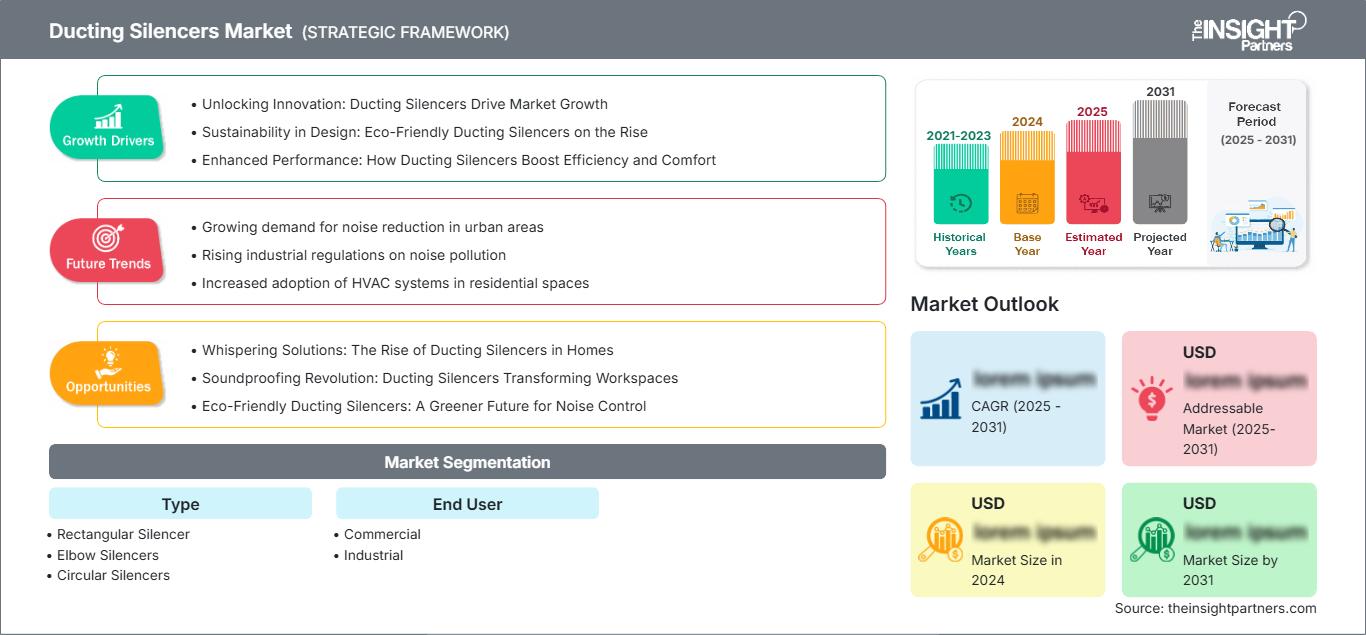
Ducting Silencers Market: Strategic Insights
Regional Insights
North America Ducting Silencers Market
North America accounted for 22-24% of global revenue in 2025 and is forecast to grow at a CAGR of 3.4-3.8% from 2025 to 2034. North America Ducting Silencers Market share includes highly evolved HVAC sound engineering, consultant spec requirements, and replacement opportunities in office buildings, hospitals, research laboratories, airports, and educational institutions. Data centers add an application where attenuation must work along with redundancy and energy-efficiency considerations.
The US market occupies the largest share in the market, but Canada stands out because of healthcare buildings, institutional building construction, and mixed-use developments. Industrial applications are made possible by workplace control measures that are based on OSHA standards. Documentation of sound attenuation is achieved through sound engineering principles based on ASHRAE guidelines. There is an increasing trend towards preferring domestic rectangular silencers owing to time certainty apart from circular silencers with standard airflow systems.
U.S. Ducting Silencers Market
The US represented 79-81% of North American revenues in 2025 and is forecasted to grow at a 3.5-3.9% CAGR through 2026-2034. Mission-critical buildings offer the best specification opportunities because data centers have high cooling loads, hospitals have quiet patient areas, and semiconductor or pharmaceutical manufacturing facilities incorporate sound constraints alongside sanitation, security, and reliability issues.
Supplier base includes both air control as well as acoustic companies in order to provide options to choose from the products as well as custom designs. Application trends include compact and highly efficient silencers, low-pressure drop geometry for energy efficiency considerations, and rugged housing for rooftop or industrial applications. Remodeling activities in commercial buildings create consistent demand due to the fact that facility managers update their air handling systems, increase ventilation rates outdoors and also resolve noise issues due to fans and ductwork.
Europe Ducting Silencers Market
Supplier base includes both air control as well as acoustic companies in order to provide options to choose from the products as well as custom designs. Application trends include compact and highly efficient silencers, low-pressure drop geometry for energy efficiency considerations, and rugged housing for rooftop or industrial applications. Remodeling activities in commercial buildings create consistent demand due to the fact that facility managers update their air handling systems, increase ventilation rates outdoors and also resolve noise issues due to fans and ductwork.
APAC Ducting Silencers Market
Asia Pacific captured 40–42% share in 2025 and is forecast to expand at a 4.4–4.8% CAGR. China leads on manufacturing scale, commercial construction, and industrial ventilation, while India gains from data centers, metros, hospitals, and factories.
The Japanese and Koreans focus on small, proven technologically solutions, while the Australians factor in institutional and resource sector needs. Controls of urban noise, modernization of industry, and increase in cooling loads contribute to region’s adoption, but cost consciousness keeps localized manufacture important.
Middle East & Africa Ducting Silencers Market
Middle East and Africa is projected to grow at a 3.8–4.2% CAGR through 2034. Saudi Arabia leads through airports, hospitality, healthcare, industrial diversification, and large mixed-use developments; the UAE follows with premium commercial and data-center projects.
Demand from South Africa includes mining, industry and institutions, whereas the Rest of MEA relies on projects. Heavy cooling requirements, generator ventilation, and power generation make for tough acoustical environment, requiring corrosion-proof casings and pressure drop control.
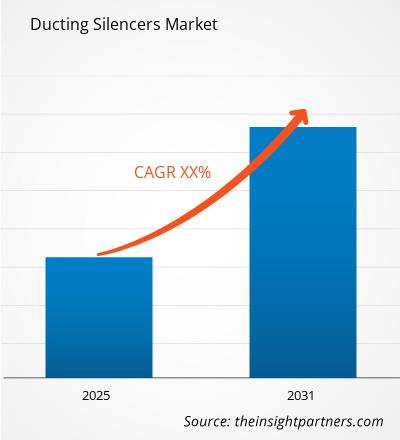
Segmentation Analysis
Type
The Type segment is projected to grow at a 3.5–3.9% CAGR during 2026–2034. Ducting Silencers Market scope by configuration reflects duct geometry, available straight length, target frequency attenuation, airflow velocity, hygiene needs, and acceptable pressure loss. Rectangular products remain central to air-handling systems, while elbow and circular formats solve spatial or standardized-duct requirements.
- Rectangular Silencer: The leading format suits large air-handling units and custom duct sections, offering flexible splitter depth, face area, and acoustic performance for commercial and industrial projects.
- Elbow Silencers: These units combine directional change with attenuation, preserving scarce plantroom space and reducing separate fittings, making them strategically useful in retrofits and congested mechanical layouts.
- Circular Silencers: Standardized connections and straightforward installation support modular ventilation systems, smaller air volumes, branch ducts, and applications where rapid selection and repeatable fabrication matter.
End User
The End User segment is expected to register a 3.8–4.2% CAGR during 2026–2034. Commercial demand is specification-driven and broad, while industrial projects often require heavier construction, higher attenuation, and resistance to temperature, moisture, particulates, or corrosive conditions. Lifecycle energy cost increasingly influences both groups because silencer pressure loss affects fan selection and operating expenditure.
- Commercial: Offices, hospitals, hotels, airports, education buildings, laboratories, and data centers generate recurring demand, with consultant specifications emphasizing comfort, low pressure drop, spatial efficiency, and certified acoustic data.
- Industrial: Manufacturing, power, process, pharmaceutical, and resource facilities prioritize occupational compliance, equipment reliability, and rugged customization, supporting higher-value projects and the strongest end-user growth outlook.
Opportunity Snapshot
| End User | Revenue Contribution | Trend Tag | Adoption Stage |
| Commercial | High | Quiet Buildings | Mature |
| Industrial | Medium | Plant Compliance | Scaling |
Ducting Silencers Market Growth Drivers and Impact Analysis
Higher Ventilation Intensity in Mission-Critical Buildings
Data centers, hospitals, laboratories, and advanced manufacturing sites move large air volumes continuously, increasing fan power and duct-borne sound. Silencers become essential where equipment rooms adjoin occupied spaces or where exterior discharge points face community limits. The purchasing impact extends beyond unit volume: projects require larger face areas, multiple attenuation stages, and careful aerodynamic modeling. Because a poorly selected unit can raise pressure loss and operating cost, consultants increasingly compare insertion loss and resistance together. This favors vendors that provide reliable selection software, tested octave-band data, and rapid project engineering. It also supports premium configurations tailored to restricted plantroom space, redundancy, hygiene, and commissioning requirements.
Stricter Occupational and Environmental Noise Management
Industrial operators face sustained pressure to reduce employee exposure and boundary noise around factories, power assets, and process plants. Duct paths frequently transmit fan, combustion, and machinery sound beyond the source enclosure, making attenuation a practical compliance measure. Projects often arise during capacity expansions, permit renewals, or community-noise investigations, creating demand that is less dependent on new-building cycles. The Market benefits when acoustic consultants specify measurable insertion-loss targets and manufacturers supply robust casings, removable access, or specialized media. Compliance-driven procurement also raises the value of documentation, testing, and application support, while encouraging replacement of undersized legacy units that constrain airflow or fail under harsh conditions.
Energy-Efficient HVAC Retrofit and Building Modernization
Owners are upgrading fans, controls, air-handling units, and outdoor-air strategies to reduce energy use and improve indoor environments. These interventions alter airflow and acoustic profiles, often exposing regenerated noise, breakout paths, or inadequate legacy attenuation. A silencer selected for low pressure drop can resolve sound issues without eroding fan-efficiency gains, making acoustic design part of retrofit economics rather than a late-stage accessory. The real-world impact is recurring replacement demand in offices, universities, hospitals, hotels, and public buildings. Suppliers able to survey existing constraints, provide compact geometries, and coordinate dimensions with prefabricated ductwork can shorten shutdowns and protect project schedules, supporting higher conversion rates in renovation-led markets.
Ducting Silencers Market Future Trends
Digital Selection Linked to BIM Workflows
Ducting Silencers Market trends will increasingly center on product selection embedded in digital building models. Designers will expect automatically generated dimensions, pressure-drop calculations, insertion-loss schedules, and connection data that update as airflow changes. This reduces coordination errors and allows acoustic decisions earlier, before plantroom geometry is fixed. Manufacturers can convert digital engagement into specification advantage by linking verified performance libraries with configurable products and regional lead-time information. Over time, project data may also support commissioning checks and replacement planning. The shift will reward suppliers that maintain accurate digital objects, transparent algorithms, and engineering support across commonly used design platforms.
Lower-Carbon Materials and Circular Product Design
Future procurement will place greater weight on embodied carbon, recycled content, material health, and end-of-life separation alongside acoustic performance. Steel-intensive silencers offer a clear pathway through lower-emission sheet, optimized casing weight, recyclable liners, and modular components. Buyers in Europe and large multinational projects are likely to request environmental product information and supply-chain transparency. Design teams will scrutinize whether pressure-drop savings offset embodied impacts during operation. Manufacturers that document carbon attributes without compromising fire, hygiene, or durability requirements can differentiate in green-building specifications. Circular design may also enable replaceable acoustic media and reusable casings, extending service life in long-lived ventilation systems.
Ducting Silencers Market Opportunities
Localized Engineering and Fabrication in Fast-Growth Regions
Investors can target regional assembly and application engineering in India, Southeast Asia, and the Gulf, where imported custom units may face freight cost and schedule risk. Ducting Silencers Market Forecasts support a model combining standardized acoustic cores with locally fabricated casings and connectors. Success requires calibrated testing, quality control, and consultant engagement rather than commodity sheet-metal capacity alone. Partnerships with ductwork contractors can create early project visibility and coordinated delivery. A localized footprint also enables dimensions adapted to regional standards, faster replacements, and responsive commissioning support. Capital should prioritize flexible machinery, digital configuration, and technical sales teams serving data centers, hospitals, transport, and industrial projects.
Acoustic Retrofit Services for Existing Facilities
A service-led opportunity exists in diagnosing and correcting ventilation noise across aging commercial and industrial estates. Providers can bundle site measurement, airflow assessment, silencer redesign, installation planning, and post-completion verification. This approach addresses owners who know the symptom but lack a defined equipment specification. It also creates pull-through for compact elbow units, replacement rectangular sections, and industrial-grade assemblies. Attractive targets include hospitals operating around the clock, universities with phased capital programs, hotels protecting guest comfort, and factories managing boundary complaints. Investment in mobile acoustic capability and rapid-turn engineering can differentiate suppliers, generate repeat work, and reduce dependence on new-construction tender cycles.
Recent Developments
- May 2026: Kinetics Group has highlighted multi-resonator duct silencers as an advanced HVAC noise-control solution designed to reduce broadband sound while maintaining efficient airflow. The technology uses compact, space-folded resonators tuned to different frequencies, enabling effective noise attenuation with minimal pressure loss. These silencers help improve acoustic comfort in buildings by controlling fan and mechanical system noise without compromising ventilation performance.
- March 2026: Hush Acoustics has launched Hush Lag 5/25, a lightweight acoustic lagging solution designed to reduce noise from ductwork, pipes, enclosures, HVAC systems, and industrial equipment. The 15.25mm-thick tri-layer acoustic laminate combines mineral fibre, a high-mass barrier, and foil protection to deliver sound insulation, vibration damping, and durability. The product offers 36dB Rw acoustic performance and improved fire and thermal resistance.
- November 2024: FläktGroup has agreed to divest its European ducts, fittings, and silencers portfolio to Veloduct AB, backed by a Norwegian investment group. The deal includes production assets, equipment, inventories, and selected brands such as Veloduct, Ecoduct, and Ekoduct. Veloduct will continue operations and develop the product range, while FläktGroup will focus on its core ventilation technologies and solutions.
Frequently Asked Questions

- Comprehensive Market Sizing and Forecast Analysis
- Detailed Segmentation Analysis
- In-Depth Market Dynamics Assessment
- Regional and Country-Level Insights
- Competitive Landscape and Company Benchmarking
- Strategic Business Intelligence
Recent Reports
Testimonials

The Insight Partners provided valuable market intelligence that supported our global go-to-market strategy. Their team was professional, responsive, and attentive to our feedback, providing thoughtful analysis and helpful methodological clarifications throughout the project.
Junmo Kim Chief Financial Officer (CFO), Enertech Co., Ltd.
The Insight Partners' SCADA System Market report is comprehensive, with valuable insights on current trends and future forecasts. The team was highly professional, responsive, and supportive throughout. We are very satisfied and highly recommend their services.
RAN KEDEM Partner, Reali Technologies LTDs
I requested a report on a very specific software market and the team produced the report in a few days. The information was very relevant and well presented. I then requested some changes and additions to the report. The team was again very responsive and I got the final report in less than a week.
JEAN-HERVE JENN Chairman, Future Analytica
We worked with The Insight Partners for an important market study and forecast. They gave us clear insights into opportunities and risks, which helped shape our plans. Their research was easy to use and based on solid data. It helped us make smart, confident decisions. We highly recommend them.
PIYUSH NAGPAL Sr. Vice President, High Beam Global
The Insight Partners delivered insightful, well-structured market research with strong domain expertise. Their team was professional and responsive throughout. The user-friendly website made accessing industry reports seamless. We highly recommend them for reliable, high-quality research services
YUKIHIKO ADACHI CEO, Deep Blue, LLC.
This is the first time I have purchased a market report from The Insight Partners.While I was unsure at first, I visited their web site and felt more comfortable to take the risk and purchase a market report.I am completely satisfied with the quality of the report and customer service. I had several questions and comments with the initial report, but after a couple of dialogs over email with their analyst I believe I have a report that I can use as input to our strategic planning process.Thank you so much for taking the extra time and making this a positive experience.I will definitely recommend your service to others and you will be my first call when we need further market data.
JOHN SUZUKI President and Chief Executive Officer, Board Director, BK Technologies
I wish to appreciate your support and the professionalism you displayed in the course of attending to my request for information regarding to infectious disease IVD market in Nigeria. I appreciate your patience, your guidance, and the fact that you were willing to offer a discount, which eventually made it possible for us to close a deal. I look forward to engaging The Insight Partners in the future, all thanks to the impression you have created in me as a result of this first encounter.
DR CHIJIOKE ONYIA MANAGING DIRECTOR, PineCrest Healthcare Ltd.Reason to Buy
- Informed Decision-Making
- Understanding Market Dynamics
- Competitive Analysis
- Identifying Emerging Markets
- Customer Insights
- Market Forecasts
- Risk Mitigation
- Boosting Operational Efficiency
- Strategic Planning
- Investment Justification
- Tracking Industry Innovations
- Aligning with Regulatory Trends





 Get Free Sample for