
DYNAMIC RAM (DRAM) Market Share, Growth & Forecast by 2034
Coverage: by Type (SDRAM, SDRAM II/DDR RAM, SGRAM, Mobile DRAM, and Legacy DRAM); Standard (Fast Page Mode (FPM), Extended Data Out (EDO), Burst EDO (BEDO), ARAM (Audio RAM)); Application (Mobile Device Market, Computing Device Market, Server Market, Specialized DRAM Market), and Geography (North America, Europe, Asia Pacific, and South and Central America)
- Status : Data Released
- Report Code : TIPEL00002036
- Category : Electronics and Semiconductor
- No. of Pages : 150
- Available Report Formats :


- Last update date : August 07, 2026


2025 Market Size
US$ 88.89 Bn
Base year value
2034 Forecast
US$ 122.79 Bn
Projected by 2034
CAGR 2026-2034
3.66 %
Growth rate
Addressable Market
US$ 961.66 Bn
(2026-2034)
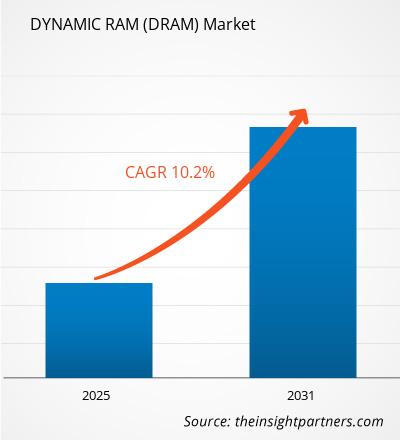
The Dynamic RAM Market was valued at US$ 88.89 Billion in 2025 and will likely be worth US$ 122.79 Billion by 2034, with an annual CAGR of 3.66%. It includes volatile memory devices that can perform fast read-write operations in server, smartphone, PC, graphics, networking, automotive, and embedded applications that need rapid data accessing.
In the North American region, the Dynamic RAM Market size is anticipated to grow at a CAGR of 3.2% to 3.8% during the forecast period of 2026 to 2034, driven by investments in hyperscale data centers and refresh cycles for enterprise servers. The growth will be boosted by infrastructure for AI, cloud services, DDR5, and domestic semiconductor capacity programs to ensure better supply security for key computing, defense, and electronic applications.
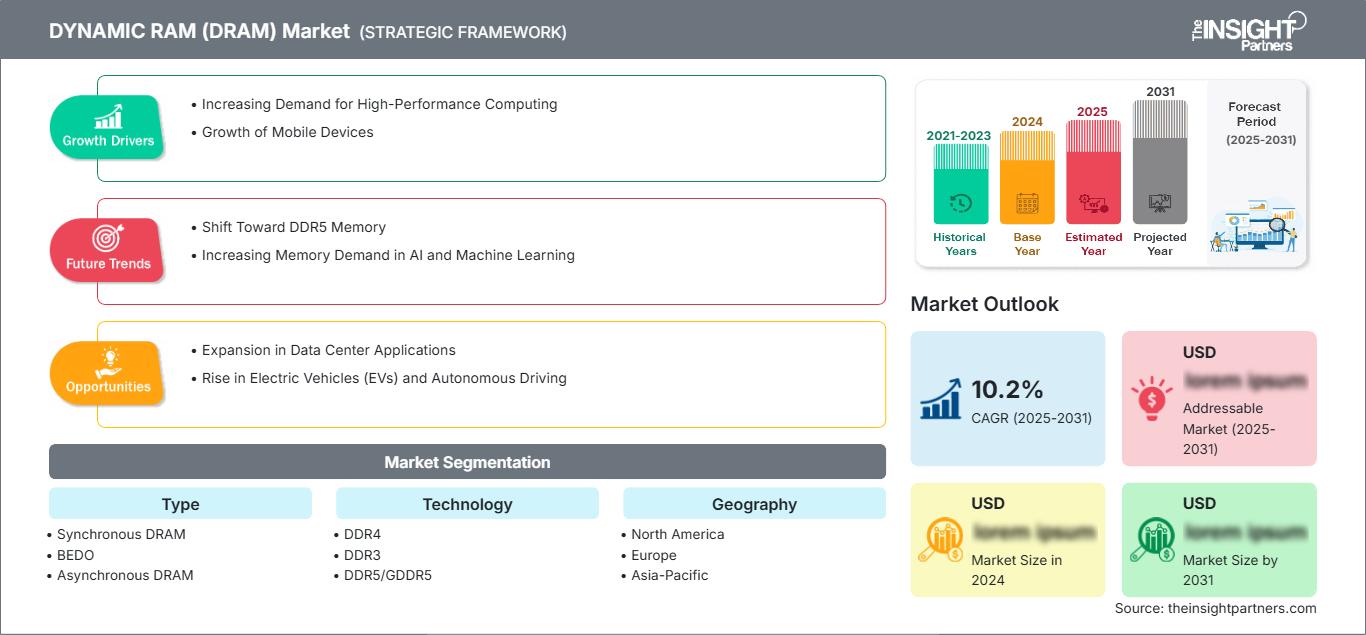
DYNAMIC RAM (DRAM) Market Assessment and Insights
- North America held 18–21% Dynamic RAM Market share in 2025 and is growing at a CAGR of 3.2–3.8% during 2026–2034, supported by cloud, AI servers, and enterprise computing demand.
- US represented 82–86% of North American revenue in 2025 and is growing at a CAGR of 3.3–3.9% during 2026–2034.
- Europe accounted for 12–15% share in 2025 and is growing at a CAGR of 2.8–3.4% during 2026–2034, led by Germany, the UK, France, Italy, and Spain.
- Asia Pacific held 55–59% share in 2025 and is growing at a CAGR of 3.8–4.4% during 2026–2034, led by South Korea, China, Japan, Taiwan, and India.
- Largest Segment SDRAM II/DDR RAM holds 45–50% market share in 2025 and is expanding at a CAGR of 3.5–4.0% due to widespread use in computing and server applications.
- High Growth Segment Mobile DRAM accounts for 18–22% share in 2025 and is growing at a CAGR of 4.5–5.2% driven by smartphone upgrades and AI-enabled mobile processors.
- Key companies analyzed in detail: Samsung Electronics Co., Ltd.; Micron Technology, Inc.; Nanya Technology Corporation; SK hynix Inc.; Winbond Electronics Corporation; Etron Technology, Inc.; NEC Corporation; Transcend Information, Inc.; Kingston Technology Company, Inc.; Mosel Vitelic Inc.
Source: The Insight Partners' analysis based on proprietary research, government publications, company annual reports, investor presentations, industry databases, and expert interviews.
The memory technology landscape is evolving away from generic commodity capacity towards differentiated performance and power efficiency. The transition from DDR4 to DDR5 memory modules in servers and high-end PCs continues, along with rising graphics and AI applications driving higher bandwidth requirements. The production environment consists of few players in the memory industry, with expertise in Taiwan playing a role in mature nodes and niche DRAM. Hence, The Dynamic RAM Market is driven by cyclical price movements, wafer availability, node transitions, and capital allocation.
Future demand will be more diversified due to AI servers, edge computing, automotive electronics, and industrial automation requiring more memory capacity per unit. Geographies that are emerging markets are offering semiconductor incentives for localization of packaging, testing, and assembly processes. Regulatory tailwinds on chip supply chain resilience are enabling longer term investment decisions, but the DRAM business remains vulnerable to inventory management, technology transitions, and demand visibility.
DYNAMIC RAM (DRAM) Market Report Scope
| Report Attribute | Details |
|---|---|
| Market size in 2025 | US$ 88.89 Billion |
| Market Size by 2034 | US$ 122.79 Billion |
| Global CAGR (2026 - 2034) | 3.66% |
| Historical Data | 2021-2024 |
| Forecast period | 2026-2034 |
DYNAMIC RAM (DRAM) Market Analysis
The market for Dynamic RAM is boosted by the increasing memory requirements needed in cloud servers, AI accelerators, gaming machines, smartphones, and connected vehicles. The DRAM is the primary memory used by the processor and its capacity requirement increases with larger and parallel software loads. The supply chain includes the processes of wafer production, lithography, test, packaging, module assembly, controller compatibility, distribution, OEM qualification, and hyperscale sourcing.
The supply situation is impacted by transition to advanced nodes, HBM wafer availability, ramping up of DDR5, and continued use of DDR4 in the installed base of enterprise and industrial equipment. According to TrendForce, the global DRAM revenues in 3Q25 totaled $41.4 billion and the top three companies accounted for the majority of the total revenue.
Dynamic Random Access Memory market analysis reveals a competitive environment characterized by Samsung Electronics Co., Ltd., SK hynix Inc., and Micron Technology, Inc. While Nanya Technology Corporation and Winbond Electronics Corporation continue to play a role in the market for specialty and mature node memories, Kingston Technology Company, Inc. and Transcend Information, Inc. still have relevance in modules and storage adjacent memory products where buyers seek configurability and branding.
Strategic investments are expected in DDR5, HBM capacity, advanced packaging, and high-end server memory over commodity expansion. Companies like Etron Technology, Inc., NEC Corporation, and Mosel Vitelic Inc. will be relevant in the legacy, specialty, or local memory environments. Strategic advantage will be gained through technology leadership, supply contracts, product qualification, and pricing strategy that can balance artificial intelligence-enabled premium needs with PC and mobile applications and industrial needs.
● REPORT CUSTOMIZATION
Tailor This Report To Align With Your Specific Business Requirements
This report can be customized to align precisely with your business objectives, scope, and target markets. Customization options include tailored segmentation, geography, competitive analysis, and strategic insights to support informed decision-making.
Customize This Report →WHAT YOU CAN ADJUST
- ● Segmentations
- ● Geography
- ● Competitive Analysis
- ● Language Preferences
DYNAMIC RAM (DRAM) Market: Strategic Insights
Regional Insights
North America Dynamic RAM Market
North America held a 18-21% share in the Dynamic RAM Market in 2025 and is expected to exhibit a CAGR of 3.2-3.8% between 2026 and 2034. The factors driving demand include hyperscale cloud spending, AI clusters, enterprise servers, network infrastructure, defense computing, and high performance workstations. The purchasing criteria include the availability of DDR5, supply agreements, cooling capabilities, module reliability, and memory bandwidth per server rack.
Some of the advantages of North America include large-scale cloud services providers, favorable semiconductor policies, and memory purchases connected to the domestic manufacturing resilience of semiconductors. Among the major vendors are Micron Technology, Inc., which holds a strategic position in US DRAM market, and Samsung Electronics Co., Ltd., SK hynix Inc., Kingston Technology Company, Inc., and Transcend Information, Inc.
U.S. Dynamic RAM Market
North America accounted for 82-86% of the U.S. in 2025 and has been forecast to exhibit a CAGR of 3.3-3.9% over 2026-2034. The demand for applications of memory technology is high in AI servers, cloud data centers, high-end PCs, military, telecommunication devices, and automobiles where a greater memory density and faster data transfer rates are needed.
The influence of companies is ensured by manufacturing capabilities of Micron Technology, Inc., large cloud customers, system integration, and module makers. Samsung Electronics Co., Ltd. and SK hynix Inc. are competing fiercely in premium DRAM and Kingston Technology Company, Inc. provides channels and enterprise modules. There is an increased focus on supply security and DDR5 validated platform in procurement from the U.S.
Europe Dynamic RAM Market
In 2025, Europe accounted for 12-15% market share and will grow at a CAGR of 2.8-3.4% from 2026 to 2034. Germany dominates the region through automotive electronics, industrial automation, embedded computing, and engineering workstations. The UK contributes to the region's demand through data centers, defense technology, and financial computing, where server refresh drives the adoption of DDR5.
France, Italy, and Spain contribute to the demand through aerospace, telecom infrastructure, smart manufacturing, and government digitization initiatives. Consumers in the region prioritize energy-efficient, RoHS-compliant solutions, traceable products, and reliable supply of modules. Some of the key companies serving the region include Samsung Electronics Co., Ltd., Micron Technology, Inc., SK hynix Inc., Kingston Technology Company, Inc., and Transcend Information, Inc.
APAC Dynamic RAM Market
In 2025, Asia Pacific held 55% to 59% market share and is projected to witness a CAGR of 3.8% to 4.4% between 2026 and 2034. South Korea dominates in production due to Samsung Electronics Co., Ltd. and SK hynix Inc., whereas China dominates in consumption for electronics assembly, cloud computing infrastructure, smartphones, and industrial electronics.
Countries such as Japan, Taiwan, India, and Australia increase demand through semiconductor manufacturing equipment, consumer electronics, module manufacturing, digital infrastructure, and electronics manufacturing policy support. Some major companies in this region include Nanya Technology Corporation, Winbond Electronics Corporation, Etron Technology, Inc., Transcend Information, Inc., and Kingston Technology Company, Inc.
Middle East & Africa Dynamic RAM Market
The Middle East & Africa market is projected to grow at a CAGR of 3.0–3.6% during 2026–2034. Saudi Arabia leads regional demand as cloud regions, smart-city programs, telecom modernization, and energy-sector digitalization increase server and networking memory requirements.
The UAE supports adoption through data centers, aviation systems, financial technology, and government digital platforms, while South Africa and Rest of MEA rely on enterprise IT upgrades, telecom expansion, and mining automation. Buyers prioritize reliable module sourcing, thermal stability, and compatibility with mainstream server platforms.
Segmentation Analysis
Type
The Type segment is projected to grow at a CAGR of 3.4–3.9% during 2026–2034. The DYNAMIC RAM (DRAM) Market scope within this segment is shaped by evolving performance requirements across applications. Transition toward high-speed DDR memory is driving adoption, while legacy types continue to serve niche industrial and embedded applications.
- SDRAM supports synchronized clock operations, ensuring stable performance in computing systems. It maintains steady demand in legacy computing environments where cost efficiency and compatibility remain key considerations.
- SDRAM II/DDR RAM dominates modern computing with enhanced bandwidth and efficiency, widely used in servers, desktops, and laptops, making it the most commercially significant DRAM category globally.
- SGRAM is primarily used in graphics applications, offering optimized performance for GPUs and gaming systems, contributing to specialized demand in high-performance visualization applications.
- Mobile DRAM is gaining traction with increasing smartphone and wearable device adoption, driven by demand for power-efficient and high-speed memory solutions in mobile ecosystems.
- Legacy DRAM continues to serve industrial and embedded systems where long product life cycles and compatibility requirements outweigh the need for high-speed performance.
Standard
The Standard segment is expanding at a CAGR of 2.8–3.3% during the forecast period. Adoption varies across applications, with older standards gradually declining while niche use cases sustain demand for specialized memory formats.
- Fast Page Mode (FPM) remains relevant in legacy systems where cost considerations dominate, although its adoption is gradually declining due to technological obsolescence.
- Extended Data Out (EDO) offers improved performance over FPM and is used in older computing systems, maintaining limited but consistent demand in legacy applications.
- Burst EDO (BEDO) provides enhanced data transfer rates compared to EDO, but its usage is restricted to specific legacy systems with limited scalability.
- ARAM (Audio RAM) is used in audio processing applications, supporting specialized hardware where low latency and efficient data handling are critical.
Application
The Application segment is projected to grow at a CAGR of 3.6–4.2% during 2026–2034. Increasing demand from computing, mobile, and server applications is driving growth, supported by expanding digital ecosystems and data-intensive workloads.
- Mobile Device Market benefits from rapid smartphone adoption and increasing integration of AI features, driving demand for high-performance and energy-efficient DRAM solutions.
- Computing Device Market remains a major contributor due to widespread use in personal computers and enterprise systems, supported by steady replacement cycles.
- Server Market is expanding with rising cloud computing and data center investments, significantly increasing demand for high-capacity DRAM modules.
- Specialized DRAM Market includes automotive and industrial applications where reliability and performance consistency are critical, supporting niche growth opportunities.
Opportunity Snapshot
| Application | Revenue Contribution | Trend Tag | Adoption Stage |
|---|---|---|---|
| Mobile Device Market | High | AI Mobility | Scaling |
| Computing Device Market | High | PC Refresh | Mature |
| Server Market | High | Cloud Memory | Scaling |
| Specialized DRAM Market | Medium | Auto Electronics | Emerging |
DYNAMIC RAM (DRAM) Market Growth Drivers and Impact Analysis
AI data centers lift memory bandwidth requirements
The demands of training and inference, as well as high performance computing applications, will need larger memory pools and increased speed of movement of data from processors to accelerators. This means increased demand for DDR5 memory modules, graphics memory and higher end DRAM offerings that minimize the bottleneck in compute clusters. Market implication is increased pricing power for more sophisticated memory products, allocation of leading edge wafer capacity and extended procurement planning on the part of cloud customers. Providers with solid qualification track record and roadmaps will be able to close strategic deals, whereas small customers will have to deal with longer lead times in up cycles.
DDR5 migration reshapes enterprise refresh cycles
IT professionals at enterprise companies are now adopting the latest generations of processors that are compatible with DDR5 memory modules. There are several advantages to the adoption of the new modules, including better bandwidth and power management, among other benefits, and this allows the data centers to effectively use virtualization, analytics, and cloud-native computing. From the market point of view, there is an established upgrade path for these modules that allows supporting high-value modules even in case of unstable demand from consumer electronics. DDR4 is relevant for existing solutions, however, purchases will favor DDR5.
Consumer electronics recovery stabilizes baseline volume
Smartphones, notebooks, gaming PCs, consoles, and connected devices continue to provide the volume base for memory manufacturers. Even modest unit recovery can absorb significant DRAM output because memory content per device rises with richer applications, higher-resolution media, and multitasking expectations. The market impact is improved factory utilization and better balance between premium server products and mainstream devices. Module brands and channel suppliers benefit when retail and OEM demand normalizes. However, producers must avoid oversupply because consumer cycles are more price-sensitive than AI infrastructure, making inventory discipline central to profitability.
DYNAMIC RAM (DRAM) Market Future Trends
Memory architectures move closer to processors
Dynamic RAM Market trends indicate that memory will increasingly be evaluated as part of the compute architecture rather than a standalone component. Advanced packaging, shorter interconnects, and higher-bandwidth memory interfaces will influence server, GPU, and accelerator design decisions. As AI and analytics workloads expand, system builders will prioritize throughput per watt and memory density per rack. This trend will reward manufacturers that coordinate DRAM roadmaps with processor vendors, foundries, and packaging partners. It also raises barriers for suppliers that lack advanced process technology, deep customer qualification, or capital strength.
Supply agreements become more strategic
Long-term agreements between cloud providers, OEMs, and memory manufacturers will become more important as HBM and DDR5 compete for advanced wafer capacity. Buyers will seek predictable allocation, pricing mechanisms, and technology transition timelines before committing to large server deployments. Suppliers will use agreements to improve demand visibility and reduce cyclical exposure. The market will therefore shift from purely spot-driven purchasing toward closer planning between chipmakers and strategic customers. This trend favors companies with global scale, proven execution, and the balance sheet needed to support multi-year capacity investments.
DYNAMIC RAM (DRAM) Market Opportunities
DDR5 platform support for enterprise modernization
Dynamic RAM Market Forecasts point to an opportunity in validated DDR5 modules for servers, workstations, networking platforms, and industrial edge systems. Customers need memory that supports new processor platforms while reducing qualification risk. Suppliers can invest in reference compatibility lists, thermal guidance, error-correction options, and procurement programs that simplify modernization. Module companies can differentiate through reliability testing, rapid availability, and lifecycle support. This opportunity is attractive because enterprise buyers value continuity and documentation, not only price, particularly when memory directly affects uptime and application performance.
Specialty DRAM for long-life embedded systems
Industrial automation, telecom infrastructure, medical devices, and transportation systems often keep platforms active for many years, creating demand for DDR3, DDR2, FPM, and other compatible memory products. Suppliers can capture value by maintaining controlled inventories, offering form-factor continuity, and supporting smaller production runs. This opportunity is distinct from AI-driven premium demand because it rewards stability, traceability, and backward compatibility. Taiwanese and specialist memory companies can strengthen relationships with equipment makers that need predictable supply after mainstream manufacturers shift capacity toward advanced nodes and higher-margin products.
Recent Developments
- June 2026: NVIDIA and SK hynix announced a multiyear technology partnership to advance next-generation memory for the global AI factory buildout and accelerate semiconductor design and manufacturing. The agreement builds on years of deep co-engineering collaboration that has powered some of the world’s most advanced AI computing platforms.
- March 2026: SK hynix announced Mar. 10 that it has successfully developed a 16Gb LPDDR6* DRAM based on the sixth-generation 10nm-class (1c) process technology. After unveiling the product at CES last January, the company recently completed the world’s first validation of 1c LPDDR6 development. SK hynix plans to complete preparations for mass production within the first half of the year and begin supplying the product in the second half, expanding its conventional DRAM lineup optimized for AI applications.
- May 2025: XCMEMORY has increasingly rolled out various niche products, including DDR3L, DDR4, LPDDR4X, and PSRAM, which cover different densities and operating temperatures. These products fully satisfy the mainstream demands of the consumer electronics market, such as TVs, projectors, tablets, smart homes, security, communications, and set-top boxes (STBs). In addition, due to the growing adoption of System in Package (SiP) in many applications, XCMEMORY has also developed Known-Good-Die (KGD) solutions for its memory products. This enables XCMEMORY to provide high-quality, highly reliable, and cost-effective KGD products and services on demand. XCMEMORY has redoubled its efforts to find the sweet spot between cost and product reliability, thereby boosting the performance of end products and bringing a better experience to its customers.
Frequently Asked Questions

- Comprehensive Market Sizing and Forecast Analysis
- Detailed Segmentation Analysis
- In-Depth Market Dynamics Assessment
- Regional and Country-Level Insights
- Competitive Landscape and Company Benchmarking
- Strategic Business Intelligence
Recent Reports
Testimonials

The Insight Partners' SCADA System Market report is comprehensive, with valuable insights on current trends and future forecasts. The team was highly professional, responsive, and supportive throughout. We are very satisfied and highly recommend their services.
RAN KEDEM Partner, Reali Technologies LTDs
I requested a report on a very specific software market and the team produced the report in a few days. The information was very relevant and well presented. I then requested some changes and additions to the report. The team was again very responsive and I got the final report in less than a week.
JEAN-HERVE JENN Chairman, Future Analytica
We worked with The Insight Partners for an important market study and forecast. They gave us clear insights into opportunities and risks, which helped shape our plans. Their research was easy to use and based on solid data. It helped us make smart, confident decisions. We highly recommend them.
PIYUSH NAGPAL Sr. Vice President, High Beam Global
The Insight Partners delivered insightful, well-structured market research with strong domain expertise. Their team was professional and responsive throughout. The user-friendly website made accessing industry reports seamless. We highly recommend them for reliable, high-quality research services
YUKIHIKO ADACHI CEO, Deep Blue, LLC.
This is the first time I have purchased a market report from The Insight Partners.While I was unsure at first, I visited their web site and felt more comfortable to take the risk and purchase a market report.I am completely satisfied with the quality of the report and customer service. I had several questions and comments with the initial report, but after a couple of dialogs over email with their analyst I believe I have a report that I can use as input to our strategic planning process.Thank you so much for taking the extra time and making this a positive experience.I will definitely recommend your service to others and you will be my first call when we need further market data.
JOHN SUZUKI President and Chief Executive Officer, Board Director, BK Technologies
I wish to appreciate your support and the professionalism you displayed in the course of attending to my request for information regarding to infectious disease IVD market in Nigeria. I appreciate your patience, your guidance, and the fact that you were willing to offer a discount, which eventually made it possible for us to close a deal. I look forward to engaging The Insight Partners in the future, all thanks to the impression you have created in me as a result of this first encounter.
DR CHIJIOKE ONYIA MANAGING DIRECTOR, PineCrest Healthcare Ltd.Reason to Buy
- Informed Decision-Making
- Understanding Market Dynamics
- Competitive Analysis
- Identifying Emerging Markets
- Customer Insights
- Market Forecasts
- Risk Mitigation
- Boosting Operational Efficiency
- Strategic Planning
- Investment Justification
- Tracking Industry Innovations
- Aligning with Regulatory Trends





 Get Free Sample for