
Dynamic Random Access Memory Market Trends, Demand & Growth by 2034
Coverage: By Technology (DDR2, DDR3, DDR4, Others); Application (Mobile Devices, PC/Laptop, Server, Others), and Geography (North America, Europe, Asia Pacific, and South and Central America)
- Status : Data Released
- Report Code : TIPRE00015323
- Category : Electronics and Semiconductor
- No. of Pages : 150
- Available Report Formats :


- Last update date : August 12, 2026


2025 Market Size
US$ 99.35 Bn
Base year value
2034 Forecast
US$ 237.94 Bn
Projected by 2034
CAGR 2026-2034
10.19 %
Growth rate
Addressable Market
US$ 1,498.53 Bn
(2026-2034)
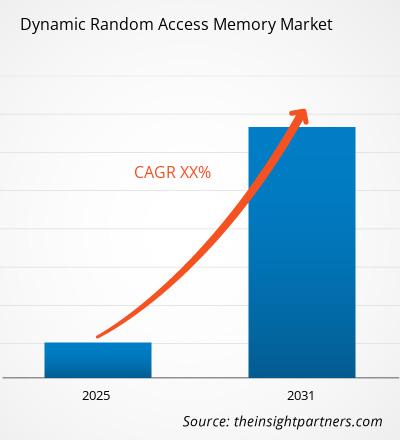
The Dynamic Random Access Memory Market was valued at US$ 99.35 Billion in 2025 and is projected to reach US$ 237.94 Billion by 2034, registering a CAGR of 10.19% during 2026–2034. Growth stems from the increasing memory intensity of AI, cloud computing, smartphones, personal computers, and enterprise servers. Manufacturers are working on the simultaneous improvement of bit density, bandwidth, power efficiency, and packaging for increasingly challenging computing needs.
North America is projected to grow at an estimated CAGR of 9.2% to 10.2% between 2024 and 2034 due to the increased memory intensity in hyperscale data centers, AI accelerators, and enterprise server upgrades. The Dynamic Random Access Memory Market size in North America is positively affected by local semiconductor incentives and stable cloud computing capital spending, despite fabrication being located mainly in Asia.
Dynamic Random Access Memory Market Assessment and Insights
- North America represented an estimated 22–25% share in 2025 and is projected to grow at 9.2–10.2% CAGR during 2026–2034, supported by hyperscale cloud, AI infrastructure, and enterprise server investments.
- US accounted for 82–86% of North American revenue in 2025 and should advance at 9.4–10.4% CAGR as data center and high-performance computing procurement rises.
- Europe held an estimated 15–18% share in 2025 and is forecast to expand at 8.3–9.3% CAGR, led by Germany, the UK, and France through automotive, industrial, and cloud demand.
- Asia Pacific captured an estimated 45–48% share in 2025 and should grow at 10.8–11.8% CAGR, with South Korea, China, Japan, and Taiwan anchoring fabrication and device assembly.
- Largest Segment Mobile Devices represented an estimated 38–42% share in 2025 and is projected to record 8.8–9.8% CAGR as premium smartphones adopt higher-capacity low-power memory.
- High Growth Segment Server held an estimated 27–31% share in 2025 and should post 12.5–13.5% CAGR as AI training, inference, and cloud workloads increase capacity per platform.
- Key companies analyzed in detail: Alliance Memory, Inc.; Centon Electronics, Inc.; Infineon Technologies AG; Elpida Memory, Inc.; Intel Corporation; Kingston Technology Company, Inc.; Micron Technology, Inc.; Nanya Technology Corporation; Samsung Electronics Co., Ltd.; Texas Instruments Incorporated.
Source: The Insight Partners' analysis based on proprietary research, government publications, company annual reports, investor presentations, industry databases, and expert interviews.
Market development is transitioning from the sequential improvements in DDR2/DDR3 to DDR4 scaling, and the forefront manufacturing is increasingly focusing on DDR5, LPDDR5X, and other high bandwidth designs beyond the above segmentation. Extreme ultraviolet lithography, smaller process nodes, through-silicon vias, and advanced packaging increase bandwidth and bit generation but require a considerable capital investment and careful yield control. With advanced capacity increasingly being devoted by suppliers to AI devices, conventional DRAM supply and contract pricing may become tighter, encouraging cyclical inventory dynamics in mobile, PC, and industrial markets.
For the future, capacity investments will happen mainly in South Korea, USA, Japan, and Taiwan, while India and Southeast Asia will create assembly and electronics hubs. The incentive programs of semiconductors, data localization programs, sovereign cloud programs, and energy efficiency requirements must work to the advantage of the eligible local supply chains. Strategic sourcing, dual sourcing, and memory tuning will be part of procurement processes.
Dynamic Random Access Memory Market Report Scope
| Report Attribute | Details |
|---|---|
| Market size in 2025 | US$ 99.35 Billion |
| Market Size by 2034 | US$ 237.94 Billion |
| Global CAGR (2026 - 2034) | 10.19% |
| Historical Data | 2021-2024 |
| Forecast period | 2026-2034 |
Dynamic Random Access Memory Market Analysis
In addition, DRAM demand is becoming ever more related to memory density per device as opposed to being just unit sales-based. There is increased demand for more extensive pools of memory along with greater bandwidth in the case of AI servers. The same applies to premium smartphones and AI-enhanced personal computers with increased memory for doing inference locally, multitasking, and operating systems.
The supply side still remains limited and capital-intensive. While node changes could lead to improved bit output per wafer, limited yield, packaging issues, and increased allocation towards high margin products could limit the availability of commodity supply. For example, Micron stated that its new 1-gamma DDR5 process provides 30+% higher bit output and over 20% lower power consumption compared to its previous version.
Dynamic Random Access Memory Market Report of Dynamic Random Access Memory reveals that there are two levels of competition existing in the industry. Samsung Electronics Co., Ltd., Micron Technology, Inc., and Nanya Technology Corporation are the three largest firms that dominate the high and standard end of the supply chain, while Alliance Memory, Inc., Centon Electronics, Inc., and Kingston Technology Company, Inc. cater to the module, legacy continuity, and channel solutions. Infineon Technologies AG, Intel Corporation, and Texas Instruments Incorporated matter through adjacency, embedded, and ecosystem impacts.
Positioning is increasingly dependent on technology qualification, customer development, packaging expertise, and geographic spread. The investment into advanced process nodes, high bandwidth products, and domestic manufacturing facilities is growing, even though the existing DDR generations retain some value due to their industrial applications and legacy. Those vendors who could combine advanced investment with stable legacy would be able to reduce their risks and increase customers' lifetimes regardless of pricing cyclicity.
● REPORT CUSTOMIZATION
Tailor This Report To Align With Your Specific Business Requirements
This report can be customized to align precisely with your business objectives, scope, and target markets. Customization options include tailored segmentation, geography, competitive analysis, and strategic insights to support informed decision-making.
Customize This Report →WHAT YOU CAN ADJUST
- ● Segmentations
- ● Geography
- ● Competitive Analysis
- ● Language Preferences
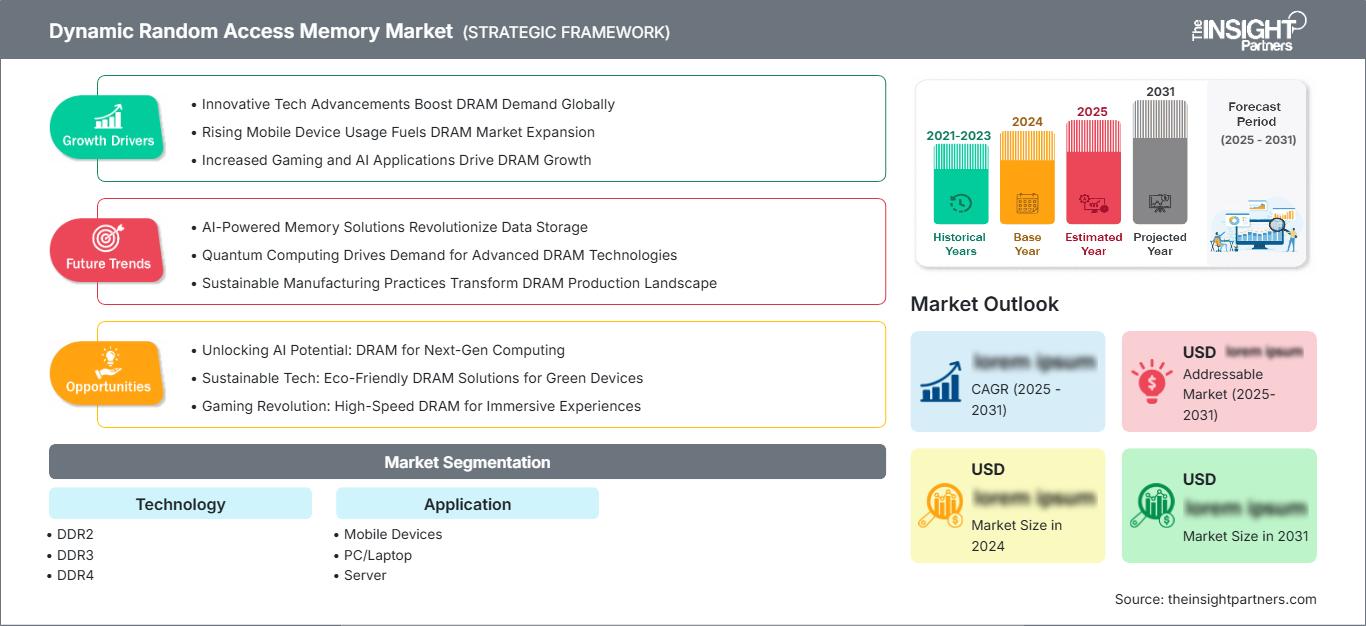
Dynamic Random Access Memory Market: Strategic Insights
Regional Insights
North America Dynamic Random Access Memory Market
The North American region had 22-25% Dynamic Random Access Memory Market share in 2025 and is expected to grow at a 9.2-10.2% CAGR between 2026 and 2034. Hyperscale cloud computing, artificial intelligence accelerators, database migration projects, and workstations will keep server-class sales strong. Furthermore, federal and state programs to incentivize semiconductor production and related activities support in situ manufacturing, fabrication, development and training, yet complete self-sufficiency is out of reach.
Procurement in this region benefits from strong connections between cloud service providers, chipmakers, systems manufacturers and Micron Technology, Inc. Demand is oriented towards reliable, high density, low-power modules with assured supply, not purely cost-competitive pricing. In addition to server applications, automotive electronic systems, military systems and automation, and edge computer infrastructure provide more diversification for demand. Asia-based wafer and packaging capacity makes keeping inventory and long-term contracts crucial.
U.S. Dynamic Random Access Memory Market
US is expected to have accounted for 82-86% of North American revenues in 2025 and be growing at 9.4-10.4% CAGR to 2034. The US presence of hyperscalers, AI model providers, chip vendors, server OEMs, and capital markets speeds up product validation and volume purchases. Micron Technology, Inc., Intel Corporation, Kingston Technology Company, Inc., Alliance Memory, Inc., Centon Electronics, Inc., and Texas Instruments Incorporated participate in the market in manufacturing, platform, module, and distribution segments.
Server end-use drives additional value capture as the result of generative AI and analytics raising memory capacity, bandwidth, and power limits per rack. The premium PC and workstation segment takes advantage of AI capabilities locally whereas mobile is dependent on flagship releases and carrier refresh cycles. Local fab investments can build resilience over time, yet it depends on equipment lead times, construction timelines, labor force availability, and package technologies.
Europe Dynamic Random Access Memory Market
Europe had a share between 15% and 18% in 2025, and its market is expected to grow at CAGR between 8.3% and 9.3% up to 2034. Germany has led the region by automotive electronics, industrial automation, engineering workstations, and edge computing applications. The qualification process is longer than in consumer applications, making it advantageous for suppliers to provide prolonged product availability, functional safety features, and product change management for embedded DDR generations and tough environment.
The UK offers cloud services, financial computing, and AI research services, while France provides sovereign cloud, aerospace computing, and high-performance computing solutions. Italy and Spain provide computing services by virtue of industrial digitization, automotive suppliers, telecommunication modernization, and regional data centers. European chip policy might boost the development of design, research, packaging, and some manufacturing competencies, but availability will remain highly dependent on production in Asia.
APAC Dynamic Random Access Memory Market
The Asia Pacific region accounted for about 45–48% in 2025 and is expected to grow by 10.8-11.8% CAGR up to 2034. South Korea excels because of its DRAM production and leading-edge packaging, while China provides electronics assembly along with growing cloud applications. Japan is known for material and equipment supply as well as automotive and industrial applications.
The Indian market expands the consumption by producing more data centers and devices. The Australian market is involved in the production of clouds and scientific computations. The policy tools and availability of energy will influence the capacity decisions.
Middle East & Africa Dynamic Random Access Memory Market
Middle East & Africa is expected to grow at a CAGR of 7.2%-8.2% through 2034. UAE takes the leadership of the regional market with hyperscale cloud, artificial intelligence, and data center investments, whereas the digital infrastructure initiatives of Saudi Arabia cater to servers, storage, and enterprise computing needs. South Africa continues to be the dominant sub-Saharan region.
Rest of MEA is driven by the modernization of telecom, adoption of public cloud, and digitization of the finance sector. Availability of reliable power, cooling, fiber, logistics for imports, and skilled maintenance ecosystem emerges as critical considerations.
Segmentation Analysis
Technology
The Technology segment is projected to grow at 9.4–10.4% CAGR during 2026–2034. Dynamic Random Access Memory Market scope across DDR2, DDR3, and DDR4 reflects a balance between performance migration and installed-base longevity. DDR4 captures mainstream volume, while DDR3 and DDR2 remain strategically relevant where redesign costs, certification requirements, and long equipment lives outweigh bandwidth gains.
- DDR2 serves legacy industrial, networking, and embedded platforms where long-term availability and pin-compatible replacement matter more than leading performance, creating a specialized but persistent aftermarket.
- DDR3 retains a broad installed base across cost-sensitive computers, communications equipment, and industrial controls, supporting stable replacement demand and supplier strategies centered on lifecycle continuity.
- DDR4 holds the strongest position within the specified technology set because servers, PCs, and embedded systems combine mature ecosystems, high capacity, and favorable cost-per-bit economics.
Application
The Application segment is expected to advance at 10.2–11.2% CAGR during 2026–2034. Mobile devices provide the largest installed-volume base, PCs and laptops gain from AI-enabled replacement cycles, and servers generate the fastest value growth. Purchasing decisions increasingly consider capacity per system, power efficiency, qualification, and total platform cost instead of unit price alone.
- Mobile Devices lead volume demand as premium smartphones add memory for multitasking, imaging, gaming, and on-device AI, while lower tiers remain highly sensitive to bill-of-materials costs.
- PC/Laptop demand depends on commercial refreshes, gaming, content creation, and AI-capable systems, with higher memory configurations supporting productivity while extending replacement value for manufacturers.
- Server is strategically critical because cloud, databases, virtualization, and AI raise memory capacity per processor, making qualification, power efficiency, reliability, and supply assurance central procurement criteria.
Opportunity Snapshot
| Application | Revenue Contribution | Trend Tag | Adoption Stage |
| Mobile Devices | High | On-device AI | Mature |
| PC/Laptop | Medium | AI Refresh | Scaling |
| Server | High | Memory Density | Scaling |
Dynamic Random Access Memory Market Growth Drivers and Impact Analysis
AI Infrastructure Raises Memory Content per Server
Generative AI changes server architecture by making memory bandwidth, capacity, and power efficiency system-level constraints. Training clusters require rapid movement of model parameters, while inference servers retain large context and cache data close to processors. This raises DRAM value per rack even when server unit growth is moderate. The operational impact extends beyond chip suppliers: module makers, packaging providers, thermal engineers, and data-center operators must coordinate qualification and deployment. Vendors that secure accelerator compatibility and predictable delivery can capture longer contracts, whereas buyers without diversified sourcing face exposure to allocation and price volatility when leading-edge capacity shifts toward premium memory products.
Higher Memory Density in Mobile and Client Devices
Smartphones, PCs, and laptops increasingly execute AI features locally to improve responsiveness, privacy, and offline operation. Larger language models, richer imaging pipelines, gaming, and multitasking therefore raise minimum viable memory configurations. The effect is strongest in premium devices, but it gradually moves into mainstream tiers as process scaling improves cost and power. Manufacturers can differentiate through capacity, speed, and battery efficiency, while component suppliers gain from greater bits shipped per device. Risks remain because consumer replacement cycles, channel inventory, and bill-of-materials pressure can delay adoption. Successful suppliers align product roadmaps with platform launches and offer multiple density options for varied price bands.
Semiconductor Localization and Supply Resilience
Government incentives and customer risk controls are encouraging geographically distributed fabrication, packaging, and inventory. Memory production still benefits from scale and dense supplier ecosystems, so localization will be gradual rather than absolute. Nevertheless, new capacity in the United States and policy support across Asia and Europe can reduce single-region exposure, accelerate research partnerships, and strengthen workforce development. Buyers are also adopting dual sourcing, longer agreements, and product qualification across several vendors. These measures improve continuity for servers, vehicles, industrial equipment, and communications infrastructure, but they may raise near-term costs because duplicated qualification, inventory buffers, and underutilized capacity trade efficiency for resilience.
Dynamic Random Access Memory Market Future Trends
Memory Becomes a Co-Designed System Component
Dynamic Random Access Memory Market trends point toward deeper collaboration among memory producers, processor designers, cloud operators, and packaging specialists. Future platforms will optimize memory channels, power delivery, thermals, firmware, and workload scheduling together rather than treat DRAM as a standardized add-on. This approach can shorten qualification cycles and improve real-world performance, but it also raises switching costs and makes ecosystem access strategically important. Suppliers with strong reference designs, simulation capabilities, and customer engineering teams should gain influence. Smaller vendors can compete by targeting legacy continuity, specialized temperatures, module customization, or regional service instead of matching the largest manufacturers in process investment.
Power Efficiency Shapes Product Selection
Memory power consumption will become a more visible procurement metric as AI racks, mobile devices, and edge systems face thermal and energy limits. Process-node advances, low-voltage designs, smarter refresh management, and compact packaging can reduce operating costs while enabling denser configurations. Data-center buyers will evaluate performance per watt and cooling implications alongside capacity and price, while smartphone manufacturers will prioritize battery life and thin form factors. This shift creates opportunities for differentiated modules and system software, but claims will require workload-specific validation. Suppliers able to quantify energy savings across realistic use cases should command stronger design-win credibility.
Dynamic Random Access Memory Market Opportunities
Secure Legacy DRAM Supply for Long-Life Equipment
Industrial, medical, networking, transportation, and defense platforms often remain deployed longer than mainstream memory product cycles. Suppliers can build durable businesses by providing qualified DDR2, DDR3, and DDR4 replacements, transparent product-change notices, controlled bill-of-materials management, and multi-year inventory programs. Alliance Memory, Inc. and specialized module vendors are positioned for this need because customers value redesign avoidance and continuity more than peak bandwidth. Investment should focus on die banking, test coverage, counterfeit prevention, and regional stocking. Commercial success depends on credible lifecycle commitments and engineering support, not merely holding obsolete inventory, because customers must validate electrical, thermal, and reliability behavior.
Develop Low-Power Memory Platforms for AI Inference
AI inference is spreading from centralized clouds to enterprise servers, workstations, smartphones, vehicles, and edge appliances. Vendors can address this opportunity through low-power DRAM, compact modules, validated reference designs, and software tools that balance memory allocation against latency and energy. Partnerships with processor and platform providers can accelerate qualification and create recurring demand across product generations. Investment priorities include thermal characterization, power-management features, security, and workload benchmarking. The strongest propositions will demonstrate total system savings or better user experience, because customers increasingly evaluate memory through application outcomes rather than component specifications alone.
Recent Developments
- June 2026: NVIDIA and SK hynix have announced a multi-year technology partnership to advance next-generation memory solutions for AI factories. The collaboration will support NVIDIA’s AI infrastructure roadmap, including advanced memory development for AI supercomputers, personal AI devices, and robotics platforms. The companies will also use AI-driven tools for semiconductor design, manufacturing optimization, and digital twin-based autonomous factory operations.
- May 2026: Micron Technology has begun 1-alpha DRAM manufacturing at its Manassas, Virginia facility, expanding U.S. memory production capabilities. The advanced DRAM technology will strengthen domestic supply for automotive, defense, industrial, and AI-related applications. The expansion, backed by a multi-billion-dollar investment, is expected to significantly increase DDR4 wafer capacity while supporting secure and reliable memory supply chains in the United States.
- April 2026: SK hynix has started mass production of its 192GB SOCAMM2 memory module, designed for next-generation AI servers and optimized for NVIDIA’s Vera Rubin platform. Built on advanced 1cnm LPDDR5X DRAM technology, the module delivers more than double the bandwidth and over 75% better power efficiency compared with traditional RDIMM solutions. SOCAMM2 aims to reduce AI infrastructure bottlenecks and improve large-scale AI model processing performance.
Frequently Asked Questions

- Comprehensive Market Sizing and Forecast Analysis
- Detailed Segmentation Analysis
- In-Depth Market Dynamics Assessment
- Regional and Country-Level Insights
- Competitive Landscape and Company Benchmarking
- Strategic Business Intelligence
Recent Reports
Testimonials

The Insight Partners provided valuable market intelligence that supported our global go-to-market strategy. Their team was professional, responsive, and attentive to our feedback, providing thoughtful analysis and helpful methodological clarifications throughout the project.
Junmo Kim Chief Financial Officer (CFO), Enertech Co., Ltd.
The Insight Partners' SCADA System Market report is comprehensive, with valuable insights on current trends and future forecasts. The team was highly professional, responsive, and supportive throughout. We are very satisfied and highly recommend their services.
RAN KEDEM Partner, Reali Technologies LTDs
I requested a report on a very specific software market and the team produced the report in a few days. The information was very relevant and well presented. I then requested some changes and additions to the report. The team was again very responsive and I got the final report in less than a week.
JEAN-HERVE JENN Chairman, Future Analytica
We worked with The Insight Partners for an important market study and forecast. They gave us clear insights into opportunities and risks, which helped shape our plans. Their research was easy to use and based on solid data. It helped us make smart, confident decisions. We highly recommend them.
PIYUSH NAGPAL Sr. Vice President, High Beam Global
The Insight Partners delivered insightful, well-structured market research with strong domain expertise. Their team was professional and responsive throughout. The user-friendly website made accessing industry reports seamless. We highly recommend them for reliable, high-quality research services
YUKIHIKO ADACHI CEO, Deep Blue, LLC.
This is the first time I have purchased a market report from The Insight Partners.While I was unsure at first, I visited their web site and felt more comfortable to take the risk and purchase a market report.I am completely satisfied with the quality of the report and customer service. I had several questions and comments with the initial report, but after a couple of dialogs over email with their analyst I believe I have a report that I can use as input to our strategic planning process.Thank you so much for taking the extra time and making this a positive experience.I will definitely recommend your service to others and you will be my first call when we need further market data.
JOHN SUZUKI President and Chief Executive Officer, Board Director, BK Technologies
I wish to appreciate your support and the professionalism you displayed in the course of attending to my request for information regarding to infectious disease IVD market in Nigeria. I appreciate your patience, your guidance, and the fact that you were willing to offer a discount, which eventually made it possible for us to close a deal. I look forward to engaging The Insight Partners in the future, all thanks to the impression you have created in me as a result of this first encounter.
DR CHIJIOKE ONYIA MANAGING DIRECTOR, PineCrest Healthcare Ltd.Reason to Buy
- Informed Decision-Making
- Understanding Market Dynamics
- Competitive Analysis
- Identifying Emerging Markets
- Customer Insights
- Market Forecasts
- Risk Mitigation
- Boosting Operational Efficiency
- Strategic Planning
- Investment Justification
- Tracking Industry Innovations
- Aligning with Regulatory Trends





 Get Free Sample for