
E-Field Generator Market Share, Growth & Forecast by 2034
Coverage: By Type (Horizontal Electric Field Generator, Vertical Electric Field Generator); Application (Residential, Industrial, Commercial), and Geography (North America, Europe, Asia Pacific, and South and Central America)
- Status : Data Released
- Report Code : TIPRE00014689
- Category : Electronics and Semiconductor
- No. of Pages : 150
- Available Report Formats :


- Last update date : August 10, 2026


2025 Market Size
US$ 2.07 Bn
Base year value
2034 Forecast
US$ 3.72 Bn
Projected by 2034
CAGR 2026-2034
6.75 %
Growth rate
Addressable Market
US$ 26.19 Bn
(2026-2034)
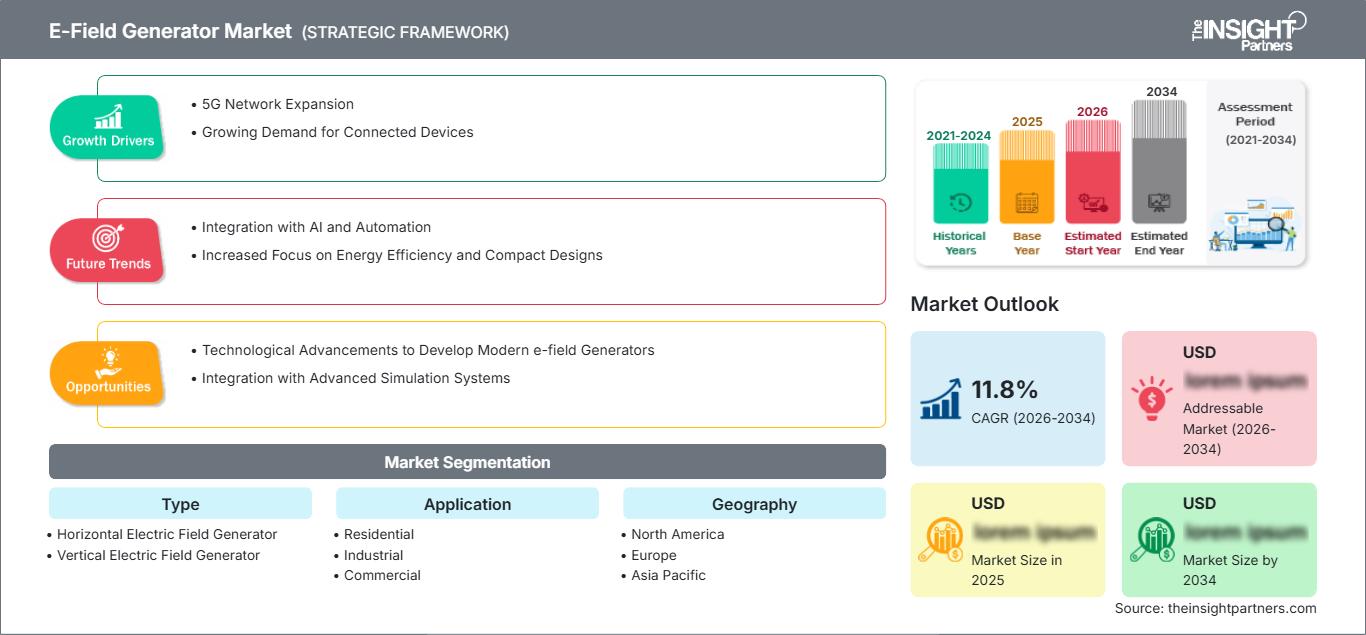
The E-Field Generator Market is worth US$ 2.07 Billion in 2025 and will rise to US$ 3.72 Billion by 2034 with a growth rate of 6.75% during 2026–2034. This market is being driven by rising electromagnetic immunity testing requirements in automotive, industrial, medical, aerospace, military, and connected electronics applications. Manufacturers are focusing on frequency ranges, field intensity, uniformity, and automatic positioning designs, which cut down calibration duration and enable repeatable compliance testing.
North America will be registering a compound annual growth rate of 6.4–6.9% over 2034 due to laboratory upgrades to radiated immunity facilities and car manufacturers' validations of electronic-based cars. The E-Field Generator Market size in North America is positively impacted by EMC testing capabilities, defense qualifications, increasing use of electric vehicles, and remote control of chambers. Buyers are interested in configuration of test capacity, polarization switching, software, and amplifiers utilization.
E-Field Generator Market Assessment and Insights
- North America: Accounted for 34–37% share in 2025 and is projected to grow at a 6.4–6.9% CAGR between 2026–2034, supported by automotive EMC laboratories, defense qualification programs, and installed chamber modernization.
- US: Represented 78–82% of North American revenue in 2025 and is expected to expand at a 6.5–7.0% CAGR between 2026–2034 as certification capacity broadens.
- Europe: Held 27–30% share in 2025 and should advance at a 6.0–6.5% CAGR between 2026–2034, led by Germany, the UK, France, Italy, and Spain.
- Asia Pacific: Captured 24–27% share in 2025 and is forecast to rise at a 7.4–8.0% CAGR between 2026–2034, with China, Japan, South Korea, and India leading investment.
- Largest Segment: Industrial applications held 48–52% market share in 2025 and are projected to grow at a 6.8–7.3% CAGR during 2026–2034.
- High Growth Segment: Vertical electric field generators represented 42–46% market share in 2025 and are expected to post a 7.2–7.8% CAGR during 2026–2034.
- Key companies analyzed in detail: AR Benelux B.V., AR RF/Microwave Instrumentation, TDK RF Solutions Inc., AMETEK, Inc., EMAG eldec Induction GmbH, ETS-Lindgren Inc., Instruments for Industry, MDL Technologies Ltd., montena technology sa, and SureView Instruments.
Source: The Insight Partners' analysis based on proprietary research, government publications, company annual reports, investor presentations, industry databases, and expert interviews.
Product development has evolved from primarily mechanical single polarized systems to modular transmission line systems offering remote height adjustment, quick transition between horizontal and vertical, and built-in testing capabilities. Modern product offerings cover frequencies from kilohertz up to hundreds of megahertz, with improvements in power terminations for continuous duty use. Manufacturing is niche since fiberglass structures, baluns, loads, precision conductors, and chamber connections all necessitate application-specific design. Manufacturers are beginning to offer their products bundled together with generators, amplifiers, probes, software, and enclosures in a turnkey immunity ecosystem approach.
For the entire forecast period, capacity additions will be aimed at sites close to automotive electronics, aerospace, defense, and advanced manufacturing plants. Investments in electrification, resilient infrastructure, and local semiconductor eco-systems will unintentionally drive equipment spending via higher electronic control density. Convergence in regulations of repeatable test methodologies for radiated immunity testing will help modular systems that can be upgraded instead of replaced. The Asia Pacific area will have new laboratory set-ups, while North America and Europe will concentrate on chamber upgrade and digitalization.
E-Field Generator Market Report Scope
| Report Attribute | Details |
|---|---|
| Market size in 2025 | US$ 2.07 Billion |
| Market Size by 2034 | US$ 3.72 Billion |
| Global CAGR (2026 - 2034) | 6.75% |
| Historical Data | 2021-2024 |
| Forecast period | 2026-2034 |
E-Field Generator Market Analysis
Market Drivers for E-Field Generator are based on increasing electronic content per unit and necessity of verification for immunity before certification or going into production. Electronic control units, industrial drives, medical electronics, avionics, wireless products operate in ever-more challenging EM environment. Supply chain involves manufacturers of conductors and structures, RF amplifiers suppliers, chamber suppliers, field probe manufacturers, automation software companies, calibration labs, accredited test labs.
Supply side is rather concentrated, since engineering of uniformity of fields, ability to carry high power, dielectric isolation and stability are interrelated. Delivery time depends on high power requirements, special fiberglass frames, RF connectors, timing of chambers installations. Therefore, buyers consider factors such as life cycle support, calibration data availability, upgrade capabilities, compatibility with existing amplifiers. Turnkey solutions have competitive advantages, since they eliminate risks of implementation and establish repeatable relationships between generation of stimulus, field measurements, operating of devices and reporting.
E-Field Generator Market report reveals that competition is more about the usable test capacity, frequency range, field strength, polarization capability, and integration skills rather than the price per unit. AR RF/Microwave Instrumentation, TDK RF Solutions Inc., ETS-Lindgren Inc., and Instruments for Industry compete by virtue of wide EMC product lines, whereas montena technology sa focuses on transient and immunity engineering. MDL Technologies Ltd. gains in access to channels and systems integration in Europe.
Investment is made into remote actuation, calibration profiles in memory, increased continuous power, and software switch for improved laboratory efficiency. AMETEK, Inc. is able to benefit from the instrumentation scale and service breadth, whereas AR Benelux B.V. specializes in regional application engineering. EMAG eldec Induction GmbH and SureView Instruments cover adjacent technical segments increasing customer access. Strategic positioning now revolves around offering fully integrated and standards-compliant workflow and servicing in proximity to valuable certification centers.
● REPORT CUSTOMIZATION
Tailor This Report To Align With Your Specific Business Requirements
This report can be customized to align precisely with your business objectives, scope, and target markets. Customization options include tailored segmentation, geography, competitive analysis, and strategic insights to support informed decision-making.
Customize This Report →WHAT YOU CAN ADJUST
- ● Segmentations
- ● Geography
- ● Competitive Analysis
- ● Language Preferences
E-Field Generator Market: Strategic Insights
Regional Insights
North America E-Field Generator Market
North America comprised 34-37% of the E-Field Generator market share in 2025 and would grow at a CAGR of 6.4-6.9% from 2026 through 2034. North America is home to established EMC laboratories, aerospace and defense programs, automotive validation, medical-device certification, and extensive industrial electronics manufacture. Needs include system compatibility for chambers that have high-field-strength capability, consistent polarity inversion, and automation of calibrations for various devices.
The replacement market is just as significant. Many existing installations are replacing controllers, amplifiers, probes, and mechanical positioning hardware without reconfiguring their entire chambers. Application-engineering, calibration capabilities, and system-integration capabilities are advantageous for vendors as the system's performance requires the whole RF chain. Testing is more intensive due to electrification of vehicles, grid control, connected factories, and defense electronics; domestic manufacturing incentives will drive additional labs into the target market. Canada adds aerospace, transportation, and industrial programs, while Mexico adds automotive electronics manufacturing.
U.S. E-Field Generator Market
The United States constituted 78–82% of North American revenues in 2025 and is expected to expand at a 6.5–7.0% CAGR until 2034. Applications emerge out of automotive test sites, defense contractors, aerospace labs, semiconductor equipment firms, and medical device makers. Specifications involve increasing size of units being tested, more power, auditable documentation of calibrations, and compatibility with existing controls on chambers. Homegrown suppliers and technical support networks decrease setup, installation, and maintenance timeframes.
Industrial applications dominate buying in the United States since industries demand reliable tests for their immunities. Commercial labs equip themselves with flexible testing systems to cater to different client applications. The applications linked to the home include those related to connected appliances, energy management, and consumer electronics. Relevant vendors include AR RF/Microwave Instrumentation, TDK RF Solutions Inc., ETS-Lindgren Inc., AMETEK, Inc., and Instruments for Industry.
Europe E-Field Generator Market
Europe represents 27% to 30% of the world's revenue in 2025 and is estimated to register 6.0% to 6.5% CAGR till 2034. Germany leads via automotive engineering, industrial automation, power electronics, and high capacity of accreditation for test facilities. The test labs focus on flexible polarization, large immunity tests, and incorporation with existing semi-anechoic rooms. Germany is predicted to register 6.2% to 6.7% CAGR due to vehicle electrification and machinery digitalization qualifying tasks.
Advantages accrue to the UK in terms of aerospace, defense, telecommunications, and compliance solutions, where the procurement process involves adaptability and serviceability of the devices used. France is known for its demands for aerospace, rail, defense, and energy electronics products. Italy contributes to the supply of industrial automation, appliances, and transport manufacturing, whereas Spain contributes to renewable energy control and automotive components testing. Regional harmonization calls for standardization in approach and documentations. The experience of suppliers such as montena technology sa and MDL Technologies Ltd makes the solutions readily available.
APAC E-Field Generator Market
The Asia Pacific region accounted for 24-27% in 2025 and will witness a 7.4-8.0% CAGR between 2026-2034. China dominates in electronics, EVs, batteries, control systems, and expansion of domestic compliance infrastructure. The Japanese and South Korean regions maintain excellence in advanced automotive, robotics, and semiconductor testing, whereas the Indian market has electronics manufacturing and defense qualification.
The Australian region provides an opportunity in aerospace, mining automation, and independent lab demand. Government support for localization, export qualification, and advanced manufacturing drives the growth in building chambers than just replacement of the existing chambers. Buyers have preference towards modular chambers that are capable of testing across various standards and different devices sizes.
Middle East & Africa E-Field Generator Market
MEA/Africa is anticipated to grow at a CAGR of 5.4-6.0% until 2034. Leading countries in the region include UAE, which focuses on aviation, military, telecoms, and smart infrastructure testing, followed by Saudi Arabia, driven by electronics qualification needs due to localization and grid upgrade trends.
In general, procurement in the region usually prefers turnkey solutions due to variable local calibrations and radio frequency testing capacity. Energy diversification, data centers' construction, and transport upgrade trends lead to electronics immunity verification requirements. Collaboration with services, operators' training, and remote diagnostics play an important role in establishing a presence in the region.
Segmentation Analysis
Type
Type is projected to expand at a 6.6–7.1% CAGR during 2026–2034. The E-Field Generator Market scope spans configurable horizontal and vertical field architectures selected according to polarization, chamber geometry, device dimensions, and applicable immunity method. Purchasing decisions emphasize uniform fields, safe power handling, adjustable conductor spacing, and rapid reconfiguration. Dual-mode platforms gain preference where laboratories must maximize chamber utilization across automotive, industrial, aerospace, and defense test programs.
- Horizontal Electric Field Generator: This configuration remains important for large-device and vehicle-component testing where controlled lateral polarization, adjustable conductor spacing, and broad immunity volume support repeatable qualification across demanding low-frequency programs.
- Vertical Electric Field Generator: Adoption is accelerating as laboratories seek straightforward ground-plane coupling, compact chamber integration, and high-intensity performance for industrial controls, automotive electronics, defense subsystems, and specialized certification workflows.
Application
Application demand is expected to increase at a 6.7–7.2% CAGR during 2026–2034. Industrial testing provides the deepest installed base because automation, transportation, energy, aerospace, and defense electronics require rigorous immunity validation. Commercial laboratories value flexible systems that support varied client workloads, while residential-linked demand follows connected appliances, smart-energy controls, and consumer electronics. Across applications, automation and reproducible calibration increasingly determine total ownership value.
- Residential: Demand arises indirectly through conformity testing of smart appliances, home-energy systems, connected security devices, and consumer electronics, where compact equipment and cost-efficient, repeatable immunity workflows are strategically important.
- Industrial: This application leads because factories, vehicles, power converters, robotics, avionics, and defense electronics face severe electromagnetic environments, making high field strength, large test volume, and auditability essential.
- Commercial: Independent laboratories, telecommunications facilities, universities, and certification providers prioritize adaptable systems that accommodate varied device sizes, standards, and throughput requirements while supporting dependable calibration records and service continuity.
Opportunity Snapshot
| Application | Revenue Contribution | Trend Tag | Adoption Stage |
| Residential | Low | Smart Homes | Scaling |
| Industrial | High | Factory Immunity | Mature |
| Commercial | Medium | Lab Expansion | Scaling |
E-Field Generator Market Growth Drivers and Impact Analysis
Rising Electronic Content Intensifies Immunity Qualification
Vehicles, factories, medical devices, aircraft, grid equipment, and consumer products now combine more processors, sensors, converters, radios, and high-speed communication links. Each additional subsystem creates potential susceptibility pathways and raises the cost of late-stage failure. Manufacturers consequently move radiated-immunity work earlier into design verification and repeat testing after hardware or software changes. E-field generators provide controlled exposure over defined frequencies and polarizations, enabling engineers to identify resets, communication interruptions, sensor errors, and degraded control behavior before certification. The commercial impact extends beyond new laboratory purchases: higher test frequency increases utilization, service, calibration, software, and replacement demand across the installed base.
Standards Alignment Expands Repeatable Test Infrastructure
IEC 61000-4-3 establishes a common method for evaluating electronic equipment against radiated radio-frequency fields, while automotive and military programs apply demanding sector-specific procedures. This standards framework pushes laboratories toward documented field uniformity, amplifier linearity, repeatable device layouts, and traceable calibration. Generators that integrate positioning, switching, monitoring, and reporting reduce operator variability and make evidence easier to audit. The effect is strongest in export-oriented manufacturing, where a product may require multiple qualification pathways before market entry. Consequently, suppliers offering standards-aligned configurations, application engineering, and lifecycle calibration can participate in initial equipment sales and recurring service revenue.
Electrification and Automation Increase High-Power Test Needs
Electrified transport, renewable-energy conversion, robotics, motor drives, and automated production introduce fast-switching power electronics near sensitive control circuits. These environments require immunity verification that reflects substantial field intensity and large equipment dimensions. Laboratories therefore seek generators with robust terminations, stable input impedance, adjustable structures, and compatibility with powerful broadband amplifiers. Larger usable test volumes also let facilities validate integrated assemblies rather than isolated boards. This driver supports premium configurations and chamber retrofits because customers must accommodate heavier devices without sacrificing repeatability. Vendors that coordinate generator, amplifier, probe, software, and safety interlocks can reduce commissioning risk and capture a larger share of project spending.
E-Field Generator Market Future Trends
Closed-Loop Field Control and Digital Test Orchestration
E-Field Generator Market trends will increasingly center on closed-loop control that links signal generation, amplifier output, field probes, positioning, device monitoring, and reporting. Instead of relying on discrete manual steps, laboratories will use stored profiles to reproduce test conditions across sites and product revisions. Remote-controlled conductor height, spacing, and polarization will shorten setup and reduce exposure to high-power areas. Data models will flag drift, predict calibration needs, and compare device responses over time. This transition will favor suppliers with interoperable software, open interfaces, cybersecurity controls, and service capabilities extending beyond the mechanical generator.
Modular Architectures for Wider Frequencies and Device Volumes
Future systems will be designed around replaceable baluns, loads, conductors, positioning modules, and control electronics so laboratories can extend frequency coverage or power capability without replacing entire installations. Configurable geometry will support both compact electronic modules and large integrated assemblies. Suppliers will increasingly pre-engineer interfaces for chamber ceilings, ground planes, safety systems, and amplifier racks. Standardized modules can also improve manufacturing economics in a low-volume market by reducing one-off engineering. Customers will value upgrade guarantees and documented compatibility because test standards, wireless services, and product dimensions continue to evolve throughout long chamber lifecycles.
E-Field Generator Market Opportunities
Retrofit Packages for Installed EMC Chambers
A substantial opportunity lies in upgrading existing chambers with remote positioning, modern loads, safer switching, field-monitoring integration, and unified software. Retrofits require less capital and downtime than complete facility replacement, which is attractive to laboratories facing rising workloads but constrained construction budgets. Vendors can package site surveys, mechanical adaptation, commissioning, calibration, and operator training into outcome-based projects. Recurring revenue follows through preventive maintenance, software support, and periodic recalibration. Success requires accurate compatibility assessment because chamber geometry and legacy amplifiers vary. Partnerships with local integrators can extend geographic coverage while preserving specialist engineering oversight.
Localized Compliance Capacity in Emerging Manufacturing Hubs
Electronics, electric-vehicle, battery, aerospace, and defense manufacturing is expanding in locations where advanced EMC capacity remains limited. Suppliers can capture this gap by establishing demonstration centers, regional spares, training programs, and application engineering near production clusters. Turnkey systems configured for several standards reduce the risk faced by first-time laboratory operators. Leasing, staged payments, and shared testing facilities can address capital constraints while building installed base. Local partnerships are critical for civil works, chamber integration, accreditation preparation, and after-sales response. Early entrants can influence specifications and create durable service relationships before procurement patterns become entrenched.
Recent Developments
- April 2026: ePropelled has expanded its Hercules starter generator product line to support next-generation hybrid missions across unmanned aerial, ground, and marine platforms. The upgraded systems offer wider power options from 500W to 12kW, improved thermal performance, reduced weight, and enhanced power management capabilities. Integrated with the ePConnected ecosystem, Hercules enables real-time monitoring and greater efficiency for extended-duration hybrid operations.
- March 2025: Aeronero has launched its Atmospheric Water Generator (AWG) 2.0 on World Water Day, introducing advanced technology that produces clean drinking water directly from air. The deep-tech company’s new range uses patented air-to-water generation systems for homes, communities, and industries. The devices offer purified, alkaline, and mineralized water while aiming to provide a sustainable solution to growing global water challenges.
- February 2026: INTRACOM DEFENSE (IDE) is advancing military energy solutions with its Hybrid Electrical Power Systems (HEPS), designed to improve mission endurance and operational efficiency. The tactical hybrid systems combine conventional generators, renewable energy sources, and energy storage technologies to create resilient power networks. During NATO exercises, IDE solutions demonstrated fuel savings, reduced maintenance needs, lower thermal and acoustic signatures, and enhanced battlefield power reliability.
Frequently Asked Questions

- Comprehensive Market Sizing and Forecast Analysis
- Detailed Segmentation Analysis
- In-Depth Market Dynamics Assessment
- Regional and Country-Level Insights
- Competitive Landscape and Company Benchmarking
- Strategic Business Intelligence
Recent Reports
Testimonials

The Insight Partners provided valuable market intelligence that supported our global go-to-market strategy. Their team was professional, responsive, and attentive to our feedback, providing thoughtful analysis and helpful methodological clarifications throughout the project.
Junmo Kim Chief Financial Officer (CFO), Enertech Co., Ltd.
The Insight Partners' SCADA System Market report is comprehensive, with valuable insights on current trends and future forecasts. The team was highly professional, responsive, and supportive throughout. We are very satisfied and highly recommend their services.
RAN KEDEM Partner, Reali Technologies LTDs
I requested a report on a very specific software market and the team produced the report in a few days. The information was very relevant and well presented. I then requested some changes and additions to the report. The team was again very responsive and I got the final report in less than a week.
JEAN-HERVE JENN Chairman, Future Analytica
We worked with The Insight Partners for an important market study and forecast. They gave us clear insights into opportunities and risks, which helped shape our plans. Their research was easy to use and based on solid data. It helped us make smart, confident decisions. We highly recommend them.
PIYUSH NAGPAL Sr. Vice President, High Beam Global
The Insight Partners delivered insightful, well-structured market research with strong domain expertise. Their team was professional and responsive throughout. The user-friendly website made accessing industry reports seamless. We highly recommend them for reliable, high-quality research services
YUKIHIKO ADACHI CEO, Deep Blue, LLC.
This is the first time I have purchased a market report from The Insight Partners.While I was unsure at first, I visited their web site and felt more comfortable to take the risk and purchase a market report.I am completely satisfied with the quality of the report and customer service. I had several questions and comments with the initial report, but after a couple of dialogs over email with their analyst I believe I have a report that I can use as input to our strategic planning process.Thank you so much for taking the extra time and making this a positive experience.I will definitely recommend your service to others and you will be my first call when we need further market data.
JOHN SUZUKI President and Chief Executive Officer, Board Director, BK Technologies
I wish to appreciate your support and the professionalism you displayed in the course of attending to my request for information regarding to infectious disease IVD market in Nigeria. I appreciate your patience, your guidance, and the fact that you were willing to offer a discount, which eventually made it possible for us to close a deal. I look forward to engaging The Insight Partners in the future, all thanks to the impression you have created in me as a result of this first encounter.
DR CHIJIOKE ONYIA MANAGING DIRECTOR, PineCrest Healthcare Ltd.Reason to Buy
- Informed Decision-Making
- Understanding Market Dynamics
- Competitive Analysis
- Identifying Emerging Markets
- Customer Insights
- Market Forecasts
- Risk Mitigation
- Boosting Operational Efficiency
- Strategic Planning
- Investment Justification
- Tracking Industry Innovations
- Aligning with Regulatory Trends





 Get Free Sample for