
Edge AI Hardware Market Size, Share & Demand by 2034
Coverage: by Processors (Central processing units (CPU graphic), Processing unit (GPU), Application-specific integrated circuits (ASICs)); Device (Smartphones, Cameras, Robots, Wearables, Smart Speaker, Automotive, Smart Mirror); Power Consumption (Less Than 1 W, 1-3 W, 3-5 W, 5-10 W, More Than 10 W); Process (Training, Inference); End user (Consumer electronics, Smart Home, Automotive and Transportation, Government, Healthcare, Industrial, Aerospace and Defense, Construction) , and Geography (North America, Europe, Asia Pacific, and South and Central America)
- Status : Data Released
- Report Code : TIPRE00004131
- Category : Electronics and Semiconductor
- No. of Pages : 150
- Available Report Formats :


- Last update date : August 13, 2026


2025 Market Size
US$ 8. Bn
Base year value
2034 Forecast
US$ 25.22 Bn
Projected by 2034
CAGR 2026-2034
13.61 %
Growth rate
Addressable Market
US$ 143.79 Bn
(2026-2034)
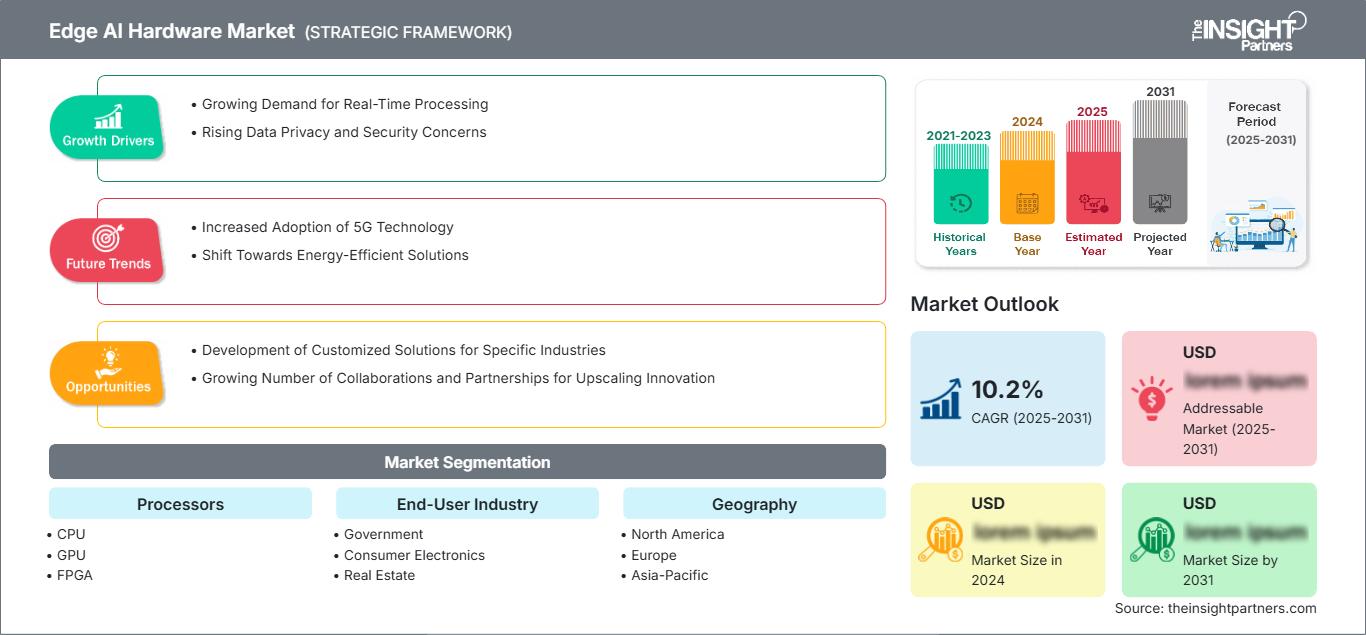
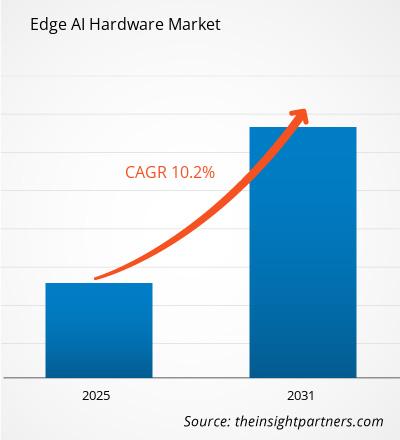
The global Edge AI Hardware market was valued at US$ 8 billion in 2025 and is expected to reach US$ 25.22 billion by 2034; it is estimated to record a CAGR of 13.61% during 2026-2034.
Edge AI Hardware Market Assessment and Insights
- North America held 36–40% share in 2025 and is growing at a CAGR range of 14.6–15.4% during 2026–2034, supported by AI chip design, edge servers, smart devices, and defense-grade inference workloads.
- US represented 82–86% of North America in 2025 and is growing at a CAGR range of 14.8–15.6%, led by hyperscalers, semiconductor leaders, automotive AI, and industrial IoT.
- Europe accounted for 22–26% share in 2025 and is advancing at a CAGR range of 13.2–14.0%, with Germany, the UK, France, Italy, and Spain leading industrial, automotive, and public-sector adoption.
- Asia Pacific captured 28–32% share in 2025 and is expanding at a CAGR range of 16.4–17.2%, led by China, Japan, South Korea, India, and Taiwan-centered electronics supply chains.
- Largest Segment: The GPU processor segment represented an estimated 38–42% market share in 2025 and is projected to register a 14.5–16.5% CAGR during 2026–2034, reflecting its parallel-processing capabilities for demanding AI workloads.
- High Growth Segment: The automotive device segment accounted for approximately 14–18% market share in 2025 and is projected to expand at a 19.0–21.0% CAGR during 2026–2034, driven by ADAS, driver monitoring, and intelligent cockpit applications.
- Key companies analyzed in detail: Adapteva, Inc., Apple Inc., Applied Brain Research, Inc., Arm Limited, General Vision Inc., Horizon Robotics Inc., MediaTek Inc., Qualcomm Technologies, Inc., SecureRF Corporation, and Synopsys, Inc.
Source: The Insight Partners' analysis based on proprietary research, government publications, company annual reports, investor presentations, industry databases, and expert interviews.
Market trends are moving beyond general-purpose embedded processing to heterogenous edge acceleration, including CPUs, GPUs, FPGAs, ASIPs, NPUs, memory technology, and software stacks. The market will be shaped by power limits, model compressions, advanced packaging, and the need for local inference. Companies designing smartphones, automobiles, surveillance cameras, robotics, and industrial machines are beginning to consider AI hardware an integral part of the design process.
Future demands will be greatest for cases in which device independence, data management, and instant responsiveness are critical. New regions take advantage of smart manufacturing, digital health care, security infrastructures, and transportation automation initiatives. Incentives for semiconductor investment, frameworks for AI governance, and energy efficiency considerations are driving consumers to buy hardware that can perform local processing on sensor data and reduce cloud traffic.
Edge AI Hardware Market Report Scope
| Report Attribute | Details |
|---|---|
| Market size in 2025 | US$ 8. Billion |
| Market Size by 2034 | US$ 25.22 Billion |
| Global CAGR (2026 - 2034) | 13.61% |
| Historical Data | 2021-2024 |
| Forecast period | 2026-2034 |
Edge AI Hardware Market Analysis
The Edge AI Hardware Market is driven by real-time decision making, higher sensor density, onboard generative AI, and a shift toward cloud independence. This includes IP vendors, semiconductor companies, foundries, modules manufacturers, devices OEM, software vendors, systems integrations, and vertical customers. These markets show the most demand when there is a need to minimize latency, enhance privacy, increase power efficiency, and maintain offline capabilities.
The supply dynamics hinge on access to advanced process nodes, memory bandwidth, packaging capabilities, and AI compiler optimization. Edge AI Hardware Market report indicates that increasing differentiation among design is happening through the right balance of performance per watt with developer tools. The companies which offer silicon and developer tools can reduce time to market in industrial, automotive, healthcare, and consumer products.
The competitive positioning will be driven by the depth of the ecosystem and not just chip capabilities. Apple Inc. and Qualcomm Technologies, Inc. deliver AI acceleration on volume consumer and mobile products, Arm Limited and Synopsys, Inc. deliver design enablement tools for the whole semiconductor value chain. MediaTek Inc. delivers improved SoCs for smartphones and IoT devices, and Horizon Robotics Inc. focuses on intelligent mobility and vision computing solutions.
The players such as Adapteva, Inc., Applied Brain Research, Inc., General Vision Inc., and SecureRF Corporation have different strengths in parallel processing, neuromorphic methods, pattern recognition, and secure embedded systems, respectively. The current investment trend is inclined towards edge inference engines, AI-enabled MCUs, automotive domain controllers, and software-defined accelerators in order to help OEMs to deal with cost and heat management.
● REPORT CUSTOMIZATION
Tailor This Report To Align With Your Specific Business Requirements
This report can be customized to align precisely with your business objectives, scope, and target markets. Customization options include tailored segmentation, geography, competitive analysis, and strategic insights to support informed decision-making.
Customize This Report →WHAT YOU CAN ADJUST
- ● Segmentations
- ● Geography
- ● Competitive Analysis
- ● Language Preferences
Edge AI Hardware Market: Strategic Insights
Regional Insights
North America Edge AI Hardware Market
North America accounted for a market share of 36–40% in 2025 and is expected to expand at a CAGR of 14.6–15.4% from 2025 to 2034. The growth in Edge AI Hardware Market share can be attributed to semiconductor design expertise, cloud-edge architecture, military upgrades, significant AI expenditure by enterprises, and AI-driven consumer electronics. With global GDP growth rate estimates of 3.0% by the IMF in 2025, there seems to be a conservative macroeconomic outlook where productivity-enhancing automation becomes an essential enterprise need.
Regional demand will arise from smartphones, connected vehicles, industrial cameras, edge servers, and medical devices. Energy and AI according to IEA, reveal a trend where the electricity required by AI data centers creates a strong case for inference to be made locally within the device due to concerns about AI data center energy consumption.
U.S. Edge AI Hardware Market
The US accounts for 82-86% of North America and is expected to see a CAGR between 14.8-15.6%. Demand will be driven by consumer electronics, AI PCs, military electronics, self-driving cars, surveillance improvement, and automation in manufacturing factories. Apple Inc., Qualcomm Technologies, Inc., Arm Limited, Synopsys, Inc., and others have design licensing ecosystem strengths.
The application areas being seen to grow include device assistants, computer vision, predictive maintenance, local patient care, and secure government applications. Low-power inference, model upgradability, and chain security will be needed by the consumers. The US Market has strengths like advanced chip design ecosystem, startup investments, and acquisition programs that demand secure platforms domestically or through alliances.
Europe Edge AI Hardware Market
The European market had 22-26% market share in 2025 and is estimated to have a compound annual growth rate of 13.2-14.0%. Germany leads the market with automobile electronics, industrial automation, and artificial intelligence for machines, UK is involved with AI software, semiconductors, and defense, while France is contributing in aerospace, healthcare, and digital government.
Italy and Spain are contributing to the adoption of artificial intelligence through smart manufacturing, transportation monitoring, energy infrastructure, and advanced medical technologies. The European region is constrained due to fragmented procurement but benefited by digital sovereignty. The demand for the market is high where there is a need for deterministic processing, localized data processing, and energy efficiency.
APAC Edge AI Hardware Market
Asia Pacific has held 28-32% market share in 2025 and is projected to witness CAGR of 16.4-17.2%. China dominates in terms of production of devices and intelligent vehicles, while Japan and South Korea provide expertise in electronics and robotics; India builds out digital infrastructure locally, and Taiwan continues to be important for semiconductor manufacturing.
In industry and policy drivers include smartphones AI, surveillance cameras, industrial automation, intelligent transportation, and semiconductors programs. Drivers of market include electronics value chain concentration and rapid product lifecycle management. The highest adoption takes place in areas where local manufacturing, AI software, and hardware acceleration can be combined.
Middle East & Africa Edge AI Hardware Market
Middle East & Africa is projected to grow at a CAGR range of 12.0–12.8% as Saudi Arabia, the UAE, South Africa, and the rest of MEA expand smart-city, energy, security, and transport infrastructure. The UAE leads formal adoption through data centers, digital government, and connected surveillance.
Edge computing is relevant to energy and infrastructure sectors such as electrical grids, oil and gas installations, airports, ports, and transportation systems. Implementation has been sporadic due to the underdeveloped semiconductor ecosystem at a local level. However, the need for rugged and secure devices is increasing, and growth relies on systems integration and procurement funds.
Segmentation Analysis
Processors
Processors are projected to record a 14.5–16.5% CAGR during 2026–2034 as hardware architectures evolve to execute increasingly complex neural networks under strict latency, memory, and power constraints. The Edge AI Hardware Market scope across processors is increasingly shaped by heterogeneous computing, where general-purpose processing and specialized accelerators operate together to optimize inference performance across consumer, automotive, industrial, and embedded applications.
- Central processing units (CPU graphic): CPUs provide flexible control and general-purpose computation for edge systems, particularly where AI inference operates alongside operating systems, connectivity, sensor management, and conventional application workloads.
- Processing unit (GPU): GPUs maintain a strong position because highly parallel architectures efficiently execute matrix-intensive AI workloads, supporting computer vision, generative AI, robotics, autonomous systems, and advanced multimedia processing.
- Application-specific integrated circuits (ASICs): ASICs are strategically important for high-volume edge applications requiring optimized performance per watt, predictable latency, compact footprints, and acceleration tailored to specific neural-network operations.
Device
Device applications are projected to expand at a 16.0–18.0% CAGR during 2026–2034 as artificial intelligence becomes embedded across everyday electronics, vehicles, machines, and connected infrastructure. Hardware requirements vary substantially by device, encouraging processor suppliers to balance inference throughput, thermal constraints, battery life, connectivity, and memory. Smartphones remain important volume platforms, while automotive systems and robots are creating increasingly compute-intensive opportunities.
- Smartphones: Smartphones represent a major deployment platform as neural processing supports photography, speech recognition, personalization, translation, security, generative AI assistants, and increasingly sophisticated applications without continuous cloud processing.
- Cameras: AI-enabled cameras use local computer vision for object detection, classification, behavioral analysis, quality inspection, traffic monitoring, and security while minimizing bandwidth requirements associated with transmitting continuous video.
- Robots: Robotics platforms require deterministic, low-latency processing for navigation, perception, manipulation, collision avoidance, and human-machine interaction, creating demand for compact accelerators capable of processing multiple sensor streams simultaneously.
- Wearables: Wearables favor highly energy-efficient AI processors capable of supporting contextual computing, voice processing, activity recognition, sensor fusion, and personalized experiences while preserving limited battery capacity.
- Smart Speaker: Smart speakers use edge intelligence for wake-word detection, voice processing, personalization, and selected conversational functions, reducing response latency and improving functionality when cloud connectivity is constrained.
- Automotive: Automotive adoption is accelerating through ADAS, driver monitoring, intelligent cockpits, perception, voice interfaces, and autonomous-driving functions requiring high-throughput inference with stringent reliability and latency characteristics.
- Smart Mirror: Smart mirrors represent an emerging application combining computer vision, contextual interfaces, personalization, wellness functionality, and interactive retail experiences through compact processing hardware integrated directly into display systems.
Power Consumption
Power Consumption categories are projected to register a 14.0–16.0% CAGR during 2026–2034, reflecting the increasing importance of performance per watt in distributed AI architectures. Hardware selection depends on workload intensity, device mobility, thermal design, battery availability, and inference frequency. Semiconductor developers are consequently emphasizing optimized neural engines, reduced-precision computation, advanced process nodes, and workload scheduling to increase intelligence without proportionately increasing energy requirements.
- Less Than 1 W: Ultra-low-power hardware addresses always-on sensing, lightweight classification, wake-word detection, wearables, and battery-constrained endpoints where energy efficiency takes precedence over maximum computational throughput.
- 1-3 W: This category supports compact connected products requiring recurring inference, balancing sufficient AI acceleration with battery longevity and manageable thermal characteristics across portable and embedded applications.
- 3-5 W: Processors within this range address moderately intensive computer-vision and multimodal workloads in cameras, smart-home equipment, portable electronics, and embedded systems requiring sustained inference capabilities.
- 5-10 W: Higher-performance edge platforms use this power envelope for robotics, intelligent cameras, industrial controllers, and advanced embedded systems requiring concurrent processing of multiple AI and sensor workloads.
- More Than 10 W: High-compute systems prioritize inference throughput for autonomous machines, vehicles, industrial platforms, and sophisticated vision applications where performance requirements justify greater thermal and electrical design capacity.
Process
Process is projected to expand at a 15.0–17.0% CAGR during 2026–2034 as organizations distribute selected AI workloads closer to data-generating assets. Inference remains the principal edge workload because real-time decisions must frequently occur locally. Training is also gaining strategic relevance through incremental learning and specialized adaptation, although memory capacity, power consumption, and computational intensity continue to favor centralized infrastructure for large-scale model development.
- Training: Edge training supports specialized use cases involving personalization, adaptive systems, federated learning, and localized model updates, particularly where organizations seek to limit movement of sensitive or proprietary datasets.
- Inference: Inference represents the core hardware workload because deployed devices must transform trained models into immediate decisions, classifications, predictions, recommendations, or control actions with minimal cloud dependency.
End user
End user demand is projected to register a 15.5–17.5% CAGR during 2026–2034, supported by increasingly diverse requirements for localized intelligence. Consumer electronics provides large deployment volumes, while automotive, healthcare, government, industrial, and aerospace applications emphasize latency, privacy, resilience, and deterministic performance. Hardware vendors increasingly differentiate platforms through vertical-specific software, development tools, safety features, connectivity, and optimized AI models rather than computational capability alone.
- Consumer electronics: Device manufacturers are embedding AI accelerators into smartphones, PCs, wearables, and entertainment products to deliver personalized, multimodal, and generative experiences without transferring every interaction to cloud infrastructure.
- Smart Home: Smart-home platforms use local AI for security, voice interfaces, occupancy detection, automation, and energy management, improving responsiveness while limiting transmission of sensitive household information.
- Automotive and Transportation: Transportation applications require edge intelligence for perception, ADAS, fleet monitoring, intelligent cockpits, traffic analysis, and autonomous functions where network-dependent decision-making can introduce unacceptable latency.
- Government: Government deployments span intelligent surveillance, public infrastructure, border applications, emergency response, and secure computing, where localized processing can strengthen operational continuity and information control.
- Healthcare: Medical devices increasingly employ embedded intelligence for imaging assistance, monitoring, diagnostics support, and workflow automation, creating demand for reliable processors capable of handling sensitive information locally.
- Industrial: Manufacturers deploy edge AI across machine vision, predictive maintenance, robotics, process control, worker safety, and quality inspection, making industrial environments strategically important for ruggedized inference hardware.
- Aerospace and Defense: Mission-critical platforms benefit from autonomous perception, navigation, sensor fusion, and threat detection performed locally where communication bandwidth, cybersecurity considerations, and disconnected operations constrain cloud dependence.
- Construction: AI-equipped cameras, machinery, drones, and monitoring systems support site safety, equipment utilization, progress tracking, inspection, and autonomous operations across increasingly digitized construction environments.
Opportunity Snapshot
| End Users | Revenue Contribution | Trend Tag | Adoption Stage |
| Consumer electronics | High | On-device GenAI | Mature |
| Smart Home | Medium | Local Automation | Scaling |
| Automotive and Transportation | High | Autonomous Perception | Scaling |
| Government | Medium | Secure Inference | Scaling |
| Healthcare | Medium | Clinical Edge | Scaling |
| Industrial | High | Machine Vision | Mature |
| Aerospace and Defense | Medium | Mission AI | Scaling |
| Construction | Low | Site Intelligence | Emerging |
Edge AI Hardware Market Growth Drivers and Impact Analysis
Device-Level Inference Reduces Latency and Bandwidth Pressure
AI processing loads call for actions to be taken near the sensor, camera, microphone, machine, and vehicle. Processing on the edge helps to avoid delay caused by the time required to send information to a server and back, prevents any congestion of the network, and avoids sending sensitive information to another place. The economic implications of edge processing include the increasing need for processors that are not only fast in inference but also have the ability to operate with minimal energy consumption and thermal management.
AI-Enabled Consumer Devices Create High-Volume Silicon Demand
Mobile phones, wearables, laptops, speakers, cameras, and even home appliances will be the main medium for using AI on a daily basis. Device manufacturers have a need for a chip that will provide support for imaging processing, speech recognition, personal assistants, health monitoring, and local generation without continuous connection to the cloud. High-volume manufacturing cycles of devices allow achieving economies of scale in terms of ASICs, GPUs, CPUs, and AI accelerators, thus reducing costs per unit and making the products available to other industries. The result for the market will be faster development of compact and energy-efficient processors and increased competition in developer tools.
Industrial Automation Requires Reliable Local Decision-Making
AI-based cameras, robots, controllers, and sensors have been embraced by manufacturers for enhancing accuracy, minimizing downtime, and ensuring the safety of the workers. Sometimes cloud analytics fail to comply with the timing, cybersecurity, and connectivity needs of production lines, and hence on-premise computation is necessary. Edge devices make it possible to conduct defect inspection, vibration monitoring, computer vision, and process control in factories with consistent reaction times. The effect in the market would be an increase in demand for rugged modules, FPGAs, GPUs, and ASIC-based accelerators that work under rugged conditions.
Edge AI Hardware Market Future Trends
On-Device Generative AI Moves Into Mainstream Products
Edge AI Hardware Market trends will increasingly center on compact models that run directly on phones, PCs, vehicles, cameras, and industrial terminals. Local generative AI can support summarization, voice interaction, visual search, coding assistance, and diagnostics while reducing cloud usage and improving privacy. Over the next decade, hardware roadmaps will prioritize memory efficiency, transformer acceleration, sparse computing, and mixed-precision inference. This shift will favor architectures that deliver sustained performance within strict thermal envelopes. Device makers that optimize silicon, operating systems, and model deployment together will gain differentiation through faster response and lower recurring service costs.
Secure Edge AI Becomes a Design Requirement
Future deployments will place stronger emphasis on hardware roots of trust, encrypted model storage, secure boot, tamper resistance, and protected inference pipelines. As AI moves into vehicles, public infrastructure, healthcare, and government devices, compromised edge hardware could expose sensitive data or manipulate decisions. Security will therefore become a buying criterion alongside power, cost, and performance. Suppliers with embedded security IP, certification pathways, and lifecycle update support will gain advantage. This trend also benefits companies that combine AI acceleration with authentication, post-quantum readiness, and device identity management for distributed environments.
Edge AI Hardware Market Opportunities
AI Hardware for Regulated Healthcare Devices
Healthcare offers a targeted investment opportunity because diagnostics, imaging, patient monitoring, and surgical systems require fast interpretation without unnecessary data movement. Edge AI Hardware Market Forecasts point to expanding demand for privacy-preserving medical intelligence, especially where hospitals manage bandwidth constraints and regulatory controls. Hardware suppliers can work with device OEMs to create validated reference designs for ultrasound, endoscopy, bedside monitoring, wearables, and remote care equipment. Opportunity exists in low-power inference, medical-grade reliability, secure data handling, and software update governance. Vendors that support clinical workflow integration and compliance documentation can achieve longer sales cycles but more defensible revenue.
Automotive and Transportation Edge Platforms
Automotive and transportation systems need local AI for perception, driver monitoring, predictive maintenance, fleet safety, traffic management, and autonomous functions. Companies can invest in scalable platforms that serve passenger vehicles, commercial fleets, rail networks, ports, and drones rather than isolated use cases. The opportunity lies in balancing compute density, safety certification, energy efficiency, and over-the-air updateability. Partnerships between chip suppliers, Tier 1 integrators, mapping firms, and mobility operators can accelerate adoption. Winning platforms will support multiple sensor types, deterministic response, and long lifecycle support while meeting cost targets for mass deployment.
Recent Developments
- June 2026: Qualcomm Technologies, Inc. introduced expanded edge AI platform capabilities for connected devices and industrial applications, emphasizing on-device inference, power efficiency, and software support for developers deploying computer vision and generative AI workloads at the edge.
- September 2025: Apple Inc. advanced on-device intelligence across its latest device ecosystem, reinforcing local AI processing through integrated silicon, privacy-focused model execution, and tighter coordination between hardware, operating systems, and application experiences.
- May 2025: MediaTek Inc. announced new AI-enabled chipset capabilities for mobile and connected devices, supporting improved generative AI, imaging, and power-efficient inference functions for high-volume consumer electronics and edge device manufacturers.
Frequently Asked Questions

- Comprehensive Market Sizing and Forecast Analysis
- Detailed Segmentation Analysis
- In-Depth Market Dynamics Assessment
- Regional and Country-Level Insights
- Competitive Landscape and Company Benchmarking
- Strategic Business Intelligence
Recent Reports
Testimonials

The Insight Partners' SCADA System Market report is comprehensive, with valuable insights on current trends and future forecasts. The team was highly professional, responsive, and supportive throughout. We are very satisfied and highly recommend their services.
RAN KEDEM Partner, Reali Technologies LTDs
I requested a report on a very specific software market and the team produced the report in a few days. The information was very relevant and well presented. I then requested some changes and additions to the report. The team was again very responsive and I got the final report in less than a week.
JEAN-HERVE JENN Chairman, Future Analytica
We worked with The Insight Partners for an important market study and forecast. They gave us clear insights into opportunities and risks, which helped shape our plans. Their research was easy to use and based on solid data. It helped us make smart, confident decisions. We highly recommend them.
PIYUSH NAGPAL Sr. Vice President, High Beam Global
The Insight Partners delivered insightful, well-structured market research with strong domain expertise. Their team was professional and responsive throughout. The user-friendly website made accessing industry reports seamless. We highly recommend them for reliable, high-quality research services
YUKIHIKO ADACHI CEO, Deep Blue, LLC.
This is the first time I have purchased a market report from The Insight Partners.While I was unsure at first, I visited their web site and felt more comfortable to take the risk and purchase a market report.I am completely satisfied with the quality of the report and customer service. I had several questions and comments with the initial report, but after a couple of dialogs over email with their analyst I believe I have a report that I can use as input to our strategic planning process.Thank you so much for taking the extra time and making this a positive experience.I will definitely recommend your service to others and you will be my first call when we need further market data.
JOHN SUZUKI President and Chief Executive Officer, Board Director, BK Technologies
I wish to appreciate your support and the professionalism you displayed in the course of attending to my request for information regarding to infectious disease IVD market in Nigeria. I appreciate your patience, your guidance, and the fact that you were willing to offer a discount, which eventually made it possible for us to close a deal. I look forward to engaging The Insight Partners in the future, all thanks to the impression you have created in me as a result of this first encounter.
DR CHIJIOKE ONYIA MANAGING DIRECTOR, PineCrest Healthcare Ltd.Reason to Buy
- Informed Decision-Making
- Understanding Market Dynamics
- Competitive Analysis
- Identifying Emerging Markets
- Customer Insights
- Market Forecasts
- Risk Mitigation
- Boosting Operational Efficiency
- Strategic Planning
- Investment Justification
- Tracking Industry Innovations
- Aligning with Regulatory Trends





 Get Free Sample for