
Education Smart Display Market Growth, Trends & Forecast by 2034
Education Smart Display Market Size and Forecasts (2021–2034), Global and Regional Share, Trends, and Growth Opportunity Analysis Report Coverage : By Application (Interactive Learning, Virtual Classrooms, Collaborative Tools, Presentations, Assessment and Testing), Display Type (LED, LCD, OLED, Projector, Touch Screens), End Use (K-12 Schools, Higher Education Institutions, Corporate Training, Tutoring Centers, Vocational Training), Connectivity (Wired, Wireless, HDMI, VGA, USB)
- Status : Data Released
- Report Code : TIPRE00039824
- Category : Electronics and Semiconductor
- No. of Pages : 150
- Available Report Formats :


- Last update date : August 25, 2026


2025 Market Size
US$ 4.19 Bn
Base year value
2034 Forecast
US$ 6.98 Bn
Projected by 2034
CAGR 2026-2034
5.83 %
Growth rate
Addressable Market
US$ 50.60 Bn
(2026-2034)
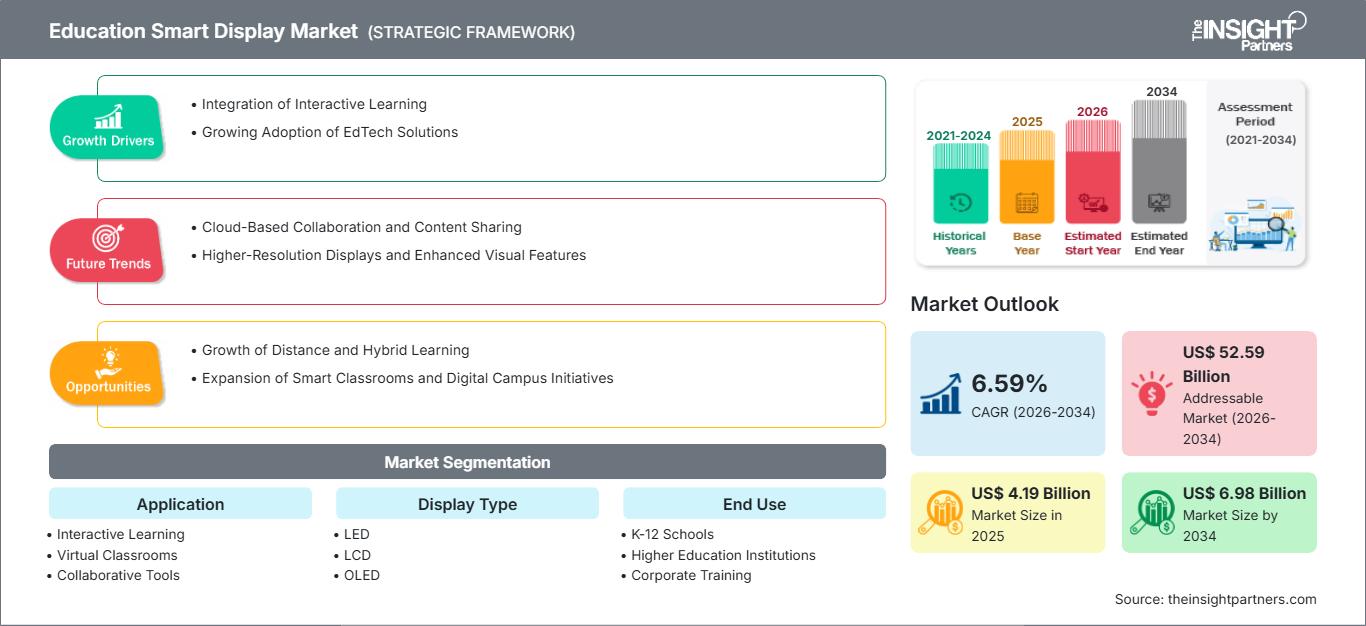
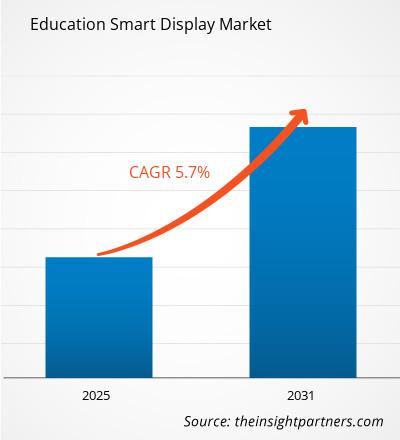
The Education Smart Display market was valued at US$ 4.19 billion in 2025 and is expected to reach US$ 6.98 billion by 2034; it is estimated to record a CAGR of 5.83% during 2026-2034.
Education Smart Display Market Assessment and Insights
- North America: The region is expected to command a 32–36% share in 2025 and expand at a CAGR of 6.8–7.5% between 2026–2034, supported by digital classroom modernization, replacement demand, and connected teaching environments.
- US: The US is estimated to represent 78–82% of North American revenue in 2025, advancing at a 6.9–7.6% CAGR between 2026–2034 through K-12 and higher education technology upgrades.
- Europe: Europe is projected to hold a 24–28% share in 2025 and grow at 6.1–6.8% CAGR, led by Germany, the UK, France, Italy, and Spain as institutions pursue digitally enabled and inclusive learning.
- Asia Pacific: Asia Pacific is estimated at a 31–35% share in 2025, with a 7.2–8.0% CAGR through 2034. China, Japan, South Korea, India, and Australia are key demand centers.
- Largest Segment: Interactive Learning is estimated at a 28–32% market share in 2025, with a 7.1–7.7% CAGR between 2026–2034 as interactive instruction becomes mainstream.
- High Growth Segment: Wireless connectivity is estimated at an 18–22% market share in 2025, expanding at an 8.1–8.8% CAGR as schools prioritize flexible device integration.
- Key companies analyzed in detail: ASUSTeK Computer Inc., Sharp Corporation, Microsoft Corporation, Acer Incorporated, Dell Technologies Inc., Sony Corporation, Sharp NEC Display Solutions Ltd., Samsung Electronics Co., Ltd., Panasonic Corporation, LG Electronics Inc.
Source: The Insight Partners' analysis based on proprietary research, government publications, company annual reports, investor presentations, industry databases, and expert interviews.
The placement of the display has evolved from the traditional visual display to computerized classroom placement. The large format LCD panels, touchscreen capabilities, wireless casting capabilities, operating system installation, camera technology, and collaboration applications are becoming more integrated into a single learning space. This shift in trend means the production focus will evolve from availability of the panel to processor speed, accuracy of touch, software compatibility, energy consumption, management, and sustainability.
Future trends include investments in scalable classroom estates and not just premium individual installations. The EU’s Digital Education Action Plan continues to advocate for digital education ecosystems, whereas China is moving ahead with national educational digitalization and AI incorporation. These policy trends enhance the need for displays that can integrate content delivery, participants from distance, assessment processes, and administrative software systems.
Education Smart Display Market Report Scope
| Report Attribute | Details |
|---|---|
| Market size in 2025 | US$ 4.19 Billion |
| Market Size by 2034 | US$ 6.98 Billion |
| Global CAGR (2026 - 2034) | 5.83% |
| Historical Data | 2021-2024 |
| Forecast period | 2026-2034 |
Education Smart Display Market Analysis
Demand, ecosystem, and supply dynamics
The Education Smart Display Market share depends on the desire for interactive teaching, simple content sharing and consistency of audio/visual experience in classrooms. Demand follows a value chain consisting of panel and semiconductor suppliers, display makers, touch element makers, operating systems developers, software platforms, distributors, system integrators and education buying organizations. Larger institutions pay attention to lifecycle considerations, interoperability, security and centralization along with the specifications of screens.
The supply side of the market is affected by panel production capacity, availability of semiconductors, processing technology development, as well as the economics of display size. Panel manufacturers increasingly compete not on resolutions but on embedded computing capabilities, touch, wireless networking and software ecosystems. Sony, Samsung, LG Electronics and Sharp NEC Display Solutions are examples of convergence of professional display technology development with the demands of education deployments, whereas Microsoft builds up the software layer.
Competitive positioning and investment environment
Education Smart Display Market report reveals competition is moving away from specifications in hardware to full-classroom solutions. Samsung Electronics provides interactive displays with device management and AI-powered classroom features, while LG Electronics has added AI capabilities for education within its CreateBoard portfolio. Sony provides professional displays, hybrid learning, content sharing, and campus audiovisual systems. Thus, it becomes evident that the competitive strategy depends on software and flexibility of deployment.
Investment areas have also moved away from hardware to ecosystem capabilities. Microsoft provides education-specific AI capabilities, while Dell Technologies, Acer, and ASUSTeK Computer Inc. provide the necessary capabilities for computing on devices' sides. Panasonic Corporation and Sharp NEC Display Solutions provide professional AV capabilities, while Toshiba Corporation, Samsung Electronics, and LG Electronics provide a wider range of display and electronics value chains.
● REPORT CUSTOMIZATION
Tailor This Report To Align With Your Specific Business Requirements
This report can be customized to align precisely with your business objectives, scope, and target markets. Customization options include tailored segmentation, geography, competitive analysis, and strategic insights to support informed decision-making.
Customize This Report →WHAT YOU CAN ADJUST
- ● Segmentations
- ● Geography
- ● Competitive Analysis
- ● Language Preferences
Education Smart Display Market: Strategic Insights
Regional Insights
North America Education Smart Display Market
North America is estimated to account for 32–36% of the 2025 market and is expected to register a 6.8–7.5% CAGR through 2034. The US dominates regional demand because K-12 districts, universities, and training organizations increasingly prioritize connected classrooms, wireless content sharing, interactive instruction, and centrally managed audiovisual infrastructure.
Regional sourcing efforts are shifting towards platforms that utilize display, camera, microphone, collaborative tools, and remote management capabilities. The higher education sector is driving the demand for these technologies by using the HyFlex teaching approach to link both on-campus and distant participants. Interactive learning and distance education are highlighted by Sony as key applications of professional audio visual technology, while Microsoft keeps enhancing its educational capabilities via AI.
U.S. Education Smart Display Market
The United States accounts for the 78–82% share of revenue in North America in 2025, growing at a CAGR of 6.9–7.6%. Strong demand is seen in K-12 schools and colleges, where the displays play an increasing role in interactive lessons, presentations, cooperation and blended learning.
Market players are numerous, including Samsung Electronics, Microsoft Corporation, Dell Technologies Inc., Sony Corporation, Sharp NEC Display Solutions Ltd., LG Electronics Inc., and Panasonic Corporation targeting complementary aspects of the technology stack in classrooms. Application trends include touch-based interaction, wireless presentations, video collaboration, accessibility features and device management, which increases the significance of software compatibility as a procurement criterion.
Europe Education Smart Display Market
Europe is projected to make up 24–28% of the 2025 market and is projected to grow at 6.1–6.8% CAGR. The UK and Germany are seen as key markets thanks to well-developed e-learning ecosystems, whereas France, Italy, and Spain are contributors with school modernization and digitization of higher education. The EU Digital Education Action Plan constitutes an institutional framework for digital learning and infrastructure development.
In the UK, demand is driven by the presence of established e-teaching practices and audiovisual equipment upgrades in higher education. Germany gains from investments in digital classrooms and infrastructure in vocational education. France, Italy, and Spain progress thanks to school modernization projects where procurement increasingly takes into account accessibility, energy efficiency, interoperability, and life-cycle considerations. Germany is recognized as the leader among the regional markets due to a solid technological base of institutions and industry ecosystem.
APAC Education Smart Display Market
Estimated APAC region market size stands at 31%-35% in 2025, and the region is forecasted to experience CAGR of 7.2%-8.0%, with China leading demand in this region. Japan, South Korea, India, and Australia are sources of growth due to upgrading educational facilities, universities’ digitization, and connected classroom development.
The strategy of China for the digitization of its national education system implies implementation of smart technology and AI into education system, while India continues building infrastructure of digital learning. Japan and South Korea leverage electronics ecosystem, and Australia helps with digital connected learning environment.
Middle East & Africa Education Smart Display Market
Middle East and Africa is a smaller regional market, with demand concentrated in Saudi Arabia and the UAE, followed by South Africa and other Middle Eastern and African markets. The regional market is expected to expand at a 6.0–6.7% CAGR through 2034, led by the UAE.
Saudi Arabia and the UAE are investing in digitally enabled education infrastructure alongside broader diversification and smart-city programs. South Africa provides demand through universities, schools, and vocational institutions, while the Rest of MEA remains more project-driven. Energy-efficient displays, centralized administration, durable installation, and scalable connectivity are particularly relevant where institutions seek to control operating costs.
Segmentation Analysis
Application
The application segment is projected to grow at a 7.1–7.7% CAGR during 2026–2034. Education Smart Display Market scope increasingly centers on interactive instruction, collaborative content creation, remote participation, and digital assessment. Institutions are therefore moving beyond passive presentation toward displays that support multiple classroom workflows.
- Interactive Learning: Represents the principal application opportunity because touch interaction, annotation, multimedia content, and simultaneous student participation directly support active teaching methodologies and improve the functional utilization of classroom displays.
- Virtual Classrooms: Supports hybrid instruction by connecting in-room learners with remote participants, requiring dependable video, audio, content sharing, and display interoperability across institutional networks.
- Collaborative Tools: Enables groups to work simultaneously on shared visual content, strengthening demand for multi-user touch, wireless casting, cloud synchronization, and classroom productivity software.
- Presentations: Remains a foundational application across schools, universities, and training centers, with demand shifting toward high-resolution displays, simplified source switching, and wireless presentation capabilities.
- Assessment and Testing: Gains strategic relevance as institutions digitize quizzes, formative assessment, feedback, and visual evaluation, requiring displays that integrate reliably with educational software and learning platforms.
Display Type
The display type segment is expected to advance at a 6.3–6.9% CAGR through 2034. LCD remains commercially important because of cost, availability, brightness, and broad screen-size options, while LED, OLED, projectors, and touch screens address specialized performance and interaction requirements.
- LED: Provides high brightness, long operating capability, and suitability for large learning spaces, lecture halls, auditoriums, and institutional signage where visibility across extended viewing distances matters.
- LCD: Maintains broad classroom adoption because mature supply chains, competitive pricing, dependable brightness, and varied screen sizes make it suitable for standardized school deployments.
- OLED: Serves premium applications where contrast, thin form factors, and visual quality justify higher acquisition costs, particularly in specialized higher education and presentation environments.
- Projector: Retains relevance where very large images are required, particularly auditoriums and multipurpose rooms, although installation, maintenance, ambient-light performance, and lifecycle economics influence purchasing decisions.
- Touch Screens: Provide direct interaction with lessons, diagrams, assessments, and collaborative content, making them strategically important for classrooms emphasizing active participation and multi-user workflows.
End Use
The end use segment is forecast to grow at a 6.8–7.4% CAGR from 2026–2034. Procurement patterns differ by institution size, funding structure, technical requirements, and teaching model, creating distinct opportunities across formal education and professional learning environments.
- K-12 Schools: Represent a major deployment base because classroom standardization, interactive pedagogy, and replacement of conventional boards create recurring demand for connected displays and managed device fleets.
- Higher Education Institutions: Require larger and more specialized systems for lecture halls, seminars, laboratories, distance learning, campus communication, and collaborative teaching environments.
- Corporate Training: Uses smart displays for employee development, workshops, onboarding, and distributed training, emphasizing conferencing, content sharing, device integration, and flexible room configurations.
- Tutoring Centers: Favor compact, interactive systems that support small-group instruction, rapid lesson changes, digital worksheets, and individualized teaching across multiple rooms.
- Vocational Training: Requires durable displays for technical instruction, demonstrations, simulations, and visual workflows, making connectivity and clear visualization important procurement considerations.
Connectivity
Connectivity is projected to record an 8.1–8.8% CAGR during 2026–2034, the fastest among the principal segments. Education Smart Display Market trends increasingly emphasize interoperability because institutions operate heterogeneous computers, mobile devices, cameras, peripherals, and cloud platforms within shared learning environments.
- Wired: Provides predictable performance and remains important where institutional networks prioritize stable connections, controlled access, and low-latency transmission for fixed classroom equipment.
- Wireless: Gains importance as educators and students increasingly connect laptops, tablets, and smartphones without physical switching, improving classroom flexibility and reducing cable dependence.
- HDMI: Remains a widely adopted physical interface for computers, cameras, media players, and other audiovisual sources, supporting straightforward integration with installed classroom equipment.
- VGA: Continues to serve legacy infrastructure in institutions with older computers and projectors, although its strategic importance is gradually constrained by newer digital interfaces.
- USB: Supports peripherals, storage, touch interfaces, cameras, and direct device connectivity, making it useful for classrooms requiring simple plug-and-play interaction.
Opportunity Snapshot
| Application | Revenue Contribution | Trend Tag | Adoption Stage |
|---|---|---|---|
| Interactive Learning | High | Touch Collaboration | Mature |
| Virtual Classrooms | Medium | Hybrid Teaching | Scaling |
| Collaborative Tools | High | Multi-user Work | Scaling |
| Presentations | High | Wireless Casting | Mature |
| Assessment and Testing | Medium | Digital Assessment | Scaling |
Education Smart Display Market Growth Drivers and Impact Analysis
Expansion of interactive and blended teaching models
As interactive and blended learning is being adopted, more functions will be expected of classroom displays. Instructors are being asked to rely on a single display for annotation, multimedia capabilities, remote involvement, content distribution, and collaboration between the students, not just to project their visuals. The procurement logic has changed in that buyers are assessing the usage of the equipment in multiple instructional settings. Higher education seems like an appropriate application domain for such installations because HyFlex systems depend on both the in-classroom and remote students having access to identical instructional materials. Sony offers solutions in education that include interactive learning, distance learning, and networked AV systems.
Greater institutional focus on centralized classroom technology
There is an increased need in schools and colleges for the management of technology from multiple rooms to multiple buildings and campuses. This involves centralized configuration, remote troubleshooting, content control, security settings, and software updates, and all of these help minimize the complexities involved in the process when hundreds of displays are being used. This leads the buyers to look at device management in addition to the screen display and touch features in the devices. This trend in the education market can be seen in Samsung’s education solution, where account management, centralized device management, and classroom software have been included in their interactive display systems.
Integration of AI with classroom display workflows
Artificial Intelligence is creating expectations in the realm of functionality of educational displays by offering automation in summary creation, quizzes, content personalization, accessibility support, and instructional support. The emergence of these new needs implies that there will be a requirement for displays that have adequate computing power, operating systems, cameras, microphones, and access to the cloud service. Microsoft has widened the scope of AI in education in terms of teaching and learning processes, while Samsung has brought AI assistant features to interactive display offerings. With the rise of AI in classroom software, display vendors can leverage value addition in software platforms beyond hardware revenue.
Education Smart Display Market Future Trends
AI-native interactive classroom interfaces
The Education Smart Display Market is expected to evolve towards display solutions centered on AI-based classroom activities rather than traditional screen utilities. Future display technologies could be equipped with functionalities like voice command, handwriting input, automatic lesson summarization, adaptive tests, translation services, accessibility services, and personalized content suggestions via the display itself. The hardware would accordingly require local computing capabilities, secure cloud connection, microphones, cameras, and security measures. Samsung has already developed an AI-powered classroom solution, while Microsoft is taking AI-based services further into the education sector. The future development path for these technologies would likely consist of greater integration between the display OS, LMS, productivity suite, and identity system.
Display fleets managed as institutional digital infrastructure
Future deployments will increasingly treat classroom displays as managed infrastructure rather than individual audiovisual purchases. Procurement teams are likely to prioritize remote monitoring, automated configuration, fleet analytics, energy controls, security policies, and standardized software images. This approach can simplify technology refresh cycles across school districts and university networks while improving visibility into device utilization and maintenance. Interoperability will also become more important as institutions combine displays from different generations with existing computers, cameras, access systems, and learning platforms. Vendors able to provide open interfaces and predictable lifecycle support should be better positioned as buyers shift from room-by-room purchasing toward institution-wide technology architectures.
Education Smart Display Market Opportunities
Integrated classroom technology platforms
Education Smart Display Market Forecasts indicate an opportunity for suppliers to package displays with management software, collaboration tools, installation, training, and lifecycle support. Institutions increasingly need predictable deployment across many classrooms, creating room for vendors and integrators to provide standardized technology architectures rather than standalone hardware. Investment priorities can focus on interoperability, remote administration, cybersecurity, device analytics, and simplified maintenance. Suppliers can also differentiate through flexible subscription structures that spread software and service costs across the equipment lifecycle. Such approaches may improve procurement visibility for education administrators while creating recurring revenue opportunities for technology providers. The strongest opportunities are likely to emerge where hardware, software, and professional services can be specified through a single institutional framework.
Emerging-market classroom modernization programs
Emerging education systems present an investment opportunity where digital infrastructure is being developed alongside broader school modernization. China’s national digital education strategy and India’s continuing expansion of technology-enabled learning create potential demand for scalable display deployments, particularly when solutions can accommodate diverse connectivity environments and budget levels. Manufacturers can target these markets through modular products, localized software support, training partnerships, and regional service networks. Lower total ownership cost is likely to matter more than premium specifications in many projects, favoring durable LCD and touch-based systems with straightforward maintenance. Strategic partnerships with distributors, education integrators, and public-sector procurement organizations can therefore become important routes to market as institutional digitization expands.
Recent Developments
- June 2026: Samsung Electronics introduced new education tools for its Android-based Interactive Display portfolio at ISTELive 26, including the Samsung Account Management Solution (AMS) and Samsung AI Assistant. AMS enables teachers to securely personalize shared classroom displays using QR codes or NFC-enabled ID cards, while Samsung AI Assistant provides content discovery, transcription, summaries, and AI-generated quizzes to support interactive learning.
- November 2025: Hikvision introduced WonderOS 4, an AI- and cloud-powered operating system designed to enhance smart education through its interactive display ecosystem. The platform supports the teaching process from AI-assisted lesson preparation and cloud-based content delivery to classroom interaction and student evaluation, while enabling teachers and students to access educational resources and collaborate more efficiently.
- June 2026: ViewSonic launched its AI-powered IN05 Series ViewBoard interactive displays in India, comprising 65-inch, 75-inch, and 86-inch models designed to enhance classroom teaching and collaboration. The displays integrate AI-powered tools such as Ask AI voice assistance, Video Pilot for automated video summaries and subtitles, AI MindMap for organizing ideas,
Frequently Asked Questions

- Comprehensive Market Sizing and Forecast Analysis
- Detailed Segmentation Analysis
- In-Depth Market Dynamics Assessment
- Regional and Country-Level Insights
- Competitive Landscape and Company Benchmarking
- Strategic Business Intelligence
Recent Reports
Testimonials

The Insight Partners' SCADA System Market report is comprehensive, with valuable insights on current trends and future forecasts. The team was highly professional, responsive, and supportive throughout. We are very satisfied and highly recommend their services.
RAN KEDEM Partner, Reali Technologies LTDs
I requested a report on a very specific software market and the team produced the report in a few days. The information was very relevant and well presented. I then requested some changes and additions to the report. The team was again very responsive and I got the final report in less than a week.
JEAN-HERVE JENN Chairman, Future Analytica
We worked with The Insight Partners for an important market study and forecast. They gave us clear insights into opportunities and risks, which helped shape our plans. Their research was easy to use and based on solid data. It helped us make smart, confident decisions. We highly recommend them.
PIYUSH NAGPAL Sr. Vice President, High Beam Global
The Insight Partners delivered insightful, well-structured market research with strong domain expertise. Their team was professional and responsive throughout. The user-friendly website made accessing industry reports seamless. We highly recommend them for reliable, high-quality research services
YUKIHIKO ADACHI CEO, Deep Blue, LLC.
This is the first time I have purchased a market report from The Insight Partners.While I was unsure at first, I visited their web site and felt more comfortable to take the risk and purchase a market report.I am completely satisfied with the quality of the report and customer service. I had several questions and comments with the initial report, but after a couple of dialogs over email with their analyst I believe I have a report that I can use as input to our strategic planning process.Thank you so much for taking the extra time and making this a positive experience.I will definitely recommend your service to others and you will be my first call when we need further market data.
JOHN SUZUKI President and Chief Executive Officer, Board Director, BK Technologies
I wish to appreciate your support and the professionalism you displayed in the course of attending to my request for information regarding to infectious disease IVD market in Nigeria. I appreciate your patience, your guidance, and the fact that you were willing to offer a discount, which eventually made it possible for us to close a deal. I look forward to engaging The Insight Partners in the future, all thanks to the impression you have created in me as a result of this first encounter.
DR CHIJIOKE ONYIA MANAGING DIRECTOR, PineCrest Healthcare Ltd.Reason to Buy
- Informed Decision-Making
- Understanding Market Dynamics
- Competitive Analysis
- Identifying Emerging Markets
- Customer Insights
- Market Forecasts
- Risk Mitigation
- Boosting Operational Efficiency
- Strategic Planning
- Investment Justification
- Tracking Industry Innovations
- Aligning with Regulatory Trends





 Get Free Sample for