
Electric Gripper Market Size, Demand & Growth by 2034
Coverage: by Type (Two-Finger Electric Gripper, Three-Finger Electric Gripper); Application (Automotive, Electronics and Electrical, Food and Beverage, Rubber and Plastics, Metal Products, Others) , and Geography (North America, Europe, Asia Pacific, and South and Central America)
- Status : Data Released
- Report Code : TIPRE00007946
- Category : Electronics and Semiconductor
- No. of Pages : 150
- Available Report Formats :


- Last update date : August 11, 2026


2025 Market Size
US$ 3.71 Bn
Base year value
2034 Forecast
US$ 5.7 Bn
Projected by 2034
CAGR 2026-2034
4.88 %
Growth rate
Addressable Market
US$ 42.69 Bn
(2026-2034)
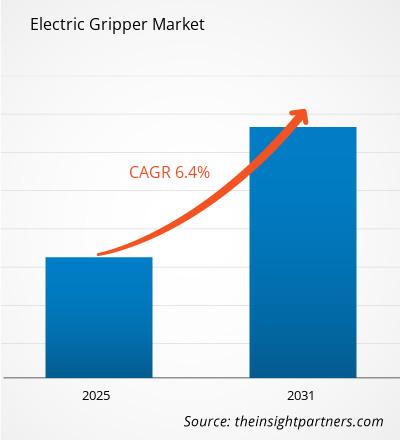
The Electric gripper Market size was valued at US$ 3.71 Billion in 2025 and is forecasted to grow to US$ 5.7 Billion by 2034, growing at a CAGR of 4.88% during 2026-2034. The market size indicates ongoing investments in programmable end-of-arm tooling, factory flexibility, and accurate manipulation in the production of automotive, electronics and electrical, food and beverages, rubber and plastics, and metal products.
North America is estimated to grow at a modelled CAGR of 4.2-4.8% till 2034 due to the benefit received by the Electric Gripper Market size due to automation driven by reshoring and increased use of collaborative robots. End-users prefer electrically powered tools that eliminate the need for compressed air, enable changeover based on recipes, and store positional/force data.
Electric Gripper Market Assessment and Insights
- North America: Accounted for 28–32% Electric gripper Market share in 2025 and is projected to record a 4.2–4.8% CAGR between 2026–2034, supported by reshoring, cobot retrofits, and precision assembly investment.
- US: Represented 76–80% of North American demand in 2025 and is expected to grow at a 4.3–4.9% CAGR during 2026–2034.
- Europe: Held 24–28% share in 2025 and should advance at a 4.0–4.6% CAGR through 2034, led by Germany, Italy, France, the UK, and Spain.
- Asia Pacific: Captured 34–38% share in 2025 and is forecast to expand at a 5.4–6.0% CAGR through 2034, with China, Japan, South Korea, and India driving deployment.
- Largest Segment: Two-Finger Electric Gripper held 66–70% market share in 2025 and is anticipated to post a 4.5–5.1% CAGR through 2034.
- High Growth Segment: Electronics and Electrical represented 22–26% market share in 2025 and is expected to register a 5.5–6.1% CAGR through 2034.
- Key companies analyzed in detail: DESTACO, EMI Corporation, Festo SE & Co. KG, IAI America, Inc., Parker-Hannifin Corporation, PHD, Inc., SCHUNK GmbH & Co. KG, SMAC Corporation, SMC Corporation, and Yamaha Motor Co., Ltd.
Source: The Insight Partners' analysis based on proprietary research, government publications, company annual reports, investor presentations, industry databases, and expert interviews.
From fixed-stroke, binary actuators to servomotors that combine adjustable force, position feedback, and production information, electric grippers have progressed. More manufacturers are now standardizing mechanical connections and protocols, making it possible for one gripper to operate a larger family of parts. Suppliers are trying to keep lead times short by optimizing compact motors, sealed guides, electronics, and local assembly. The Electric Gripper Market also demonstrates an effort towards abandoning pneumatic systems because in cases where auditing energy, reducing noise, clean performance, and quick changeover outweigh costs of acquisition.
According to the Electric Gripper Market forecast, the adoption of such technology is expected to expand from the proven automotive and electronics industry clusters to India, Southeast Asia, Eastern Europe, and certain manufacturing regions of the Middle East up until 2034. Capital expenditures will go towards modular cells that can be easily redeployed without additional plumbing. Standards of safety for collaborative environments, energy efficiency programs, and advanced manufacturing incentives should stimulate investment; however, capabilities of integrators and programmers are crucial factors in this regard.
Electric Gripper Market Report Scope
| Report Attribute | Details |
|---|---|
| Market size in 2025 | US$ 3.71 Billion |
| Market Size by 2034 | US$ 5.7 Billion |
| Global CAGR (2026 - 2034) | 4.88% |
| Historical Data | 2021-2024 |
| Forecast period | 2026-2034 |
Electric Gripper Market Analysis
Electric Gripper Market growth depends on mixed assembly operations, narrower tolerance ranges, and automation of tasks that don't require pneumatics setup. Robot builders, gripper producers, distributors, system integrators, finger developers, and control suppliers make up a tightly connected chain. The selection process starts with weight, stroke, force, protection, speed, and communication parameters, followed by customization and testing for safety.
The situation in supply makes vendors with an ability to blend product variety with application engineering attractive. Motors, encoders, guides, gearboxes, sensors, and embedded electronics define price and availability. Even though limitations of electronic components were decreased, customers appreciate regional inventory, downloadable CAD files, robot add-ons, and support services. Electrification simplifies pneumatic preparation and eliminates leakage risks, yet the total ownership depends on duty cycle, maintenance competencies, and integration difficulty.
Electric Gripper Market analysis reveals that competition is becoming less about force and more about software, communication, and speed of commissioning. SCHUNK GmbH & Co. KG and SMC Corporation bring together extensive product lines and worldwide distribution networks, whereas DESTACO, PHD, Inc., and EMI Corporation rely on their expertise in end-of-arm tooling. Festo SE & Co. KG, Parker-Hannifin Corporation, and IAI America, Inc. link grippers with motion systems.
Capital expenditures are going into IO-Link connectivity, Ethernet connectivity, battery-free absolute encoders, and configurable grip recipes. SMAC Corporation provides a competitive edge with its programmable motion capabilities, while Yamaha Motor Co., Ltd. allows for precise placement of grippers in robot cells. Competitive advantage lies in robot compatibility verification, fast sizing, and lifecycle support services. Collaboration with cobot vendors and integrators shortens qualification timeframes and helps suppliers cater to small manufacturers who do not have a robotics engineering staff.
● REPORT CUSTOMIZATION
Tailor This Report To Align With Your Specific Business Requirements
This report can be customized to align precisely with your business objectives, scope, and target markets. Customization options include tailored segmentation, geography, competitive analysis, and strategic insights to support informed decision-making.
Customize This Report →WHAT YOU CAN ADJUST
- ● Segmentations
- ● Geography
- ● Competitive Analysis
- ● Language Preferences
Electric Gripper Market: Strategic Insights
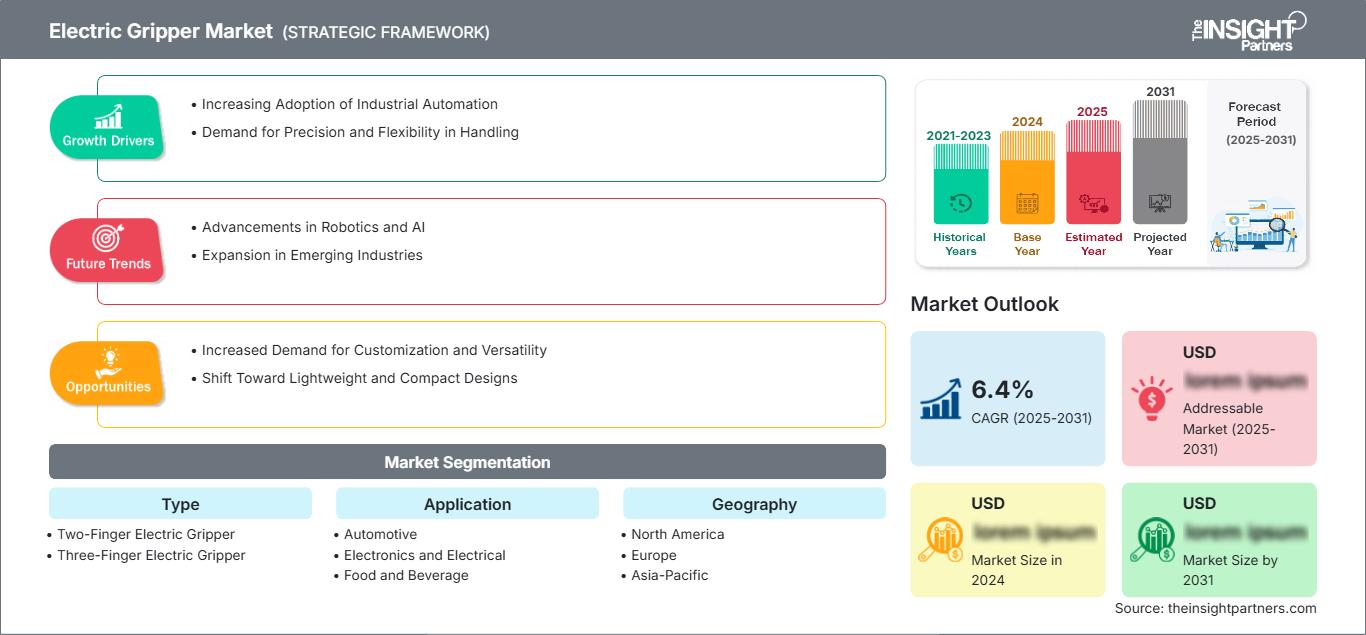
Regional Insights
North America Electric Gripper Market
In North America, the percentage of revenues on a global scale stood at 28-32% in 2025, with a forecasted growth at a CAGR of 4.2-4.8% between 2026-2034. The market share of the Electric Gripper indicates an entrenched base of robots, well-developed integration ecosystem, and funding that focuses on domestic manufacturing. Automotive, aerospace, medical device, food processing, and electronics manufacturers value repeatable force control, trackable manipulation, and fast switching of products.
The Electric Grippers find adoption where labor shortage affects capacity or where there are expenses related to leaks from pneumatics. Canada promotes the market share via automotive and advanced manufacturing corridors, while Mexico gains due to nearshoring and export-oriented assembly. Companies strive for regional stocking, certified kits for robots, and applications' support. The conservative attitude of the region is justified by high costs of financing and cautious investments but is compensated by replacement spending and increasing usage of collaborative cells among mid-size companies.
U.S. Electric Gripper Market
The U.S. accounted for 76-80% of the demand in North America in 2025 and is projected to experience a CAGR of 4.3-4.9% through 2034. Installation is aided by automotive retooling, semiconductor capacity expansion, warehouse automation, and precision manufacturing in defense-related applications. End-users in the country often prefer to use electric grippers in machine tending, component insertion, inspection transfer, and packaging lines where programmable force and position minimize damage or setup time.
DESTACO, EMI Corporation, Festo SE & Co. KG, IAI America, Inc., Parker-Hannifin Corporation, PHD, Inc., SCHUNK GmbH & Co. KG, SMAC Corporation, SMC Corporation, and Yamaha Motor Co., Ltd. have products, distribution networks, or services that are deployed in U.S. installations. Integrators are now including grippers alongside cobots, vision systems, safety scanners, and digital work instructions. Adoption depends on plant size, with large users stressing data integration and small users stressing easy commissioning and payback.
Europe Electric Gripper Market
Europe will represent 24% to 28% of the worldwide revenue by 2025, and is expected to increase by 4.0% to 4.6% CAGR through 2034. Germany continues to be the largest country owing to the presence of the machinery, automotive, metalworking, and automation supplier segments. Energy efficiency targets and labor skills drive the use of electrical solutions, but weak cyclicality of capital expenditures might slow down new cell installations. Italy adds the packaging and machine-building segment, France and Spain – automotive, aerospace, food, and general industry sectors.
The United Kingdom's market will be influenced by the aerospace, life sciences, food manufacturing, and flexible automation in the context of smaller players, and cell integration will help overcome the lack of internal knowledge. Germany profits from highly-developed engineering clusters and early implementation of connected mechatronics. France, Italy, and Spain are increasingly opting for the use of programmable tools in cases where traceability and multiple product lines play a role.
APAC Electric Gripper Market
Asia Pacific held 34–38% share in 2025 and is projected to grow at a 5.4–6.0% CAGR through 2034. China leads through its extensive electronics, automotive, battery, and machinery capacity, while Japan and South Korea sustain demand for precise, compact automation.
India’s expanding automotive and electronics production supports new installations, and Australia contributes mining-equipment, food, and specialized manufacturing applications. Industrial upgrading policies, localization of robot supply, and dense component ecosystems reinforce adoption. Price competition is pronounced, yet export factories continue to value reliability, cleanroom options, and fast integration.
Middle East & Africa Electric Gripper Market
The region is projected to register a 3.8–4.4% CAGR through 2034. Saudi Arabia leads as industrial diversification channels capital toward automotive components, food processing, metals, logistics equipment, and local manufacturing. The UAE supports advanced logistics, aerospace services, and demonstration-scale smart factories.
South Africa remains the principal sub-Saharan base through automotive and mining-related manufacturing, while the Rest of MEA develops selectively. Energy infrastructure, industrial zones, and sovereign-backed projects create opportunities, but smaller installed bases, imported equipment costs, and limited integration capacity constrain deployment speed.
Segmentation Analysis
Type
The Electric Gripper Market scope by type covers Two-Finger Electric Gripper and Three-Finger Electric Gripper, with the main segment projected to expand at a 4.6–5.2% CAGR during 2026–2034. Adoption depends on workpiece geometry, centering requirements, stroke, force, and cycle speed. Two-finger designs dominate general handling, whereas three-finger units address cylindrical parts and self-centering operations.
- Two-Finger Electric Gripper: This format leads general pick-and-place, assembly, packaging, and machine-tending demand because parallel jaws accommodate broad part families and simplify custom finger design.
- Three-Finger Electric Gripper: Centering capability makes this configuration strategically important for shafts, gears, bearings, and round workpieces where stable concentric gripping improves loading accuracy and process repeatability.
Application
Application demand is projected to grow at a 4.8–5.4% CAGR during 2026–2034 as programmable gripping extends across discrete and process-adjacent manufacturing. Buyers weigh cleanliness, ingress protection, jaw force, workpiece variability, and line integration. Electronics and electrical applications provide the highest growth profile, while automotive remains a substantial installed-base market and food production increasingly values washable or food-compatible configurations.
- Automotive: Demand centers on component transfer, machine loading, battery assembly, and flexible body or powertrain production, where recipe-based gripping supports multiple variants and traceability requirements.
- Electronics and Electrical: Miniaturized components and fragile surfaces favor precise force adjustment, compact bodies, clean operation, and position feedback across semiconductor, connector, battery, and device assembly.
- Food and Beverage: Producers adopt electric gripping for packaging, sorting, and gentle product handling where sanitation, reduced air infrastructure, rapid changeovers, and consistent motion improve operating control.
- Rubber and Plastics: Mold tending, insert loading, and finished-part handling benefit from adjustable stroke and force, particularly when components vary by geometry, compliance, or surface sensitivity.
- Metal Products: Machine tending and process transfer require robust guides, secure force maintenance, and resistance to contamination, positioning durable electric grippers as flexible alternatives in mixed production.
Opportunity Snapshot
| Application | Revenue Contribution | Trend Tag | Adoption Stage |
| Automotive | High | Battery Assembly | Mature |
| Electronics and Electrical | High | Micro Handling | Scaling |
| Food and Beverage | Medium | Gentle Handling | Scaling |
| Rubber and Plastics | Medium | Mold Tending | Scaling |
| Metal Products | Medium | Machine Tending | Mature |
| Others | Low | Flexible Cells | Emerging |
Electric Gripper Market Growth Drivers and Impact Analysis
High-Mix Manufacturing Requires Programmable Changeovers
Increased product proliferation is making production runs shorter and expensive because of frequent changes in manual tools. With electric grippers, it is possible to save different programs in terms of positioning, speed, and strength of the gripping force for different types of products in one cell to process more diverse product ranges. In terms of automation of automotive components, electronics, contract manufacturing, and packaging, this will positively affect utilization rates. According to The International Federation of Robotics, there were 542,000 industrial robots installed in 2024 and 4.664 million industrial robots working all over the world, which shows how large the potential installed base is. When it comes to Electric Gripper Market, this means higher retrofit demand from customers that want to increase their capacity without expanding floor space.
Energy and Maintenance Economics Favor Electric Actuation
The compressed air system incurs generation losses, leaks, filtration, piping, and maintenance expenses that are typically apportioned over plant overhead. Electric grippers draw electricity where needed and may keep their grip using mechanical self-locking or improved motor controls, according to the design. IAI Automation claims that the switch from pneumatic cylinder actuators to electric actuators will result in up to 90% lower energy usage, while SMC Corporation states up to 52% lower carbon emissions per year for its LEHR collaborative gripper due to motor control improvement. The greatest market effect can be observed in highly utilized factories or newly developed cells without air supply infrastructure. Potential buyers begin to consider not only the initial price but also total cost, noise, accessibility, and energy accounting.
Precision Handling Expands Quality-Critical Automation
The electronics industry, battery production, medical parts, and sensitive consumer goods need controlled interaction which does not involve deformations, damage to the product or its displacement. The servo-controlled gripper is capable of modifying force and position and ensuring that the part was grasped, making an end effector a process control tool. According to the data provided by the International Federation of Robotics, there were 64,542 collaborative robots deployed in 2024 which marked a 12% increase, and increasing the number of compact cells in which electrically powered tooling is utilized. In the Electric Gripper Market, the driver leads to increased need for low force resolution, cleanroom versions, small controllers, and feedback capability. Value realization comes in the form of reduced scrap, less dropped items, and better traceability.
Electric Gripper Market Future Trends
Software-Defined Gripping and Condition Intelligence
The Electric Gripper market trends will be characterized by software-driven functionality rather than standalone mechanical functionality. In future generations of grippers, forces, positions, cycles, temperatures, and error codes will be communicated to cell controllers and maintenance software. Simulation and digital twins will make it possible for engineers to verify stroke, collision, and timing much earlier in the design phase. Edge computing will detect increasing friction and part misalignment issues prior to downtime. Open architecture, standard function blocks, and remote firmware upgrades will become buying considerations. These developments favor vendors that provide secure software environments, but easy local control when there is no plant network or cloud available.
Application-Specific Fingers from Additive Manufacturing
The use of additive manufacturing will reduce the distance from the workpiece sample to the optimized geometry of the gripper fingers. Lightweight polymers or metals in the form of fingers may contain compliant surfaces, internal passages, sensor placements, and complex geometries, which would be costly using traditional machining methods. With faster iteration cycles, the economics of the electric grippers will become more attractive for small batch sizes, laboratories, and contract manufacturing. Vendors could use downloadable finger designs with approved materials and simulation guidelines, while systems integrators can provide fast qualification services. The new business model will place the value on application engineering and digital libraries.
Electric Gripper Market Opportunities
Retrofit Kits for Pneumatic Gripper Replacement
The presence of a significant installed base of pneumatic actuators leads to an obvious retrofit potential in case factories are dealing with leakage, noise, maintenance, or changeover issues. Tool suppliers are able to bundle the electric gripper with the adapter plate, cabling, pre-programmed controller, and migration tools corresponding to the most widespread pneumatic footprint. Integrators need to look for opportunities in areas where high product variability, air line complexity, or poor quality can provide justification. Pilot commercial activities could start with an energy and cycle audit followed by the cell pilot. Offers that will retain the robot and safety setup whenever possible will prove successful.
Electronics Capacity Expansion in Emerging Asian Hubs
The introduction of new electronics, batteries, appliances, and component factories in India and Southeast Asia presents an opportunity for suppliers to make their preferences known regarding the selection of electric grippers prior to designing a factory layout. The strategy that would work best in such situations is one where investment is made in application labs in the region, distributor training programs, and stock of compact electric grippers that facilitate clean processing and quick setup times. Supplier relationships with robot manufacturers and machine builders can integrate preferred grippers in cell designs. Prices are quite sensitive, so modular design and clear cost benefits will have to be considered.
Recent Developments
- June 2025: DESTACO has launched its new eRDH Series Electric Parallel Gripper, a next-generation automation solution designed to improve precision, flexibility, and efficiency in industrial handling applications. The latest addition to the company’s Robohand product portfolio is built to support manufacturers seeking smarter and more adaptable automation technologies.
- October 2025: SRT has introduced the NVG-A30 Soft Gripper Module, a compact robotic gripping solution designed to improve flexibility, precision, and efficiency in automated handling applications. The new soft gripper targets industries that require gentle yet reliable handling of lightweight, delicate, or irregularly shaped products.
- June 2026: Festo has introduced GripperAI, an artificial intelligence-powered software solution designed to transform robotic handling by enabling robots to identify, grip, and move a wide range of products without extensive programming or manual reconfiguration. The new technology is aimed at manufacturers seeking more adaptable automation systems for handling mixed, unfamiliar, and randomly positioned items.
Frequently Asked Questions

- Comprehensive Market Sizing and Forecast Analysis
- Detailed Segmentation Analysis
- In-Depth Market Dynamics Assessment
- Regional and Country-Level Insights
- Competitive Landscape and Company Benchmarking
- Strategic Business Intelligence
Recent Reports
Testimonials

The Insight Partners provided valuable market intelligence that supported our global go-to-market strategy. Their team was professional, responsive, and attentive to our feedback, providing thoughtful analysis and helpful methodological clarifications throughout the project.
Junmo Kim Chief Financial Officer (CFO), Enertech Co., Ltd.
The Insight Partners' SCADA System Market report is comprehensive, with valuable insights on current trends and future forecasts. The team was highly professional, responsive, and supportive throughout. We are very satisfied and highly recommend their services.
RAN KEDEM Partner, Reali Technologies LTDs
I requested a report on a very specific software market and the team produced the report in a few days. The information was very relevant and well presented. I then requested some changes and additions to the report. The team was again very responsive and I got the final report in less than a week.
JEAN-HERVE JENN Chairman, Future Analytica
We worked with The Insight Partners for an important market study and forecast. They gave us clear insights into opportunities and risks, which helped shape our plans. Their research was easy to use and based on solid data. It helped us make smart, confident decisions. We highly recommend them.
PIYUSH NAGPAL Sr. Vice President, High Beam Global
The Insight Partners delivered insightful, well-structured market research with strong domain expertise. Their team was professional and responsive throughout. The user-friendly website made accessing industry reports seamless. We highly recommend them for reliable, high-quality research services
YUKIHIKO ADACHI CEO, Deep Blue, LLC.
This is the first time I have purchased a market report from The Insight Partners.While I was unsure at first, I visited their web site and felt more comfortable to take the risk and purchase a market report.I am completely satisfied with the quality of the report and customer service. I had several questions and comments with the initial report, but after a couple of dialogs over email with their analyst I believe I have a report that I can use as input to our strategic planning process.Thank you so much for taking the extra time and making this a positive experience.I will definitely recommend your service to others and you will be my first call when we need further market data.
JOHN SUZUKI President and Chief Executive Officer, Board Director, BK Technologies
I wish to appreciate your support and the professionalism you displayed in the course of attending to my request for information regarding to infectious disease IVD market in Nigeria. I appreciate your patience, your guidance, and the fact that you were willing to offer a discount, which eventually made it possible for us to close a deal. I look forward to engaging The Insight Partners in the future, all thanks to the impression you have created in me as a result of this first encounter.
DR CHIJIOKE ONYIA MANAGING DIRECTOR, PineCrest Healthcare Ltd.Reason to Buy
- Informed Decision-Making
- Understanding Market Dynamics
- Competitive Analysis
- Identifying Emerging Markets
- Customer Insights
- Market Forecasts
- Risk Mitigation
- Boosting Operational Efficiency
- Strategic Planning
- Investment Justification
- Tracking Industry Innovations
- Aligning with Regulatory Trends





 Get Free Sample for