
Electric Iron Market Growth, Trends & Demand by 2034
Coverage: by Product (Dry, Steam); Distribution Channel (Offline, Online); Application (Residential, Commercial), and Geography (North America, Europe, Asia Pacific, and South and Central America)
- Status : Data Released
- Report Code : TIPRE00013535
- Category : Electronics and Semiconductor
- No. of Pages : 150
- Available Report Formats :


- Last update date : August 25, 2026


2025 Market Size
US$ 1,672.34 Mn
Base year value
2034 Forecast
US$ 3,229.98 Mn
Projected by 2034
CAGR 2026-2034
7.59 %
Growth rate
Addressable Market
US$ 22,087.49 Mn
(2026-2034)
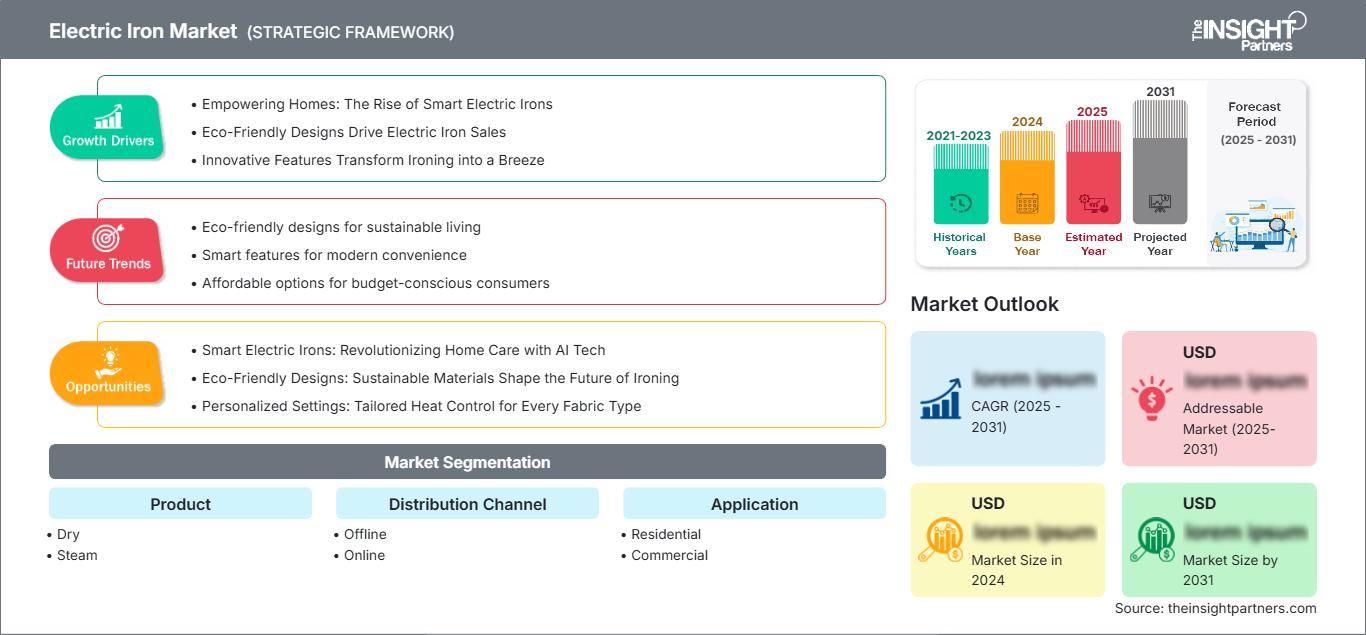
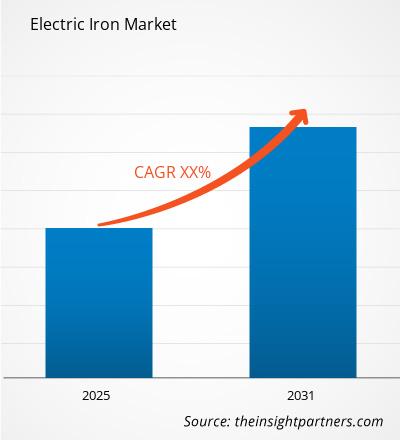
The electric iron market size was assessed to be US$ 1,672.34 million in 2025 and is anticipated to grow up to US$ 3,229.98 million by 2034 with a CAGR of 7.59% for the period 2026-2034. The rise in the growth of the market can be attributed to increased consumer preferences for advanced clothes pressing products due to rising disposable incomes and the importance being laid on professionalism.
North America stands out as a mature but still growing part of the Electric Iron market. It is expected that North America will have a growth rate of 5.5-6.5% in the forecast period. The growth of the market in North America will mainly be attributed to replacement cycle, advancements in technology (cordless and smart irons) and use of garment steamers.
Electric Iron Market Assessment and Insights
- North America captured approximately 18–22% of the global Electric Iron market share in 2025, driven by established household penetration and replacement demand. The region is expected to grow at a CAGR of 5.5–6.5% during 2026–2034, supported by innovation in cordless and smart iron technologies.
- US represented roughly 80–85% of the North American market in 2025. The country is forecast to expand at a CAGR of 5.8–6.8% through 2034, propelled by consumer preference for premium features and smart home integration.
- Europe accounted for approximately 20–24% of the global market in 2025, led by Germany, the UK, and France. The region is projected to grow at a CAGR of 5.0–6.0%, underpinned by energy efficiency regulations and consumer focus on product durability.
- Asia Pacific represented approximately 40–45% of the global market in 2025, led by China, India, and Japan. The region is expected to register the fastest growth at a CAGR of 9.0–10.0%, driven by rapid urbanization, rising middle-class population, and increasing household appliance penetration.
- Largest Segment: The Steam iron product segment captured over 60–65% of the market in 2025. This segment is projected to grow at a CAGR of 7.0–8.0% through 2034, driven by superior wrinkle removal capabilities and advanced features such as auto shut-off and precision temperature controls.
- High Growth Segment: The Online distribution channel segment is projected to achieve a CAGR of 9.0–10.0% during 2026–2034, driven by increasing e-commerce penetration and consumer preference for convenient shopping experiences.
- Key companies analyzed in detail: BSH Home Appliances, Groupe SEB, Hamilton Beach, Impex Technologies, Koninklijke Philips N.V., Morphy Richards, Panasonic Corporation, Rowenta, Stanley Black and Decker, Inc., Transform SR Brands LLC (Kenmore).
Source: The Insight Partners' analysis based on proprietary research, government publications, company annual reports, investor presentations, industry databases, and expert interviews.
The Electric Iron Market report indicates that the market has evolved from basic heating devices into modern garment care systems which use advanced technologies. Dry irons have become less common compared to steam irons, which feature variable temperature settings, anti-calc functionality and even the self-cleaning mode. Moreover, there has been an increased popularity of the cordless iron and steamer products which satisfy customers' demands regarding greater convenience. Manufacturers have started to produce more energy-efficient products in line with growing concerns about environment preservation and regulatory requirements. Advanced solutions use lightweight materials, have ergonomic design and include smart technologies such as fabric sensors.
The Electric Iron Market forecast shows that the market is going to demonstrate continuous growth as emerging economies have higher rates of household appliance penetration and developed countries face replacement cycle due to innovations. Sustainable materials and energy efficiency in production will drive product development in the market, whereas the development of e-commerce platforms will contribute to the growth of the geographical presence. Urban lifestyle which implies wearing professional clothes and garment care will provide long-term demand dynamics.
Electric Iron Market Report Scope
| Report Attribute | Details |
|---|---|
| Market size in 2025 | US$ 1,672.34 Million |
| Market Size by 2034 | US$ 3,229.98 Million |
| Global CAGR (2026 - 2034) | 7.59% |
| Historical Data | 2021-2024 |
| Forecast period | 2026-2034 |
Electric Iron Market Analysis
Electric Iron market trends show that the market is driven by the factors like urbanization, increase in disposable income, and participation of people in the workforce requiring professional attire. Innovation in the product towards steam and cordless solutions has widened the targetable market as people are looking for convenient methods to take care of their clothes.
The value chain involves raw material suppliers, component manufacturers, assembly of products, brand owners, and distribution channels, whereas Asia Pacific has emerged as the leading region for production. The supply side dynamics involve the instability of raw material prices, especially steel, aluminum, and copper used in the soleplate and heating elements, thus impacting the margins of the manufacturers and their pricing strategies for the products.
The competitive structure includes established home appliance giants, along with specialized garment care brands. Koninklijke Philips N.V. and Panasonic Corporation make use of their vast portfolio of consumer electronic products to deliver premium Electric Irons. Similarly, Groupe SEB and BSH Home Appliances make use of complete ecosystem of home appliances and brand equity to compete, whereas Rowenta and Morphy Richards deliver garment care solutions.
Investment trends indicate significant R&D expenditure toward cordless technology, smart connectivity, and energy efficiency enhancements. Strategic positioning increasingly revolves around brand differentiation, online channel penetration, and product innovation addressing sustainability concerns.
● REPORT CUSTOMIZATION
Tailor This Report To Align With Your Specific Business Requirements
This report can be customized to align precisely with your business objectives, scope, and target markets. Customization options include tailored segmentation, geography, competitive analysis, and strategic insights to support informed decision-making.
Customize This Report →WHAT YOU CAN ADJUST
- ● Segmentations
- ● Geography
- ● Competitive Analysis
- ● Language Preferences
Electric Iron Market: Strategic Insights
Regional Insights
North America Electric Iron Market
In 2025, the North American Electric Iron market had a revenue share of approximately 18–22%. The United States leads the way as the leading national market with its regional demand of approximately 80-85%. This is because of the already existing market penetration and product replacement cycle of electric irons. North America has adopted the use of cordless and smart iron products which have attracted consumers who appreciate the use of more innovative products such as the auto shut-off and fabric sensing. Hospitality and commercial laundry industries have contributed to continuous demand for the product alongside the emerging market for garment steamers as additional products.
U.S. Electric Iron Market
The growth rate of the U.S. Electric Iron market is expected to be a CAGR of 5.8–6.8% between 2026 and 2034 due to high replacement rate and innovation. The U.S. held more than 80% share of the North America market in 2025, and steam irons were the most popular category within the market. The applications that can be seen on the rise include adoption of cordless irons and garment steamers in professional and domestic usage. Major retail outlets and e-commerce websites are the major distribution channels for the product.
Europe Electric Iron Market
In 2025, Europe was expected to capture a share of around 20-24% of the global Electric Irons market. Germany, the UK, and France are some of the prominent markets for Electric Irons in this region. Germany is expected to emerge as the leading market for electric irons in Europe due to the consumer preference towards superior engineering and energy-efficient products. Germany accounts for a share of nearly 7% of the global market. The UK market holds a share of around 5% of the global market owing to stable domestic consumption along with consumer preference for compact designs suitable for small-sized households. Increasing demand for premium steam irons and garment care appliances from France, Italy, and Spain is fueled by fashionable consumer behavior in these countries.
APAC Electric Iron Market
Asia Pacific region held a share of 40-45% of the total revenue share of the world in 2025 and is expected to witness the highest CAGR of 9.0-10.0% from 2026-2034. China is the largest market in this region due to its large number of households and manufacturing strength, holding 18% of the world's demand share. India provides many growth opportunities in the region with increased rate of urbanization and increase in household appliances usage. Japan and South Korea have high demand for portable and feature rich irons having better steam controls. Premium appliances are in demand in the market of Australia.
Middle East & Africa Electric Iron Market
The Middle East & Africa Electric Iron market is estimated to expand at a CAGR of 8.0–9.0% through 2034, driven by population growth, urbanization, and improving electricity infrastructure. Saudi Arabia's Vision 2030 program is stimulating investments in household appliance manufacturing, while the UAE shows strong demand for premium appliances driven by high disposable incomes. South Africa represents the continent's most developed appliance market, with established distribution networks and consumer financing options. The region's improving economic conditions and urban development projects support long-term growth prospects.
Segmentation Analysis
Product
The product segment of the Electric Iron market is categorized into Dry and Steam. This segment is expected to exhibit a CAGR of 7.2–8.2% from 2026 to 2034.
- Dry: These traditional irons operate without water and are typically lighter and more affordable. They are widely used in price-sensitive markets and rural areas, though adoption is gradually declining in favor of steam irons in urban markets.
- Steam: These irons use water-generated steam for superior wrinkle removal and fabric care. This segment dominates the market, capturing over 60–65% of revenue in 2025, driven by advanced features and consumer preference for efficient garment care.
Distribution Channel
The distribution channel segment includes Offline and Online. This segment is expected to witness a CAGR of 8.0–9.0% from 2026 to 2034.
- Offline: Physical retail channels remain significant, capturing over 55–60% of the market in 2025. Consumer preference for physically checking product condition and the presence of helpful sales professionals support offline retail.
- Online: This channel is experiencing rapid growth, capturing 40–45% of the market in 2025. E-commerce platforms offer convenience, competitive pricing, and access to a wider product range, driving growth in this segment.
Application
The application segment comprises Residential and Commercial. This segment is projected to register a CAGR of 7.5–8.5% during 2026–2034.
- Residential: This is the largest application segment, capturing over 85–90% of the market in 2025. Household demand is driven by daily garment care needs, with consumers increasingly preferring steam irons and cordless models.
- Commercial: This segment includes hospitality, garment manufacturing, and professional laundry services. Commercial applications grow at a faster rate, driven by the expanding hospitality industry and professional garment care demand.
Opportunity Snapshot
| Application | Revenue Contribution | Trend Tag | Adoption Stage |
|---|---|---|---|
| Residential | High | Daily Care | Mature |
| Commercial | Medium | Hospitality | Scaling |
Electric Iron Market Growth Drivers and Impact Analysis
Rising Urbanization and Disposable Income Growth
Rapid urbanization and increasing disposable incomes across developing economies are significant drivers for the Electric Iron market. As populations migrate to urban areas, household appliance ownership rates rise substantially. The expanding middle class in Asia Pacific and Latin America is driving demand for electric irons as essential household appliances. Data indicates that urban households exhibit significantly higher appliance penetration rates compared to rural areas. This trend is particularly pronounced in countries such as China, India, and Brazil, where urban populations are growing at unprecedented rates. The correlation between income growth and appliance adoption creates a sustained demand trajectory, with manufacturers expanding their presence in these high-growth markets through accessible pricing and distribution network development.
Product Innovation and Technological Advancements
Continuous product innovation is driving market growth, with manufacturers introducing cordless irons, smart connectivity, and advanced steam technologies. Cordless models address consumer demand for maneuverability and convenience, while smart irons equipped with sensors automatically adjust temperature based on fabric detection. Features such as auto shut-off, anti-calc systems, and self-cleaning functions enhance safety and product longevity. These innovations stimulate replacement purchases as consumers upgrade from traditional models. The integration of IoT connectivity and mobile app controls, allowing remote monitoring and maintenance alerts, is increasingly influencing purchasing decisions among younger, tech-savvy consumers.
Growing E-Commerce Penetration
The rapid expansion of e-commerce platforms is a significant driver for the Electric Iron market. Online channels offer consumers convenience, competitive pricing, access to detailed product information, and wider product selection compared to traditional retail. The shift toward digital commerce is particularly pronounced in developed markets, with online channels accounting for a substantial share of total distribution. This digital momentum aligns with broader industry trends of manufacturers developing direct-to-consumer capabilities. E-commerce penetration is also expanding market reach into underserved areas, enabling manufacturers to tap into new customer segments.
Electric Iron Market Future Trends
Integration of Smart and Connected Technologies
The Electric Iron market is witnessing significant technological evolution toward smart, connected appliances. Manufacturers are incorporating IoT connectivity and mobile app controls, allowing users to monitor ironing progress, receive maintenance alerts, and customize temperature settings remotely. Smart irons equipped with sensors can automatically adjust temperature based on fabric type detection, reducing the risk of damage and improving user experience. This trend toward digitalization aligns with broader consumer electronics patterns, with connected features increasingly influencing purchasing decisions. The integration of artificial intelligence for personalized ironing recommendations is emerging as a differentiator in premium product segments.
Sustainability and Energy Efficiency Focus
Growing environmental awareness is shaping product development toward sustainable, energy-efficient designs. Manufacturers are investing in recyclable materials, reduced energy consumption, and eco-friendly packaging. Energy efficiency regulations across regions are pushing manufacturers to develop products that consume less power without compromising performance. This trend is particularly pronounced in Europe, where sustainability regulations drive product innovation. The emphasis on product durability and reparability is also growing, with manufacturers exploring modular designs that enable component replacement rather than complete product disposal.
Electric Iron Market Opportunities
Expansion in Emerging Asia Pacific Markets
The Asia Pacific region, particularly India and Southeast Asian countries, presents significant growth opportunities. Rapid urbanization, rising disposable incomes, and increasing electrification rates are driving household appliance penetration. Government initiatives promoting manufacturing and infrastructure development further support market growth. The large population base, combined with low current penetration rates, offers substantial untapped potential for manufacturers. Companies that establish strong local presence, develop affordable product offerings, and build robust distribution networks can capture significant market share in these high-growth economies.
Growing Commercial Application Demand
The commercial segment offers substantial growth opportunities, particularly in hospitality, garment manufacturing, and professional laundry services. Expanding tourism and hospitality industries in emerging economies are driving demand for commercial-grade electric irons. The garment manufacturing sector, particularly in countries with strong textile industries, requires reliable, durable appliances. Professional laundry services, growing in urban areas, represent another promising segment. Manufacturers can capitalize on this opportunity by developing specialized products with enhanced durability and higher performance specifications.
Recent Developments
- January 2026: LG Electronics (066570.KS) announced Wednesday the launch of "LG System Ironing," an all-in-one garment care solution that combines a steam iron, handheld steamer, and styling board. The new product enhances user convenience, allowing anyone to iron easily while reducing concerns about fabric damage. Fine high-pressure steam from the steam iron and handheld steamer quickly removes wrinkles from fabrics without leaving moisture, while sterilizing up to 99.99% of harmful bacteria at high temperatures. Seven dedicated courses adjust steam temperature according to fabric types including cotton, wool, and rayon, minimizing fabric damage.
- April 2024: GM Modular, renowned for its excellence in the electrical and modular switch industries, is embarking on a new venture by expanding its business into the home appliances sector. With a strong desire to establish a prominent presence in this category, GM Modular plans to introduce a diverse range of clothing irons that combine utility, advanced technology, durability, and style to meet the contemporary needs of discerning customers.
- September 2024: Versuni India, home to legacy brands Philips Domestic Appliances and Preethi, announced the launch of smart steam iron DST 8040. Versuni India called out to consumers across Mumbai and Delhi to take on the #BurnTheShirt Challenge with the focus of offering consumer an experience of their industry first innovation which guarantees no burns, at Croma and Vijay’s flagship stores.
Frequently Asked Questions

- Comprehensive Market Sizing and Forecast Analysis
- Detailed Segmentation Analysis
- In-Depth Market Dynamics Assessment
- Regional and Country-Level Insights
- Competitive Landscape and Company Benchmarking
- Strategic Business Intelligence
Recent Reports
Testimonials

The Insight Partners' SCADA System Market report is comprehensive, with valuable insights on current trends and future forecasts. The team was highly professional, responsive, and supportive throughout. We are very satisfied and highly recommend their services.
RAN KEDEM Partner, Reali Technologies LTDs
I requested a report on a very specific software market and the team produced the report in a few days. The information was very relevant and well presented. I then requested some changes and additions to the report. The team was again very responsive and I got the final report in less than a week.
JEAN-HERVE JENN Chairman, Future Analytica
We worked with The Insight Partners for an important market study and forecast. They gave us clear insights into opportunities and risks, which helped shape our plans. Their research was easy to use and based on solid data. It helped us make smart, confident decisions. We highly recommend them.
PIYUSH NAGPAL Sr. Vice President, High Beam Global
The Insight Partners delivered insightful, well-structured market research with strong domain expertise. Their team was professional and responsive throughout. The user-friendly website made accessing industry reports seamless. We highly recommend them for reliable, high-quality research services
YUKIHIKO ADACHI CEO, Deep Blue, LLC.
This is the first time I have purchased a market report from The Insight Partners.While I was unsure at first, I visited their web site and felt more comfortable to take the risk and purchase a market report.I am completely satisfied with the quality of the report and customer service. I had several questions and comments with the initial report, but after a couple of dialogs over email with their analyst I believe I have a report that I can use as input to our strategic planning process.Thank you so much for taking the extra time and making this a positive experience.I will definitely recommend your service to others and you will be my first call when we need further market data.
JOHN SUZUKI President and Chief Executive Officer, Board Director, BK Technologies
I wish to appreciate your support and the professionalism you displayed in the course of attending to my request for information regarding to infectious disease IVD market in Nigeria. I appreciate your patience, your guidance, and the fact that you were willing to offer a discount, which eventually made it possible for us to close a deal. I look forward to engaging The Insight Partners in the future, all thanks to the impression you have created in me as a result of this first encounter.
DR CHIJIOKE ONYIA MANAGING DIRECTOR, PineCrest Healthcare Ltd.Reason to Buy
- Informed Decision-Making
- Understanding Market Dynamics
- Competitive Analysis
- Identifying Emerging Markets
- Customer Insights
- Market Forecasts
- Risk Mitigation
- Boosting Operational Efficiency
- Strategic Planning
- Investment Justification
- Tracking Industry Innovations
- Aligning with Regulatory Trends





 Get Free Sample for