
Electric Sewing Machine Market Trends, Size & Forecast by 2034
Coverage: By Type (Single Head, Multi Head); Application (Commercial, Household), and Geography (North America, Europe, Asia Pacific, and South and Central America)
- Status : Data Released
- Report Code : TIPRE00016117
- Category : Electronics and Semiconductor
- No. of Pages : 150
- Available Report Formats :


- Last update date : July 31, 2026


2025 Market Size
US$ 1.5 Bn
Base year value
2034 Forecast
US$ 3.04 Bn
Projected by 2034
CAGR 2026-2034
8.16 %
Growth rate
Addressable Market
US$ 20.40 Bn
(2026-2034)
The Electric Sewing Machine Market was valued at US$ 1.5 Billion in 2025 and is projected to reach US$ 3.04 Billion by 2034, registering a CAGR of 8.16% during 2026–2034. The market includes single head and multi head electric sewing machines used in commercial tailoring, apparel workshops, home sewing, craft production, alteration services, and small-batch textile manufacturing.
North America Electric Sewing Machine Market size is expected to expand at a CAGR of 6.9–7.5% during 2026–2034, supported by online craft communities, home-based microbusinesses, and replacement demand for app-connected household machines. Regional growth is also reinforced by tailoring services, alterations, school sewing programs, and durable product preferences among consumers seeking repair, customization, and sustainable apparel habits.
Electric Sewing Machine Market Assessment and Insights
- North America held 18–22% share in 2025 and is growing at a CAGR of 6.9–7.5% during 2026–2034, led by household upgrades, tailoring services, and creator-led sewing demand.
- US represented 82–86% of North American revenue in 2025 and is growing at a CAGR of 7.0–7.6% during 2026–2034, supported by strong retail channels and hobbyist demand.
- Europe accounted for 20–24% share in 2025 and is growing at a CAGR of 6.5–7.1% during 2026–2034, with Germany, the UK, France, Italy, and Spain leading adoption.
- Asia Pacific held 45–49% share in 2025 and is growing at a CAGR of 8.8–9.4% during 2026–2034, led by China, India, Japan, Vietnam, and South Korea.
- Largest Segment Single head machines held 66–70% market share in 2025 and are growing at a CAGR of 7.4–8.0% during 2026–2034 due to broad household and tailoring use.
- High Growth Segment Commercial applications represented 57–61% market share in 2025 and are growing at a CAGR of 8.6–9.2% during 2026–2034, supported by garment workshops and alteration businesses.
- Key companies analyzed in detail: Brother Industries, Ltd.; Feiyue Group Co., Ltd.; Jack Technology Co., Ltd.; Jaguar International Corporation; JUKI Corporation; Mitsubishi Electric Corporation; Typical Sewing Machine Wanping Machinery Co., Ltd.; Shang Gong Group Co., Ltd.; Singer Corporation; SunStar Co., Ltd.
Source: The Insight Partners' analysis based on proprietary research, government publications, company annual reports, investor presentations, industry databases, and expert interviews.
Electrical sewing equipment has progressed from simply motor-powered machines to electronically-controlled speed mechanisms, computer-aided pattern programming, automatic thread cutting, servo motors, and advanced feeding systems. The production process is influenced by factors such as castings, motors, circuitry, needles, presser feet, distribution and customer services. There is a combination of mass-produced household sewing machines and quality commercial products that are employed by tailors, boutiques, repair shops and clothing contractors.
Upcoming demand trends will be determined by Asian apparel manufacturers, North American creation commerce, European repair industry, and developing tailoring businesses. Investments will be made in terms of silent motors, assisted stitch programming, maintenance diagnostics and energy efficient systems. Textile exportation policies, skills development, women-operated micro-businesses and circular fashion trends will affect purchases through commercial and residential distribution systems.
Electric Sewing Machine Market Report Scope
| Report Attribute | Details |
|---|---|
| Market size in 2025 | US$ 1.5 Billion |
| Market Size by 2034 | US$ 3.04 Billion |
| Global CAGR (2026 - 2034) | 8.16% |
| Historical Data | 2021-2024 |
| Forecast period | 2026-2034 |
Electric Sewing Machine Market Analysis
Electric Sewing Machine Market Growth is due to the manufacturing of apparels, tailoring services, repair services, and home-based creative ventures. This market value chain includes motors manufacturers, metal casting companies, electronics vendors, needles and feeding mechanism producers, assemblers, distributors, learning centers, and service partners. The demand will increase if consumers require increased sewing speed, reduced fatigue, better speed control, and improved quality regardless of fabric thickness.
Supply factors include automation, components supply chain, exports, and good distribution practices. Single head machine dominates at home and boutique levels, as well as in smaller tailoring workshops. Multi head machines are needed for embroidery works, batch production processes, and high volume commercial uses. The market will also gain from online learning materials, manufacturing community members, and smaller apparels sellers who have limited industrial capacity.
Electric Sewing Machine Market report suggests that competition is based on product range, durability, channel depth, and electronics integration. Brother Industries, Ltd. and Singer Corporation are highly visible among households, while JUKI Corporation, Jack Technology Co., Ltd., SunStar Co., Ltd., and Shang Gong Group Co., Ltd. are competing on productivity and automation, as well as through business connections.
Feiyue Group Co., Ltd., Jaguar International Corporation, Mitsubishi Electric Corporation, and Typical Sewing Machine Wanping Machinery Co., Ltd. improve specialized and local supplies to household, sewing, and industrial markets. The priorities for investments are expected to be digital stitch control, energy-saving motors, operators’ training, maintenance equipment, and product families, which facilitate price differentiation without decreasing reliability.
● REPORT CUSTOMIZATION
Tailor This Report To Align With Your Specific Business Requirements
This report can be customized to align precisely with your business objectives, scope, and target markets. Customization options include tailored segmentation, geography, competitive analysis, and strategic insights to support informed decision-making.
Customize This Report →WHAT YOU CAN ADJUST
- ● Segmentations
- ● Geography
- ● Competitive Analysis
- ● Language Preferences
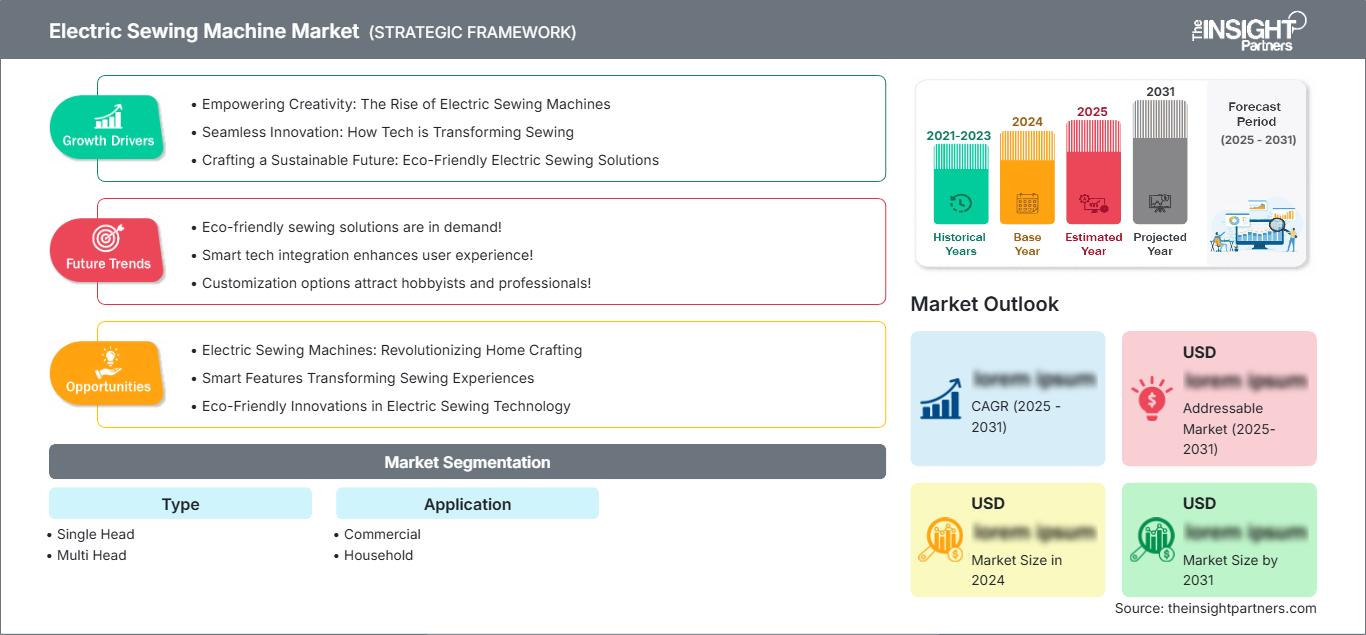
Electric Sewing Machine Market: Strategic Insights
Regional Insights
North America Electric Sewing Machine Market
The Electric Sewing Machine Market Share contributed 18–22% in North America in 2025 and is expected to grow at a CAGR of 6.9–7.5% from 2026 to 2034. This growth can be attributed to hobby stitching, alterations, quilting, small batch clothing production, and apps on household sewing machines. E-commerce channels enable customers to compare different features,
While the commercial demand for these sewing machines comes from tailors, dry-cleaning alterations counters, costume designers, upholsterers, and maker business organizations offering customized goods. Energy efficiency, warranty and easy threading capabilities impact the buying process. The high labor cost in the region leads the manufacturers to produce the machine which will cut down any rework.
U.S. Electric Sewing Machine Market
The USA was responsible for 82–86% of the total North American market revenue in 2025 and is forecasted to have a CAGR of 7.0–7.6% from 2026 to 2034. Applications include quilting, garment alteration, home interior design, cosplay, education curriculum, and micro-business production. Sales come through major retailers, online stores, and sewing equipment dealers.
Brother Industries, Ltd. and Singer Corporation are consumer-friendly while Juki Corporation and Jack Technology Co., Ltd. serve the needs of industrial tailoring. The stitch library, the speed regulation, the throat area, durability, maintenance, and teaching systems are increasingly important considerations. The consumer demand for a durable household machine becomes more pronounced with continued use of fabric.
Europe Electric Sewing Machine Market
Europe accounted for 20-24% market share in 2025 and is anticipated to record a CAGR of 6.5-7.1% during 2026-2034. Germany dominates due to technical textile fabrics, tailoring machines, and repairable culture; and UK provides the demand generated by craft activities, costumes, quilt making, and bespoke clothing manufacturers.
France, Italy, and Spain will make contributions owing to fashion schools, boutiques, alteration services, leather goods, and home sewing enthusiasts. The safety of products, availability of spare parts, energy usage, and reparability are important factors for European customers. The Electric Sewing Machine Market is aided by the sustainable practices of clothing repairing and small manufacturers.
APAC Electric Sewing Machine Market
APAC constituted 45-49% share in 2025 and is expected to expand with CAGR of 8.8-9.4% during 2026-2034. China takes the lead via manufacturing capacity, supply chain capabilities, and local brands, whereas India, Japan, Vietnam, South Korea, and Australia contribute to demand from apparel factories and homes.
Industrial policies, export of textiles, skilled labor force, and more expenditure from the middle class on crafts ensure its implementation. The business clients will favor consistency, availability of spare parts, and efficiency of the machines, while household users like compact, affordable, and easy to use sewing machines. There is tough price competition in the area, but automation technology allows expensive products.
Middle East & Africa Electric Sewing Machine Market
Middle East & Africa is estimated to exhibit a CAGR of 7.4–8.0% from 2026 to 2034. Tailoring, uniforms, hospitality textile, abaya, and small clothing workshops fuel growth in Saudi Arabia and the UAE, while repair, school, and craft activities fuel South Africa’s demand.
Demand in RoMEA is driven by micro-enterprise formation, vocational training programs, and informal apparel manufacturing. Motors with high efficiency and effective service network are critical in regions where electricity availability and maintenance support may differ. Commercial establishments prefer to start off with single head machines before progressing to multi-head machines.
Segmentation Analysis
Type
Type is projected to grow at a CAGR of 7.8–8.4% during 2026–2034. The Electric Sewing Machine Market scope includes compact single head machines for homes, tailoring counters, and small workshops, alongside multi head systems used for embroidery, batch stitching, and higher-throughput production. Buyers select configurations according to output volume, operator skill, stitch variety, fabric handling, and service availability.
- Single Head machines dominate because they fit household sewing, tailoring, repair, quilting, and boutique production, offering manageable cost, simpler maintenance, and flexible placement in small workspaces.
- Multi Head machines serve embroidery houses, uniform suppliers, and commercial decorators where repeated patterns, higher throughput, and synchronized stitching improve productivity and order consistency.
Application
Application is forecast to grow at a CAGR of 8.2–8.8% during 2026–2034. Commercial demand is supported by apparel manufacturing, alterations, uniforms, upholstery, boutiques, and home-based sellers scaling production. Household adoption is influenced by DIY culture, sustainable repair, quilting, craft education, and app-guided learning. Both segments increasingly value lower noise, accurate feed, automatic features, and dependable support.
- Commercial users require reliable machines for long operating hours, faster stitching, heavier fabrics, and repeatable quality, making service support and spare-part availability critical purchase factors.
- Household buyers prioritize ease of use, compact size, stitch variety, safety features, and learning support, with demand rising from repair, personalization, quilting, and craft communities.
Opportunity Snapshot
| Application | Revenue Contribution | Trend Tag | Adoption Stage |
| Commercial | High | Workshop Automation | Scaling |
| Household | Medium | DIY Repair | Mature |
Electric Sewing Machine Market Growth Drivers and Impact Analysis
Commercial tailoring shifts toward higher productivity
Commercial tailoring, alteration shops, and small garment units are adopting electric machines to increase stitch consistency, shorten turnaround times, and reduce operator fatigue. This driver is strongest in markets where labor availability is uneven and order sizes are fragmented. Better speed control, automatic trimming, and improved fabric feed allow workshops to handle uniforms, repairs, customized apparel, and small production batches with fewer quality rejects. The impact is a shift from manual or basic machines toward durable electric platforms that support repeat revenue through accessories, maintenance, and operator training.
Household sewing expands through repair and customization
Households are purchasing electric sewing machines for clothing repair, home décor, quilting, craft learning, and personalization. Online classes and social media communities reduce learning barriers, while sustainability-minded consumers use sewing to extend garment life. The impact is broader demand for easy-threading, portable, safe, and multifunctional models that can serve beginners and experienced users. Brands gain advantage when machines are supported by tutorials, pattern libraries, spare parts, and responsive service, because confidence after purchase strongly affects repeat accessory sales and brand loyalty.
Automation features improve quality in garment production
Garment producers increasingly rely on electric and electronically controlled machines to improve throughput, reduce stitch defects, and standardize output across operators. Servo motors, programmable stitch settings, digital feed control, and diagnostic functions help factories manage productivity while training new workers faster. The market impact is higher willingness to invest in reliable commercial equipment, especially in apparel-export hubs. Suppliers that combine machines with technical service, operator education, and spare-part availability can defend margins even when entry-level machines face price pressure.
Electric Sewing Machine Market Future Trends
Connected guidance becomes a mainstream feature
Electric Sewing Machine Market trends point toward connected guidance that helps users select stitches, set tension, troubleshoot issues, and transfer designs from mobile devices. This trend will matter because many new buyers are hobbyists, creators, and microbusiness owners who value confidence as much as machine speed. App-based support can reduce product returns, increase accessory purchases, and create subscription opportunities around patterns or training. Manufacturers that keep interfaces simple while protecting reliability will be better positioned than brands that add complex features without improving outcomes.
Energy-efficient motors reshape value propositions
Servo motors and optimized electronic controls are expected to become more common in commercial and advanced household machines. Buyers will compare not only stitch speed but also noise, heat, power consumption, and control at low speeds. This trend supports workshops that operate many machines for long hours and households that prefer quieter equipment. Manufacturers can differentiate by quantifying energy savings, improving motor durability, and pairing efficient drive systems with stronger warranties, creating a value proposition based on lifecycle cost rather than purchase price alone.
Electric Sewing Machine Market Opportunities
Commercial service bundles for small workshops
Electric Sewing Machine Market Forecasts support investment in bundled offerings for small workshops, including machines, attachments, maintenance plans, operator training, and financing. Many commercial users are not large factories but tailors, uniform suppliers, alteration counters, and home-based sellers moving into paid production. These buyers need predictable uptime and guidance rather than only low prices. Distributors can capture higher value by packaging installation, preventive maintenance, spare parts, and application-specific accessories, turning one-time equipment sales into recurring service relationships.
Household creator ecosystems and learning platforms
Brands can build opportunity around household creator ecosystems that combine machines with lessons, patterns, accessories, fabric partnerships, and community support. This approach is attractive because beginners often delay purchases when they lack confidence, while experienced users buy upgrades when they see clear creative benefits. Retailers and manufacturers can use workshops, online tutorials, mobile apps, and loyalty programs to sustain engagement after purchase. The strongest opportunity lies in converting occasional sewing interest into regular use, accessory demand, and future machine upgrades.
Recent Developments
- June 2026: JUKI Corporation will launch the DX-01 Single-Needle Lockstitch Sewing System with Electronic Belt Feed, a premium flat-bed sewing machine designed to deliver exceptional precision through its innovative six-belt feed-assist mechanism. By precisely controlling the rotation of six belts positioned above and below the fabric, the DX-01 ensures highly accurate, stable, and consistent fabric feeding. This advanced technology simplifies complex three-dimensional sewing operations, including curved seams on shoulders and collars as well as gathering, significantly reducing reliance on operator skill while improving efficiency and quality across a wide range of apparel manufacturing applications.
- September 2024: JUKI CORPORATION launched the phased sales of the LK-1900C high-speed electronic bartacking sewing system. This versatile sewing machine can be used for various processes such as bartacking (the reinforcement of sewing sections) and the attachment of belt loops or buttons.
- May 2024: SINGER India Limited, a leading brand in the sewing machine and home appliances category, announced the launch of its latest 3-in-1, Wi-Fi enabled sewing machine, The SE9185.
Frequently Asked Questions

- Comprehensive Market Sizing and Forecast Analysis
- Detailed Segmentation Analysis
- In-Depth Market Dynamics Assessment
- Regional and Country-Level Insights
- Competitive Landscape and Company Benchmarking
- Strategic Business Intelligence
Recent Reports
Testimonials

The Insight Partners' SCADA System Market report is comprehensive, with valuable insights on current trends and future forecasts. The team was highly professional, responsive, and supportive throughout. We are very satisfied and highly recommend their services.
RAN KEDEM Partner, Reali Technologies LTDs
I requested a report on a very specific software market and the team produced the report in a few days. The information was very relevant and well presented. I then requested some changes and additions to the report. The team was again very responsive and I got the final report in less than a week.
JEAN-HERVE JENN Chairman, Future Analytica
We worked with The Insight Partners for an important market study and forecast. They gave us clear insights into opportunities and risks, which helped shape our plans. Their research was easy to use and based on solid data. It helped us make smart, confident decisions. We highly recommend them.
PIYUSH NAGPAL Sr. Vice President, High Beam Global
The Insight Partners delivered insightful, well-structured market research with strong domain expertise. Their team was professional and responsive throughout. The user-friendly website made accessing industry reports seamless. We highly recommend them for reliable, high-quality research services
YUKIHIKO ADACHI CEO, Deep Blue, LLC.
This is the first time I have purchased a market report from The Insight Partners.While I was unsure at first, I visited their web site and felt more comfortable to take the risk and purchase a market report.I am completely satisfied with the quality of the report and customer service. I had several questions and comments with the initial report, but after a couple of dialogs over email with their analyst I believe I have a report that I can use as input to our strategic planning process.Thank you so much for taking the extra time and making this a positive experience.I will definitely recommend your service to others and you will be my first call when we need further market data.
JOHN SUZUKI President and Chief Executive Officer, Board Director, BK Technologies
I wish to appreciate your support and the professionalism you displayed in the course of attending to my request for information regarding to infectious disease IVD market in Nigeria. I appreciate your patience, your guidance, and the fact that you were willing to offer a discount, which eventually made it possible for us to close a deal. I look forward to engaging The Insight Partners in the future, all thanks to the impression you have created in me as a result of this first encounter.
DR CHIJIOKE ONYIA MANAGING DIRECTOR, PineCrest Healthcare Ltd.Reason to Buy
- Informed Decision-Making
- Understanding Market Dynamics
- Competitive Analysis
- Identifying Emerging Markets
- Customer Insights
- Market Forecasts
- Risk Mitigation
- Boosting Operational Efficiency
- Strategic Planning
- Investment Justification
- Tracking Industry Innovations
- Aligning with Regulatory Trends





 Get Free Sample for