
Electrical Fittings Market Size, Growth & Demand by 2034
Coverage: By Type (Metallic Electrical Fittings, Non-metallic Electrical Fittings); Application (Industrial, Commercial, Residential) , and Geography (North America, Europe, Asia Pacific, and South and Central America)
- Status : Data Released
- Report Code : TIPRE00024430
- Category : Electronics and Semiconductor
- No. of Pages : 150
- Available Report Formats :


- Last update date : August 10, 2026


2025 Market Size
US$ 2.85 Bn
Base year value
2034 Forecast
US$ 4.77 Bn
Projected by 2034
CAGR 2026-2034
6.65 %
Growth rate
Addressable Market
US$ 35.88 Bn
(2026-2034)
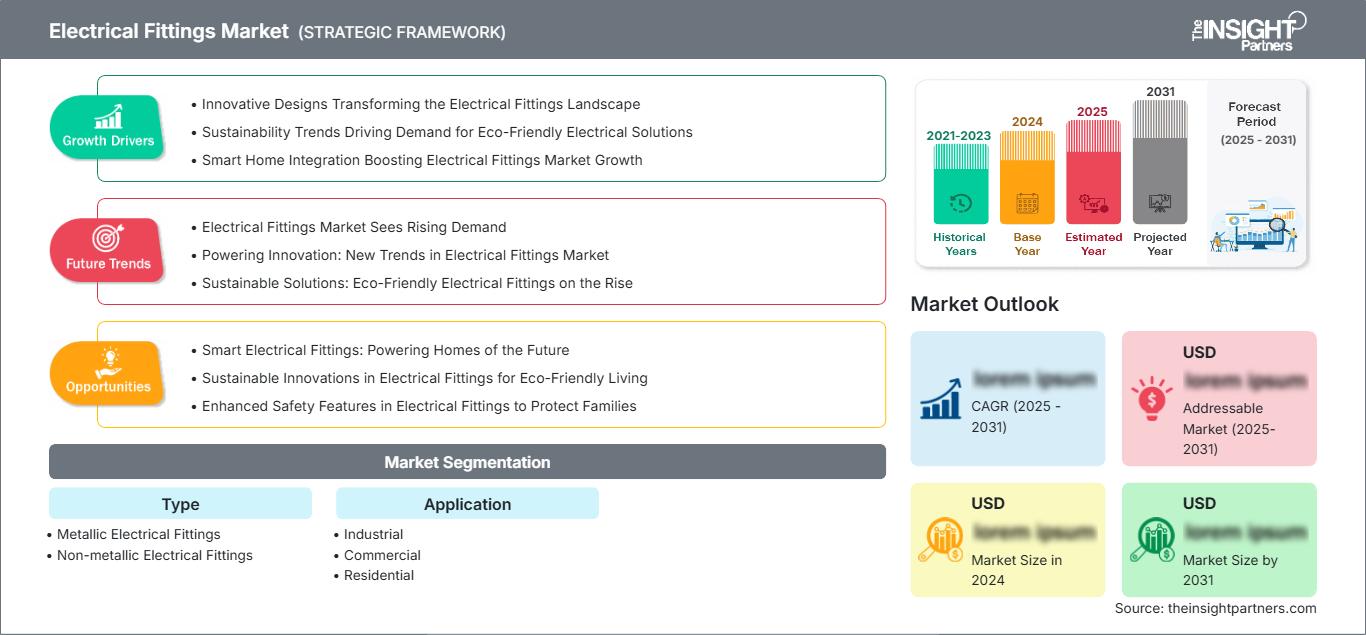
The Electrical Fittings Market size accounted for US$ 2.85 Billion in 2025 and is expected to achieve a market size of US$ 4.77 Billion by 2034 growing at a CAGR of 6.65% during 2026-2034. The market is growing owing to the need for safer electrical conduits, corrosion-resistant fittings, and code-compliant electrical systems among others.
The Electrical Fittings Market growth in North America is expected to be in the CAGR range of 5.8-6.4% due to code compliance, manufacturing reshoring, construction of data centers, grid modernization, and renovation of nonresidential buildings. The region offers an advantage due to established distribution channels, preference among contractors for code-compliant metallic fittings, and increased adoption of non-metallic fittings where corrosion resistance and lightweight is required.
Electrical Fittings Market Assessment and Insights
- North America held 49–52% share in 2025 and is growing at a CAGR range of 5.8–6.4% during 2026–2034, supported by NEC-driven construction, industrial retrofits, and domestic manufacturing capacity.
- US represented 82–85% of North America in 2025 and is growing at a CAGR range of 5.9–6.5%, led by data centers, factories, utilities, and commercial renovations.
- Europe accounted for 14–17% share in 2025 and is advancing at a CAGR range of 5.5–6.1%, with Germany, the UK, France, Italy, and Spain leading demand.
- Asia Pacific captured 24–27% share in 2025 and is expanding at a CAGR range of 7.0–7.8%, led by China, India, Japan, South Korea, and Australia.
- Largest Segment Metallic Electrical Fittings held 80–83% market share in 2025 and is growing at a CAGR range of 6.0–6.6%, supported by industrial strength and grounding reliability.
- High Growth Segment Non-metallic Electrical Fittings held 17–20% market share in 2025 and is growing at a CAGR range of 7.2–8.0%, driven by corrosion resistance and lightweight installation.
- Key companies analyzed in detail: Arlington Industries, Inc., Eaton Corporation plc, Emerson Electric Co., ABB Ltd., Bridgeport Fittings, Inc., Topaz Lighting & Electric, AMFICO, Madison Electric Products, Orbit Industries, Inc., and EVT Electrical.
Source: The Insight Partners' analysis based on proprietary research, government publications, company annual reports, investor presentations, industry databases, and expert interviews.
In the market of Electrical Fittings, the trend towards commodity fittings to engineered fittings that save on installation time, enhance the efficiency of bonding continuity and provide protection for wiring under harsh conditions is evident. Metallic fittings are key in rigid, IMC, EMT and hazardous location applications, but polymer fittings have been increasingly utilized for applications involving moisture, chemicals or weight considerations. The production process involves zinc die casting, steel fabrication, PVC and nylon molding, certification testing and disciplined distribution inventory management.
During the forecast period, new geographic locations will drive demand through urban construction, renewable energy connectivity, electrification of manufacturing industries and utility upgrades. The regulatory factors including electrical safety codes, fire codes and industrial workplace regulations will drive the growth in demand for higher value fittings with appropriate listings. Companies with comprehensive product offerings, prompt delivery capabilities and product innovation targeted at contractors will benefit the most.
Electrical Fittings Market Report Scope
| Report Attribute | Details |
|---|---|
| Market size in 2025 | US$ 2.85 Billion |
| Market Size by 2034 | US$ 4.77 Billion |
| Global CAGR (2026 - 2034) | 6.65% |
| Historical Data | 2021-2024 |
| Forecast period | 2026-2034 |
Electrical Fittings Market Analysis
The drivers include non-residential building construction, industrial automation, utility distribution modernization, and the need to secure conductors in code-approved applications. Fittings link conduit sections, cable assemblies, enclosures, and equipment and are critical yet relatively tiny components. The market is recurring since every expansion, upgrade, new equipment addition, and power distribution update entails using certified fittings, including connectors, couplings, clamps, bushings, hubs, and transition components.
The value chain starts from metals, plastics, casting, stamping, machining, plating, and certifications before reaching electrical distributors, wholesalers, contractors, original equipment manufacturers (OEM), and maintenance staff. The supply dynamics favor firms with a broad range of metal and non-metallic fittings despite the volatility in the prices of zinc, steel, resin, and logistics. It is even more crucial since fittings are often ordered in proximity to their installations.
Electrical Fittings Market competitive positioning involves catalog comprehensiveness, UL/CSA listing, installer prestige, local availability, and application-based innovations. Arlington Industries, Inc. and Bridgeport Fittings, Inc. have competitive advantages with respect to specialty fittings sold via contractors, while Eaton Corporation plc, Emerson Electric Co. and ABB Ltd. have competitive advantages due to broad range of electrical equipment and industrial projects.
The investments are currently focused on products which reduce the labor intensity, increase corrosion resistance, and apply to premium application markets like data centers, renewable energy plants, water works facilities, food processing plants, and oil and gas infrastructure. Topaz Lighting & Electric, Madison Electric Products, Orbit Industries, Inc., AMFICO, and EVT Electrical can sustain their competitive advantages through distribution services, specialty fittings, and catalog flexibility. Competitive advantage is shifting towards the solution of field installation issues and not merely standard commodity products.
● REPORT CUSTOMIZATION
Tailor This Report To Align With Your Specific Business Requirements
This report can be customized to align precisely with your business objectives, scope, and target markets. Customization options include tailored segmentation, geography, competitive analysis, and strategic insights to support informed decision-making.
Customize This Report →WHAT YOU CAN ADJUST
- ● Segmentations
- ● Geography
- ● Competitive Analysis
- ● Language Preferences
Electrical Fittings Market: Strategic Insights
Regional Insights
North America Electrical Fittings Market
North America held 49–52% share in 2025 and is projected to grow at a CAGR range of 5.8–6.4% through 2034. Electrical Fittings Market share is supported by the National Electrical Code cycle, high contractor awareness of listed fittings, aging commercial buildings, and sustained demand from data centers, manufacturing plants, healthcare facilities, and utility distribution work.
The regional market benefits from strong wholesaler networks and domestic specialist suppliers that can service fast-moving construction schedules. US and Canadian projects favor metallic fittings for grounding and durability, while non-metallic products gain share in wastewater, coastal, agriculture, and light commercial installations. Infrastructure funding, grid hardening, and factory investments should keep replacement and expansion activity steady.
U.S. Electrical Fittings Market
The US represented 82–85% of North America in 2025 and is forecast to grow at a CAGR range of 5.9–6.5%. Demand is tied to semiconductor fabs, logistics warehouses, commercial offices, hospitals, schools, and data centers. Arlington Industries, Inc., Eaton Corporation plc, Emerson Electric Co., Bridgeport Fittings, Inc., Madison Electric Products, and Orbit Industries, Inc. maintain strong channel visibility.
Application trends emphasize labor-saving connectors, prefabricated electrical assemblies, weatherproof fittings, flexible conduit accessories, and fittings compatible with industrial control upgrades. Contractors prefer products that reduce rework and pass inspection quickly. Facilities with critical power loads are also specifying higher-quality fittings because loose connections, corrosion, or poor bonding can raise downtime and safety risk.
Europe Electrical Fittings Market
Europe held 14–17% share in 2025 and is expected to grow at a CAGR range of 5.5–6.1%. Germany leads through industrial automation, machinery manufacturing, and strict electrical installation practices. The UK supports commercial refurbishment and transport projects, while France benefits from energy renovation, public infrastructure, and power distribution modernization in urban and industrial facilities.
Italy and Spain add demand through manufacturing clusters, tourism-related building upgrades, and solar-linked electrical works. Nordic and Benelux markets support specifications for safety, lifecycle reliability, and corrosion resistance. European buyers often emphasize compliance documentation and long service life, creating opportunities for fittings designed for industrial durability, cable management precision, and harsh-environment performance.
APAC Electrical Fittings Market
In Asia Pacific, the market share was 24-27% in 2025 and will grow at a CAGR rate of 7.0-7.8%. China dominates due to industrial scale, urban infrastructure, and manufacturing capabilities, while India contributes its share by way of electrification, commercial constructions, metros, and industries. In Japan, South Korea, and Australia, safety, reliability, and application-specific nature dominate.
The drivers of policy will be increased grids, increased renewables, industrial parks, and expanded housing. Local manufacture will ensure that competition remains fierce, but global and specialist manufacturers could win in certification, anti-corrosive coatings, and faster installations. This is the main driver of unit growth in the future.
Middle East & Africa Electrical Fittings Market
Middle East & Africa is projected to grow at a CAGR range of 5.4–6.2% as Saudi Arabia, the UAE, South Africa, and rest of MEA invest in utilities, oil and gas, commercial buildings, transport, and industrial zones. Saudi Arabia leads through megaprojects, energy facilities, and manufacturing diversification.
Demand favors fittings that tolerate heat, dust, humidity, and corrosive industrial environments. UAE projects emphasize high-spec commercial and hospitality installations, while South Africa requires reliable products for power distribution maintenance. Growth remains project-led, but infrastructure and energy investment create attractive selective opportunities.
Segmentation Analysis
Type
Type is expected to grow at a CAGR range of 6.2–6.9% during 2026–2034 as Electrical Fittings Market scope covers Metallic Electrical Fittings and Non-metallic Electrical Fittings. Metallic products remain preferred where strength, grounding, impact protection, and fire resistance are central. Non-metallic options gain adoption where corrosion resistance, lower weight, and easier handling improve total installed cost.
- Metallic Electrical Fittings dominate industrial and commercial installations because steel, zinc, aluminum, and malleable iron designs offer mechanical strength, grounding continuity, high-temperature tolerance, and compatibility with EMT, rigid, and IMC conduit.
- Non-metallic Electrical Fittings are strategically important in wet, corrosive, underground, coastal, and light commercial locations where PVC, nylon, or engineered polymers reduce corrosion risk and simplify installation.
Application
Application is projected to grow at a CAGR range of 6.3–7.1% during 2026–2034 as industrial, commercial, and residential users require safer wiring pathways and faster installation. Industrial facilities generate specification-driven demand, commercial projects create high-volume standardized consumption, and residential buildings support recurring use through remodeling, outdoor circuits, garages, and utility connections.
- Industrial is the largest application because factories, utilities, processing plants, and energy assets require robust conduit connections, hazardous-area fittings, liquid-tight systems, grounding reliability, and maintenance-friendly designs.
- Commercial demand is broad across offices, retail, hospitals, schools, warehouses, and data centers, where fittings support code compliance, flexible layouts, prefabricated assemblies, and fast-paced contractor installation schedules.
- Residential consumption is steadier and project-specific, supported by housing starts, renovations, electric appliances, outdoor power, EV chargers, and safety upgrades requiring reliable boxes, connectors, and conduit accessories.
Opportunity Snapshot
| Application | Revenue Contribution | Trend Tag | Adoption Stage |
| Industrial | High | Plant Automation | Mature |
| Commercial | Medium | Data Centers | Scaling |
| Residential | Low | Home Electrification | Emerging |
Electrical Fittings Market Growth Drivers and Impact Analysis
Electrical Safety Codes Raise Specification Discipline
Demand for safety codes is one of the major drivers since the fittings used have an impact on the continuity of grounding, enclosure, conductor protection, and the inspection process itself. The use of listed fittings with proper documentation becomes more popular among contractors and building owners as inspection failures lead to delays in energization and increased labor costs. The effect becomes especially pronounced when talking about projects in the industrial or commercial sector, as electrical systems tend to be rather dense there. This results in the use of premium metal fittings, weather-proof boxes, liquid-tight fittings, grounding bushings, and other application-specific items.
Industrial Electrification Expands Harsh-Environment Demand
Factories, utilities, water plants, energy facilities, and logistics sites are adding more motors, sensors, controls, chargers, and automation equipment. Each upgrade increases conduit runs and connection points that need durable fittings. Harsh environments amplify value because moisture, vibration, dust, chemicals, and temperature swings can shorten service life. This driver improves demand for zinc die-cast, steel, aluminum, stainless, PVC-coated, and liquid-tight fittings engineered for reliability. Market impact is visible in maintenance budgets as facilities replace degraded components before failures occur. Suppliers that combine rugged products with broad size coverage can capture repeat demand from expansion, modernization, and planned maintenance cycles.
Construction Labor Pressure Rewards Installer-Friendly Designs
Electrical contractors face persistent labor constraints, so fittings that reduce steps, simplify alignment, and support prefabrication have measurable value. Snap-in connectors, adjustable boxes, combination fittings, and improved cable supports can reduce installation time across repetitive commercial and residential work. The market impact is not limited to product price because labor often represents a larger installed-cost component than hardware. Distributors and contractors are therefore more willing to trial specialty fittings when they reduce rework or support faster inspections. Manufacturers that demonstrate time savings through field training, videos, and contractor feedback can differentiate even in mature product categories.
Electrical Fittings Market Future Trends
Corrosion-Resistant Materials Move into Mainstream Specifications
Electrical Fittings Market trends will increasingly include corrosion-resistant products as infrastructure moves into coastal, wastewater, food processing, renewable, and outdoor utility environments. Specifiers are expected to shift from reactive replacement toward lifecycle-based material selection, especially where moisture and chemicals raise maintenance risk. Non-metallic fittings, stainless steel options, and coated metallic products will gain attention because they extend service intervals and protect wiring pathways. This trend can change bidding behavior by making total installed cost and service life more important than lowest unit price, particularly in municipal, industrial, and energy applications.
Prefabricated Electrical Assemblies Reshape Fitting Selection
Prefabrication will influence fitting demand as contractors assemble conduit racks, cable supports, boxes, and wiring modules off-site to improve productivity and quality control. This shift favors fittings with consistent dimensions, quick installation features, and compatibility with standardized assemblies. Manufacturers may need tighter packaging, digital product data, and distributor coordination to support prefabricated workflows. The trend can also increase demand for specialty connectors that accommodate repeatable layouts in data centers, hospitals, warehouses, and multifamily buildings. Suppliers aligned with prefab contractors can become embedded in project standards earlier.
Electrical Fittings Market Opportunities
Distributor-Led Kits for High-Volume Commercial Projects
Electrical Fittings Market Forecasts point to an opportunity for distributor-led fitting kits aligned with offices, warehouses, hospitals, and data center electrical rooms. Suppliers can package common connectors, straps, bushings, box supports, and weatherproof accessories by project phase or room type. This reduces picking errors, improves inventory visibility, and supports faster contractor installation. The opportunity is practical because fittings are relatively low-cost but high-count items, making jobsite organization valuable. Manufacturers that provide digital catalogs, barcoded packaging, and training support can strengthen distributor relationships while improving repeat purchasing across large construction programs.
Non-Metallic Systems for Corrosive and Lightweight Applications
Non-metallic fittings offer an investment opportunity in wastewater plants, agriculture, coastal buildings, solar farms, and light commercial applications where corrosion resistance and easier handling matter. Suppliers can focus on engineered polymers, UV-stable materials, liquid-tight designs, and fittings compatible with PVC conduit and flexible raceways. The opportunity is distinct because buyers are not only seeking lower cost; they need reliable performance in environments where metal may corrode quickly. Expansion should be supported by certification, contractor education, and clear selection guides that explain where non-metallic products are suitable and where metallic systems remain necessary.
Recent Developments
- July 2026: ABB introduced six new wiring accessories rangesAcus, Velet, Zita, Mayple, Velet120, and Mayple120 at its launch event, “Powering Modern Living through Comfort, Safety and Sustainability,” held on 24 July 2026. The expanded portfolio is designed to meet diverse design preferences and application requirements across residential, commercial, and hospitality projects, while promoting safer, more convenient, and sustainable living and building environments.
- July 2026: IDEAL Electrical, a leading manufacturer of tools and supplies for electricians, is expanding its European lever connector portfolio with the launch of a new 6mm2 lever connector. A new solution for data centre construction, electrical vehicle (EV) infrastructure, and more, this lever connector delivers quick and secure connections for 0.5mm2 to 6.0mm2 cable.
- November 2025: Stäubli Electrical Connectors, the global leader in PV cable couplers, is proud to announce the release of its enhanced BosCon series of large-format PV cable connectors, now for use with aluminum cables. The new BosCon connector is specifically designed for connecting large-format aluminum cables in utility-scale PV systems. Following Stäubli's commitment to high quality, the new connector provides a reliable solution for carrying and protecting high current loads in harsh and demanding outdoor environments.
Frequently Asked Questions

- Comprehensive Market Sizing and Forecast Analysis
- Detailed Segmentation Analysis
- In-Depth Market Dynamics Assessment
- Regional and Country-Level Insights
- Competitive Landscape and Company Benchmarking
- Strategic Business Intelligence
Recent Reports
Testimonials

The Insight Partners' SCADA System Market report is comprehensive, with valuable insights on current trends and future forecasts. The team was highly professional, responsive, and supportive throughout. We are very satisfied and highly recommend their services.
RAN KEDEM Partner, Reali Technologies LTDs
I requested a report on a very specific software market and the team produced the report in a few days. The information was very relevant and well presented. I then requested some changes and additions to the report. The team was again very responsive and I got the final report in less than a week.
JEAN-HERVE JENN Chairman, Future Analytica
We worked with The Insight Partners for an important market study and forecast. They gave us clear insights into opportunities and risks, which helped shape our plans. Their research was easy to use and based on solid data. It helped us make smart, confident decisions. We highly recommend them.
PIYUSH NAGPAL Sr. Vice President, High Beam Global
The Insight Partners delivered insightful, well-structured market research with strong domain expertise. Their team was professional and responsive throughout. The user-friendly website made accessing industry reports seamless. We highly recommend them for reliable, high-quality research services
YUKIHIKO ADACHI CEO, Deep Blue, LLC.
This is the first time I have purchased a market report from The Insight Partners.While I was unsure at first, I visited their web site and felt more comfortable to take the risk and purchase a market report.I am completely satisfied with the quality of the report and customer service. I had several questions and comments with the initial report, but after a couple of dialogs over email with their analyst I believe I have a report that I can use as input to our strategic planning process.Thank you so much for taking the extra time and making this a positive experience.I will definitely recommend your service to others and you will be my first call when we need further market data.
JOHN SUZUKI President and Chief Executive Officer, Board Director, BK Technologies
I wish to appreciate your support and the professionalism you displayed in the course of attending to my request for information regarding to infectious disease IVD market in Nigeria. I appreciate your patience, your guidance, and the fact that you were willing to offer a discount, which eventually made it possible for us to close a deal. I look forward to engaging The Insight Partners in the future, all thanks to the impression you have created in me as a result of this first encounter.
DR CHIJIOKE ONYIA MANAGING DIRECTOR, PineCrest Healthcare Ltd.Reason to Buy
- Informed Decision-Making
- Understanding Market Dynamics
- Competitive Analysis
- Identifying Emerging Markets
- Customer Insights
- Market Forecasts
- Risk Mitigation
- Boosting Operational Efficiency
- Strategic Planning
- Investment Justification
- Tracking Industry Innovations
- Aligning with Regulatory Trends





 Get Free Sample for