
Electricity Transmission and Distribution Market Size, Growth & Trends by 2034
Coverage: by Product (Transformer, Switchgears, Transmission Tower, Power Cables and Wires, Others); Transmission Cable (Overhead Transmission, Sub Transmission, Underground Transmission); Application (Residential, Commercial, Industrial), and Geography (North America, Europe, Asia Pacific, and South and Central America)
- Status : Data Released
- Report Code : TIPRE00015652
- Category : Electronics and Semiconductor
- No. of Pages : 150
- Available Report Formats :


- Last update date : August 14, 2026


2025 Market Size
US$ 373.71 Bn
Base year value
2034 Forecast
US$ 746.24 Bn
Projected by 2034
CAGR 2026-2034
7.99 %
Growth rate
Addressable Market
US$ 5,037.49 Bn
(2026-2034)
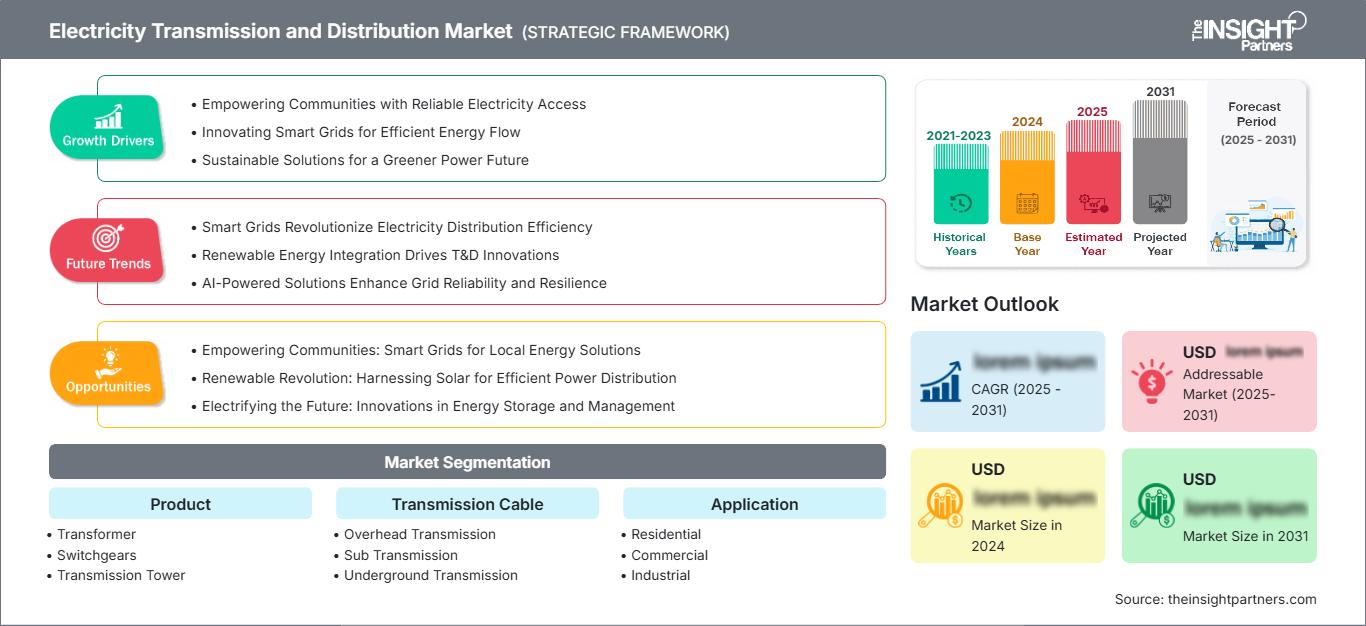
The global Electricity Transmission and Distribution Market size was valued at US$ 373.71 Billion in 2025 and is projected to reach US$ 746.24 Billion by 2034, registering a compound annual growth rate (CAGR) of 7.99% from 2026 to 2034. This robust growth trajectory reflects increasing global electricity demand, rapid urbanization, and the critical need for modernizing aging grid infrastructure. The rising integration of renewable energy sources and the expansion of smart grid technologies continue to shape market expansion dynamics across developed and developing economies.
North America represents a significant revenue pocket, with estimates suggesting a CAGR of approximately 7.5-8.0% through the forecast period. The region's growth is anchored by substantial investments in grid modernization initiatives and the replacement of aging transmission infrastructure. Additionally, the expanding renewable energy portfolio and increasing electrification of transportation, particularly electric vehicle adoption, support incremental demand for advanced transmission and distribution equipment across the United States and Canada.
Electricity Transmission and Distribution Market Assessment and Insights
- North America: Captured approximately 28-32% of the global Electricity Transmission and Distribution market share in 2025, supported by grid modernization programs and renewable integration mandates. The region is projected to grow at a CAGR of 7.5-8.0% during 2026-2034, driven by infrastructure replacement and smart grid deployments.
- US: Representing about 85-90% of the North American market in 2025, the U.S. continues to lead regional demand. The market is projected to expand at a CAGR of 7.0-7.5% through 2034, supported by federal funding for grid resilience and state-level renewable portfolio standards.
- Europe: Held roughly 22-26% of the global market share in 2025, with Germany, the UK, and France as leading contributors. The region is expected to witness a CAGR of 7.0-7.5% from 2026 to 2034, driven by the energy transition agenda and cross-border interconnection projects.
- Asia Pacific: Accounted for approximately 38-42% of the global market in 2025, with China, India, and Japan as major contributors. The region is projected to grow at a robust CAGR of 8.5-9.0% during 2026-2034, driven by rapid urbanization, industrialization, and large-scale renewable energy integration.
- Largest Segment: The Transformer segment dominated the Electricity Transmission and Distribution Market in 2025, accounting for an estimated 28-32% market share. This segment's prominence is attributed to its critical role in voltage regulation and power flow management across transmission and distribution networks.
- High Growth Segment: The Power Cables and Wires segment is projected to exhibit robust growth, with a CAGR of 8.0-8.5% from 2026 to 2034. This growth is driven by expanding transmission network coverage, submarine cable projects, and underground cabling initiatives in urban areas.
- Key companies analyzed in detail: Siemens Energy, Mitsubishi Electric Corporation, ABB, Eaton, CG Power and Industrial Solutions Ltd, Bharat Heavy Electricals Limited, Larsen and Toubro Limited, General Electric, Schneider Electric, Kirloskar Electric Company.
Source: The Insight Partners' analysis based on proprietary research, government publications, company annual reports, investor presentations, industry databases, and expert interviews.
The development of the Electricity Transmission and Distribution Market is associated with revolutionary changes from traditional passive grid infrastructure to digital and intelligent systems. This is enabled by the continuous digitalization and introduction of smart grids . Companies are now increasingly working on the creation of advanced equipment with monitoring functionality, such as digital substations and IoT-enabled transformers, which allow real-time information gathering and preventive maintenance. The advancement in HVDC technology and ultra-high-voltage power transmission is enhancing power transmission efficiency and decreasing transmission losses.
In the future, the Electricity Transmission and Distribution Market is forecasted to experience steady growth thanks to the development of emerging economies and investment in infrastructure. Governments' initiatives related to renewable energy integration and energy access in such regions as Asia Pacific and Africa are likely to bring significant deployment prospects to T&D equipment . In addition, artificial intelligence integration with management systems of the grid is expected to bring additional value due to its optimization potential and fault prediction features. Regulatory factors, primarily in Europe and North America, will have an influence on the demand for T&D solutions.
Electricity Transmission and Distribution Market Report Scope
| Report Attribute | Details |
|---|---|
| Market size in 2025 | US$ 373.71 Billion |
| Market Size by 2034 | US$ 746.24 Billion |
| Global CAGR (2026 - 2034) | 7.99% |
| Historical Data | 2021-2024 |
| Forecast period | 2026-2034 |
Electricity Transmission and Distribution Market Analysis
The demand for electricity transmission and distribution equipment is driven by the increasing demand for reliable electricity delivery and upgrading of the power network in various sectors of end-users. In the utility industry, the T&D network plays a major role in electricity generation; hence, there is a constant demand for transformers, switchgears, and power cables to ensure reliability and meet increasing demand. Industrial firms require strong transmission and distribution systems to operate their factories, whereas consumers enjoy increased reliability and reduced outages due to upgrades in the electricity transmission and distribution grid. With increasing use of renewable energy sources such as wind and solar energy, there is an increased need for flexible electricity networks that can manage electricity flow, thereby generating the demand for electricity transmission and distribution equipment.
In the Electricity Transmission and Distribution Market, the value chain consists of raw material producers, component suppliers, manufacturers of equipment, and operators of utilities. Increasing focus is being placed on offering an end-to-end grid solution. There has been significant investment in R&D by the manufacturers to produce efficient and reliable equipment with advanced digital features. It is imperative that there should be a regular supply of raw materials with good quality, such as copper, aluminum, and insulating materials, to sustain manufacturing capacity and be competitive in cost terms.
Competition in the Electricity Transmission and Distribution Market is marked by the existence of well-established international companies and dedicated equipment suppliers. ABB leads strongly in terms of full product ranges and grid automation experience, whereas Siemens Energy and Schneider Electric concentrate on energy systems. Technologically advanced and internationally oriented Mitsubishi Electric and General Electric enter the market, while region-specific players, such as Larsen and Toubro and Bharat Heavy Electricals Limited, lead the market in India due to their cost-effective products. Investment tendencies show that a key strategy is the digitization of the business, especially through grid management software and smart substations.
In addition, companies are seeking alliances and mergers to diversify their products and geographies. Collaboration between equipment vendors and technology vendors is increasing the pace of developing solutions in line with the smart grid architecture. Geographic expansions especially within the fast-growing Asia Pacific region are important for most companies who would like to exploit huge infrastructural upgrading programs. Moreover, the change towards performance-based contract and service-oriented solutions is changing the revenue and customer approach model in the Electricity Transmission and Distribution Market.
● REPORT CUSTOMIZATION
Tailor This Report To Align With Your Specific Business Requirements
This report can be customized to align precisely with your business objectives, scope, and target markets. Customization options include tailored segmentation, geography, competitive analysis, and strategic insights to support informed decision-making.
Customize This Report →WHAT YOU CAN ADJUST
- ● Segmentations
- ● Geography
- ● Competitive Analysis
- ● Language Preferences
Electricity Transmission and Distribution Market: Strategic Insights
Regional Insights
North America Electricity Transmission and Distribution Market
The Electricity Transmission and Distribution Market forecast indicates that the North America accounted for approximately 28-32% of the global market share in 2025 and is projected to grow at a CAGR of 7.5-8.0% from 2026 to 2034. The strength of the market in the area is supported by the need for upgrading an extensive grid system, strong regulatory policies supporting reliability, and renewable energy integration goals. For the U.S. and Canada, investments in transmission infrastructure and smart grids have been encouraged by government initiatives at the federal and state levels as a solution to aging infrastructure and climate-related disasters. Commercial establishments such as data centers and manufacturing plants depend on efficient T&D infrastructure in order to operate efficiently and cut down downtime. Finally, the growing adoption of electric cars and related infrastructure is putting additional strain on grid systems.
U.S. Electricity Transmission and Distribution Market
According to the Electricity Transmission and Distribution Market report, the U.S. approximately 85-90% of the North American market in 2025 and is expected to grow at a CAGR of 7.0-7.5% during 2026-2034. Market domination of the country is due to the presence of federal investments in grid modernization programs, renewable portfolio standards on the state level, and the availability of extensive transmission infrastructure that needs upgrading. Companies like ABB, Siemens Energy, and General Electric dominate the market as suppliers of a wide spectrum of T&D equipment for utilities and industries. Current trends in application include a shift to digital substations with IoT functionality and monitoring capability. Increased deployment of renewable energy generation in places like Texas and California requires improvements in transmission capacity in order to integrate far-off generation facilities with load centers. Energy storage systems integration with distribution networks is becoming increasingly popular.
Europe Electricity Transmission and Distribution Market
The European Electricity Transmission and Distribution Market captured approximately 22-26% of the global market share in 2025 and is projected to expand at a CAGR of 7.0-7.5% from 2026 to 2034. The growth in this region is fueled by ambitious renewable energy goals, interconnections, and smart grid technology deployment. Germany leads in terms of the market size due to its Energiewende energy policy and considerable investments in the transmission network expansion in order to integrate offshore wind farms. The UK comes second, owing to the infrastructure investments which help connect renewable energy sources to the grid and make it more reliable. The markets in France, Italy, and Spain are growing steadily as well due to the use of EU financing instruments and energy security policies. The HVDC transmission network deployment which enables electricity trading is one of the trends in the region.
APAC Electricity Transmission and Distribution Market
The Asia Pacific Electricity Transmission and Distribution Market accounted for approximately 38-42% of the global market share in 2025 and is projected to grow at the highest CAGR of 8.5-9.0% during 2026-2034. China and India are the major contributors to the market, as both countries are experiencing rapid urbanization, industrialization, and renewable energy deployment. China’s market includes many ultra-high voltage (UHV) transmission lines linking distant sources of renewable power with coastal consumption hubs, owing to the country’s priorities in terms of energy security. India’s market grows due to the Saubhagya program for electrification and renewable energy goals necessitating investment in transmission networks. Japan and South Korea are also substantial markets, which concentrate their efforts on grid modernization and strengthening after natural disasters. The development of renewable energy zones in Australia stimulates the market growth there.
Middle East & Africa Electricity Transmission and Distribution Market
The Middle East & Africa Electricity Transmission and Distribution Market is projected to experience robust growth, with a CAGR of approximately 8.0-8.5% from 2026 to 2034. The two countries that account for the majority of the demand are Saudi Arabia and the UAE owing to their large scale infrastructure and economic diversification initiatives like Saudi Vision 2030, which focuses on renewable energy and grid upgrades. The market in South Africa is driven by the Integrated Resource Plan as well as investments needed to solve the load-shedding issues. In the Rest of MEA region, there is a steady adoption being witnessed due to the efforts of rural electrification. The trend of cost-efficient transmission and distribution automation is emerging, especially in areas with no existing infrastructure.
Segmentation Analysis
Product
The Product segment of the Electricity Transmission and Distribution Market is categorized into Transformer, Switchgears, Transmission Tower, and Power Cables and Wires. This segment is projected to grow at a CAGR of 7.5-8.0% during 2026-2034, driven by the diverse requirements of grid expansion and modernization projects. Transformers remain the backbone of T&D infrastructure, while switchgears protect and control power flow. Transmission towers support overhead lines, and power cables facilitate underground and submarine transmission. The market is witnessing increasing demand for advanced, digitally-enabled equipment that supports smart grid functionalities and enhances grid reliability.
- Transformer: Transformers are critical components for voltage regulation and power flow management across transmission and distribution networks. These devices enable efficient power transfer at different voltage levels, supporting grid stability and reducing losses. The demand for transformers is driven by grid expansion, renewable integration, and replacement of aging assets.
- Switchgears: Switchgears are essential for protecting electrical equipment from faults and ensuring safe operation of power networks. These devices control power flow and isolate faulty sections, enhancing system reliability and reducing downtime. The growing integration of renewables and smart grid technologies boosts demand for advanced switchgears.
- Transmission Tower: Transmission towers support overhead power lines, enabling long-distance electricity transfer with minimal losses. These structures are critical for connecting generation sources to load centers. The expansion of transmission networks, particularly in developing regions, drives demand for transmission towers and associated infrastructure.
- Power Cables and Wires: Power cables and wires form the backbone of transmission and distribution networks, facilitating electricity flow from generation to consumption points. This segment includes overhead conductors, underground cables, and submarine cables. The segment's growth is driven by expanding transmission coverage, urban undergrounding initiatives, and renewable energy connection projects.
Transmission Cable
The Transmission Cable segment of the Electricity Transmission and Distribution Market is categorized into Overhead Transmission, Sub Transmission, and Underground Transmission. This segment is projected to grow at a CAGR of 7.5-8.0% from 2026 to 2034, reflecting the diverse cable requirements of modern power networks. Overhead transmission remains the dominant approach for long-distance power transfer, while underground and sub-transmission cables are increasingly adopted in urban areas and environmentally sensitive locations where aesthetics and land use constraints apply.
- Overhead Transmission: Overhead transmission lines are the most common method for long-distance power transfer, offering cost-effectiveness and ease of maintenance. These lines are widely used in rural and intercity connections. The demand for overhead transmission is driven by grid expansion and renewable energy integration projects in developing regions.
- Sub Transmission: Sub-transmission lines connect transmission networks to distribution systems, operating at intermediate voltage levels. These lines serve as the interface between bulk power transfer and local distribution. The growth of sub-transmission is supported by distribution network expansion and the integration of distributed generation.
- Underground Transmission: Underground transmission cables are increasingly adopted in urban areas and locations where overhead lines are impractical or visually undesirable. These cables offer reliability benefits and reduced vulnerability to weather events. The segment's growth is driven by urban infrastructure development and environmental considerations in developed regions.
Application
The Application segment of the Electricity Transmission and Distribution Market is categorized into Residential, Commercial, and Industrial sectors. This segment is projected to grow at a CAGR of 7.5-8.0% from 2026 to 2034, driven by diverse end-user requirements for reliable power supply. The Industrial and Commercial sectors lead in consumption and infrastructure investment, while the residential sector supports growth through urbanization and increasing electricity access in developing regions.
- Residential: Residential applications account for a significant share of electricity consumption, requiring robust T&D infrastructure to ensure reliable supply. The growth of the residential segment is driven by urbanization, population growth, and increasing electricity access in developing countries. Rising adoption of electric vehicles and home charging infrastructure creates new demands on distribution networks.
- Commercial: Commercial applications encompass office buildings, retail spaces, and public institutions requiring reliable and high-quality power supply. The commercial sector's growth is driven by economic expansion, infrastructure investment, and the increasing digitization of commercial operations. Data centers and healthcare facilities represent particularly critical applications requiring high reliability.
- Industrial: Industrial applications represent a significant segment of the T&D market, with manufacturing facilities and industrial processes requiring stable power supply. The industrial sector's growth is driven by industrialization in developing economies and the expansion of energy-intensive industries. The integration of renewable energy and energy storage in industrial facilities creates additional infrastructure requirements.
Opportunity Snapshot
| Application Segment | Revenue Contribution | Trend Tag | Adoption Stage |
|---|---|---|---|
| Residential | Medium | Urbanization | Scaling |
| Commercial | High | Data Centers | Mature |
| Industrial | High | Load Growth | Mature |
Electricity Transmission and Distribution Market Growth Drivers and Impact Analysis
Renewable Energy Integration Driving Transmission Infrastructure Expansion
The global shift toward renewable energy sources, including solar, wind, and hydroelectric power, is fundamentally reshaping transmission and distribution infrastructure requirements. Renewable generation facilities are often located in remote areas with high resource potential but limited existing grid connectivity, necessitating significant investments in transmission lines and substations. The variability of solar and wind power also demands flexible grid infrastructure capable of managing fluctuating power flows and maintaining system stability. Utilities are investing in advanced transmission systems, including HVDC lines and flexible AC transmission systems (FACTS), to enable the efficient transport of renewable power to load centers. This driver has a direct and substantial impact on market growth, as renewable energy targets continue to rise globally.
Grid Modernization and Replacement of Aging Infrastructure
A significant portion of the global transmission and distribution infrastructure is approaching or exceeding its operational lifespan, creating substantial replacement demand. In North America and Europe, many transmission lines, transformers, and substations were installed decades ago and require upgrading to meet modern reliability and efficiency standards. Grid modernization initiatives, including the deployment of smart grid technologies and digital substations, are replacing outdated equipment with advanced solutions offering enhanced monitoring, control, and automation capabilities. This driver is particularly pronounced in developed economies, where public and private investments are accelerating the modernization of critical energy infrastructure, directly stimulating demand for T&D equipment and services.
Urbanization and Rising Electricity Demand in Emerging Economies
Rapid urbanization and industrialization in emerging economies, particularly in Asia Pacific and Africa, are driving significant expansion of transmission and distribution infrastructure. Growing populations, rising living standards, and expanding industrial bases are creating unprecedented electricity demand, requiring large-scale investments in generation, transmission, and distribution capacity. Countries such as China, India, and Indonesia are undertaking ambitious grid expansion programs, including ultra-high-voltage transmission projects and rural electrification initiatives. This driver has a profound impact on market growth, as developing nations prioritize energy infrastructure investment to support economic development and improve energy access for their populations.
Electricity Transmission and Distribution Market Future Trends
Digitalization of Grid Infrastructure and Smart Grid Deployment
The integration of digital technologies with transmission and distribution systems is transforming how power networks are managed and operated. Smart grids, equipped with sensors, communication networks, and advanced analytics, enable real-time monitoring, automated fault detection, and optimized power flow management. The deployment of advanced metering infrastructure, digital substations, and grid automation solutions is becoming increasingly widespread, as utilities seek to enhance reliability, reduce losses, and integrate renewable energy sources effectively. This trend is expected to accelerate as technology costs decline and regulatory frameworks evolve to support grid modernization investments.
Expansion of High-Voltage Direct Current and Submarine Transmission Systems
HVDC transmission technology is experiencing increased adoption for long-distance power transfer and interconnection of asynchronous grids. HVDC systems offer lower transmission losses and enable efficient integration of offshore wind and remote renewable generation. Submarine cable projects, connecting islands and continents, are becoming more common as countries seek to diversify energy sources and enhance grid security. This trend is particularly relevant in Europe and Asia Pacific, where cross-border interconnections and offshore wind developments are driving significant investments in HVDC and submarine transmission infrastructure.
Electricity Transmission and Distribution Market Opportunities
Expansion into Emerging Smart City Projects and Infrastructure Modernization
Government-led smart city initiatives in Asia Pacific, the Middle East, and other regions present significant opportunities for transmission and distribution equipment deployments. These projects require integrated energy infrastructure solutions, including smart grids, microgrids, and advanced distribution networks. Companies that offer scalable, interoperable T&D systems with digital capabilities and cloud-based analytics are well-positioned to capitalize on these large-scale infrastructure investments, which often include substantial funding for energy infrastructure modernization.
Development of Integrated Grid Management Platforms with Value-Added Services
Opportunities exist for T&D equipment manufacturers to develop integrated platforms that combine hardware with software analytics, grid management, and predictive maintenance functionalities. Subscription-based models offering real-time monitoring, asset performance management, and system optimization provide recurring revenue streams while addressing the evolving needs of utilities seeking comprehensive grid solutions . The shift toward performance-based contracts and lifecycle services is creating new business models beyond traditional equipment supply.
Recent Developments
- July 2025: Advait Energy Transitions Ltd. signed a strategic Memorandum of Understanding (MoU) with MEIL (Mangal Electrical Industries Ltd.) to jointly pursue opportunities in India's energy transition sector. The partnership will focus on developing and executing projects across power transmission and distribution, renewable energy, battery energy storage systems (BESS), green hydrogen, electrolysers, solar EPC, and advanced power infrastructure. By combining Advait's expertise in energy technologies with MEIL's engineering and execution capabilities, the collaboration aims to strengthen participation in large-scale domestic and international energy infrastructure projects, expand technical capabilities, and support India's transition toward a cleaner and more resilient energy ecosystem.
- June 2026: National Grid launched the next phase of its Electricity Transmission Partnership (ETP) by awarding a £1.2 billion overhead line framework to five strategic partners to upgrade more than 1,000 km of existing transmission lines across England and Wales. The initiative forms part of National Grid's broader RIIO-T3 investment plan, which aims to upgrade around 3,500 km of transmission infrastructure by 2031 to connect increasing volumes of renewable energy and strengthen grid capacity. The long-term partnership model is expected to accelerate project delivery, expand supply chain capability, drive investment in workforce training and innovation, and enhance the resilience and efficiency of the UK's electricity transmission network.
- May 2026: Larsen & Toubro's (L&T) Power Transmission & Distribution (PT&D) business secured significant EPC orders (valued between ₹1,000 crore and ₹2,500 crore) from clients in the Middle East for the turnkey construction of one 380 kV and two 132 kV extra-high voltage substations. The projects are designed to improve grid reliability, decongest transmission networks, and ensure stable power supply to major load centers amid rising electricity demand. These order wins strengthen L&T's international presence in power infrastructure, reinforce its expertise in delivering high-voltage transmission solutions, and support the expansion and modernization of electricity networks across the region.
Frequently Asked Questions

- Comprehensive Market Sizing and Forecast Analysis
- Detailed Segmentation Analysis
- In-Depth Market Dynamics Assessment
- Regional and Country-Level Insights
- Competitive Landscape and Company Benchmarking
- Strategic Business Intelligence
Recent Reports
Testimonials

The Insight Partners' SCADA System Market report is comprehensive, with valuable insights on current trends and future forecasts. The team was highly professional, responsive, and supportive throughout. We are very satisfied and highly recommend their services.
RAN KEDEM Partner, Reali Technologies LTDs
I requested a report on a very specific software market and the team produced the report in a few days. The information was very relevant and well presented. I then requested some changes and additions to the report. The team was again very responsive and I got the final report in less than a week.
JEAN-HERVE JENN Chairman, Future Analytica
We worked with The Insight Partners for an important market study and forecast. They gave us clear insights into opportunities and risks, which helped shape our plans. Their research was easy to use and based on solid data. It helped us make smart, confident decisions. We highly recommend them.
PIYUSH NAGPAL Sr. Vice President, High Beam Global
The Insight Partners delivered insightful, well-structured market research with strong domain expertise. Their team was professional and responsive throughout. The user-friendly website made accessing industry reports seamless. We highly recommend them for reliable, high-quality research services
YUKIHIKO ADACHI CEO, Deep Blue, LLC.
This is the first time I have purchased a market report from The Insight Partners.While I was unsure at first, I visited their web site and felt more comfortable to take the risk and purchase a market report.I am completely satisfied with the quality of the report and customer service. I had several questions and comments with the initial report, but after a couple of dialogs over email with their analyst I believe I have a report that I can use as input to our strategic planning process.Thank you so much for taking the extra time and making this a positive experience.I will definitely recommend your service to others and you will be my first call when we need further market data.
JOHN SUZUKI President and Chief Executive Officer, Board Director, BK Technologies
I wish to appreciate your support and the professionalism you displayed in the course of attending to my request for information regarding to infectious disease IVD market in Nigeria. I appreciate your patience, your guidance, and the fact that you were willing to offer a discount, which eventually made it possible for us to close a deal. I look forward to engaging The Insight Partners in the future, all thanks to the impression you have created in me as a result of this first encounter.
DR CHIJIOKE ONYIA MANAGING DIRECTOR, PineCrest Healthcare Ltd.Reason to Buy
- Informed Decision-Making
- Understanding Market Dynamics
- Competitive Analysis
- Identifying Emerging Markets
- Customer Insights
- Market Forecasts
- Risk Mitigation
- Boosting Operational Efficiency
- Strategic Planning
- Investment Justification
- Tracking Industry Innovations
- Aligning with Regulatory Trends





 Get Free Sample for