
Electromagnetic Flow Meters Market Size, Growth & Demand by 2034
Coverage: by Excitation Type (Alternating Current (AC), Direct Current(DC)); Application (Chemical, Pharmaceutical, Food and Beverage, Pulp and Paper, Municipal Applications, Mining, Agricultural, Other) , and Geography (North America, Europe, Asia Pacific, and South and Central America)
- Status : Data Released
- Report Code : TIPEL00002721
- Category : Electronics and Semiconductor
- No. of Pages : 150
- Available Report Formats :


- Last update date : August 06, 2026


2025 Market Size
US$ 14.28 Bn
Base year value
2034 Forecast
US$ 28.99 Bn
Projected by 2034
CAGR 2026-2034
8.19 %
Growth rate
Addressable Market
US$ 194.46 Bn
(2026-2034)
The Electromagnetic Flow Meters Market size reached a value of US$ 14.28 Billion in 2025 and is estimated to touch US$ 28.99 Billion by 2034 with a Compound Annual Growth Rate (CAGR) of 8.19% between 2026–2034. The growth of the market is based on precise and reliable measurement of conductive liquids in various industries such as chemicals, pharmaceuticals, food & beverages, pulp & paper, municipal operations, mining, and agriculture.
North America is forecast to grow at a CAGR of 7.6-8.4% during 2026-2034 on account of utility water renewal, chemical processes automation, and replacement of mechanical meters in old facilities. Structural demand in this industry is very high wherever wastewater regulation, leak prevention, and connectivity of flow information are increasingly key considerations.
Electromagnetic Flow Meters Market Assessment and Insights
- North America held 24–27% share in 2025 and is growing at a CAGR of 7.6–8.4% during 2026–2034, led by water utility digitization, chemical processing upgrades, and stricter discharge monitoring.
- US represented 78–82% of North American revenue in 2025 and is growing at a CAGR of 7.7–8.5% during 2026–2034, supported by municipal retrofits and process automation.
- Europe accounted for 21–24% share in 2025 and is growing at a CAGR of 7.1–7.9% during 2026–2034, with Germany, France, the UK, Italy, and Spain leading adoption.
- Asia Pacific held 38–42% share in 2025 and is growing at a CAGR of 8.7–9.5% during 2026–2034, led by China, India, Japan, South Korea, and Australia.
- Largest Segment Municipal Applications held 32–36% market share in 2025 and are growing at a CAGR of 8.0–8.8% during 2026–2034 due to water and wastewater measurement needs.
- High Growth Segment Pharmaceutical applications represented 10–13% market share in 2025 and are growing at a CAGR of 9.1–9.9% during 2026–2034, supported by hygienic low-flow measurement.
- Key companies analyzed in detail: ABB Ltd.; Badger Meter, Inc.; Emerson Electric Co.; Endress+Hauser AG; Hitachi, Ltd.; KROHNE Messtechnik GmbH; McCrometer, Inc.; ONICON Incorporated; Schneider Electric SE; Siemens Aktiengesellschaft.
Source: The Insight Partners' analysis based on proprietary research, government publications, company annual reports, investor presentations, industry databases, and expert interviews.
From mechanical flow measurements to reduced pressure losses, corrosion resistance, and reliable readings in full-pipe conductive liquid services, process industries have transitioned into electromagnetic flow measurement technologies. Production conditions include the compatibility of linings, the material used for electrodes, transmitter diagnostics, and preparedness for digital communications. The development puts the market in line with the utility digitalization, batch manufacturing, and industrial automation trends where measurement accuracy is relevant to dosing and compliance reporting.
Future demand will get a boost from developing nations increasing the wastewater infrastructure, desalination processes, mineral extraction, and food processing capabilities. The market is experiencing a growing investment in batteries-powered district metering, hygienic low-flow sensors, and intelligent transmitters ready to communicate with SCADA and asset management systems. Water loss reduction, effluent treatment, and pharmaceutical process validation regulatory developments bring tailwinds as electromagnetic meters are capable of providing verified flow rates without any mechanical components.
Electromagnetic Flow Meters Market Report Scope
| Report Attribute | Details |
|---|---|
| Market size in 2025 | US$ 14.28 Billion |
| Market Size by 2034 | US$ 28.99 Billion |
| Global CAGR (2026 - 2034) | 8.19% |
| Historical Data | 2021-2024 |
| Forecast period | 2026-2034 |
Electromagnetic Flow Meters Market Analysis
The Electromagnetic Flow Meters Market growth is due to water accountability, chemical batching, and digital manufacturing. The municipal utility companies employ meters to minimize non-revenue water and improve pumping efficiency, whereas chemical and food manufacturers employ electromagnetic flow meters to measure conductive liquids in dosing, blending, and cleaning processes.
The ecosystem comprises of magnetic coils, liners, electrodes, transmitters, calibration laboratories, distributors, system integrators, EPC contractors, and end-users. The supply dynamics are affected by material compatibility, certification, reliability of firmware, and service network since the instrument qualification process of the plants takes a long time.
The competitive scenario involves the automation firms along with flow meter manufacturers. ABB Ltd., Emerson Electric Co., Endress+Hauser AG, Schneider Electric SE, and Siemens Aktiengesellschaft are competitors for the market via their instrumentation solutions, digital capabilities, and services via installed base. KROHNE Messtechnik GmbH, Badger Meter, Inc., McCrometer, Inc., and ONICON Incorporated aid Electromagnetic Flow Meters Market by way of application specific engineering.
The areas of investment include diagnostics, remote configuration, low power communication, hygienic assembly, and anti-corrosion materials. Positioning has become important through lifecycle cost, local calibration, cyber secure communication, and capability to cater water utilities and process plants with standard hardware families for all sizes of pipes.
● REPORT CUSTOMIZATION
Tailor This Report To Align With Your Specific Business Requirements
This report can be customized to align precisely with your business objectives, scope, and target markets. Customization options include tailored segmentation, geography, competitive analysis, and strategic insights to support informed decision-making.
Customize This Report →WHAT YOU CAN ADJUST
- ● Segmentations
- ● Geography
- ● Competitive Analysis
- ● Language Preferences
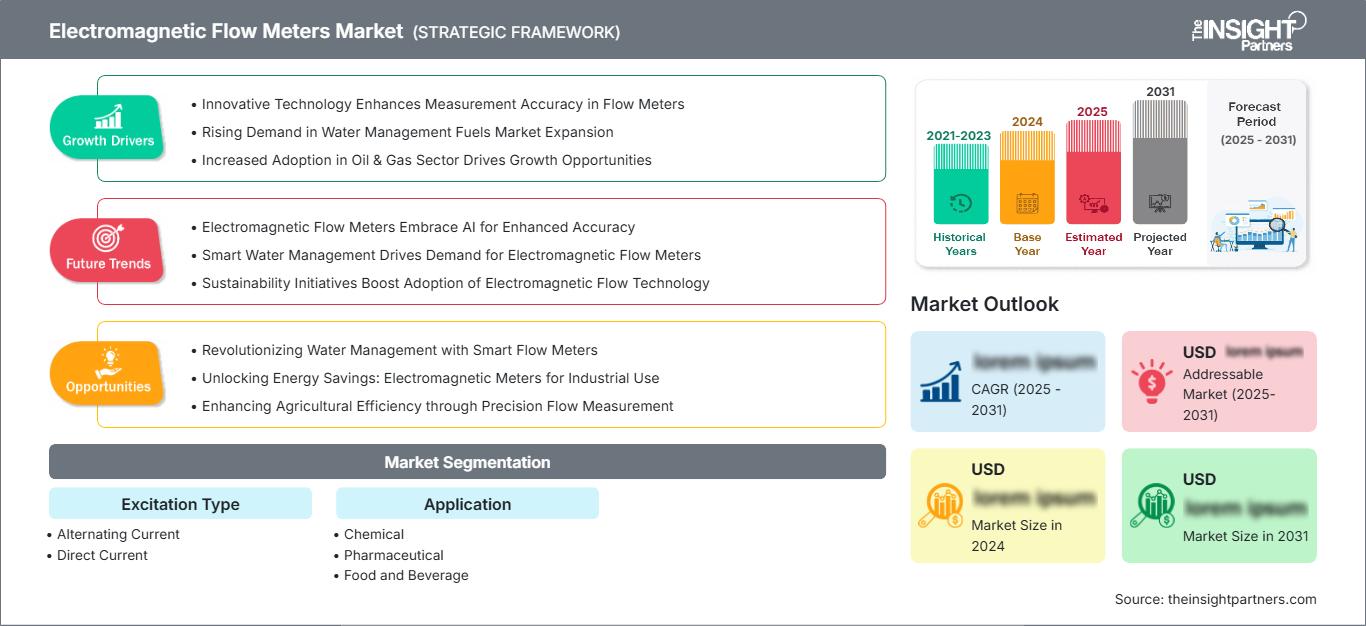
Electromagnetic Flow Meters Market: Strategic Insights
Regional Insights
North America Electromagnetic Flow Meters Market
North America accounted for 24–27% of Electromagnetic Flow Meters Market share in 2025 and is projected to grow at a CAGR of 7.6–8.4% during 2026–2034. Utility leakage programs, EPA-driven reporting discipline, and replacement of aging meters support adoption in municipal networks.
Industrial demand comes from chemicals, pharmaceuticals, food processing, mining slurry handling, and pulp operations that require non-obstructive measurement. ABB Ltd., Emerson Electric Co., Badger Meter, Inc., McCrometer, Inc., and ONICON Incorporated support the region through local manufacturing, distribution, calibration, and utility relationships.
U.S. Electromagnetic Flow Meters Market
The competitive scenario involves the automation firms along with flow meter manufacturers. ABB Ltd., Emerson Electric Co., Endress+Hauser AG, Schneider Electric SE, and Siemens Aktiengesellschaft are competitors for the market via their instrumentation solutions, digital capabilities, and services via installed base. KROHNE Messtechnik GmbH, Badger Meter, Inc., McCrometer, Inc., and ONICON Incorporated aid Electromagnetic Flow Meters Market by way of application specific engineering.
The areas of investment include diagnostics, remote configuration, low power communication, hygienic assembly, and anti-corrosion materials. Positioning has become important through lifecycle cost, local calibration, cyber secure communication, and capability to cater water utilities and process plants with standard hardware families for all sizes of pipes.
Europe Electromagnetic Flow Meters Market
In 2025, Europe had 21-24% market share which is expected to have a CAGR of 7.1-7.9% between 2026-2034. German buyers are driving growth via demand for chemicals, automation, and water infrastructure while French and British buyers are driven by wastewater compliance and Italian and Spanish buyers via food, beverages and municipality projects.
European consumers value Metering Instrumentation Directive compliant meters, hygienic documentation, remote diagnostics and reduced maintenance lifecycle. Endress+Hauser AG, KROHNE Messtechnik GmbH, ABB Ltd., Siemens Aktiengesellschaft and Schneider Electric SE take advantage of their proximity to utilities companies and process manufacturing.
APAC Electromagnetic Flow Meters Market
Asia Pacific contributed 38-42% market share in 2025 and is estimated to grow at a CAGR of 8.7-9.5% from 2026-2034. China remains dominant with municipal infrastructure and chemical applications, whereas India increases adoption in wastewater and irrigation measurements. Demand from Japan, South Korea, and Australia comes from automated installations.
Industrial policies, urbanization trends, and water management programs position APAC as key region for volume growth. The mining, pulp & paper, food processing, and pharmaceutical industries need rugged sensors, stable electrodes, and transmitters that can withstand harsh or regulated environments.
Middle East & Africa Electromagnetic Flow Meters Market
The Middle East & Africa market is projected to grow at a CAGR of 6.8–7.6% during 2026–2034. Saudi Arabia leads through desalination, water transmission, and industrial diversification. The UAE supports smart infrastructure, while South Africa and Rest of MEA add mining and municipal refurbishment demand.
Energy and infrastructure programs increase demand for robust meters that withstand heat, variable water quality, and abrasive process fluids. Buyers prioritize remote diagnostics, corrosion-resistant liners, and service availability because dispersed assets require fewer site visits and predictable maintenance planning.
Segmentation Analysis
Excitation Type
Excitation Type is projected to grow at a CAGR of 7.9–8.7% during 2026–2034. The Electromagnetic Flow Meters Market scope covers excitation designs selected by signal stability, noise rejection, power consumption, and fluid conductivity. Alternating current designs remain relevant in demanding industrial services, while direct current designs gain preference in modern low-power and digitally connected instruments.
- Alternating Current excitation supports applications where strong signal generation and robust measurement are needed in challenging conductive liquids, especially larger pipelines and industrial environments with electrical noise.
- Direct Current excitation is strategically important for modern smart meters because lower power demand, stable zero-point control, and compatibility with battery-powered designs support remote municipal and agricultural installations.
Application
Application is forecast to grow at a CAGR of 8.0–8.8% during 2026–2034. Municipal applications lead because water and wastewater networks require accurate, low-maintenance flow data. Chemical, pharmaceutical, food and beverage, pulp and paper, mining, and agricultural users adopt these meters where corrosive liquids, slurries, hygienic fluids, or irrigation water must be measured without moving parts.
- Chemical applications require corrosion-resistant liners and electrodes for acids, alkalis, solvents, and dosing streams, making electromagnetic meters valuable for batch accuracy and safer process control.
- Pharmaceutical facilities use hygienic low-flow meters for purified water, buffers, and liquid ingredients where validation, repeatability, cleanability, and documentation are essential for regulated production.
- Food and Beverage users adopt sanitary meters for syrups, dairy liquids, beverages, and cleaning cycles, where obstruction-free measurement supports quality control and reduces contamination risk.
- Pulp and Paper plants rely on magnetic meters for stock, coatings, process water, and chemical additives because abrasive and fibrous fluids challenge mechanical measurement technologies.
- Municipal Applications represent the largest demand base, covering drinking water, wastewater, district metering, leak detection, billing, and treatment-plant process control across urban networks.
- Mining applications use electromagnetic meters for slurry, tailings, reagent dosing, and process water, where rugged liners and stable readings improve plant balance and environmental reporting.
- Agricultural adoption is rising in irrigation networks, fertigation, and groundwater monitoring as water-stressed regions require accurate allocation, pumping optimization, and remote flow visibility.
Opportunity Snapshot
| Application | Revenue Contribution | Trend Tag | Adoption Stage |
| Chemical | High | Corrosion Control | Mature |
| Pharmaceutical | Medium | Hygienic Flow | Scaling |
| Food and Beverage | Medium | Sanitary Lines | Scaling |
| Pulp and Paper | Medium | Slurry Stability | Mature |
| Municipal Applications | High | Leak Analytics | Scaling |
| Mining | Medium | Tailings Control | Scaling |
| Agricultural | Low | Irrigation Metering | Emerging |
Electromagnetic Flow Meters Market Growth Drivers and Impact Analysis
Water accountability and wastewater compliance accelerate adoption
Utilities are under pressure to reduce losses, document effluent performance, and manage pumping energy more effectively. Electromagnetic meters support these goals because they measure conductive liquids without moving parts, reducing obstruction and wear in distribution and treatment networks. The market impact is higher deployment in district metered areas, raw water intake, sludge handling, and treated-water discharge. Suppliers that combine battery operation, pressure data, alarms, and cloud connectivity can help operators identify abnormal flows faster, prioritize repairs, and justify capital spending with measurable operational evidence.
Process automation raises demand for precise conductive-liquid data
Chemical, pharmaceutical, food, beverage, and pulp manufacturers need accurate flow information to control recipes, reduce waste, and maintain documentation. Electromagnetic meters fit these requirements when fluids are conductive and mechanical intrusion could create pressure loss or contamination points. The market impact is stronger demand for hygienic fittings, corrosion-resistant liners, and transmitters with digital protocols. Manufacturers that offer application engineering, calibration certificates, and validated cleaning compatibility gain preference because plant teams increasingly standardize instruments across multiple production lines and sites.
Mining and agriculture require durable meters for difficult fluids
Mining operations measure slurry, tailings, reagents, and process water, while agriculture needs accurate irrigation and fertigation control. These environments expose meters to abrasion, variable conductivity, sediment, and remote operating conditions. The market impact is growing demand for rugged liners, insertion designs, battery-powered transmitters, and telemetry-ready instruments that minimize field visits. Vendors able to support harsh-service selection and regional maintenance can improve adoption, particularly where water scarcity, environmental reporting, and resource productivity are becoming investment priorities.
Electromagnetic Flow Meters Market Future Trends
Smart diagnostics become standard in distributed water networks
Electromagnetic Flow Meters Market trends point toward instruments that report flow, pressure, battery health, empty-pipe events, and abnormal consumption patterns through low-bandwidth communication. Water utilities will increasingly expect meters to support leak localization, pressure management, and asset prioritization rather than only volumetric measurement. Future designs will emphasize firmware security, long battery life, and easier integration with analytics platforms. This direction favors suppliers that can combine proven metering accuracy with digital services, reducing the operational gap between field instrumentation and utility decision-making.
Material engineering expands use in aggressive process fluids
Future meter selection will place greater weight on liners, electrodes, coatings, and cleanability as process fluids become more specialized. Chemical and pharmaceutical plants will require instruments that withstand aggressive media while maintaining measurement stability and validation documentation. Food and beverage facilities will favor hygienic designs that reduce dead zones and cleaning time. This trend supports premium products with application-specific materials, modular transmitters, and documented lifecycle performance, especially where downtime, contamination risk, or measurement drift can affect production economics.
Electromagnetic Flow Meters Market Opportunities
Utility packages for district metering and leak reduction
Electromagnetic Flow Meters Market Forecasts support investment in integrated utility packages that combine meters, pressure sensors, communications, installation hardware, and analytics dashboards. Municipal buyers need solutions that reduce non-revenue water and simplify field deployment across many pipeline locations. Vendors should develop standardized district metered area kits for different pipe diameters, supported by commissioning services and data interpretation. The opportunity is strongest where utilities have aging infrastructure, water scarcity, or funding tied to measurable leakage and efficiency outcomes.
Hygienic and low-flow platforms for regulated manufacturing
Pharmaceutical, biotechnology, and food manufacturers present an investment opportunity for compact meters that combine hygienic design, low-flow accuracy, and validated documentation. Buyers increasingly require instruments that integrate with batch records, cleaning systems, and quality audits. Suppliers can differentiate through sanitary fittings, certified materials, rapid calibration, and application support for purified water, buffers, syrups, and cleaning media. This opportunity rewards firms that help regulated plants reduce measurement uncertainty while maintaining production flexibility and audit readiness.
Recent Developments
- March 2026: Endress+Hauser announces a new OEM-configured variant of the Picomag electromagnetic flowmeter for the US market. Purpose-built for liquid cooling applications in data centers and OEM cooling systems, this version provides customers with a factory-configured option designed for environments where instrumentation without wireless connectivity is required. Picomag is Endress+Hauser's compact electromagnetic flowmeter designed for accurate measurement of conductive fluids in small-diameter pipelines. It combines flow, temperature and conductivity measurement in a single device.
- November 2025: ABB has launched AquaMaster4 electromagnetic flowmeter with Message Queuing Telemetry Transport (MQTT) technology to support water conservation efforts across the water industry. The solution will minimize pipeline water leaks, reduce energy use, and support broader sustainability goals in the water industry. MQTT is a lightweight, open-standard messaging protocol designed specifically for efficient, real-time communication in Internet of Things (IoT) applications. MQTT requires minimal network bandwidth and device resources.
- August 2025: ABB has launched its latest generation of electromagnetic flowmeters bringing unmatched accuracy, connectivity and flexibility to industrial and utility applications. With this launch, ABB streamlines its product portfolio, converging on two highly versatile and advanced products – ProcessMaster and AquaMaster. The products combine high performance, modularity and IoT connectivity.
Frequently Asked Questions

- Comprehensive Market Sizing and Forecast Analysis
- Detailed Segmentation Analysis
- In-Depth Market Dynamics Assessment
- Regional and Country-Level Insights
- Competitive Landscape and Company Benchmarking
- Strategic Business Intelligence
Recent Reports
Testimonials

The Insight Partners' SCADA System Market report is comprehensive, with valuable insights on current trends and future forecasts. The team was highly professional, responsive, and supportive throughout. We are very satisfied and highly recommend their services.
RAN KEDEM Partner, Reali Technologies LTDs
I requested a report on a very specific software market and the team produced the report in a few days. The information was very relevant and well presented. I then requested some changes and additions to the report. The team was again very responsive and I got the final report in less than a week.
JEAN-HERVE JENN Chairman, Future Analytica
We worked with The Insight Partners for an important market study and forecast. They gave us clear insights into opportunities and risks, which helped shape our plans. Their research was easy to use and based on solid data. It helped us make smart, confident decisions. We highly recommend them.
PIYUSH NAGPAL Sr. Vice President, High Beam Global
The Insight Partners delivered insightful, well-structured market research with strong domain expertise. Their team was professional and responsive throughout. The user-friendly website made accessing industry reports seamless. We highly recommend them for reliable, high-quality research services
YUKIHIKO ADACHI CEO, Deep Blue, LLC.
This is the first time I have purchased a market report from The Insight Partners.While I was unsure at first, I visited their web site and felt more comfortable to take the risk and purchase a market report.I am completely satisfied with the quality of the report and customer service. I had several questions and comments with the initial report, but after a couple of dialogs over email with their analyst I believe I have a report that I can use as input to our strategic planning process.Thank you so much for taking the extra time and making this a positive experience.I will definitely recommend your service to others and you will be my first call when we need further market data.
JOHN SUZUKI President and Chief Executive Officer, Board Director, BK Technologies
I wish to appreciate your support and the professionalism you displayed in the course of attending to my request for information regarding to infectious disease IVD market in Nigeria. I appreciate your patience, your guidance, and the fact that you were willing to offer a discount, which eventually made it possible for us to close a deal. I look forward to engaging The Insight Partners in the future, all thanks to the impression you have created in me as a result of this first encounter.
DR CHIJIOKE ONYIA MANAGING DIRECTOR, PineCrest Healthcare Ltd.Reason to Buy
- Informed Decision-Making
- Understanding Market Dynamics
- Competitive Analysis
- Identifying Emerging Markets
- Customer Insights
- Market Forecasts
- Risk Mitigation
- Boosting Operational Efficiency
- Strategic Planning
- Investment Justification
- Tracking Industry Innovations
- Aligning with Regulatory Trends





 Get Free Sample for