
Electron Beam Machining Market Size, Trends & Demand by 2034
Coverage: by Application (Welding, Drilling, Cutting, Surface Processing); Industry Vertical (Automotive, Aerospace and Defense, Energy and Power, Others) , and Geography (North America, Europe, Asia Pacific, and South and Central America)
- Status : Data Released
- Report Code : TIPRE00006554
- Category : Electronics and Semiconductor
- No. of Pages : 150
- Available Report Formats :


- Last update date : August 13, 2026


2025 Market Size
US$ 952.33 Mn
Base year value
2034 Forecast
US$ 1,442.75 Mn
Projected by 2034
CAGR 2026-2034
4.72 %
Growth rate
Addressable Market
US$ 10,870.58 Mn
(2026-2034)
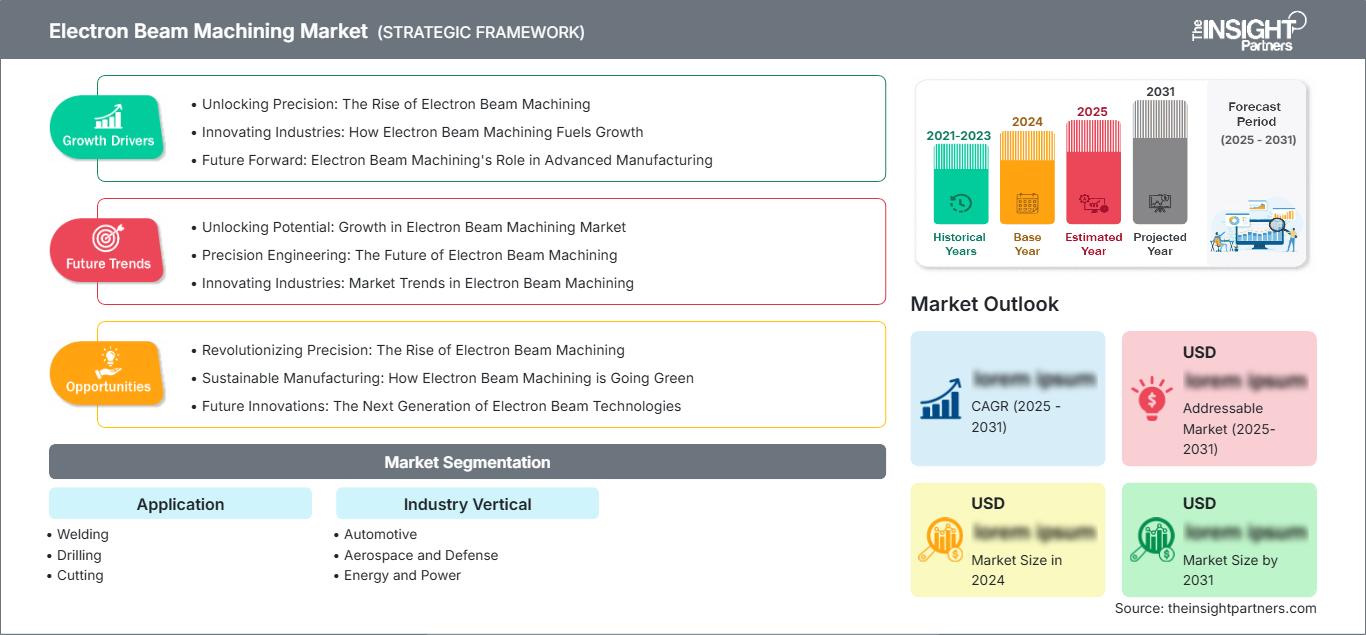
The global Electron Beam Machining market was valued at US$ 952.33 million in 2025 and is expected to reach US$ 1442.75 million by 2034; it is estimated to record a CAGR of 4.72% during 2026-2034.
Electron Beam Machining Market Assessment and Insights
- North America: Accounted for 30–32% of 2025 Electron Beam Machining Market share and is expected to grow at a 4.8–5.4% CAGR during 2026–2034, supported by aerospace, defense, electric-drivetrain, and nuclear manufacturing investment.
- US: Represented 78–82% of North American revenue in 2025 and is projected to expand at a 4.9–5.5% CAGR through 2034.
- Europe: Held 28–30% in 2025 and should register a 4.6–5.2% CAGR, with Germany leading and the UK, France, Italy, and Spain sustaining specialized demand.
- Asia Pacific: Captured 32–34% in 2025 and is forecast to grow at a 6.0–6.6% CAGR, led by China, Japan, South Korea, India, and Australia.
- Largest Segment: Welding held a 42–46% market share in 2025 and is projected to grow at a 5.0–5.6% CAGR during 2026–2034.
- High Growth Segment: Surface Processing represented 14–18% in 2025 and is expected to expand at a 6.3–6.9% CAGR through 2034.
- Key companies analyzed in detail: ABB Ltd.; Carrier Global Corporation; Danfoss A/S; Emerson Electric Co.; Honeywell International Inc.; Johnson Controls International plc; KMC Controls, Inc.; Schneider Electric SE; Siemens AG; Venstar, Inc.; pro-beam GmbH & Co. KGaA; Cambridge Vacuum Engineering Ltd.; Sciaky, Inc.; Steigerwald Strahltechnik GmbH; Mitsubishi Electric Corporation; Sodick Co., Ltd.; FOCUS GmbH; and evobeam GmbH.
Source: The Insight Partners' analysis based on proprietary research, government publications, company annual reports, investor presentations, industry databases, and expert interviews.
Electron beam processing has moved from dedicated batch systems to digitally controlled cells with fast evacuation, automation, recipe control, and in-process monitoring. The change in technology alters buying factors, since buyers now consider cycle uniformity, availability, and system integration in addition to beam power. Manufacturing logistics will move towards modularity for series parts and local vacuum capability for big assemblies. Thus, the Electron Beam Machining Market covers capital equipment, contract processing, control systems, retrofits, and application engineering, with process qualification being an important competitive factor.
The Electron Beam Machining Market forecast indicates that in the future, the capacity expansions in Asia Pacific and energy-related projects in Europe will expand procurement beyond the traditional aerospace cluster centers. Government backing for advanced manufacturing, electric mobility, defense preparedness, and low-carbon infrastructure increases the economic rationale behind precision joining and surface treatment. Companies that bring together application laboratories, regional service, and well-understood process windows will be in a position to turn pilot operations into production facilities as buyers seek to cut scrap rates, produce parts domestically, and control quality in highly regulated supply chains.
Electron Beam Machining Market Report Scope
| Report Attribute | Details |
|---|---|
| Market size in 2025 | US$ 952.33 Million |
| Market Size by 2034 | US$ 1,442.75 Million |
| Global CAGR (2026 - 2034) | 4.72% |
| Historical Data | 2021-2024 |
| Forecast period | 2026-2034 |
Electron Beam Machining Market Analysis
The Electron Beam Machining Market growth is predicated on applications where traditional joining or material removal leads to distortion, contamination, and tooling wear. The value chain includes electron guns, high voltage power supply, vacuum chamber, motion system, control system, and safety equipment, which further expands into integration firms, service companies, and qualified production customers. Durable demand comes from aerospace/defense programs where titanium, nickel alloys, and critical rotating components need precise thermal control.
The supply chain is highly engineered and long sales cycles are due to the application evaluation, fixture engineering, operator training, and qualification process, not the procurement of standard machines. Service bureaus remove adoption challenges for low volume processing, whereas captive systems are cost effective when the need for utilization, traceability, and IP control becomes a concern. Availability of cathodes, lead times of vacuum components and skills impact delivery schedules.
The Electron Beam Machining Market is characterized by a fragmented market structure comprising beam technology experts, diversified automation providers, and contract manufacturers. The major competitors include pro-beam GmbH & Co. KGaA, Cambridge Vacuum Engineering Ltd., Sciaky, Inc., Steigerwald Strahltechnik GmbH, Mitsubishi Electric Corporation, Sodick Co., Ltd., FOCUS GmbH, and evobeam GmbH, who compete using chamber design, beam control, application expertise, and service responsiveness rather than just pricing alone.
Capital expenditure trends towards digitization of process documentation, real-time imaging, seam detection automation, and flexible cells capable of serving several component types. Siemens AG, ABB Ltd., Schneider Electric SE, Emerson Electric Co., Honeywell International Inc., and Johnson Controls International plc provide enabling technologies in automation, control and industrial software space, whereas Carrier Global Corporation, Danfoss A/S, KMC Controls, Inc., and Venstar, Inc. are the adjacent industries. Strategic positioning is becoming increasingly about collaboration of beam physics, robotics, quality management and end-user validation.
● REPORT CUSTOMIZATION
Tailor This Report To Align With Your Specific Business Requirements
This report can be customized to align precisely with your business objectives, scope, and target markets. Customization options include tailored segmentation, geography, competitive analysis, and strategic insights to support informed decision-making.
Customize This Report →WHAT YOU CAN ADJUST
- ● Segmentations
- ● Geography
- ● Competitive Analysis
- ● Language Preferences
Electron Beam Machining Market: Strategic Insights
Regional Insights
North America Electron Beam Machining Market
North America had a 30–32% market share of 2025 Electron Beam Machining and is expected to grow at a CAGR of 4.8–5.4% over 2026–2034. There are strong applications for deep and narrow welding and processing of reactive materials due to aerospace engine, launch systems, defense, and nuclear programs. Reshoring trends help drive equipment assessment where manufacturing locally and traceable quality mitigate supply chain risks.
The adoption rate is highest in the US, followed by Canada and Mexico. The region enjoys well-established certification frameworks, state-of-the-art research facilities, and contract processing capability. There are high prospects in aircraft part replacement, electric powertrain assemblies, turbine parts, and large energy structures. Limitations are steep upfront costs, need for specialized labor, and process qualifications, prompting suppliers to offer application testing, training, preventive maintenance, and modernization solutions.
U.S. Electron Beam Machining Market
North America had 78-82% of US revenue in 2025 and is expected to record a 4.9-5.5% CAGR through 2034. Demand is driven by aircraft and engines' backlogs, defense upgrades, space initiatives, electric motors' fabrication, and nuclear components. Welding is the primary application, while drilling drives turbine cooling technologies and surface treatment enhances local properties.
The US is home to electron beam welding and large-scale additive manufacturing companies such as Sciaky, Inc., while international companies help in servicing US customers with equipment, contract manufacturing, and technical service. There is increasing demand for data on processes, repeatable recipes, and automation to enable auditability. Government manufacturing programs, coupled with investments in advanced materials, offer favorable outlooks in the long run despite exports control, technical labor shortage, and qualification timelines.
Europe Electron Beam Machining Market
The region held 28–30% of revenues in 2025 and is expected to see growth at a 4.6–5.2% CAGR till 2034. Germany dominates through its strength in machine building, automotive industry, aerospace, and turbomachinery, as well as through specialized application engineering. Regional needs include upgrading nuclear power stations, defense spending, and the move towards industrializing low distortion joining technology for large energy systems.
UK advantages are seen in Cambridge Vacuum Engineering Ltd. and regional vacuum technologies for nuclear and heavy engineering applications. Germany unites pro-beam GmbH & Co. KGaA, Steigerwald Strahltechnik GmbH, FOCUS GmbH, and evobeam GmbH with comprehensive suppliers network. France specializes in aerospace and nuclear power applications, Italy in automotive and machinery, Spain in aerospace structures and renewable energy manufacturing.
APAC Electron Beam Machining Market
Asia Pacific held 32–34% in 2025 and should achieve a 6.0–6.6% CAGR through 2034, the fastest regional range. China leads through aerospace, automotive, electronics, and energy investment; Japan combines Mitsubishi Electric Corporation and Sodick Co., Ltd. with precision-machine expertise.
South Korea’s advanced manufacturing base, India’s aerospace and defense localization, and Australia’s energy and research projects widen demand. Industrial policy favoring domestic high-value production, alongside growing qualification capability, supports adoption despite capital intensity and uneven specialist service coverage.
Middle East & Africa Electron Beam Machining Market
The Middle East & Africa market is projected to expand at a 4.2–4.8% CAGR through 2034. Saudi Arabia leads as industrial diversification supports defense, aviation maintenance, and energy equipment manufacturing, while the UAE develops aerospace servicing and advanced production capabilities.
South Africa contributes established engineering and power-sector demand. Rest-of-MEA opportunities center on contract processing for turbines, oil and gas hardware, and infrastructure components. Limited installed capacity and specialist skills favor partnerships, regional service hubs, and phased technology transfer.
Segmentation Analysis
Application
The Application segment is projected to grow at a 5.1–5.7% CAGR during 2026–2034. Electron Beam Machining Market scope spans joining, localized material removal, and property modification where concentrated, digitally controlled energy improves precision. Adoption depends on component geometry, alloy behavior, production volume, chamber configuration, and qualification economics. Welding leads, while surface processing gains from interest in extending component life without bulk material changes.
- Welding: The largest application supports deep-penetration, low-distortion joining of gears, turbine parts, aerospace structures, copper conductors, and pressure components requiring clean, repeatable seams.
- Drilling: Demand centers on high-throughput microholes for turbine cooling, filtration, and specialized flow control, where beam deflection provides speed and consistent geometry.
- Cutting: Cutting serves precision work on difficult materials and intricate features, complementing established thermal and mechanical methods when noncontact processing and narrow heat input matter.
- Surface Processing: Surface processing supports hardening, alloying, texturing, and localized modification, enabling manufacturers to improve wear, fatigue, or functional performance at selected component zones.
Industry Vertical
The Industry Vertical segment is expected to register a 5.2–5.8% CAGR during 2026–2034. Adoption is strongest where component failure carries high cost and material performance justifies process qualification. Aerospace and defense remains strategically important, automotive expands through electrified powertrains and efficient transmissions, and energy and power creates opportunities in turbines, nuclear vessels, and large structures. Procurement increasingly links equipment selection with certification, lifecycle service, and production data.
- Automotive: Applications include gears, shafts, turbochargers, battery conductors, and motor stators, with demand driven by lightweighting, electrification, throughput, and reduced post-weld finishing.
- Aerospace and Defense: Critical titanium and nickel-alloy components require deep penetration, low contamination, and documented repeatability, sustaining premium demand despite long qualification cycles.
- Energy and Power: Turbine, nuclear, and power-generation components benefit from narrow welds and large-section capability, while infrastructure investment supports localized and chamber-based solutions.
Opportunity Snapshot
| Application | Revenue Contribution | Trend Tag | Adoption Stage |
| Welding | High | Deep Joining | Mature |
| Drilling | Medium | Micro Holes | Scaling |
| Cutting | Low | Precision Features | Emerging |
| Surface Processing | Medium | Surface Hardening | Scaling |
Electron Beam Machining Market Growth Drivers and Impact Analysis
High-Integrity Joining for Advanced Materials
The increased use of titanium, nickel alloys, refractory metals, and dissimilar material joins requires more concentrated heat and the benefits of vacuum processing. EB Welding generates deep narrow joints with minimal distortion and eliminates filler materials and subsequent machining. This effect is seen in jet engine assemblies, space construction, defense applications, turbines, and precise powertrains, in which the failure of an assembly will result in a great amount of lifecycle cost. Customers evaluate the process for scrap minimization, dimensional control, and qualifying data versus the hourly rate of the equipment. This situation provides an advantage to the suppliers that have application laboratories and contract processes since the customer can prove the range of welding windows before making a capital investment.
Electrification of Automotive Production
The electric powertrain is opening new opportunities for welding of copper hairpins, bus bars, motor stators, transmissions, and heat-sensitive assemblies. Electron beams have no limitations due to optical reflectance issues faced in some laser systems and do not require any mechanical deflection to be quickly deflected. In a manufacturing environment, this may help improve porosity, electrical properties, and consistency while cutting down on the need for prior trimming or finishing. But even beyond the welding systems, the business impact is broader since it involves automatic handling, joint sensing, recipe management, evacuation improvement, and inspection. This technology adoption will be driven by cycle-time economics in an automotive environment, but a good cell design may be scaled up to other platforms.
Energy Infrastructure and Large-Section Fabrication
The nuclear, wind, turbine, and power generation industries demand reliable connections for heavy plates and expensive assemblies. Local vacuum electron beam welding offers a solution for parts that do not fit into traditional chambers, thus extending the applicability of this technology to more geometries. The use of local vacuum electron beams to weld pressure vessels in the nuclear industry explains why the potential users are considering this technology: a localized energy source allows reducing the time needed for welding, minimizing the need for filler material, and restricting distortions compared to multipass techniques. The market application of this technique will depend on codes, non-destructive testing, and customer approval. Thus, the commercialization of the technology will proceed through funded projects and references.
Electron Beam Machining Market Future Trends
Closed-Loop Beam Control and Digital Qualification
Electron Beam Machining Market trends will increasingly center on closed-loop control, where imaging, backscattered-electron signals, vacuum data, and machine parameters support automatic correction. Instead of treating qualification as a static recipe, manufacturers will build digital process envelopes that flag drift and connect each component to a traceable record. This approach can shorten root-cause analysis and support predictive maintenance while improving confidence in low-volume, high-value production. Suppliers will differentiate through software usability, sensor integration, cybersecurity, and compatibility with factory quality systems. Over time, validated data packages may become as important as beam power or chamber size in regulated procurement.
Flexible Local-Vacuum and Hybrid Platforms
Future installations will become more adaptable to component size, production mix, and factory constraints. Local-vacuum heads can process large structures without evacuating an entire chamber, while hybrid platforms can combine welding, additive deposition, preheating, or surface treatment. Modularity will allow users to start with one qualified process and add handling, beam sources, or inspection as volumes rise. The trend supports distributed manufacturing because a flexible cell can serve several programs instead of one dedicated line. Commercial success will depend on reliable sealing, rapid setup, radiation protection, operator simplicity, and standardized interfaces that reduce integration risk across complex industrial facilities.
Electron Beam Machining Market Opportunities
Regional Application Centers and Contract Processing
Equipment suppliers can accelerate adoption by establishing regional centers that combine feasibility trials, prototype production, operator training, and low-volume contract services. This model addresses the capital barrier and gives customers evidence on distortion, cycle time, metallurgy, and inspection before a purchase. It is especially relevant in India, Southeast Asia, the Middle East, and emerging European manufacturing clusters where advanced programs are growing faster than installed expertise. Investors should prioritize locations near aerospace, automotive, or energy ecosystems and build partnerships with universities and certification bodies. Revenue can be diversified across machine sales, process development, fixtures, consumables, maintenance, and recurring production contracts.
Retrofit and Lifecycle Optimization Services
Aging installed systems create an opportunity for controls modernization, vacuum upgrades, new beam generators, automation, and digital quality modules. Retrofitting can extend asset life while delivering faster setup, improved repeatability, lower unplanned downtime, and compatibility with contemporary production systems. Specialized suppliers should package condition assessments with quantified business cases covering energy use, throughput, scrap, and maintenance exposure. Remote diagnostics and predictive service agreements can add recurring revenue while reducing the shortage of experienced technicians. The strongest targets are customers with qualified legacy processes, because modernization preserves established metallurgical approvals and avoids the full disruption of replacing a production line or repeating extensive certification.
Recent Developments
- June 2026: IAEA’s portable electron beam system was used to train experts from 21 countries on e-beam applications in environmental protection and industry. The many uses of electron beams in industry and environmental protection were the focus of a hands-on training workshop featuring the IAEA’s new Transportable E-beam System, held this week at the IAEA’s Nuclear Applications Laboratories in Seibersdorf, Austria.
- January 2026: ALD Vacuum Technologies GmbH, based in Hanau, Germany, has announced the commercial availability of its EBuild 850 Electron Beam Powder Bed Fusion (PBF-EB) metal additive manufacturing system. Designed for the production of complex, large-scale components, the machine features a spacious 850 × 850 × 1,000 mm build volume and supports continuous manufacturing processes. To further improve productivity, ALD offers an optional second build chamber that separates setup and cooling operations from the printing cycle, enabling higher production efficiency and increased throughput.
- January 2024: Jenoptik is making a low double-digit million-euro investment in an advanced electron-beam lithography system for its high-tech fab currently under construction in Dresden. The state-of-the-art E-Beam system, supplied by Jena-based specialist Vistec Electron Beam GmbH, will enable the production of highly precise micro-optical components for customers in the semiconductor and optical communications industries. The system is scheduled for delivery in early 2025 and will strengthen Jenoptik’s capabilities in next-generation optical manufacturing.
Frequently Asked Questions

- Comprehensive Market Sizing and Forecast Analysis
- Detailed Segmentation Analysis
- In-Depth Market Dynamics Assessment
- Regional and Country-Level Insights
- Competitive Landscape and Company Benchmarking
- Strategic Business Intelligence
Recent Reports
Testimonials

The Insight Partners' SCADA System Market report is comprehensive, with valuable insights on current trends and future forecasts. The team was highly professional, responsive, and supportive throughout. We are very satisfied and highly recommend their services.
RAN KEDEM Partner, Reali Technologies LTDs
I requested a report on a very specific software market and the team produced the report in a few days. The information was very relevant and well presented. I then requested some changes and additions to the report. The team was again very responsive and I got the final report in less than a week.
JEAN-HERVE JENN Chairman, Future Analytica
We worked with The Insight Partners for an important market study and forecast. They gave us clear insights into opportunities and risks, which helped shape our plans. Their research was easy to use and based on solid data. It helped us make smart, confident decisions. We highly recommend them.
PIYUSH NAGPAL Sr. Vice President, High Beam Global
The Insight Partners delivered insightful, well-structured market research with strong domain expertise. Their team was professional and responsive throughout. The user-friendly website made accessing industry reports seamless. We highly recommend them for reliable, high-quality research services
YUKIHIKO ADACHI CEO, Deep Blue, LLC.
This is the first time I have purchased a market report from The Insight Partners.While I was unsure at first, I visited their web site and felt more comfortable to take the risk and purchase a market report.I am completely satisfied with the quality of the report and customer service. I had several questions and comments with the initial report, but after a couple of dialogs over email with their analyst I believe I have a report that I can use as input to our strategic planning process.Thank you so much for taking the extra time and making this a positive experience.I will definitely recommend your service to others and you will be my first call when we need further market data.
JOHN SUZUKI President and Chief Executive Officer, Board Director, BK Technologies
I wish to appreciate your support and the professionalism you displayed in the course of attending to my request for information regarding to infectious disease IVD market in Nigeria. I appreciate your patience, your guidance, and the fact that you were willing to offer a discount, which eventually made it possible for us to close a deal. I look forward to engaging The Insight Partners in the future, all thanks to the impression you have created in me as a result of this first encounter.
DR CHIJIOKE ONYIA MANAGING DIRECTOR, PineCrest Healthcare Ltd.Reason to Buy
- Informed Decision-Making
- Understanding Market Dynamics
- Competitive Analysis
- Identifying Emerging Markets
- Customer Insights
- Market Forecasts
- Risk Mitigation
- Boosting Operational Efficiency
- Strategic Planning
- Investment Justification
- Tracking Industry Innovations
- Aligning with Regulatory Trends





 Get Free Sample for