
Electronic Films Market Share, Size & Demand by 2034
Coverage: By Film Type (Conductive and Non-Conductive); Material (Polymer, ITO on PET, ITO on Glass, Metal Mash, and Carbon Nanotubes); Application (Electronic Display, Semiconductors, Printed Circuit Boards, and Photovoltaic); , and Geography (North America, Europe, Asia Pacific, and South and Central America)
- Status : Data Released
- Report Code : TIPRE00003230
- Category : Electronics and Semiconductor
- No. of Pages : 150
- Available Report Formats :


- Last update date : August 12, 2026


2025 Market Size
US$ 11.24 Bn
Base year value
2034 Forecast
US$ 18.90 Bn
Projected by 2034
CAGR 2026-2034
5.95 %
Growth rate
Addressable Market
US$ 136.56 Bn
(2026-2034)
The Electronic Films Market Size stood at US$ 11.24 Billion in 2025, and it is estimated to grow to US$ 18.90 Billion by 2034 at a CAGR of 5.95%. Growth is driven by the increasing application of functional films for electronic displays, semiconductors, printed circuit boards, and photovoltaic technology. The demand for thinner, optically clear, thermally stable, and electrically controllable film material for supporting device miniaturization, flexiblity, and high-volume production is emerging.
In North America, the growth rate of the Electronic Films Market size is anticipated to be 5.2-5.8% CAGR by 2034. It is driven by increased semiconductor localization, investments in advanced packaging, and film adoption in automotive display and solar module applications. Regional customers place more importance on qualified local sourcing, low-defect coating, and availability of specialty polymers, conductive materials, and barriers than on the lowest cost source.
Electronic Films Market Assessment and Insights
- North America: Share in 2025 was 25–27%, with a CAGR between 2026 – 2034 of 5.2–5.8%, supported by semiconductor investment, automotive electronics, photovoltaic deployment, and qualified specialty-material supply.
- US: Share in 2025 was 80–84% of North America, with a CAGR between 2026 – 2034 of 5.3–5.9%, led by chip fabrication and advanced packaging.
- Europe: Share in 2025 was 20–22%, with a CAGR between 2026 – 2034 of 4.7–5.3%; Germany leads, followed by the UK, France, Italy, and Spain.
- Asia Pacific: Share in 2025 was 43–45%, with a CAGR between 2026 – 2034 of 6.4–7.0%, led by China, Japan, South Korea, India, and Australia.
- Largest Segment: Non-Conductive films held 57–61% market share in 2025 and are projected to grow at a 5.3–5.9% CAGR during 2026–2034.
- High Growth Segment: Conductive films represented 39–43% in 2025 and are expected to expand at a 6.4–7.0% CAGR through 2034.
- Key companies analyzed in detail: 3M Company; DuPont de Nemours, Inc.; Mitsubishi Chemical Group Corporation; Nitto Denko Corporation; Compagnie de Saint-Gobain S.A.; TDK Corporation; Gunze Limited; The Chemours Company; Toray Industries, Inc.; and Toyobo Co., Ltd.
Source: The Insight Partners' analysis based on proprietary research, government publications, company annual reports, investor presentations, industry databases, and expert interviews.
E-Film advancements have moved past simple insulator and transparency to engineered films balancing conductive, adhesive, optical control, barrier functions, and thermal management properties. Roll-to-Roll coating, multi-layer extrusion, high-quality sputter deposition, and nanomaterial dispersion dictate the output and applicability of e-films. Manufacturing characteristics will benefit vendors who dominate resin formulation, surface treatment, coating quality, and cleanroom conversion. The Electronic Films Market will become increasingly reliant on suppliers that produce defect-free e-films, large width capabilities, thin gauge products, and qualified applications.
The capacity additions during the forecast period will be influenced by semiconductor, display, battery, and solar manufacturing clusters in Asia Pacific, North America, and selected European countries. Domestic content policies and incentives for clean energy chain drive demand for local coating and conversion facilities. Regulations against persistent chemicals, recycling needs, and solvent emission will also drive the chemistry focus to more environmentally-friendly alternatives. E-Film producers with expertise in material science, pilot production cooperation, and local conversion will hold the best specification position.
Electronic Films Market Report Scope
| Report Attribute | Details |
|---|---|
| Market size in 2025 | US$ 11.24 Billion |
| Market Size by 2034 | US$ 18.90 Billion |
| Global CAGR (2026 - 2034) | 5.95% |
| Historical Data | 2021-2024 |
| Forecast period | 2026-2034 |
Electronic Films Market Analysis
The Electronic Films market growth will be driven by increased functionality per device, not just unit shipment volumes. Increased area per display, higher density multi-layer circuitry, flexible interfaces, and advanced packaging require increased area per device of insulation, protection, light management, and conduction of the surface. The supply chain consists of polymers, specialty chemicals, metals, glass, and nanocarbon materials, followed by processes for films production, coating, metallization, patterning, slitting, lamination, and assembly of components.
Supply reliability depends on resin purity, substrate flatness, coating uniformity, sheet resistance, optical transmission, haze factor, moisture barrier properties, and dimensional stability. Cost exposure differs according to technology: ITO films rely on deposition process and indium pricing, metal mesh relies on patterning accuracy, and carbon nanotube films rely on uniform dispersion. Prolonged qualification cycle is a strong protection barrier for incumbents but creates customers' concerns about single source risks, leading to dual qualification and geographic diversification of finishing capacity.
The Electronic Films Market analysis reveals that competition is structured according to proprietary formulation, coating capabilities, customer qualification, and worldwide converting network. 3M Company and Nitto Denko Corporation are leading players in display, adhesive, and process films; DuPont de Nemours, Inc. and The Chemours Company are providers of high-performance polymer systems; Toray Industries, Inc. and Toyobo Co., Ltd. utilize film-forming technology to produce optical, insulation, and electronic films.
The Mitsubishi Chemical Group Corporation, Compagnie de Saint-Gobain S.A., TDK Corporation, and Gunze Limited utilize specialized substrates, conductive films, functional coatings, and engineering to the order. Priorities of investments include broader coating capabilities, thinner films, PFAS alternative development, recycling films, and high-frequency electronics' materials. Strategic differentiation relies more and more on partnership with panel, chip, PCB, and module producers since early design integration helps to incorporate a material into qualified platforms for several generations of products.
● REPORT CUSTOMIZATION
Tailor This Report To Align With Your Specific Business Requirements
This report can be customized to align precisely with your business objectives, scope, and target markets. Customization options include tailored segmentation, geography, competitive analysis, and strategic insights to support informed decision-making.
Customize This Report →WHAT YOU CAN ADJUST
- ● Segmentations
- ● Geography
- ● Competitive Analysis
- ● Language Preferences
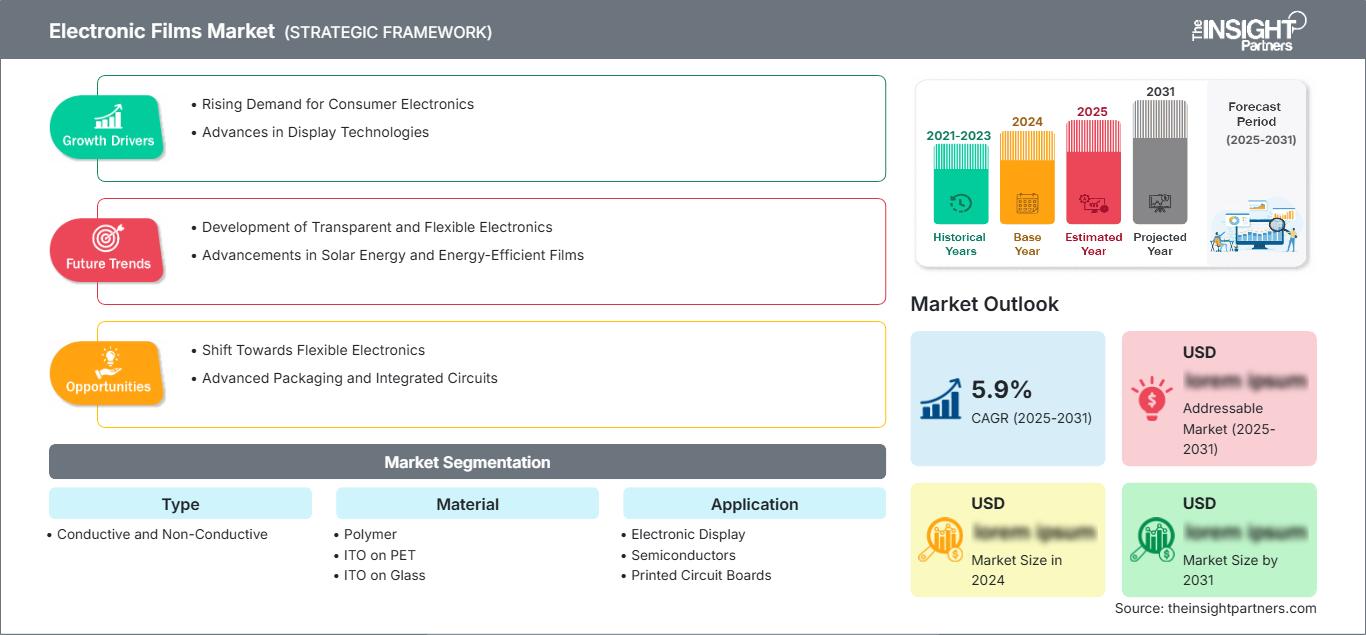
Electronic Films Market: Strategic Insights
Regional Insights
North America Electronic Films Market
North America accounts for 25-27% of 2025 Electronic Films Market share and is expected to witness a CAGR of 5.2-5.8% during 2026-2034. Fabrication facilities, packaging, automotive display application, and solar panel usage in North America boost market growth. The region demands expensive dielectric, protective, conductive, optical, and barrier films where the requirement of traceability, heat resistance, and contamination control warrants costly qualifications.
The Electronic Films Market in the US is leading consumption, Canada is engaged in electronics research and clean energy initiatives, and Mexico in automotive and electronics assembly. Domestic source preference makes for slitting and coating in the region even if base films come from overseas. Limitations in the region are high cleanroom investment, delayed customer approval process, and dependency on particular specialty resins and conductive materials. Film suppliers that provide pilot coating services, failure analysis, and dual production facility minimize the risk of qualification process.
U.S. Electronic Films Market Market
US Electronic Films Market accounted for 80-84% of North America revenue in 2025 and is projected to witness a CAGR of 5.3-5.9% between 2026 and 2034. The new fabrication, packaging facilities, data center hardware, defense electronics, electric vehicles, and solar production expand use cases beyond consumer displays. The applications in semiconductor and PCB are focused on low ionic contamination, dimensional stability, control of adhesion, ease of removal, and stability at repeated heating cycles.
3M Company, DuPont de Nemours, Inc., The Chemours Company, and Compagnie de Saint-Gobain S.A. have relevant capabilities in US regarding production, R&D, or customer service, along with the presence of the Japanese competitors supporting multinational customers in electronics. More and more automotive applications integrate display optics, touch sensing, electromagnetic and battery insulation into one thin module. Federal and state subsidies enhance addressable demand, yet the materials need to be tested over several years by the procurement departments for their safety.
Europe Electronic Films Market Market
Europe Electronic Films Market held 20–22% market share in 2025 revenues and will register a 4.7–5.3% CAGR until 2034. Germany stands out in automotive electronics, industrial controls, semiconductor investments, and machinery demand. Regional regulations speed up the substitution of prohibited materials and promote recyclable and repairable constructions, increasing development needs and creating opportunities for innovative films that have proven environmental impacts.
The UK focuses on compound semiconductor research, aerospace electronics, and flexible devices, providing specialty products but not commodity volumes. Germany enjoys advantages in automotive displays, power electronics, and industrial PCBs. France integrates aerospace, electronics, and photovoltaic activities; Italy offers machinery and appliance electronics; Spain offers solar modules and automotive applications. The European customers value documentation on the lifecycle, chemical information, and regional technical support, preferring manufacturers capable of tailoring multilayers without impacting the electrical/optical performance.
APAC Electronic Films Market Market
Asia Pacific held 43–45% in 2025 and should achieve a 6.4–7.0% CAGR through 2034. China leads through display panels, photovoltaics, PCBs, and electronics assembly; Japan supplies advanced film chemistry and precision coating; South Korea concentrates OLED, semiconductor, and battery production.
India is adding electronics and solar manufacturing under localization programs, while Australia contributes renewable-energy deployment and specialty research. Integrated supply chains, scale, skilled processing, and policy-backed capacity investment reinforce regional leadership, although price competition and geopolitical sourcing controls increase pressure for technical differentiation.
Middle East & Africa Electronic Films Market Market
The Middle East & Africa market is projected to expand at a 4.4–5.0% CAGR through 2034. Saudi Arabia leads through solar manufacturing ambitions, industrial diversification, and electronics localization, while the UAE supports advanced logistics, clean energy, and technology investment.
South Africa contributes photovoltaic deployment and established industrial electronics demand. Rest-of-MEA opportunities center on imported display, PCB, and solar materials supported by regional converting. Limited coating infrastructure and qualification expertise favor distributor partnerships, technical service hubs, and phased investment near energy and assembly clusters.
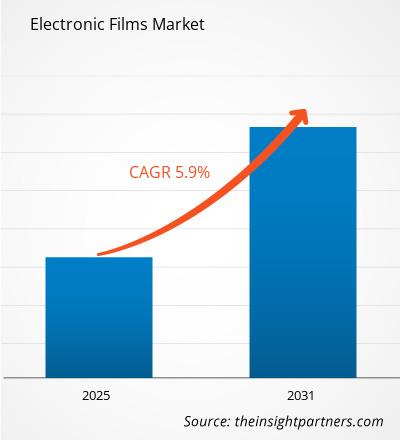
Segmentation Analysis
Type
The Type segment is projected to grow at a 5.7–6.3% CAGR during 2026–2034. Electronic Films Market scope covers current-carrying, transparent conductive, dielectric, insulating, protective, and process functions. Selection depends on sheet resistance, transmission, dielectric strength, thermal stability, adhesion, flexibility, and conversion yield. Non-Conductive films remain larger across insulation and protection, while Conductive films gain from touch, sensing, heating, shielding, and flexible circuitry.
- Conductive: Demand grows in touch sensors, transparent electrodes, flexible circuits, electromagnetic shielding, and printed electronics, where low resistance, optical clarity, bendability, and patterning economics determine specification.
- Non-Conductive: The larger category serves insulation, dielectric separation, surface protection, release, barrier, and optical functions across chips, boards, displays, and modules, benefiting from broad process integration.
Material
The Material segment is expected to register a 6.0–6.6% CAGR during 2026–2034. Polymer platforms dominate flexible insulation, optical protection, release, and barrier uses, while transparent conductor selection balances conductivity, clarity, flex performance, deposition cost, and pattern resolution. ITO remains established on glass and PET; metal mesh and carbon nanotubes gain where larger formats, repeated bending, or lower resistance challenge brittle oxide layers.
- Polymer: PET, polyimide, fluoropolymer, and related substrates provide scalable insulation, flexibility, dimensional control, and surface functionality, making polymer films foundational across displays, circuits, semiconductors, and solar modules.
- ITO on PET: Flexible transparent electrodes support touch, wearable, and curved interfaces, balancing proven optical-electrical performance against bending durability and the cost of precision sputtering.
- ITO on Glass: Rigid transparent conductors retain importance in established displays and touch panels where flatness, optical quality, thermal stability, and mature patterning outweigh weight and flexibility limitations.
- Metal Mash: Fine metallic networks deliver low resistance over large areas and improve flex endurance, making them strategically relevant for larger touch surfaces, heaters, and transparent shielding.
- Carbon Nanotubes: Nanotube coatings offer flexibility, transparency, and solution processing potential, but commercial scaling depends on dispersion uniformity, contact resistance, patternability, and consistent high-volume quality.
Application
The Application segment is forecast to advance at a 5.9–6.5% CAGR during 2026–2034. Displays remain the largest outlet because each panel may integrate optical, protective, adhesive, polarizing, and conductive layers. Semiconductor and PCB uses emphasize cleanliness, thermal stability, dielectric control, and process compatibility. Photovoltaic demand benefits from rapid capacity additions, with barrier, encapsulation, insulation, and conductive functions supporting module reliability and new form factors.
- Electronic Display: Displays generate broad film consumption across televisions, mobile devices, notebooks, automotive cockpits, and industrial interfaces, with larger areas and OLED migration increasing functional complexity.
- Semiconductors: Process, dicing, die-attach, release, dielectric, and protective films support wafer fabrication and packaging, where contamination control, thermal endurance, fine features, and traceability are essential.
- Printed Circuit Boards: Flexible circuitry, coverlay, dry-film processing, shielding, and insulation demand films with controlled adhesion, dimensional stability, chemical resistance, and compatibility with higher-frequency electronic designs.
- Photovoltaic: Encapsulation, backsheets, barriers, conductive layers, and insulation support module durability and manufacturing yield, while flexible and building-integrated systems create differentiated material requirements.
Opportunity Snapshot
| Application | Revenue Contribution | Trend Tag | Adoption Stage |
| Electronic Display | High | OLED Expansion | Mature |
| Semiconductors | High | Advanced Packaging | Scaling |
| Printed Circuit Boards | Medium | Flexible Circuits | Mature |
| Photovoltaic | Medium | Module Durability | Scaling |
Electronic Films Market Growth Drivers and Impact Analysis
Advanced Displays Require More Functional Layers
Increased display area, automotive cockpit displays, OLED laptops, tablets, and folding designs drive the need for films that manage light, surface protection, signal transmission, adhesion, and bend endurance. The large area display market grew to 910.5 million units in 2025, with OLED shipments growing 12.9%, indicating a more diverse product mix despite slower growth in the mature LCD segments. The effects of the market go beyond volume since each system has more stringent requirements on haze, birefringence, coating uniformity, and moisture barrier specifications. Suppliers can realize greater value by bundling multiple functions in one thinner film stack, eliminating additional steps and decreasing bezel size. Wide-web coating and lower defect processing become critical as panel sizes increase, along with the revenue visibility provided by automotive certification.
Semiconductor Packaging Raises Material Performance Requirements
The fields of artificial intelligence, data center infrastructure, and high-performance computing are driving package complexity and increase in processes employing temporary protection, dicing, die attachment, insulating, releasing, and low loss dielectrics. World-wide sales of semiconductors have grown to US$ 772 billion in 2025 with an average 22% per annum growth rate due to the dominance of logic and memory. The business impact for the film supplier is confined to stricter contamination requirements, smaller feature sizes, increased heat generation, and extended qualification time period. If a material proves to be successful, it may become entrenched in multiple generations of packages leading to retention. But entry into the market is not easy due to many factors.
Solar Deployment Expands Durable Film Demand
It is anticipated that solar PV will contribute close to 80% of the 4,600 GW of renewables capacity additions expected worldwide until 2030. Such magnitude will underpin the continued consumption of backsheets, encapsulation layers, electrical insulation materials, barriers, and certain conductive films. The market effects will be dictated by economics of lifetime, since end users are seeking products that are resistant to UV exposure, moisture, heat, stress, and potential induced degradation for decades after purchase. Manufacturers that enhance durability without adding to the laminate thickness will mitigate warranty issues and the weight factor. Building-integrated, light-weight, and flexible solar panels add further specifications; however, they need greater barrier and adhesion properties.
Electronic Films Market Future Trends
Transition from Brittle Oxides to Hybrid Conductors
The Electronic Films Market trends will move towards a new generation of hybrid transparent conductors that incorporate metal mesh, conductive polymers, carbon nanotubes or ultra thin metal films into substrates. This new trend aims to overcome the drawbacks of ITO including its brittleness, indium usage as well as resistance problems on large areas and when flexing. Commercial deployment of this technology will occur case by case since optical neutrality, pattern visibility, junction resistance, corrosion resistance and touch controller capability must all be tested at once. Automotive curved displays, flexible electronics, transparent heaters, and large interactive surfaces represent early opportunities with high premiums.
Circular and Lower-Impact Film Architectures
Regulatory and customer environmental objectives will force the film manufacturers to use PFAS-free chemistry, reduce solvents, increase recycled content, reduce gauges, and make structures for separation or repair. Performance must be maintained, therefore the emphasis will be placed on surface modification and multilayer construction, which can achieve the same performance with a reduced amount of materials. Digital product passports and chemical disclosure will be mandatory in select electronics and automotive applications. The winners will demonstrate life cycle impact at application level and not make general sustainability statements. Cooperation with recyclers, converters and OEMs is critical as the whole laminate needs to be recovered, not a single film.
Electronic Films Market Opportunities
Regional Coating and Qualification Centers
Investors can establish pilot coating, slitting, lamination, and analytical centers near semiconductor, display, PCB, and solar clusters in the US, India, Southeast Asia, and the Middle East. Electronic Films Market Forecasts support facilities that shorten sample cycles and convert imported base films into locally qualified formats. The operating model should combine small-batch development with scalable recipes, contamination control, reliability testing, and technical field support. Revenue can span toll coating, prototyping, conversion, failure analysis, and eventual material supply. Partnerships with equipment vendors and universities reduce initial capability gaps, while dual-site process transfer gives multinational customers continuity. Success depends on disciplined qualification pipelines rather than speculative commodity capacity.
Integrated Films for High-Frequency Electronics
High-speed computing, advanced antennas, and compact power electronics create an investment opportunity for films combining low dielectric loss, thermal management, electromagnetic shielding, insulation, and precise adhesion. Suppliers should target co-development with laminate producers, PCB fabricators, and packaging houses because electrical performance depends on the completed stack. Pilot programs need frequency-dependent testing, thermal cycling, moisture reliability, and compatibility with laser or chemical processing. Integrated constructions can reduce layer count and assembly variability, supporting premium pricing where signal integrity or heat limits system performance. Intellectual property should cover formulations and interfaces, while manufacturing plans require clean coating, tight thickness control, and resilient sourcing of specialty polymers and fillers.
Recent Developments
- July 2026: Cosmo Films, a global leader in specialty films for packaging, lamination, and labelling applications today announced the launch of a new product under its Cosmo Synthetic Paper vertical, the CSP DigiLux-MW. With a strong emphasis on durability, sustainability and quality, Cosmo First’s CSP DigiLux-MW has been designed to elevate the printing experience for high-end digital applications. Ideal for high-end applications where the visual appeal of the print is crucial, this latest offering with enhanced whiteness, providing a luxurious look to the printed materials.
- March 2026: Panasonic has introduced its new ERJPC high-precision thick-film resistors, delivering accuracy and stability traditionally associated with thin-film technology while offering greater power density and lower cost. The new resistor series features a temperature coefficient of resistance (TCR) as low as 25 ppm/K and precision tolerances of ±0.1% and ±0.5%, ensuring reliable performance in demanding applications. Compared with equivalent thin-film resistors, the ERJPC family provides up to twice the power density, making it an attractive solution for compact, high-performance electronic designs where efficiency, precision, and cost are key considerations.
- November 2025: FUJIFILM India, a diversified conglomerate whose focus stretches from imaging to healthcare, electronics and business innovation, has launched its latest brand film “Healthcare Technology that Transcends” under its ongoing “Stories of MORE SMILES” series in India. Set against the breathtaking backdrop of Spiti Valley in Himachal Pradesh, the film captures how care, courage, and innovation come together to bring quality healthcare and genuine smiles to the one of the highest and farthest regions of the country.
Frequently Asked Questions

- Comprehensive Market Sizing and Forecast Analysis
- Detailed Segmentation Analysis
- In-Depth Market Dynamics Assessment
- Regional and Country-Level Insights
- Competitive Landscape and Company Benchmarking
- Strategic Business Intelligence
Recent Reports
Testimonials

The Insight Partners' SCADA System Market report is comprehensive, with valuable insights on current trends and future forecasts. The team was highly professional, responsive, and supportive throughout. We are very satisfied and highly recommend their services.
RAN KEDEM Partner, Reali Technologies LTDs
I requested a report on a very specific software market and the team produced the report in a few days. The information was very relevant and well presented. I then requested some changes and additions to the report. The team was again very responsive and I got the final report in less than a week.
JEAN-HERVE JENN Chairman, Future Analytica
We worked with The Insight Partners for an important market study and forecast. They gave us clear insights into opportunities and risks, which helped shape our plans. Their research was easy to use and based on solid data. It helped us make smart, confident decisions. We highly recommend them.
PIYUSH NAGPAL Sr. Vice President, High Beam Global
The Insight Partners delivered insightful, well-structured market research with strong domain expertise. Their team was professional and responsive throughout. The user-friendly website made accessing industry reports seamless. We highly recommend them for reliable, high-quality research services
YUKIHIKO ADACHI CEO, Deep Blue, LLC.
This is the first time I have purchased a market report from The Insight Partners.While I was unsure at first, I visited their web site and felt more comfortable to take the risk and purchase a market report.I am completely satisfied with the quality of the report and customer service. I had several questions and comments with the initial report, but after a couple of dialogs over email with their analyst I believe I have a report that I can use as input to our strategic planning process.Thank you so much for taking the extra time and making this a positive experience.I will definitely recommend your service to others and you will be my first call when we need further market data.
JOHN SUZUKI President and Chief Executive Officer, Board Director, BK Technologies
I wish to appreciate your support and the professionalism you displayed in the course of attending to my request for information regarding to infectious disease IVD market in Nigeria. I appreciate your patience, your guidance, and the fact that you were willing to offer a discount, which eventually made it possible for us to close a deal. I look forward to engaging The Insight Partners in the future, all thanks to the impression you have created in me as a result of this first encounter.
DR CHIJIOKE ONYIA MANAGING DIRECTOR, PineCrest Healthcare Ltd.Reason to Buy
- Informed Decision-Making
- Understanding Market Dynamics
- Competitive Analysis
- Identifying Emerging Markets
- Customer Insights
- Market Forecasts
- Risk Mitigation
- Boosting Operational Efficiency
- Strategic Planning
- Investment Justification
- Tracking Industry Innovations
- Aligning with Regulatory Trends





 Get Free Sample for