
Electronic Skin Patch Market Share, Size & Growth Opportunities by 2034
Electronic Skin Patch Market Size and Forecasts (2021 - 2034), Global and Regional Share, Trends, and Growth Opportunity Analysis Report Coverage : By Type (Monitoring & Diagnostic, Therapeutic), Wireless Connectivity (Connected, Non-connected), Application (Diabetes Management, Cardiovascular Monitoring, Temperature Sensing), End User (Healthcare, Fitness and Sports, Others)
- Status : Data Released
- Report Code : TIPRE00039825
- Category : Electronics and Semiconductor
- No. of Pages : 150
- Available Report Formats :


- Last update date : August 12, 2026


2025 Market Size
US$ 22.47 Bn
Base year value
2034 Forecast
US$ 70.77 Bn
Projected by 2034
CAGR 2026-2034
13.59 %
Growth rate
Addressable Market
US$ 403.46 Bn
(2026-2034)
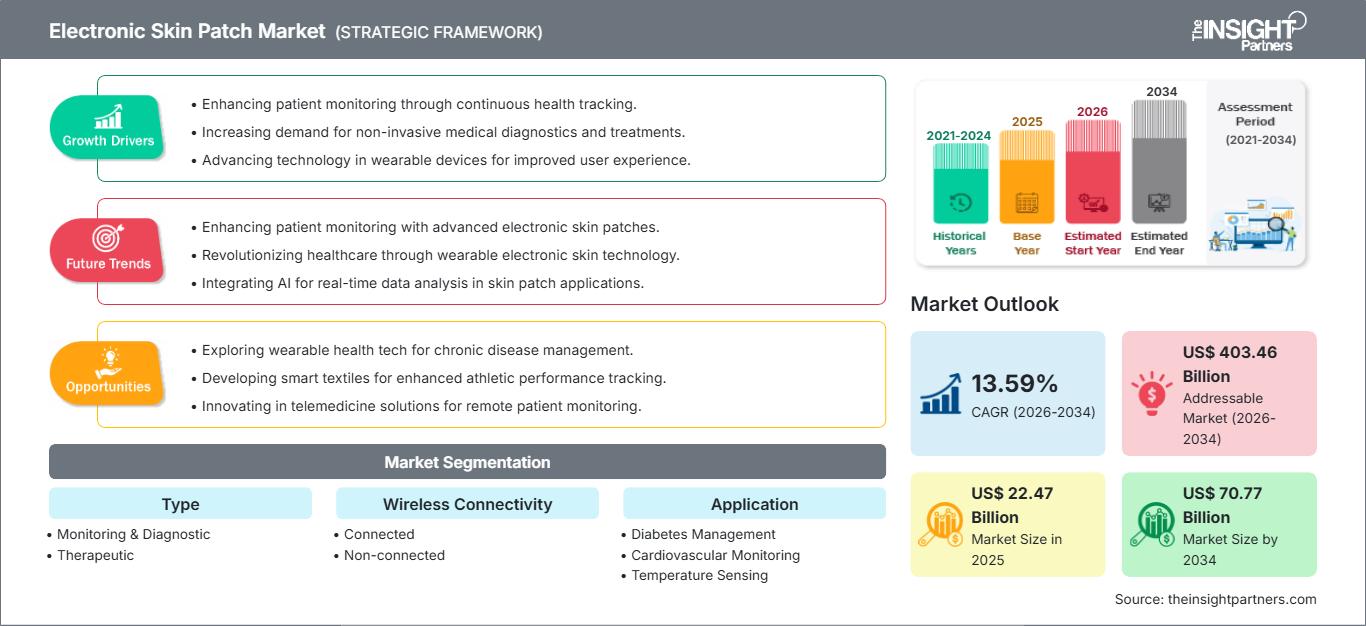
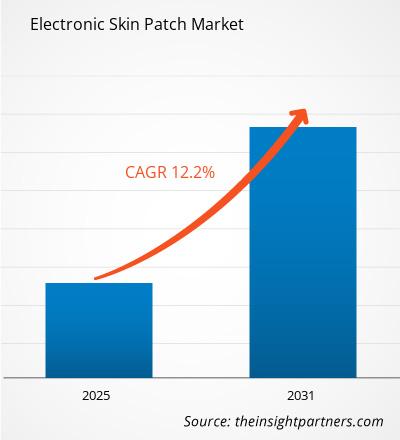
Electronic Skin Patch Market had a value of US$ 22.47 Billion in 2025 and is forecasted to be US$ 70.77 Billion by 2034, registering a CAGR of 13.59% in 2026-2034. The increase is driven by ongoing adoption of skin-conformable devices for monitoring, diagnostics, drug delivery, and digitally-enabled treatments. The analysis includes the defined type, wireless capability, application, and end-users across the global market scope.
North America continues to be the leading commercial hub, with a forecasted 12.8-13.8% CAGR up to 2034. The Electronic Skin Patch Market size in North America is propelled by widespread reimbursement of continuous glucose monitoring, hospital at home services, and digital health ecosystem. Presence of a dense network of specialists and well-established regulatory pathways reduce the time of adoption, while interoperability of sensors, smartphones, insulin pumps, and clinical dashboards increases the demand.
Electronic Skin Patch Market Assessment and Insights
- North America held 36–38% share in 2025 and is expected to grow at 12.8–13.8% CAGR during 2026–2034, supported by reimbursement, digital-care integration, and established wearable-device channels.
- US represented 82–86% of North American revenue in 2025 and is projected to expand at 12.9–13.9% CAGR through 2034.
- Europe accounted for 27–29% in 2025 and should register 12.1–13.1% CAGR, led by Germany, the UK, France, Italy, and Spain as remote monitoring scales.
- Asia Pacific captured 24–26% in 2025 and is forecast to grow at 15.0–16.0% CAGR, with China, Japan, South Korea, India, and Australia driving adoption.
- Largest Segment Monitoring & Diagnostic held 66–70% market share in 2025 and is projected to expand at 13.2–14.2% CAGR during 2026–2034.
- High Growth Segment Connected held 58–62% market share in 2025 and is expected to grow at 15.0–16.0% CAGR during 2026–2034.
- Key companies analyzed in detail: Abbott Laboratories, DexCom, Inc., Medtronic plc, Insulet Corporation, Boston Scientific Corporation, Koninklijke Philips N.V., Biolinq Incorporated, GENTAG, Inc., VitalConnect, Inc., and The Surgical Company Group B.V.
Source: The Insight Partners' analysis based on proprietary research, government publications, company annual reports, investor presentations, industry databases, and expert interviews.
The electronic skin technology stack has developed from a one-dimensional adhesive sensor solution to a complete platform that integrates flexible substrate, miniature electrochemical or electrophysiological sensing, on-board computing, and wireless radio communication. In doing so, manufacture has moved towards roll-to-roll electronics, medical-grade adhesives, self-calibrating devices, and secure cloud connectivity. The development of longer wear time, less sensor waste, and interoperable data flow is now the norm for device manufacturers. This makes the economics of the recurring consumables business more robust but raises expectations of biocompatibility, security, and analytics validation.
From 2024 through 2034, funding needs to expand beyond existing US and European funding sources to include manufacturing capabilities and care delivery ecosystems in the Asia Pacific. The approval for remote monitoring, along with aging demographics and chronic disease, will create opportunities for hospitals, ambulatory systems, and home health providers to purchase these solutions. Investment is expected to focus on clinically actionable alerts, adhesive durability, and reimbursement capability. Emerging markets provide an additional runway for smartphones to circumvent fixed infrastructure and specialist oversight in dispersed populations.
Electronic Skin Patch Market Report Scope
| Report Attribute | Details |
|---|---|
| Market size in 2025 | US$ 22.47 Billion |
| Market Size by 2034 | US$ 70.77 Billion |
| Global CAGR (2026 - 2034) | 13.59% |
| Historical Data | 2021-2024 |
| Forecast period | 2026-2034 |
Electronic Skin Patch Market Analysis
The Electronic Skin Patch market growth is supported by constant monitoring of diabetes, arrhythmia, body temperature, and recovery in non-traditional settings. Wear time and smartphone connectivity enhance compliance, whereas alarm-driven workflow enables physicians to focus on exceptions, not on the evaluation of every measurement.
Ecosystem includes specialty material companies, sensor and semiconductor companies, contract manufacturers, software platforms, providers of care, payors, and distribution companies. Consistency of supply chain is linked to adhesive quality, calibrated sensors, battery effectiveness, sterilization if necessary, and data transmission validation. Vertical integration helps to reduce launch risks due to the fact that hardware alterations might influence the algorithm, comfort level, and evidence.
According to Electronic Skin Patch Market analysis, the competitive environment is becoming increasingly based on platform systems instead of individual products. Abbott Laboratories and DexCom, Inc. focus on glucose ecosystems, whereas Medtronic plc and Insulet Corporation link sensing and treatment. VitalConnect, Inc. stands out with its multi-parameter cardiac and remote monitoring capabilities.
According to Electronic Skin Patch Market forecast, strategic investment is being driven towards capacity, long-term wear chemistry, direct consumer engagement, and data collection. Koninklijke Philips N.V., Boston Scientific Corporation, Biolinq Incorporated, GENTAG, Inc., and The Surgical Company Group B.V. all have unique positioning in connected care, cardiac technology, minimally invasive biosensing, wireless identification, and temperature management, respectively. Strategic strength lies in reimbursement, regulation, manufacturing efficiency, and interoperability.
● REPORT CUSTOMIZATION
Tailor This Report To Align With Your Specific Business Requirements
This report can be customized to align precisely with your business objectives, scope, and target markets. Customization options include tailored segmentation, geography, competitive analysis, and strategic insights to support informed decision-making.
Customize This Report →WHAT YOU CAN ADJUST
- ● Segmentations
- ● Geography
- ● Competitive Analysis
- ● Language Preferences
Electronic Skin Patch Market: Strategic Insights
Regional Insights
North America Electronic Skin Patch Market
In 2025, North America represented 36-38% of worldwide revenue and is estimated to achieve 12.8-13.8% CAGR for 2026-2034. Electronic Skin Patch market share is characterized by substantial use of continuous glucose monitoring, adoption of ambulatory cardiac monitoring, and payer experience with sensor reimbursements. Collaboration between academia and medicine will speed up the transition of flexible electronics into the medical market.
Future growth in the Electronic Skin Patch Market will rely more on transitioning connected patches from diagnostic to longitudinal care. "Hospital at home" projects, monitoring after discharge, and metabolic consumer products expand the population of addressable users. Nevertheless, cybersecurity, alert fatigue, adhesive issues, and data integration fragmentation are still procurement filters. Established contract manufacturing and components supply chain facilitate commercialization, and doctors prefer platforms that minimize workflow and demonstrate results.
U.S. Electronic Skin Patch Market
The United States accounted for 82-86% of North America revenues in 2025 and is expected to grow at a CAGR of 12.9-13.9% until 2034. Availability of devices, presence of major corporate headquarters, and Medicare and/or commercial reimbursement routes drive adoption. Diabetes management is the area of primary adoption, while long-term Holter monitoring and mobile cardiac telemetry boost cardiovascular adoption.
Abbott Laboratories, DexCom, Inc., Medtronic plc, Insulet Corporation, Boston Scientific Corporation, and VitalConnect, Inc. have considerable commercial or developmental presence. The usage trends are moving towards wearable sensors, connections with smartwatches/smartphones, auto insulin integration, and clinical review remotely. FDA clearances could quickly alter product life cycles, but the factors of evidence, prescription process, reimbursement policy, and patient affordability will drive adoption from availability to utilization.
Europe Electronic Skin Patch Market
Europe accounted for 27–29% of worldwide Electronic Skin Patch Market revenues in 2025, and growth in Europe is forecasted at 12.1–13.1% CAGR. Germany emerges as a market leader due to good medtech infrastructure and well-organized chronic disease management services. Hospitals and insurers in Germany assess connected patches not only according to their technical specifications but also according to clinical benefit, data privacy, and pathways.
In the UK, there are possibilities in remote monitoring, thanks to digitally-enabled primary care and trials in remote monitoring. Evidence is crucial for procurement; hence, health economics documentation is required to get wider adoption. Aging population and diabetes treatment in France, Italy, and Spain represent additional demand in Europe. France has a strong reimbursement policy in digitized care, whereas Italy and Spain have regional potential in the context of hospital upgrading and decentralized care.
APAC Electronic Skin Patch Market
APAC constituted 24–26% Electronic Skin Patch Market share in 2025 and is expected to exhibit a 15.0–16.0% CAGR, making it the fastest-growing region. China holds leadership in manufacturing capabilities and increasing chronic care requirement, whereas Japan and South Korea contribute advanced electronics, needs of aging population, and advanced clinical channels.
India provides volume opportunity owing to high rate of diabetes and mobility care, whereas Australia provides early adoption opportunity owing to reimbursement and clinical research developments. Incentives for local manufacturing, digital health strategies, and improved hospital infrastructure would reduce access barriers, but pricing strategy and rural distribution need country-specific approaches.
Middle East & Africa Electronic Skin Patch Market
Middle East and Africa should grow at 10.7–11.7% CAGR through 2034. Saudi Arabia leads as health-system digitization and major hospital investment create demand for connected monitoring. The UAE follows through smart-health infrastructure and private-provider adoption.
South Africa anchors sub-Saharan clinical use, particularly in private care and research settings, while the Rest of MEA remains selective because reimbursement and connectivity vary. Energy-resilient, low-maintenance designs and cloud-based specialist oversight can improve deployment across dispersed populations.
Segmentation Analysis
Type
The type segment is projected to register 13.0–14.0% CAGR during 2026–2034. The Electronic Skin Patch Market scope spans sensing-led products and interventions that deliver stimulation or therapy. Monitoring platforms benefit from recurring replacement cycles and established clinical workflows, while therapeutic designs require stronger evidence around dosing, energy delivery, safety, and outcomes.
- Monitoring & Diagnostic dominates recurring use through glucose, ECG, temperature, and multi-vital sensing, giving providers continuous datasets that support earlier intervention and remote follow-up.
- Therapeutic remains strategically important for drug delivery and electrical stimulation, where precise control, skin tolerability, and integration of sensing with intervention can differentiate products.
Wireless Connectivity
Wireless connectivity is expected to expand at 14.2–15.2% CAGR during 2026–2034. Connected designs gain from remote dashboards, automated alerts, and interoperability with mobile devices. Non-connected formats remain relevant where simplicity, privacy, cost, or limited infrastructure outweigh real-time transmission requirements.
- Connected leads strategic investment because continuous transmission enables telehealth, caregiver visibility, algorithmic triage, and recurring software services, provided cybersecurity and battery performance satisfy clinical requirements.
- Non-connected retains demand in short-duration measurement, localized therapy, and cost-sensitive settings where stored readings or standalone functionality can meet the intended clinical purpose.
Application
Application revenue is forecast to grow at 13.1–14.1% CAGR during 2026–2034. Diabetes provides established scale and frequent sensor replacement, cardiovascular monitoring benefits from ambulatory diagnostics, and temperature sensing supports acute care, recovery, infection surveillance, and industrially resilient monitoring workflows.
- Diabetes Management provides the strongest recurring-demand model, supported by continuous glucose visibility, treatment adjustment, consumer metabolic interest, and integration with insulin pumps or decision-support applications.
- Cardiovascular Monitoring addresses intermittent arrhythmias and post-discharge surveillance, making lightweight patches valuable for longer observation periods without the inconvenience of conventional wired equipment.
- Temperature Sensing serves hospitals, home recovery, and infection monitoring, with strategic value rising when continuous trends are combined with respiratory, activity, or cardiac indicators.
End User
End-user demand is projected to advance at 12.7–13.7% CAGR during 2026–2034. Healthcare channels prioritize clinical accuracy, reimbursement, and workflow integration, whereas fitness and sports users value comfort, direct feedback, and personalized coaching. Product positioning must clearly separate wellness insights from diagnostic claims.
- Healthcare remains the principal revenue channel because hospitals, clinics, and home-care programs purchase validated monitoring that can influence treatment, triage, and resource utilization.
- Fitness and Sports expands the addressable audience through metabolic, hydration, temperature, and recovery insights, but success depends on intuitive interpretation and sustained user engagement.
Opportunity Snapshot
| Application | Revenue Contribution | Trend Tag | Adoption Stage |
| Diabetes Management | High | Closed Loop | Mature |
| Cardiovascular Monitoring | High | Remote ECG | Scaling |
| Temperature Sensing | Medium | Continuous Fever | Scaling |
Electronic Skin Patch Market Growth Drivers and Impact Analysis
Rising Chronic-Disease Monitoring Requirements
Continuous measurement needs are generated by diabetes and heart disease, since traditional office visits cannot provide the continuous measures required. The skin patch helps to turn intermittent measures into continuous measurements, thus helping with dose adjustments, arrhythmias, and more timely escalation. Market growth is achieved by the recognition by payers of the avoided complications, and by the ability for the clinician to analyze trends without burdening themselves. Commercial traction is gained through those applications where there is a need for repeatable sensor change, threshold definition, and known treatment protocols. Manufacturers must hence integrate easy-to-use devices with validated software, patient education, and economic data.
Expansion of Remote and Decentralized Care
There is a transition from hospital bedsides to the home for conducting appropriate monitoring in order to maintain bed capacity and minimize unnecessary trips. The electronic sensors allow for constant monitoring when recovering after discharge, managing chronic illnesses, and decentralized clinical trials, while still remaining mobile. The market influence of these devices goes beyond selling devices, as the dashboard, connectivity, and monitoring also generate ongoing software/services revenues. The adoption process is expedited when there are clear clinical alerts integrated into the EHR. On the other hand, disjointed platforms will lead to higher workloads and delays in procurement.
Advances in Flexible Electronics and Wearability
Advancements in flexible circuits, power-efficient chips, small sensors, and biomedical adhesives will enhance signal fidelity while reducing size and weight. The increased period of use decreases the need for replacements and increases the possibility of data continuity, but only if the adhesion and skin compatibility persist even with varying activities, bath times, weather conditions, and different subjects. Improved yields facilitate more affordable prices and broader availability. Commercial success is evident from the increase in indications, increased usage, and the combination of several readings on one sensor. Companies with unique material or application-specific integrated circuit technologies can win designs, whereas device manufacturers who standardize components between their products might expedite their development process and regulatory submission.
Electronic Skin Patch Market Future Trends
Multimodal Patches with Predictive Analytics
The Electronic Skin Patch Market trends are expected to include multimodal integration of physiological signals including ECG, respiration, temperature, activity, and biochemical markers analyzed by predictive modeling algorithms, not single thresholds. Multi-signal analysis is expected to decrease the risk of false positives while providing earlier indication of decompensation, thus being clinically relevant. Sensor technology and analytical algorithms will be developed as separate modules to allow using a single platform for multiple biomarker pathways. Algorithm performance and subgroup validation, monitoring of algorithm drift, and clear logic of alerts will be scrutinized by regulators. Companies able to accumulate high-quality longitudinal data can design valid analytics, but their success depends on the demonstration of improved decision-making.
Closed-Loop Sensing and Therapy Convergence
In future designs, there will be more linkage between physiologically measured data and interventions. There is already continuous sensing of data leading to automated or manually operated insulin delivery in diabetes; similar systems can be built for delivery of electrical stimulation, heat-based therapies, or transdermally delivered drugs. This fusion will change the economics of the market from being simple monitor products to an ecosystem that is far more complex and of high clinical value and will be governed by safety considerations. Collaboration will be more between sensor companies, drug delivery device developers, software companies, and therapy device makers. The early success will be limited to specific indications.
Electronic Skin Patch Market Opportunities
Localized Platforms for High-Growth Asian Markets
Investors and manufacturers can build country-specific platforms around local languages, smartphone ecosystems, pricing structures, and regulatory requirements in China, India, Japan, South Korea, and Southeast Asia. Regional manufacturing of sensors, adhesives, and electronics can reduce landed costs and protect supply continuity. The most actionable opportunities combine a clinically validated core device with modular software and distribution partnerships, avoiding a separate hardware redesign for every market. Companies should prioritize diabetes and cardiac pathways with identifiable patient pools, then secure hospital reference sites and payer evidence. Local data hosting, cybersecurity compliance, and training networks are essential to convert pilot programs into recurring procurement.
Enterprise Monitoring for Hospitals and Trials
Providers and pharmaceutical sponsors need scalable systems that monitor many patients without creating unmanageable alert volumes. An enterprise opportunity exists in combining patches, patient enrollment, logistics, analytics, and integration into a single contracted service. Hospitals can use such platforms across inpatient step-down, hospital-at-home, and post-discharge programs, improving asset utilization. Trial sponsors can capture continuous endpoints and reduce onsite visits. Vendors should invest in configurable protocols, role-based dashboards, audit trails, and application programming interfaces. Demonstrating operational savings alongside clinical quality can support multi-year agreements and differentiate against device-only competitors, particularly where procurement committees evaluate total workflow impact.
Recent Developments
- July 2026: Scientists at the University of Chicago have developed an advanced electronic skin (e-skin) patch that integrates artificial intelligence directly into a flexible, skin-mounted device. Unlike conventional wearables that transmit health data to smartphones or cloud servers for processing, this innovative patch performs AI analysis on the body itself, delivering medical insights within milliseconds.
- February 2026: North Carolina State University (NC State) researchers have developed a next-generation electronic skin (e-skin) patch capable of detecting multiple environmental hazards, including toxic gases, airborne contaminants, and heavy metals in water. Unlike conventional environmental sensors that rely on smartphone notifications, the wearable patch provides instant haptic (vibration) alerts, enabling users to react immediately to potential dangers.
- November 2024: Linxens and Henkel have jointly demonstrated an innovative electronic skin (e-skin) patch that uses printed electronics to improve comfort and performance in medical wearable devices. The proof-of-concept integrates self-regulating micro-heating technology into a thin, flexible skin patch, making it more comfortable for patients who require prolonged wearable monitoring or therapy.
Frequently Asked Questions

- Comprehensive Market Sizing and Forecast Analysis
- Detailed Segmentation Analysis
- In-Depth Market Dynamics Assessment
- Regional and Country-Level Insights
- Competitive Landscape and Company Benchmarking
- Strategic Business Intelligence
Recent Reports
Testimonials

The Insight Partners' SCADA System Market report is comprehensive, with valuable insights on current trends and future forecasts. The team was highly professional, responsive, and supportive throughout. We are very satisfied and highly recommend their services.
RAN KEDEM Partner, Reali Technologies LTDs
I requested a report on a very specific software market and the team produced the report in a few days. The information was very relevant and well presented. I then requested some changes and additions to the report. The team was again very responsive and I got the final report in less than a week.
JEAN-HERVE JENN Chairman, Future Analytica
We worked with The Insight Partners for an important market study and forecast. They gave us clear insights into opportunities and risks, which helped shape our plans. Their research was easy to use and based on solid data. It helped us make smart, confident decisions. We highly recommend them.
PIYUSH NAGPAL Sr. Vice President, High Beam Global
The Insight Partners delivered insightful, well-structured market research with strong domain expertise. Their team was professional and responsive throughout. The user-friendly website made accessing industry reports seamless. We highly recommend them for reliable, high-quality research services
YUKIHIKO ADACHI CEO, Deep Blue, LLC.
This is the first time I have purchased a market report from The Insight Partners.While I was unsure at first, I visited their web site and felt more comfortable to take the risk and purchase a market report.I am completely satisfied with the quality of the report and customer service. I had several questions and comments with the initial report, but after a couple of dialogs over email with their analyst I believe I have a report that I can use as input to our strategic planning process.Thank you so much for taking the extra time and making this a positive experience.I will definitely recommend your service to others and you will be my first call when we need further market data.
JOHN SUZUKI President and Chief Executive Officer, Board Director, BK Technologies
I wish to appreciate your support and the professionalism you displayed in the course of attending to my request for information regarding to infectious disease IVD market in Nigeria. I appreciate your patience, your guidance, and the fact that you were willing to offer a discount, which eventually made it possible for us to close a deal. I look forward to engaging The Insight Partners in the future, all thanks to the impression you have created in me as a result of this first encounter.
DR CHIJIOKE ONYIA MANAGING DIRECTOR, PineCrest Healthcare Ltd.Reason to Buy
- Informed Decision-Making
- Understanding Market Dynamics
- Competitive Analysis
- Identifying Emerging Markets
- Customer Insights
- Market Forecasts
- Risk Mitigation
- Boosting Operational Efficiency
- Strategic Planning
- Investment Justification
- Tracking Industry Innovations
- Aligning with Regulatory Trends





 Get Free Sample for