
Electronic Torquemeter Market Growth, Trends & Demand by 2034
Coverage: By Type (Dynamic, Static); Application (Automotive, Industrial, Aerospace and Defense, Others) , and Geography (North America, Europe, Asia Pacific, and South and Central America)
- Status : Data Released
- Report Code : TIPRE00022723
- Category : Electronics and Semiconductor
- No. of Pages : 150
- Available Report Formats :


- Last update date : August 27, 2026


2025 Market Size
US$ 537.56 Mn
Base year value
2034 Forecast
US$ 1,230. Mn
Projected by 2034
CAGR 2026-2034
9.63 %
Growth rate
Addressable Market
US$ 7,879.23 Mn
(2026-2034)
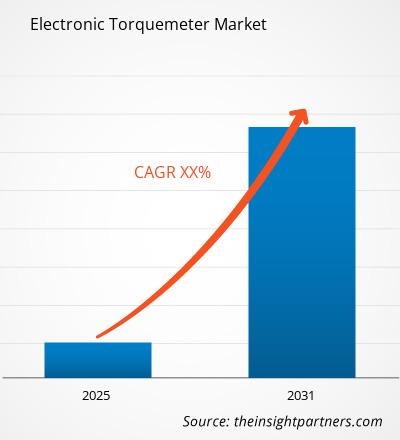
The Electronic Torquemeter Market was valued at US$ 537.56 Million in 2025 and is projected to reach US$ 1,230.00 Million by 2034, registering a CAGR of 9.63% during 2026–2034. The market encompasses electronic torque measurement instruments that provide precision torque monitoring and control across automotive, industrial, and aerospace and defense applications. These devices utilize strain gauge, magnetoelastic, and optical sensing technologies to deliver accurate, real-time torque data for quality assurance, process control, and system performance optimization worldwide.
North America Electronic Torquemeter Market size is expected to expand at a CAGR of 8.5–9.2% during 2026–2034, supported by automotive manufacturing, industrial production, and aerospace and defense requirements across the US and Canada. Demand is reinforced by quality assurance standards, process control requirements, and procurement preferences for reliable, accurate torque measurement solutions in manufacturing and testing applications.
Electronic Torquemeter Market Assessment and Insights
- North America held 28–31% Electronic Torquemeter Market share in 2025 and is growing at a CAGR of 8.5–9.2% during 2026–2034, led by automotive manufacturing, industrial production, and aerospace applications across the US and Canada.
- US represented 82–85% of North American revenue in 2025 and is growing at a CAGR of 8.7–9.4% during 2026–2034.
- Europe accounted for 24–27% share in 2025 and is growing at a CAGR of 8.2–8.9% during 2026–2034, led by Germany, the UK, France, Italy, and Spain.
- Asia Pacific held 32–35% share in 2025 and is growing at a CAGR of 10.5–11.2% during 2026–2034, led by China, India, Japan, South Korea, and Australia.
- Largest Segment Dynamic held 58–62% market share in 2025 and is growing at a CAGR of 9.0–9.7% during 2026–2034.
- High Growth Segment Static represented 38–42% market share in 2025 and is growing at a CAGR of 10.0–10.7% during 2026–2034.
- Key companies analyzed in detail: Crane Electronics; DATUM ELECTRONICS; PCE Deutschland GmbH; Honeywell International Inc.; ABB Ltd.; FUTEK Advanced Sensor Technology; Applied Measurements; Kistler Holding; Norbar Torque Tools; MagCanica; HBM; Interface, Inc.
Source: The Insight Partners' analysis based on proprietary research, government publications, company annual reports, investor presentations, industry databases, and expert interviews.
Electronic torquemeters have developed from the use of simple mechanical meters to highly advanced devices featuring fast data capture, wireless communication facilities, and analysis software for quality and process purposes. The dynamics of production in the current scenario involve accurate measurement, data recording, and factory-calibrated performance of devices over different torque ranges and under diverse conditions. The Electronic Torquemeter Market is also influenced by quality engineers and production managers who match torquemeter offerings with quality standards, process control considerations, and process needs.
Future investment will be made in the Asian Pacific, North American, and European manufacturing regions where process standards and quality considerations need advanced measurement solutions with better accuracy and data handling features. Alignment with calibration standards and quality requirements will help in the acceptance of instruments. Purchasers will prefer those products that offer good measurement accuracy, data management capabilities, and technical assistance services.
Electronic Torquemeter Market Report Scope
| Report Attribute | Details |
|---|---|
| Market size in 2025 | US$ 537.56 Million |
| Market Size by 2034 | US$ 1,230. Million |
| Global CAGR (2026 - 2034) | 9.63% |
| Historical Data | 2021-2024 |
| Forecast period | 2026-2034 |
Electronic Torquemeter Market Analysis
Market growth in electronic torquemeter is fueled by automotive manufacturing, manufacturing industry, quality assurance needs and testing. The supply chain comprises of sensor manufacturers, instrument manufacturers, distributors, and end-users. Supply chain dynamics are determined by component availability, technology advancement, and production cycles. Analysis shows that dynamic torquemeters will remain dominant due to the rotating nature of applications while static torquemeters become popular due to calibration and testing applications. Service capability is key since calibration service, technical support and data management can influence the quality and reliability of measurements.
The competition will be provided by measurement instrument providers and sensor producers. Honeywell International Inc., ABB Ltd., Kistler Holding AG, Norbar Torque Tools, Crane Electronics, FUTEK Advanced Sensor Technology Inc., Applied Measurements Ltd., DATUM ELECTRONICS, PCE Deutschland GmbH, MagCanica, HBM Group, and Interface Inc. are competing in terms of measuring accuracy, reliability, data management capabilities, and application knowledge. Investment opportunities lie in development of wireless technologies, data logging and digitization. Honeywell and ABB retain their leaders' positions due to measurement portfolios and industrial relationships, and Kistler and Norbar have advantage due to specialization in torque measurements.
The evolution of technology is making it possible to incorporate features such as wireless capability, data logging, automatic calibration, and quality management system into electronic torquemeters. With the features, electronic torquemeters can be enhanced to improve traceability, visibility, and quality documentation. The growth is also being driven by the increasing use of automated manufacturing and EV manufacturing, which requires precise torque measurement. Companies that are able to measure torque and have the capability to facilitate communication and data management are poised to meet more industrial needs.
Regional markets will be affected by automotive production, automation, laboratory facilities, and quality of manufacturing. There is need for electronic torquemeters that have the ability to provide accurate torque measurements in harsh environments in industries such as aerospace, automotive, electronics, and advanced manufacturing. Technical support, calibration services, software integration, and certification are becoming key value propositions in addition to product performance. Companies that are able to offer complete measurement solutions from installation to calibration, data integration, and after-sales services can build lasting customer relationships.
● REPORT CUSTOMIZATION
Tailor This Report To Align With Your Specific Business Requirements
This report can be customized to align precisely with your business objectives, scope, and target markets. Customization options include tailored segmentation, geography, competitive analysis, and strategic insights to support informed decision-making.
Customize This Report →WHAT YOU CAN ADJUST
- ● Segmentations
- ● Geography
- ● Competitive Analysis
- ● Language Preferences
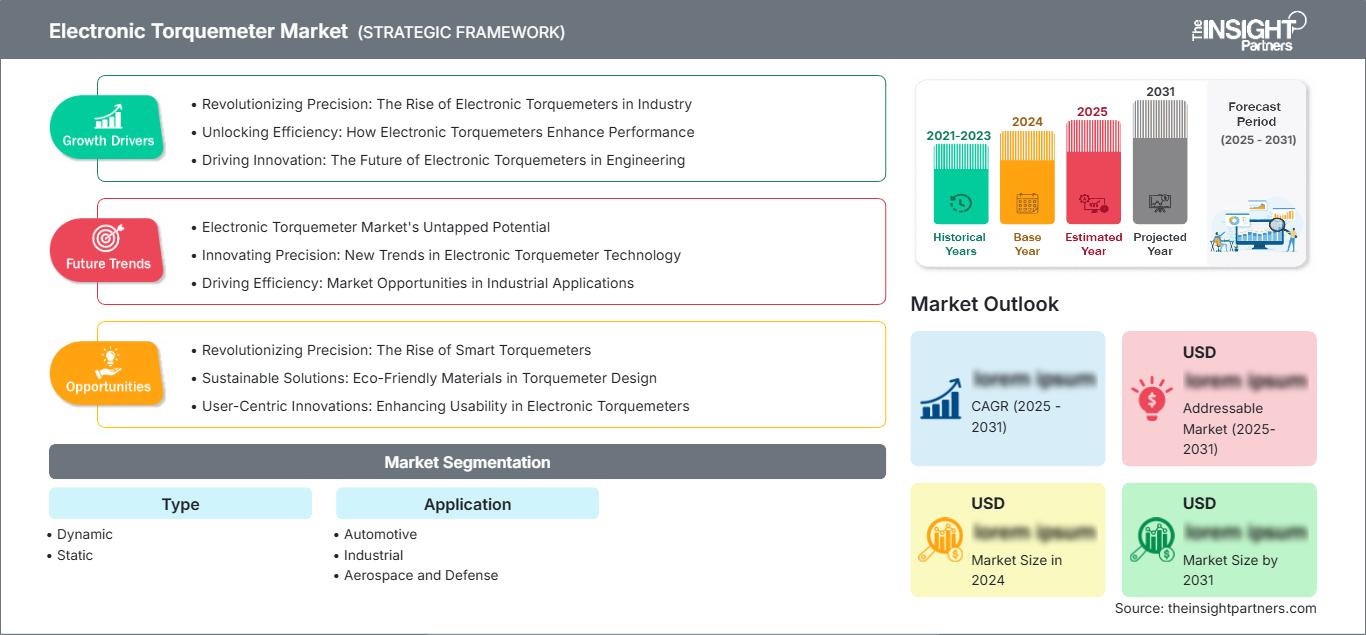
Electronic Torquemeter Market: Strategic Insights
Regional Insights
North America Electronic Torquemeter Market
North America accounted for 28–31% of Electronic Torquemeter Market share in 2025 and is projected to grow at a CAGR of 8.5–9.2% during 2026–2034. The industry receives demand from the automobile sector, industries, aerospace, and defense industry, and also through quality control measures in both the US and Canada. The industrial base of the region and its quality infrastructure provide for a sustained demand for the torquemeters. Honeywell International Inc., ABB Ltd., Kistler Holding, Norbar Torque Tools, and FUTEK Advanced Sensor Technology service installations in the US and Canada.
U.S. Electronic Torquemeter Market
The U.S. represented 82–85% of North American revenue in 2025 and is forecast to grow at a CAGR of 8.7–9.4% during 2026–2034. Applications are concentrated in vehicle manufacturing, industrial processes, aerospace, and quality control laboratories. The company’s market is supported through Honeywell International Inc., ABB Ltd., Kistler Holding, Norbar Torque Tools, and FUTEK Advanced Sensor Technology. The buyer’s preferences include precision, accuracy, data capacity, calibration facilities, and integration to improve quality assurance and increase the reliability of the torque measurements.
Europe Electronic Torquemeter Market
Europe held 24–27% share in 2025 and is expected to grow at a CAGR of 8.2–8.9% during 2026–2034. Germany is the leader in terms of automotive manufacturing and industrial standards, whereas the UK acts on the demand generated by aerospace and testing applications. France, Italy, and Spain generate demand through their automotive and industrial manufacturing operations. Standards for quality and calibration benefit suppliers that can prove their performance and accuracy levels. Honeywell International Inc., ABB Ltd., Kistler Holding, Norbar Torque Tools, and HBM continue to be prominent in automotive and industrial projects.
APAC Electronic Torquemeter Market
Asia Pacific accounted for 32–35% share in 2025 and is projected to grow at a CAGR of 10.5–11.2% during 2026–2034. China leads through manufacturing scale and quality infrastructure investment, while India expands through industrial development and quality programs. Japan and South Korea prioritize precision measurement for advanced manufacturing, while Australia adds testing and industrial applications. Policy support for manufacturing quality and industrial development strengthen Electronic Torquemeter Market adoption where measurement accuracy and quality assurance carry significant value.
Middle East & Africa Electronic Torquemeter Market
The Middle East & Africa market is projected to grow at a CAGR of 7.5–8.2% during 2026–2034. Saudi Arabia leads through industrial development and manufacturing investment, while the UAE adds industrial and testing applications. South Africa and Rest of MEA rely on manufacturing and quality infrastructure. Industrial development and quality requirements create demand for torque measurement solutions. Suppliers succeed when they combine product quality, calibration support, and application expertise.
Segmentation Analysis
Type
Type is projected to grow at a CAGR of 9.0–9.7% during 2026–2034. Electronic Torquemeter Market scope covers Dynamic and Static. Selection depends on measurement application and operating conditions. Dynamic leads through established applications and broad adoption.
- Dynamic torquemeters measure torque in rotating applications with real-time data for process monitoring and control.
- Static torquemeters provide torque measurement for calibration, testing, and stationary applications.
Application
Application is forecast to grow at a CAGR of 9.5–10.2% during 2026–2034. Automotive, Industrial, and Aerospace and Defense represent distinct application sectors.
- Automotive applications include powertrain testing, assembly quality, and component validation.
- Industrial applications encompass motor testing, process control, and equipment monitoring.
- Aerospace and Defense applications require precision torque measurement for critical systems.
Opportunity Snapshot
| Application | Revenue Contribution | Trend Tag | Adoption Stage |
|---|---|---|---|
| Automotive | High | Assembly Quality | Mature |
| Industrial | High | Process Control | Mature |
| Aerospace and Defense | Medium | Critical Systems | Mature |
Electronic Torquemeter Market Growth Drivers and Impact Analysis
Quality Assurance Requirements Drive Torque Measurement Demand
Quality assurance requirements and manufacturing standards across automotive, industrial, aerospace, and other precision-oriented sectors are creating significant demand for electronic torquemeters that enable accurate torque verification and process control. Manufacturers increasingly rely on precise torque measurement to ensure fasteners, assemblies, and mechanical components meet defined performance and safety requirements. Electronic torquemeters provide accurate readings, digital data capture, and improved measurement repeatability compared with basic mechanical tools. As quality control procedures and regulatory expectations become more demanding, reliable torque measurement equipment is becoming an essential part of production and inspection processes. This driver benefits suppliers capable of delivering accurate, durable, and easy-to-use torquemeters with dependable calibration, data recording, and measurement capabilities. The market impact is sustained demand for precision torque measurement solutions supporting quality assurance, manufacturing consistency, and regulatory compliance.
Automotive Manufacturing and Testing Applications Create Consistent Demand
Automotive manufacturing and testing applications across powertrain, assembly, component validation, and vehicle systems create consistent demand for electronic torquemeters used for precise torque measurement and quality control. Automotive manufacturers require accurate torque verification to ensure fasteners, engines, transmissions, and critical components meet defined performance and safety specifications. Increasing automation and stringent production standards are further encouraging the use of digital torque measurement equipment for process monitoring and validation. Testing facilities also rely on reliable torquemeters to evaluate component performance and verify torque characteristics during development and quality assurance procedures. As global automotive production and technology development continue, demand for precision measurement equipment is expected to remain steady. This driver benefits suppliers capable of delivering accurate, durable, calibrated, and easy-to-integrate torquemeters for demanding automotive manufacturing and testing environments.
Industrial Automation and Process Control Drive Measurement Adoption
Industrial automation and process control requirements across manufacturing sectors are creating demand for electronic torquemeters used for equipment monitoring, assembly verification, and production optimization. Automated manufacturing systems increasingly require accurate torque measurement to monitor fastening operations, detect process variations, and maintain consistent equipment performance. Integration with digital control systems also enables torque data to support real-time monitoring, quality assurance, and predictive maintenance initiatives. As manufacturers expand automation and smart production capabilities, reliable torque measurement becomes increasingly important for maintaining process efficiency and minimizing production errors. This driver benefits suppliers that can provide accurate, durable, and digitally connected torquemeters suitable for automated environments. The market impact is sustained demand for precision torque measurement solutions supporting industrial automation, process control, equipment monitoring, and continuous manufacturing improvement.
Electronic Torquemeter Market Future Trends
Wireless Data Connectivity Enables Remote Monitoring
Electronic Torquemeter Market trends indicate growing adoption of wireless data connectivity to enable remote monitoring, digital reporting, and integration with broader quality management systems. Modern electronic torquemeters can increasingly support the transfer of measurement data to computers, mobile devices, production systems, and cloud-based platforms, improving process visibility and reducing manual data recording. The next product cycle is expected to combine accurate torque measurement with wireless communication, automated data capture, and system integration capabilities. This development is particularly valuable for manufacturers seeking real-time quality monitoring, traceability, and improved production control. As industrial operations become more connected and data-driven, suppliers with expertise in wireless communication, digital interfaces, cybersecurity, and measurement technology will be better positioned to meet evolving data requirements and strengthen their competitive position in precision torque measurement applications.
Digital Integration with Quality Management Systems
Digital integration with quality management systems is emerging as an important capability for electronic torquemeters, enabling automated data capture, measurement traceability, and streamlined quality documentation. Next-generation instruments are expected to incorporate communication interfaces and standardized protocols that allow torque measurements to be transferred directly to manufacturing execution systems, quality platforms, and other digital production environments. This connectivity can reduce manual data entry, improve record accuracy, and support faster identification of process deviations. Automated documentation also helps manufacturers strengthen audit readiness and maintain consistent quality procedures across production facilities. As industrial operations become increasingly data-driven, suppliers that combine reliable torque measurement with robust digital integration, secure communication, and user-friendly software will gain credibility among quality-focused manufacturers seeking greater process automation, traceability, and regulatory compliance.
Electronic Torquemeter Market Opportunities
Torque Measurement Solutions for Electric Vehicle Manufacturing
Electronic Torquemeter Market Forecasts support continued investment in precision torque measurement solutions for electric vehicle manufacturing and testing, where accurate torque verification is required across powertrain assembly, battery systems, electric motors, and critical component production. EV manufacturers need reliable measurement equipment to maintain assembly accuracy, validate component performance, and support stringent quality control requirements. The transition toward electric powertrains is creating new manufacturing processes and increasing the need for precise torque monitoring throughout production and testing operations. Suppliers can capture emerging opportunities by developing EV-focused torquemeters with high accuracy, digital data capture, and integration capabilities. The opportunity is strongest in regions experiencing rapid EV manufacturing expansion, where growing production volumes are driving demand for reliable, precise, and digitally connected torque measurement solutions.
Calibration and Testing Instruments for Quality Laboratories
Calibration and testing instruments used in quality laboratories create consistent demand for precise and reliable electronic torquemeters for instrument verification, measurement validation, and quality control. Laboratories require accurate reference equipment to verify torque tools, establish measurement traceability, and ensure compliance with defined testing procedures. Increasing emphasis on manufacturing quality, calibration standards, and measurement accuracy is supporting investment in advanced laboratory-grade torquemeters. Suppliers with established calibration expertise can capture opportunities by offering high-accuracy instruments, dependable performance, comprehensive calibration services, and technical support. The opportunity particularly rewards companies capable of providing traceable measurement, repeatable results, durable equipment, and convenient calibration solutions. As manufacturers and testing organizations strengthen quality assurance processes, demand for reliable torquemeters designed for laboratory calibration and verification applications is expected to remain strong.
Recent Developments
- April 2025: At this year’s Hannover Messe, Motion Technology Company Schaeffler will unveil innovative sensor solutions for industrial applications. These advanced sensors play a crucial role in enhancing the efficiency, reliability, and service life of machinery and vehicles. Following its successful merger with Vitesco Technologies in October 2024, Schaeffler is presenting its expanded portfolio in Germany for the first time, featuring eight distinct product families. With this broadened offering, the company now provides cutting-edge sensor solutions covering all aspects of motion. The key product highlights at this year’s Hannover Messe include Schaeffler’s torque sensor, hydrogen application sensors, and the compact Zone Controller for intelligent system management.
- May 2025: Canon Singapore (Canon Singapore Pte. Ltd.) announced its first ever collaboration with Mitsubishi Electric Asia in Southeast Asia, unveiling a powerful new automation solution integrating Canon’s state-of-the-art Force Torque Sensor FH-300-20 with Mitsubishi Electric’s MELFA FR series FR PLUS industrial robots. This collaboration marks a significant milestone in bringing precision robotics to industries across the region. The combined solution will be showcased for the first time in Southeast Asia1 at SEMICON Southeast Asia 2025.
- May 2024: NSK Ltd. has developed a practical magnetostrictive torque sensor (3rd-generation sensor) for automobiles which enables failure prediction, a comfortable ride, extension of driving mileage and performance improvement thanks to its weight-reducing and space-saving features, while also shortening the development period. The newly developed product is scheduled to be exhibited at the Automotive Engineering Exposition 2024 Yokohama to be held at Pacifico Yokohama on May 22-24, 2024. NSK also plans to make a joint presentation about the product at the 2024 JSAE Annual Congress (Spring) to be held at the same venue.
Frequently Asked Questions

- Comprehensive Market Sizing and Forecast Analysis
- Detailed Segmentation Analysis
- In-Depth Market Dynamics Assessment
- Regional and Country-Level Insights
- Competitive Landscape and Company Benchmarking
- Strategic Business Intelligence
Recent Reports
Testimonials

The Insight Partners' SCADA System Market report is comprehensive, with valuable insights on current trends and future forecasts. The team was highly professional, responsive, and supportive throughout. We are very satisfied and highly recommend their services.
RAN KEDEM Partner, Reali Technologies LTDs
I requested a report on a very specific software market and the team produced the report in a few days. The information was very relevant and well presented. I then requested some changes and additions to the report. The team was again very responsive and I got the final report in less than a week.
JEAN-HERVE JENN Chairman, Future Analytica
We worked with The Insight Partners for an important market study and forecast. They gave us clear insights into opportunities and risks, which helped shape our plans. Their research was easy to use and based on solid data. It helped us make smart, confident decisions. We highly recommend them.
PIYUSH NAGPAL Sr. Vice President, High Beam Global
The Insight Partners delivered insightful, well-structured market research with strong domain expertise. Their team was professional and responsive throughout. The user-friendly website made accessing industry reports seamless. We highly recommend them for reliable, high-quality research services
YUKIHIKO ADACHI CEO, Deep Blue, LLC.
This is the first time I have purchased a market report from The Insight Partners.While I was unsure at first, I visited their web site and felt more comfortable to take the risk and purchase a market report.I am completely satisfied with the quality of the report and customer service. I had several questions and comments with the initial report, but after a couple of dialogs over email with their analyst I believe I have a report that I can use as input to our strategic planning process.Thank you so much for taking the extra time and making this a positive experience.I will definitely recommend your service to others and you will be my first call when we need further market data.
JOHN SUZUKI President and Chief Executive Officer, Board Director, BK Technologies
I wish to appreciate your support and the professionalism you displayed in the course of attending to my request for information regarding to infectious disease IVD market in Nigeria. I appreciate your patience, your guidance, and the fact that you were willing to offer a discount, which eventually made it possible for us to close a deal. I look forward to engaging The Insight Partners in the future, all thanks to the impression you have created in me as a result of this first encounter.
DR CHIJIOKE ONYIA MANAGING DIRECTOR, PineCrest Healthcare Ltd.Reason to Buy
- Informed Decision-Making
- Understanding Market Dynamics
- Competitive Analysis
- Identifying Emerging Markets
- Customer Insights
- Market Forecasts
- Risk Mitigation
- Boosting Operational Efficiency
- Strategic Planning
- Investment Justification
- Tracking Industry Innovations
- Aligning with Regulatory Trends





 Get Free Sample for