
Elemental Analyzer Market Size, Share & Forecast by 2034
Coverage: by Type (C-H-S Analyzer, O-N-H Analyzer, XRF Analyzer); Application (Research, Mining, Construction, Petrochemical, Pharmaceutical, Others) , and Geography (North America, Europe, Asia Pacific, and South and Central America)
- Status : Data Released
- Report Code : TIPRE00005260
- Category : Electronics and Semiconductor
- No. of Pages : 150
- Available Report Formats :


- Last update date : August 26, 2026


2025 Market Size
US$ 1,034.4 Mn
Base year value
2034 Forecast
US$ 1,588.75 Mn
Projected by 2034
CAGR 2026-2034
5.51 %
Growth rate
Addressable Market
US$ 12,290.10 Mn
(2026-2034)
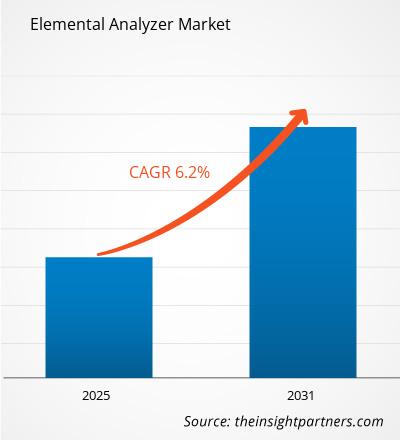
The Elemental Analyzer Market was valued at US$ 1,034.4 million in 2025 and is estimated to rise to US$ 1,588.75 million by 2034 growing at a CAGR of 5.51% in 2026-2034 period. The market comprises of C-H-S Analyzer, O-N-H Analyzer, and XRF Analyzer types used for Research, Mining, Construction, Petrochemical, Pharmaceutical, and Others purposes. The demand will be driven by material quality demands, laboratory automation, process control needs, and increased demands for composition and trace element verification.
Elemental Analyzer Market Size in North America has been facilitated due to presence of well-established laboratories, pharmaceutical QC, materials research, environmental testing, and energy sectors uses. The market in the region is anticipated to grow with an approximate 5.0-5.6% CAGR during 2026-2034 period. Equipment replacement needs, laboratory workflow automation, and demand for rapid material analysis are the underlying forces, along with extensive service network for equipment procurement.
Elemental Analyzer Market Assessment and Insights
- North America: North America remains a major regional market, supported by pharmaceutical, environmental, energy, and advanced-material laboratories. It held a 31–34% Elemental Analyzer Market share in 2025 and is projected to grow at a 5.0–5.6% CAGR between 2026–2034.
- US: The US represents 77–82% of North American share in 2025, with a 5.1–5.7% CAGR between 2026–2034, supported by established analytical laboratories, industrial quality programs, and research expenditure.
- Europe: Europe is characterized by strong laboratory penetration and established analytical-instrument manufacturing, led by Germany, the UK, France, Italy, and Spain. The region held a 26–29% share in 2025 and is expected to grow at a 4.8–5.4% CAGR between 2026–2034.
- Asia Pacific: Asia Pacific combines expanding manufacturing capacity with growing pharmaceutical, electronics, mining, chemical, and materials-testing requirements. The region held a 30–33% share in 2025 and is forecast to grow at a 6.0–6.8% CAGR between 2026–2034, led by China, Japan, India, and South Korea.
- Largest Segment: XRF Analyzer is the largest technology segment, supported by rapid elemental screening and nondestructive material testing. It represented a 47–50% market share in 2025 and is expected to grow at a 5.3–5.9% CAGR during 2026–2034.
- High Growth Segment: O-N-H Analyzer is positioned as the high-growth technology segment, reflecting increasing demand for oxygen, nitrogen, and hydrogen measurement in advanced materials. It held an 18–22% market share in 2025 and is expected to grow at a 6.2–7.0% CAGR during 2026–2034.
- Key companies analyzed in detail: AMETEK, Inc., Elementar Analysensysteme GmbH, ELTRA GmbH, Endress+Hauser AG, EuroVector, Exeter Analytical, Inc., HORIBA, Ltd., LECO Corporation, PerkinElmer Inc., Thermo Fisher Scientific
Source: The Insight Partners' analysis based on proprietary research, government publications, company annual reports, investor presentations, industry databases, and expert interviews.
According to the Elemental Analyzer Market report, market evolution from standalone combustion and spectroscopy instruments has been towards modular systems integrating sample-handling systems, software, and various measuring technologies. XRF has become increasingly significant in rapid materials screening, and the combustion equipment continues to be vital in carbon, sulfur, oxygen, nitrogen, and hydrogen analysis. Development efforts continue to focus on improved throughput, accuracy, reduced sample sizes, and system compatibility with laboratory information systems.
The Elemental Analyzer Market forecast indicates that future developments in terms of the demand growth may become increasingly driven by Asian Pacific region countries with growing manufacturing capacity, particularly related to semiconductor, battery, pharmaceutical production, and minerals processing. Priority for investment would shift increasingly towards automation, traceability, cost reduction, and systems capable of satisfying more stringent quality control requirements. Regulatory requirements for material composition, food authenticity, environmental monitoring, and industrial safety would support the demand for recurring expenditures on analytical equipment.
Elemental Analyzer Market Report Scope
| Report Attribute | Details |
|---|---|
| Market size in 2025 | US$ 1,034.4 Million |
| Market Size by 2034 | US$ 1,588.75 Million |
| Global CAGR (2026 - 2034) | 5.51% |
| Historical Data | 2021-2024 |
| Forecast period | 2026-2034 |
Elemental Analyzer Market Analysis
The demand is driven by laboratories and production settings where measurements of reproducible elemental composition are required for materials, intermediates, and final products. Pharmaceutical and research laboratories focus on accuracy and repeatability, whereas mineralogical, metals, cement, and other materials analyses needed by mining and construction sectors stress speed. Elemental information needs of petrochemical producers include feedstocks and process stream analysis. The value chain in this ecosystem consists of suppliers providing instruments, detectors, combustion assemblies, X-ray sources, software, consumables, calibration materials, installation, and after-sales services.
Current supply trends point to increased advantages for vendors that can integrate hardware with industry-specific software and service infrastructure. Higher throughput and automated sample preparation may increase laboratory productivity without a proportionate growth of personnel. Carrier gases, catalysts, reference materials, detector parts, and maintenance agreements continue to play an important role as recurrent parts of the value chain. Thus, total cost of ownership becomes an important purchasing criterion along with analytical capabilities.
Competitive positioning is influenced by breadth of technology, installed base, geographic reach of services, and expertise in specific applications. AMETEK, Inc. stays present across material analysis technologies, Elementar Analysensysteme GmbH and ELTRA GmbH focus on elemental analysis based on combustion technique, while HORIBA, Ltd. offers combustion, XRF, and more general analysis. LECO Corporation specializes in combustion analysis and materials testing, whereas Thermo Fisher Scientific provides CHNS/O analysis systems in research, pharmaceutical, petrochemical, energy, and materials industries.
Elemental Analyzer Market trends indicate that investments in the market are shifting towards application-specific systems rather than equipment. Vendors compete on workflow automation, increased speed of analysis, software, and analysis of novel materials including batteries and recycled critical minerals. Positioning of vendors is also influenced by the trend towards field and inline measurements, which allow to make fast decisions and decrease laboratory workload. HORIBA's development of inline XRF solution for catalyst coating demonstrates the trend towards integration of elemental measurements into manufacturing process.
● REPORT CUSTOMIZATION
Tailor This Report To Align With Your Specific Business Requirements
This report can be customized to align precisely with your business objectives, scope, and target markets. Customization options include tailored segmentation, geography, competitive analysis, and strategic insights to support informed decision-making.
Customize This Report →WHAT YOU CAN ADJUST
- ● Segmentations
- ● Geography
- ● Competitive Analysis
- ● Language Preferences
Elemental Analyzer Market: Strategic Insights
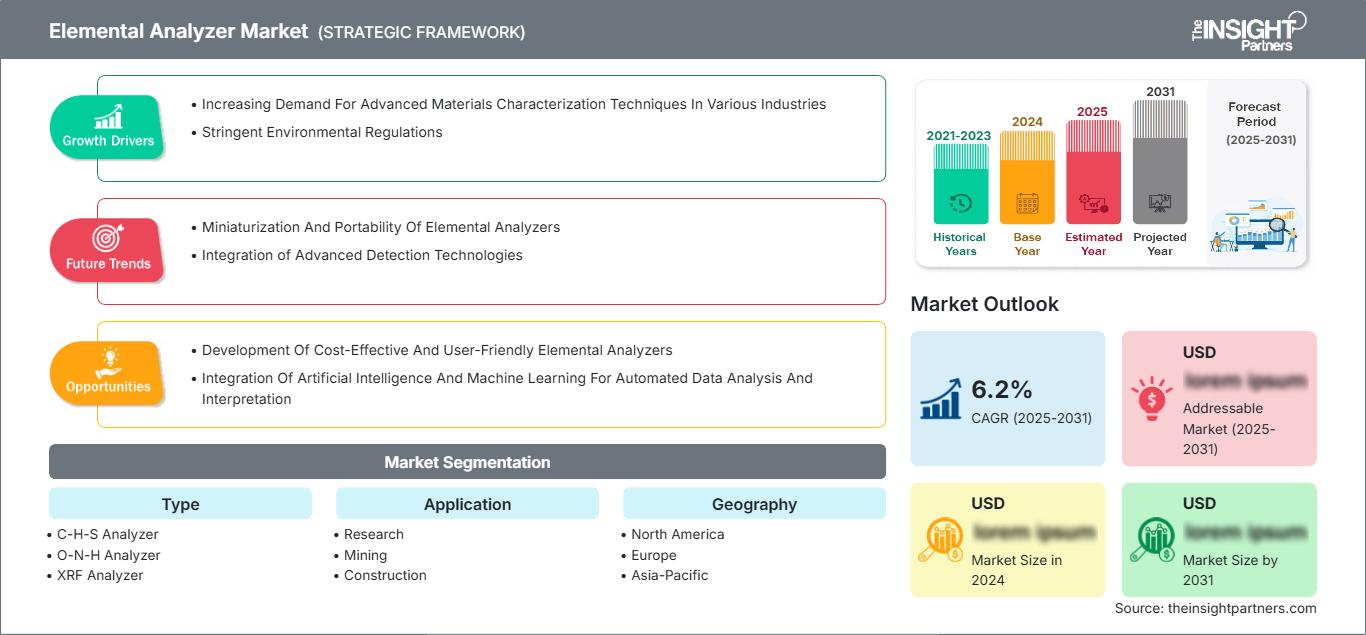
Regional Insights
North America Elemental Analyzer Market
North America has been contributing around 31–34% to the market in 2025, and is expected to grow at a CAGR of 5.0–5.6% between 2026 and 2034. USA contributes 77–82% to the North American market in 2025; on the other hand, Canada and Mexico add further demand from applications such as mining, environmental testing, food analysis, and industrial laboratories.
The Elemental Analyzer Market demand in the region is driven by an already mature pharmaceutical industry, manufacturing activities, environment monitoring, and research facilities. Demand due to replacement is significant since the laboratories that have been operating for some time require upgrades to their combustion, XRF and similar analytical platforms. There is a growing interest in battery material, recycling, semiconductors, and critical mineral applications.
U.S. Elemental Analyzer Market Market
The U.S. had an estimated 77%-82% market share in North America in 2025 and is forecast to expand at a 5.1%-5.7% CAGR from 2026-2034. The demand is primarily centered on the pharmaceuticals, research, environment, petrochemicals, metals, and advanced materials industry segments, thanks to the well-developed network of laboratories.
Market coverage is wide, with Thermo Fisher Scientific, AMETEK, Inc., LECO Corporation, PerkinElmer Inc., HORIBA, Ltd., Elementar Analysensysteme GmbH, and others serving various analytical needs. Current developments include automation of CHNS/O analysis, material validation, and fast elemental screening. In addition, the rise in lab digitalization enhances the need for systems which provide traceability and efficiency in reports.
Europe Elemental Analyzer Market
Europe had a Elemental Analyzer market share of 26-29% in 2025 and is expected to have a CAGR of 4.8-5.4% during 2026-2034, where Germany will be one of the prominent national markets in Europe. Europe is advantaged due to having already existing chemical, pharmaceutical, automotive, energy, food, and research industries that will require repeatability in elemental characterization.
The UK, Germany, France, Italy, and Spain offer different demand characteristics in the Elemental Analyzer Market. Germany is favored by chemicals, automotive materials, and industrial research; the UK has pharmaceuticals, academic, and environmental tests. France has nuclear, aerospace, chemical, and research needs, and Italy and Spain through manufacturing, construction materials, food, energy, and environmental laboratories. European standardization is also encouraging analytical workflows, which include CEN-18054:2024 on stable isotope analysis in food authenticity testing.
APAC Elemental Analyzer Market
The APAC region accounted for a 30–33% share of the Elemental Analyzer Market in 2025 and is expected to experience a 6.0–6.8% CAGR between 2026 and 2034, thereby emerging as the top high-growth regional segment. The China, Japan, India, South Korea, and Australia are some key regions driving the demand in the manufacturing and resource sectors.
China is a key driver of the Elemental Analyzer Market in the region owing to manufacturing, chemical, electronic, mining, and infrastructure applications. Japan and South Korea are majorly focusing on high purity materials and manufacturing applications, whereas India is growing in pharmaceutical, semiconductor, research, and clean energy laboratories. Australia continues to be a significant market for mining and resource analysis.
Middle East & Africa Elemental Analyzer Market Market
The Middle East and Africa market is expected to expand at a 4.5–5.2% CAGR during 2026–2034. Saudi Arabia and the UAE are important demand centers because of energy diversification, petrochemical investment, and industrial development, while South Africa benefits from mining, metals, environmental testing, and materials analysis.
Demand across the Rest of MEA remains project-driven and concentrated around energy, mining, construction, food, and water-related laboratories. Infrastructure development and resource-sector modernization can increase demand for portable and laboratory elemental analysis. Procurement remains sensitive to installation support, consumable availability, technical training, and total ownership cost, making regional distribution and service capabilities important competitive factors.
Segmentation Analysis
Type
The Type segment comprises C-H-S Analyzer, O-N-H Analyzer, and XRF Analyzer. Technology selection depends on target elements, sample matrix, required detection capability, throughput, and whether testing is laboratory-based or closer to production. The segment is expected to maintain steady expansion as laboratories replace aging systems and industrial users adopt more automated analytical workflows. The overall type landscape favors platforms that deliver repeatable results with limited sample preparation.
- C-H-S Analyzer: Widely used for carbon and sulfur determination in metals, fuels, chemicals, and materials, this technology supports established quality-control workflows where repeatability and rapid combustion-based analysis are operational priorities.
- O-N-H Analyzer: Demand centers on metallurgy, advanced materials, powder processing, and research requiring oxygen, nitrogen, and hydrogen measurement. Its strategic importance is increasing as material purity and performance requirements become more demanding.
- XRF Analyzer: XRF provides rapid, often nondestructive elemental screening across mining, construction materials, metals, petrochemical, and industrial applications. Its combination of speed and limited sample preparation supports broad laboratory and production adoption.
Application
The Application segment is expected to expand at a 5.2–5.8% CAGR during 2026–2034, reflecting broad use across scientific and industrial environments. Research laboratories require flexible instrumentation for characterization, while industrial users increasingly connect elemental analysis with quality assurance, process optimization, regulatory documentation, and materials qualification. Adoption is strongest where composition directly influences product performance, safety, or compliance.
- Research: Research institutions use elemental analyzers for material characterization, organic chemistry, environmental studies, and experimental validation. Flexible configurations and reliable quantification are strategically important for multi-purpose laboratories.
- Mining: Mining applications emphasize rapid determination of elemental composition in ores, concentrates, and related materials. Analytical speed supports exploration, grade assessment, process optimization, and resource-management decisions.
- Construction: Construction-material laboratories apply elemental analysis to cement, minerals, aggregates, metals, and other materials. Consistent composition data helps support specification compliance and quality assurance across infrastructure projects.
- Petrochemical: Petrochemical users require elemental measurement for fuels, feedstocks, catalysts, and process-related materials. Automated analysis can strengthen quality control while reducing delays associated with manual or outsourced testing.
- Pharmaceutical: Pharmaceutical laboratories use elemental analysis for research, raw-material characterization, quality control, and formulation-related investigations. Reliable data integrity, repeatability, and standardized workflows are particularly important for regulated environments.
Opportunity Snapshot
| Application | Revenue Contribution (High/Medium/Low) | Trend Tag | Adoption Stage |
| Research | High | Lab Automation | Mature |
| Mining | Medium | Ore Screening | Scaling |
| Construction | Medium | Material QC | Scaling |
| Petrochemical | High | Process Testing | Mature |
| Pharmaceutical | High | Quality Analytics | Mature |
| Others | Low | Niche Testing | Emerging |
Elemental Analyzer Market Growth Drivers and Impact Analysis
Expansion of Advanced Materials and Critical-Mineral Processing
The expansion of battery materials, rare-earth processing, recycled metals, specialty alloys, and high-performance ceramics is increasing the need for precise elemental verification at multiple production stages. Producers need to separate materials that meet the requirement for use from those that have contaminating elements that will affect performance, output, or safety. This opens up avenues for the use of combustion and XRF units that can deal with different matrices with minimal sample preparation. The effects are most significant where the outcomes of the analysis affect the decision-making process for the production of the batch. Suppliers of systems suited for the analysis of critical minerals, recycling and advanced materials stand to benefit from application-specific offerings, supplies, and service agreements.
Laboratory Automation and Higher Throughput Requirements
The search for automation among laboratory users is on the rise due to the increasing amount of analysis to be done despite the limitations of the skilled technical manpower available. Automation can cut down the need for human interaction and help in optimizing the process. This business impact goes beyond that of instrument purchases, as automated systems increase the demand for accessory equipment, reagents, maintenance, upgrades in software, and workflow integration. Thermo Fisher Scientific's FlashSmart system, for example, has various CHNS/O configurations and automated workflow in organic chemistry, pharmaceuticals, petrochemicals, energy, and material characterization applications.
Increasing Requirements for Traceable Material and Product Verification
Greater emphasis on product authenticity, material traceability, environmental compliance, and process consistency is increasing the value of defensible elemental measurements. Food authenticity testing, pharmaceutical quality programs, environmental analysis, and industrial certification all require analytical results that can be reproduced and documented. Standardized methods can accelerate adoption by reducing uncertainty around measurement protocols and acceptance criteria. The publication of CEN-18054:2024, for example, establishes a standardized approach for stable isotope ratio analysis of foodstuffs using EA-IRMS, strengthening the role of elemental analytical workflows in authenticity and traceability programs. These requirements create demand for systems with strong calibration, documentation, software, and data-management capabilities.
Elemental Analyzer Market Future Trends
AI-Assisted Interpretation and Connected Analytical Workflows
Future platforms are likely to incorporate increasingly sophisticated software that assists with method selection, quality checks, spectral interpretation, anomaly identification, and automated reporting. AI-supported workflows can reduce the expertise required for routine interpretation while helping experienced analysts identify unusual results faster. Connectivity will also allow analytical instruments to exchange data with laboratory information systems, manufacturing execution systems, and enterprise quality platforms. This development could shift competition from detector performance alone toward the quality of the complete data workflow. Vendors that provide secure connectivity, explainable analytics, automated audit trails, and adaptable application libraries should gain relevance among organizations managing large laboratory networks. The long-term opportunity lies in reducing analytical decision time while preserving validation and human oversight.
Greater Adoption of Inline and Near-Line Elemental Measurement
Elemental analysis is likely to move closer to manufacturing processes as producers seek earlier detection of composition changes and tighter control of material usage. Inline and near-line XRF systems can provide continuous or frequent measurements without requiring every sample to be transported to a central laboratory. This approach is particularly relevant to coatings, metals, energy materials, petrochemicals, and high-volume manufacturing. Production teams can use faster feedback to identify drift, adjust process conditions, and reduce scrap. HORIBA's catalyst coating monitoring system demonstrates the direction of this transition by applying XRF for continuous, non-contact measurement in roll-to-roll processing. Future systems should increasingly emphasize response time, ruggedization, automated calibration, and integration with plant-control environments.
Elemental Analyzer Market Opportunities
Application-Specific Platforms for Battery and Recycling Laboratories
Battery manufacturing and recycling create an opportunity for suppliers to develop application-specific analytical packages rather than generic instruments. Producers need elemental information to evaluate raw materials, active materials, process intermediates, and recycled streams, while recyclers need composition data to support sorting and recovery decisions. A focused offering can combine analyzer hardware with optimized methods, sample preparation, reference materials, software, and service agreements. This approach can shorten qualification cycles and make analytical systems easier to deploy across distributed facilities. LECO Corporation has highlighted carbon and sulfur analysis for battery materials, demonstrating how established combustion technologies can be aligned with emerging energy applications. Suppliers that build validated workflows for new battery chemistries and recycled feedstocks can capture specialized demand.
Regional Service Networks in Emerging Manufacturing Hubs
Emerging manufacturing hubs present an opportunity to expand analytical-instrument sales through localized technical support rather than relying primarily on equipment exports. India, Southeast Asia, the Middle East, and selected Latin American markets are adding pharmaceutical, electronics, energy, mining, and materials capacity that requires dependable analytical infrastructure. Buyers increasingly evaluate installation time, training, spare-parts availability, calibration support, and maintenance responsiveness alongside instrument specifications. Establishing regional application centers, certified service partners, and local training programs can lower adoption barriers and increase recurring revenue from consumables and service contracts. The opportunity is especially relevant where laboratories are being established alongside new industrial facilities and have limited access to experienced elemental-analysis specialists.
Recent Developments
- March 2026: Rigaku — Rigaku launched the NEX QC II Series benchtop EDXRF analyzers for industrial quality control, introducing enhanced detector performance, a compact fanless design, touchscreen operation, and integrated reporting. The systems support nondestructive elemental analysis across solids, liquids, powders, and thin films for applications including petroleum, coatings, wood preservatives, and recycled materials.
- January 2025: Evident Corporation — Evident launched the next-generation Vanta Element and Vanta Element-S handheld XRF analyzers, designed for alloy identification in scrap sorting, metal manufacturing, and precious-metals testing. The series combines silicon drift detection and Axon Technology with improved ergonomics, faster grade identification, wireless connectivity, cloud data management, and configurable analytical capabilities.
- August 2026: SPECTRO Analytical Instruments GmbH — SPECTRO introduced the improved SPECTROSCOUT kt portable ED-XRF analyzer for rapid, nondestructive analysis of precious metals and alloys. The instrument supports analysis of 25 elements, incorporates a 1 mm analysis spot with integrated video positioning, and targets hallmarking centers, jewelers, refiners, recyclers, and other users requiring portable elemental analysis.
Frequently Asked Questions

- Comprehensive Market Sizing and Forecast Analysis
- Detailed Segmentation Analysis
- In-Depth Market Dynamics Assessment
- Regional and Country-Level Insights
- Competitive Landscape and Company Benchmarking
- Strategic Business Intelligence
Recent Reports
Testimonials

The Insight Partners' SCADA System Market report is comprehensive, with valuable insights on current trends and future forecasts. The team was highly professional, responsive, and supportive throughout. We are very satisfied and highly recommend their services.
RAN KEDEM Partner, Reali Technologies LTDs
I requested a report on a very specific software market and the team produced the report in a few days. The information was very relevant and well presented. I then requested some changes and additions to the report. The team was again very responsive and I got the final report in less than a week.
JEAN-HERVE JENN Chairman, Future Analytica
We worked with The Insight Partners for an important market study and forecast. They gave us clear insights into opportunities and risks, which helped shape our plans. Their research was easy to use and based on solid data. It helped us make smart, confident decisions. We highly recommend them.
PIYUSH NAGPAL Sr. Vice President, High Beam Global
The Insight Partners delivered insightful, well-structured market research with strong domain expertise. Their team was professional and responsive throughout. The user-friendly website made accessing industry reports seamless. We highly recommend them for reliable, high-quality research services
YUKIHIKO ADACHI CEO, Deep Blue, LLC.
This is the first time I have purchased a market report from The Insight Partners.While I was unsure at first, I visited their web site and felt more comfortable to take the risk and purchase a market report.I am completely satisfied with the quality of the report and customer service. I had several questions and comments with the initial report, but after a couple of dialogs over email with their analyst I believe I have a report that I can use as input to our strategic planning process.Thank you so much for taking the extra time and making this a positive experience.I will definitely recommend your service to others and you will be my first call when we need further market data.
JOHN SUZUKI President and Chief Executive Officer, Board Director, BK Technologies
I wish to appreciate your support and the professionalism you displayed in the course of attending to my request for information regarding to infectious disease IVD market in Nigeria. I appreciate your patience, your guidance, and the fact that you were willing to offer a discount, which eventually made it possible for us to close a deal. I look forward to engaging The Insight Partners in the future, all thanks to the impression you have created in me as a result of this first encounter.
DR CHIJIOKE ONYIA MANAGING DIRECTOR, PineCrest Healthcare Ltd.Reason to Buy
- Informed Decision-Making
- Understanding Market Dynamics
- Competitive Analysis
- Identifying Emerging Markets
- Customer Insights
- Market Forecasts
- Risk Mitigation
- Boosting Operational Efficiency
- Strategic Planning
- Investment Justification
- Tracking Industry Innovations
- Aligning with Regulatory Trends





 Get Free Sample for