
Emergency Spill Response Market Growth, Trends & Demand by 2034
Emergency Spill Response Market Size and Forecasts (2021–2034), Global and Regional Share, Trends, and Growth Opportunity Analysis Report Coverage : By Components (Hardware and Services), Spill Environment (Spills on Sea and Spills on Land), Spill Material (Oil Spills, Chemical and Hazardous Material Spills, and Food & Drinks Spills), End User (Oil and Gas, Chemical, Ports and Harbors, Industrial Facilities, Transportation, Government, and Others)
- Status : Data Released
- Report Code : TIPRE00039828
- Category : Electronics and Semiconductor
- No. of Pages : 150
- Available Report Formats :


- Last update date : August 26, 2026


2025 Market Size
US$ 37.49 Bn
Base year value
2034 Forecast
US$ 61.04 Bn
Projected by 2034
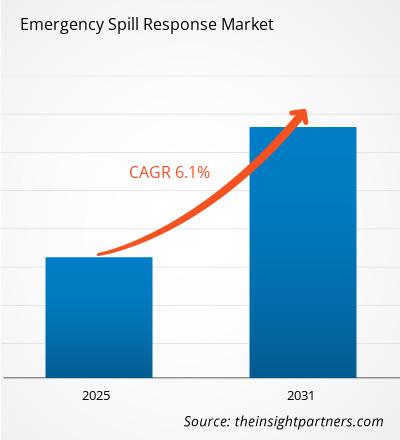
CAGR 2026-2034
6.28 %
Growth rate
Addressable Market
US$ 463.20 Bn
(2026-2034)
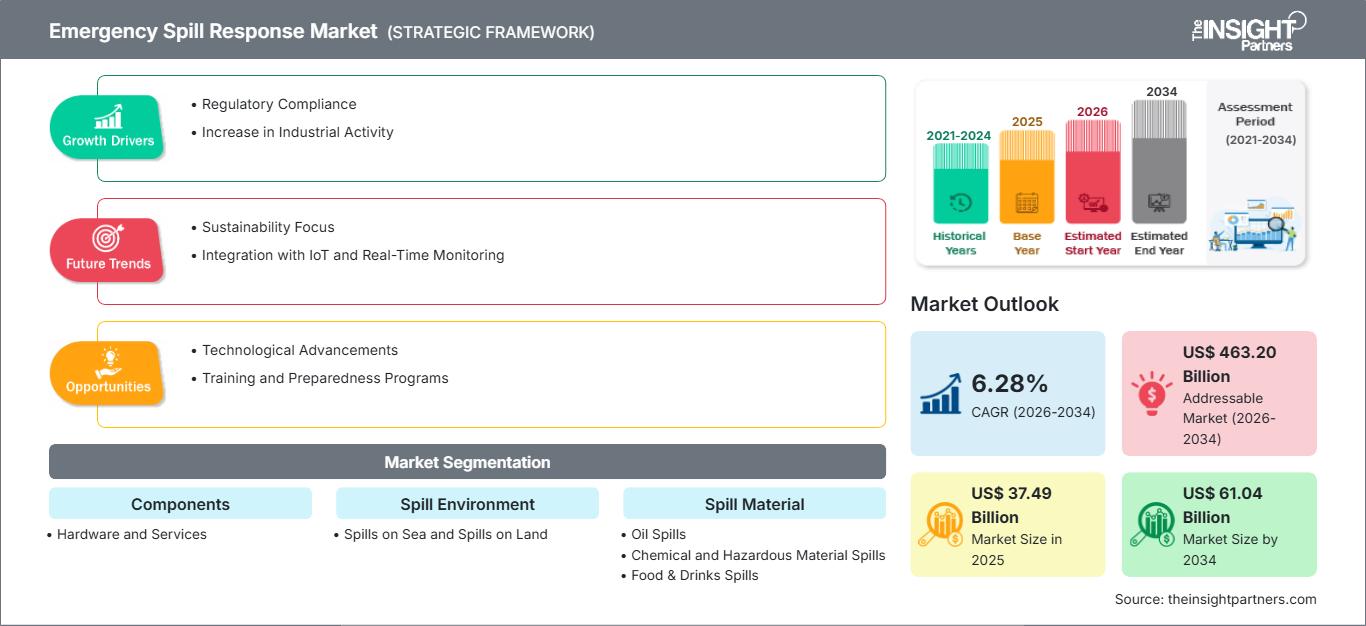
The Emergency Spill Response Market was worth US$ 37.49 Billion in 2025 and is expected to be US$ 61.04 Billion by 2034 with a CAGR of 6.68% from 2026 to 2034. This market consists of hardware and services that are deployed for spill incidents over sea and land. The types of spills include oil spills, chemical spills, hazardous material spills, food and beverages spill incidents. Users of emergency spill response include oil and gas, chemical, ports and harbors, industry, transport, and governments.
North America continues to play a strategic role in this market owing to mature environmental laws and regulations, robust oil and gas industry, chemical manufacturing industry, logistics, and emergency response capabilities. The Emergency Spill Response Market size in North America is anticipated to grow at a CAGR of 7.5–8.0% from 2026 to 2034.
Emergency Spill Response Market Assessment and Insights
- North America: North America held a 30–32% Emergency Spill Response Market share in 2025 and is projected to grow at a 7.5–8.0% CAGR between 2026–2034, supported by environmental compliance, industrial exposure, mature response infrastructure, and substantial oil and gas activity.
- US: The US represented 77–81% of North American share in 2025 and is expected to expand at a 7.8–8.2% CAGR between 2026–2034, supported by industrial preparedness and established emergency-response networks.
- Europe: Europe accounted for a 26–29% share in 2025 and is forecast to grow at a 6.7–7.2% CAGR between 2026–2034, led by Germany, the UK, France, Italy, and Spain, where environmental controls and maritime preparedness remain significant.
- Asia Pacific: Asia Pacific represented a 22–25% share in 2025 and is projected to grow at an 8.0–8.8% CAGR between 2026–2034, led by China, India, Japan, South Korea, and Australia as industrial and maritime activity expands.
- Largest Segment: Services held a 55–60% market share in 2025 and is expected to grow at a 6.9–7.5% CAGR between 2026–2034, reflecting recurring response, remediation, training, and compliance requirements.
- High Growth Segment: Oil and Gas held an 18–22% market share in 2025 and is projected to grow at an 8.0–8.8% CAGR between 2026–2034, supported by continuing spill-preparedness requirements and energy infrastructure.
- Key companies analyzed in detail: RPS Group, Veolia Environnement S.A., AMBIPAR Participações e Empreendimentos S.A., DESMI A/S, Lamor Corporation Plc, 3E, CSG, RSK Group Ltd., Biffa plc, Oil Spill Response Limited, ENVA, Polyeco S.A.
Source: The Insight Partners' analysis based on proprietary research, government publications, company annual reports, investor presentations, industry databases, and expert interviews.
Incorporation of technology has led to the move from containment-focused technology towards integration of preparedness, field operations, waste management, remediation, modeling, and incident reporting. There is increasing reliance on digital spill trajectory tools, remote sensing, connectivity and monitoring, as well as specialized response teams together with booms, skimmers, sorbents, pumps and transfer systems. There is a growing trend towards greater services due to need for preparedness, rapid deployment, waste management and remediation by customers.
Demand growth in the Emergency Spill Response Market is expected to expand into new manufacturing economies, ports, logistics routes, chemical complexes, and energy facilities. Preparedness for regulation through IMO OPRC standards and hazardous substance response standards leads to regular investments in planning, exercises, equipment stockpiling and staff training. There will also be a growing preference for response partnerships that bring together physical assets with environmental assessment, data management and remediation.
Emergency Spill Response Market Report Scope
| Report Attribute | Details |
|---|---|
| Market size in 2025 | US$ 37.49 Billion |
| Market Size by 2034 | US$ 61.04 Billion |
| Global CAGR (2026 - 2034) | 6.28% |
| Historical Data | 2021-2024 |
| Forecast period | 2026-2034 |
Emergency Spill Response Market Analysis
Factors that affect the demand for the Emergency Spill Response Market include the increase in industrial production, energy transportation, chemicals management, maritime activities, and regulatory demands related to the same. The industry consists of equipment manufacturers, emergency services providers, waste treatment firms, environmental consultants, insurance companies, port authorities, government, and industries. Increasing competition in the industry relates to being ready, the geographic presence, expertise of people, equipment, waste treatment capacity, and the capability of managing an incident until its full remediation and not only the initial containment.
The supply side of the Emergency Spill Response Market is thus becoming oriented towards service provision. The equipment plays an important role in the containment of incidents in the initial stage, however, increasing value is generated from standby arrangements, training, drills, incident command, monitoring, transportation, waste treatment, and restoration of sites. The International Maritime Organization OPRC system requires national response system, equipment inventory, drills, and coordination of assistance among others.
Emergency Spill Response Market report identifies a fragmented competitive landscape with worldwide environmental services firms, maritime-specific responders, equipment providers, and local cleanup organizations. RPS Group offers modeling and response planning, while Veolia Environnement S.A. has combined emergency response with environmental services. AMBIPAR Participações e Empreendimentos S.A. has brought in all aspects of emergency response, hazardous material handling, waste management, and remediation. DESMI A/S and Lamor Corporation Plc have included equipment and maritime-specific capabilities.
Geographic responsiveness and capability integration into the environmental services becomes key factors in strategic positioning. Oil Spill Response Limited specializes in maritime preparation, while RSK Group Ltd. adds investigative capabilities and remediation to the emergency response capabilities. ENVA and Biffa plc complement the ecosystem with waste management capabilities. Lamor Corporation Plc continues to establish its equipment operations in different regions, while Veolia's acquisition of 2025 Clean Earth demonstrates the value of hazardous waste capabilities and environmental service integration.
● REPORT CUSTOMIZATION
Tailor This Report To Align With Your Specific Business Requirements
This report can be customized to align precisely with your business objectives, scope, and target markets. Customization options include tailored segmentation, geography, competitive analysis, and strategic insights to support informed decision-making.
Customize This Report →WHAT YOU CAN ADJUST
- ● Segmentations
- ● Geography
- ● Competitive Analysis
- ● Language Preferences
Emergency Spill Response Market: Strategic Insights
Regional Insights
North America Emergency Spill Response Market
The North American region was expected to account for 30-32% in 2025 and is forecast to witness a 7.5-8.0% CAGR from 2026 to 2034. This regional market is helped by strict environmental requirements, industrial infrastructure development, advanced emergency response setup, and oil and gas activities. The United States is considered the main market owing to its chemical industry, pipelines, refineries, ports, transport and well-established environmental services providers.
Oil sands, mining, maritime activities, industrial transport in Canada and energy infrastructure, ports, manufacturing in Mexico increase demand in this market segment. Preparedness procurement increasingly relies on integrated readiness – equipment, training, incident command, waste transport and remediation. Regulations encourage the use of providers who can deploy quickly and provide documented procedures, while repeat preparedness contracts limit dependency on incident-based revenues. The IMO structure aids response planning in marine operations.
U.S. Emergency Spill Response Market Market
The US is responsible for 77–81% of the North American market share in 2025 and is forecasted to register a CAGR of 7.8–8.2% between 2026 and 2034. The market will profit from vast petroleum, chemical, transportation, manufacturing, and marine infrastructure, coupled with regulatory preparedness to drive recurring demand.
RPS Group, Veolia Environnement S.A., AMBIPAR Participações e Empreendimentos S.A., among other vendors offer their services for industry and environment purposes, including response planning, hazardous material handling, clean-up, waste management, and remediation. Changing demands involve programs combining preparedness and quick field responses. The oil and gas industry is a high growth end-user segment, while chemicals plants and transportation industries require more formalized emergency plans.
Europe Emergency Spill Response Market
Europe represented a 26–29% share in 2025 and is projected to grow at a 6.7–7.2% CAGR during 2026–2034. Germany is a leading national market, while the UK, France, Italy, and Spain contribute through industrial production, ports, chemicals, transportation, energy, and environmental services.
While the UK boasts robust maritime assets along with proven responders and remediation companies, Germany enjoys the advantage of chemicals, industry, logistics, and port-related activity. French interests feature energy, industry, and maritime risk, while Italy and Spain create demand through port activity, refining, transport, tourism, and industrial facilities. Preparedness, waste tracking, quick deployment, and proper remediation are gaining importance with European purchasers. Key regional competitors include RPS Group, Veolia Environnement S.A., DESMI A/S, RSK Group Ltd., Biffa plc, ENVA, and Polyeco S.A.
APAC Emergency Spill Response Market
APAC held a 22–25% share in 2025 and is forecast to grow at an 8.0–8.8% CAGR during 2026–2034, making it the fastest-growing major region. China leads regional demand, followed by India, Japan, South Korea, and Australia.
China's manufacturing and port infrastructure, India's expanding industrial and maritime assets, Japan and South Korea's advanced manufacturing bases, and Australia's resource sector support demand. Government preparedness, port modernization, chemical production, and offshore energy activity are broadening response requirements. Oil and gas is among the faster-growing end users, while marine response equipment is gaining importance across strategically significant coastal locations.
Middle East & Africa Emergency Spill Response Market Market
The Middle East and Africa market is projected to grow at a 5.8–6.4% CAGR during 2026–2034. Saudi Arabia and the UAE are key demand centers because of energy infrastructure, petrochemicals, ports, and industrial diversification, while South Africa contributes through mining, manufacturing, and maritime activity.
The Rest of MEA remains more project-driven, with demand concentrated around oil and gas, ports, transportation, industrial facilities, and government preparedness. Marine response is particularly important along major energy and shipping corridors. Procurement increasingly favors portable containment assets, trained response teams, waste-management capabilities, and regional service coverage because infrastructure maturity varies substantially between countries.
Segmentation Analysis
Components
Components is projected to grow at a 6.9–7.5% CAGR during 2026–2034. Services remain dominant because response planning, emergency mobilization, cleanup, waste handling, training, and remediation are recurring requirements. Hardware remains essential for containment and recovery, particularly where operators maintain dedicated response inventories.
- Hardware: Includes containment, recovery, transfer, absorbent, communication, and related response equipment. Demand is strongest where ports, industrial facilities, and energy operators require rapid deployment assets available close to incident locations.
- Services: Covers emergency mobilization, cleanup, waste management, training, assessment, monitoring, and remediation. Recurring preparedness agreements make services strategically important for customers seeking predictable response capability.
Spill Environment
Spill Environment is expected to expand at a 6.8–7.5% CAGR during 2026–2034. Marine and terrestrial incidents require different containment strategies, logistics, equipment, and regulatory coordination. Coastal industrialization and shipping activity increase the strategic importance of marine preparedness, while land incidents remain widespread across transportation and industrial sites.
- Spills on Sea: Require booms, skimmers, storage, vessel support, surveillance, and specialized marine personnel. Ports, offshore facilities, and shipping corridors create sustained preparedness requirements.
- Spills on Land: Demand rapid containment, drainage protection, excavation, waste removal, decontamination, and site restoration. Transportation, manufacturing, chemical storage, and fuel facilities remain key applications.
Spill Material
Spill Material is forecast to grow at a 6.4–7.1% CAGR during 2026–2034. Oil remains a major demand source, while chemical and hazardous-material incidents require specialized containment and decontamination. Food and drinks spills represent a narrower application base but still require rapid hygiene-focused intervention in logistics and industrial environments.
- Oil Spills: Remain strategically important because petroleum releases can affect water, soil, infrastructure, and sensitive ecosystems, requiring containment, recovery, disposal, monitoring, and remediation.
- Chemical and Hazardous Material Spills: Require substance-specific risk assessment, protective equipment, containment, neutralization, decontamination, and compliant waste handling, making specialized expertise essential.
- Food & Drinks Spills: Primarily involve hygiene, contamination control, drainage protection, and safe cleanup across food-processing, warehousing, hospitality, and transportation facilities.
End User
End User is projected to grow at a 6.7–7.4% CAGR during 2026–2034. Oil and gas and chemical operators have high consequence exposure, while ports, industrial facilities, transportation companies, and governments require preparedness aligned with local risk profiles. The Emergency Spill Response Market scope therefore extends from private industrial contracts to public contingency systems.
- Oil and Gas: Requires response planning, equipment stockpiles, marine and land containment, contractor readiness, and remediation across production, storage, refining, and transportation assets.
- Chemical: Needs substance-specific emergency planning, hazardous-material response, containment, decontamination, waste treatment, and regulatory documentation.
- Ports and Harbors: Depend on marine containment equipment, trained responders, surveillance, vessel coordination, and contingency planning for petroleum and hazardous cargo incidents.
- Industrial Facilities: Require site-specific response plans covering storage, production, drainage, fire protection, contamination control, and waste removal.
- Transportation: Road, rail, aviation, and logistics operators need mobile response capabilities that can address incidents away from fixed industrial facilities.
- Government: Public agencies procure equipment, training, exercises, stockpiles, coordination systems, and contracted response capacity to support national or regional preparedness.
Opportunity Snapshot
| End User | Revenue Contribution (High/Medium/Low) | Trend Tag | Adoption Stage |
| Oil and Gas | High | Marine Readiness | Mature |
| Chemical | High | Hazmat Preparedness | Mature |
| Ports and Harbors | High | Port Response | Scaling |
| Industrial Facilities | Medium | Site Preparedness | Scaling |
| Transportation | Medium | Mobile Response | Scaling |
| Government | Medium | Contingency Planning | Mature |
Emergency Spill Response Market Growth Drivers and Impact Analysis
Stricter Preparedness and Environmental Compliance Requirements
Environmental regulation is converting spill preparedness from a discretionary safety activity into an operational requirement. The IMO OPRC system obliges participating governments to ensure mechanisms are in place for dealing with pollution incidents, while ship and offshore structures need emergency plans. There will be additional national regulations creating more obligations in relation to industrial establishments, transport services, and energy assets. Such a structure implies regular expenses for equipment, training, exercises, contracts, documentation, and planning. For businesses, it is especially relevant when they are working in several countries at once, since standardization of response procedures helps to minimize compliance issues and makes contractors' management easier.
Expansion of Industrial and Maritime Risk Exposure
Industrial expansion is increasing the number of locations where hazardous substances are stored, processed, transported, and transferred. Chemical plants, refineries, terminals, ports, warehouses, and logistical routes offer multiple release sources, whereas increasing maritime transport activity raises the significance of being prepared for incidents along coastlines. The impact on the suppliers will be two-fold. On the one hand, new facilities necessitate equipment, preparation, training, and contractor certification. On the other hand, existing facilities require periodic inspection, drills, new equipment, and remediation services. Therefore, emerging markets provide an opportunity for service provision even if incident rates cannot be predicted. Regional presence and mobility of suppliers allow servicing the companies, which cannot afford to have their own preparedness capability internally.
Integration of Response, Waste Management, and Remediation
Customers increasingly prefer a single accountable provider capable of managing the full incident lifecycle. Initial containment is only one stage, followed by contaminated-material characterization, transportation, treatment, disposal, environmental assessment, restoration, and regulatory reporting. Integrating these functions can reduce handoffs, shorten response timelines, and improve documentation. It also changes competitive economics because providers with licensed waste facilities, specialist vehicles, trained personnel, and remediation expertise can capture recurring value after the immediate emergency ends. Veolia Environnement S.A., ENVA, Biffa plc, and RSK Group Ltd. illustrate the relevance of combining emergency intervention with broader environmental or waste capabilities. This integrated model can be especially valuable for industrial customers seeking predictable contractual arrangements rather than multiple incident-specific suppliers.
Emergency Spill Response Market Future Trends
Real-Time Monitoring and Predictive Incident Management
The Emergency Spill Response Market trends are moving toward continuous monitoring, digital mapping, predictive modeling, and connected response coordination. Sensors, satellite observations, drifting buoys, geospatial platforms, and trajectory models can provide earlier indications of contamination and improve decisions about where personnel and equipment should be deployed. RPS already uses environmental data services and spill-modeling platforms to support response planning and operational decision-making. Over time, these technologies should become more closely connected to incident command systems, allowing responders to update forecasts as weather, currents, terrain, and spill characteristics change. The strategic value will extend beyond faster cleanup because predictive information can improve resource allocation, reduce unnecessary deployment, and support more defensible environmental-impact assessments.
Lower-Impact Materials and More Sustainable Remediation
Future solutions are likely to place greater emphasis on minimizing secondary environmental impacts during containment and cleanup. Operators are evaluating biodegradable absorbents, lower-toxicity treatment approaches, material recovery, waste minimization, and remediation methods that reduce unnecessary excavation or disposal. Sustainability criteria can increasingly influence procurement alongside response speed and containment performance, particularly for ports, energy companies, food producers, and public agencies. Equipment suppliers may respond with reusable containment systems, improved recovery efficiency, and materials designed for controlled disposal. Service providers can differentiate through waste segregation, recovery, treatment, and documented environmental outcomes. The trend also aligns with broader corporate environmental objectives, making spill response increasingly relevant to sustainability teams rather than remaining solely within emergency management or operational departments.
Emergency Spill Response Market Opportunities
Integrated Preparedness Contracts for Industrial Customers
The Emergency Spill Response Market Forecasts indicate an opportunity to package preparedness, training, equipment inspection, emergency mobilization, waste management, and remediation into multi-year service agreements. Such contracts can provide industrial customers with predictable response capacity while reducing the need to maintain large internal specialist teams. Providers can use regional depots and shared equipment pools to improve asset utilization across multiple customers. Contract structures may include defined response times, annual exercises, equipment audits, documentation support, and post-incident remediation provisions. The model is particularly suitable for chemical manufacturers, refineries, logistics companies, ports, and large industrial estates where the financial consequences of delayed response can exceed the cost of preparedness. Integrated agreements also strengthen customer retention because response readiness becomes embedded within operating procedures.
Regional Response Hubs Across Emerging Maritime Corridors
Emerging ports, energy corridors, industrial clusters, and coastal manufacturing zones create opportunities for strategically located response hubs. Investment can focus on containment equipment, skimmers, storage systems, mobile treatment resources, trained personnel, and digital coordination capabilities positioned near high-risk areas. India, Southeast Asia, the Middle East, and selected African coastal markets offer potential where industrial and maritime infrastructure is expanding faster than specialized response capacity. Local partnerships can reduce mobilization times while improving knowledge of environmental conditions, regulations, and port procedures. Suppliers can also establish training centers and equipment-maintenance operations alongside response bases, creating recurring revenue beyond incident deployment. The approach provides a scalable route into markets where customers need professional capability but may not justify dedicated internal response infrastructure.
Recent Developments
- August 2026: Clean Harbors entered into a definitive agreement to acquire EnviroServe for US$470 million in cash, expanding its environmental and waste-management footprint through EnviroServe’s 40-location network and permitted operations across 48 states. The transaction is expected to generate approximately US$25 million in cost synergies over two years and strengthen waste processing, recycling, emergency response, industrial cleaning, and rail-service capabilities.
- May 2026: The Government of India launched an indigenous Cell Broadcast System to provide instant disaster alerts to mobile users. Developed under the guidance of the Ministry of Home Affairs and Ministry of Communications, the system enables authorities to disseminate geographically targeted emergency warnings directly to mobile handsets, supporting faster public communication during disasters and strengthening India's nationwide emergency-alert infrastructure.
Frequently Asked Questions

- Comprehensive Market Sizing and Forecast Analysis
- Detailed Segmentation Analysis
- In-Depth Market Dynamics Assessment
- Regional and Country-Level Insights
- Competitive Landscape and Company Benchmarking
- Strategic Business Intelligence
Recent Reports
Testimonials

The Insight Partners' SCADA System Market report is comprehensive, with valuable insights on current trends and future forecasts. The team was highly professional, responsive, and supportive throughout. We are very satisfied and highly recommend their services.
RAN KEDEM Partner, Reali Technologies LTDs
I requested a report on a very specific software market and the team produced the report in a few days. The information was very relevant and well presented. I then requested some changes and additions to the report. The team was again very responsive and I got the final report in less than a week.
JEAN-HERVE JENN Chairman, Future Analytica
We worked with The Insight Partners for an important market study and forecast. They gave us clear insights into opportunities and risks, which helped shape our plans. Their research was easy to use and based on solid data. It helped us make smart, confident decisions. We highly recommend them.
PIYUSH NAGPAL Sr. Vice President, High Beam Global
The Insight Partners delivered insightful, well-structured market research with strong domain expertise. Their team was professional and responsive throughout. The user-friendly website made accessing industry reports seamless. We highly recommend them for reliable, high-quality research services
YUKIHIKO ADACHI CEO, Deep Blue, LLC.
This is the first time I have purchased a market report from The Insight Partners.While I was unsure at first, I visited their web site and felt more comfortable to take the risk and purchase a market report.I am completely satisfied with the quality of the report and customer service. I had several questions and comments with the initial report, but after a couple of dialogs over email with their analyst I believe I have a report that I can use as input to our strategic planning process.Thank you so much for taking the extra time and making this a positive experience.I will definitely recommend your service to others and you will be my first call when we need further market data.
JOHN SUZUKI President and Chief Executive Officer, Board Director, BK Technologies
I wish to appreciate your support and the professionalism you displayed in the course of attending to my request for information regarding to infectious disease IVD market in Nigeria. I appreciate your patience, your guidance, and the fact that you were willing to offer a discount, which eventually made it possible for us to close a deal. I look forward to engaging The Insight Partners in the future, all thanks to the impression you have created in me as a result of this first encounter.
DR CHIJIOKE ONYIA MANAGING DIRECTOR, PineCrest Healthcare Ltd.Reason to Buy
- Informed Decision-Making
- Understanding Market Dynamics
- Competitive Analysis
- Identifying Emerging Markets
- Customer Insights
- Market Forecasts
- Risk Mitigation
- Boosting Operational Efficiency
- Strategic Planning
- Investment Justification
- Tracking Industry Innovations
- Aligning with Regulatory Trends





 Get Free Sample for