
Energy Harvesting System for Wireless Sensor Network Market Size, Growth & Demand by 2034
Energy Harvesting System for Wireless Sensor Network Market Size and Forecasts (2021–2034), Global and Regional Share, Trends, and Growth Opportunity Analysis Report Coverage : By Sensors (Temperature Sensors, Pressure Sensors, Flow Sensors, Level Sensors, Humidity Sensors, Motion & IR Sensors, Position Sensors, & Gas Sensors), Primary Batteries (Lithium Batteries, Alkaline Batteries, Others), Application (Building and Home Automation, Industrial, Aerospace, Automotive, Railways, Transportation Infrastructure, Security, and Others)
- Status : Data Released
- Report Code : TIPRE00039832
- Category : Electronics and Semiconductor
- No. of Pages : 150
- Available Report Formats :


- Last update date : August 18, 2026


2025 Market Size
US$ 497.8 Mn
Base year value
2034 Forecast
US$ 869.5 Mn
Projected by 2034
CAGR 2026-2034
6.39 %
Growth rate
Addressable Market
US$ 6,185.02 Mn
(2026-2034)
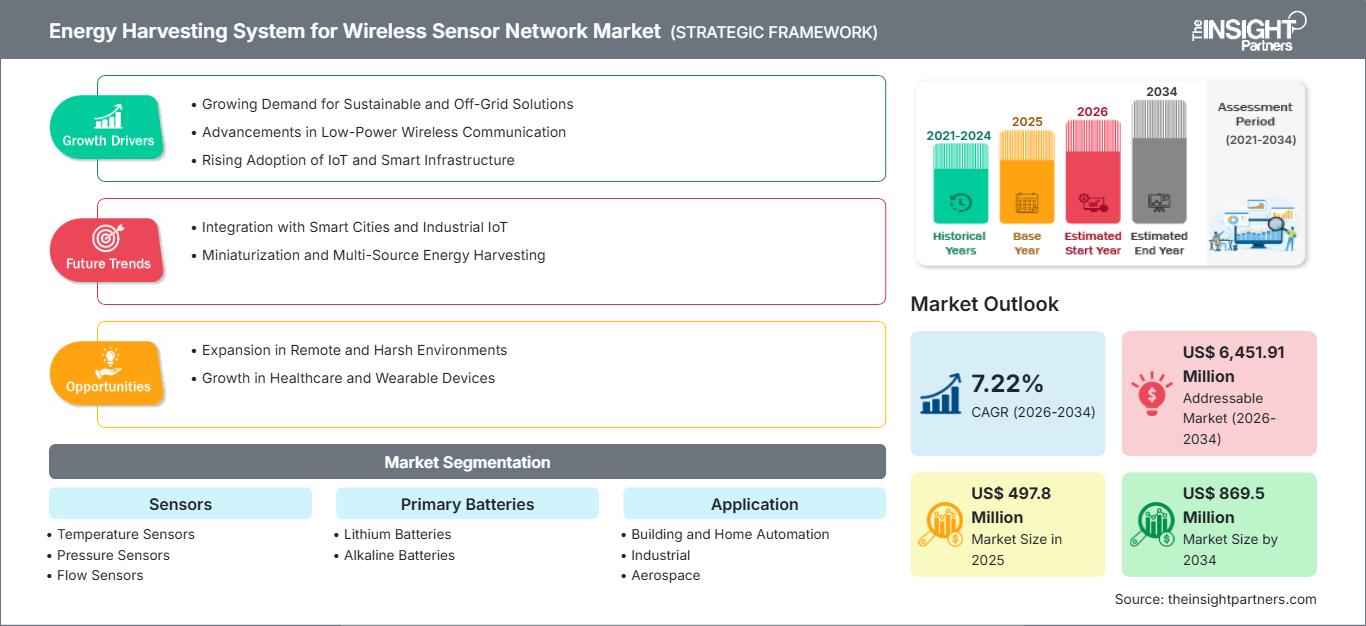
The Energy Harvesting System for Wireless Sensor Network market was valued at US$ 497.8 million in 2025 and is expected to reach US$ 869.5 million by 2034; it is estimated to record a CAGR of 6.39% during 2026-2034.
Energy Harvesting System for Wireless Sensor Network Market Assessment and Insights
- North America held 34–36% share in 2025 and is forecast to grow at 6.7–7.5% CAGR during 2026–2034, supported by smart-building retrofits, industrial monitoring, and established automation integrators.
- US represented 78–82% of North American revenue in 2025 and is projected to expand at 6.8–7.6% CAGR through 2034.
- Europe accounted for 27–29% in 2025 and should register 6.9–7.7% CAGR, led by Germany, the UK, France, Italy, and Spain through building-efficiency and industrial-digitization programs.
- Asia Pacific captured 25–27% in 2025 and is forecast to grow at 8.4–9.2% CAGR, with China, Japan, South Korea, India, and Australia driving adoption.
- Largest Segment Sensors held 52–56% market share in 2025 and is projected to expand at 7.0–7.8% CAGR during 2026–2034.
- High Growth Segment Industrial held 24–28% market share in 2025 and is expected to grow at 8.2–9.0% CAGR during 2026–2034.
- Key companies analyzed in detail: ABB Ltd, Convergence Wireless, Inc., Cymbet Corporation, Infineon Technologies AG, EnOcean GmbH, Fujitsu Limited, Honeywell International Inc., Analog Devices, Inc., LORD MicroStrain Sensing Systems, Microchip Technology Inc.
Source: The Insight Partners' analysis based on proprietary research, government publications, company annual reports, investor presentations, industry databases, and expert interviews.
The power architecture of wireless sensors has developed from pure battery-based systems to hybrid systems with both ambient energy harvesting and ultra low power electronics, energy storage and adaptive duty-cycling. The manufacture of such systems has moved towards small PVs, thermoelectric generators, piezo harvesters, efficient rectification circuitry, and power management ICs. In general, the module vendors are now looking at optimizing entire energy budgets rather than individual components, making it easier to install the systems and cheaper to maintain them.
Investment between now and 2034 should move from high-end building automation controls into industrial, transportation, and infrastructure applications. This should be supported by Asian Pacific production volume, European energy efficiency standards, and North American refurbishment needs. The International Energy Agency estimated that the global energy efficiency improvements were 1.8% in 2025 and there were more than 250 new or amended policies affecting 85% of the energy demand.
Energy Harvesting System for Wireless Sensor Network Market Report Scope
| Report Attribute | Details |
|---|---|
| Market size in 2025 | US$ 497.8 Million |
| Market Size by 2034 | US$ 869.5 Million |
| Global CAGR (2026 - 2034) | 6.39% |
| Historical Data | 2021-2024 |
| Forecast period | 2026-2034 |
Energy Harvesting System for Wireless Sensor Network Market Analysis
Wireless Sensor Network Energy Harvesting System Market growth is driven by the increasing expenses involved in battery maintenance. This technology becomes unfeasible for traditional wireless network setup due to the presence of sensors in ceilings, rotating devices, bridges, railcars, or hazardous locations. Energy harvesting allows for fewer maintenance trips and greater density of the sensors, which depends on whether ambient energy is compatible with the node's sensing and communication properties.
This market consists of various players including sensor producers, semiconductor makers, energy harvesters, energy storage, module producers, protocol organizations, systems integrators, and customers. Supply chain efficiency is based on transducer effectiveness, quiescent current, cold start voltage, battery type, packaging, and firmware. More and more systems integrators apply to hybrid designs with harvested energy plus lithium or alkaline batteries.
Energy Harvesting System for Wireless Sensor Network Market Report reveals the competition to be based on reference platforms and application ecosystems. EnOcean GmbH focuses on the manufacture of self-powered building control products; Cymbet Corporation and Analog Devices, Inc., on energy storage and power management solutions; and Infineon Technologies AG and Microchip Technology Inc., on low-power connectivity, security features, microcontrollers, and analog capabilities.
ABB Ltd and Honeywell International Inc. could make use of autonomous sensing for incorporation into their product line of industrial and building controls, whereas Fujitsu Limited, Convergence Wireless Inc., and LORD MicroStrain Sensing Systems would be suitable for connectivity, harvesting, and condition monitoring respectively. Opportunities for investment include low start-up cost, multiple sources of harvesting, secure commissioning, edge computing, and availability of energy confirmation software. The competitive edge is derived from applications, channel access, interoperability, and lower maintenance costs.
● REPORT CUSTOMIZATION
Tailor This Report To Align With Your Specific Business Requirements
This report can be customized to align precisely with your business objectives, scope, and target markets. Customization options include tailored segmentation, geography, competitive analysis, and strategic insights to support informed decision-making.
Customize This Report →WHAT YOU CAN ADJUST
- ● Segmentations
- ● Geography
- ● Competitive Analysis
- ● Language Preferences
Energy Harvesting System for Wireless Sensor Network Market: Strategic Insights
Regional Insights
North America Energy Harvesting System for Wireless Sensor Network Market
North America held 34–36% of global revenue in 2025 and is expected to record 6.7–7.5% CAGR during 2026–2034. The Energy Harvesting System for Wireless Sensor Network Market share reflects mature building automation, industrial IoT investment, and high labor costs for battery replacement. Commercial offices, data centers, factories, pipelines, utilities, and transport assets provide recurring demand for low-maintenance sensing.
The trend in regional acceptance now leans more towards hybrid nodes combining the generation of power from either indoor PV, vibrations, heat or radio frequency with energy storage. Good semiconductors, controls and integration expertise reduces the time to market. Consumers value cybersecurity, device commissioning, supply chain availability and consistent savings through maintenance. The economics of wireless retrofits are especially strong in occupied spaces and hard-to-reach equipment.
U.S. Energy Harvesting System for Wireless Sensor Network Market Market
The US generated 78–82% of North American revenue in 2025 and should expand at 6.8–7.6% CAGR through 2034. Federal building modernization, advanced manufacturing, logistics automation, and infrastructure monitoring support demand. Temperature, pressure, vibration, occupancy, humidity, and position nodes are deployed where wiring costs exceed device costs or battery access is difficult.
Relevant companies such as ABB Ltd, Honeywell International Inc., Analog Devices, Inc., Microchip Technology Inc., Cymbet Corporation, Convergence Wireless Inc., and LORD MicroStrain Sensing Systems are active in this regard. The applications are increasingly focusing on areas like predictive maintenance, smart space use, bridges and rails monitoring, and secured asset tracking. Procurement is based on total cost, radio compatibility, compliance, and variable energy conditions performance.
Europe Energy Harvesting System for Wireless Sensor Network Market Market
Europe constitutes 27–29% of global revenue by 2025 and is forecasted to grow with a CAGR of 6.9–7.7%. Germany dominates due to its strong industrial automation, building control, and sensor manufacturing capabilities. The German industry and commercial buildings more often consider battery-less nodes for predictive maintenance, occupancy-based HVAC, and retrofitting lights.
The UK takes advantage of the modernization of commercial buildings and the monitoring of railways infrastructure along with the increasing connection between sensors and energy performance reporting. France, Italy, and Spain provide further growth opportunities because of their renovation projects, transportation modernizations, and smart cities initiatives. France focuses on building control, Italy has its strengths in manufacturing and heritage buildings' modernizations, and Spain leverages the solar power source and digitization of the infrastructure.
APAC Energy Harvesting System for Wireless Sensor Network Market Market
Asia Pacific contributed 25–27% in 2025 and is expected to achieve 8.4–9.2% CAGR, the highest regional growth rate. China takes the lead through electronics manufacturing, factory automation, and massive infrastructure projects, while Japan and South Korea provide advanced sensors, semiconductor technology, and railway solutions.
In India, the scalability factor comes from digitalizing industries and transportation, whereas in Australia, mining and utilities, as well as asset monitoring, form the main focus areas. The use of incentives for manufacturers, smart building codes, and development of IoT ecosystems will ensure cost reductions in implementing technologies.
Middle East & Africa Energy Harvesting System for Wireless Sensor Network Market Market
Middle East and Africa should grow at 6.2–7.0% CAGR through 2034. Saudi Arabia leads as smart-city, industrial, and transport projects create demand for autonomous sensing. The UAE follows through high-specification buildings, airports, logistics, and utilities.
Mining and industrial processes take place in South Africa while the Rest of MEA is selective owing to variations in terms of connectivity, procurement capacity, and technical expertise. Solar radiation is high thus PV generation is appropriate but environmental conditions make packaging and energy storage durable.
Segmentation Analysis
Sensors
Sensors are projected to register 7.0–7.8% CAGR during 2026–2034. The Energy Harvesting System for Wireless Sensor Network Market scope spans environmental, process, occupancy, motion, and safety measurements. Adoption rises when low-duty-cycle sensing and efficient radios fit available light, heat, vibration, or radio-frequency energy. Sensor calibration, startup power, sampling frequency, and event-triggered transmission determine whether a node can operate autonomously or requires backup storage.
- Temperature Sensors hold broad demand across HVAC, industrial equipment, cold chains, and rail assets, where low sampling power and clear maintenance value support autonomous deployment.
- Pressure Sensors serve process equipment, pipelines, pneumatics, and vehicles; their strategic importance increases when difficult access makes battery replacement costly and predictive alerts valuable.
- Flow Sensors support water, gas, and industrial fluid management, with demand strongest where harvested power can sustain periodic measurements and low-data-rate transmission.
- Level Sensors address tanks, bins, wastewater, and storage infrastructure, enabling remote inventory or overflow monitoring without extensive cabling across distributed sites.
- Humidity Sensors are important in buildings, warehouses, agriculture, and electronics environments, where compact sensing supports comfort, quality control, condensation prevention, and energy optimization.
- Motion & IR Sensors occupy a central position in occupancy-based lighting, HVAC, and security because intermittent detection aligns well with self-powered wireless operation.
- Position Sensors support doors, windows, machinery, valves, and transport assets, providing event-driven status data with limited energy consumption and straightforward retrofit economics.
- Gas Sensors deliver high strategic value in safety and environmental monitoring, although heater requirements and continuous sampling can demand larger harvesters or hybrid storage.
Primary Batteries
Primary batteries are expected to expand at 5.8–6.6% CAGR during 2026–2034. They remain integral to hybrid systems by bridging periods when ambient energy is unavailable or insufficient. Selection depends on shelf life, pulse-current capability, temperature tolerance, form factor, leakage, and disposal requirements. Harvesting can extend replacement intervals, allowing designers to reduce battery size while maintaining service continuity.
- Lithium Batteries lead demanding deployments through high energy density, long shelf life, and broad temperature capability, making them suitable for industrial, aerospace, automotive, and infrastructure nodes.
- Alkaline Batteries retain cost-sensitive building and security applications where replacement access is manageable, operating temperatures are moderate, and standardized formats simplify procurement.
Application
Application revenue is forecast to grow at 8.2–9.0% CAGR during 2026–2034. Building automation provides established retrofit economics, while industrial applications offer the highest-growth opportunity through condition monitoring. Mobility and infrastructure use cases prioritize ruggedness, long life, and safety. Each deployment requires matching the energy source, sensor workload, radio protocol, and backup capacity to a defined operating environment.
- Building and Home Automation remains a major adoption area for occupancy, lighting, HVAC, windows, and indoor-air monitoring, where wireless retrofits avoid disruptive cabling and repeated battery labor.
- Industrial is the high-growth segment as factories deploy vibration, temperature, pressure, flow, and position sensing on distributed or moving assets for predictive maintenance.
- Aerospace values weight reduction, wiring avoidance, and structural monitoring, but qualification cycles, extreme environments, and safety requirements create a selective, high-value demand profile.
- Automotive uses autonomous sensing for tires, cabins, components, and condition monitoring, with adoption governed by temperature tolerance, compactness, electromagnetic compatibility, and lifecycle reliability.
- Railways apply wireless nodes to tracks, bearings, doors, bridges, and rolling stock, where vibration harvesting and reduced inspection visits offer compelling maintenance economics.
- Transportation Infrastructure covers bridges, roads, ports, airports, and tunnels, supporting structural health, traffic, environment, and asset monitoring across geographically dispersed installations.
- Security benefits from self-powered door, window, motion, gas, and perimeter sensors that remain deployable where wiring is impractical and routine battery service is undesirable.
Opportunity Snapshot
| Application | Revenue Contribution | Trend Tag | Adoption Stage |
| Building and Home Automation | High | Batteryless Retrofit | Mature |
| Industrial | High | Predictive Sensing | Scaling |
| Aerospace | Medium | Structural Health | Emerging |
| Automotive | Medium | Embedded Monitoring | Scaling |
| Railways | Medium | Vibration Power | Scaling |
| Transportation Infrastructure | Medium | Remote Assets | Scaling |
| Security | Medium | Self-Powered Access | Mature |
Energy Harvesting System for Wireless Sensor Network Market Forecasts indicate that industrial monitoring offers the strongest expansion through high-value downtime avoidance, while building automation provides mature retrofit volume. Railways and transportation infrastructure present attractive service economies where inspection access is difficult. Aerospace remains selective but valuable, and automotive growth depends on integration with existing electronic architectures and qualification standards.
Energy Harvesting System for Wireless Sensor Network Market Growth Drivers and Impact Analysis
Rising Cost of Battery Maintenance in Distributed Networks
Battery replacement is often the largest lifecycle expense once wireless sensors are dispersed across ceilings, machines, bridges, rail cars, pipelines, or secured sites. Labor, access equipment, shutdowns, documentation, and disposal can exceed the purchase price of individual nodes. Energy harvesting changes the economic threshold by extending replacement intervals or eliminating batteries where duty cycles are low. The impact is strongest in applications with hundreds or thousands of endpoints and predictable ambient light, heat, vibration, or radio-frequency energy. Vendors that quantify avoided service visits can shorten procurement cycles. However, credible savings require realistic energy budgets, storage degradation assumptions, and commissioning tools that verify source availability after installation.
Expansion of Industrial IoT and Predictive Maintenance
Manufacturers are adding sensors to motors, pumps, conveyors, bearings, valves, and process equipment to detect deterioration before failure. Wiring every measurement point is costly, while battery-only nodes create recurring service obligations. Harvesting from vibration, thermal gradients, or indoor light supports condition-monitoring networks with limited infrastructure changes. Commercial impact extends beyond hardware because analytics, alarms, gateways, and maintenance software create recurring value. Adoption accelerates when sensed variables connect directly to work orders, spare-parts planning, or production scheduling. Suppliers must demonstrate reliable operation across machine states, including idle periods when harvested energy declines. Hybrid storage and adaptive transmission therefore become essential for industrial-grade service continuity.
Building Efficiency Rules and Retrofit Digitization
Building owners need granular occupancy, temperature, humidity, air-quality, window, and lighting data to reduce energy use and document performance. Wireless sensors avoid opening walls or interrupting tenants, while self-powered devices reduce maintenance across large portfolios. The International Energy Agency’s 2025 efficiency assessment identified more than 250 new or updated policies in economies representing 85% of global energy demand, strengthening the policy context for data-driven controls. Market impact is concentrated in commercial retrofits, where existing structures will remain operational for decades. Interoperable switches and sensors can connect with HVAC and lighting platforms, but installers require secure commissioning, predictable radio range, and simple replacement procedures.
Energy Harvesting System for Wireless Sensor Network Market Future Trends
Multi-Source Harvesting with Energy-Aware Edge Intelligence
Energy Harvesting System for Wireless Sensor Network Market trends will move toward nodes that combine light, thermal, vibration, and radio-frequency inputs instead of relying on one source. Firmware will predict available energy, adjust sensing frequency, compress data, and defer noncritical transmissions. Edge models will run only when storage thresholds permit, preserving service during weak ambient conditions. This architecture improves reliability across changing seasons, occupancy patterns, and machine states. Development priorities will include ultra-low-leakage storage, efficient cold starts, miniature conversion circuits, and standardized telemetry that reports energy health alongside sensor data. Buyers will increasingly evaluate energy resilience as a measurable system attribute.
Ambient IoT Standards and Batteryless Asset Networks
Batteryless connectivity will expand from building controls toward product-level and asset-level sensing as Bluetooth, Wi-Fi, cellular, and proprietary ecosystems improve interoperability. The Ambient IoT Alliance formed in 2025 with participants including Infineon Technologies AG to coordinate open, multi-standard approaches for energy-harvesting devices. Future networks may use backscatter, wake-up radios, or intermittent active transmission to identify location, temperature, condition, or handling events. Commercial adoption will depend on low-cost tags, secure identity, reader coverage, and cloud integration. Supply-chain and logistics users offer scale, but standardized commissioning and data ownership models must mature before deployments become broadly repeatable.
Energy Harvesting System for Wireless Sensor Network Market Opportunities
Retrofit Packages for Existing Commercial Buildings
Solution providers can package self-powered occupancy, temperature, humidity, window, and light sensors with gateways, controls, analytics, and installation services. Existing buildings offer a large addressable base because many will remain operational through 2050 and cannot justify disruptive rewiring. The investable opportunity lies in repeatable room-level kits with secure commissioning, interoperable protocols, and auditable energy savings. Partners should target offices, schools, hospitals, hotels, and retail portfolios where battery labor scales rapidly. Energy Harvesting System for Wireless Sensor Network Market Forecast participants can improve conversion by financing installations through shared savings or performance contracts and by integrating sensor outputs with established building-management platforms.
Rugged Autonomous Monitoring for Rail and Industry
Rail operators, manufacturers, miners, and infrastructure owners need measurement at assets that are remote, moving, exposed, or costly to access. Investors can support rugged modules combining vibration or thermal harvesting, long-life storage, condition sensors, and low-power radios. Commercial teams should prioritize bearings, motors, pumps, bridges, track equipment, rotating machinery, and pipelines where avoided inspections or downtime provide measurable returns. Demonstration projects must document energy availability across operating states, false-alarm rates, and service savings. Partnerships with maintenance software providers and systems integrators can turn component sales into multi-year monitoring programs, creating defensible recurring revenue and application-specific datasets.
Recent Developments
- July 2026: ByteSnap Design has introduced a new engineering blueprint, "Energy Harvesting: The Key to Maintenance-Free Industrial IoT, aimed at helping hardware developers overcome one of the biggest challenges in Industrial IoT (IIoT) deployments—battery maintenance. The guide addresses rising maintenance costs and stricter environmental regulations by outlining practical strategies for designing self-powered industrial devices.
- April 2025: Asahi Kasei Microdevices (AKM) has developed the AP4413, a new series of ultra-low current power management ICs (PMICs) ideal for battery charging systems used in energy harvesting¹ applications. The AP4413 series enables efficient battery charging while consuming an extremely low current of 52 nA and features four variants with voltage threshold characteristics matching several common rechargeable battery types. The AP4413 comes in a tiny 3.0 × 3.0 × 0.37 mm HXQFN package and has been in mass production since February of 2025.
- January 2025: Researchers at the Seoul National University of Science and Technology (SEOULTECH) have developed an innovative design for electromagnetic induction-based vibration energy harvesters that significantly improves power generation while maintaining a compact form factor. The breakthrough could accelerate the development of self-powered electronic devices, reducing dependence on conventional batteries.
Frequently Asked Questions

- Comprehensive Market Sizing and Forecast Analysis
- Detailed Segmentation Analysis
- In-Depth Market Dynamics Assessment
- Regional and Country-Level Insights
- Competitive Landscape and Company Benchmarking
- Strategic Business Intelligence
Recent Reports
Testimonials

The Insight Partners provided valuable market intelligence that supported our global go-to-market strategy. Their team was professional, responsive, and attentive to our feedback, providing thoughtful analysis and helpful methodological clarifications throughout the project.
Junmo Kim Chief Financial Officer (CFO), Enertech Co., Ltd.
The Insight Partners' SCADA System Market report is comprehensive, with valuable insights on current trends and future forecasts. The team was highly professional, responsive, and supportive throughout. We are very satisfied and highly recommend their services.
RAN KEDEM Partner, Reali Technologies LTDs
I requested a report on a very specific software market and the team produced the report in a few days. The information was very relevant and well presented. I then requested some changes and additions to the report. The team was again very responsive and I got the final report in less than a week.
JEAN-HERVE JENN Chairman, Future Analytica
We worked with The Insight Partners for an important market study and forecast. They gave us clear insights into opportunities and risks, which helped shape our plans. Their research was easy to use and based on solid data. It helped us make smart, confident decisions. We highly recommend them.
PIYUSH NAGPAL Sr. Vice President, High Beam Global
The Insight Partners delivered insightful, well-structured market research with strong domain expertise. Their team was professional and responsive throughout. The user-friendly website made accessing industry reports seamless. We highly recommend them for reliable, high-quality research services
YUKIHIKO ADACHI CEO, Deep Blue, LLC.
This is the first time I have purchased a market report from The Insight Partners.While I was unsure at first, I visited their web site and felt more comfortable to take the risk and purchase a market report.I am completely satisfied with the quality of the report and customer service. I had several questions and comments with the initial report, but after a couple of dialogs over email with their analyst I believe I have a report that I can use as input to our strategic planning process.Thank you so much for taking the extra time and making this a positive experience.I will definitely recommend your service to others and you will be my first call when we need further market data.
JOHN SUZUKI President and Chief Executive Officer, Board Director, BK Technologies
I wish to appreciate your support and the professionalism you displayed in the course of attending to my request for information regarding to infectious disease IVD market in Nigeria. I appreciate your patience, your guidance, and the fact that you were willing to offer a discount, which eventually made it possible for us to close a deal. I look forward to engaging The Insight Partners in the future, all thanks to the impression you have created in me as a result of this first encounter.
DR CHIJIOKE ONYIA MANAGING DIRECTOR, PineCrest Healthcare Ltd.Reason to Buy
- Informed Decision-Making
- Understanding Market Dynamics
- Competitive Analysis
- Identifying Emerging Markets
- Customer Insights
- Market Forecasts
- Risk Mitigation
- Boosting Operational Efficiency
- Strategic Planning
- Investment Justification
- Tracking Industry Innovations
- Aligning with Regulatory Trends





 Get Free Sample for