
Enterprise Networking Market Size, Share & Growth by 2034
Coverage: by Product (Ethernet Switches, Routers, WLAN, and Network Security); Deployment Type (On-Premise and Cloud); and Application (BFSI, Healthcare, IT & Telecom, Manufacturing, Retail, Government & Public Sector, and Energy & Utility), and Geography (North America, Europe, Asia Pacific, and South and Central America)
- Status : Data Released
- Report Code : TIPRE00002959
- Category : Electronics and Semiconductor
- No. of Pages : 150
- Available Report Formats :


- Last update date : August 06, 2026


2025 Market Size
US$ 93.45 Bn
Base year value
2034 Forecast
US$ 174.06 Bn
Projected by 2034
CAGR 2026-2034
7.16 %
Growth rate
Addressable Market
US$ 1,207.50 Bn
(2026-2034)
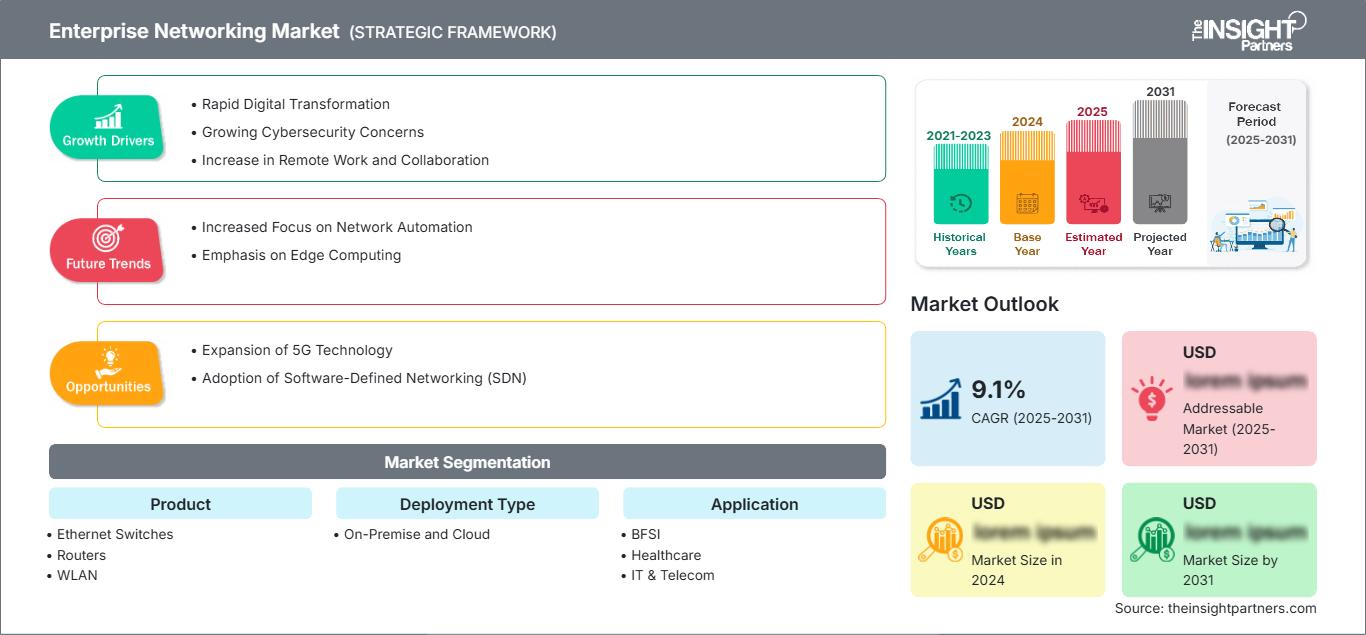
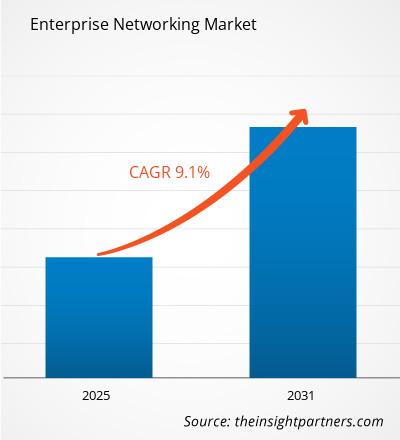
The Enterprise Networking Market size reached US$ 93.45 Billion in 2025 and will be forecast to reach US$ 174.06 Billion by 2034, growing at a CAGR of 7.16% during 2026-2034. Enterprise users are focusing on building robust switching, routing, WLAN and security networks in light of new enterprise connectivity needs arising out of hybrid work models, AI workloads, cloud connectivity, branch office modernization and zero trust policies.
North America Enterprise Networking Market is projected to grow at a CAGR of 6.1% to 6.9% during 2026-2034 driven by cloud-managed campus networking, AI-friendly data center fabric and security-driven network upgradations. North America enjoys the advantage of having well-funded enterprise IT budgets, high SaaS adoption, more data center capacity and continued shift from traditional branch networks to SD-WAN, SASE and Assurance.
Enterprise Networking Market Assessment and Insights
- North America held 31–34% share in 2025 and is growing at a CAGR of 6.1–6.9% during 2026–2034, driven by AI-ready campuses, secure cloud access, and data center modernization.
- US represented 80–84% of North American revenue in 2025 and is growing at a CAGR of 6.2–7.0% during 2026–2034, led by large enterprises and cloud operators.
- Europe accounted for 23–26% share in 2025 and is growing at a CAGR of 5.8–6.6% during 2026–2034, with Germany, the UK, France, Italy, and Spain leading regulated digital infrastructure demand.
- Asia Pacific captured 30–34% share in 2025 and is growing at a CAGR of 7.8–8.6% during 2026–2034, led by China, India, Japan, South Korea, and Australia.
- Largest Segment Ethernet Switches held 35–39% market share in 2025 and is growing at a CAGR of 6.5–7.3% during 2026–2034 because campus and data center refresh cycles require higher port speeds.
- High Growth Segment Cloud deployment represented 34–38% market share in 2025 and is growing at a CAGR of 9.0–9.8% during 2026–2034, supported by cloud-managed networking, SASE, and AIOps adoption.
- Key companies analyzed in detail: Arista Networks, Inc.; Broadcom Inc.; Check Point Software Technologies Ltd.; Cisco Systems, Inc.; Dell Technologies Inc.; Extreme Networks, Inc.; F5, Inc.; Mandiant, Inc.; Fortinet, Inc.; Hewlett Packard Enterprise Company.
Source: The Insight Partners' analysis based on proprietary research, government publications, company annual reports, investor presentations, industry databases, and expert interviews.
Enterprise networks have moved away from hardware-driven connections to policy-based, software-defined networks that unify users, apps, devices, and security. Current trends revolve around the availability of merchant silicon, optical components, Wi-Fi 7, cloud controller scaling capabilities, and secure access integration. Enterprise Networking Market is an indicator of this transition as enterprises are updating their LANs, WANs, WLANs, and data center fabrics for increased bandwidth, reduced latency, and automation.
Forward-looking demand would grow in geographic areas deploying cloud regions, smart manufacturing facilities, public services digitization, and critical infrastructure resiliency. Tailwinds from regulation on cybersecurity, data security, and business continuity are bringing network buying into the realm of board risk management. Vendors are innovating AI native assurance, zero trust integration, and open Ethernet fabric technologies to enable distributed apps and infrastructure modernization.
Enterprise Networking Market Report Scope
| Report Attribute | Details |
|---|---|
| Market size in 2025 | US$ 93.45 Billion |
| Market Size by 2034 | US$ 174.06 Billion |
| Global CAGR (2026 - 2034) | 7.16% |
| Historical Data | 2021-2024 |
| Forecast period | 2026-2034 |
Enterprise Networking Market Analysis
Enterprise Networking Market growth is fueled by hybrid work, SaaS migrations, AI workloads, IoT proliferation, and the need to secure users beyond the edge. The enterprise needs networks that provide reliable connectivity, segmentation, telemetry, and policy control throughout campus, branch, data center, and cloud operations. Network upgrades are now more frequently motivated by reliability, security, application experience, and operational simplicity.
The industry ecosystem includes silicon partners, original equipment manufacturers (OEMs), software partners, distributors, managed services providers, systems integrators, cloud providers, and enterprise IT organizations. Availability trends are a function of switch silicon roadmaps, radio availability, optical component supply, software readiness, and certification windows. Buyers today are considering platform compatibility, support life cycle, automation capabilities, and security features in advance of making long-term network architecture commitments.
Analysis of the Enterprise Networking Market indicates the shift of competition from hardware-centric solutions to an integrated approach. Cisco Systems, Inc., Hewlett Packard Enterprise Company, Arista Networks, Inc., Extreme Networks, Inc., Dell Technologies Inc., Broadcom Inc., Fortinet, Inc., Check Point Software Technologies Ltd., F5, Inc., and Mandiant, Inc. are competing based on switch portfolio, cloud orchestration, security integration, and AI assurance.
The investment focus is on 400G/800G data center fabrics, Wi-Fi 7 access, SASE solutions, SD-WAN upgrades, and intent-based management. Key factors to succeed include proven performance, ease of use, partner scope, and capability to integrate wired, wireless, routing, and security policies. Companies able to minimize tool sprawl and enable open integrations may gain bigger budgets for transformation.
● REPORT CUSTOMIZATION
Tailor This Report To Align With Your Specific Business Requirements
This report can be customized to align precisely with your business objectives, scope, and target markets. Customization options include tailored segmentation, geography, competitive analysis, and strategic insights to support informed decision-making.
Customize This Report →WHAT YOU CAN ADJUST
- ● Segmentations
- ● Geography
- ● Competitive Analysis
- ● Language Preferences
Enterprise Networking Market: Strategic Insights
Regional Insights
North America Enterprise Networking Market
In 2025, North America had 31–34% share in the Enterprise Networking Market and is expected to have a CAGR of 6.1–6.9% for 2026–2034. There will be significant demand in cloud first enterprises, data center, financial services, health care networks, universities, and government organizations that are upgrading their secure access. Enterprise Networking Market share includes WLAN, campus switch upgrade, and zero-trust network segmentation.
The Structural Drivers include investments made in AI infrastructure, heavy reliance on SaaS services, compliance requirements, and bandwidth requirements arising out of collaboration, analytics, and edge devices. Simplification of operations through SD-WAN consolidation, firewall, cloud access management, and monitoring will help in decision-making. Replacement cycles in maturity stage help sustain the region.
U.S. Enterprise Networking Market
The U.S. accounted for 80-84% of North America's revenue in 2025 and is forecasted to witness a growth rate of CAGR of 6.2-7.0% from 2026 to 2034. The U.S. is witnessing increased adoption of SD-WAN solutions in BFSI, healthcare, IT and telecom, manufacturing, retail, and public sectors where robust connectivity, auditing-ready security, and application-based performance is a must.
The companies operating in this market are Cisco Systems, Inc., Arista Networks, Inc., Hewlett Packard Enterprise Company, Fortinet, Inc., Dell Technologies Inc., and Extreme Networks, Inc. The major applications of these solutions include AI-based data center switching, cloud-based WLAN, secure branch solutions, and network security appliances. The enterprises are also leveraging automation to minimize troubleshooting time.
Europe Enterprise Networking Market
The Europe region holds 23-26% market share in 2025 and is expected to have a CAGR of 5.8-6.6% during 2026-2034. Germany emerges as the leader due to industrial automation, automotive factories, and manufacturing secure networks. The UK emerges with contributions of cloud migration, finance sector connectivity, and public sector transformation. France brings its expertise in healthcare, telecommunication, transportation, and regulated data infrastructure.
Italy and Spain add to the demand with retail, manufacturing, logistics, and smart cities initiatives. Buyers are being propelled by cyber-security regulation, data sovereignty, and digital resilience to adopt networking and security solutions. Companies like Cisco Systems, Inc., Hewlett Packard Enterprise Company, Fortinet, Inc., Check Point Software Technologies Ltd., and Extreme Networks, Inc. benefit from managed services via partnerships.
APAC Enterprise Networking Market
Share for Asia Pacific was estimated to be 30–34% in 2025 and is predicted to expand at a CAGR of 7.8–8.6% between 2026 and 2034. China dominates the market with high manufacturing, cloud region presence, and intelligent infrastructure. Japan and South Korea have high requirements for reliable enterprise-grade networks, whereas India and Australia contribute to cloud-managed campuses and security.
Drivers for growth in the region are the 5G enterprise use case, digital government, semiconductor investments, smart factories, and data localization. Customers focus on scalable WLAN and Ethernet switches with secure access to support the growing number of devices. Growth is most pronounced when companies are leapfrogging existing legacy networks.
Middle East & Africa Enterprise Networking Market
The MEA region is estimated to witness a CAGR of 6.4–7.2% for the period of 2026-2034. Key contributors to growth include Saudi Arabia's smart city and energy sectors, cloud services, and public infrastructure projects, and the UAE's financial services sector, aviation, retail, and data center interconnectivity projects. South Africa and RoMEA contribute to the mining, telecom, and government modernization needs.
Networks should be ruggedized, secure, and manageable for energy and infrastructure buyers. Branch networking, WLAN, network security, and cloud management solutions are becoming increasingly relevant as companies aim to minimize downtime and secure their critical networks. Local system integrators play an important role as projects need site surveys, configuration, and compliance with local cybersecurity laws.
Segmentation Analysis
Product
Product is projected to grow at a CAGR of 6.8–7.6% during 2026–2034. The Enterprise Networking Market scope covers connectivity, traffic control, wireless access, and security enforcement across enterprise environments. Product selection depends on throughput, latency, manageability, interoperability, compliance, and lifecycle support as buyers modernize campus, branch, data center, and cloud access architectures.
- Ethernet Switches remain the core platform for campus and data center networks, supporting higher port speeds, segmentation, power over Ethernet, and AI-ready fabric architectures.
- Routers support WAN resilience, branch connectivity, and cloud access by directing traffic across internet, private, wireless, and service provider links with policy-based control.
- WLAN demand is rising as enterprises support mobile devices, IoT endpoints, hybrid work, location services, and high-density collaboration spaces requiring reliable wireless performance.
- Network Security is strategically important as firewalls, secure access, segmentation, threat inspection, and zero-trust controls converge with networking procurement and operations.
Deployment Type
Deployment Type is forecast to grow at a CAGR of 7.2–8.0% during 2026–2034. Enterprises are balancing on-premise control with cloud-managed agility as network teams manage distributed sites, application performance, and security policy. Deployment choices depend on data sensitivity, latency, regulatory requirements, IT staffing, integration complexity, and preference for subscription-based operations.
- On-Premise deployment remains important for regulated industries, latency-sensitive operations, and organizations needing direct control over controllers, policies, logs, and critical network functions.
- Cloud deployment is expanding as enterprises adopt cloud-managed WLAN, SD-WAN, SASE, and AIOps platforms that simplify distributed operations and accelerate configuration changes.
Application
Application is expected to grow at a CAGR of 7.0–7.8% during 2026–2034. Adoption is shaped by sector-specific uptime, compliance, latency, and security requirements. BFSI, healthcare, IT and telecom, manufacturing, retail, government, and energy users are upgrading networks to support cloud applications, connected devices, protected transactions, and data-driven operations.
- BFSI requires secure, low-latency networks for branches, trading systems, digital banking, fraud analytics, and compliance reporting across distributed customer and employee environments.
- Healthcare demand is driven by connected medical devices, telehealth, imaging, electronic records, and protected data flows requiring resilient WLAN and segmented network security.
- IT & Telecom users need scalable switching, routing, and security platforms for cloud services, network operations, enterprise hosting, and high-availability customer infrastructure.
- Manufacturing depends on deterministic connectivity, industrial IoT, plant segmentation, remote monitoring, and secure links between operational technology and enterprise systems.
- Retail adoption is supported by omnichannel stores, payment systems, inventory visibility, digital signage, customer Wi-Fi, and secure connectivity across distributed branch estates.
- Government & Public Sector projects prioritize secure citizen services, smart infrastructure, agency modernization, education networks, and compliance-driven procurement for resilient public connectivity.
- Energy & Utility networks support grid monitoring, field operations, substations, distributed assets, and critical infrastructure protection where downtime and cyber risk carry material consequences.
Opportunity Snapshot
| Application | Revenue Contribution | Trend Tag | Adoption Stage |
| BFSI | High | Secure Branch | Mature |
| Healthcare | Medium | Connected Care | Scaling |
| IT & Telecom | High | Cloud Fabric | Mature |
| Manufacturing | High | Industrial IoT | Scaling |
| Retail | Medium | Store Wi-Fi | Scaling |
| Government & Public Sector | Medium | Digital Services | Scaling |
| Energy & Utility | Medium | Grid Security | Emerging |
Enterprise Networking Market Growth Drivers and Impact Analysis
Hybrid Work and Cloud Access Reshape Network Architecture
Hybrid work has made enterprise connectivity less dependent on a single campus perimeter and more dependent on secure, policy-based access from many locations. Employees, contractors, and devices now reach SaaS, private applications, and collaboration platforms through home networks, branches, mobile links, and cloud gateways. The market impact is higher spending on SD-WAN, SASE, WLAN upgrades, and cloud-managed assurance. Enterprises want consistent user experience, identity-aware access, and simplified troubleshooting across locations. This driver also increases demand for integrated network security because access decisions, traffic inspection, and application performance are now evaluated together.
AI Workloads Increase Data Center Fabric Requirements
AI training, inference, analytics, and automation workloads require dense east-west traffic, predictable latency, and high-throughput Ethernet fabrics. Enterprises and service providers are upgrading switching layers, optics, telemetry, and fabric automation to support GPU clusters and AI-enabled applications. The market impact is stronger demand for 400G, 800G, and emerging 1.6T roadmaps, plus software that detects congestion and validates configuration. AI also affects campus and branch design because inference and intelligent agents create new traffic patterns. Suppliers with silicon, switching systems, observability, and automation capabilities are positioned to capture larger infrastructure programs.
Cybersecurity Convergence Pulls Networking Budgets Forward
Network modernization is increasingly funded through cyber resilience programs because attackers exploit unmanaged endpoints, flat networks, exposed branches, and inconsistent policy enforcement. Enterprises are refreshing switches, routers, WLAN, firewalls, and cloud access platforms to enable segmentation, encrypted traffic inspection, identity controls, and faster incident response. The market impact is higher attachment of security software, managed detection services, and zero-trust access to traditional networking deals. Procurement teams now assess whether a network platform can reduce attack surface, improve visibility, and support compliance audits. This favors vendors that combine networking depth with security operations integration.
Enterprise Networking Market Future Trends
AI-Native Network Operations Become Standard Practice
Enterprise Networking Market trends point toward AI-native operations becoming a default requirement rather than an optional management feature. Network teams will use predictive analytics, natural-language troubleshooting, automated root-cause analysis, and policy validation to reduce ticket volumes and accelerate remediation. The shift will be most visible in large campuses, hospitals, retailers, and distributed manufacturing sites where small outages affect productivity. As telemetry improves, enterprises will expect platforms to recommend configuration changes, identify anomalous device behavior, and quantify user experience. Vendors that prove closed-loop automation without sacrificing governance will gain procurement advantage.
Ethernet Fabrics Extend Deeper into AI Infrastructure
Ethernet is expected to extend further into AI infrastructure as enterprises seek familiar operations, broad supplier ecosystems, and scalable economics for training and inference clusters. Future data center designs will place greater emphasis on congestion management, lossless transport, liquid-cooled switches, high-density optics, and fabric-wide visibility. This trend will widen the addressable role of enterprise networking vendors beyond traditional campus refreshes. It will also encourage procurement teams to align data center, cloud, and campus roadmaps so AI applications can move from centralized compute environments to edge locations without fragmented policies.
Enterprise Networking Market Opportunities
Cloud-Managed Branch Modernization Programs
Enterprise Networking Market Forecasts support investment in cloud-managed branch modernization because enterprises operate thousands of distributed sites with limited local IT staff. Retail stores, clinics, bank branches, warehouses, and public offices need secure connectivity, Wi-Fi reliability, remote troubleshooting, and rapid policy updates. Vendors can package SD-WAN, WLAN, firewall, switching, and monitoring into subscription-led offerings with centralized control. The opportunity is strongest where customers want predictable rollout, lower onsite support cost, and consistent compliance across locations. Partners can add value through design templates, migration services, and managed operations.
Secure Networking for Critical Infrastructure Operators
Critical infrastructure operators need resilient networking that connects control rooms, substations, field assets, ports, pipelines, airports, and public services while limiting cyber exposure. Suppliers can target utilities, energy producers, transport agencies, and defense-linked facilities with ruggedized switches, secure routing, segmentation, and remote monitoring. The opportunity requires proof of reliability, lifecycle support, and compliance alignment rather than generic enterprise features. Integrators that understand operational technology environments can help bridge IT and field networks. This creates room for specialized service contracts, secure edge gateways, and long-cycle infrastructure refresh programs.
Recent Developments
- July 2026: At the Huawei Network Summit 2026 (HNS 2026) in Johannesburg, Huawei launched its next-generation data center network solution and products tailored for general-purpose computing and AI computing scenarios. Designed to establish an ultra-resilient, ultra-efficient computing foundation for local enterprises, the solution aims to accelerate regional digital industrial growth.
- May 2026: Nokia announced the launch of its AI Networking Innovation Lab, a new center designed to drive co-innovation with AI and cloud partners and accelerate the development of next-generation networking technologies for artificial intelligence (AI) infrastructure. Located within Nokia’s Sunnyvale, California facility, the lab serves as an innovation hub where Nokia will work across advanced AI networking technologies, architectures and ecosystems with a variety of partners to help shape the future of data center networking.
- February 2026: Broadcom Inc. (NASDAQ: AVGO), a global leader in semiconductor and infrastructure software solutions, announced the industry’s first Wi-Fi 8 access point (AP) and switch solution purpose-built with a unified architecture for AI-ready enterprise networks.
Frequently Asked Questions

- Comprehensive Market Sizing and Forecast Analysis
- Detailed Segmentation Analysis
- In-Depth Market Dynamics Assessment
- Regional and Country-Level Insights
- Competitive Landscape and Company Benchmarking
- Strategic Business Intelligence
Recent Reports
Testimonials

The Insight Partners provided valuable market intelligence that supported our global go-to-market strategy. Their team was professional, responsive, and attentive to our feedback, providing thoughtful analysis and helpful methodological clarifications throughout the project.
Junmo Kim Chief Financial Officer (CFO), Enertech Co., Ltd.
The Insight Partners' SCADA System Market report is comprehensive, with valuable insights on current trends and future forecasts. The team was highly professional, responsive, and supportive throughout. We are very satisfied and highly recommend their services.
RAN KEDEM Partner, Reali Technologies LTDs
I requested a report on a very specific software market and the team produced the report in a few days. The information was very relevant and well presented. I then requested some changes and additions to the report. The team was again very responsive and I got the final report in less than a week.
JEAN-HERVE JENN Chairman, Future Analytica
We worked with The Insight Partners for an important market study and forecast. They gave us clear insights into opportunities and risks, which helped shape our plans. Their research was easy to use and based on solid data. It helped us make smart, confident decisions. We highly recommend them.
PIYUSH NAGPAL Sr. Vice President, High Beam Global
The Insight Partners delivered insightful, well-structured market research with strong domain expertise. Their team was professional and responsive throughout. The user-friendly website made accessing industry reports seamless. We highly recommend them for reliable, high-quality research services
YUKIHIKO ADACHI CEO, Deep Blue, LLC.
This is the first time I have purchased a market report from The Insight Partners.While I was unsure at first, I visited their web site and felt more comfortable to take the risk and purchase a market report.I am completely satisfied with the quality of the report and customer service. I had several questions and comments with the initial report, but after a couple of dialogs over email with their analyst I believe I have a report that I can use as input to our strategic planning process.Thank you so much for taking the extra time and making this a positive experience.I will definitely recommend your service to others and you will be my first call when we need further market data.
JOHN SUZUKI President and Chief Executive Officer, Board Director, BK Technologies
I wish to appreciate your support and the professionalism you displayed in the course of attending to my request for information regarding to infectious disease IVD market in Nigeria. I appreciate your patience, your guidance, and the fact that you were willing to offer a discount, which eventually made it possible for us to close a deal. I look forward to engaging The Insight Partners in the future, all thanks to the impression you have created in me as a result of this first encounter.
DR CHIJIOKE ONYIA MANAGING DIRECTOR, PineCrest Healthcare Ltd.Reason to Buy
- Informed Decision-Making
- Understanding Market Dynamics
- Competitive Analysis
- Identifying Emerging Markets
- Customer Insights
- Market Forecasts
- Risk Mitigation
- Boosting Operational Efficiency
- Strategic Planning
- Investment Justification
- Tracking Industry Innovations
- Aligning with Regulatory Trends





 Get Free Sample for