
Enterprise Session Border Controller Market Size, Share & Demand by 2034
Coverage: By Session Capacity (Up to 200, Up to 600, Up to 1000, Up to 5, 000, More Than 5, 000); Function (Security, Connectivity, Quality Of Service, Regulatory, Media Services, Revenue Optimization, Others); Organization Sizes (SMEs, Large Enterprises); Industry (Manufacturing, BFSI, Transportation, Healthcare, Media and Entertainment, IT and Telecommunication, Other) , and Geography (North America, Europe, Asia Pacific, and South and Central America)
- Status : Data Released
- Report Code : TIPRE00011981
- Category : Electronics and Semiconductor
- No. of Pages : 150
- Available Report Formats :


- Last update date : August 14, 2026


2025 Market Size
US$ 490.74 Mn
Base year value
2034 Forecast
US$ 776.1 Mn
Projected by 2034
CAGR 2026-2034
5.22 %
Growth rate
Addressable Market
US$ 5,745.49 Mn
(2026-2034)
The global Enterprise Session Border Controller market was valued at US$ 490.74 million in 2025 and is expected to reach US$ 776.1 million by 2034; it is estimated to record a CAGR of 5.22% during 2026-2034.
Enterprise Session Border Controller Market Assessment and Insights
- North America: The region held 34–37% share in 2025 and is expected to record a 5.4–6.0% CAGR during 2026–2034, supported by cloud telephony, security modernization, and direct-routing architectures.
- US: The country represented 78–82% of North American revenue in 2025 and is projected to expand at a 5.5–6.1% CAGR during 2026–2034.
- Europe: Europe accounted for 27–30% share in 2025 and is forecast to grow at a 5.1–5.7% CAGR during 2026–2034, led by the UK and Germany.
- Asia Pacific: Asia Pacific captured 23–26% share in 2025 and should post a 6.8–7.5% CAGR during 2026–2034, with China, Japan, and India leading adoption.
- Largest Segment: Large Enterprises held 63–67% market share in 2025 and are expected to register a 5.4–6.0% CAGR during 2026–2034.
- High Growth Segment: Security accounted for 24–28% market share in 2025 and is projected to advance at a 6.8–7.4% CAGR during 2026–2034.
- Key companies analyzed in detail: ADTRAN, Inc., AudioCodes Ltd., Avaya LLC, Cisco Systems, Inc., Huawei Technologies Co., Ltd., Ingate Systems AB, Nokia Corporation, Oracle Corporation, Patton LLC, and Ribbon Communications Inc.
Source: The Insight Partners' analysis based on proprietary research, government publications, company annual reports, investor presentations, industry databases, and expert interviews.
Voice boundary lines for the enterprise are no longer confined to physical gateways; they have evolved to become software-controlled points covering branch offices, private clouds, and hyperscale environments. Manufacturers are focusing on shared code base for appliances, virtualized, and containerized platforms, with certification programs reducing interoperability efforts for cloud telephony service. Dynamics of production have thus moved towards subscription-based licensing models, elasticity of session management, automated configuration, and policy-driven solutions.
During the coming decade, funding needs to be expanded to quickly digitizing economies in Asia and the Middle East, with enterprises moving to consolidate their communication assets in parallel with carriers' withdrawal from legacy voice switching. The requirements of regulatory bodies related to caller identification, protection from fraud, privacy, and critical infrastructure resiliency will gain prominence in procurement policies. Suppliers will need to focus on regional availability, cloud ecosystems, standards compliance, and managed operations, especially in the presence of voice security expertise absence or multinational coordination needs.
Enterprise Session Border Controller Market Report Scope
| Report Attribute | Details |
|---|---|
| Market size in 2025 | US$ 490.74 Million |
| Market Size by 2034 | US$ 776.1 Million |
| Global CAGR (2026 - 2034) | 5.22% |
| Historical Data | 2021-2024 |
| Forecast period | 2026-2034 |
Enterprise Session Border Controller Market Analysis
Growth in the Enterprise Session Border Controller market is supported by cloud telephony, SIP trunking, distributed contact centers, and the requirement to protect real-time traffic without impacting voice quality. Increasingly, customers see the SBC as the means of enforcing policy between carrier networks, collaboration platforms, recordings applications, and legacy PBX systems.
The supply chain is made up of silicon suppliers, appliance providers, software developers, cloud computing providers, channel partners, managed service providers, and telcos. Software delivery provides greater scalability, but certification processes, codec license requirements, regional support, and migration services keep barriers to entry high. Therefore, acquisition of SBC equipment considers total cost of ownership, flexibility, session elasticity, security, and interoperability over simple capacity.
Enterprise Session Border Controller Market analysis reveals an industry characterized by the presence of both integrated networking groups and specialized voice companies. The likes of Cisco Systems, Inc. and Oracle Corporation derive an advantage from their existing installed base of enterprise and carrier customers, whereas AudioCodes Ltd. and Ribbon Communications Inc. differentiate themselves on account of wide certification, cloud-based deployments, and voice management.
The positioning strategy of players in the industry is increasingly focused on licensing fees, managed connectivity, automation, and integration with UCaaS and CCaaS systems. ADTRAN, Inc., Ingate Systems AB, and Patton LLC cater to specialized branch and mid-market needs where there is a need for simplicity in provisioning and prudent budgeting. The industry trend sees increased investments in containerization, policy analytics, and service orchestration, apart from partnership with carriers and cloud calling companies.
● REPORT CUSTOMIZATION
Tailor This Report To Align With Your Specific Business Requirements
This report can be customized to align precisely with your business objectives, scope, and target markets. Customization options include tailored segmentation, geography, competitive analysis, and strategic insights to support informed decision-making.
Customize This Report →WHAT YOU CAN ADJUST
- ● Segmentations
- ● Geography
- ● Competitive Analysis
- ● Language Preferences
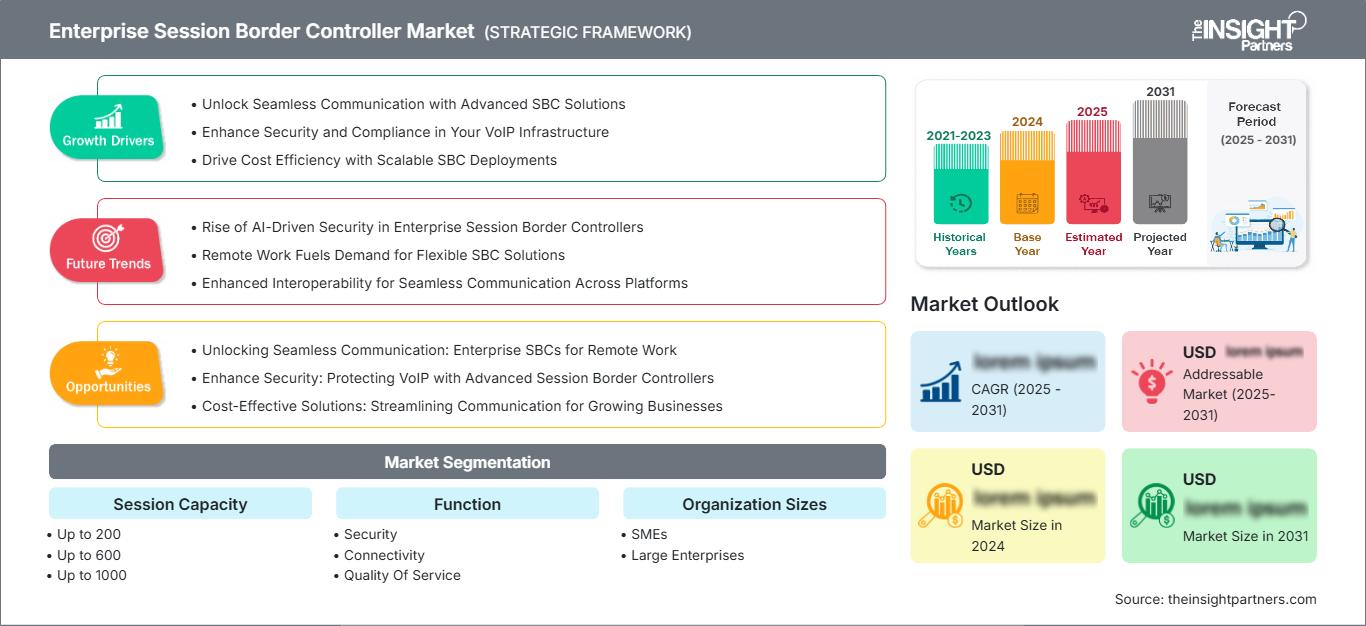
Enterprise Session Border Controller Market: Strategic Insights
Regional Insights
North America Enterprise Session Border Controller Market
North America held 34–37% of Enterprise Session Border Controller Market share in 2025 and is projected to expand at a 5.4–6.0% CAGR during 2026–2034. The presence of large installed bases of SIP trunking, cloud collaboration, and distributed contact centers enables replacement and expansion spend. The region also enjoys developed channel ecosystems, availability of public cloud solutions, and stringent continuity needs in the financial services, healthcare, government, and communications segments.
US requirements for caller authentication and Canadian telecom transformation drive customers towards robust identity verification, encryption of signaling, audit, and certified interconnection. Hybrid workforces ensure branch resiliency and security for remote users, and consolidation of multiple carriers and UC platforms under centralized policies occurs among enterprises. Most intense competition occurs in software-based SBCs, managed direct routing, and cloud-native deployments, even though dedicated appliances are also critical at some locations.
U.S. Enterprise Session Border Controller Market
The US represented 78–82% of North American revenue in 2025 and should grow at a 5.5–6.1% CAGR through 2034. Adoption is driven by large multinational network connections, well-developed SIP trunking capabilities, public cloud voice services, and rigorous uptime requirements. FCC caller-authentication regulations promote enterprise and carrier practices of retaining attestations, detecting malicious behavior patterns, and maintaining control where signing is handled by third parties.
Channel visibility and certification visibility are high among Cisco Systems Inc., Oracle Corp, Ribbon Communications Inc., and AudioCodes Ltd., while Avaya LLC assists with updating existing communication infrastructures for their customers. The application need extends from Microsoft Teams direct routing, Webex calling, cloud-based contact centers, emergency calling, and secure carrier interconnect. Buyers in the healthcare and BFSI markets seek recording redundancy, encryption, and failover capabilities, while large retail and manufacturing buyers require multi-site policies and quick branch onboarding.
Europe Enterprise Session Border Controller Market
Europe accounted for 27–30% of global revenue in 2025 and is expected to advance at a 5.1–5.7% CAGR during 2026–2034. The United Kingdom is taking the lead in regional deployment, facilitated by cloud calling, concentration of finance services, and new caller-line identification expectations. The need for traceable routing, data protection and fraud prevention in domestic and international communication flows creates the demand for software and managed SBC solutions.
Second on the list comes Germany because of its digital transformation in industry, operational resilience and multilocation communications. In France, the combination of the state modernization and call center growth is needed. In Italy and Spain, it is necessary to consider carrier migration, tourism traffic and branch offices. The alignment with GDPR, NIS2 and telecommunication security evaluation improve governance during the whole lifecycle of deployment.
APAC Enterprise Session Border Controller Market
The share of Asia-Pacific stood at 23-26% in 2025 and is expected to grow at a CAGR of 6.8-7.5% from 2026 to 2034, the highest growth in any region. China dominates on account of sheer size, Japan and South Korea on account of advanced enterprise communication systems, India due to cloud computing, and Australia owing to managed services capabilities.
Rapid industrialization, 5G technology-enabled network modernization, data localization regulations, and digitalization initiatives drive demand. Consumers prefer flexibility in licensing model, availability of cloud in the region, and carrier interoperability, while multi-national corporations need standardized voice policies for factories, offices, and customer service facilities.
Middle East & Africa Enterprise Session Border Controller Market
The Middle East and Africa region is forecasted to grow at a CAGR of 5.8%-6.5% from 2026 to 2034. The UAE is leading in enterprise adoption, and after that, comes Saudi Arabia where there are major digital infrastructure initiatives and cloud regions enabling voice migration. South Africa is the driver of demand in the banking, telecom, and business services sectors.
Energy firms, airlines, government, and critical infrastructures need a robust interconnect environment among their scattered facilities. The remaining MEA region is offering selective growth opportunities via carrier transformation, managed services, and branch interconnectivity.
Segmentation Analysis
Session Capacity
The session capacity segment is forecast to grow at a 5.6–6.2% CAGR during 2026–2034. The Enterprise Session Border Controller Market scope spans compact branch deployments through carrier-scale enterprise hubs. Capacity selection depends on peak concurrency, redundancy design, codec processing, remote-worker traffic, contact-center seasonality, and the ability to activate licenses without replacing hardware or software instances.
- Up to 200: Serves small offices and distributed branches requiring secure SIP connectivity, straightforward administration, and affordable redundancy without the operational burden of enterprise-scale platforms.
- Up to 600: Addresses growing midmarket sites, healthcare facilities, and regional contact centers that need broader concurrency, survivability, and multi-carrier interworking within controlled budgets.
- Up to 1000: Supports larger campuses and multi-site organizations balancing predictable performance with virtual deployment, centralized policies, and room for cloud-calling migration.
- Up to 5, 000: Fits major enterprises and contact-center hubs that require high availability, intensive transcoding, complex routing, and coordinated security across multiple platforms.
- More Than 5, 000: Targets very large enterprises, shared-service environments, and provider-managed estates where elastic capacity, geographic redundancy, analytics, and automation are strategic requirements.
Function
The function segment is projected to expand at a 6.0–6.6% CAGR during 2026–2034. Security remains the leading requirement, but buyers increasingly bundle connectivity, quality assurance, regulatory controls, media handling, and revenue protection. Integrated functionality reduces the number of network elements, provides consistent policy enforcement, and improves troubleshooting across hybrid communications estates.
- Security: Leads spending as enterprises protect signaling and media from denial-of-service attacks, fraud, spoofing, eavesdropping, malformed traffic, and unauthorized network access.
- Connectivity: Enables reliable interworking among SIP trunks, PBXs, UCaaS, CCaaS, carriers, and remote users through protocol normalization, routing, and network-address translation.
- Quality Of Service: Supports media monitoring, prioritization, codec control, and diagnostics that protect call experience across variable internet, cloud, and wide-area network conditions.
- Regulatory: Helps organizations implement caller identity, emergency calling, lawful intercept, recording, privacy, and retention policies consistently across jurisdictions and communication platforms.
- Media Services: Provides transcoding, media anchoring, encryption, recording integration, and manipulation capabilities required for interoperability and advanced voice or video workflows.
- Revenue Optimization: Improves route selection, capacity utilization, fraud prevention, and service assurance, supporting lower termination costs and more dependable monetization of communications services.
Organization Sizes
The organization sizes segment is expected to register a 5.7–6.3% CAGR during 2026–2034. Large enterprises dominate because they operate complex, multi-country voice estates and require high availability, compliance, and centralized governance. SMEs are adopting cloud-managed SBCs as predictable subscriptions, simplified provisioning, and partner-operated services lower technical barriers and initial capital requirements.
- SMEs: Favor virtual appliances and managed services that deliver essential security, direct routing, and interoperability with limited in-house voice expertise or capital expenditure.
- Large Enterprises: Require geographic redundancy, high session density, advanced analytics, compliance evidence, and consistent policies spanning carriers, clouds, contact centers, and global branches.
Industry
The industry segment is forecast to post a 5.9–6.5% CAGR during 2026–2034. Adoption patterns reflect regulatory exposure, call criticality, branch distribution, customer-contact intensity, and tolerance for downtime. IT and telecommunication leads scale, while BFSI and healthcare emphasize security and auditability. Manufacturing and transportation prioritize continuity across dispersed operational sites.
- Manufacturing: Connects plants, suppliers, headquarters, and service centers while preserving call continuity, centralized policy, and interoperability across mixed legacy and cloud communications.
- BFSI: Sustains strong demand for encryption, recording integration, identity assurance, resilient routing, and audit trails across branches, trading workflows, and customer-service operations.
- Transportation: Requires dependable communications among terminals, fleets, control centers, partners, and passengers, with failover and quality controls supporting time-sensitive operational coordination.
- Healthcare: Prioritizes privacy, emergency availability, secure remote access, and reliable interworking among hospitals, clinics, contact centers, telehealth platforms, and public networks.
- Media and Entertainment: Uses SBCs for high-quality media handling, event-driven capacity, remote production collaboration, customer engagement, and secure interconnection across distributed creative ecosystems.
- IT and Telecommunication: Leads high-capacity consumption through managed voice, cloud communications, network interconnect, multi-tenant services, and stringent requirements for scale, automation, and resiliency.
Opportunity Snapshot
| Industry Vertical | Revenue Contribution | Trend Tag | Adoption Stage |
| Manufacturing | Medium | Plant Voice | Scaling |
| BFSI | High | Call Compliance | Mature |
| Transportation | Medium | Control Resilience | Scaling |
| Healthcare | Medium | Secure Telehealth | Scaling |
| Media and Entertainment | Low | Media Interworking | Emerging |
| IT and Telecommunication | High | Cloud Interconnect | Mature |
Enterprise Session Border Controller Market Growth Drivers and Impact Analysis
Cloud Voice Migration Expands the Secure Interconnect Layer
Companies are moving from individual PBXs to UCaaS, CCaaS, and cloud contact center solutions but with carriers, recorders, E911 services, and certain on-prem applications. The result is a set of protocol, number, identity, and media policy boundaries that an SBC can address in a normalized and protected fashion. The need for a certified SBC connection is inherent in Microsoft Teams Direct Routing and highlights the product's importance in migration design. The effect on the market is increased software sales, recurring license revenue, and more professional services related to routing, testing, and cutover. Hybrid environments are also prolonging refresh cycles, since companies have to run both the old and new platform side by side.
Voice Fraud and Identity Rules Elevate Security Spending
Voice is still vulnerable to attack through spoofing, toll fraud, denial of service, malformed SIP signaling, and misuse of credentials. In the United States, the enhanced STIR/SHAKEN framework requires responsible attestation decisions and provider certificates even where technical signing is outsourced. In the United Kingdom, revised caller line ID guidelines require providers to identify potentially troublesome international calls and safeguard number presentation integrity. Such controls promote the elevation of SBCs from simple connection mechanisms to auditing enforcers. Enterprises focus on topology concealment, encryption, anomaly detection, call validation, and logging. The business impact is increased emphasis on security subscriptions, analytics, and managed monitoring, with vendors having demonstrated reliability and quick policy changes getting ahead of procurement curves.
Distributed Operations Increase Resilience Requirements
The hybrid workplace, global service centers, and multi-site environments create a situation where voice connectivity becomes dependent on a number of different networks and cloud applications. Thus, enterprises need to deploy active-passive SBCs, geographical redundancy, local survivability, and policy-based routing in order to keep outages under control. Deterministic failover is important for manufacturing facilities, hospitals, banks, and transport companies since communication breakdowns may have an impact on safety, access to customers, and compliance with regulations. It creates opportunities for higher lifecycle revenues for vendors as a result of monitoring, support, and capacity expansion. The industry also appreciates solutions that maintain session state, are capable of isolating failures and producing diagnostics.
Enterprise Session Border Controller Market Future Trends
Cloud-Native SBCs Become Operationally Elastic
Enterprise Session Border Controller Market trends will continue to prioritize containerized and horizontally scalable architectures that ensure voice security within a cloud operation framework. Instead of reserving capacity for standalone devices, enterprises will create policy-compliant instances within different geographic locations and scale their sessions based on need. Kubernetes management, automated failover, infrastructure-as-code approach, and subscription-based licensing will be standard benchmarks to consider. Such an approach will enable faster geographic coverage and better disaster recovery capabilities; however, there will be higher needs for observability, automated certificate management, and determinism of media delivery.
AI-Assisted Operations Move from Alerts to Policy Actions
Future management of SBCs will use machine learning for baselines of call quality, fraud detection, anomalies in routing, and capacity forecasting. The initial systems will prioritize recommendation and root cause analysis, whereas mature solutions will automate bounded actions such as throttling, re-routing, and scaling instances. The use of machine learning will be conditioned by explainable decision making, audits of decisions, and protection from false positives that affect normal traffic flows. Machine learning will integrate the whole security operations and communications analytics in one solution for viewing signaling, media, identity, and application health. Suppliers offering machine learning for improving service levels can differentiate themselves.
Enterprise Session Border Controller Market Opportunities
Managed SBC Services for Midmarket Cloud Calling
Typical mid-market companies usually do not have dedicated experts to develop SIP security, routing of SIP traffic via carriers, certificates, and failover management. Managed services providers may bundle certified SBC capacity, deployment, monitoring, upgrades, and compliance reporting into a single package for a certain price per user or session. Enterprise Session Border Controller Market Forecasts make the business case for investment in white label solutions that enable telecom operators and value-added resellers to on-board their customers fast without building up individual infrastructure. Most attractive offers will include a self-service portal, migration guidelines, service level agreements, and regional support.
Regional Cloud and Sovereign Deployment Partnerships
Growth markets will increasingly demand local hosting, inter-working of carriers domestically, and provision for the handling of numbers, logging, emergency calling services, and data governance that is specific to the country. Vendors can speed up their entry by ensuring that software is certified on regional clouds, forming alliances with licensed operators and creating policy packs for regulated industries. Areas where the investment would be particularly critical are India, Southeast Asia, the Gulf countries, and some of the business centers in Africa where the number of cloud regions and digital infrastructure initiatives are growing.
Recent Developments
- August 2026: ASTPP has launched a built-in Session Border Controller (SBC) designed to help VoIP providers secure their communication infrastructure while simplifying network management. The new solution enables operators to protect SIP-based networks, improve call reliability, and manage voice traffic without relying on separate SBC hardware or third-party platforms.
- June 2025: AudioCodes has announced that it has secured multiple certifications for Cloud Connect for Webex Calling. The achievement enables service providers and partners to deliver secure, dependable, and high-quality Webex Calling services to their customers. AudioCodes’ Webex Calling solutions are powered by the AudioCodes Live Platform, a white-label, multi-tenant SaaS platform designed to simplify the deployment and management of cloud-based voice services. The offering combines streamlined service delivery with AudioCodes’ industry-leading expertise in session border controller (SBC) technology, providing scalable, resilient, and secure voice connectivity for modern enterprise communication environments.
- May 2026: Ribbon Communications Inc. (Nasdaq: RBBN), a global leader in real-time communications technology, IP routing and optical networking solutions, today announced that Salesforce is partnering with Ribbon for its proven Session Border Controller Cloud Native edition (SBC CNe) and Policy and Routing Engine (PSX) in the public cloud to accelerate time to market for its new agentic AI contact center offering, Agentforce Contact Center.
Frequently Asked Questions

- Comprehensive Market Sizing and Forecast Analysis
- Detailed Segmentation Analysis
- In-Depth Market Dynamics Assessment
- Regional and Country-Level Insights
- Competitive Landscape and Company Benchmarking
- Strategic Business Intelligence
Recent Reports
Testimonials

The Insight Partners provided valuable market intelligence that supported our global go-to-market strategy. Their team was professional, responsive, and attentive to our feedback, providing thoughtful analysis and helpful methodological clarifications throughout the project.
Junmo Kim Chief Financial Officer (CFO), Enertech Co., Ltd.
The Insight Partners' SCADA System Market report is comprehensive, with valuable insights on current trends and future forecasts. The team was highly professional, responsive, and supportive throughout. We are very satisfied and highly recommend their services.
RAN KEDEM Partner, Reali Technologies LTDs
I requested a report on a very specific software market and the team produced the report in a few days. The information was very relevant and well presented. I then requested some changes and additions to the report. The team was again very responsive and I got the final report in less than a week.
JEAN-HERVE JENN Chairman, Future Analytica
We worked with The Insight Partners for an important market study and forecast. They gave us clear insights into opportunities and risks, which helped shape our plans. Their research was easy to use and based on solid data. It helped us make smart, confident decisions. We highly recommend them.
PIYUSH NAGPAL Sr. Vice President, High Beam Global
The Insight Partners delivered insightful, well-structured market research with strong domain expertise. Their team was professional and responsive throughout. The user-friendly website made accessing industry reports seamless. We highly recommend them for reliable, high-quality research services
YUKIHIKO ADACHI CEO, Deep Blue, LLC.
This is the first time I have purchased a market report from The Insight Partners.While I was unsure at first, I visited their web site and felt more comfortable to take the risk and purchase a market report.I am completely satisfied with the quality of the report and customer service. I had several questions and comments with the initial report, but after a couple of dialogs over email with their analyst I believe I have a report that I can use as input to our strategic planning process.Thank you so much for taking the extra time and making this a positive experience.I will definitely recommend your service to others and you will be my first call when we need further market data.
JOHN SUZUKI President and Chief Executive Officer, Board Director, BK Technologies
I wish to appreciate your support and the professionalism you displayed in the course of attending to my request for information regarding to infectious disease IVD market in Nigeria. I appreciate your patience, your guidance, and the fact that you were willing to offer a discount, which eventually made it possible for us to close a deal. I look forward to engaging The Insight Partners in the future, all thanks to the impression you have created in me as a result of this first encounter.
DR CHIJIOKE ONYIA MANAGING DIRECTOR, PineCrest Healthcare Ltd.Reason to Buy
- Informed Decision-Making
- Understanding Market Dynamics
- Competitive Analysis
- Identifying Emerging Markets
- Customer Insights
- Market Forecasts
- Risk Mitigation
- Boosting Operational Efficiency
- Strategic Planning
- Investment Justification
- Tracking Industry Innovations
- Aligning with Regulatory Trends





 Get Free Sample for