
Environmental Monitoring Market Size, Share & Growth by 2034
Coverage: by Component (Hardware, Software, and Service); Sampling Method (Active, Passive, Continuous and Intermittent) Sensor Type (Analog, Digital, Temperature, Moisture Detection, Biological Detection, Chemical Detection, Noise and Other); and Application (Air Pollution, Water Pollution, Soil Pollution, and Noise Pollution), and Geography (North America, Europe, Asia Pacific, and South and Central America)
- Status : Data Released
- Report Code : TIPTE100001368
- Category : Electronics and Semiconductor
- No. of Pages : 150
- Available Report Formats :


- Last update date : September 15, 2026


2025 Market Size
US$ 25.38 Bn
Base year value
2034 Forecast
US$ 42.54 Bn
Projected by 2034
CAGR 2026-2034
5.91 %
Growth rate
Addressable Market
US$ 307.74 Bn
(2026-2034)
The Environmental Monitoring Market was valued at US$ 25.38 Billion in 2025 and is projected to reach US$ 42.54 Billion by 2034, registering a CAGR of 5.91% during 2026–2034. The market encompasses monitoring systems, sensors, and services that measure and analyze environmental parameters including air quality, water quality, soil conditions, and noise levels across industrial, commercial, and governmental applications. These solutions support regulatory compliance, public health protection, and environmental management through continuous and intermittent data collection worldwide.
North America Environmental Monitoring Market size is expected to expand at a CAGR of 5.2–5.9% during 2026–2034, supported by regulatory compliance, environmental protection programs, and public health monitoring across the US and Canada. Demand is reinforced by EPA regulations, environmental standards, and procurement preferences for reliable, accurate monitoring solutions in government and industrial applications.
Environmental Monitoring Market Assessment and Insights
- North America held 28–31% share in 2025 and is growing at a CAGR of 5.2–5.9% during 2026–2034, led by regulatory compliance, environmental programs, and public health monitoring across the US and Canada.
- US represented 82–85% of North American revenue in 2025 and is growing at a CAGR of 5.4–6.1% during 2026–2034.
- Europe accounted for 25–28% share in 2025 and is growing at a CAGR of 5.0–5.7% during 2026–2034, led by Germany, the UK, France, Italy, and Spain.
- Asia Pacific held 30–33% share in 2025 and is growing at a CAGR of 6.8–7.5% during 2026–2034, led by China, India, Japan, South Korea, and Australia.
- Largest Segment Hardware held 38–42% market share in 2025 and is growing at a CAGR of 5.2–5.9% during 2026–2034.
- High Growth Segment Service represented 32–35% market share in 2025 and is growing at a CAGR of 6.5–7.2% during 2026–2034.
- Key companies analyzed in detail: Siemens AG; Emerson Electric Co; Honeywell International, Inc.; TE Connectivity Ltd.; Agilent Technologies, Inc.; Danaher Corporation; Teledyne Technologies Incorporated; Merck KGaA; General Electric Company; Sutron Corporation; Thermo Fisher Scientific Inc.; Hach Company.
Source: The Insight Partners' analysis based on proprietary research, government publications, company annual reports, investor presentations, industry databases, and expert interviews.
The development of environmental monitoring technology has seen a shift from primitive manual methods to highly sophisticated sensing systems that enable real-time transmission of collected data into the cloud, with analytics and automatic reporting for regulatory and management purposes. In production dynamics, there is a growing need for increased sensor accuracy and data reliability along with factory calibration and performance under different environmental factors and pollutants.
The demand for Environmental Monitoring Market is influenced by environmental agencies and facility managers who choose monitoring tools that meet their regulatory and operational requirements. In addition, forward investments are increasingly focused on the Asia-Pacific, North America, and Europe regions, where advanced environmental monitoring is needed because of more strict requirements related to regulations, environmental sustainability, and public health awareness.
Environmental Monitoring Market Report Scope
| Report Attribute | Details |
|---|---|
| Market size in 2025 | US$ 25.38 Billion |
| Market Size by 2034 | US$ 42.54 Billion |
| Global CAGR (2026 - 2034) | 5.91% |
| Historical Data | 2021-2024 |
| Forecast period | 2026-2034 |
Environmental Monitoring Market Analysis
Development drivers for Environmental Monitoring Market include regulatory compliance, environmental protection measures, public health monitoring, and sustainability issues. The supply chain includes sensors manufacturers, instruments suppliers, system integrators, and buyers. Supply features are influenced by components availability, technological developments, and regulations cycle. Based on the results of Environmental Monitoring Market Report, hardware will remain the market leader because of measurement capabilities, while services will grow their share of the market due to data management and program management. Services' importance is rising because of calibration, data management, and support influence measurement accuracy and compliance.
The market leaders are represented by instrumentation producers and environmental monitoring firms. Siemens AG, Emerson Electric Co, Honeywell International, Inc., General Electric Company, Thermo Fisher Scientific Inc., Danaher Corporation, Teledyne Technologies Incorporated, Agilent Technologies, Inc., TE Connectivity Ltd., Merck KGaA, Sutron Corporation, and Hach Company are competing for their superior measurement capabilities, reliability, specialization, and regulation compliance. Current investment tendencies focus on real-time monitoring and wireless communications and data processing. Siemens and Emerson are dominating on account of their broad automation and monitoring product lines, whereas Thermo Fisher and Danaher succeed due to instrumentation capabilities.
There is also growing demand for continuous monitoring systems for the air, water, soil, and industries. The usage of connected sensors, cloud platforms, and analytics is helping organizations detect changes in the environment and report them efficiently. With growing frequency and complexity of monitoring processes, vendors are now promoting systems that integrate high accuracy of measurement and diagnostics, automatic alarms, and data access.
Further market growth may be driven by smart environmental infrastructure, strict emission standards, climate change monitoring programs, and sustainability of industrial operations. Advanced analytics, interoperability, and compliance automation are likely to be important drivers in developed regions, whereas growing environmental monitoring along with urbanization and industry development in emerging economies is an important driver there. Increasing competition may result from sensor accuracy, system integration, cybersecurity, service, and data analytics.
● REPORT CUSTOMIZATION
Tailor This Report To Align With Your Specific Business Requirements
This report can be customized to align precisely with your business objectives, scope, and target markets. Customization options include tailored segmentation, geography, competitive analysis, and strategic insights to support informed decision-making.
Customize This Report →WHAT YOU CAN ADJUST
- ● Segmentations
- ● Geography
- ● Competitive Analysis
- ● Language Preferences
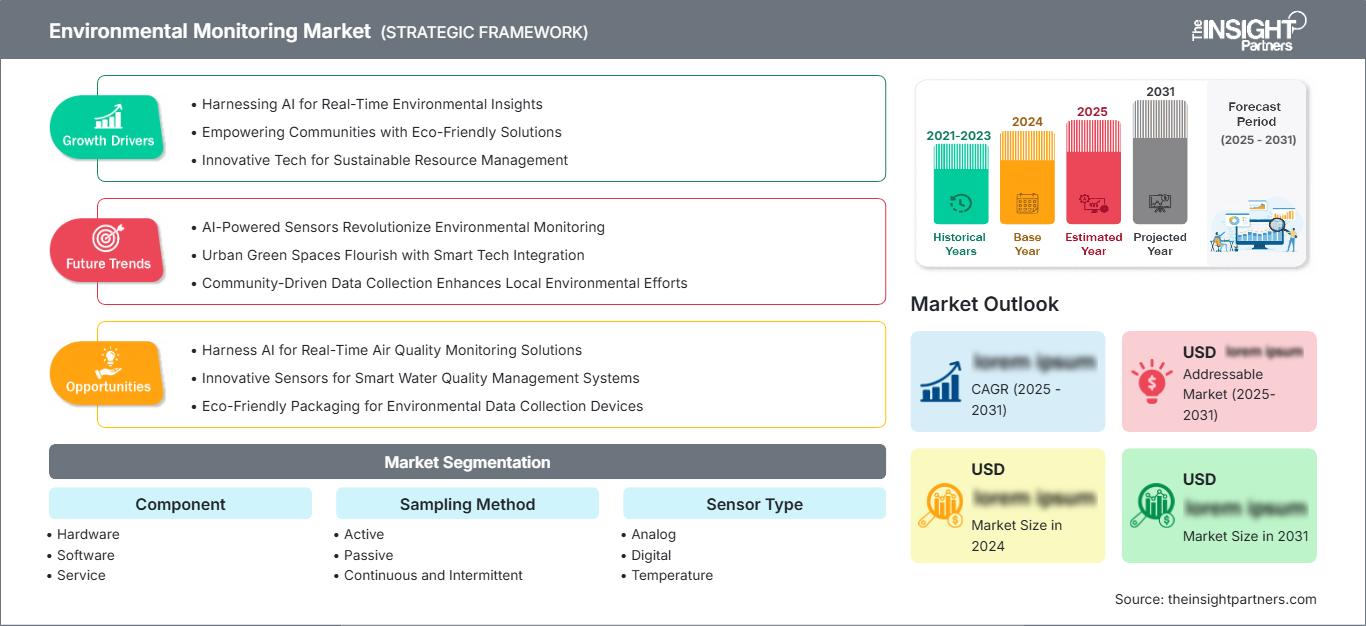
Environmental Monitoring Market: Strategic Insights
Regional Insights
North America Environmental Monitoring Market
North America Environmental Monitoring Market Share was 28-31% in 2025 and is forecasted to increase at CAGR of 5.2-5.9% from 2026 to 2034. The demand will be supported by compliance issues, environmental protection programs, health monitoring, and sustainability considerations in the United States and Canada. Regional regulatory compliance and environment will ensure constant demand for monitoring. Siemens AG, Emerson Electric Co, Honeywell International, Inc., General Electric Company, and Thermo Fisher Scientific Inc. provide existing installations in various government agencies and industries and environmental monitoring networks in the United States and Canada.
U.S. Environmental Monitoring Market
United States constituted 82-85% of total revenue of North America in 2025 and will grow at a CAGR of 5.4-6.1% between 2026-2034. Major application areas will include air quality monitoring, water quality testing, industrial compliance and environmental programs. Buyer needs are backed up by Siemens AG, Emerson Electric Co, Honeywell International, Inc., General Electric Company, and Danaher Corporation. Buyers value measurement accuracy and reliability, data management, regulatory compliance, and integration that improves environmental monitoring and ensures reliable compliance data.
Europe Environmental Monitoring Market
The Europe region held 25-28% market share in 2025 and is expected to register a CAGR of 5.0-5.7% over 2026-2034. Germany is dominant due to environmental regulations & industrial compliance, and the UK drives due to demand from environmental programs & public health monitoring. France, Italy, and Spain drive due to demand from environmental protection and compliance regulations. The environmental standards and regulations benefit suppliers with proven performance and compliance credentials. Siemens AG, Emerson Electric Co, Honeywell International, Inc., and Thermo Fisher Scientific Inc. continue to be present in environmental and industrial projects.
APAC Environmental Monitoring Market
The Asia Pacific held 30-33% market share in 2025 and is expected to register a CAGR of 6.8-7.5% over 2026-2034. China dominates due to environmental regulations and investments in monitoring infrastructure, whereas India grows due to environmental programs and compliance needs. Japan & South Korea are driven due to advanced monitoring for urban & industrial environments, and Australia drives due to environmental monitoring and research applications. The policy support for environmental protection and pollution control help Environmental Monitoring Market penetration where monitoring capabilities and compliance are of high value.
Middle East & Africa Environmental Monitoring Market
The Middle East & Africa market is projected to grow at a CAGR of 4.5–5.2% during 2026–2034. Saudi Arabia leads through environmental programs and industrial compliance, while the UAE adds environmental monitoring and sustainability initiatives. South Africa and Rest of MEA rely on environmental programs and regulatory development. Environmental awareness and regulatory development create demand for monitoring solutions. Suppliers succeed when they combine product quality, regulatory expertise, and local support.
Segmentation Analysis
Component
Component is projected to grow at a CAGR of 5.5–6.2% during 2026–2034. Environmental Monitoring Market scope covers Hardware, Software, and Service. Selection depends on application requirements and program needs. Hardware leads through essential measurement capability.
- Hardware includes sensors, instruments, and data loggers for environmental measurement and data collection.
- Software enables data management, analysis, and reporting for environmental programs.
- Services encompass installation, maintenance, calibration, and program support.
Sampling Method
Sampling Method is forecast to grow at a CAGR of 5.8–6.5% during 2026–2034. Active, Passive, and Continuous and Intermittent address diverse monitoring requirements.
- Active sampling uses powered collection for quantitative measurement applications.
- Passive sampling provides integrated exposure assessment for screening applications.
- Continuous and Intermittent sampling provides ongoing measurement for regulatory and operational applications.
Sensor Type
Sensor Type is expected to grow at a CAGR of 5.5–6.2% during 2026–2034. Analog, Digital, Temperature, Moisture Detection, Biological Detection, Chemical Detection, and Noise represent diverse measurement capabilities.
- Analog sensors provide continuous measurement for traditional monitoring applications.
- Digital sensors enable precise, data-capable measurement for modern monitoring systems.
- Temperature sensors monitor thermal conditions for environmental assessment.
- Moisture Detection sensors measure humidity and water content.
- Biological Detection sensors identify biological contaminants and indicators.
- Chemical Detection sensors measure chemical pollutants and contaminants.
- Noise sensors monitor environmental noise levels.
Application
Application is projected to grow at a CAGR of 5.6–6.3% during 2026–2034. Air Pollution, Water Pollution, Soil Pollution, and Noise Pollution represent key environmental monitoring areas.
- Air Pollution monitoring measures ambient air quality and pollutant concentrations.
- Water Pollution monitoring assesses water quality for regulatory and health applications.
- Soil Pollution monitoring evaluates soil contamination and quality.
- Noise Pollution monitoring measures environmental noise levels.
Opportunity Snapshot
| Application | Revenue Contribution | Trend Tag | Adoption Stage |
|---|---|---|---|
| Air Pollution | High | Air Quality | Mature |
| Water Pollution | High | Water Quality | Mature |
| Soil Pollution | Medium | Soil Assessment | Scaling |
| Noise Pollution | Medium | Noise Management | Scaling |
Environmental Monitoring Market Growth Drivers and Impact Analysis
Regulatory Compliance Drives Monitoring Infrastructure Investment
Environmental regulations and compliance requirements across global jurisdictions are creating significant demand for advanced environmental monitoring systems. Organizations across industrial, energy, manufacturing, and infrastructure sectors increasingly require reliable monitoring technologies to demonstrate regulatory adherence, track emissions, and document environmental performance. As governments strengthen environmental standards and introduce more stringent reporting requirements, compliance obligations are driving sustained investment in monitoring infrastructure and data management capabilities. Regulatory frameworks create consistent demand for accurate, reliable, and certified monitoring systems capable of providing traceable data for audits, reporting, and enforcement purposes. This trend is also encouraging organizations to adopt automated and continuous monitoring solutions that improve operational visibility while supporting environmental protection objectives. The practical market impact is growing demand for certified monitoring technologies that combine measurement accuracy, data reliability, regulatory compliance, and ease of integration. Suppliers offering robust, standards-compliant solutions are well positioned to benefit from these evolving requirements globally.
Public Health Awareness Increases Monitoring Demand
Growing public health awareness and increasing concern about environmental impacts on human health are driving the adoption of environmental monitoring systems across government, institutional, and community applications. Rising awareness of air pollution, water contamination, hazardous substances, and other environmental risks is encouraging organizations to strengthen monitoring capabilities to identify potential threats and support timely intervention. Health protection priorities are therefore contributing to sustained investment in reliable monitoring infrastructure and data collection technologies. Public demand for greater transparency regarding environmental conditions is also increasing the need for accessible and accurate monitoring information. This trend creates opportunities for suppliers capable of delivering reliable, cost-effective, and user-friendly monitoring solutions that support both public health objectives and environmental protection. As governments, institutions, and communities place greater emphasis on preventive health measures and environmental risk management, demand for dependable monitoring technologies is expected to remain strong across diverse applications and geographic markets.
Sustainability Programs and Corporate Responsibility Drive Monitoring
Sustainability programs and corporate environmental responsibility initiatives across industrial and commercial sectors are driving demand for environmental monitoring solutions that enable accurate performance measurement, reporting, and continuous improvement. As organizations establish sustainability targets and strengthen environmental commitments, reliable monitoring systems are becoming essential for tracking emissions, resource consumption, waste generation, and other environmental indicators. Corporate sustainability strategies increasingly require transparent, verifiable data to demonstrate progress to regulators, investors, customers, and other stakeholders. These commitments are therefore encouraging sustained investment in monitoring infrastructure and data management technologies. The market impact is growing demand for solutions that combine measurement accuracy, data accessibility, reporting capabilities, and operational efficiency. Suppliers offering scalable and reliable monitoring technologies can benefit as businesses integrate environmental performance tracking into broader sustainability strategies. As corporate responsibility expectations continue to increase, environmental monitoring will remain an important tool for supporting sustainability programs, regulatory reporting, and long-term environmental performance management.
Environmental Monitoring Market Future Trends
IoT-Enabled Monitoring Enables Real-Time Data Access
Environmental Monitoring Market trends are increasingly focused on IoT-enabled systems that provide real-time data access, remote visibility, and seamless integration with environmental management platforms. As organizations seek faster insights and greater operational control, connected monitoring solutions are becoming increasingly important for tracking environmental conditions and responding to potential issues. The next generation of products is expected to combine advanced sensor capabilities with connectivity, cloud-based analytics, and automated data management. This evolution will enable users to access monitoring information remotely, analyze trends in real time, and improve decision-making across diverse applications. The growing emphasis on real-time data and remote accessibility is therefore reshaping product requirements and technology development. Vendors with strong expertise in IoT connectivity, sensor technologies, cloud platforms, and analytics will be better positioned to address evolving customer needs and capture opportunities as environmental monitoring systems become increasingly connected and intelligent.
Integrated Multi-Parameter Platforms Enable Comprehensive Monitoring
Integrated multi-parameter monitoring platforms are emerging as an important trend, combining multiple measurement capabilities to provide more comprehensive environmental assessment. Traditional monitoring approaches often rely on separate systems for individual parameters, creating fragmented data and increasing operational complexity. Next-generation platforms are expected to integrate air, water, noise, and other environmental measurements within unified systems, enabling users to obtain broader visibility from a single monitoring solution. This evolution can improve data accessibility, simplify monitoring operations, and support more informed environmental management decisions. As organizations increasingly seek efficient and holistic approaches to environmental assessment, demand for integrated platforms is expected to strengthen across industrial, commercial, governmental, and institutional applications. Suppliers capable of delivering scalable systems with proven measurement accuracy, reliable performance, and seamless data integration are likely to gain credibility among environmental managers and strengthen their competitive position in the evolving environmental monitoring market.
Environmental Monitoring Market Opportunities
Air Quality Monitoring Networks for Urban Environments
Environmental Monitoring Market forecasts support continued investment in air quality monitoring networks as urban environments face growing requirements for comprehensive pollution measurement, analysis, and reporting. Rapid urbanization, increasing public health awareness, and tightening environmental regulations are encouraging cities and municipalities to strengthen monitoring infrastructure. Reliable air quality data is essential for identifying pollution sources, assessing health risks, supporting regulatory compliance, and informing environmental management decisions. This creates opportunities for providers offering integrated network solutions that combine sensors, data connectivity, analytics, and reporting capabilities. Scalable monitoring platforms can enable cities to expand coverage while improving real-time visibility into changing air quality conditions. The opportunity is particularly strong in densely populated urban areas where pollution concerns and regulatory requirements create sustained demand for comprehensive monitoring systems. Suppliers with proven network performance, measurement accuracy, and data management capabilities are well positioned to benefit from increasing investment in urban environmental monitoring infrastructure.
Water Quality Monitoring for Industrial and Municipal Applications
Water quality monitoring across industrial and municipal applications is creating sustained demand for reliable measurement solutions that support regulatory compliance, process control, and quality assurance. Industrial facilities and water management organizations require accurate monitoring of key water quality parameters to detect contamination, maintain treatment performance, and meet increasingly stringent environmental standards. As regulatory requirements evolve, continuous and reliable monitoring is becoming an important component of effective water management and operational decision-making. This creates opportunities for suppliers with specialized expertise in water quality monitoring technologies and application-specific solutions. Providers that can deliver accurate, durable, and easy-to-integrate systems are well positioned to capture demand across industrial, municipal, and infrastructure applications. Competitive advantage will increasingly depend on demonstrated measurement reliability, data accuracy, operational efficiency, and compliance with applicable regulatory standards. The opportunity is particularly strong where water quality requirements drive investment in advanced monitoring infrastructure and continuous measurement capabilities.
Recent Developments
- January 2026: Veeva Systems (NYSE: VEEV) today announced a new environmental monitoring (EM) solution to advance quality control (QC) for manufacturing operations. Veeva Environmental Monitoring, a cloud-native application unified with Veeva LIMS, will enable laboratories and manufacturing facilities to schedule, collect, and analyze environmental samples to ensure compliance with GMP and internal sterility standards. Part of Veeva Quality Cloud, Veeva Environmental Monitoring will seamlessly integrate with Veeva quality applications to eliminate data silos and paper-based processes that slow batch release. With unified QC, users can automatically initiate quality events in Veeva QMS, surface procedures from Veeva QualityDocs, and publish critical environmental monitoring data to Veeva Batch Release to optimize the batch release process.
- August 2024: Renesas Electronics Corporation (TSE:6723), a premier supplier of advanced semiconductor solutions, today introduced an advanced all-in-one sensor module designed for indoor air quality monitoring. The RRH62000, the first multi-sensor air quality module from Renesas, integrates multiple sensor parameters in a compact design and accurately detects different particle sizes, volatile organic compounds, and gasses harmful to human health. With a Renesas microcontroller (MCU) on board, the module offers an intelligent sensor management solution for a growing market of air monitoring applications, including air purifiers, smoke detectors, HVAC systems, weather stations, and smart home systems. Its robust firmware also enables customer products to comply with various air quality standards around the world.
- February 2024: Advantech, a leading provider of industrial IoT solutions, has announced the launch of its innovative EVA-2000 series, a new line of smart wireless sensors incorporating LoRaWAN technology. This series marks a significant advancement in the field of industrial sensing applications, offering long-range data transmission combined with exceptional power efficiency. The EVA-2000 series, comprising of diverse sensor models from temperature and humidity to water leak detection, is designed for the demanding sectors of industrial automation, equipment monitoring, and environmental monitoring.
Frequently Asked Questions

- Comprehensive Market Sizing and Forecast Analysis
- Detailed Segmentation Analysis
- In-Depth Market Dynamics Assessment
- Regional and Country-Level Insights
- Competitive Landscape and Company Benchmarking
- Strategic Business Intelligence
Recent Reports
Testimonials

The Insight Partners' SCADA System Market report is comprehensive, with valuable insights on current trends and future forecasts. The team was highly professional, responsive, and supportive throughout. We are very satisfied and highly recommend their services.
RAN KEDEM Partner, Reali Technologies LTDs
I requested a report on a very specific software market and the team produced the report in a few days. The information was very relevant and well presented. I then requested some changes and additions to the report. The team was again very responsive and I got the final report in less than a week.
JEAN-HERVE JENN Chairman, Future Analytica
We worked with The Insight Partners for an important market study and forecast. They gave us clear insights into opportunities and risks, which helped shape our plans. Their research was easy to use and based on solid data. It helped us make smart, confident decisions. We highly recommend them.
PIYUSH NAGPAL Sr. Vice President, High Beam Global
The Insight Partners delivered insightful, well-structured market research with strong domain expertise. Their team was professional and responsive throughout. The user-friendly website made accessing industry reports seamless. We highly recommend them for reliable, high-quality research services
YUKIHIKO ADACHI CEO, Deep Blue, LLC.
This is the first time I have purchased a market report from The Insight Partners.While I was unsure at first, I visited their web site and felt more comfortable to take the risk and purchase a market report.I am completely satisfied with the quality of the report and customer service. I had several questions and comments with the initial report, but after a couple of dialogs over email with their analyst I believe I have a report that I can use as input to our strategic planning process.Thank you so much for taking the extra time and making this a positive experience.I will definitely recommend your service to others and you will be my first call when we need further market data.
JOHN SUZUKI President and Chief Executive Officer, Board Director, BK Technologies
I wish to appreciate your support and the professionalism you displayed in the course of attending to my request for information regarding to infectious disease IVD market in Nigeria. I appreciate your patience, your guidance, and the fact that you were willing to offer a discount, which eventually made it possible for us to close a deal. I look forward to engaging The Insight Partners in the future, all thanks to the impression you have created in me as a result of this first encounter.
DR CHIJIOKE ONYIA MANAGING DIRECTOR, PineCrest Healthcare Ltd.Reason to Buy
- Informed Decision-Making
- Understanding Market Dynamics
- Competitive Analysis
- Identifying Emerging Markets
- Customer Insights
- Market Forecasts
- Risk Mitigation
- Boosting Operational Efficiency
- Strategic Planning
- Investment Justification
- Tracking Industry Innovations
- Aligning with Regulatory Trends





 Get Free Sample for