
Environmental Test Chambers Market Trends, Share & Demand by 2034
Coverage: by Type (Temperature and Humidity Chambers, Customized Chambers, Thermal Shock Chambers, Others); Industry (Aerospace and Defense, Automotive, Medical and Pharmaceutical, Others) , and Geography (North America, Europe, Asia Pacific, and South and Central America)
- Status : Data Released
- Report Code : TIPRE00009339
- Category : Electronics and Semiconductor
- No. of Pages : 150
- Available Report Formats :


- Last update date : August 07, 2026


2025 Market Size
US$ 950.60 Mn
Base year value
2034 Forecast
US$ 1,254.60 Mn
Projected by 2034
CAGR 2026-2034
3.13 %
Growth rate
Addressable Market
US$ 10,012.43 Mn
(2026-2034)
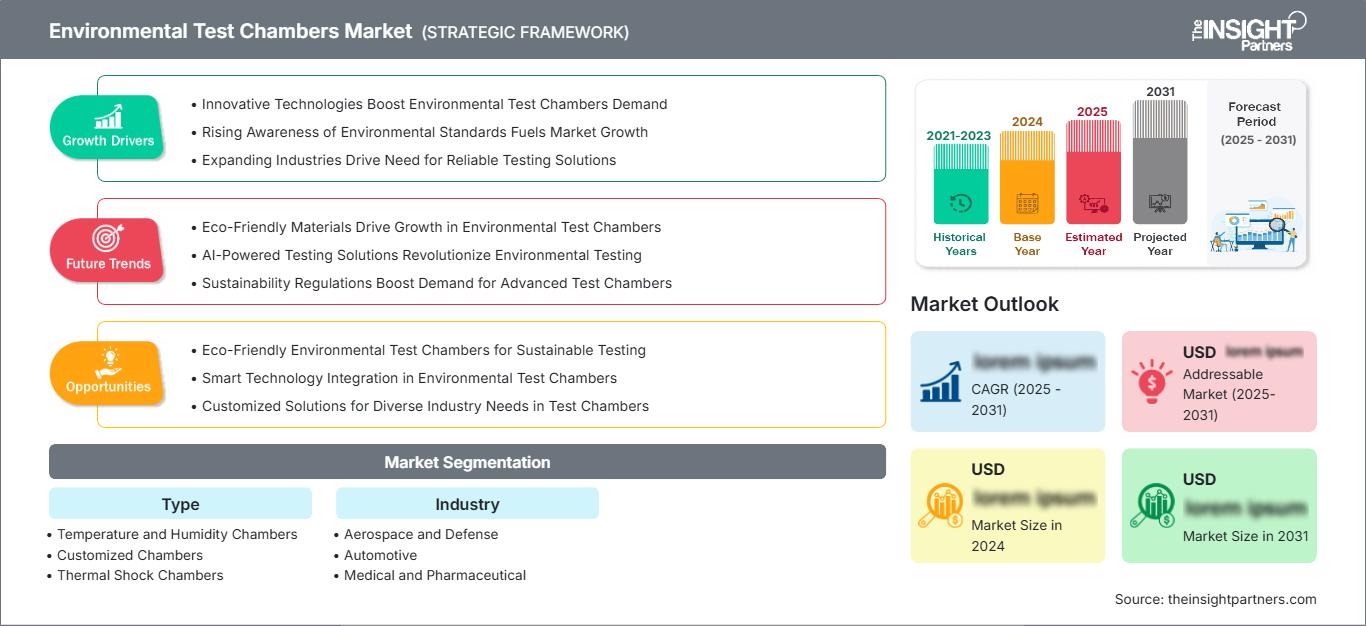
The Environmental Test Chambers Market size stood at US$ 950.60 Million in 2025, and is estimated to reach US$ 1,254.60 Million by 2034 at a compound annual growth rate (CAGR) of 3.13%. Factors influencing demand include controlled simulation of temperature, humidity, and thermal stress testing for validation of products prior to launch in aerospace, automotive, medical, pharmaceutical, electronics, and industrial manufacturing industries.
North America will witness market growth at a compound annual growth rate (CAGR) of 2.8–3.4%, from 2026 to 2034, due to the presence of aerospace qualification projects, electric vehicle validation activities, and health care manufacturing regulated environments in the region. The market is aided by the presence of laboratory facilities, defense procurement programs, and pharmaceutical stability testing in the region.
Environmental Test Chambers Market Assessment and Insights
- North America held 26–29% Environmental Test Chambers Market share in 2025 and is growing at a CAGR of 2.8–3.4% during 2026–2034, driven by aerospace, defense, EV, and pharmaceutical validation requirements.
- US represented 78–82% of North American revenue in 2025 and is growing at a CAGR of 2.9–3.5% during 2026–2034, led by laboratories and OEM programs.
- Europe accounted for 24–27% share in 2025 and is growing at a CAGR of 2.6–3.2% during 2026–2034, with Germany, the UK, France, Italy, and Spain leading regulated testing demand.
- Asia Pacific captured 34–38% share in 2025 and is growing at a CAGR of 3.5–4.2% during 2026–2034, led by China, Japan, South Korea, India, and Australia.
- Largest Segment Temperature and Humidity Chambers held 38–41% market share in 2025 and is growing at a CAGR of 2.9–3.5% during 2026–2034 because stability and durability testing remain universal.
- High Growth Segment Thermal Shock Chambers represented 23–26% market share in 2025 and is growing at a CAGR of 3.7–4.4% during 2026–2034, supported by electronics, EV battery, and aerospace component stress testing.
- Key companies analyzed in detail: Angelantoni Test Technologies S.r.l.; BINDER GmbH; Climatic Testing Systems, Inc.; ESPEC CORP.; Hastest Solutions Inc.; Memmert GmbH + Co. KG; Russells Technical Products; Thermal Product Solutions; Thermotron Industries; Weiss Technik GmbH.
Source: The Insight Partners' analysis based on proprietary research, government publications, company annual reports, investor presentations, industry databases, and expert interviews.
From independent pieces of conditioning equipment to networked, programmable systems that enable fast product qualification through environmental testing, chamber manufacturers have developed new systems with uniformity, reduced refrigerant effects, data logging, and customizable test fixtures to handle complex product assemblies. The market has thus responded to such trends through the development of platforms that accelerate life testing, battery safety, avionics qualification, medical device longevity and pharmaceutical stability testing.
Future demands will come from manufacturing growth from Asia, defense labs in North America, quality regulations in Europe and hospital expansion in health care. Investment will go into chamber designs that not only simulate climate accurately but also feature remote monitoring, energy management and maintainable refrigeration systems. Regulatory headwinds on safety, reliability and validation will continue replacement cycles despite limited manufacturing growth.
Environmental Test Chambers Market Report Scope
| Report Attribute | Details |
|---|---|
| Market size in 2025 | US$ 950.60 Million |
| Market Size by 2034 | US$ 1,254.60 Million |
| Global CAGR (2026 - 2034) | 3.13% |
| Historical Data | 2021-2024 |
| Forecast period | 2026-2034 |
Environmental Test Chambers Market Analysis
Market drivers include regulatory requirements for product reliability, shorter development cycles, and increased validation complexities in aerospace, automotive, medical, and pharmaceutical applications. Chambers allow the controlled exposure to temperature, humidity, and fast changing temperatures, which reduces the likelihood of failures during deployment. Prior to purchasing, buyers consider controller precision, chamber recovery time, calibration services, and document control.
Participants in the ecosystem include suppliers of refrigeration parts, sensors, chambers' OEMs, testing labs, certifying bodies, maintenance companies, and end-users' quality assurance groups. The supply chain is dependent on compressors, insulation systems, stainless steel construction, programmable controllers, and refrigerants. According to the Environmental Test Chambers Market report, the following factors become more important in selecting vendors besides the cost of equipment and delivery times: service capabilities, customization, and documentation.
The competition is evened out between global specialists and companies that manufacture chambers based on their technical features. Angelantoni Test Technologies S.r.l., BINDER GmbH, ESPEC CORP., Memmert GmbH + Co. KG, Thermotron Industries, Weiss Technik GmbH, Thermal Product Solutions, Russells Technical Products, Climatic Testing Systems, Inc., and Hastest Solutions Inc. compete via precision, engineering, energy saving, floor space, and after-sales services.
The investment directions include the use of low-GWP refrigerants, touch-screen controls, IoT technologies for monitoring, automated report generation, and chambers designed for the testing of batteries, avionics, and medical packaging. The strategic position is determined by the validation of performance according to international standards, the ability to change the volume of the chamber, and the fast reaction on any claims.
● REPORT CUSTOMIZATION
Tailor This Report To Align With Your Specific Business Requirements
This report can be customized to align precisely with your business objectives, scope, and target markets. Customization options include tailored segmentation, geography, competitive analysis, and strategic insights to support informed decision-making.
Customize This Report →WHAT YOU CAN ADJUST
- ● Segmentations
- ● Geography
- ● Competitive Analysis
- ● Language Preferences
Environmental Test Chambers Market: Strategic Insights
Regional Insights
North America Environmental Test Chambers Market
North America accounted for 26–29% market share in 2025 and expected to grow at a CAGR of 2.8–3.4% between 2026 and 2034. Its demand is based on aerospace qualification, defense electronics, EV battery testing, pharmaceuticals’ stability studies, and medical devices' validation. There is a need in traceability, calibration procedures, and environmental test chambers providing repeatable conditions.
The drivers are the trend toward reshoring of manufacturing capacities, the FAA testing requirements, quality systems in the pharmaceutical industry, and automotive electrification. The purchasers replace the old generation of chambers to avoid failures, to increase energy efficiency and meet the regulations regarding refrigerants. The market is advantageous in the context of maintenance-heavy installations.
U.S. Environmental Test Chambers Market
The U.S. accounted for 78% to 82% of North American revenue in 2025 and is estimated to have a CAGR of 2.9% to 3.5% between 2026 and 2034. The applications generating maximum demand are aerospace suppliers, defense manufacturers, automotive proving grounds, pharmaceutical labs, electronic products manufacturers, and medical device manufacturers requiring performance documentation under controlled environmental stress conditions.
Organizations active in the industry include Thermotron Industries, Thermal Product Solutions, Russells Technical Products, Climatic Testing Systems, Inc., ESPEC CORP., and BINDER GmbH through their manufacturing, distribution, or service operations. Walk-in chambers find more use in assembling units, benchtop in laboratories, and thermal shock chambers in electronics. Market growth is also driven by contract testing labs scaling up capacity.
Europe Environmental Test Chambers Market
Europe held the largest market share of 24-27% in 2025 and is expected to witness growth at a CAGR of 2.6–3.2% between 2026 and 2034. Germany is the market leader due to its engineering of automobiles, industrial equipment, and laboratory facilities. The UK has made contributions in aerospace, military, and life science tests.
France has been contributing to the aerospace, energy, and medical product validations. Italy and Spain have made contributions by way of demand coming from industrial machinery, automotive, packaging, and pharmaceutical production facilities. Europeans prefer efficiency in energy use, usage of low emission refrigerants, documentation, and conformity with quality standards. BINDER GmbH, Memmert GmbH + Co. KG, Weiss Technik GmbH, and Angelantoni Test Technologies S.r.l. are the beneficiaries here.
APAC Environmental Test Chambers Market
Asia Pacific held 34–38% share in 2025 and is projected to grow at a CAGR of 3.5–4.2% during 2026–2034. China leads through electronics, EV, battery, and industrial production. Japan and South Korea add precision testing demand, while India and Australia expand aerospace, defense, and medical manufacturing validation.
Industrial and policy drivers include semiconductor localization, battery supply chains, export quality requirements, and government-backed manufacturing incentives. Regional buyers prioritize chamber throughput, service availability, and automation because laboratories handle high test volumes. Market adoption is strongest where manufacturers integrate reliability testing earlier in product design.
Middle East & Africa Environmental Test Chambers Market
The Middle East & Africa region is projected to grow at a CAGR of 2.4–3.0% during 2026–2034. Saudi Arabia leads through industrial diversification, defense localization, and energy equipment testing. The UAE supports aviation, logistics, and healthcare laboratories, while South Africa and Rest of MEA add mining, utilities, and public-sector testing demand.
Energy and infrastructure projects require chambers for electronics, coatings, batteries, and outdoor equipment exposed to heat, humidity, dust, and transport stress. Purchases are often project-led, with import channels and local integrators supporting installation. Market growth remains moderate but resilient where quality assurance becomes part of national industrial strategies.
Segmentation Analysis
Type
Type is projected to grow at a CAGR of 3.0–3.6% during 2026–2034. The Environmental Test Chambers Market scope covers standard and customized systems that reproduce temperature, humidity, and rapid transition conditions. Adoption depends on chamber volume, recovery rate, uniformity, controller validation, refrigerant design, and the ability to match industry-specific test profiles.
- Temperature and Humidity Chambers hold the leading position because climate stability testing is required across pharmaceuticals, electronics, packaging, automotive parts, and aerospace components before release.
- Customized Chambers address specialized dimensions, fixtures, airflow, altitude, vibration integration, and safety requirements, making them important for complex assemblies and non-standard qualification programs.
- Thermal Shock Chambers support accelerated stress screening where products face abrupt temperature changes, especially electronics, EV components, sensors, defense systems, and aerospace modules.
Industry
Industry is forecast to grow at a CAGR of 3.1–3.7% during 2026–2034. Market demand is shaped by regulated end users that must prove durability, safety, and stability under controlled stress. Aerospace, automotive, medical, and pharmaceutical buyers value documentation, repeatability, uptime, and test-cycle flexibility over basic chamber capacity alone.
- Aerospace and Defense remains strategically important because avionics, materials, sensors, batteries, and mission-critical assemblies require qualification under severe temperature, humidity, altitude, and reliability conditions.
- Automotive demand is supported by EV batteries, electronics, sensors, powertrain parts, interiors, and exterior components that must withstand thermal cycling and humidity exposure.
- Medical and Pharmaceutical users require chambers for stability studies, packaging validation, device durability, and controlled storage testing aligned with quality and regulatory expectations.
Opportunity Snapshot
| Industry | Revenue Contribution | Trend Tag | Adoption Stage |
| Aerospace and Defense | High | Avionics Stress | Mature |
| Automotive | High | EV Validation | Scaling |
| Medical and Pharmaceutical | Medium | Stability Testing | Scaling |
Environmental Test Chambers Market Growth Drivers and Impact Analysis
Reliability Testing Becomes Central to Product Qualification
Manufacturers are under pressure to prove that products can operate safely after exposure to heat, cold, humidity, vibration interfaces, transport stress, and long storage periods. This shifts environmental testing from a late-stage compliance step to an embedded part of design validation. The market impact is higher utilization of programmable chambers, more demand for data traceability, and greater investment in preventive maintenance. Suppliers benefit when customers standardize test protocols across plants and laboratories, because validated chamber fleets reduce recall risk, support warranty decisions, and improve confidence before product launch.
Electric Vehicles and Batteries Raise Thermal Stress Requirements
Electrification increases the need to test battery modules, power electronics, sensors, connectors, and thermal management components across temperature extremes and rapid cycling conditions. Automakers and suppliers use chambers to identify swelling, condensation, insulation degradation, connector failure, and performance drift before scale production. The market impact includes demand for larger chambers, safety interlocks, thermal shock systems, and custom fixtures. Market growth is reinforced by EV platform proliferation, battery chemistry changes, and global qualification programs that require repeatable results across engineering centers, supplier labs, and certification facilities.
Healthcare and Pharmaceutical Validation Supports Stable Demand
Medical device makers and pharmaceutical companies require controlled environments for stability studies, packaging validation, shelf-life assessment, and device durability testing. Quality systems place strong emphasis on documented temperature and humidity performance, calibration, audit trails, and repeatable test methods. The market impact is resilient replacement and capacity expansion demand, even when broader industrial cycles soften. Market vendors gain advantage by offering chambers that support validation packages, secure data logging, and reliable service response. These features help laboratories maintain compliance, reduce batch risk, and avoid disruption during inspections or product submissions.
Environmental Test Chambers Market Future Trends
Connected Chambers Improve Laboratory Productivity
Environmental Test Chambers Market trends point toward connected chambers that capture test data, alert technicians, and integrate with laboratory information systems. Future systems will emphasize remote monitoring, automated report generation, predictive maintenance, and secure user access. This shift will reduce manual recording errors and improve chamber utilization across multi-site organizations. Suppliers that provide intuitive controls and validated data exports can strengthen relationships with regulated customers. The trend also supports service models where vendors monitor operating health, recommend maintenance windows, and help laboratories avoid unplanned downtime during long qualification cycles.
Energy-Efficient Refrigeration Shapes Replacement Cycles
Laboratories are expected to replace aging chambers with systems that reduce electricity consumption, manage heat rejection, and use refrigerants aligned with environmental rules. Future procurement will consider total cost of ownership, not only purchase price, because long-duration tests can consume substantial energy. Vendors will respond with improved insulation, variable-speed compressors, optimized airflow, and better standby modes. Market competitiveness will increasingly depend on proving efficiency without compromising recovery time, uniformity, or temperature range. This creates opportunities for retrofit services, controller upgrades, and high-efficiency chamber designs.
Environmental Test Chambers Market Opportunities
Battery and Power Electronics Validation Capacity
Environmental Test Chambers Market Forecasts support investment in battery and power electronics validation as EVs, energy storage, drones, and industrial electrification expand. Suppliers can target customers needing thermal cycling, humidity exposure, safety interlocks, and custom fixtures for modules and assemblies. The opportunity is action-oriented because many laboratories must add capacity before platform launches or certification milestones. Vendors that combine chamber hardware with commissioning, operator training, and validation documentation can secure larger projects. Partnerships with battery labs, automotive suppliers, and certification centers can also create recurring service and calibration revenue.
Contract Testing Laboratory Expansion
Contract laboratories are expanding environmental testing services for companies that lack internal chambers or need independent validation. This creates equipment opportunities across walk-in rooms, reach-in chambers, thermal shock systems, and stability chambers. Buyers prioritize uptime, calibration support, and flexible chamber configurations because revenue depends on completing client test programs on schedule. Environmental Test Chambers Market suppliers can address this channel through financing, rapid installation, spare parts availability, and service agreements. Laboratories that serve aerospace, automotive, electronics, and medical clients can become repeat buyers as test queues and qualification complexity rise.
Recent Developments
- March 2026: KOMEG’s latest Ultra-Low Temperature Test Chamber has achieved a technical breakthrough, reaching a minimum temperature of -90°C. With a temperature fluctuation of ≤±0.5°C under no-load conditions, this temperature is lower than the natural record low in Antarctica (-89.2°C) certified by the World Meteorological Organization (WMO). This provides unprecedented experimental conditions for studying material behavior in extreme environments and verifying high-end product performance.
- March 2026: Caron Scientific, Inc., a leading provider of advanced environmental testing, incubation, and controlled environment equipment, announced at the EU Advanced Therapies conference their newest product, the 7406 Incubator Shaker. The 7406 is the highest capacity single chamber Incubator Shaker with the smallest footprint for cell culture environments. The vertical system allows lab and production floor space savings, while the integrated design provides optimum condition uniformity across all system levels.
- January 2024: Weiss Technik launches the new Endurance: the Reach-In Temperature and Humidity chamber that stands alone. Intelligently designed for maximum airflow coverage and accurate gradients, the mobile design and small footprint provides complete testing flexibility.
Frequently Asked Questions

- Comprehensive Market Sizing and Forecast Analysis
- Detailed Segmentation Analysis
- In-Depth Market Dynamics Assessment
- Regional and Country-Level Insights
- Competitive Landscape and Company Benchmarking
- Strategic Business Intelligence
Recent Reports
Testimonials

The Insight Partners' SCADA System Market report is comprehensive, with valuable insights on current trends and future forecasts. The team was highly professional, responsive, and supportive throughout. We are very satisfied and highly recommend their services.
RAN KEDEM Partner, Reali Technologies LTDs
I requested a report on a very specific software market and the team produced the report in a few days. The information was very relevant and well presented. I then requested some changes and additions to the report. The team was again very responsive and I got the final report in less than a week.
JEAN-HERVE JENN Chairman, Future Analytica
We worked with The Insight Partners for an important market study and forecast. They gave us clear insights into opportunities and risks, which helped shape our plans. Their research was easy to use and based on solid data. It helped us make smart, confident decisions. We highly recommend them.
PIYUSH NAGPAL Sr. Vice President, High Beam Global
The Insight Partners delivered insightful, well-structured market research with strong domain expertise. Their team was professional and responsive throughout. The user-friendly website made accessing industry reports seamless. We highly recommend them for reliable, high-quality research services
YUKIHIKO ADACHI CEO, Deep Blue, LLC.
This is the first time I have purchased a market report from The Insight Partners.While I was unsure at first, I visited their web site and felt more comfortable to take the risk and purchase a market report.I am completely satisfied with the quality of the report and customer service. I had several questions and comments with the initial report, but after a couple of dialogs over email with their analyst I believe I have a report that I can use as input to our strategic planning process.Thank you so much for taking the extra time and making this a positive experience.I will definitely recommend your service to others and you will be my first call when we need further market data.
JOHN SUZUKI President and Chief Executive Officer, Board Director, BK Technologies
I wish to appreciate your support and the professionalism you displayed in the course of attending to my request for information regarding to infectious disease IVD market in Nigeria. I appreciate your patience, your guidance, and the fact that you were willing to offer a discount, which eventually made it possible for us to close a deal. I look forward to engaging The Insight Partners in the future, all thanks to the impression you have created in me as a result of this first encounter.
DR CHIJIOKE ONYIA MANAGING DIRECTOR, PineCrest Healthcare Ltd.Reason to Buy
- Informed Decision-Making
- Understanding Market Dynamics
- Competitive Analysis
- Identifying Emerging Markets
- Customer Insights
- Market Forecasts
- Risk Mitigation
- Boosting Operational Efficiency
- Strategic Planning
- Investment Justification
- Tracking Industry Innovations
- Aligning with Regulatory Trends





 Get Free Sample for