
EO IR Gimbal Market Share, Growth & Forecast by 2034
Coverage: By Product Type (2 Axis EO IR Gimbals, 3 Axis EO IR Gimbals); End-User (UAV UAS, Defense, Marine, Law Enforcement, Others) , and Geography (North America, Europe, Asia Pacific, and South and Central America)
- Status : Data Released
- Report Code : TIPRE00011128
- Category : Electronics and Semiconductor
- No. of Pages : 150
- Available Report Formats :


- Last update date : August 14, 2026


2025 Market Size
US$ 2.38 Bn
Base year value
2034 Forecast
US$ 3.66 Bn
Projected by 2034
CAGR 2026-2034
4.9 %
Growth rate
Addressable Market
US$ 27.42 Bn
(2026-2034)
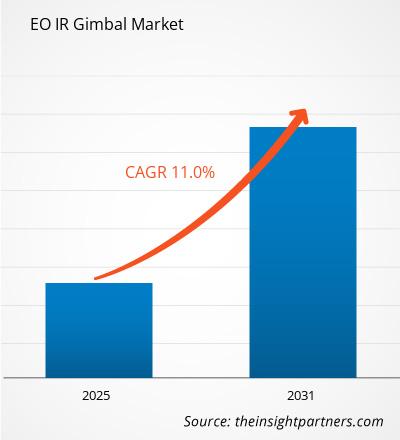
The global EO IR Gimbal market was valued at US$ 2.38 billion in 2025 and is expected to reach US$ 3.66 billion by 2034; it is estimated to record a CAGR of 4.9% during 2026-2034.
EO IR Gimbal Market Assessment and Insights
- North America – Accounted for 35–38% share in 2025 and is projected to grow at 5.4–5.9% CAGR during 2026–2034 as defense modernization, border surveillance, and public-safety aviation sustain replacement and retrofit demand.
- US – Represented 82–86% of North American revenue in 2025, with a 5.5–6.0% CAGR expected through 2034, led by military UAS and law-enforcement adoption.
- Europe – Held 25–28% share in 2025 and should record 5.2–5.7% CAGR, with the UK, Germany, and France leading procurement for tactical ISR, maritime security, and border monitoring.
- Asia Pacific – Captured 23–26% share in 2025 and is forecast to expand at 6.1–6.7% CAGR, supported by China, India, Japan, South Korea, and Australia.
- Largest Segment – Defense held 43–47% market share in 2025 and is expected to post 5.4–5.9% CAGR through 2034 as multispectral ISR and targeting requirements intensify.
- High Growth Segment – UAV UAS represented 25–29% market share in 2025 and should deliver 6.5–7.2% CAGR through 2034 as compact payload integration accelerates.
- Key companies analyzed in detail: AeroVironment, Inc.; Ascent Vision Technologies, LLC; CONTROP Precision Technologies Ltd.; DroneBase, Inc.; EchoBlue Ltd.; Teledyne FLIR LLC; Harris Aerial LLC; I2Tech; Leonardo DRS, Inc.; and PVP Advanced EO Systems, Inc.
Source: The Insight Partners' analysis based on proprietary research, government publications, company annual reports, investor presentations, industry databases, and expert interviews.
The payload architecture has transitioned from sophisticated mechanical systems involving camera turrets to modular architectures based on software, which involve high definition electro-optic cameras, infrared detectors (cooled or uncooled), laser ranging equipment, designators, inertial navigation systems, and edge analytics. The manufacture of payloads is increasingly focused on making them compact, light, low power-consuming, and affordable, as well as featuring standardized interfaces in order to accelerate the certification process for the platform. Suppliers will be working towards improving stabilization loops, detector packaging, and thermal management in order to ensure proper identification performance in small airframes subject to vibration, wind, salt, dust, and temperature.
In the coming years, investors will need to look at not just US and European projects, but also into Asia Pacific and the Middle East sovereign platforms, coast guard monitoring applications, and counter-UAS networks. Increased defense budgets will allow room for procurement, and civil aviation regulations will increasingly institutionalize unmanned operations and payload capabilities. Suppliers capable of certifying their products as interoperable, supplying detectors and maintaining them in the region will have an edge over competitors.
EO IR Gimbal Market Report Scope
| Report Attribute | Details |
|---|---|
| Market size in 2025 | US$ 2.38 Billion |
| Market Size by 2034 | US$ 3.66 Billion |
| Global CAGR (2026 - 2034) | 4.9% |
| Historical Data | 2021-2024 |
| Forecast period | 2026-2034 |
EO IR Gimbal Market Analysis
EO/IR Gimbal Market growth is driven by the need for intelligence, the proliferation of unmanned platforms, and the need for positive identification prior to taking action. The procurement value chain goes from detector and optics suppliers to stabilization experts, payload manufacturers, platform manufacturers, secure data-link manufacturers, and software developers for missions. Customers are more inclined to purchase performance as a chain of sensors rather than a single camera.
Supply limitations result from limited specialty infrared material supplies, cooled detectors, precision bearings, inertial systems, laser modules, and controlled export technology. Dual-sourcing and modularity help to minimize program risks but qualification time is long as imaging, geolocation, electromagnetic compatibility, survivability, and aircraft integration have to be qualified altogether.
Research on the EO/IR Gimbal Market indicates that competition moves from the performance of sensors to mission results, fast integration, and life cycle management. Teledyne FLIR LLC and Leonardo DRS, Inc. possess solid expertise in detectors; CONTROP Precision Technologies Ltd. and Ascent Vision Technologies, LLC are specialists in stabilizing payloads; AeroVironment, Inc. combines payloads and UAS ecosystems.
Funding should focus on artificial intelligence, robust navigation, automatic target recognition, and open interfaces. Specialized companies like PVP Advanced EO Systems, Inc., I2Tech, EchoBlue Ltd., Harris Aerial LLC, and DroneBase, Inc. could stand out in terms of their engineering capabilities, platform integration, services, and applications. Effective strategic positioning needs to include export compliance and upgradeable electronics.
● REPORT CUSTOMIZATION
Tailor This Report To Align With Your Specific Business Requirements
This report can be customized to align precisely with your business objectives, scope, and target markets. Customization options include tailored segmentation, geography, competitive analysis, and strategic insights to support informed decision-making.
Customize This Report →WHAT YOU CAN ADJUST
- ● Segmentations
- ● Geography
- ● Competitive Analysis
- ● Language Preferences
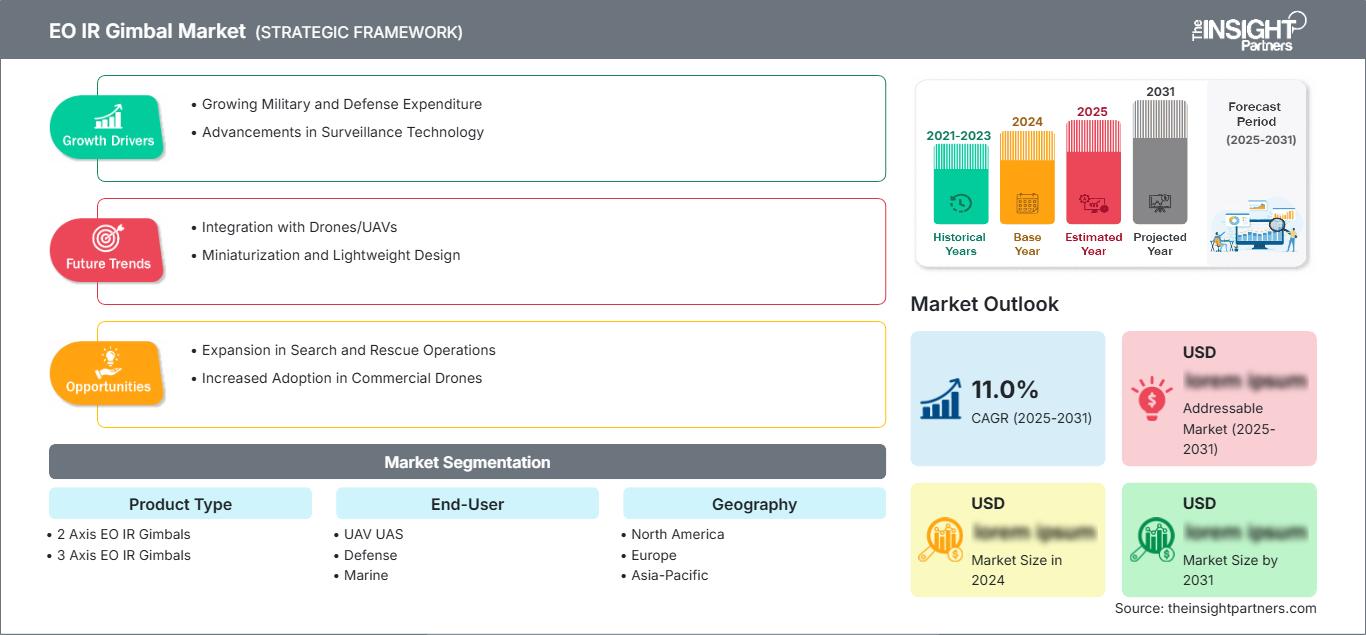
EO IR Gimbal Market: Strategic Insights
Regional Insights
North America EO/IR Gimbal Market
North America held 35–38% EO/IR Gimbal Market share in 2025 and is modeled to expand at 5.4–5.9% CAGR through 2034. High defense spending, sophisticated aerospace integration, and regular upgrading of tactical aircraft, UAS, helicopters, aerostats, patrol boats, and ground-based surveillance platforms drive demand. Open architecture emphasis promotes payload interchangeability, while national capability for detection and electronics minimizes certain risks in the supply chain.
There is an increasing preference for small multispectral sensors with EO and MWIR/LWIR/SWIR, laser ranging, designator, geolocation, and tracking functionality. Public safety organizations employ stabilized payloads for wildfire inspection, search and rescue, border surveillance, and critical infrastructure protection purposes. Canada participates via maritime surveillance and Arctic activities, whereas the United States is the leading buyer, integrator, and innovator in the region.
U.S. EO/IR Gimbal Market
The US represented 82–86% of North American revenue in 2025 and should advance at 5.5–6.0% CAGR through 2034. Defense Department modernization efforts, allied export programs, and an extensive installed base of unmanned and manned vehicles help to bolster demand. Registration and Remote ID systems add to the accountabilities for civilian and government aircraft operating with modular imaging suites.
AeroVironment, Inc., Teledyne FLIR LLC, Leonardo DRS, Inc., Ascent Vision Technologies, LLC, and PVP Advanced EO Systems, Inc. have strong domestic capabilities for engineering or integration. Applications are transitioning from pure observation to sensor to shooter operations, automated targeting, precision geolocation, and laser-targeting applications. Law enforcement, disaster relief, utilities and infrastructure inspection expand the target base, but subject to privacy regulations, export regulations, and platform certifications.
Europe EO/IR Gimbal Market
Europe accounted for 25–28% share in 2025 and is expected to record 5.2–5.7% CAGR through 2034, with the UK leading regional demand. The UK integrates defense aviation, maritime protection, and autonomous systems with payloads. Germany's army modernization and defense industry promote interoperable sensors for tactical UAVs, helicopters, and border monitoring, and procurement increasingly focuses on NATO compatibility and independent maintenance.
France sustains demand through aerospace, maritime patrol, and security outside Europe. Italy enjoys defense electronics and airborne integration associated with Leonardo, and Spain develops coastal situational awareness, unmanned surveillance, and response capability. Military spending surged in 2024 in the whole region, improving the fiscal climate for ISR recapitalization. Nonetheless, disjointed procurement, export controls, and local content stipulations favor suppliers with regional alliances, modular designs, and dependable through-life support.
APAC EO/IR Gimbal Market
APAC held 23–26% share in 2025 and should grow at 6.1–6.7% CAGR through 2034, the fastest regional pace. China leads through domestic unmanned-platform scale and border surveillance, while India expands indigenous defense electronics and maritime awareness.
Japan, South Korea, and Australia prioritize maritime domain awareness, alliance interoperability, and long-range surveillance. Industrial policy supporting sovereign sensors, local assembly, and technology transfer accelerates capacity, although export restrictions and detector dependence can reshape sourcing decisions.
Middle East & Africa EO/IR Gimbal Market
MEA is projected to expand at 5.7–6.3% CAGR through 2034, led by Saudi Arabia. The kingdom and UAE invest in border security, critical infrastructure protection, maritime surveillance, and localized defense production, creating opportunities for ruggedized airborne and ground payloads.
South Africa contributes aerospace engineering and wildlife or infrastructure monitoring, while Rest of MEA demand centers on coastlines, pipelines, ports, and remote borders. Harsh operating conditions favor sealed systems, thermal stability, long-range optics, and regional maintenance.
Segmentation Analysis
Product Type
Product Type is modeled to expand at 5.3–5.8% CAGR during 2026–2034. The EO/IR Gimbal Market scope spans cost-sensitive two-axis assemblies and higher-performance three-axis platforms. Selection depends on motion environment, pointing accuracy, payload mass, endurance, target-identification range, and integration complexity. Suppliers are reducing weight while improving stabilization, enabling smaller aircraft to carry multisensor packages previously limited to larger platforms.
- 2 Axis EO IR Gimbals – Maintain a strong position in compact, cost-controlled aircraft and ground applications where pan-and-tilt stabilization delivers sufficient imagery without the weight, power draw, and integration burden of added roll compensation.
- 3 Axis EO IR Gimbals – Serve high-vibration, long-range, and precision-targeting missions requiring superior line-of-sight stability, horizon control, and laser-pointing accuracy, making them strategically important for advanced defense and maritime platforms.
End-User
End-User demand is modeled to increase at 5.6–6.1% CAGR during 2026–2034. Defense remains the largest revenue base, while UAV UAS adoption provides the fastest expansion as payload miniaturization improves endurance economics. Marine and law-enforcement buyers prioritize persistent visibility, evidentiary imaging, and all-weather tracking. Procurement varies by mission criticality, regulatory authority, fleet size, and support infrastructure.
- UAV UAS – Demand accelerates as Group 1–3 platforms adopt lighter multispectral payloads for reconnaissance, mapping, search and rescue, border monitoring, and targeting, with modular interfaces shortening integration and field-swap cycles.
- Defense – Represents the largest application base because airborne, naval, and ground forces require day-night identification, tracking, geolocation, and designation under vibration, obscurants, stand-off distances, and contested operating conditions.
- Marine – Purchasers emphasize corrosion resistance, horizon stabilization, long-range thermal detection, and integration with radar or automatic identification systems for patrol, port security, search and rescue, and unmanned surface vessels.
- Law Enforcement – Adoption centers on helicopter and drone overwatch, fugitive tracking, disaster response, crowd monitoring, and evidence capture, requiring reliable metadata, secure video links, clear governance, and rapid operator training.
Opportunity Snapshot
| End Users | Revenue Contribution | Trend Tag | Adoption Stage |
| UAV UAS | High | Payload Miniaturization | Scaling |
| Defense | High | Multispectral ISR | Mature |
| Marine | Medium | Coastal Awareness | Scaling |
| Law Enforcement | Medium | Aerial Evidence | Scaling |
| Others | Low | Asset Inspection | Emerging |
EO IR Gimbal Market Growth Drivers and Impact Analysis
Rising Defense and Security Modernization
Global military expenditure reached US$ 2.718 trillion in 2024, rising 9.4% in real terms, while Europe increased spending 17%. The increase in budgets for the aforementioned programs calls for stabilized day/night sensors used in these applications. These electro-optical/infrared payloads provide intelligence through their ability to keep a line of sight and positive ID in case of vibration, darkness, haze, and distance. The demand will not be limited to new platforms since existing helicopters, vehicles, ships, towers, and aerostats can be equipped with these sensors. Companies offering exportable architecture, approved lasers, secure metadata, and regional presence will be able to benefit from such programs.
Expansion of Unmanned Mission Platforms
Rather than being designed with fixed camera payloads, unmanned vehicles are becoming increasingly configured with payload specific to the mission at hand, necessitating a continuous need for smaller size gimbals that do not affect aircraft endurance and center-of-gravity constraints. The use of regulatory systems that enforce vehicle registration, Remote ID, operator licensing, and airspace authorization enhances responsibility and professionalism in fleet management practices. For the military applications, surveillance and targeting missions are needed, whereas civilian users utilize thermal imagery for firefighting, utility inspection, search and rescue, and inspection missions. All the uses of the vehicle benefit from stable imagery as well as accurate geolocation information.
Convergence of Multispectral Sensing and Edge Analytics
The EO/IR Gimbal Market trends indicate that modern payloads integrate visual, MWIR or LWIR, SWIR, laser range finding, designation, IMU, and embedded computing into a single stabilized payload module. Sensor fusion enhances object detection and recognition through various lighting, weather, camouflage, and backgrounds, whereas edge computing cuts down operator burden through target tracking, attention drawing, and compression of data prior to sending. This trend increases average system worth and changes competition from hardware to software, algorithms, calibration, and updateability. Integration becomes difficult because of power, thermal management, vibration, cybersecurity, and export controls, which need to be addressed simultaneously. Suppliers that demonstrate full mission capability have an advantage over component providers.
EO IR Gimbal Market Future Trends
Software-Defined Payloads and Autonomous Tracking
EO/IR Gimbal Trends are going to be increasingly defined by software-based payload performance, not fixed hardware configurations. Open interfaces will allow algorithms to be updated, new tracking modes to be deployed, computer vision models to be applied, and mission workflows to be developed without reconfiguration of the hardware assemblies. Automated target recognition and multi-target tracking capability will enable operators to handle multiple unmanned systems or large surveillance regions. Human decision-making will continue to play a significant role in important decisions, with an encouragement towards explainability, confidence scoring, and auditing trails.
Common Payload Families Across Multiple Domains
The manufacturers will create standard cores for airborne, naval, land, and stationary systems through standardization of electronics, software, and interfaces coupled with mission-specific packaging or optics. Commonality will allow lower costs due to reduced nonrecurring engineering, easier training, better spare parts availability, and quicker qualification within the fleets. The buyers will get upgrade pathways that retain the investments in the integration work, while the sellers will be able to amortize the development of detectors and processors in larger quantities. The approach favors modular mechanical designs, digital engineering, environmental qualification databases, and configurable cyber security. The success will hinge on finding an optimal balance between standard elements and domain-specific needs.
EO IR Gimbal Market Opportunities
Regional Integration and Lifecycle Support Hubs
The creation of integration, calibration, repair and training facilities around growing end users can turn one-off equipment sales into a stream of revenue generated by support. Local facilities will assist the suppliers in meeting sovereign content requirements, reducing turnaround, dealing with export controlled parts and tailoring interfaces for domestic platforms. Some of the priority regions to consider are India, the Gulf States, Australia, and some selected Eastern European countries, where defense modernization meets industrial policy. Investments can start with the certified partners followed by the assembly and localization of components.
Mission Packages for Public Safety and Infrastructure
Suppliers can package stabilized thermal and visible imaging with communications, mapping, evidence management, and operator training for wildfire agencies, police aviation, utilities, ports, and emergency services. These buyers often lack defense-grade integration teams but value rapid deployment, clear operating procedures, and lifecycle affordability. Modular offerings should emphasize non-cooled sensors where appropriate, secure video, geolocation, privacy controls, and compatibility with common small UAS. Partnerships with platform dealers and specialist service providers can reduce sales friction. Investment should target repeatable configurations rather than bespoke engineering, enabling faster delivery, transparent pricing, and scalable support across distributed fleets.
Recent Developments
- May 2026: CACI International has highlighted its advanced range of gyro-stabilized electro-optical/infrared (EO/IR) imaging gimbal systems designed for tactical unmanned aerial vehicles (UAVs), unmanned platforms, and counter-drone (C-UAS) missions. These lightweight, ruggedized sensor solutions provide enhanced intelligence, surveillance, reconnaissance (ISR), and target acquisition capabilities for modern defense operations.
- April 2026: Hyderabad-based deep-tech company EON Space Labs has launched Lumira_E40I50, an indigenous lightweight electro-optical and infrared (EO/IR) imaging system designed for next-generation Intelligence, Surveillance, and Reconnaissance (ISR) missions. The new platform eliminates the need for germanium-based optical components, reducing dependence on critical imported materials used in traditional thermal imaging systems.
- April 2026: Velox showcased its latest commercial sensing payload technologies at XPONENTIAL Europe 2026 in Düsseldorf, Germany, highlighting compact electro-optical/infrared (EO/IR) gimbal systems designed to improve imaging performance for unmanned aerial vehicles (UAVs) and autonomous platforms. The demonstration focused on delivering stable, high-quality imagery in challenging flight conditions affected by vibration, turbulence, and rapid movement.
Frequently Asked Questions

- Comprehensive Market Sizing and Forecast Analysis
- Detailed Segmentation Analysis
- In-Depth Market Dynamics Assessment
- Regional and Country-Level Insights
- Competitive Landscape and Company Benchmarking
- Strategic Business Intelligence
Recent Reports
Testimonials

The Insight Partners' SCADA System Market report is comprehensive, with valuable insights on current trends and future forecasts. The team was highly professional, responsive, and supportive throughout. We are very satisfied and highly recommend their services.
RAN KEDEM Partner, Reali Technologies LTDs
I requested a report on a very specific software market and the team produced the report in a few days. The information was very relevant and well presented. I then requested some changes and additions to the report. The team was again very responsive and I got the final report in less than a week.
JEAN-HERVE JENN Chairman, Future Analytica
We worked with The Insight Partners for an important market study and forecast. They gave us clear insights into opportunities and risks, which helped shape our plans. Their research was easy to use and based on solid data. It helped us make smart, confident decisions. We highly recommend them.
PIYUSH NAGPAL Sr. Vice President, High Beam Global
The Insight Partners delivered insightful, well-structured market research with strong domain expertise. Their team was professional and responsive throughout. The user-friendly website made accessing industry reports seamless. We highly recommend them for reliable, high-quality research services
YUKIHIKO ADACHI CEO, Deep Blue, LLC.
This is the first time I have purchased a market report from The Insight Partners.While I was unsure at first, I visited their web site and felt more comfortable to take the risk and purchase a market report.I am completely satisfied with the quality of the report and customer service. I had several questions and comments with the initial report, but after a couple of dialogs over email with their analyst I believe I have a report that I can use as input to our strategic planning process.Thank you so much for taking the extra time and making this a positive experience.I will definitely recommend your service to others and you will be my first call when we need further market data.
JOHN SUZUKI President and Chief Executive Officer, Board Director, BK Technologies
I wish to appreciate your support and the professionalism you displayed in the course of attending to my request for information regarding to infectious disease IVD market in Nigeria. I appreciate your patience, your guidance, and the fact that you were willing to offer a discount, which eventually made it possible for us to close a deal. I look forward to engaging The Insight Partners in the future, all thanks to the impression you have created in me as a result of this first encounter.
DR CHIJIOKE ONYIA MANAGING DIRECTOR, PineCrest Healthcare Ltd.Reason to Buy
- Informed Decision-Making
- Understanding Market Dynamics
- Competitive Analysis
- Identifying Emerging Markets
- Customer Insights
- Market Forecasts
- Risk Mitigation
- Boosting Operational Efficiency
- Strategic Planning
- Investment Justification
- Tracking Industry Innovations
- Aligning with Regulatory Trends





 Get Free Sample for